WASHINGTON — In their first official acts of the 115th Congress, Sen. Richard Shelby (R-Ala.) and Congressman Bradley Byrne (R-AL1) both introduced legislation proposing a constitutional amendment that would require Congress to produce a balanced budget each year.
Shelby’s office said the proposal, which he has pushed every year since he was first elected, is “an effort to reduce our nation’s mounting debt, which has increased from $10.6 trillion when President Obama took office to more than $19 trillion today.”
“The idea behind a balanced budget amendment is simple: the federal government should be required to do what hardworking Americans do every day – balance a budget,” said Shelby. “A $19 trillion debt is simply unsustainable and will place a heavy burden on our children and grandchildren if we do not take steps to reverse this irresponsible course. I’m pleased to once again introduce this common sense policy that would reduce wasteful government spending, restore confidence in our economy, and foster job growth.”
Byrne introduced identical legislation in the House.
“I thought it was important and fitting for my first bill introduced in the 115th Congress to be a balanced budget amendment,” he said. “With the national debt over $19 trillion dollars, it is no secret the federal government has serious spending issues, and I believe a balanced budget amendment is the best way to ensure responsible budgeting.
“Requiring balanced budgets is not a far flung idea. Already, most states are required to have a balanced budget, and families and small businesses face the challenge of living within their means every single day,” he continued. “The federal government should have to play by the same rules in order to restore fiscal sanity in Washington.”
If passed by Congress and then ratified by three-fourths of the states, the amendment to the Constitution would require that the total amount of money spent by the United States during any fiscal year, except during times of war, not exceed the amount of revenue received by the United States during the same fiscal year and not exceed 20 percent of the gross domestic product of the United States during the previous calendar year.
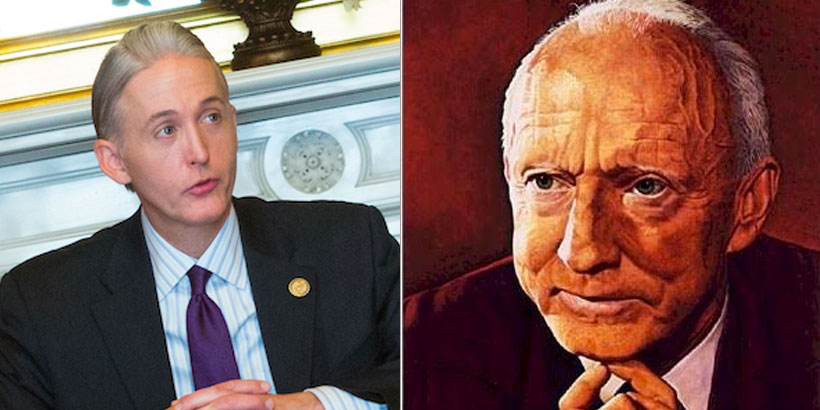
Trey Gowdy (R-SC) has already reached heights in his career in public service that many ambitious politicians could only dream of. He clerked for a state Supreme Court justice and a federal judge. He spent six years as an assistant U.S. attorney and a decade as a district attorney. He was then elected to Congress in the tea party wave of 2010, rose to prominence as one of that class’s fastest rising stars, then stepped into the national spotlight as the chairman of the Select Committee on Benghazi.
It’s that type of résumé that usually leads to an eventual run for U.S. Senate, or a move from the legislative branch to the executive branch, either with a run for governor or an appointment to a presidential cabinet post.
As Roll Call points out in a new piece discussing Gowdy’s career trajectory, “the path from the legislative to the executive branch is as well-worn as usual, with five senators and a former senator now hoping to succeed another onetime senator as president and 15 former members joining the Cabinets of the Obama and George Bush administrations.”
But individuals who are close to Gowdy say he is planning to take the road less traveled.
Not a single member of Congress has left the Capitol for a federal judicial appointment in the past three decades, and as Roll Call points out, “the last Supreme Court justice with any congressional experience retired in 1971.” It may take some time, but South Carolina’s most well-known conservative firebrand is hoping to buck the trend.
“I think he would tell you that the best job he’s ever had is being a prosecutor,” Gowdy’s South Carolina colleague Sen. Tim Scott told National Review last year. “I think I could change that if we were able to make him a federal judge. That would be the best job he’s ever had. And after he becomes a federal judge, I assume he’ll be a Supreme Court justice before he’s 65 or so.”
If Gowdy does aspire to go from his seat in Congress to the federal bench, he can look to the career path of Alabama’s only U.S. Supreme Court justice of the 20th century, Hugo Black, as a blueprint for how to get there.
Black, a University of Alabama-educated attorney from Ashland, was elected to the United States Senate in 1926. Similar to Gowdy in recent years, Black quickly earned a reputation for being a tireless worker and a dogged investigator. In his first high profile Senate probe, Black exposed fraud and collusion between Herbert Hoover’s administration and private airline owners in what was ultimately known as the “Air Mail scandal.” He later went after “high-powered, deceptive, telegram-fixing, letter-framing, Washington-visiting” lobbyists by pushing legislation forcing them to register their names and clients, a practice that continues to this day.
Black also became well-known for delivering forceful, passionate speeches on the Senate floor, a reputation that Gowdy has earned during his tenure in the House as well.
Black voted in favor of all 24 programs in President Franklin Roosevelt’s “New Deal,” prompting FDR to consider the Alabama senator for an opening on the U.S. Supreme Court in 1937. His persistent use of the Senate’s investigative role sealed the deal for the president, who nominated Black to succeed retiring justice Willis Van Devante. He was overwhelmingly confirmed by his colleagues by a vote of 63-16, served 34 years on the bench and is now considered in some circles to be among the most influential jurists of the 20th century.
Presidents have the authority to nominate federal judges in states all over the country, but typically seek the blessing of each state’s U.S. senators to ensure confirmation. The second part of that equation will be easy for Gowdy, whose two senators are Republicans. But just as Black had Roosevelt, Gowdy will need an ally in the White House for his judicial dreams to come true.
With next year’s presidential election, that time could come sooner rather than later.
“Two of the South Carolinians on the 4th U.S. Circuit Court of Appeals will become eligible for the semiretirement of senior status during the next presidential term, freeing up their seats,” explains Roll Call. “One rung down the pecking order, a pair of seats on the federal trial court in Gowdy’s state have been vacant and without nominees for more than a year, a situation that could well last through the election.”
Trey Gowdy’s conservative political views could not be more different from Hugo Black’s, who was a liberal Democrat his entire life. But we could look back several decades from now and find that their career trajectories were remarkably similar. As far as Gowdy’s concerned, that would be just fine by him.
RELATED: This Alabama college has produced the fourth most U.S. Supreme Court Justices
.@TGowdySC’s likely career switch is unusual, but follows in the footsteps of an Alabama icon https://t.co/hIlKV9DL7T
— Cliff Sims (@Cliff_Sims) November 16, 2015

There was apparently a time when Americans briefly served in political office as a public service before returning to their jobs in the private sector. I say apparently because for much of my adult life that simply has not been the case.
In the stunning GIF below, which was created using data complied by the Brookings Institution, statistician David Mendoza tracks the occupations of sitting U.S. congressmen over the last half-century. What he found was that the whole concept of being a “career politician” is relatively new phenomenon.

The other part of the GIF that jumps out is that the number of military veterans serving in Congress has plummeted over the last few decades.

Lawyers continue to make up a good chunk of the U.S. House, and the number of businessmen serving in Congress has remained relatively steady over the years.
Congress’s approval rating last year dropped to the lowest level of any institution on record. Does this GIF give us any insight into why that may be? Is it time we got serious about term limits?
Let us know what you think in the comment section below, or by tweeting @YHPolitics.
Follow Cliff on Twitter @Cliff_Sims

Sen. Scott Beason, R-Gardendale, who announced only a week ago that he would not seek re-election to his state senate seat, will be a last-minute qualifier to run for the U.S. House of Representatives in Alabama’s 6th Congressional District.
Multiple sources close to Beason told Yellowhammer by phone today that Beason did not make a final decision on his plans until this morning, but is now full-speed-ahead with his Congressional campaign.
He is expected to qualify at ALGOP headquarters in the next couple of hours. We will update this story as soon as it’s official.
Follow Cliff on Twitter @Cliff_Sims

At the height of the debate over the so-called Gang of Eight’s immigration reform bill last May, Yahoo! News published an article in their “Power Players” section titled “Sen. Jeff Sessions almost single-handedly trying to derail ‘Gang of Eight’ immigration bill.”
Although he wasn’t able to stop it in the Senate, the consistent pressure he put on House Republicans to hold the line was a major factor in getting the bill bogged down in the lower chamber.
And that wasn’t his first rodeo.
“Many blame [Sessions] for the defeat of the last immigration reform bill in 2008,” Yahoo! News noted.
But last week, House Republican leadership released a new blueprint for immigration reform.
Sessions immediately sprang into action.
Once again, we have the same recycled talking points—crafted, it would appear, with the help of the same consultants and special interests. Each time, the talking points are followed by legislation that fails to match the promises — legislation that, at bottom, ensures only the amnesty and not the enforcement. The leadership talking points look like an attempted repackaging of the tired Gang-of-Eight-style formula that has been proposed, rejected, and re-proposed for years. It is no surprise then that Senator Schumer and former Speaker Pelosi are so encouraged by these developments. But while Democrat leaders and interest groups appear satisfied, this document was not voted upon by the GOP conference and clearly does not represent the consensus of Republican members. Is it not time we pushed aside the stale proposals stitched together in concert with the same lobbyists, and asked what is in the best interests of the hardworking American citizen—and the nation?
With that kind of rhetoric being aimed at members of the Washington establishment in both parties, it’s no wonder that conservatives around the country are starting to realize what we here in Alabama have known for a long time — Sen. Sessions is one of us.
#SESSIONS2016: Here’s an idea for the 2017 State of the Union Address
Over the weekend, James Carafano of The Heritage Foundation, one of the nation’s top experts on defense and homeland security, wrote a piece for The Washington Examiner praising Sen. Sessions for his efforts.
“In person Sessions doesn’t look like the bill-slayer type,” Carafano wrote. “Polite and affable, he comes across as a perpetual ‘Mr. Smith Goes to Washington’ rather than a bulldog. Yet over the years, Sessions has proved to be very serious about some very serious issues. He hates higher taxes, has no use for Obamacare, and has a passion for providing for the common defense.”
The Heritage Foundation scholar noted that Sessions’ decision to get so far out in front on the immigration issue has made him a favorite target of leftwing bloggers and TV personalities like Rachel Maddow.
“But, Sessions doesn’t back off,” Carafano proclaimed. “One might wonder why he picked an explosive issue like immigration for his lonely crusade. But the impetus for his determined stand is clear: a total commitment to the rule of law. Before running for the U.S. Senate, he served as both a federal prosecutor and state attorney general. After serving as a U.S. attorney for the Southern District of Alabama, Ronald Reagan nominated him for a federal judgeship, but later withdrew it in the face of Democratic opposition. Sessions’ entire professional career has been shaped by the belief that impartial justice is the glue that holds a free society together.”
“In the end, Congress may do the right thing and put the principle of rule-of-law above a politically-driven amnesty,” Carafano concluded optimistically. “If that happens, no one will deserve more credit than the not so quiet lion from Alabama.”
Follow Cliff on Twitter @Cliff_Sims

Navy SEALS are well known for their unmatched toughness on the battlefield, but former Navy SEAL commander Ryan Zinke has decided he’s ready to put his skill set to use in the rough-and-tumble arena of U.S. politics. He’s currently running for the lone congressional seat in his home state of Montana.
Zinke is a former member of the legendary SEAL Team 6, the elite special forces unit that carried out the mission to kill Osama bin Laden.
He has since gone on the serve in the Montana State Senate, and gained some national notoriety in 2012 for launching a super PAC called Special Operations for America, which gave the special forces community a channel through which they could express their frustrations with President Obama.
Montana’s current congressman, Republican Steve Daines, recently announced that he’s running for the U.S. Senate seat being vacated by Democratic Sen. Max Baucus, who President Obama is nominating to be the new U.S. Ambassador to China.
The move opened up a competitive Republican primary in Montana, but Zinke has emerged as the frontrunner in recent weeks.
On Monday Feb. 17, Zinke will be in Birmingham, Ala. for a fundraiser hosted by Landon Ash and Bradley Stegmeier of Alabama-based defense contractor XTreme Concepts and Alabama State Sen. Clay Scofield, R-Arab. The event is being held at The Club and has a suggested donation of $250 per person, or $1,000 for a chance to participate in a “business roundtable” and photo op with Zinke.
For more information, call Clayton Turner at (205)540-3264 or email c.turner@xtremeconcepts.com.
Follow Cliff on Twitter @Cliff_Sims
Negotiators on Capitol Hill unveiled a giant 1,582 page, $1.1 trillion government funding bill this week, which would fund the government for the remainder of the current fiscal year and put an end to all the government shutdown talk. The House of Representatives passed the bill today by a vote of 359-67.
Both Republicans and Democrats praised the bill, which typically means that the American people will see little — if any — progress in reining in government spending. When cuts happen, one side or the other make noise because one of their favored areas got hit.
However, it is no doubt a positive that Congress is returning to so-called “regular order” and actually passing spending bills. And it’s noteworthy that the package is $164 billion less than President George W. Bush’s last discretionary budget.
So what does it all mean for our state?
As Vice Chairman of the Senate Appropriations Committee, our very own Senator Richard Shelby served as the top Republican negotiator on the Senate side.
Here are 7 things in the Omnibus Spending Bill that might actually impact your life right here in Alabama:
COLAs are back and military folks got a pay raise
The bill repeals the recently enacted cut to cost of living adjustments, or COLAs for disabled military retirees and survivors. This is good news for Alabama’s huge population of military retirees and survivors. U.S. military personnel and civilian federal workers also got a 1 percent pay raise.
Sen. Jeff Sessions said he was glad to see retired vets being better taken care of in this deal, but insisted there’s still more that could be done.
“I was pleased that the House-Senate package includes a provision restoring the pensions for disabled veterans, after we called attention to the fact that wounded warriors would be impacted by the budget deal,” Sessions said. “However, the deal fails to restore pension payments for millions of active duty and retired military personnel and leaves more than 90 percent of the original reductions in place. For a currently-serving officer nearing retirement, this cut could exceed $120,000 in pension payments, reducing the cost-of-living adjustments by more than 60 percent.”
Sessions said he believes there are better ways to save money and suggested closing a tax credit loophole that illegal immigrants take advantage of.
“Unfortunately, Leader Reid and his conference blocked my effort to implement this fix during the budget debate in December,” Sessions said. “I hope the majority will allow us to make this fix and stop shielding these illicit tax payments. In order to end annual deficits all of us will have to tighten our belts, but our military personnel must not disproportionately bear the burden.”
North Alabama folks get bump in NASA funding
NASA has an almost $3 billion impact on Alabama’s economy, but it has been a big target for cuts by the Obama Administration. Both Sen. Richard Shelby and Rep. Mo Brooks, have been big advocates for NASA’s Space Launch System (SLS), which is built in Huntsville.
Included in this week’s omnibus legislation is $1.9 billion for the Space Launch System. This figure is approximately $200 million above the President’s request in the budget he submitted to Congress. Of the $1.9 billion for SLS, $1.6 billion is for development of rocket systems at Marshall Space Flight Center in North Alabama.
“I am pleased that this legislation includes the funding necessary to continue the great work underway in Huntsville on the Space Launch System,” Sen. Shelby said. “If we are to maintain our leadership role in human space flight, we must continue to make SLS a top priority in NASA’s budget. I will continue to do everything in my power to ensure that it is.”
Mobile’s getting a new federal courthouse
The bill provides $69.5 million to construct a new federal courthouse in Mobile and to renovate the existing courthouse, which was built from 1932-1934. Combined with the $49 million that is remaining from previously appropriated courthouse funding for Mobile, the total project cost will be $118.5 million. The total design and construction work is expected to take 5 1/2 years.

“These funds will provide Mobile with a new courthouse that meets modern security standards and facilitates efficient processing of cases,” said Sen. Shelby. “The construction and operation of this facility will also generate huge economic activity in the heart of Mobile. I am pleased that this was included in the legislation.”
Another step toward widening the Port of Mobile
The report accompanying the omnibus bill directs the Corps of Engineers to study the widening and deepening of Mobile harbor. This is a necessary, preliminary step under the Corps’ regulations before the work can be undertaken.
Sen. Shelby has in the past discussed his 10-12 year plan of making Mobile a world center of trade and commerce by making its port wide enough and deep enough to handle the world’s largest ships.
“Mobile can be one of the top five ports in the country,” Shelby said today. “Its economic potential is limitless. I am pleased that this legislation provides for the next critical step in that direction.”
Littoral Combat Ship (LCS) gets funding
The president requested and received $1.7 billion for the procurement of 4 Littoral Combat Ships, which are built in Mobile.
Alabama Tea Party groups get a small victory
The omnibus specifically instructs the IRS not to use any funds to “target citizens of the United States for exercising any right guaranteed under the First Amendment.”
It’s remarkable that those words even need to be included in a bill, and it’s a far cry from justice being served in the targeting cases that have already taken place. However, it’s a small victory for Alabama groups like the Wetumpka Tea Party who were targeted by the IRS for their political beliefs.
Environmental groups escape unscathed
Attempts by Republicans to drastically cut funding to the Environmental Protection Agency were unsuccessful. The federal agency that implements heavy-handed mandates and regulations on businesses all over the country has long been reviled by conservatives. And recent efforts by Alabama-based environmental groups to speed up the process of shutting down coal plants have really put the EPA front and center in the state. Alabama Governor Robert Bentley and Attorney General Luther Strange back in December challenged the EPA’s power to halt economic development. The fights will continue on the state level, but the EPA’s federal funding remains intact for now.
Follow Cliff on Twitter @Cliff_Sims

Former Democratic Congressman Bobby Bright has been laying low since losing his congressional seat to Republican Rep. Martha Roby three years ago, but he’s not ready to be done with politics just yet. According to a statement Bright gave to the Alabama News Network, he’s now considering running for the Alabama Senate — this time as a Republican.
“If I did this, my primary concerns are to bring good paying jobs to Alabama, as I did in Montgomery,” Bright said referencing his time as Montgomery mayor. “It’s also important to spend people’s tax payer money as if it were my own and cut out wasteful spending.”
State Senator Bryan Taylor, R-Prattville, currently holds the seat Bright is eyeing. Taylor announced in late October that he will not be seeking re-election. Two other Republicans have already announced they are running to succeed him (Harris Garner and Suzelle Josey), but Bright would certainly shake the race up because of his high name recognition.
Bright was first elected Mayor of Montgomery in 1999 and subsequently re-elected in 2003. His Wikipedia page touts his administration’s revitalization of the city’s downtown and riverfront areas — including the Renaissance Montgomery complex and Riverwalk Stadium. He also paints himself as a budget hawk while overseeing the city’s finances.
But since municipal elections are non-partisan, Bright’s 2008 congressional campaign was the first year he had to put a letter beside his name. He chose a “D” and rode the Obama wave into office.
Bright’s record in Congress was one of the most conservative among Democrats — but that’s obviously not saying much. He voted against ObamaCare, which is the only reason he’s able to even consider running as a Republican at this point. But he did have some bad votes on other bills, including the Obama Administration’s much-maligned Cash for Clunkers program. He also voted in favor of the big-spending Fiscal Year 2009 Omnibus bill that was pushed through by Democrats and only garnered a handful of moderate Republican votes.
But without question, the vote Bright wishes he could have back more than any other is the one he cast for Nancy Pelosi to be Speaker of the House.
When Roby challenged Bright in 2010, he promised he would not vote for Pelosi again if re-elected, but the damage had already been done.
The National Republican Congressional Committee pummeled Bright with the below ad during the 2010 campaign.
“Firsts are memorable moments,” the ad says. “First date — first car — first home. And on Bobby Bright’s first day in Congress, he voted for Nancy Pelosi as Speaker.”
Ouch.
But Bright maintains solid relationships with a decent number of folks in the Montgomery-area business community who see him as a pragmatist. And again, his name recognition would certainly give him a head start on the competition.
But can a man who voted for Nancy Pelosi to be Speaker of the United States House of Representatives get elected to the Alabama legislature as a Republican? That’s a tall order.
Follow Cliff on Twitter @Cliff_Sims

With Republican congressional hopeful Bradley Byrne having dispatched of the GOP competition in Alabama’s first congressional district, the heavy-hitters are coming together to make sure he’s well funded for the upcoming general election and beyond.
U.S. Sens. Richard Shelby and Jeff Sessions are spearheading a fundraiser for Byrne on Dec. 10 in Washington, D.C.
Other special guests will include the rest of the Republicans in Alabama’s House delegation, House Majority Whip Kevin McCarthy, and numerous other congressmen from around the country. Suggested contributions range from $1,000 to $5,000.
Alabama Reps. Martha Roby, Mike Rogers and Mo Brooks already dropped $2,500 each into Byrne’s campaign in the home stretch of the Republican primary runoff. With the general election against Democrat Burton LeFlore scheduled for Dec. 17 — and the prospect of already having to run for re-election in 2014 if he wins — Byrne is keeping the fundraising push going.
The full list of special guests for the event is below.
Rep. Robert Aderholt
Rep. Spencer Bachus
Rep. Mo Brooks
Rep. Martha Roby
Rep. Mike Rogers
House Majority Whip Kevin McCarthy
Rep. Charles Boustany
Rep. Tom Cole
Rep. Richard Hudson
Rep. Bill Huizenga
Rep. Devin Nunes
Rep. Alan Nunnelee
Rep. Steve Scalise
Rep. Steve Stivers
Rep. Lee Terry
Rep. Lynn Westmoreland
Follow Cliff on Twitter @Cliff_Sims

Huntsville School Board member David Blair announced earlier this week that he will be challenging State Sen. Paul Sanford, R-Huntsville, in the Republican primary in Alabama Senate District 7. But according to polling data obtained today by Yellowhammer News, Blair is facing an uphill challenge against a popular incumbent.
A poll conducted by McLaughlin and associates, a nationally-known public opinion research firm commissioned by Alabama 2014 PAC, shows Sanford receiving over half the vote, even in a three-way race between him, Blair and former Congressman Parker Griffith.
“Senator Sanford receives 54% of the vote, followed by Parker Griffith who receives 14% and David Blair who receives 8%,” the polling memo states. “One in four (24%) remain undecided. It is important to note that even in a three-way race, Senator Sanford is over 50%.”
Sanford’s job approval rating is also very strong. 57% of Senate District 7 voters approve of Sen. Sanford’s job performance, while only 11% disapprove.
Sanford is no stranger to crowded races. He overcome a packed field to win the seat in a 2009 special election. The seat had previously been held by Parker Griffith, who left it open after being elected to Congress. Over the last several years, Sanford has beaten back numerous big names in north Alabama politics, including Mary Scott Hunter, Sam Givan, Jeff Enfinger and Laura Hall.
Also worth noting in the poll is just how unpopular Parker Griffith is in the district.
“Parker Griffith is widely unpopular,” the memo states bluntly. “Griffith has a two to one net negative opinion rating, with 27% holding a favorable opinion of him and 55% holding an unfavorable opinion of him. There is significant intensity on the negative side, with 43% holding a ‘very’ unfavorable opinion of him.”
The McLaughlin poll surveyed 300 likely Republican primary election voters in Alabama’s 7th State Senate District and has a margin of error of +/- 5.7%.
Follow Cliff on Twitter @Cliff_Sims

Pictured: Wetumpka Tea Party with Senator Jeff Sessions at March for Jobs Rally in Washington, D.C.
Alabama’s Junior U.S. Senator Jeff Sessions today continued his fight against the “Gang of Eight’s” immigration bill in a speech in Washington, D.C. at the March for Jobs Rally. The march was organized by The Black American Leadership Alliance (BALA) “along with community leaders of all races from around the country,” according to the group’s website.
“We come here today with a message for Congress: we need an immigration policy that serves the American worker and taxpayer,” Sessions said to loud applause. “We need an immigration policy that creates higher wages — not lower wages. We need an immigration policy that helps promotes upward mobility and financial independence. We need an immigration policy that helps our struggling citizens find good-paying jobs that can support their families and lift up their communities.”
Sessions encouraged House members to scrap the Gang of Eight’s plan entirely. “The House must not negotiate with the Senate bill,” Sessions quipped.
He also took a shot at Republican lightning rod Karl Rove, who has in recent years become a target for grassroots conservatives who view him as a symbol of everything that is wrong with the “Washington establishment.”
“With all due respect to my good friend Karl Rove,” Sessions said as the crowed booed the mention of Rove, “There’s no shortage of workers in America, there’s a shortage of jobs in America.”
The BALA agreed with Sessions’ assessment of the current jobs situation.
“If passed in its current form, the Senate Immigration Bill would give virtually all of the millions of illegal immigrants in the country the ability to work and compete with citizens of all races for scarce employment opportunities,” the group said in a statement.
Several Alabama Tea Party Groups, including the Rainy Day Patriots and the Wetumpka Tea Party, among others, joined together and bussed a group to the D.C. rally. Donning shirts that said, “Protect American Jobs. No Amnesty,” the group joined thousands of conservative activists from around the country in trying to stop a bill that Sessions’ Senate Colleague Richard Shelby called “the mother of all amnesties.”
Other speakers at the event included Sen. Ted Cruz and Col. Allen West and Alabamians, Congressman Mo Brooks and activist K Carl Smith.
What else is going on?
1. AARP environmental push part of increasingly liberal agenda
2. EXCLUSIVE: Rep. Jay Love discusses his time in the House and his impending departure
3. AL01 candidates give their take on rifts in the GOP
4. Poll shows Artur Davis could make political comeback in bid for Virginia congressional seat
4. AL01 candidates talk job creation and the economy
 WASHINGTON – Back in 2006, there were only two Alabama congressmen that voted against the renewal of the Voting Rights Act of 1965, which had parts declared unconstitutional by the Supreme Court on Tuesday.
Rep. Jo Bonner, R-Mobile, and then-Rep. Terry Everett, R-Rehobeth, were the only two of Alabama’s two senators and seven congressmen to vote against the 25-year extension. The extension passed overwhelmingly in both chambers, 390-33 in the House and 98-0 in the Senate.
According to the record of the debate of the Fannie Lou Hamer, Rosa Parks, and Coretta Scott King Voting Rights Act Reauthorization and Amendments Act of 2006 from July 13, 2006, Everett had made many of the same arguments the high court made in its majority opinion.
“I am disappointed that the House chose not to update the 1965 Voting Rights Act when it reauthorized the measure,” Everett argued. “The whole debate was cast as either you’re for the Voting Rights Act or you’re not. There was no attention paid to the fact that the Act’s formulas are out of date and place the Act itself at risk of constitutional challenge. As a result, states like Alabama continue to be punished for wrongs committed 40 years ago and the same criteria will remain in effect for another 25 years, through 2032.”
“The Voting Rights Act remains locked in a time-warp reflecting the voting realities of 1964, not 2006. The very constitutionality of the Voting Rights Act may be in question,” he added. “The Supreme Court found more than 30 years ago that the Act’s formula, which is based on the 1964, 1968 and 1972 presidential election voting data, was constitutional because it is was temporary and narrowly tailored to address a specific problem. Thirty years have since passed calling into question the basis of this ruling.”
Bonner, who announced last month he was stepping down from his First Congressional District post effective mid-August, had similar reasoning at the time in his opposition to the Voting Rights Act’s renewal.
“I regret that we were not able to be bold enough to say to the southern States which have shown so much progress that, after 40 years of advancement, we are now ready to move forward and give those areas where the sins of our fathers are no longer committed an opportunity to come out from under the burden of crawling to the U.S. Justice Department, on bended knee, and asking for its blessing to continue on the march for equality.”
What else is going on?
1. Obama declares war
2. Sewell: Injustices suffered on Bloody Sunday in 1965 have ‘not been fully vindicated’
3. Sarah Palin coming back to Alabama
4. To D.C. & back again, will Wells Griffith run for Congress?
5. SCOTUS rules in favor of Shelby County in Voting Rights Act case
According to Gallup, “Americans’ confidence in Congress as an institution is down to 10%, ranking the legislative body last on a list of 16 societal institutions for the fourth straight year. This is the lowest level of confidence Gallup has found, not only for Congress, but for any institution on record.” They began tracking in 1973. “Americans remain most confident in the military, at 76%,” Gallup added.

Although we have grown accustomed to having very little confidence in our federal legislative bodies, that has not always been the case. Americans in the 1970s trusted Congress at roughly the same level they trust churches or organized religion today.

Typically Party affiliation has had a bearing on how individuals view Congress. Today, both Democrats and Republicans hold Congress in equally low esteem. Gallup points out that this “likely reflects the split control of Congress.

Americans also have little trust in the newspapers who are supposed to be holding our elected leaders accountable.

…And television news is not fairing any better.

Gallup believes that “social sites and the Internet in general, as well as the 24/7 television news cycle, have challenged traditional media outlets and brought new ones to the fore, creating an increasingly complex — and sometimes messy — news environment. While individual news consumers have better access to news and to journalists than ever before, the struggles of the news industry seem to be affecting Americans’ confidence in it.
What else is going on?
1. Black Louisiana senator releases stirring video explaining why he became a Republican
2. Sessions touts $625 billion defense spending mark-up with significant funding for Alabama
3. Alabama football legend running for House of Representatives
4. The 10 largest private companies in Birmingham
5. Q&A with Governor Bentley while on the industrial recruitment trail in France

Fincher made a name for himself in Republican circles during the 2013 legislative session by sponsoring the Alabama Accountability Act, the GOP’s landmark school choice bill that was the most-discussed issue of the session.
Fincher will join State Rep. Randy Davis, Journalist Quin Hillyer, businessman Dean Young, former Marine James Halland, realtor Jessica James, and former state senator Bradley Byrne is the official entrants into the race. State Senators Trip Pittman and Bill Hightower, and Baldwin County Commissioner Tucker Dorsey, among others, remain on the fence.
“Fincher’s a sleeper in this race,” a Republican political consultant told Yellowhammer Thursday morning. “He may not have the name ID that a Byrne or a Pittman have, but if he can raise the money, he’ll be a strong candidate with a real shot at making it a race.”
Related:
Hillyer fires first shots of the AL-01 race, releases TV/web ad
What else is going on?
1. Hillyer fires first shots of the AL-01 race, releases TV/web ad
2. Roby touts amendment to prohibit bonuses for VA executives
3. Alabama Democrats & Farrakhan get the old band back together
4. Sessions, Cruz, Lee & Grassley team up to fight gang of eight immigration bill
5. Wetumpka Tea Party president gives emotional congressional testimony
WASHINGTON — Although it has been suggested that some portion of the U.S. Navy’s Littoral Combat Ship program, part of which is set to be built in Mobile, could be in danger with Rep. Jo Bonner’s sudden retirement announcement last week, Republican Sen. Richard Shelby’s office seemed to indicate there is little to be concerned about.
Jonathan Graffeo, a spokesman for Shelby, told Yellowhammer Alabama’s senior senator, who serves as the vice chairman of the Senate Appropriations Committee, will “remain fully engaged on this issue.”

Back in late 2010, Shelby intervened when Arizona Republican Sen. John McCain, then a high-ranking member of the Senate Armed Services Committee, attempted to torpedo a bill that would split the Littoral Combat Ship contract between Austal and Lockheed Martin.
While McCain’s efforts temporarily sunk the proposal, Sen. Shelby resurrected it days later by convincing Senate Minority Leader Mitch McConnell to insert the LCS program into a budget resolution.
Press-Register reporter George Talbot at the time described the successful last-ditch efforts of the Alabama congressional delegation led by Shelby as “deft negotiating.”
The maneuver continues to pay off for Alabama’s economy.
Dr. Donald Epley, the director of the University of South Alabama’s Mitchell College of Business Real Estate Studies Center, estimates the most recent Austal contract with the U.S. Navy, valued at $5 billion, already has or will create 4,800 new jobs for Mobile and Washington Counties with a total economic impact of over $402 million. For the whole state of Alabama, the figure rises to 6,726 jobs and a total economic impact of nearly $713 million. And at a national level, Epley estimated 11,214 jobs have been or will be created with a total economic impact of over $2.2 billion as a result of that $5 billion contract.
“In looking ahead, understanding how we got to this point provides valuable perspective,” Graffeo said to Yellowhammer in an email.
What else is going on?
1. Fridy running for Alabama House of Representatives
2. Alabama native playing key role in Republican efforts to take over U.S. Senate
3. Sessions warns immigration proposal will depress wages ‘for maybe 20 years-plus’
4. Study shows Birmingham’s city government is gigantic
5. Bentley will not shut the door on Medicaid expansion
Last week’s bombshell that Republican Rep. Jo Bonner of Mobile will be resigning his congressional seat to take a job with the University of Alabama system sent shockwaves through the political world on Thursday and has set up the potential for an interesting race with a crowded field for the Republican nomination in a special election.
Bonner’s decision did inspire a number of reactions from prominent figures involved in Alabama politics:
Gov. Robert Bentley
“Congressman Bonner has made a tremendous difference for the people of South Alabama. He’s worked hard on several major issues, including the ongoing recovery from the Deepwater Horizon explosion and oil spill. He’s a devoted family man and a true friend. I wish him nothing but the best.”
.@repjobonner made a tremendous difference for the people of South Alabama. I’ve enjoyed working with him & wish him nothing but the best.
— Gov.Robert Bentley (@GovernorBentley) May 23, 2013
Sen. Jeff Sessions
“Jo is one of the most talented and hard-working members of Congress. I have deeply valued the opinions and insights of ‘my’ Congressman. He knows his district like the palm of his hand and personally knows an incredible number of constituents. He has served with wisdom, courage, and dedication, consistently supporting the highest Alabama values.
“Jo will do a great job as Vice Chancellor of the University of Alabama system. His gifts will be a perfect fit for them. He loves the University and will love the work.
“We had a great partnership and I will certainly miss his counsel.”
Rep. Martha Roby:
“Jo Bonner has been a dear friend and mentor to me since I first came to Congress. I have deeply appreciated and valued his discerning, deliberate and consistent leadership from day one. Though I will miss him as a member of Alabama’s congressional delegation, I’m proud and happy for Jo and his family as they begin this new chapter of their lives.
“Jo will be an invaluable asset to the University of Alabama System, serving the students and faculty with same distinction as he has his constituents and the State of Alabama during his time in Congress. To Jo – along with his wife, Janée and their children, Lee and Robins – Riley and I offer our best wishes on this new, exciting endeavor as well as our thanks for all you have given in your decades of service to our state and country.”
Hate to lose him in Congress but proud & happy for my dear friend & mentor @repjobonner on his new endeavors back home #ThanksJo #alpolitics
— Rep. Martha Roby(@RepMarthaRoby) May 23, 2013
Rep. Robert Aderholt:
“Jo Bonner is an esteemed colleague and friend. He is a dedicated public servant and incredible advocate for his district and the entire state of Alabama,” said Aderholt. “It has been a pleasure working with him over the years and his presence in Washington will be greatly missed. I wish Jo the very best and know he’ll continue his commitment to Alabamians in his next endeavor.”
Sad to see my friend @repjobonner leave Congress. He’s a dedicated public servant & will be greatly missed. #ThanksJo
— Rep. Robert Aderholt (@Robert_Aderholt) May 23, 2013
Rep. Mike Rogers:
It has been a privilege to work with @repjobonner as both a colleague and a close personal friend.I will miss him greatly. #ThanksJo
— Mike Rogers (@RepMikeRogersAL) May 23, 2013
Rep. Mo Brooks:
“It has been an honor to serve with Congressman Bonner in the U.S. House of Representatives. The State of Alabama and Congress were made better by his work. I appreciate his friendship and wish him the best in his future role as Vice Chancellor for Government Relations and Economic Development at the University of Alabama. Jo’s retirement is Congress’ loss and the University of Alabama’s gain. Thank you, Jo, for your dedication to Alabama and our great Nation; we all wish you the best.”
Honored to have served with @repjobonner. His retirement is Congress’ loss and @uofalabama‘s gain. brooks.house.gov/press-releases… #ThanksJo
— Mo Brooks (@RepMoBrooks) May 23, 2013
Rep. Terri Sewell:
“It has been such an honor to serve in Congress and the Alabama Delegation alongside Congressman Jo Bonner. Jo has always put the interests of his constituents ahead of partisan politics and I will miss the bipartisan town hall meetings we held together in Clarke County. Since his election in November 2002, Jo has left an indelible mark on Alabama’s First Congressional District and this nation. Jo and his wife Janée have been dear friends and I wish them the best in the next step of their lives. I know The University of Alabama System will greatly benefit from his leadership and that he will help the State of Alabama continue to move forward. I’m very sorry to see Congressman Bonner leave the Alabama Delegation and the House of Representatives.”
Former Rep. Artur Davis: “Jo is the single best public servant I met in politics, in addition to being my best friend in Congress. His departure is a loss to anyone who values civility and statesmanship.”
It has been such an honor to serve in Congress & the AL Delegation with @repjobonner. He will be missed… on.fb.me/10AwSDg #ThanksJo
— Rep. Terri A. Sewell (@RepTerriSewell) May 23, 2013
Speaker of the House John Boehner:
Grateful for @repjobonner‘s service and friendship. When he leaves, the House will lose a statesman. #ThanksJo
— Speaker John Boehner (@SpeakerBoehner) May 23, 2013
Speaker of the Alabama House Mike Hubbard
.@repjobonner is a first-class person and his strong voice and character will be greatly missed in the AL Delegation #alpolitics
— Mike Hubbard (@SpeakerHubbard) May 23, 2013
What else is going on?
1. Handicapping the Upcoming Congressional Race in AL01
2. Jo Bonner to leave Congress, take job at Univ. of Alabama System
3. Hobby Lobby Continues Fight for Religious Liberty
4. AEA Plans to Hire Obama Political Operation for 2014
5. Bentley Signs Gun Bill into Law
BY CLIFF SIMS & JEFF POOR
 Less than five minutes after Yellowhammer broke the news that Congressman Jo Bonner would be resigning from congress, speculation was already running rampant about who might run for his seat. After reaching out to political insiders and potential candidates, here’s an early attempt at handicapping the field in AL-01.
Candidates are listed from most likely to be elected, on down. In an effort to pair down the list, any candidate who has already indicated they won’t be running has been left off.
Bradley Byrne
Early money is on Byrne. Although the first congressional seat has never been held by a candidate from Baldwin Co., Byrne has ties to Mobile. He can split the geographical spread.
He is probably the first name that popped into many Alabama politicos’ minds when they heard Bonner was planning to resign. The former state senator and head of Alabama’s two-year college system came very close to landing in the governor’s office in 2010. He placed first in the Republican primary, but fell short of reaching the 50 percent threshold needed to win.
Byrne has remained somewhat active in the political discourse since 2010 through his non-profit group, Reform Alabama.
Funniest line we got about Byrne while calling around to get feedback: “AEA doesn’t play in congressional races, then again they’d probably spend $2 million to keep Byrne from becoming dog catcher.”
Trip Pittman

As a powerful budget chairman in the state senate, Pittman has been a major player since Republicans took over the majority in 2010. The prospect of going from being one of the most powerful senators in a body of 35, to being a freshman congressman in a body of 435 will no doubt play a role in his decision making process.
Pittman has the ability to raise a lot of money from individual donors, as he has shown in his Senate races. He would be an appealing candidate to both business and grassroots conservatives.
“I’ll think about it and pray about it,” Pittman told Yellowhammer this afternoon. “I’ll consider it.”
Sam Cochran
Since winning the sheriff’s race handily back in 2006, Cochran has been the most solid Republican in Mobile County. Insiders in the first congressional district say it’s hard for them to imagine Cochran losing a race to a Baldwin County candidate with the strength candidates out of Mobile Co. have displayed over the last 48 years, with just three people filling the void.
Almost all of the folks on the ground in the District say this race will likely come down to Byrne and Cochran. If it does, it will be tough to bet against Mobile County (Cochran).
However, his position on gun rights could make him vulnerable.

Sandy Stimpson
The only reason Stimpson is not much higher on this list is because it is highly unlikely he will forego his campaign for mayor of Mobile and transition to a run for Congress. But he would immediately become the favorite if he did.
His campaign infrastructure is already in place, his name ID is high (and rising) and the financial resources he could tap into would outclass the competition.
[Update: Stimpson says he will not be running for Congress]
Fincher’s made a name for himself in Republican circles as the sponsor of the Accountability Act. Some say it might be a little early for Fincher to make a move for U.S. Congress, but he could be a sleeper.
Strongly considering a run to replace Congressman Jo Bonner. Congressman Bonner has been a great leader for south AL! nationaljournal.com/blogs/hotlineo…
— Chad Fincher (@RepChadFincher) May 23, 2013
Rep. Randy Davis
After receiving a lot of encouragement to run for mayor of Daphne last cycle, Davis ultimately decided to stay in the legislature. But sources close to Davis say he is very likely to announce he will be running for Congress this time around. If he and Sen. Pittman both run, they could potentially eat into each other’s base of support.
Hightower has been in the state senate for less than two months, but he’s already proven his talent as a campaigner against a heavily funded opponent. Sources close to Hightower indicated to Yellowhammer that he will consider a run for Congress. However, at this point it is probably unlikely he will run so soon after being elected to the senate.
Quin Hillyer
Hillyer announced his intention to run just hours after Bonner’s resignation. But the long-time semi-Washington, D.C. quasi-pundit and former staffer for Rep. Bob Livingston doesn’t seem to have earned a household moniker in the first district.
However, Hillyer has the ability to activate the University of Mobile base, much like Rick Santorum and Mike Huckabee before, which is at least worth watching in a low-turnout election.
Connie Hudson
Well, what can you say? Mobile County Commissioner Hudson has clawed her way up from city councilwoman to county commissioner. She’s had her stumbles along the way, with a failed bid for state senate.
Field
In a tumultuous time of politics, someone could rise from the ashes and win the Republican nomination, or as the Democratic nominee/token opposition could pull off the upset.
If PPP decides to poll, then this becomes a likely position.
Tony Kennon
The Orange Beach mayor is a “fan favorite.” Just know the whole Steve Russo thing is what people think of when they put Orange Beach and politics together.
A Baldwin County commissioner who is an up-and-comer with little to lose – why not make a name for yourself? He’s indicated that he’s considering a run.
Uncle Henry
He’s been a fixture of Mobile for 30 years or so, and is included on this list because he’s had the best quote of the “campaign” so far:
I will run for Congress if I am allowed to serve “Joseph Mitchell” style: sit at home, send angry emails, get paid. @jeff_poor @alexpappas
— UncleHenry (@unclehenry) May 23, 2013
Likely outcome: A crowded primary will ultimately result in a run-off. While a Baldwin County candidate is tops in this contest early on, in the end a run-off between a Baldwin County candidate and a Mobile County candidate historically results in the Mobile County candidate as the victor.
What else is going on?
1. Jo Bonner to leave Congress, take job at Univ. of Alabama System
2. Hobby Lobby Continues Fight for Religious Liberty
3. AEA Plans to Hire Obama Political Operation for 2014
4. Bentley Signs Gun Bill into Law
5. Cap-and-Trade by Other Means

“Rumors and Rumblings” is a weekly feature that runs each Wednesday. It includes short nuggets of information that we glean from conversations throughout the week. Have a tip? Send it here. All sources remain confidential.
1. Fielding to run Medicaid?
There have been whispers the last several weeks that Senator Jerry Fielding may be a possible candidate to fill the Medicaid Commissioner post in Governor Bentley’s cabinet.
Medicaid Commissioner Bob Mullins resigned last year citing the need for someone with a budgeting background to fill the role. “I came to this position with a clinical background which is important,” Mullins told AL.com. “However, the current budget environment requires a different set of skills, and I want to give Governor Bentley the opportunity to bring in a person to meet that need.”
State Health Officer Dr. Don Williamson chaired Governor Bentley’s Medicaid Advisory Commission and Stephanie Azar has been acting Medicaid Commissioner since Dr. Mullins’ departure.
2. D.C. Roundup
Internet Sales Tax
The U.S. Senate advanced an Internet Sales Tax bill in a 74-20 prodedural vote Monday morning. 26 Republicans joined the Democrats on the vote. Debate has now begun on amendments, and the vote for final passage is expected later this week. The bill is expected the pass out of the Senate and head down to the House, where many would assume a bill to implement a new tax would be dead.
They’d be wrong.
Capitol Hill insiders told Yellowhammer Tuesday that they are expecting to see a strange mix of Republicans and Democrats voting in favor of the measure in the House, just as they have done so far in the Senate.
“The lobbying effort in favor of the tax has been far more effective than the lobbying effort opposed to it,” one insider said. “They’ve been quiet and steady without the outside groups whipping up either side.”
Immigration
The Gang of Eight’s comprehensive immigration reform bill may be bogged down after the Boston Marathon bombing due to increased concerns over border security, but even if it passes the Senate, insiders say a “comprehensive” bill has no chance in the House. “‘Comprehensive’ is a deal killer,” one Senior GOP Congressional staffer told Yellowhammer. If it makes it to the House, it’s expected to be broken into pieces.
Tax Reform
Montana Senator Max Baucus (D) announced yesterday that he will not seek re-election in 2014. Baucus is the longtime Chairman of the Senate Finance Committee. While his decision likely came as a result of his dwindling re-election chances in a deep red state, the announcement is stoking rumors that a deal on tax reform may now be possible.
In the House, Congressman Dave Camp is in his last term as Chairman of the powerful Ways & Means Committee.
With political ramifications no longer a worry for Baucus and Camp, could a tax reform deal finally get done? Baucus worked closely with Republicans to co-write the Bush-era tax cuts. He may be ready to team up again.
3. AEA Polling in the Field
The teachers’ union went into the field with push polls earlier this week, but it’s unclear at this time exactly how many districts they hit. The calls featured a live questioner and lasted approximately 5 minutes each. The questions were primarily focused on education issues, but they also asked ballot questions featuring the incumbent and a possible challenger.
We expect to hear more about these polls in the coming days as they will likely be used as part of the AEA’s lobbying efforts.
4. Bentley gets a win on State Park bill
A bill that would pave the way for a beachside hotel and conference center at Gulf State Park cleared the Senate last night. “[the] governor worked this one hard,” one Senator texted Yellowhammer Tuesday evening. The bill’s passage was a victory for Bentley who recently took his pitch to a closed door meeting of the Senate GOP caucus. The Governor came on the Senate floor after the vote and thanked Senators for their support.
5. A legend at work
Senator Tom Whatley tweeted the below picture of an almost empty Senate gallery at about midnight last night as the Senate’s work bled into another day. The Senate gallery is mostly empty in the photo with the exception of a few security guards and a couple of observers. But if you look in the top right corner of the picture you’ll see legendary Alabama political figure Joe Fine sitting in his usual spot next to Mary Margaret Carroll of Fine Geddie & Associates. When the Senate finally adjourned at 3 a.m., a Senator texted me that Mr. Fine was still there. Clearly there’s a reason he has maintained his perch at the top of the game for this long.
If the Senate gallery caught on fire, Joe Fine wouldn’t leave unless the Senate adjourned first. #Legend
— Yellowhammer (@YHPolitics) April 24, 2013

WASHINGTON, D.C. – Rep. Martha Roby (R-AL) today introduced an amendment to the U.S. Constitution that, if passed and ratified, would require Congress to annually pass a balanced budget and finally force the federal government to live within its means. Rep. Roby’s proposed amendment would also require the President to submit a balanced budget to the Congress on time each year. The White House said yesterday that they will not meet the legal deadline to submit a budget for the third time in four years.
As Members of the House of Representatives took to the floor today to read the Constitution at length, Rep. Roby said making the nation’s governing framework just one amendment longer could fundamentally change the direction of the country for the better.

“Hardworking, taxpaying Americans balance their family budgets every month,” Rep. Roby said. “But, for the past four years, they’ve watched the federal government over-spend by more than $1 trillion. We’re $16 trillion in debt. It’s past time Congress and the President were Constitutionally required to balance the budget. A Balanced Budget Amendment would restore the fiscal common sense that regular Americans employ every day. It would also provide economic clarity and confidence for a country still struggling to create jobs.”
The ongoing debate about the rate of federal spending and how to reduce the public debt underscores the need for this amendment.
“Yesterday the President spent an hour lecturing Congress about ‘paying our bills.’ Well, one great way to ensure you can always pay your bills is to never charge up more than you can afford. The spending reductions through entitlement reforms we’ve continued to seek are important and needed, but the long-term solution to our country’s debt problem is requiring Washington politicians to pass a balanced budget every year.”
The Balanced Budget Amendment would:
· prohibit federal expenditures from exceeding federal revenues within the same fiscal year and 20 percent of the gross domestic product for the preceding calendar year.
· require the President to, on time before each fiscal year, submit to Congress a proposed federal budget in which total outlays do not exceed total revenues received by the United States.
· have an exception for times of Congressionally-declared war and authorize suspension of prohibitions by concurrent resolution approved by a three-fifths vote of the Senate and a two-thirds vote of the House of Representatives.
Rep. Roby introduced a similar amendment in her first term. The House of Representatives demonstrated its ability to pass such an amendment in the last Congress as part of its efforts to reduce the debt, but the Senate failed to seriously consider the measure.
Constitutional Amendments require passage from both Houses of Congress with a two-thirds majority (290 Representatives, 67 senators) and ratification by three-fourths (38) of the states. Click HERE to see the amendment.