Dr. Charles L. Karr, president of the University of Alabama in Huntsville since 2022, is retiring next year, the university announced.
Karr joined UAH as interim president in November 2021 and was named the university’s president in September 2022. His retirement is effective May 2026, concluding a transformative tenure defined by visionary leadership, deepened community engagement and the creation of a dynamic campus atmosphere, the university said in a news release.
“Serving as president of UAH has been one of the greatest honors of my life,” said Karr. “Together with our faculty, staff, students, alumni and community partners, and supported by the University of Alabama System Board of Trustees and UA System leadership, we have elevated UAH’s impact across research, academics and public service.
“The Charger spirit is strong, and the future of this university is brighter than ever.”
Since assuming leadership, Karr has advanced UAH’s academic mission, strengthened its research enterprise, expanded facilities and championed student success.
“It has been a true honor to work alongside Dr. Karr,” said University of Alabama System Chancellor Sid J. Trant. “He has positioned UAH for an even brighter future, and the momentum he has created will launch UAH to new heights. As Huntsville continues its ascent, UAH is perfectly positioned to meet the moment thanks to Dr. Karr’s leadership.”
Major capital projects, research, and community engagement
Under Karr’s leadership, UAH initiated major capital projects that will transform the campus. The university broke ground and is nearing completion of the Raymond B. Jones Engineering Building, and renovations will soon begin on the Bevill Center, enhancing the Center for Cybersecurity Research, Education, and Advanced Training.
The campus will also start construction of a Track and Field Complex, and critical funding was secured to develop the former Executive Plaza site on Sparkman Drive.
During Karr’s tenure, UAH achieved top-10 federally funded national rankings in four research areas for the 12th consecutive year. The annual research and development expenditures approached $170 million in FY2022 and topped nearly $640 million within the last five years. Of particular note, UAH made a major impact in the weather industry when it became home to the largest mobile weather radar facility in the United States.
Karr’s presidency is held in high regard for his ability to reinvigorate Huntsville’s connection to UAH, helping position the university as a key contributor to the city, the news release said.
He was pivotal in the establishment of the first-of-its-kind Air Force/Space Force ROTC operating location. Karr’s community engagement efforts will continually be mentioned as one of his hallmark accomplishments, especially enhancing relationships with Redstone Arsenal, Cummings Research Park, business, education and health care sectors.
“Though Dr. Karr initially stepped in on an interim basis, we were fortunate that he graciously extended his service to UAH to see through a critical period of transformation,” said Trustee Ronald Gray. “What began as a short-term commitment became a pivotal chapter in the university’s history. Dr. Karr’s dynamic leadership, incredible drive and unwavering belief in the potential of UAH has launched the university on a strong trajectory that matches the remarkable growth of Huntsville and the surrounding region.”
Enrollment and academic quality
A passionate advocate for student recruitment, Dr. Karr traveled extensively across Alabama, Tennessee and beyond to connect with prospective students. His efforts contributed to record-setting, high-achieving freshman classes in Fall 2024 and 2025, with average GPAs of 3.97 and ACT scores of 27. UAH saw the continued rise in academic quality across all student populations and garnered national recognition for UAH’s Colleges of Business, Engineering, and Nursing.
Athletics and student life
Karr oversaw a renewed emphasis on athletics and student life at UAH. The university earned multiple Gulf South Conference championships, including Men’s and Women’s Lacrosse, Softball, Men’s Track and Field, Men’s Basketball and Men’s Cross Country. A successful athletic logo rebranding was launched to modernize the Chargers’ visual identity. The 4.0 Night tradition honored 128 student-athletes for academic excellence in 2024, which was the most ever.
Students have often remarked that they have felt Karr’s presence when he attends one of the nearly 200 student organizations’ events.
From hitting flyballs to the baseball team to cheering on the Space Hardware Club at NASA’s Human Exploration Rover Challenge, he demonstrated an enthusiasm for students that nurtured a warm and vibrant campus life.
A celebrated legacy
Karr’s unprecedented successes have earned him numerous awards, and most recently he was inducted into the state of Alabama Engineering Hall of Fame. He has served on various local and state boards, making a significant impact. The UAH and UAH Foundation’s endowment crossed the $100 million threshold during his presidency.
Millions were raised to support technology and innovation initiatives throughout the campus to build a brighter future. His leadership has left a lasting imprint on higher education, research and the communities he has served.
Karr underscored his intention to continue working on campus priorities while supporting the transition.
“Under Dr. Karr’s leadership, UAH has strengthened its identity as a research and academic powerhouse and a critical asset to the success of this region and our nation,” said Trustee Jeff Gronberg, chair of the Board’s UAH Committee. “Dr. Karr has built tremendous momentum that will allow the university to capitalize on the many opportunities that lie ahead. We are deeply grateful for Dr. Karr’s service and wish him and Jodie the very best in this well-earned retirement.”
Karr and his wife, Jodie, will be living in Florida.
Karr’s announcement provides time for the University of Alabama System Board of Trustees and UA System leadership to conduct a national search for the next president of UAH. The UA System will soon appoint and announce a presidential search advisory committee, which will be supported by an executive search firm.
Courtesy of UAH.
Huntsville’s economy – and, therefore, much of North Alabama – has long been tied to federal government institutions, especially major facilities of the US Army, NASA, and most recently the FBI. Those are wonderful assets for the region that should always be highly prized, but North Alabama must also pursue other avenues for job growth, and entrepreneurship creates virtually all net job growth in America. Fortunately, some exciting initiatives in that regard are underway.
Three regional entrepreneurship initiatives are setting an increasingly fast pace, engaging all eight counties of North Alabama, and building on the outdoor economy, which is such a promising regional asset. In doing so, they are aligning with and reinforcing Innovate Alabama, the statewide entity that has a charter to enhance Alabama’s entrepreneurship ecosystem by offering a wealth of resources and a collaborative statewide community.
The first of the three initiatives is Launch, the nonprofit regional partnership that brings together business, community, and elected leaders from all eight counties to rethink and imagine the region’s economic growth in the future. Now in its 10th year, Launch has been a catalyst for much of the energy in the region around entrepreneurship. I co-chair the entrepreneurship pillar at Launch – along with John Joseph IV, CEO of the Decatur/Morgan County e-Center – and I see its impact first-hand.
The second initiative is the Singing River Trail, started by Launch in 2020 – amid the COVID-19 pandemic – as a 200-mile land-use project to lift up the North Alabama economy.
The Trail, which has become a galvanizing backbone of the region, is being built throughout North Alabama. Some of it is paved; some is more rural. Some pieces are now in use; others are still gaps where nothing is yet in place. But the plan and ambition embrace all eight counties. Its pieces and its conceptual whole are newly defining the region and the opportunities that it holds.
The third initiative is the Singing River Trail Launch Tank, a collaboration between Launch and the Singing River Trail. A “Shark Tank”-style competition for new and existing North Alabama entrepreneurs, its final events each year feature live pitches with an audience of hundreds of business leaders, public officials, ecosystem stakeholders, and the public. Finalists receive funding plus direct introductions to programs and tailored resources.
The Launch Tank, which moves each year from one county to another, recently completed its third year of competition. I’ve been involved in organizing it throughout that time.
This year’s competition generated 50 entrepreneurial applicants. It attracted an audience of 350. Each of the 12 finalists is sharing a winning purse of $25,000. Each also gets free office space, memberships in relevant business organizations, and tailored mentorship opportunities.
Finalists over the three years range from tech to lifestyle to nonprofit entities. All have entrepreneurial concepts for enhancing the Singing River Trail. All have potential for enhancing the Trail’s placemaking promise.
One of the winners from the first year, is a glamping company, which now offers upscale accommodations on the Trail; another is a candle company that is working on bringing candle- making experiences to trailside patrons. One of the second-year winners is an e-bike company that rents bikes on the Trail.
North Alabama’s entrepreneurial initiatives are setting an example for the nation and providing lessons for other states. Those lessons include the following:
- Innovation happens within defined parameters – even if they are loose ones. Both the Singing River Trail and the Launch Tank provide their own framing in which people can be innovative in their support of a regional priority.
- Providing a vehicle that pulls together every county in a particular region can create a magnetism that is hard to resist. Inclusiveness has a power that motivates shared interests.
- Offering a wide range of ways for individuals to be involved – whether formally or informally – expands the prospects of any regional initiative and engages potential customers of emerging entrepreneurs.
Sharing those lessons is especially important to me. That’s why I have become an Ambassador for the national nonprofit organization Right to Start, which is championing entrepreneurship as a civic priority for every community in the United States. Through Right to Start, models like the one that we have created in North Alabama can be shared with other parts of the nation, and we can all learn from each other to create a more vibrant entrepreneurial environment for everyone.
You don’t have to be an entrepreneur to benefit from expanding entrepreneurial opportunity. Research in the United States shows that for every 1% increase in the entrepreneurship rate, the poverty rate decreases by 2%.
In North Alabama, the model we are building combines innovation, entrepreneurship, and outdoor recreation, and everyone in North Alabama can be part of the growing success. You can hike on the Trail. You can help support the Trail. You can attend next year’s Launch Tank. You can try out any new business on the Trail or in your neighborhood. If you like its product, tell your friends.
Entrepreneurs cannot succeed without customers, so we are all crucial to the region’s entrepreneurial success. It can be as simple as buying a cup of coffee at a new coffee shop. Whatever you do, become a part – however you want – of supporting entrepreneurs in North Alabama. You will benefit, too, from the regional growth of entrepreneurship.
Toni Eberhart is an entrepreneur and strategic management consultant in Huntsville.
In compliance with a law passed earlier this year by the Alabama Legislature, campuses within the University of Alabama System will eliminate all offices and programs that are based on race, gender, sexual orientation, and any other impermissible factors included under the umbrella of Diversity, Equity, and Inclusion (DEI).
Instead, the University will redirect the resources previously allocated to DEI offices and initiatives within the University of Alabama System to comprehensive programs designed to support the success of all students, including those from disadvantaged Alabama communities.
According to campus administrators, these initiatives will enhance access and opportunity by recruiting and retaining students from underprivileged areas, improving connections to academic support services for groups such as veterans, active-duty military, and first-generation college students, and providing targeted educational assistance and mentoring for students from lower-performing high schools and adult learners.
The redirected resources will also ensure that students transition smoothly from rural areas to larger university environments and are well-prepared for high-demand, high-paying jobs, primarily within the state of Alabama.
Describing the shift in resources, University of Alabama President Stuart Bell said, “We will increase access to higher education by intensifying our outreach to prospective students and their families with lower college attendance rates. We will also foster campus-wide initiatives that enhance free speech and civil discourse, provide our students with the skills that prepare them for the global workforce, and educate our students and employees on how to work effectively with individuals from various backgrounds.”
RELATED: UA System, Presidents issue update on Alabama DEI reform implementation
The new law was championed through the Alabama Legislature this year with the unanimous support of Republicans in both chambers, sponsored by State Sen. Will Barfoot (R-Pike Road), State Rep. Ed Oliver (R-Dadeville), and ultimately signed by Governor Ivey at the end of March.
It places several prohibitions into law effective October 1, 2024: State agencies, public schools, state colleges, and universities cannot use taxpayer funds for DEI offices or initiatives. State institutions are also prohibited from directing or compelling a student or employee to affirm, adopt, or adhere to any of the nine divisive concepts defined under the law.
The law explicitly states that it will not prevent students, faculty, organizations, or associations from hosting DEI programs or discussions that may involve divisive concepts—so long as no state funds are used.
Other states across the country are implementing similar measures, most notably Florida, which recently saw its largest public college, the University of Florida, eliminate its office of diversity, instead investing a $5 million DEI earmark into a retirement fund to benefit faculty members.
The implementation at UA System campuses, including the University of Alabama at Birmingham, the University of Alabama in Huntsville, and the University of Alabama’s main campus in Tuscaloosa, will involve a systematic elimination of all DEI offices and programs that are impermissibly based on race, gender, sexual orientation, and other prohibited factors.
RELATED: JSU announces compliance with Alabama law banning state-funded DEI programs
A comprehensive transition will require institutional adjustments, including updating policies, revising web pages, and realigning departmental priorities to comply with the new regulations. This is a meticulous adjustment for the state’s largest employer and educator, the UA System, which currently has 67,000 employees and is responsible for educating 70,000 students.
According to administration, while university-funded DEI programs will be discontinued, private organizations such as student and faculty groups may continue their DEI activities independently, with the university potentially providing support services like security and food to these privately funded events.
“Information related to Alabama Act 2024-34 (formerly SB 129) is available online, and additional details and guidance will be shared in the weeks ahead as we approach the Oct. 1 enforcement date,” Dr. Bell wrote to students, faculty, and staff.
“Website updates and other processes may take time to go into effect. We appreciate The University of Alabama System leadership, including legal and government affairs, and their guidance throughout this process to help ensure our mission of teaching, research, and service remains the priority.
“Differences, including differences of opinion, shared with civility, strengthen our campus community. Our faculty, staff, and students will continue to engage in free speech, exercise academic freedom, and join in wide-ranging thought and discussion on issues that impact our world.”
Alabama Republican lawmakers secured a major victory after a prolonged three-year effort when Governor Kay Ivey signed into law a ban on the teaching of divisive concepts in K-12 education, state colleges and universities, and state agencies. Initially introduced in 2022 as a bill to ban the controversial critical race theory, the legislation evolved into a broader prohibition of diversity, equity, and inclusion (DEI) programs across Alabama’s public institutions.
Grayson Everett is the state and political editor for Yellowhammer News. You can follow him on X @Grayson270
The Alabama Legislature passed legislation to ban the teaching of divisive concepts, including critical race theory, by any state agency. It also ends Diversity, Equity, and Inclusion (DEI) programs and initiatives across those public institutions. The legislation applies to K-12 education, state agencies, and public colleges and universities.
In recent weeks, the Chancellor of the University of Alabama System and Presidents of the three universities that comprise the system issued a joint statement articulating how they are moving forward in accordance with new state law.
RELATED: Ivey signs ban on teaching, promoting ‘divisive concepts’ in schools, state agencies
“Senate Bill 129 has passed the Alabama House and Senate, and Governor Ivey has signed the bill into law,” the letter from UA says. “This legislation, which will go into effect October 2024, will limit certain types of campus activity related to what the bill defines as “divisive concepts” as well as defined diversity, equity and inclusion programs.”
“The University of Alabama System and each of its institutions are dedicated to our mission of providing exceptional educational, research and patient care experiences to all people, of all backgrounds, in welcoming and supportive environments that foster open thought, academic freedom and free expression,” the letter continues. “This priority will remain.”
“In the coming months, University leadership and legal counsel will assess the final language of the legislation to determine what actions are needed to ensure we can continue to fulfill our multifaceted missions in compliance with applicable state and federal law,” the letter continues.
“It is important to note that SB 129 defines divisive concepts and DEI programs in specific terms, and it offers several exceptions for accreditation requirements, academic freedom, medical and mental health care, research, recruiting and outreach, and a host of other areas. Please look to official university communications for guidance as we continue to assess the legislation.”
RELATED: State Sen. Barfoot: DEI has worked to divide us rather than unite us
“We recognize differences strengthen our campuses and help us successfully prepare students to live and work in a global society,” the letter states. “We remain committed to recruiting and retaining outstanding students, faculty and staff from all backgrounds, providing open and equal access to resources and opportunities, and equipping all campus community members for success at our universities and beyond.”
The letter is signed by UA Chancellor Finis St. John, University of Alabama President Stuart Bell, the President of the University of Alabama in Huntsville Charles Karr, the President of the University of Alabama at Birmingham Ray Watts.
Under the law, no student, employee, or contractor can be forced to learn, practice, adopt, or adhere to a divisive concept or DEI practice or standard. The legislation was sponsored by State Sen. Will Barfoot (R-Pike Road) and carried in the House by State Rep. Ed Oliver (R-Dadeville).
To connect with the author of this story, or to comment, email brandonmreporter@gmail.com
Universities are lining up to help Birmingham-Southern College students continue their education once the school officially closes in May.
The University of Alabama System announced Wednesday that it will be offering former BSC students an accelerated transfer process to any of the schools in the system, as well as waived application fees and credit transfer processing.
“As a fellow institution of higher education, the University of Alabama System is grateful for Birmingham-Southern College’s distinguished contributions over the past 168 years and is saddened by the college’s recently announced closure,” the system said in a statement.
“The University of Alabama System is fully committed to supporting Birmingham–Southern students in this time of transition and ensuring they have the opportunity to remain in-state and receive an excellent educational experience. As such, the UA System will offer an expedited transfer process to all eligible students currently enrolled at Birmingham–Southern College.”
RELATED: Birmingham-Southern College to officially close
“The transfer process will be available at all UA System campuses – The University of Alabama, The University of Alabama at Birmingham, and The University of Alabama in Huntsville.”
Each UA System institution will work with accepted students on an individual basis to create a competitive financial aid package to the greatest extent possible based on available funding and student eligibility.
Birmingham-Southern students interested in transferring to a UA System institution are encouraged to apply for transfer as soon as possible and to contact the following dedicated liaisons with any questions:
- University of Alabama: Jim Landers, jim.landers@ua.edu
- UAB: Bradley Barnes, bbarnes1@uab.edu
- UAH: Chris Pinto, chris.pinto@uah.edu
UWA President Ken Tucker expressed his empathy for those with ties to BSC, but also offered a path forward.
“We are committed to providing an outlet for BSC’s students, and we want to help them stay on track as they pursue their academic, extracurricular, and career goals,” said Tucker.
“Our faculty and staff have the resources and partnerships in place to allow incoming students to transition from their existing coursework to a program at UWA. By offering attractive degree programs on campus and online, we can accommodate the needs of the students who are interested in continuing their degree pursuits with flexibility despite this unexpected change in their plans.”
Tucker also promised prospective students that they will continue to receive the high level of support and guidance that they received at BSC.
“We recognize that students affected by the school’s closure face many decisions right now, and we want to assure them that they will be offered the support and guidance they need to continue their success, in an environment where they can thrive.”
“We are extending our hand to the students, and we will work with them as they earn the degrees that they have already set their sights on in a timely manner.”
Admissions counselors are available to discuss scholarships available to any eligible BSC student chooses to transfer to UWA.
The scholarships are renewable for up to four consecutive semesters. To be eligible for the academic scholarship, the transfer student must have a 3.0 or higher GPA and enroll as a full-time student in an on-campus program. Additional scholarship opportunities through UWA Housing are available for BSC students who wish to live on campus at UWA and meet the criteria to have received academic scholarships.
Spring Hill College President, Mary H. Van Brunt, explained what her school offers former BSC students.
“It is hard to imagine the hurt you’re feeling as you cope with the loss of a place you call home and the uncertainty you face in the next chapter of your college journey,” said Brunt in an open letter. “Our prayers are with you and those affected by this unexpected circumstance.
“As you look for a new college community, we’d like to invite you to explore Spring Hill College, the oldest institution of higher learning in Alabama. A faith-based institution, our campus is bustling with exciting student life, award-winning academic programs, and a caring team of faculty and staff ready to support you on your journey.
“Already one of the most affordable private colleges in the country, Spring Hill College is pleased to offer a $5,000 scholarship for BSC students who transfer. ”
Any student interested in Spring Hill can contact Grant Allen, the school’s transfer admissions counselor, for further information. You can reach him at gallen@shc.edu or by phone at 251-380-3030.
Austen Shipley is a staff writer for Yellowhammer News.
Yellowhammer News hosted its sixth annual Women of Impact Awards event last month at the Florentine in Birmingham to honor 20 of Alabama’s most influential women across government, business and nonprofit sectors in tribute to the extraordinary impact they’ve made on the state and its people.
The award recognizes women in Alabama who have earned the authority and power to move the needle in their industry. They are respected leaders, advisors, mentors, servants and advocates who empower others through the time they devote and the trails they blaze.
In addition to the 20 honorees, we presented the “Momma B” Award – named after the memory of Joann Bashinsky, a true Woman of Impact, who left a legacy of community and business advancement in Alabama and beyond – to Eva Robertson as the 2024 recipient.
Robertson, Vice President of Community Relations for the Protective Life Corporation and Executive Director of the Protective Life Foundation, now retired from her role, is certainly not retired from serving her state and those who have the good fortune to cross paths with her. She delivered moving remarks to attendees, which dignified the spirit of the award as well as the character of the Women of Impact campaign as a whole.

“This is so uncomfortable for the people here who laugh – they know me – and they know that I’m not afraid to talk in public. So it’s not that. It really is uncomfortable because I’m up here by myself.
Robertson shared deep appreciation for those closest around her, as well as those who invested in her and served alongside her along the way. She listed those people by name, including her husband, and colleagues who now carry on the torch at Protective Life.
“So, this is a really awkward moment because here I stand by myself – I have to say that on behalf of the 4,000 people that I imagine are here with me. What an honor. And for you to recognize that work; for you to recognize the impact. Thank you. And personally, I’m humbled by the opportunity to be here, standing alone awkwardly representing that work and saying thank you.”
The 2024 cohort of honorees included women from dynamic, influential industries and backgrounds. We published unique profiles of each honoree leading up to the event, which detail just a small portion of the scope and scale of their impact, hoping to capture a glimpse of the mentality they bring to their careers of service.
“This has been a record breaking year for Women of Impact,” Courtney Hancock, CEO of Soul-Grown Alabama, told the audience.
“You have each been chosen as women of impact for your unique contribution to our state. To honor your individuality we are excited to present each honoree with a one of a kind sketch done by a local female artist from Auburn, Alabama — truly embodying the overflow of your impact to women everywhere.”

Those in attendance were also surprised with a video message from a past recipient of the award, celebrating their special night and honoring their contributions.
“It is truly Alabamians like these 20 women who continue to power our great state to new heights through their stalwart leadership, transformational vision, and dedicated service in a variety of important roles,” U.S. Senator Katie Britt said.
“As a member of the 2019 Women of Impact class, I am especially proud to see such impactful, trailblazing leaders earn this honor,” Britt said. “Honorees, I am grateful for all that you do to ensure that Alabama’s future is bright, as well as the incredible example you set for future generations to follow.”
From energy and education to health and law to media, politics, entrepreneurship, philanthropy and beyond – the group assembled last month in Birmingham was an outstanding whos-who of the Yellowhammer State and those who continue to make it what it is today. Our 2024 list included:
- Ashley Robinett: VP of Shared Services, Alabama Power Company
- Caroline Aderholt: Board of Trustees, Auburn University
- Cynthia Crutchfield: CEO, Innovate Alabama
- Janice Pride: SVP, Bank Independent
- Karen Brooks: VP and Treasurer, Phifer Inc., Board of Trustees, University of Alabama
- Lafreeda Jordan: Chief External Affairs Officer, University of Alabama Huntsville
- Linda Maynor: Managing Partner, Maynor and Stiers LLC
- Lisa Devine: VP of Weapon Systems Operation at Dynetics, Inc, Leidos
- Liz Filmore: Chief of Staff for Governor Kay Ivey
- Liz Pharo: Founder, Divorce.com
- Liz Read: CEO and Founder, Clearlee Inc.
- Lora McClendon: Government and Public Affairs Rep for PowerSouth
- Maeci Walker: VP, Christie Strategy Group
- Mary Andrews Carlisle: VP and CFO, Vulcan Materials
- Mary Pat Lawrence: VP of Governmental Affairs, Protective Life
- Laura Hall: State Representative
- Leigh Hulsey: State Representative
- Rosilyn Houston: Senior Executive VP and Chief Talent and Cultural Executive, BBVA
- Sandy Hollinger: Tribal Council Member, Poarch Band of Creek Indians
- Tara Plimpton: Chief Legal Officer, Regions
“We’re incredibly privileged to have this group of women together for tonight’s ceremony,” said Ellis Terry, President of YHN Media Group. “In fact, Alabama as a whole is incredibly privileged to have this group of women, for their talent, for their careers, and for the ways they serve others. The impact they make in our state and beyond is truly remarkable.”
YHN Media Group, LLC is especially thankful for our event sponsors:
- Business Council of Alabama
- Palmer for Congress
- Great Southern Wood Preserving
- Protective Life Corporation
- Porch Band of Creek Indians
- Blue Cross Blue Shield of Alabama
- University of Alabama System
- Women’s Foundation of Alabama
- Regions Financial Corporation
- Kendra Scott
- Alabama Association of Realtors
- Spire Energy
- Bank Independent
Grayson Everett is the state and political editor for Yellowhammer News. You can follow him on Twitter @Grayson270
Researchers at the University of Alabama in Huntsville have designed a wearable biosensor that offers a new way to measure human muscle activation to potentially prevent injuries and enhance athletic performance.
The design is built around a triboelectric nanogenerator (TENG), a device that converts mechanical or thermal energy into electricity for wearable electronics, that will cost less to manufacture than traditional nanotechnology. UAH’s new sensor employs adhesive materials to harvest power by transferring an electric charge between two objects when they contact or slide against one another.

The breakthrough is detailed in a paper published in the “Journal of the Royal Society of Chemistry” coauthored by Dr. Gang Wang, an associate professor in the College of Engineering; Dr. Yu Lei, chair and an associate professor of chemical and materials engineering;; Dr. Ryan Conners, an associate professor of kinesiology and Dr. Moonhyung Jang, a postdoctoral research assistant at UAH.
“Wearable biosensors provide new insights to improve human performance and well-being,” Wang said. “Our novel wearable triboelectric biosensor design consists of Scotch tape and a metalized polyester sheet. When it is pressed and released, we are able to detect human motions involving the elbow, knee, finger, eye and jaw.
“The design is an advance because it is self-powering, light-weight, low-cost and disposable.”
Current wearable TENG devices for the human body monitor and prevent severe body injuries for medical patients and athletes, but require nanotechnology expertise and expensive manufacturing methods to produce.
“Our biosensor only involves commercial off the-shelf materials and a simple fabrication scheme compared to those used in TENG-based sensors,” Wang said. “In addition, it does not need an external power source to function.”
The size of conventional devices also tend to be quite large, relatively speaking, when compared to the UAH device, and human skin must serve as another triboelectric layer, meaning the sensing performance could degrade with perspiration or other changes in skin condition. UAH’s device using “tacky” materials simplifies the design and provides a more comfortable user experience and can detect motion involving both gross and fine motor movements.
“We have been using the sensor for a few hours in the lab test,” Wang said. “Since it is very cost effective, we could easily apply a new one if needed. The sensor can be placed anywhere on the body at the location with induced skin motion when the associated muscle is activated. For example, different knee motions can be characterized by analyzing the collected voltage signals. We also compared our sensor performance to an electromyography sensor in an isokinetic leg extension test.
“We are exploring the opportunities to conduct further tests by involving more human subjects and seek potential commercialization of our wearable sensor. We are working with Dr. Conners’ group to involve more human subjects this spring semester.”
Skin contraction and relaxation during body motion activate the contact and separation between the polypropylene and acrylic adhesive layers. Demonstrations have been conducted to detect various body motions, including elbow flexion, forearm protonation/supination, knee flexion/extension, proximal interphalangeal flexion/extension, eye blinking and more.
“The patent for this device was filed in November 2023,” Wang said. “Per our experience, it will take more than one year to grant our patent after the examination.”
“My father was so in touch with everything that was going on, he wanted to name me Freedom. My mother said no but she compromised and came up with LaFreeda to include the word free,” she said.
Jordan refers to her parents as her “foundation” and credits them for instilling in her the importance of education, being kind, helping others, and being of service to your community.
Values that have served her well over a more-than 30-year career that includes director of U.S. Sen. Richard Shelby’s North Alabama Congressional Office and in her current position as Chief of External Affairs with the University of Alabama in Huntsville.
Growing up in Montgomery, the heart of the civil rights movement, Jordan was naturally drawn to politics and world affairs.
“For me, what kicked it off was a current affairs class in high school,” she said. “It piqued my interest in politics and world affairs. And from there I majored in political science and had the opportunity to be involved in student government.”
Jordan served as class president at Spelman College in Atlanta before graduating and joining Sen. Shelby’s staff.
“It was an honor and privilege to work for Senator Shelby for over 26 years as his North Alabama representative,” she said. “It’s once in a lifetime you get to work with somebody that has that large of an impact.”
Serving as the Director of U.S. Senator Richard Shelby’s North Alabama Congressional Office, Jordan was the Senator’s principal State liaison to NASA, Department of the Army, Department of Justice and the space and defense industry leaders.
Senator Shelby calls Jordan exceptional.
“LaFreeda Jordan was an exceptional member of my staff for over 25 years, and today, she continues to serve our state and the great city of Huntsville,” he said. “I am grateful for her years of service and commitment to the United States Senate, UAH and the people of Alabama.”
Jordan’s wealth of experience in the political realm led to her position at UAH where she works with local, state, federal, and community leaders in government, business, research and development.
“Working with local, state and federal leaders and the University’s new leadership under President Dr. Karr, I have the opportunity to share their stories and tell our stories,” she said.
Jordan’s deep-rooted value for education is well-suited for UAH, one of the nation’s premier research universities.
“The University of Alabama in Huntsville is doing so many wonderful things,” she said. “We have wonderful researchers, faculty, staff and students that are so bright, that are doing unconventional things. Things you wouldn’t expect college students to be doing.”
Jordan keeps the Bible verse Luke 12:48 close to her heart, “For whom much is given, much is required”.
“We’ve been often blessed with a lot of talents, resources, knowledge and time,” she said. “We should all be readily willing to give back to others.”
Jordan’s unwavering determination and support for our state and its people have earned her respect and admiration throughout the years.
“I’m a firm believer in treating people with respect, dignity and kindness. Treat people the way you would like to be treated. When you do that you gain a sense of respect from others,” she said.
“Also, be true to your word. If you say something, do what you say and do what you mean.”
It’s also important to give back, Jordan said.
“Being a service to your community, you can help change and mold the different things that are happening in society,” she said. “If you don’t get involved, then change can’t happen.”
Jordan demonstrates her commitment to service in many ways including serving on numerous boards and is a member of more than 10 area organizations: Committee of 100, Huntsville Madison County Airport Authority Board, Air Space and Missile Defense Association, Huntsville Planning Commission, The ARC of Madison County Board, Alpha Kappa Alpha Sorority, Inc, The Links, Inc. Junior League of Huntsville, US Selective Service Board, and a past graduate of Leadership Greater Huntsville Focus Class 7 and Leadership Montgomery.
Remarking on the advice she would offer to others, Jordan emphasized knowledge is empowerment.
“Take the time to learn everything that you possibly can when you’re offered the opportunity,” she said. “The more you learn becomes knowledge and power.”
Despite her long, successful career supporting and advocating for North Alabama, Jordan still isn’t done.
“The work is never done,” she said. “You plug away every day to always give back, never say no.
“You start with a ‘yes’ and then just try to help people one day at a time.”

The University of Alabama System announced Charlie Taylor will step into the senior most external affairs role, responsible for state and federal governmental affairs across all its institutions.
Taylor formerly served as the UA System Director of External Affairs and has many years of experience working in various aspects of the political arena. Taylor received his J.D. from The University of Alabama School of Law in 2017 and a B.A. in political science from The University of Alabama in 2014.
RELATED: Clay Ryan succeeds Zeke Smith as Alabama Power SVP for External Affairs
Porter Banister has been elevated to Vice Chancellor for State Affairs and will use his extensive political experience in leading the UA System’s external affairs efforts in Montgomery. In addition to responsibility for state affairs, Banister will serve as the System’s liaison for economic development efforts statewide.
Banister graduated from Hampden-Sydney College with a degree in political science and has years of experience in both the legislative and executive branches of state government. Before joining the UA System in 2003, he worked for the Business Council of Alabama.
Ray Cole will join the UA System as Vice Chancellor for Federal Affairs. In this role, Cole will represent and advocate the UA System’s positions on legislation, appropriations and regulatory matters affecting its campuses and health system at the federal level.
Cole joins the UA System from government affairs firm Van Scoyoc Associates, where he has spent 24 years managing government relations campaigns for clients across various industries and issues, including higher education and healthcare.
Prior to joining VSA, Cole was a senior staff member to U.S. Senator Richard Shelby, served as an advisor to the U.S. Department of Commerce, and worked in political consulting. He is a graduate of The University of Alabama with a B.S. in commerce and business administration.
RELATED: UA: No tuition increase for in-state students
“Working with our local, state and federal leaders is instrumental as we continue advancing The University of Alabama System’s mission to improve the lives of all Alabamians through teaching, research and service,” said UA System Chancellor Finis St. John. “Charlie, Porter and Ray are highly accomplished leaders in this field, and their efforts will reinforce the UA System’s steadfast commitment to enhancing the quality of education and healthcare in our state.”
These leadership changes come after Clay Ryan, former UA System Senior Vice Chancellor for External Affairs, joined Alabama Power Company as Senior Vice President of External Affairs.
“The University of Alabama System greatly benefitted from Clay’s tremendous leadership over the years, and we thank him for his distinguished service to our institutions and to our state,” said UA System Board of Trustees President Pro tempore Scott Phelps.
RELATED: Scofield joins BCA as Executive Vice President
“The UA System plays a pivotal role in the continuous growth and development of the state of Alabama, and I look forward to our talented External Affairs team continuing the work that provides crucial support to our institutions.”
The Office of External Affairs works with legislative and executive branch officials to improve education and healthcare in the state, coordinates with state and local leaders in the public and private sectors to ensure that the UA System continues to play an integral role in the development of the state’s workforce, and serves as the liaison between The University of Alabama Board of Trustees and the legislative and executive branches of state and federal government.
Grayson Everett is the state and political editor for Yellowhammer News. You can follow him on Twitter @Grayson270
A study from the University of Alabama in Huntsville addresses a central question of climate change research: how much warming can be expected from adding carbon dioxide to the atmosphere through fossil fuel burning and other activities as standards of living increase around the world?
UAH Earth System Science Center Research Scientist Dr. Roy Spencer and UAH Earth System Science Center Director and Alabama State Climatologist Dr. John R. Christy have spent 10 years developing a one-dimensional climate model to answer this elusive question. Their latest research study was published in the September 2023 issue of Springer’s Theoretical and Applied Climatology journal.
Spencer and Christy’s data-based climate model found carbon dioxide does not have as big of an effect of warming of the atmosphere when compared with other climate models.
“For over thirty years, dozens of highly sophisticated computerized climate models based upon theory have been unable to agree on an answer. That’s why we developed our own one-dimensional climate model to provide an answer,” said Spencer.
Current climate models range over a factor of three, from 1.8 to 5.6 degrees Celsius, in the amount of warming produced in response to a doubling of atmospheric carbon dioxide. This warming response to double carbon dioxide is called “effective climate sensitivity.” Determining its magnitude has remained elusive for decades.
When compared to other current climate models, the research results from Spencer and Christy’s one-dimensional climate model approached the bottom end of the range, 1.9 degrees Celsius. The lower UAH value indicates that the climate impact of increasing carbon dioxide concentrations is much less that that based on other climate models.
“An important assumption of our model, as well as the more complex models used by others, is that all climate change is human caused,” Spencer said. “If recent warming is partly natural, it would further reduce climate sensitivity.”
What distinguishes this model developed at UAH from others is that it is driven by observations of warming, rather than theoretical assumptions about how the climate system responds to increasing greenhouse gases. The one-dimensional climate model uses a variety of observational datasets of warming between 1970 and 2021 of the deep ocean and land, along with associated uncertainty ranges. These datasets produced a range of estimates of climate sensitivity based upon basic concepts of energy conservation.
“The 52-year period since 1970 is key. It represents the period of most rapid warming, with the highest confidence in the observational data of deep-ocean warming,” Spencer said.
The results of Spencer and Christy’s research also showed a period of the most rapid growth in atmospheric carbon dioxide. This is due to their climate model accounting for heat storage in deeper layers of land, which other climate models ignore.
A critical advantage of their simple model is that it conserves energy.
“It should be a requirement that any physics-based model of global warming should meet,” Spencer said. “Current computerized climate models continue to have difficulty achieving this aspect.”
The model is simple enough that other scientists can easily adapt it to updated or improved global temperature measurements as they become available.
The research was supported by the United States Department of Energy.
The University of Alabama in Huntsville has developed a cybersecurity software for the U.S. Army Space and Missile Defense Command, the university announced. The software began performance testing on one of Lockheed Martin’s In-space Upgrade Satellite System (LM LINUSS) technology demonstrator CubeSats. The software, Small Satellite Defender, is an intrusion detection system designed for small satellites.
The Small Satellite Defender – created by UAH students, UAH Center for Cybersecurity Research and Education (CCRE) staff and SMDC cybersecurity engineers – will continue to run for several weeks collecting data and periodically transmitting data to the ground station. The students are members of the Space Testing and Resiliency Simulation team (STARS), who perform small satellite research and development for USASMDC.
“We are extremely proud of our students. Originally, they wrote the software and completed it for SMDC, and then Lockheed Martin approached us to collaborate with their LM LINUSS program,” said Dr. Tommy Morris, director of the UAH CCRE. “Our students restructured their code to run on LM LINUSS, passed tests on a Lockheed Martin laboratory model and developed an in-flight test plan with Lockheed Martin engineers.”
The Small Satellite Defender runs with relatively low power, monitors for satellite specific threats and requires very low bandwidth. The software is collecting data for multiple weeks and periodically transmitting the cyber status to the ground station. The initial test results indicate the Small Satellite Defender software performed as intended, and the application passed all in-flight tests.
Lockheed Martin began on-orbit operations in early 2023 with the LM LINUSS CubeSats. The internally funded satellite system was part of Lockheed Martin’s mission to validate essential maneuvering capabilities through rendezvous and proximity operations for future space upgrade and servicing missions.
“We are thrilled that LM LINUSS is being utilized above and beyond its original mission objectives, which demonstrates how Lockheed Martin is leading innovation by reconfiguring satellite missions on-orbit,” said Bob Behnken, Lockheed Martin’s director of Technology Acceleration for its Ignite organization. “We are proud to partner with UAH to provide this unique STEM opportunity for their students and to help strengthen cyber resiliency.”
UAH is a member of the SMDC’s Underserved Community Cybersecurity and Engineering Educational Development initiative, known as SUCCEED. The program began as a joint initiative between SMDC and UAH to create a talent pipeline and reach students at underserved high schools and universities across the state and beyond.
“Our students are leading the way for cybersecurity research and development programs. Their agility and knowledge allow for greater collaborations such as this with our industry and government partners,” said UAH President Dr. Charles L. Karr. “UAH is pleased to see our graduates also engaging in cybersecurity initiatives around the state. On the project alone, there were UAH alumni working for SMDC. We congratulate our students and graduates working in cyber.”
The state of Alabama is working to strengthen its STEM workforce. Through various technology initiatives, universities across the state are encouraged to create a conduit to the industrial base. Cybersecurity engineering is one of the major priorities.
“Recruiting, retaining and expanding 21st century jobs in Alabama requires us to encourage future generations of workers who are well-trained in the STEM pathways,” said Lt. Gov. Will Ainsworth. “UAH’s Small Satellite Defender on-orbit demo, enabled by Lockheed Martin’s LM LINUSS, is a key tool in developing those skills and is one of the early successes in our statewide initiative called Strengthening Alabama’s Critical Infrastructure Resiliency, which is known by the acronym SACIR.
“The technology sector is an important bedrock in Alabama’s economy, and these programs help ensure it remains healthy,”
U.S. News & World Report has released its list of the 2024 Best Colleges in the country, and a lot has changed in a year.
Since last year’s list was published some of Alabama’s schools have risen in the ranking, while others have fallen. Many of the changes are related to a new focus by the publication on social mobility and outcomes that are possible for graduating college students.
This year, Auburn University moved up four spots from 97 to 93 and was the only college in the state to crack the top 100 on the list. It was also ranked 47th among the nation’s public colleges
“Auburn’s mission is to provide our students with an exceptional experience that prepares them for life and, more importantly, to contribute their knowledge and talents for the public good,” Auburn President Christopher B. Roberts said. “While these rankings certainly reflect the extensive and exceptional efforts of our faculty and staff to deliver innovative academic programs, they also reflect our institution’s commitment to improving real and measurable student outcomes.”
The next highest ranked state university was the University of Alabama in Huntsville, which came in at 227 on the list representing a 35-spot jump from last year.
Almost all of the other schools that cracked the top 500 dropped in the rankings:
- University of Alabama at Birmingham, 142, dropped five spots
- University of Alabama, 170, dropped 33 spots
- Samford University, 185, dropped 58 spots
- University of South Alabama, 382, previous rank not given
- Alabama State University, 394-435, previous rank not given
To be ranked, institutions had to meet the following conditions: have regional accreditation, be included in Carnegie’s Basic classification but not designated as a “highly specialized” school, enroll at least 100 undergraduate students, have reported financial expenditures data to the U.S. Department of Education’s Integrated Postsecondary Education Data System (IPEDS) finance survey, and have reported a six-year graduation rate of full-time, first-year bachelor’s degree-seeking students in recent years.
Surveyed schools not passing all of these criteria are listed as unranked.
Austen Shipley is a staff writer for Yellowhammer News.
Electrical engineering senior design students at the University of Alabama in Huntsville recently designed an automated chlorine dispenser to upgrade the water supply for a village in Sabana Larga, Nicaragua.
The project was performed in conjunction with the UAH chapter of Engineers Without Borders. EWB USA is a non-governmental organization which works on engineering-oriented international development work.
Four electrical engineering students – Nicole Barnes, Noah Girkin, Audrey Simms and Mary Stewart – worked together as “Team Gyrados” to design and implement the dispenser system as part of their 400-level senior design course. The team is advised by Dennis Hite, a senior lecturer in electrical and computer engineering.
“UAH EWB has been working in partnership with Vanderbilt University’s EWB chapter to create a new water supply system for the village,” said Zach Helton, the president of UAH’s student chapter of EWB. “To say that I’m impressed with Team Gyarados’ work would simply be an understatement. We have remained in contact with the members of the team to make any modifications to the system in preparation for our eventual implementation trip to Nicaragua.”
Sabana Larga, population 209, is a remote village in the mountains of northwest Nicaragua. The community has faced a critical issue of access to potable water following a tropical storm that left the inhabitants with a broken water distribution system and an insufficient supply of water. This caused people to travel up to one mile each way to obtain a daily supply.
The community asked EWB to design and implement a water system, a four-part project that incorporated source development, water distribution, water storage and water treatment.
During the assessment trip to select a freshwater source, testing revealed the presence of E. coli in the new source. To ensure safety, the UAH team developed an automated chlorine dispenser to treat the community’s drinking water for the bacteria, while continually monitoring water quality.
“I was excited that we found a project that would result in helping people improve their everyday lives,” said Simms. “It was a big motivation throughout the project to know where this project would end up and that it can help more than 200 people receive clean drinking water.
“I was also glad that we were able to partner with a university club, Engineers Without Borders, at UAH to help with a project and that our classes gave us the skills needed to complete it.”
The team incorporated electronics to control the bypass valve and provide feedback water quality measurements to a microcontroller programmed to automate the chlorine dosing. The system determines how much chlorine dosing is required by monitoring the water quality to report back pH and oxidation reduction potential measurements (ORP). ORP is an important measurement to quickly determine overall water sanitation.
If the system determines more or less chlorine dosing is required, it regulates the total water flow over 3-inch chlorine tablets. The implementation of the water project will be performed in two phases to supply the community with potable drinking water. The water pump and storage tanks will be set up this fall, with the chlorinator and distribution lines to follow in spring 2024.
The project proved to be interdisciplinary in nature, as coursework supporting the completed design included senior design and electrical circuit and systems design and modeling; controls and robotics; three computer programing engineering classes and assembly language support for programming a microcontroller.
The team also used skills learned from the UAH College of Arts Humanities and Social Sciences to produce written technical documentation for the community as a User Manual in formal Spanish.
The University of Alabama System Board of Trustees elected Scott Phelps as president pro tempore. Phelps of Tuscaloosa was elected during the board’s annual meeting Friday.
Phelps has represented Alabama’s Fourth Congressional District on the board since 2015. H hase served as chair of the Finance and Legal Affairs committees.
RELATED: UA System: No tuition increase for in-state students
“We on the Board are very fortunate that Scott Phelps is available and willing to serve our state in this critical capacity,” said Trustee and outgoing President pro tem Stan Starnes, who served three years. “He is a person of uncommon intellect and unparalleled devotion to the University of Alabama System.
“He will serve us with distinction.”
Phelps began his career in Birmingham as an attorney at Bradley Arant Rose & White. He returned to his hometown of Tuscaloosa in 1995, joining Greene Group Inc., where he is vice president and secretary.
RELATED: University of Alabama launches four new bachelor’s degree programs
In 2005, he played an instrumental role in establishing Bryant Bank and has been a board member since its inception.
Phelps holds a bachelor’s degree from Birmingham-Southern College and a J.D. degree from the University of Alabama School of Law.
Grayson Everett is a staff writer for Yellowhammer News. You can follow him on Twitter @Grayson270
Recognizing the potential benefits of using artificial intelligence in the classroom, the University of Alabama in Huntsville has developed resources to help faculty and students incorporate this cutting-edge technology in ethical, responsible and effective ways to enhance learning.
The new guidance goes into effect this semester.
“Part of our mission at UAH is to educate individuals in innovation and critical thinking,” said Dr. Michelle Greene, director of the Enhanced Teaching and Learning Center at UAH. “Artificial intelligence does not replace the need to learn material or think critically.”
Greene, who is also a lecturer in the Department of Chemistry, led the campus task force that compiled AI resources and guidelines for faculty and students.
“Because AI provides everyone with tools to do certain tasks quicker and easier, we are providing resources to help the faculty figure out what role AI can play in the classroom and in the future lives of our students,” she said.
“It is our responsibility to give students the knowledge and experience to ask the right questions and ethically incorporate new technologies into their lives.”
ChatGPT is just one of many AI tools available to faculty and students. It is designed to create human-like conversation in natural language to answer user questions. Other AI tools focus more directly on academic research, including Consensus, designed to extract information from scientific research to offer evidence-based answers, and Research Rabbit, a citation-based literature mapping tool designed to reduce search time for sources.
UAH’s general AI guidelines point out that users of these tools should be aware that they are prone to inaccuracy and that all answers should be independently verified by users for accuracy in content and documentation.
Teaching guidelines offer examples of how AI tools and their products could be incorporated into assignments as well as discussion or debate topics:
-
Ask students to prompt ChatGPT to explain a concept from class then critique the answer given.
-
Ask students to analyze or improve products created by generative AI.
-
How might the improvement of AI models lead to changes in the job market that awaits you after graduation?
-
What sorts of privacy concerns should users have related to AI data collection?
It is up to faculty to decide whether AI will be used in their courses. If AI is allowed, faculty may restrict its use to certain assignments or may let it be used without restrictions. Faculty must make their classroom policies related to AI use clear and accessible to students.
Whenever AI is used, it must be properly documented and cited in all student work. Students who violate the AI policy will be subject to disciplinary action for academic misconduct.
Last month’s Rock the South country music festival in Cullman did not get off to a smooth start. Due to the threat of lightning on the opening day of the festival, 35,000 fans were denied entry into the venue.
Part of the accurate forecasting for the severe weather that day was made possible by technology developed at the University of Alabama in Huntsville. The NASA Short-term Prediction Research and Transition Center’s Lightning-Artificial Intelligence (AI) tool also known as SPoRT can predict the probability of the threat of lightning up to 15 minutes before an actual strike occurs. SPoRT was developed through a cooperative agreement between UAH research scientist Dr. Andrew White, NASA’s Marshall Space Flight Center in Huntsville, and UAH.
“The machine-learning model was trained on a lot of data from previous events to learn the trends and patterns that lead to lightning initiation,” said White. “It then applies what it has learned to make predictions on future events.”
Two meteorologists with the National Weather Service of Huntsville, Huntir Cramer and Dan Dixon, were at Rock the South for operational weather support.
“Summertime pop-up convection can happen very quickly, so having any type of advance warning is extremely helpful, especially with large outdoor events taking place,” Cramer said.
UAH research associate Kelley Murphy and the National Weather Service’s Application Integrations Meteorologist Kris White are members of the engagement training and assessment team and worked with Cramer and Dixon to gather feedback on the program’s performance.
“We can use feedback from Huntir and Dan to tailor the product to their operational needs,” said Murphy. “We value their input and want to make sure that products like Lightning-AI are easy to use and help them with their forecasting and decision support tasks.”
As of now, NASA SPoRT Lightning-AI is only active near NASA centers in support of NASA emergency managers.
Austen Shipley is a staff writer for Yellowhammer News.
Dr. Azita Amiri, an associate professor with the College of Nursing at the University of Alabama in Huntsville, a part of the University of Alabama System, has been awarded a $25,000 Network of Practice Grant by the Bloomberg American Health Initiatives, Johns Hopkins Bloomberg School of Public Health, to examine life expectancy inequities in Alabama.
The researcher plans to use findings from the project to develop a community-centric blueprint designed to address social environmental determinants of health in selected neighborhoods in the region.
“Evidence is convincing that social and built-environmental conditions affect health, including life expectancy, as much as genetics and other personal characteristics,” Amiri said. “In the United States, life expectancy varies widely across geographical regions, neighborhoods, and even city blocks. Equitable societies and built environments, such as access to healthcare centers or healthy food groceries, are essential for equal life expectancies.”
Fifty-five out of 67 Alabama counties are considered rural, comprising 44% of the state’s population, based on 2020 U.S. census data, and 58 of the counties are designated “medically underserved,” Amiri said.
“Rural populations in Alabama suffer from an unequal distribution of resources, poverty, low literacy, environmental injustice and unequal disease burdens from cancer, diabetes, cardiovascular disease and all-cause mortality,” he said.
The study will use life expectancy data from the Center for Disease Control’s U.S. Small-area Life Expectancy Estimates Project to support the effort, as well as health data from the Agency for Healthcare Research and Quality within the U.S. Department of Health and Human Services.
“Based on the 2022 America’s Health Rankings composite measure, Alabama is ranked 45th out of 50 states in America’s Health Rankings, according to the most recent data, and among the states with the lowest life expectancy, Alabama is 49th after Mississippi,” said Amiri. “Multiple factors, including the lack of access to care and high rates of physical inactivity, premature death, low birth weight, multiple chronic conditions and obesity drive this poor standing.”
Amiri will be supported by Dr. Shuang Zhao of the UAH Political Sciences Department, certified in public health policy, and a UAH Nursing Ph.D. candidate. The research will focus in particular on environmental challenges in the areas selected for study, and the findings of the initiative will be presented to state officials to propose cost-effective interventions aimed at addressing these challenges.
“Five neighborhoods with low life expectancies and high disparities will be selected, and focus group sessions for each will be arranged to discuss the problems and seek input and solutions from community members and leaders,” Amiri said.
Dr. Shima Hamidi, a Bloomberg assistant professor in the Department of Environmental Health and Engineering, will act as faculty advisor for the project and will tour the selected areas, discuss data analysis and address community member feedback.
“Dr. Hamidi and community representatives will meet with state officials, such as the Governor, state representatives and the head of the Alabama Department of Public Health in Montgomery to discuss proposed next steps,” Amiri said.
Environmental determinants affecting life expectancy will be identified using a variety of relevant databases. Examples include the Food Access Research Atlas for locating food ‘deserts’ where it is difficult to buy affordable or good-quality fresh food; Walkscore Inc., for indicators of walkability and transit access; the Fatality Analysis Reporting System within the National Highway Traffic Safety Administration for data on traffic crashes and fatalities; the American Community Survey for population density, socioeconomic and demographic indicators; and the National Incident-Based Reporting System for violence and crime rates.
“We will include socioeconomic and demographic variables in the analysis as well,” Dr. Amiri says. “This will include the proportion of black and other minorities, marital status, education, sex, employment status, race, income/poverty ratio, food stamp/supplemental nutrition assistance programs participants, household income, immigration status, self-care difficulty and insurance/Medicaid coverage.”
In addition, geospatial and census tract data will be used to measure the distance between neighborhoods and health centers, healthy food locations and industrial pollution, while air pollution in each area will be assessed using measurements of particulate matter from the U.S. Environmental Protection Agency.
The high heat, oppressive humidity and periods of little to no rainfall typical of Alabama summers can cause flash droughts that threaten agriculture, the state’s largest industry.
Alabama Drought Reach, a new climate program housed at the University of Alabama in Huntsville, aims to improve communication between scientists and farmers and to use that information to mitigate harm.
The program is a partnership between the Alabama Office of the State Climatologist at UAH and the Auburn University Water Resources Center with support from the Alabama Cooperative Extension System and the Alabama Agricultural Experiment Station.
“The goal of Alabama Drought Reach is to improve drought literacy across the state,” said Brianne Minton, program coordinator. “Not only will it benefit our farmers and the state climate office, but it will also serve as a valuable tool for the general public to
understand how their food and necessities are impacted by drought.”
Information generated by the program will help Dr. Lee Ellenburg, associate state climatologist, better do his job. He oversees setting Alabama’s drought levels each week.
Ellenburg’s report helps determine the classifications of drought, which could allow farmers to receive state and federal drought assistance.
The state climate office uses satellite remote sensing, weather models and in-situ data to
understand how temperature, humidity, soil moisture and precipitation can cause dry-downs during the summer.
“But how Alabama’s crops are impacted is what really defines drought,” Ellenburg said. “We
need to know from farmers how their crops are impacted by the weather. Partnering with
Auburn University in this capacity allows each of us to combine our unique strengths, better
serving our farmers across Alabama.”
To help collect weekly information on the status of Alabama’s crops, the Alabama Drought
Reach program will build a direct pipeline of communication between farmers and the state
climate office, with extension and experiment station personnel serving as liaisons.
Agents will be trained to monitor specific farm sites by taking photos and measuring the scale of wetness weekly. The scale of wetness is determined based on the crop’s critical growth stage and how the crop is faring throughout the growing season. Then they will input the scale of wetness information and photos into an app.
“This information will allow the state climate office to relay to the United States Drought Monitor the justification as to why Alabama should be in a certain classification of drought based on how crops are impacted by weather conditions weekly,” Ellenburg said.
In return, the objective data the state climate office produces will be funneled by the Alabama Drought Reach program to extension and experiment station personnel to be disseminated to farmers within their counties.
To stay informed on the latest drought information for the state, follow Alabama Drought Reach program Twitter handle, @ALDroughtReach.
Leading Alabama educators will discuss the state’s extensive aerospace workforce development resources during a panel discussion at next week’s 2023 Paris Air Show, the industry’s premier trade event this year.
The panel discussion, titled “Made in Alabama: Tapping into the Aerospace Workforce Pipeline” will be held at The Forum space within the U.S. Pavilion at 3 P.M. local time Monday, June 19, at Le Bourget Airport, the site of the air show.
The moderator for the event is Dr. Kimberly Robinson, director of Huntsville’s U.S. Space & Rocket Center, which operates Space Camp, a global leader in STEM education for students that has graduated more than 1 million participants since opening in 1982.
Participating on the panel are:
- Chuck Karr, president of the University of Alabama in Huntsville, a Carnegie R1 comprehensive university conducting $170 million per year in external research. Dr. Karr previously held the position of the Dean of the College of Engineering at The University of Alabama.
- Todd Shackett, president of Southern Union State Community College, where works to advance partnerships and program offerings with a focus on careers. Shackett has more than 35 years of engineering, leadership and management experience, having worked for General Motors, Becton Dickinson and Baxter International.
- Steven Taylor, senior vice president for research and economic development at Auburn University. Dr. Taylor is responsible for all aspects of research, scholarship and economic development across the Carnegie R1 class university, which has annual research expenditures of $304 million.
Greg Canfield, Secretary of the Alabama Department of Commerce, said the panel discussion provides an opportunity to showcase Alabama’s comprehensive network of educational resources and training programs for growing aerospace companies.
“We have a constellation of high-value assets within our workforce development delivery system, and the state’s universities and community colleges represent an important pillar in our efforts to prepare an aerospace workforce,” Secretary Canfield said.
“We have the resources, strategies and experience to equip aerospace companies with the talented workforces they need to succeed.”
WORKFORCE LEADER
Commerce is home to a Workforce Development Division whose centerpiece is AIDT, the state’s premier job-training agency. AIDT opens the one-of-a-kind Robotics Technology Park in North Alabama and the Alabama Aviation Center in Mobile, along with other training centers.
“AIDT works directly with aerospace and aviation companies to assist with new start-ups and expansions,” said Ed Castile, Deputy Commerce Secretary and AIDT Director. “Services are at no cost to the companies or trainees and include recruiting, assessing, and training new and existing employees.
“AIDT has numerous training sites, but most notably works at the company site as a full partner with the company on job specific and customized training for the company to meet their individual needs,” he added.
Auburn University’s Dr. Taylor said Alabama universities provide programs in several engineering disciplines that are indispensable to aerospace companies, and they work collaboratively with industry partners on projects and specialized job-training programs.
In addition, the state’s two-year colleges offer hands-on instruction and certification in aviation technology and electro-mechanical technology.
“The State of Alabama has a comprehensive educational network to support the workforce needs of the aerospace/aviation industry,” he said.
Southeast Gas, an Andalusia-based utility that’s involved in aerospace-related economic development in 18 Southeastern Alabama counties, is sponsoring the panel discussion in coordination with the Alabama Department of Commerce.
The region is home to Fort Novosel (formerly Rucker), the site of the U.S. Army Aviation Center of Excellence, as well as industry leaders including Sikorsky, Bell Helicopter and Lockheed Martin.
“The group of panelists we’ve assembled for this discussion are among the most esteemed aerospace and advance manufacturing educators in the world,” Southeast Gas President and CEO Greg Henderson said.
“And, while their roles and the institutions they represent are impressive, their willingness to share their expertise and enthusiastically partner with and support the growth of the industry is why the State of Alabama continues to lead in this field,” he added.
(Courtesy of Made in Alabama)
The University of Alabama System will not be raising in-state tuition prices for the upcoming 2023-2024 academic year, officials announced Friday.
That includes all three campuses – Tuscaloosa, Birmingham and Huntsville.
Last year, the system marginally increased the in-state tuition to adjust for inflation – but this will be the sixth time in a seven-year period tuition has remained unchanged for in-state students at UA and the fifth time for students at UAB and UAH.
Ultimately, the decision to keep in-state tuition consistent for the 2023-2024 academic year reinstates the tuition freeze policy which was in effect for several years prior to the 2022-2023 academic year.
RELATED: UA students win Fulbright Awards
“The Legislature’s support, our Board’s leadership, and our campuses’ dedicated efforts allowed us to continue to provide the world-class education and campus experience for which the UA System is known at a more predictably affordable cost,” UA System Chancellor Finis St. John IV said.
“As a public university system, we exist to serve Alabama and beyond through our mission to improve the lives of everyone we affect through teaching, research and service.
“We are focused on being responsible stewards for every dollar entrusted to us by students and families, and the tuition freeze for Alabama residents demonstrates our appreciation for the hardworking people of our state.”
The decision is contrasted by tuition increases at other Alabama universities, including Auburn University, which, “accepted a proposed 3% increase for tuition and fees at Auburn and a 4% increase at Auburn University at Montgomery for fall 2023,” according to a September budget announcement.
RELATED: University of Alabama marks 60 years of desegregation
Throughout the UA system, while in-state tuition will remain unchanged, nonresident tuition will see a 3% increase at each institution.
The University of Alabama System, which includes three doctoral research institutions and the UAB Health System, is the largest employer in the state, with an economic impact exceeding $2.8 billion annually.
Grayson Everett is a staff writer for Yellowhammer News. You can follow him on Twitter @Grayson270
Calhoun Community College and the University of Alabama in Huntsville signed an Advanced Manufacturing Memorandum of Understanding. The partnership creates a seamless transferable career path for Calhoun students to transfer to UAH.
Calhoun opened the Alabama Center for Additive Manufacturing Excellence in 2019, which is a division of Auburn University’s program.
The school also partners with General Electric, Huntsville City Schools, NASA, and UAH, who assist in curriculum development.
“As the only educational institution in the state of Alabama to offer an Additive Manufacturing Design degree, one of our goals was to collaborate with our ACAME partners, said Nina Bullock, Technologies Department chair and Design Drafting Technology instructor.
While elements of manufacturing and design are regularly taught in classes at Calhoun and at four-year universities, the interaction between students trained in different fields is currently lacking.
“This agreement not only offers a solution that spans cross-disciplinary and inter-disciplinary, but also with multi-disciplinary techniques for remediation,” said John Holley, Calhoun dean of Technologies.
The proposed plan has four main objectives: to team students from the associate’s program at Calhoun with bachelor’s-degree students at UAH on capstone projects that incorporate advanced manufacturing as part of the design realization; to engage graduate students in development of modules for incorporating into existing classes to connect engineering concepts with the demands of the industry’s environment; to install advanced instrumentation on existing equipment to support research efforts into certifying components; and to offer a series of short courses for local industry to disseminate the latest trends in additive manufacturing.
The diverse, inter-disciplinary and multi-disciplinary approach proposed will provide a direct pipeline of future employees to support Alabama industry from Alabama colleges and universities.
Click here to learn more about Calhoun’s Additive Manufacturing Design Degree Program.
On March 24, nearly 40 miles away from the EF-4 tornado that devastated the town of Rolling Fork, Mississippi, a research team from The University of Alabama in Huntsville (UAH) Department of Atmospheric and Earth Science and Earth System Science Center (ESSC) set up a tornado field campaign site outside Greenville, Mississippi, capturing weather data before and during the line of storms that brought destruction across the Mississippi Delta.
Now back at UAH, a part of the University of Alabama System, the research team hopes the data will reveal when and where the Rolling Fork EF-4 tornado began to develop and why it was so devastating.
“It’s heartbreaking to think about the devastation in Rolling Fork. A few of us stopped in Rolling Fork for lunch two years ago while site-surveying for tornado field campaigns. The folks were incredibly nice to us all and just downright good people,” says Joshua Huggins, Atmospheric Science graduate student.
“This is why we, UAH, participate in tornado field campaigns so we can understand what types of weather conditions spark tornadic activity in squall lines across ‘Dixie Alley’ in the spring,” Huggins says. “We hope our research will lead to more warning time for violent tornadoes and save lives.”
Using UAH’s Mobile Atmospheric Profiling Network (MAPNet) fleet of research vehicles, based in its Severe Weather Institute and Radar & Lightning Laboratories (SWIRLL), the team set up a 30-mile radius around Greenville at 11 a.m. that Friday morning. At the top of every hour, they collected wind speeds, temperature, humidity, and radar scans.
“Between 4-5 p.m., our weather balloons and wind-profiling instrumentation picked up wind speeds increasing and turning rapidly with height, creating that spin in the atmosphere needed for tornadoes,” says UAH ESSC Research Associate Preston Pangle. “Also, the data showed instability ramping up. The atmosphere was priming itself for severe weather activity.”
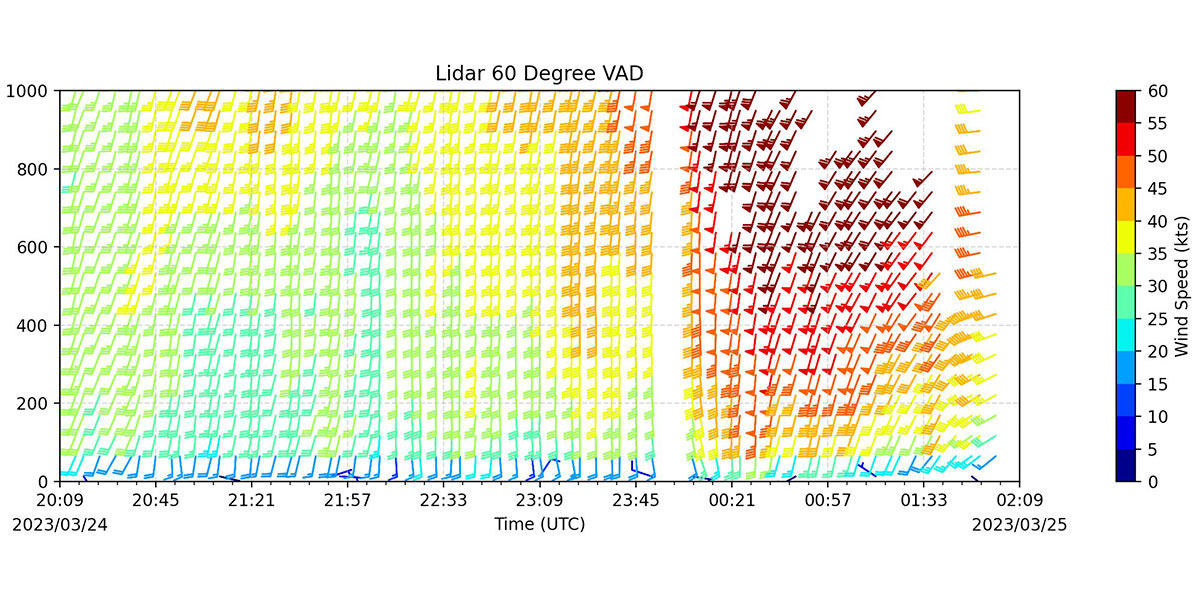
Within an hour, at 6 p.m., several tornado warnings were issued across the Mississippi Delta, including over part of the UAH research team’s site.
“It was a heart-racing experience,” says Zeb Leffler, Atmospheric and Earth Science undergraduate senior, who was one of the research team members in the tornado warning with UAH’s MAPNet Mobile Alabama X-Band Radar (MAX) vehicle.
“We kept seeing the cloud ceiling lower as the storm progressed closer to us,” he says. “Cloud-to-ground lightning increased, and a hail core was spotted using MAX’s radar, which usually indicates a storm’s intensity is increasing.”
No tornado was confirmed at the set-up location, but Leffler says the data MAX collected was valuable in identifying storm intensification due to the environment having high instability and spin in the atmosphere.
“Just five miles north-northeast of where we were located, the tornado-warned storm did produce golf ball sized hail,” he says.
Leffler’s radar data, along with the rest of the data collected by the UAH research team, will be an important addition to the data archive. It will be compared against data collected at other tornado field campaigns to determine what atmospheric conditions initiate or hinder tornadic activity.
“This non-tornadic supercell had so much significant data collected on it, it could be the most studied event so far since beginning our tornado field campaigns,” says Dr. Kevin Knupp, director of UAH SWIRLL and Atmospheric and Earth Science professor.
UAH is one of 12 research institutions chosen to participate in the Propagation, Evolution, and Rotation in Linear Storms (PERiLS), the largest Dixie Alley tornado field campaign to date. Funded by the National Science Foundation and National Oceanic and Atmospheric Administration, PERiLS is a three-year project with its second year occurring this spring.
(Courtesy of UAH)
Additions of heat-capturing infrastructure around the National Weather Service (NWS) weather station at Huntsville International Airport are likely the cause for temperature data that NWS says shows the city had the hottest July on record, says Alabama’s state climatologist.
Dr. John Christy is the director of the Earth System Science Center at The University of Alabama in Huntsville (UAH), a part of the University of Alabama System. As the state’s climatologist, he has authored a downloadable publication on climate change and Alabama.
NWS reported that Huntsville’s July average temperature, 84.2 degrees F, was the hottest July in the record books edging out 83.9 degrees F in July 1930, though still below the Augusts of 2007 and 2010. But Dr. Christy says the added infrastructure around the airport, including construction of the second largest runway in the Southeast at 12,600 feet long, creates a possible heat island effect that is the cause for the higher readings.
“It was hot, no argument there, but the hottest? Let’s take a look at the situation,” Dr. Christy says.
“A few years ago, I noticed the readings from the airport station, KHSV, used for the ‘official’ observations reported here, seemed hotter than those reported by surrounding stations,” he says.
Dr. Christy says the KHSV thermometer began to indicate a shift to warmer temperatures sometime in 2007-2008.
“In the 10 years before 2007, KHSV’s July daily maximum temperatures were on average cooler than the surrounding stations by 1.1 degrees F. From 2008 to today, KHSV was suddenly 1.6 degrees F warmer than the others, a shift of almost 3 degrees F.”
He says the NWS noticed it, too.
“So, to satisfy our collective curiosities, the NWS technicians performed an extra calibration test and found the instruments at the airport were spot on. So, why the discrepancy with other stations?”
The airport’s west runway and associated taxiways were finished around the time the NWS’ temperature readings began to increase, according to Dr. Christy.
“All that concrete so close to the KHSV instruments had a predictable effect,” he says. “Summer temperatures were likely to be hotter, not because of the background climate, but because of the exceptional growth in infrastructure near the weather station, and that certainly seems to be the case.”
More evidence comes from nearby rural stations, Pryor Field, Belle Mina, Madison and Owens Crossroads, none of which saw their hottest July in 2022 even though their records are much shorter.
When it comes to daytime heat, Dr. Christy says that even with the extra 2-3 degrees F from the likely runway heating, July 2022 was an also-ran as 12 other Julys, seven Augusts, two Junes and a September were hotter.
“The punch that gave July the title of record warmth was the nighttime heat,” he says. “With a very humid month, the heat just couldn’t escape to space to cool the surface at night because water vapor is very efficient at preventing that.”
Only August 2010 tied this past July for warm nights, he says.
“But here again, there is more to the story. When infrastructure expands around a weather station, the daily low temperatures are actually affected more than the daytime highs. It’s complicated, but we have published several scientific papers on this phenomenon.”
Because of Huntsville’s expanding infrastructure, Dr. Christy says that nights have become warmer through the years.
“And, when you look at the long-term temperature record of summer daily high temperatures, Alabama – yes, the entire state – has been experiencing a downward trend, while the nights have shown warming,” he says. “So, the station has been influenced by more than just the natural fluctuations of climate.”
August 2007 was a year of harsh drought for the state and came in with an average Huntsville temperature of 85.7 degrees F for title of hottest month, well above July 2022, Dr. Christy says.
“August 2010 at 84.7 degrees F was hotter, too,” he says. “So, July 2022 was the hottest average temperature relative to other Julys at the airport station, but looking at the historical record more closely, at other nearby stations and considering the impact of airport growth, it should not be considered hottest in the climate-sense.”
(Courtesy of UAH)
The University of Alabama in Huntsville (UAH), a part of The University of Alabama System, announced that the UAH College of Business (COB) has received a $30,000 gift to fund a new Financial Wellness Program.
This support will enable the COB to fully implement a Financial Wellness Program that will provide students the opportunity to learn about financial planning and garner tools and resources to help safeguard their financial futures.
“We are grateful for the commitment of Regions Bank to UAH, our students and the financial wellness of our community,” says Dr. Jason Greene, dean of the College of Business. “Students who are selected to participate will complete a three-week program in which they are taught sound principles influencing financial wellness, such as personal budgeting, saving, credit cards and debt. In addition to being better prepared with financial knowledge, students who complete the program earn a scholarship that is made possible by the Regions Bank gift.”
To prepare for this new offering, the COB piloted a program in 2020-2021 that generated noteworthy results indicating that such a program would greatly benefit the student population as a whole.
“With support from Regions Bank, the College of Business developed a financial wellness curriculum that is delivered to students, with a focus on students with financial need,” Dr. Greene explains.
The purpose of the pilot program was to test the effects of a financial literacy program on the financial knowledge of students. The study was designed to determine if participants scored higher on a financial literacy instrument when first provided a program covering topics such as budgeting, saving money, resources and student loans.
“Over the past year, we have run a pilot study of the financial wellness curriculum we have developed,” says Dr. Wafa Orman, COB associate dean and associate professor of economics. “We hypothesized that developing students’ financial knowledge would also increase their resilience and sense of self-efficacy. Students who participated in the program saw a statistically significant increase in their financial knowledge scores (about 16%) that persisted even three months later. They also saw improvements in their resilience and self-efficacy scores immediately after the program. We look forward to rolling the program out more broadly, and hope that many of our students can benefit from it. We are deeply grateful to Regions Bank for their support of the pilot program, the scholarships and their assistance in developing the curriculum.”
The pilot study showed student knowledge in each of these areas would be improved considerably by implementation of such a program. Going forward, support from Regions Bank will allow the COB to offer the program to a wider audience, with preference for Pell Grant recipients, with an incentive to participate of $500 administered through financial aid. Students who participate will also take part in both pre- and post-program surveys.
“The College of Business is honored to have excellent community partners like Regions Bank,” Dr. Greene says. “This gift is just the latest example of their outstanding commitment to UAH and our community.”
Regions Bank Financial Corporation is a member of the S&P 500 Index and is one of the nation’s largest full-service providers of consumer and commercial banking, wealth management and mortgage products and services. Regions Bank serves customers across the South, Midwest and Texas.
The UAH College of Business contributes to the economic vitality of Huntsville and beyond through its mission to fuel innovation in business, spark ideas through research and launch the careers of students. With its faculty of outstanding teachers and accomplished researchers, it offers accredited business degree programs at the undergraduate level in six major areas and at the graduate level through seven master’s degrees programs, including a flexible MBA program that can be taken online, in-person or a combination of both.
(Courtesy of UAH)