For 1st Lt. Francesco La Torre, the Army’s first drone-on-drone kill wasn’t the Hollywood moment most would imagine.
“In ‘A New Hope,’ Luke Skywalker flies an X-Wing through the Death Star trench and blows it up,” La Torre said. “This wasn’t like that. It was way harder. Honestly, it felt more like Darth Vader shooting down rebel pilots. He might be the villain, but he’s also one of the best pilots in the galaxy.”
That was the image in La Torre’s mind as his team with the 173rd Airborne Brigade achieved a milestone once unimaginable for conventional Army units: destroying another aircraft in flight with a first-person view drone carrying an explosive charge.
The kill took place earlier this month during the U.S. Army’s UAS and Launched Effects Summit, held Aug. 11–15 at Fort Rucker, Alabama. The live-fire event was led by the brigade’s Bayonet Innovation Team in partnership with the Pennsylvania Army National Guard and engineers from Army Combat Capabilities Development Command.
“When I heard Chief Nate Shea say, ‘arming’ when he was lined up behind the fixed wing threat UAS, I knew he’d take it down,” La Torre said. “A few seconds later he detonated the claymore, and I looked up from my end-user device (EUD) to see the fixed-wing drop out of the sky.”
The success came after weeks of training. Paratroopers flew for hours each day, building muscle memory while rehearsing how to engage a fast-moving aircraft. Chief Andrew Topits familiarized himself with the fixed-wing platform a month in advance, while Chief Shea practiced with inert claymores. Once on the ground at Rucker, the operators flew daily in changing weather, preparing for a target that could appear anywhere across the range.
Technical skill proved as important as piloting.
“The ability to train and solve problems immediately afterwards was critical to mission success,” La Torre said. “The team was soldering, disassembling, reassembling, and performing QA/QC around the clock while rehearsals were underway. While tactical units and technicians may not share the same language, they do share an intellectual curiosity and desire to succeed.”
La Torre emphasized what it means for the average paratrooper.
“With the right kit, paratroopers will be able to utilize a low-cost system with pre-existing munitions to execute a wide variety of mission tasks – and have the power to protect their unit from an endemic threat,” he said.
The drone demonstration showed that innovation doesn’t have to come from the top.
“It feels extremely satisfying to have this level of impact, but solving these kinds of problems should not be alien to junior officers, or any leader,” La Torre said. “Every year the Army produces leaders at all levels who are better educated now than ever before. At the end of the day, rank is immaterial when it comes to problem solving.”
For La Torre, the milestone reflects how far the 173rd Airborne Brigade has come.
“At this time last year, this kind of training was a pipe dream for conventional units,” he said. “For the engagement itself, Chief Shea did an incredible job and so did Chief Topits. It’s such a difficult mission profile for both aircraft.”
Lessons from the Bayonet Innovation Team fed directly into Fort Rucker’s new Lethal UAS Course, directed by Capt. Rachel Martin and Maj. Wolf Amacker. The course consolidates milestones within the Army’s UAS community and serves as a hub for education and experimentation.
“The more testing and experimentation we do, the less we must teach theoretically and the more we can back claims with real data,” La Torre said. “Safe and effective experimentation allows commanders to understand the true nature of the risks they assume with these systems and helps make this training more commonplace.”

For La Torre, the boundaries are clear: safety and scalability.
“We must safely conduct training, testing and experimentation,” he said. “We also must make sure everything we do is exportable to other units so they can do the same. I’m confident what we’ve done is scalable, and the Lethal UAS Course at Fort Rucker will centralize the growth of lethal UAS engagements while also serving as a hub for subject matter experts to gather and exchange lessons learned.”
Courtesy of the U.S. Department of Defense.
Auburn University’s McCrary Institute for Cyber and Critical Infrastructure Security is bringing two heavyweight national-security figures onto its advisory board.
Former U.S. Department of Homeland Security Secretary under President Donald Trump, Kirstjen Nielsen, now president of Lighthouse Strategies, and Auburn alumnus James Hoskins, a former U.S. Air Force intelligence leader who built Scitor Corporation into a mission-critical intelligence firm later acquired by SAIC, will join the board.
According to the institute, as board members, Nielsen and Hoskins will serve as senior advisors, bringing deep experience from the highest echelons of national security and private-sector leadership.
They join an already distinguished roster of advisors, including corporate executives, senior government officials and Auburn University leadership.
From its policy hub in Washington, D.C., the Institute works closely with federal agencies, Congress and industry leaders to shape actionable public policy in a rapidly evolving digital landscape. In Auburn and Huntsville, its applied research teams develop and deploy practical solutions that help safeguard critical infrastructure systems across the Southeast and the nation.
“It’s a pleasure to welcome former Secretary of Homeland Security Kirstjen Nielsen and Auburn’s own renowned engineer James Hoskinsto our advisory board,” said Lt. Gen. Ronald L. Burgess Jr., McCrary Institute Advisory Board chairman and former director of the U.S. Defense Intelligence Agency.
“Bringing on these renowned leaders in homeland and national security will only further our ability to help the McCrary Institute have a meaningful impact on our nation.”
“I am deeply honored to join the board of the McCrary Institute, a dynamic and mission-driven institution that not only leads in cybersecurity innovation and education but also stands as a national resource, shaping the future of policy, research and resilience,” said Kirstjen Nielsen, the sixth Secretary of the U.S. Department of Homeland Security.
“The McCrary Institute stands out because it does not stop at ideas or theory — it ensures that innovation is tested against the realities of the field. By bringing operational context and real-world requirements into its work, the Institute grounds cyber policy, research and innovation in the challenges faced every day by operators and defenders of critical infrastructure. This ‘policy informed by practice’ approach ensures that strategies are not only conceptually sound but also executable, scalable and relevant. It is a privilege to contribute to such a unique and vital institution.”
“It’s an honor and privilege to serve Auburn University’s McCrary Institute,” said James Hoskins, former chairman and CEO of the Scitor Corporation.
“The cybersecurity mission of the McCrary Institute is national in scope and priority. America’s future is in great hands considering the capabilities, personnel and facilities that have been assembled by McCrary with the aim to make a landmark difference.”
Frank Cilluffo, director of the McCrary Institute, praised the additions, saying the pair’s experience will strengthen the institute’s mission and its roster of national security leaders.
“I’m thrilled that Kirstjen and James are joining the McCrary Institute’s advisory board,” said Cilluffo. “They bring deep experience in national security, cybersecurity and public service — adding invaluable perspective to an already exceptional group. Their advice and counsel will help us strengthen our efforts to protect the critical infrastructure that underpins our nation’s security, economy and communities.”
Grayson Everett is the editor and chief of Yellowhammer News. You can follow him on X @Grayson270.
The U.S. Army officially restored the name Fort Rucker to its Wiregrass installation Thursday during a ceremony at the U.S. Army Aviation Museum.
In June, the Secretary of the Army directed the change to honor Capt Edward W. Rucker Jr., a World War I aviation pioneer and Army Air Corps pilot.
The installation, originally named after Confederate soldier Edmund Rucker, was renamed Fort Novosel in 2023 to honor Chief Warrant Officer 4 Michael J. Novosel Sr., a Medal of Honor recipient who served in World War II and the Vietnam War, as part of an initiative to remove Confederate names from military bases.
Maj. Gen. Clair A. Gill, commanding general of the Aviation Center of Excellence and Fort Rucker, welcomed attendees with a heartfelt message. He called the event a unique moment for the Wiregrass, noting that while the name returns to something familiar, it now honors a different individual.
RELATED: Tuberville opposes renaming Fort Rucker — ‘We’re going to fight that’ (2021)
Gill highlighted Rucker’s remarkable legacy as a pioneer who “flew above the best in one of the darkest moments in our nation’s history.” Rucker began his service in the Missouri National Guard in 1915, later serving on the Mexican-American border before choosing to attend flight school instead of pursuing a regular Army commission. After training in Toronto and Texas, he deployed with the 27th Aero Squadron in June 1918, where he engaged enemy forces in France in a daring mission that earned him the Distinguished Service Cross. His citation praised his courage and skill in driving off enemy aircraft and protecting reconnaissance planes despite being outnumbered deep inside enemy territory. Rucker also earned the French Croix de Guerre with a palm leaf for his extraordinary valor.
Gill noted that Rucker’s heroism and the images of brave World War I aviators inspired generations to pursue a career in aviation. He reflected on the installation’s legacy.
“They say that home is where the heart is, and our home once again has a familiar moniker, Fort Rucker. The heart of this home will forever belong to aviation warfighters like Edward Rucker, Mike Novosel, and all those who call and will call this place home.”
Secretary of the U.S. Army Dan Driscoll, joined U.S. Senator Katie Britt during a recent tour of Redstone Arsenal to display the base’s Army-related facilities and capabilities.
While at Redstone, Driscoll and Britt visited the Army Materiel Command (AMC), the Rapid Capabilities and Critical Technologies Office (RCCTO), Program Executive Office Missiles & Space (PEO Missiles and Space), and Program Executive Office Aviation (PEO Aviation), where they were briefed on the Future Long-Range Assault Aircraft (FLRAA).
“It’s always an honor to showcase Alabama’s cutting-edge capabilities at Redstone Arsenal. I’m grateful to Secretary Driscoll for prioritizing a visit to Huntsville early in his tenure as Army Secretary,” said Britt (R-Montgomery).
“Redstone plays an invaluable role in American national security by supporting several branches of the U.S. military, with a primary emphasis on the U.S. Army. Achieving peace through strength requires that our warfighters remain the best trained, best equipped, and most prepared in the world.”
“Redstone is indispensable to advancing this mission of ensuring America’s military readiness and unmatched lethality. I’m proud to champion Redstone’s critical work and be an advocate for our service members in the Senate.”
Britt worked diligently through the confirmation process of Driscoll, saying that he fully grasps the significance of Army bases throughout Alabama.
“Secretary Driscoll understands and appreciates the tremendous role Alabama’s Army installations play in strengthening America’s national defense and force readiness,” Britt stated. “I look forward to working with him to maximize the impacts of Fort Novosel, Redstone Arsenal, and Anniston Army Depot to provide President Trump and Secretary Hegseth with the resources needed to achieve peace through strength.”
In late April, the Senator made a separate visit to the Arsenal, joined by U.S. Senator Tommy Tuberville and FBI Director Kash Patel to observe the base’s intelligence capabilities, particularly that of the Bureau.
“The FBI’s operations on Redstone Arsenal are at the forefront of 21st-century innovation and training needed to combat the threats of the future, and I am confident Redstone will be instrumental in fulfilling the FBI’s core mission for decades to come,” she said following the tour. “Promises made, promises kept – and we’re just getting started.”
Austen Shipley is the News Director for Yellowhammer News. You can follow him on X @ShipleyAusten
Auburn University’s Samuel Ginn College of Engineering has set a college record for new research awards and contracts for a fiscal year, closing FY24 with $117.7 million.
Auburn Engineering has now increased its annual research awards and contracts by more than 300% since 2018, when the college brought in $29 million. The college also set a record with engineering faculty members submitting 544 proposals requesting $458 million in research funding.
“In recent years, the Samuel Ginn College of Engineering has generated record-breaking levels of funding in new research awards and contracts, alumni support and student enrollment,” said Mario Eden, dean of engineering. “Our vision is to provide research that improves quality of life and fosters economic competitiveness, and that’s exactly what our dynamic faculty and students are doing as part of one of the elite public engineering institutions in the nation.”
In 2017, the college began a strategic hiring initiative that resulted in an increase of nearly 50 faculty members. In turn, this has increased the number of research proposals and funding amounts for each request.
“Our faculty members are not only setting a standard in the classroom, they are also doing so as part of the university’s research enterprise,” said Allan David, the college’s associate dean of research. “Whether it’s related to transportation, health, advanced and additive manufacturing, cybersecurity or the environment, our faculty members are conducting cutting-edge research that is improving the quality of life, driving our economy and making us safer both here at home and across the globe.”
Funding for several high-profile research areas included:
- Transportation and Resilient Infrastructure — $32,457,000
- Advanced and Additive Manufacturing — $18,340,000
- Applied Research — $15,061,000
- Cybersecurity and Intelligent Systems — $11,100,000
- Biomedical and Health Systems Engineering — $6,900,000
- Advanced Communications and Electronics — $9,081,000
Several impactful awards and contracts included:
- $50 million ($22 million awarded in FY24)
U.S. Army Combat Capabilities Development Command Aviation & Missile Center
“Lightweight, Advanced Manufacturing of Metallic, Polymer and Composite Structures for Aviation and Missile Weapon Systems” - $10 million
Department of Energy
Model Regional Operations Center to Enhance Cyber Security of US Electricity Sector
Frank Cilluffo and James Goosby (McCrary Institute for Cyber and Critical Infrastructure Security) - $6,552,227
Federal Transit Administration
“Low and No Emission-Component Assessment”
Christian Brodbeck (engineering administration) and Mark Hoffman (mechanical engineering) - $3,255,444
State of Kansas
“Additive Manufacturing Material and Process Rapid Qualification for Vehicle Applications”
Nima Shamsaei and Shuai Shao (mechanical engineering) - $3,012,027
U.S. Air Force
“Novel Timber Structures for Air Force Expeditionary Environments”
James Davidson, J. Brian Anderson, David Roueche and Kadir Sener (civil and environmental engineering) - $1,250,000
National Asphalt Pavement Association
“Synthesis of State of Practice and Research Needs for Airfield Asphalt Pavement Resilience”
Benjamin Bowers (civil and environmental engineering) - $1,099,000
Trideum Corp.
“Missions based multi-domain operations test environment”
Stephen Mills (Applied Research Institute) and Hunter Burch (electrical and computer engineering)
Courtesy of Auburn University.
U.S. Senator Tommy Tuberville announced that he selected an educator from Trussville to be his Veteran of the Month for July. Each month, the Senator recognizes
For the month of July, Tuberville (R-Auburn) chose U.S. Army Lieutenant Colonel Wayne Davenport, to receive the honor. Davenport serves as the JROTC Instructor and Scholars Bowl Coach at Gadsden High School. Davenport served 22 years in the military, including tours to South America and Afghanistan in the 20th Special Forces Group.
“When we think of coaches, we often think of athletic coaches,” said Tuberville. “But our students also need dedicated ACADEMIC coaches, like U.S. Army Lieutenant Colonel Wayne Davenport of Trussville, Alabama.”
“Because of his gift for building successful teams, Wayne was chosen to help redesign the special forces group following 9/11. His blueprint is still used to this day.”
Tuberville noted the positive effect Davenport has on his students and peers alike.
“And for 15 years, he has been using his talents to help students find confidence and reach new heights as the JROTC Instructor at Gadsden High School. His supervisor describes him as a “Godsend.” This is evidenced by both his success AND the success of his students.”
RELATED: Tuberville highlights NDAA amendments to strengthen Alabama, U.S. military
“Recently, Gadsden High’s JROTC team became the FIRST program in Alabama to place as one of the most ELITE 32 Academic Bowl teams out of more than 2,000 teams in the WORLD. But, that’s not all,” said Tuberville. “Wayne also serves as the coach for Gadsden High’s Scholars Bowl team, where he has led FOUR teams to the National Championship. He spends many early mornings and late nights preparing for these competitions without complaint.”
Davenport is continuing to expand his reach to encourage, inspire and shape the lives of students prior to high school.
“Additionally, Wayne is helping build a culture of academic excellence that begins long before students reach high school age. Now, he is training elementary teachers on how to begin preparing students at an early age so that Alabama’s students can compete at all levels with other states.”
Constituents can nominate an Alabama veteran and submit their information to Senator Tuberville’s office for consideration by emailing press_office@
Austen Shipley is a staff writer for Yellowhammer News. You can follow him on X @ShipleyAusten
U.S. Senator Katie Britt has delivered a big win for her native Wiregrass. After her intervention, money was not diverted from Fort Novosel, the U.S. Army base in Southeast Alabama formerly known as Fort Rucker.
A rash of social media rumors emerged last week claiming that the Biden Administration’s Department of Defense was pulling $130 million from a flight simulation training program conducted at the U.S. Army Aviation Center of Excellence (USAACE) at Fort Novosel. The social media posts claimed the training program would be halted as soon as May 1, which was last Wednesday.
Amid the speculation, Sen. Britt’s team immediately engaged senior military officials to get to the bottom of the rumors and advocate for Fort Novosel.
“Our office is aware of social media posts that are circulating claims regarding U.S. Army Aviation Center of Excellence flight training programs at Fort Novosel,” Britt (R-Montgomery) said in a statement last week.”
RELATED: Alabama military construction projects receive $300M+ boost in defense bill
“We are in touch with senior military officials and received the following comment: ‘At this time no decision has been made and no dollars have been diverted.’ In the recently passed FY24 Defense Appropriations bill, I helped secure $1.38 billion for flight training at Fort Novosel, and I’ll continue to fight for every cent of that money to be spent as congressionally intended.”
Since then, the situation has become less murky due to Sen. Britt’s continued persistence on the issue.
Last Friday, the day after Sen. Britt’s original statement, the Army confirmed to Alabama’s congressional delegation that no money had been taken from Fort Novosel.
No training programs have been disrupted or halted at Fort Novosel, either.
And the best news is this – sources confirm to Yellowhammer News that the Pentagon does not have any existing plans to divert a cent from USAACE.
Now that the FY25 appropriations process is starting to pick up steam, Sen. Britt told Yellowhammer News that she remains committed to ensuring Alabama has the best possible seat at the table.
“I’m proud to support Alabama’s incredible military installations and communities. Our state is truly crucial to our national defense and homeland security, with the exemplary work being done across Alabama ensuring our servicemembers are the best trained, equipped, and resourced in the world,” said Sen. Britt. “I will always fight for every taxpayer dollar appropriated by Congress to be used responsibly, transparently, and accountably.”
Grayson Everett is the state and political editor for Yellowhammer News. You can follow him on Twitter @Grayson270
At a Leidos facility in Huntsville, the next chapter of the U.S. Army’s warfighting capability is being written.
The company announced its Enduring Shield rocket system, a ground-based technology, capable of eliminating fast-moving aerial threats, successfully cleared a critical milestone in its global delivery.
Days later, members of the Leidos team who helped design, develop and build the systems piece by piece were recognized for their devotion to a project that addresses a technological and fundamental need of the U.S. Army: Adaptability.
“The possibility of multiple threats and the need to defeat these threats is built into the Enduring Shield architecture and the U.S. Army’s layered defense architecture,” Alex Burns, the division manager for the Leidos team responsible for Enduring Shield told Yellowhammer News.
“Enduring Shield has a larger magazine capacity than comparable systems, and each launcher works in collaboration with other launchers so that the protected area is fully defended. We also work with the Army’s air defense systems to enable the optimal launcher and its optimal missile to be used for each threat,” Burns said.
RELATED: Leidos announces success in key test for Enduring Shield System
Enduring Shield is capable of targeting and eliminating three distinct, complex threats: Unmanned aerial systems (UAS), fixed-wing aircraft, such as attack helicopters, as well as cruise missiles – all of which are relied on in high volume by adversarial combat forces.
“Enduring Shield’s ability to defend against cruise missile threats is a much-needed capability to protect our warfighters, critical infrastructure and other key assets. We are also designed for quick emplacement times and to be fully operational in a short window of time to best fit the needs of the warfighter,” Burns said.
“The breakthrough that Leidos Dynetics brings is the capability to expand this solution with future interceptors. That enables our air defense solutions to change and adapt as required by the threat.”
A vital aspect of that breakthrough takes place long before the rocket leaves the canister and eliminates a threat.
Among those in attendance in Huntsville to mark the occasion was Brig. Gen. Frank Lozano, the U.S. Army Program Executive Officer (PEO) for Missiles and Space.
“We have purposely spent a lot of time designing this system to have a modular, open systems architecture,” Brig. Gen. Lozano told the facility full of employees from across the company.
“That’s important because, in the future, we’ll likely want to adapt the interceptors that we put on the system. We will likely improve the command and control capabilities that communicate with this system. And as we make all those adaptations within the kill chain, the system in and of itself has to be flexible and adaptive to react to those changes in a manner that allows us to destroy a threat that never stands still.”
“It’s a hallmark of the system,” Lozano said.
RELATED: Leidos unveils first Enduring Shield launchers ‘vital’ to future U.S. Army capability
Leidos’ Dynetics team was selected as the primary contractor to develop the Enduring Shield system as part of the Army’s IFPC Inc 2 program in September 2021. The original delivery date for the launchers was scheduled for March 2023, but supply chain issues and technical challenges led to a delay in physical delivery.
However, Leidos and the Army worked closely together to integrate and test different facets of the program to mitigate any potential negative impacts to the system production and fielding target timelines.
The team answered that call for urgency. It speaks to the company’s adaptability as well, Burns said.
“Leidos Dynetics has grown in every metric throughout this program.
“In addition to growth, this program has enabled our company to mature technology into production and deliver this critical capability into the hands of our warfighters. The progress shown on this program is a tangible way to see our strategy take shape in Huntsville.
“Leidos Dynetics has a long history in the areas of rapid technology development and increasing capabilities for our customers. From the beginning, the company has always been prepared to shift and adjust when needed. For example, after the Cold War, there was a strong belief that government contractors wouldn’t really be a necessity moving forward, but Dynetics still invested in building a headquarters with a sensitive compartment information facility when moving into Research Park,” Burns said.
He said that move paid off because they ended up being able to help MSIC with the surge of intel that came in once the Berlin Wall fell. More recently, the company proved this with two other programs: small-glide munition (SGM) and Lonestar, with Lonestar in particular being an example of delivering high quality on a fast turnaround.
Americans don’t have to look far to see the benefit of a technology like Enduring Shield. In recent months, news coverage and viral videos of Israel’s Iron Dome technology have gripped attention for its ability to eliminate incoming rocket attacks while still in the sky.
Burns said that system is highly effective at defending the Israeli homeland against the seemingly constant threat of attack.
“The technology used and the military’s approach employed by Israel is constantly refined to help defend Israel. In the same way, Enduring Shield will grow in capability through integrating new missiles, expanding how we fit into the Army’s plans for U.S. operations and the continued evolutions enabled by the Army’s IBCS network,” Burns said.
“Enduring Shield, as a ground-based yet mobile system, will be able to be placed where needed in the battlefield. Four units together can create 360-degree protection for anything from a squadron of soldiers to a hospital or school building. That protection sphere is good for up to 16 square kilometers, which provided much needed cover when trying to defend fixed, unmovable assets. While our warfighters do have Terminal High Altitude Area Defense (THAAD) and Patriot forces, Enduring Shield fills a critical gap between these and other short-range air and strategic defense systems. Bridging that gap means we find a way to protect and defend critical military and civilian infrastructure.”
The next phase for the program is a Developmental Test phase, where the Army will gather more data in addition to the successful risk reduction flight test. Anything they learn throughout that phase will provide Leidos with more information for the next order of launchers, which they expect in 2025.
The Alabama-made system is a point of great pride for the Leidos Dynetics team. That was on full display in a room full of the professionals responsible for the nuts and bolts. Literally.
“The technology developed with Enduring Shield originates from the Multi-Mission Launcher program, which was developed by the U.S. Army Combat Capabilities Development Command Aviation & Missile Center (CCDC AvMC) in Huntsville and Redstone Arsenal,” Burns told Yellowhammer.
“The program involved many Army and industry professionals throughout this engineering community. It’s exciting to see the world-class engineering make a transition to the warfighter and exciting for Leidos Dynetics to be a big part of that. Huntsville creates this unique environment that enables rapid development through partnerships and relationships, which push our technology forward to help the warfighter.”
In Huntsville, Brig. Gen. Lozano said the difference he’s witnessed in the Chase facility between his latest visit, and his initial visit one year ago is “remarkable,” with credit due to the hundreds of individuals who sacrificed their time and commitment to see the project all the way through.
“Congratulations on the things that you’ve accomplished within the last year – and really, the accomplishments of the last week – which are truly a culmination of everybody’s hard work, dedication, sacrifice, and your devotion and commitment to making this program successful. We could not be here without you.”
“There is nobody of insignificant or lesser value in this plant, in this facility, in this company, on my government team – because it requires all of us in the boat digging deep, rowing hard, focused on being successful so our soldiers can carry out their mission and be successful,” Lozano said.
“Because they have unmatched unparalleled warfighting capability – the best warfighting capability that the world has ever seen.”
Grayson Everett is the state and political editor for Yellowhammer News. You can follow him on Twitter @Grayson270
At a Leidos facility in Huntsville, the next chapter of the U.S. Army’s warfighting capability is being written.
The company announced its Enduring Shield rocket system, a ground-based technology, capable of eliminating fast-moving aerial threats, successfully cleared a critical milestone in its global delivery.
Days later, members of the Leidos team who helped design, develop and build the systems piece by piece were recognized for their devotion to a project that addresses a technological and fundamental need of the U.S. Army: Adaptability.
“The possibility of multiple threats and the need to defeat these threats is built into the Enduring Shield architecture and the U.S. Army’s layered defense architecture,” Alex Burns, the division manager for the Leidos team responsible for Enduring Shield told Yellowhammer News.
“Enduring Shield has a larger magazine capacity than comparable systems, and each launcher works in collaboration with other launchers so that the protected area is fully defended. We also work with the Army’s air defense systems to enable the optimal launcher and its optimal missile to be used for each threat,” Burns said.
RELATED: Leidos announces success in key test for Enduring Shield System
Enduring Shield is capable of targeting and eliminating three distinct, complex threats: Unmanned aerial systems (UAS), fixed-wing aircraft, such as attack helicopters, as well as cruise missiles – all of which are relied on in high volume by adversarial combat forces.
“Enduring Shield’s ability to defend against cruise missile threats is a much-needed capability to protect our warfighters, critical infrastructure and other key assets. We are also designed for quick emplacement times and to be fully operational in a short window of time to best fit the needs of the warfighter,” Burns said.
“The breakthrough that Leidos Dynetics brings is the capability to expand this solution with future interceptors. That enables our air defense solutions to change and adapt as required by the threat.”
A vital aspect of that breakthrough takes place long before the rocket leaves the canister and eliminates a threat.
Among those in attendance in Huntsville to mark the occasion was Brig. Gen. Frank Lozano, the U.S. Army Program Executive Officer (PEO) for Missiles and Space.
“We have purposely spent a lot of time designing this system to have a modular, open systems architecture,” Brig. Gen. Lozano told the facility full of employees from across the company.
“That’s important because, in the future, we’ll likely want to adapt the interceptors that we put on the system. We will likely improve the command and control capabilities that communicate with this system. And as we make all those adaptations within the kill chain, the system in and of itself has to be flexible and adaptive to react to those changes in a manner that allows us to destroy a threat that never stands still.”
“It’s a hallmark of the system,” Lozano said.
RELATED: Leidos unveils first Enduring Shield launchers ‘vital’ to future U.S. Army capability
Leidos’ Dynetics team was selected as the primary contractor to develop the Enduring Shield system as part of the Army’s IFPC Inc 2 program in September 2021. The original delivery date for the launchers was scheduled for March 2023, but supply chain issues and technical challenges led to a delay in physical delivery.
However, Leidos and the Army worked closely together to integrate and test different facets of the program to mitigate any potential negative impacts to the system production and fielding target timelines.
The team answered that call for urgency. It speaks to the company’s adaptability as well, Burns said.
“Leidos Dynetics has grown in every metric throughout this program.
“In addition to growth, this program has enabled our company to mature technology into production and deliver this critical capability into the hands of our warfighters. The progress shown on this program is a tangible way to see our strategy take shape in Huntsville.
“Leidos Dynetics has a long history in the areas of rapid technology development and increasing capabilities for our customers. From the beginning, the company has always been prepared to shift and adjust when needed. For example, after the Cold War, there was a strong belief that government contractors wouldn’t really be a necessity moving forward, but Dynetics still invested in building a headquarters with a sensitive compartment information facility when moving into Research Park,” Burns said.
He said that move paid off because they ended up being able to help MSIC with the surge of intel that came in once the Berlin Wall fell. More recently, the company proved this with two other programs: small-glide munition (SGM) and Lonestar, with Lonestar in particular being an example of delivering high quality on a fast turnaround.
Americans don’t have to look far to see the benefit of a technology like Enduring Shield. In recent months, news coverage and viral videos of Israel’s Iron Dome technology have gripped attention for its ability to eliminate incoming rocket attacks while still in the sky.
Burns said that system is highly effective at defending the Israeli homeland against the seemingly constant threat of attack.
“The technology used and the military’s approach employed by Israel is constantly refined to help defend Israel. In the same way, Enduring Shield will grow in capability through integrating new missiles, expanding how we fit into the Army’s plans for U.S. operations and the continued evolutions enabled by the Army’s IBCS network,” Burns said.
“Enduring Shield, as a ground-based yet mobile system, will be able to be placed where needed in the battlefield. Four units together can create 360-degree protection for anything from a squadron of soldiers to a hospital or school building. That protection sphere is good for up to 16 square kilometers, which provided much needed cover when trying to defend fixed, unmovable assets. While our warfighters do have Terminal High Altitude Area Defense (THAAD) and Patriot forces, Enduring Shield fills a critical gap between these and other short-range air and strategic defense systems. Bridging that gap means we find a way to protect and defend critical military and civilian infrastructure.”
The next phase for the program is a Developmental Test phase, where the Army will gather more data in addition to the successful risk reduction flight test. Anything they learn throughout that phase will provide Leidos with more information for the next order of launchers, which they expect in 2025.
The Alabama-made system is a point of great pride for the Leidos Dynetics team. That was on full display in a room full of the professionals responsible for the nuts and bolts. Literally.
“The technology developed with Enduring Shield originates from the Multi-Mission Launcher program, which was developed by the U.S. Army Combat Capabilities Development Command Aviation & Missile Center (CCDC AvMC) in Huntsville and Redstone Arsenal,” Burns told Yellowhammer.
“The program involved many Army and industry professionals throughout this engineering community. It’s exciting to see the world-class engineering make a transition to the warfighter and exciting for Leidos Dynetics to be a big part of that. Huntsville creates this unique environment that enables rapid development through partnerships and relationships, which push our technology forward to help the warfighter.”
In Huntsville, Brig. Gen. Lozano said the difference he’s witnessed in the Chase facility between his latest visit, and his initial visit one year ago is “remarkable,” with credit due to the hundreds of individuals who sacrificed their time and commitment to see the project all the way through.
“Congratulations on the things that you’ve accomplished within the last year – and really, the accomplishments of the last week – which are truly a culmination of everybody’s hard work, dedication, sacrifice, and your devotion and commitment to making this program successful. We could not be here without you.”
“There is nobody of insignificant or lesser value in this plant, in this facility, in this company, on my government team – because it requires all of us in the boat digging deep, rowing hard, focused on being successful so our soldiers can carry out their mission and be successful,” Lozano said.
“Because they have unmatched unparalleled warfighting capability – the best warfighting capability that the world has ever seen.”
Grayson Everett is the state and political editor for Yellowhammer News. You can follow him on Twitter @Grayson270
Rep. Jerry Carl visited Fort Novosel last week, meeting with base commanders and U.S. Army officials responsible for the 63,000 acres of land in Alabama’s Wiregrass region that serves as the headquarters of U.S. Army Aviation.
Novosel, previously known as Fort Rucker, first opened in 1942. Rep. Carl (R-Mobile) said he heard firsthand the ways in which the facility is showing its age.
“I just spent two days with Commanding General MG Michael McCurry and his team so I could learn more about the needs and challenges they are facing. Thanks to the hard work of Senator Britt and Chairman Mike Rogers, Fort Novosel is set to receive over $60 million dollars from the National Defense Authorization Act (NDAA), most of which will be used to improve the unsafe living conditions in many of the barracks on the installation.
RELATED: Alabama military construction projects receive $300M+ boost in defense bill
“I proudly supported the NDAA and these dollars going to Fort Novosel because this is a huge step forward for our servicemembers,” Carl added.

Fort Novosel is anchored in Dale County, and spans across Coffee, Geneva, and Houston Counties. The base, designated as a U.S. Army Aviation Center of Excellence in 2008, is home to a number of aviation brigades that support combat missions and servicemembers worldwide — including the 110th, 128th, and 1st.
The base, as well as U.S. Army Aviation itself, has been reflection of Alabama’s contribution to the warfighter, dating back to World War II, and the significant mobilization of American manpower and engineering that’s taken place since.
“Alabama has so much to be proud of, and Fort Novosel ranks high on this list. As the 5th largest employer in Alabama, and the largest employer south of Montgomery, Fort Novosel is the backbone of the Wiregrass and the surrounding communities. Not only does Fort Novosel employ nearly 15,000 people, but also, they provide support to an additional 113,000 veterans,” Rep. Carl said.
“There is still much work to be done to modernize and grow Fort Novosel, and I will continue fighting for them and all of Alabama’s military instillations because we have a duty to provide for our servicemembers who have signed up to protect and fight for our nation.”
Grayson Everett is the state and political editor for Yellowhammer News. You can follow him on Twitter @Grayson270
Fort Jackson is mourning the loss of two drill sergeants after both were found dead just days apart on base.
They have been identified by the Army as Staff Sgt. Zachary Melton, 30, of Huntsville and Staff Sgt. Allen Burtram, 34, of Cleveland.
Burtram was found dead on the South Carolina base Dec. 8; Melton was found in his car on the post Dec. 16.
The Army Criminal Investigations Division is investigating. The two deaths are unrelated and there is no apparent evidence of foul play, the Army said.
“As a Fort Jackson community, we are mourning the tragic loss of two of our drill sergeants within the past few weeks,” said Brig. Gen. Jason E. Kelly, commanding general of Fort Jackson. “While there are several ongoing investigations into the specifics of each of these deaths, we are taking very deliberate steps to ensure our resiliency resource offerings are adequate and responsive.”
Tomorrow is November 11, the anniversary of the end of World War I. Today we know it as Veterans Day. Veterans Day is a time to honor everyone who has worn the uniform of the United States.
Alabama is proud that the Veterans Day tradition started in Birmingham, in the aftermath of World War II when a local veteran named Raymond Weeks recognized the need for a day honoring all veterans. In 1947, Raymond Weeks petitioned the Army Chief of Staff, a General named Dwight Eisenhower, for a national Veterans Day.
Seven years later, General Eisenhower was President and signed it into law. Alabama is proud of Raymond Weeks, and we’re proud to be home to nearly 400,000 veterans, like Lieutenant Colonel Ron Skoneki from Montgomery, Alabama.
The son of Polish immigrants, he enlisted in the Air Force about as soon as he could—right after graduating from high school.
He served in Thailand during the Vietnam War, using his skills to repair and maintain aircraft for a strong defense. After 33 years of service, Lieutenant Colonel Skoneki retired.
He wanted to continue to serve, so he joined Alabama’s wing of the Civil Air Patrol in Montgomery, serving another 16 years helping to support the U.S. Air Force in a civilian capacity. Now, at 87 years old, he is just as proud of his time wearing the uniform as ever.
The same can be said of Command Sergeant Major Joe Godwin of Mobile. He says he first felt the call to serve when he was only 14 years old. By the time he was 17, he couldn’t wait anymore, so he got his dad’s permission to join the Army. Sergeant Major Joe Godwin went on to serve in three wars—World War II, the Korean War, and the Vietnam War. He helped guard and transport the Nazi prisoners during the Nuremberg trials.
Today, Joe is 94 years old. When people tell him he’s a hero, he humbly says, the real heroes are the ones who didn’t make it back.
But he too is a hero, like everyone else who served. And we ought to thank them today, tomorrow, and every day.
Sergeant David Henry of Warrior, Alabama, reminds us that veterans’ families make sacrifices too. He served as a firefighter and a paramedic at the Warrior Fire Department before joining the army because of a pact made with his best friend.
He used these skills to serve as an Army Combat Medic during deployments to Iraq and Afghanistan. His first deployment came when his son was only six months old. Sergeant Henry deployed again to the Middle East when his son was three.
He had to sacrifice being an ocean away from his family. He had to explain to a three-year-old why Dad was going to be gone—and he didn’t know when he was coming back. A lot of families know what that’s like. And so, on Veterans Day we ought to thank their families too. They’re also making a sacrifice.
Today, Sergeant Henry is back in Sweet Home Alabama. We are deeply grateful for his service to Alabama and to America.
Colonel Skoneki, Sergeant Major Godwin, and Sergeant Henry, are just three examples of the 400,000 heroes who call Alabama their home. The writer G.K. Chesterton once said, “The true soldier fights not because he hates what is in front of him, but because he loves what is behind him.”
You can see that in the lives of these Alabamians.
Our veterans fought because they believe in the United States of America. They believed America was worth fighting for and even dying for. They lay down their lives for the people of this country—for millions of people they don’t even know.
Everything we have in this country depends on our military.
Our economy, our security, and our way of life are all dependent on the military. President Ronald Reagan summed it up best when he said, “Veterans know better than anyone else the price of freedom, for they have suffered the scars of war. We can offer them no better tribute than to protect what they have won for us.”
This Veterans Day weekend, I hope we will remember the price of freedom and those who have paid it. And so, to all of our veterans: ‘thank you’ for your service, thank you for your sacrifice to ensure America remains a country of freedom and opportunity for generations to come.
U.S. Senator Tommy Tuberville is the senior senator from Alabama and a member of the Senate Armed Services, Agriculture, Veterans Affairs, and the Health, Education, Labor, and Pensions (HELP) committees.
Northrop Grumman has launched a trainer to teach Polish soldiers how to use the Integrated Battle Command System. The system, delivered two years ahead of schedule, will enable Poland to quickly field the transformational integrated command and control capabilities of IBCS.
Poland is the first U.S. ally to field the IBCS.
Known as Air Defense Reconfigurable Trainer, the training system hosts a wide range of materials and is configurable to support multiple missions.
“Coupling our innovative individual skills trainer with IBCS creates a complete package for the U.S. Army and allies to prepare them for tomorrow’s multi-domain battlefield,” said Rebecca Torzone, vice president and general manager, combat systems and mission readiness, Northrop Grumman. “With this IBCS package, Poland is modernizing their air and missile defense forces to enhance the safety and security of their country for years to come.”
Northrop Grumman representatives traveled to Poland and completed installation of ART at the Polish air defense school. Train-the-trainer events were also underway at Redstone Arsenal in Huntsville, allowing Northrop Grumman’s training capability to aid Polish soldiers in their understanding of IBCS.
A new economic impact study funded by the Alabama Military Stability Commission underscored the role played by the defense industry in the state’s overall economy.
The study’s findings showed the defense industry provides a staggering 264,780 jobs across Alabama. These jobs generated an annual payroll of $19.3 billion.
The total economic impact of military personnel and defense contracts across Alabama amounts to $50.3 billion, according to the report that was compiled by the University of Alabama in Huntsville College of Business.
“From aerospace development in the Tennessee Valley to shipbuilding in the Gulf Coast and at all points in between, the defense industry is vital to Alabama’s economy and job creation efforts,” said Lt. Gov. Will Ainsworth, the commission chairman. “The numbers in this report make the irrefutable case that Alabama must preserve and expand the defense infrastructure already located here while also attracting new companies and assets, as well.”
A more detailed look at the report reveals that 96,340 jobs in Alabama are held by active duty military personnel and 168,439 are filled by Department of Defense contractors.
When divided into regions with heavy military influence, the defense-related jobs are divided as follows:
- Redstone Arsenal Region — 143,156 jobs ($13.2 billion payroll)
- Fort Rucker Region — 28,865 jobs ($2.7 billion payroll)
- Maxwell/Gunter Region — 26,706 jobs ($1.9 billion payroll)
- Coastal Region — 21,331 jobs ($1.02 billion payroll)
- Anniston Region — 13,102 jobs ($1 billion payroll)
- Birmingham Region — 2,583 jobs ($146 million payroll)
- Dallas County Region — 559 jobs ($15 million payroll)
- Marion County Region — 22 jobs ($1 million)
The Alabama Military Stability Commission was created through state statute in 2011 and is comprised of elected officials, cabinet members, and regional appointees from areas of Alabama with a heavy defense concentration.
The panel is tasked with recommending and implementing the steps necessary to protect and promote, the federal military presence across the state.
Grayson Everett is a staff writer for Yellowhammer News. You can follow him on Twitter @Grayson270 for coverage of the 2023 legislative session.
Auburn University and the Army have signed a 10-year agreement to provide natural resource management services to eight military bases across the Southeast, including Redstone Arsenal in Huntsville.
The other bases are Fort Rucker in Alabama; Forts Benning, Gordon, and Stewart in Georgia; Fort Polk in Louisiana; Fort Bragg in North Carolina and Fort Jackson in South Carolina.
The renewable Intergovernmental Service Agreement is the first of its kind in the nation to include eight military bases.
“To implement the agreement, Dr. Vini Nathan, Auburn University’s interim provost, has approved the establishment of the Center for Natural Resource Management on Military Lands in the College of Forestry, Wildlife and Environment,” said Janaki Alavalapati, dean of the college.
The center will provide expertise and technical resources to perform services ranging from forest management and threatened and endangered species surveys, to surface water delineations and climate change vulnerability assessments. The center will also provide technical GIS and database support tools to manage the Army bases’ vast natural resources.
“The agreement will ensure the government’s management and diverse uses of the Army’s 1-plus million acres of military lands within these bases are sustained in order to accomplish the Army mission into the future,” said William G. Kidd, director of G4 Facilities and Logistics, Installation Management Command of the Army.
“The partnership was designed to expand to include opportunities for research and student learning as the university builds its administrative infrastructure and service capacities,” said Daowei Zhang, Alumni and George Peake Jr. Professor and associate dean of research in the College of Forestry, Wildlife and Environment, who will coordinate the services with the military.
(Courtesy of 256 Today)
Resisting demands from her homeowners association, a Huntsville woman is refusing to remove a flagpole from her lawn displaying Old Glory.
Upon attempting to make contact with the association, Dr. Jill Hudnell said she decided to move forward with the patriotic display. She said the HOA failed to respond to her questions on the correct way to erect the flagpole.
“No flagpoles other than those mounted on the home or no longer than four feet are permitted. Immediately upon receipt of this notice, please remove the flagpole,” the association wrote in a letter to Hudnell.
Undeterred by the subdivision rule-making entity’s demand, Hudnell, in a Thursday appearance on Fox News Channel’s “Fox and Friends,” declared her intent to keep the Star-Spangled Banner yet waving.
“This is going to stay right where it’s at because my family is military, and this is a representation of how I feel about their service,” she told co-host Carley Shimkus.
(Courtesy of Fox News Channel)
For Hudnell, who hails from a military family, displaying the American flag is a show of support for those who answered the call of duty.
Hudnell’s father, a Marine Corps veteran, lost his leg during the Vietnam War. Her husband, brother, father-in-law and brothers-in-law all served in the Armed Forces.
“So, this flag means a lot,” she said. “Not only do we have Old Glory hanging from that flagpole, but we also have the Army flag, because that is a representation of my husband.”
“Those two flags will stay up there. Old Glory is still waving this morning.”
Dylan Smith is the editor of Yellowhammer News. You can follow him on Twitter @DylanSmithAL
Next month, Alabamians will have the opportunity to wish a happy 100th birthday to retired U.S. Army Sgt. Victor Butler, one of the oldest surviving Tuskegee Airmen.
The Rhode Island resident and World War II veteran was part of the legendary “Red Tails” who served in the 332nd Fighter Group for the then-U.S. Army Air Forces.
“At first, I was going to join the Canadian Air Force with a friend of mine, but after I had signed up, my mother and father wouldn’t approve of it,” Butler said in a sit-down interview with NBC 10 News. “So, I joined with the American Air Force.”
Butler described the calm he finds in puzzles, which he said he does “just to occupy the time.”
Proudly displayed throughout Butler’s home is a collection of awards, coins and photographs documenting his World War II service.
The skilled mechanic enjoyed working on fighter and bomber aircraft at the Tuskegee Army Air Field while on duty. Away from the airfield, however, Butler experienced the difficulties of the Jim Crow South in 1940s Alabama.
“The airfield was very nice. It was the visit to the town that was bad,” he recalled. “Being in Tuskegee, Alabama, it wasn’t very acceptable to white people for black soldiers to be walking around.”
As valiant in service as the Tuskegee Airmen were, Butler and his fellow servicemen’s accomplishments did not end in combating the tyrannical ambitions of the Axis Powers. The group of black pilots and airmen played an instrumental role in ending segregation within the U.S. military.
Anyone that has lived a full century, and experienced as much life as Butler, is sure to have an abundance of wisdom. For Butler, the key to happiness is living a life of gratitude.
“Just enjoy life as it is. Be thankful,” he said. “I’m thankful that I have a nice wife, and a nice home to live in… There are so many people that have lost their home and I am very fortunate to have a nice home and wife and my family who come to visit me often.
Even though it will be his 100th birthday on May 24, to Butler, it will be “just another day.” He desires nothing for his birthday besides cards.
“I’ll read every one of them,” he said.
To wish Butler a happy birthday, cards may be sent to his mailing address:
Victor W. Butler
C/O Gary Butler
P.O. Box 3523
Cranston, Rhode Island 02910
Dylan Smith is a staff writer for Yellowhammer News. You can follow him on Twitter @DylanSmithAL
Tuesday, retired U.S. Army Cpl. Robert Curtis Andry was presented with the Purple Heart medal for his heroics during World War II.
The awarding, presented by U.S. Rep. Jerry Carl (R-Mobile), came on Andry’s 97th birthday.
“Today, I was honored to present Cpl. Andry with a Purple Heart medal to recognize his sacrifice and dedication to the United States,” stated Carl. “Cpl. Andry truly embodies the patriotism, determination, and fighting spirit that defines ‘The Greatest Generation.’”
He added, “Throughout the history of our country, America’s service members have put their lives on the line to keep the United States and our allies safe. Cpl. Andry – and the entire 761st Black Tank Battalion – understood that freedom is not free but is bought with a price. Thanks to their immense sacrifices, good triumphed over evil in World War II and the world became a safer place. We are forever grateful to them.”
Andry, a product of Bucks in Mobile County, was drafted into the U.S. Army upon graduating from high school. The Purple Heart recipient was part of the 761st Black Tank Battalion, which was the U.S. military’s first black armored unit.
Andry and his battalion’s ingenuity was on full display as they modified their M4 Sherman Tanks to operate twice their original speed, catching the eye of Gen. George Patton. Patton would later call upon Andry and his battalion to lead the general’s plan to move into Berlin.
While in Nazi territory, Andry’s tank was ambushed and blew up with him inside. After sustaining life-threatening wounds, Andry was rescued by medics. Andry’s battalion would go on to liberate 30 Nazi-occupied villages and concentration camps.
Dylan Smith is a staff writer for Yellowhammer News. You can follow him on Twitter @DylanSmithAL
Retired U.S. Army Colonel Casey Wardynski, Republican candidate for Alabama’s fifth congressional district, on Wednesday released his campaign’s first television advertisement of the 2022 primary election cycle.
According to Wardynski’s campaign, the ad is accompanied with a “significant” districtwide cable and broadcast media buy.
The ad, titled “With Trump,” recalls Wardynski’s service in the armed forces and his time as assistant secretary of the Army in the administration of former President Donald Trump.
“President Trump placed special trust and confidence in his ability, conservative Casey Wardynski,” says the ad narrator. “Thirty-year veteran, retired colonel, Trump’s assistant secretary of the Army. Casey Wardynski stopped Critical Race Theory in the Army. When Republicans failed to build Trump’s wall, Casey Wardynski changed the hiring rules so 450 miles of wall could be built in record time. He’s tough. He’ll fight for Trump’s agenda. Conservative Casey Wardynski for Congress.”
Watch:
https://www.youtube.com/watch?v=BLRTeLkYHSs
In a release, Wardynski campaign manager Chad Niblett spoke to the candidate’s Army background and work in assisting Trump construct the wall along the southern border.
“With more cash on hand for the primary than any other Republican candidate, our campaign is excited to share Casey’s story and conservative message throughout the district,” stated Niblett. “Casey Wardynski proudly served our country in the Army, rising to the rank of Colonel. When President Trump needed a strong conservative by his side as Assistant Secretary of the Army, he appointed Casey to serve in the Pentagon. And when President Trump was sick of weak-kneed Republicans for not building his wall, Casey Wardynski changed the hiring rules to get 450-miles of wall built in record time.”
The primary election will take place on May 24, 2022.
Dylan Smith is a staff writer for Yellowhammer News. You can follow him on Twitter @DylanSmithAL
U.S. Army veteran and former FBI special agent Kerry Straub earlier this week announced his intentions to seek the Republican nomination for the Alabama House of Representatives, District 10.
Straub holds a bachelor’s degree from Rutgers University, where he served in the ROTC program. He went on to earn a master’s degree from Auburn University at Montgomery.
In 1990, Straub entered the U.S. Army Corps of Engineers and left active military service eight years later at the rank of captain. He moved to the Tennessee Valley in 1998, where he began his career with the federal government.
According to a release, Straub served 21 years as a special agent and bomb technician with the FBI. He is currently employed as a cyber security engineer at Analytics performing cyber-based intelligence risk assessment and management for U.S. Department of Defense programs.
The seat Straub is seeking is currently held by State Rep. Mike Ball (R-Madison), who has decided to forgo reelection.
In announcing his candidacy, Straub suggested that his former leadership experience would be of benefit to the district should his candidacy prove successful.
“First and foremost, I want to thank my fellow LEO, Mike Ball, for his service, dedication, and leadership. No one can ever replace Mike Ball, the things he has achieved and accomplished for our district and state goes without saying,” Straub advised. “I decided to run because I want to make sure our district continues to have a seat at the table. I have spent my career and life serving the public, and now I want to bring that leadership and dedication to our state government.”
He continued, “We must continue to receive our fair share of funding for infrastructure, we continue to recruit jobs and that our economy continues to move in the right direction. My experience in law enforcement and public service has prepared me for this opportunity. I am proud to have served my nation and I will take this mind set to serve our state and the people of this District. Just as I have protected the people before I will protect our conservative values and morals.”
The candidate over the years has actively involved himself in community service-oriented organizations. These include the Young Life of Northern Alabama Committee, Character Foundation of Northern Alabama, Rotary Club of Madison, Tennessee Valley Crime Stoppers, as well as the Huntsville-Madison EMA Board.
House District 10 includes portions of Madison County. The primary election will take place on May 24, 2022.
Dylan Smith is a staff writer for Yellowhammer News. You can follow him on Twitter @DylanSmithAL
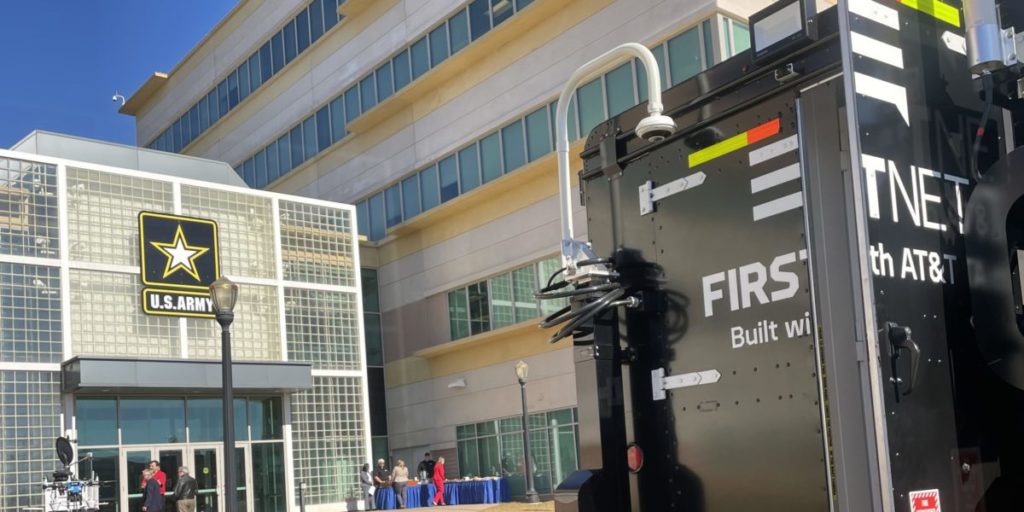
HUNTSVILLE — Public and private sector leaders on Thursday announced that Redstone Arsenal is set to benefit from enhanced wireless communications by way of AT&T’s FirstNet.
FirstNet was created to provide for efficient and high-quality communications in support of the first responder community, enabling access to reliable infrastructure during pressing emergency events.
The telecommunications company’s high-speed connectivity service will serve to enhance voice and mobile broadband coverage on the Army base, supporting always-on services across voice and data communication pathways.
Redstone Arsenal is the first installation in the world to receive the emergency-oriented communication service.
During the ribbon-cutting ceremony at the U.S. Army post, Gov. Kay Ivey applauded the collaborative effort in bringing the critical communications infrastructure to Redstone Arsenal.
“The collaboration of the U.S. Army and FirstNet will provide U.S. Army public safety personnel – firefighters, law enforcement and security – at 72 Army installations including Redstone Arsenal with increased capabilities to communicate as effectively and efficiently as possible, to best protect themselves and those they serve,” said Ivey. “We are honored to have the U.S. Army Materiel Command headquartered in Alabama and proud to celebrate the FirstNet build at Redstone Arsenal.”
We’re taking a major step forward today to ensure our first responders have access to critical broadband infrastructure. Thank you @FirstNet for making @TeamRedstone the 1st installation worldwide to receive First Net Emergency Communication coverage. #alpolitics @USArmy @ATT pic.twitter.com/VImAb9ju7l
— Governor Kay Ivey (@GovernorKayIvey) December 2, 2021
Ivey, on behalf of the state of Alabama, in 2017 opted in to FirstNet, which will serve to provide Alabama first responders enhanced capabilities to communicate during emergency crises.
Lt. Gen. Donnie Walker touched on the critical need for reliable communications infrastructure.
“Without communication, agencies cannot achieve the interoperability needed to bring vital resources to bear, especially when lives are at stake and time is of the essence,” advised Walker. “FirstNet gives us this capability. Security and safety of everyone who lives and works on this installation is job one. FirstNet is absolutely essential in that priority and pivotal in our efforts to improve the resilience of our installations. It is in a word, a game-changer.”
During the planning process of FirstNet, AT&T sought and received feedback from the U.S. Army to ensure the service met the needs of public safety personnel.
Chief Richard Carrizzo, First Responder Network Authority board of directors vice chair, spoke to the organization’s planning process in partnership with governmental entities.
“FirstNet is a dedicated broadband platform for all first responders, and we are proud to support the collaboration between FirstNet and the U.S. Army to help public safety personnel working on bases stay connected and protected,” proclaimed Carrizzo. “As we planned for this network, we worked hand-in-hand with our federal government partners, as well as the state of Alabama and its public safety community to understand the unique needs for the network across the state including at the Redstone Arsenal. These new sites are prime examples of how that input and feedback is becoming reality.”
In addition to improving public safety communications activities, the infrastructure will enhance coverage for Redstone Arsenal tenants such as the FBI and NASA, as well as the base’s visitors.
AT&T Alabama president Wayne Hutchens outlined the telecommunications company’s commitment to the first responder community.
“U.S. Army public safety personnel deserve reliable coverage to help them effectively and efficiently address incidents. And, with FirstNet, that’s exactly what they’re getting,” declared Hutchens. “At AT&T, we have long been committed to serving the public safety community and view it as both our obligation and our honor. We are proud to support the public safety mission at Redstone Arsenal by bringing greater access to the connectivity they need.”
Dylan Smith is a staff writer for Yellowhammer News. You can follow him on Twitter @DylanSmithAL
Retired U.S. Army Colonel Dr. David Cole on Tuesday announced that he would seek the Republican Party nomination for the Alabama House of Representatives, District 10.
The highly-decorated veteran, whose military background includes service in both Iraq and Afghanistan, is seeking a seat currently occupied by State Rep. Mike Ball (R-Madison), who has decided to forgo reelection.
Cole is board certified in aerospace medicine, occupational and environmental medicine. He obtained his undergraduate degree from Arkansas State University and holds a medical doctorate from the University of Arkansas College for Medical Sciences. The candidate is presently working as the medical doctor of occupational health at a local hospital.
In announcing his candidacy, Cole identified a handful of issues he intended to address should his campaign for the legislature’s lower chamber prove successful.
“I am a conservative that will work for the people of Alabama to serve with honor and transparency,” declared Cole. “I will work to improve our roadways, fund our schools, and expand benefits for veterans. I will be a voice for parental rights and protect our freedoms that are guaranteed under the Constitution, which I believe are under attack.”
The Army has awarded Cole numerous recognitions for his military service. The awards include the Bronze Star with three Oak Leaf Clusters, Air Medal, Meritorious Service Medal with three Oak Leaf Clusters, Joint Service Commendation Medal, Army Commendation Medal with Three Oak Leaf Clusters, Army Achievement Medal with Two Oak Leaf Clusters, among others.
House District 10 includes portions of Madison County. The primary election is slated to occur on May 24, 2022.
Dylan Smith is a staff writer for Yellowhammer News. You can follow him on Twitter @DylanSmithAL
HUNTSVILLE — Collins Aerospace, a unit of defense contracting giant Raytheon, last week unveiled a first-of-its-kind Army Customer Experience Center in Huntsville.
The center was designed in an effort to display Collins’ product offerings in-facility, enhancing customer experience and making way for increased industry collaboration in meeting mission-critical U.S. Army objectives.
Collins, an aviation specialty company, provides key solutions to the Army and its aviators supporting vital components of in-air war fighting.
According to the company, its “Fly Before You Buy” procurement strategy provides for a hands-on approach which enables the customer to test aircraft components prior to purchase. By way of its new customer experience center, the customer can now test flight mechanics and take a glimpse into the vehicle’s inner workings without actually taking it into true flight.

On display in the facility is a mock military rotorcraft equipped with current and emerging Collins products. Customers may test Collins and non-Collins products, paving the way for an enhanced feedback setting. Prior to purchase, customers can request specifics to be tailored to their unique needs.
The craft’s open systems platform enables the customer to integrate specific products into the display. Additionally, the craft presents customers with a simulation of scenarios warfighters could face while in flight.

Dave Nieuwsma, president of Avionics for Collins Aerospace, outlined the reasoning behind the company’s undertaking in creating the customer-friendly facility.
“Our Customer Experience Center in Huntsville is the first of its kind for Collins—established with the express purpose of delivering integrated, innovative solutions to Army Aviation for its most important programs,” advised Nieuwsma. “Collaboration will be the facility’s central focus. Collaboration with the Army, collaboration with industry, collaboration across Collins and collaboration with our sister Raytheon businesses in Huntsville.”
Collins Aerospace president of Mission Systems Phil Jasper spoke to the company’s innovative new technology designed to keep the United States one step ahead of its foreign adversaries.
“By working across our broad portfolio of tip to tail technologies, we are uniquely positioned to create cutting-edge, integrated solutions for the Army,” said Jasper. “This kind of innovation is increasingly essential for the service’s Future Vertical Lift program to meet its targets for speed, range and payload capacity, and equally important for its fleet modernization objectives.”
With its close proximity to Redstone Arsenal, the customer experience center is sure to assist in paving the way for a more efficient procurement process as Collins and its industry partners seek to solve issues relating to the Army’s goal of modernizing its aviation capabilities.
In addition to Collins’ $3.5 million investment to renovate the facility, the company expanded its North Alabama footprint by transferring its entire engineering organization, which consists of more than 70 jobs, from Richardson, Texas, to its Huntsville location.
Dylan Smith is a staff writer for Yellowhammer News. You can follow him on Twitter @DylanSmithAL
Mike Durant, famously known for his heroics in the 1993 “Black Hawk Down” incident, has formally declared his candidacy to seek to Republican nomination for the U.S. Senate.
In announcing his bid for the U.S. Senate, Durant lambasted President Joe Biden over what he sees as the administration’s failures.
“The career politicians have ruined this country, and their leader Joe Biden is pushing us to the brink,” said Durant. “Between ridiculous vaccine mandates, trillions in spending, and constant assaults on innocent life and the 2nd Amendment, it’s clear that we need to mobilize people from outside of politics to step forward and serve.”
The first-time candidate, who is running as a political outsider, gave a nod to the accomplishments of former President Donald Trump.
“President Trump showed us what’s possible when outsiders step forward and take on the insiders and the politicians,” he added. “I’ve spent my life either in service to my nation or focused on growing a successful business in Alabama. I’m not going to sit idly by while Joe Biden and the career politicians wreck the country I love. I’m signing up for one more tour of duty. I’m running for U.S. Senate.”
Yellowhammer News in early September first reported of Durant exploring the possibility of launching a campaign for the U.S. Senate.
While on combat mission Operation Gothic Serpent in Mogadishu, Somalia, Durant’s Black Hawk helicopter was struck by an RPG and crashed within the city’s interior. The crash resulted in Durant and his crew suffering severe injuries.
As a violent mob approached the injured crew, two members of the elite Special Operations unit Delta Force stepped in to defend them. All of Durant’s fellow servicemen were overcome by the mob.
Durant, the incident’s lone survivor, was captured and held as a Prisoner of War by Somali General Mohamed Farrah Aidid for 11 days. Durant credits the bravery of his fellow Americans in combat as the reason why he survived the horrors which took place.
As part of his announcement, the Durant campaign released an introductory video called “God Made a Soldier,” which tells the story of the candidate’s service and his inspiration to run for the U.S. Senate.
Watch:
Durant, in his announcement, noted the pledge he was given as he was detained behind enemy lines, which was that American forces would not abandon him. His campaign contrasted this uniquely American sentiment to the crisis which engulfed Afghanistan as Americans were stranded in the war-torn country following the withdrawal of U.S. military personnel.
“Irene” served as the code word go-signal for Operation Gothic Serpent, which his campaign said is a “warning for all career politicians.”
The release further states that the Biden administration is “cowering” to Chinese influence as the communist regime “evades responsibility” for what his campaign calls the “Wuhan Virus.” Durant’s campaign also levied an attack against the administration’s lax border policies and progressives’ support of “distorted revisions” of history through Critical Race Theory teachings.
The Durant campaign heaped praise on the prior administration as the candidate believes Trump was the first president to have consistently fought for “America First” policies, which he says he will fight for as senator.
In 2006, Durant authored a book detailing the events which took place while on mission in Somalia and his military career titled, “In the Company of Heroes.” Additionally, he wrote “The Night Stalkers,” outlining the 160th Special Operations Aviation Regiment in which he served.
Upon completing his 22-year Army career of active-duty service, Durant and his family moved to Alabama, where he founded Huntsville-based engineering services company Pinnacle Solutions.
The company employs over 500 people and has over 175 subcontractor personnel operating in 16 locations nationally and abroad. Durant’s firm holds prime and subcontracts supporting the U.S. Army, U.S. Air Force, NASA and the U.S. Special Operations Command.
Durant holds a bachelor’s degree in professional aeronautics and an MBA in aviation from Embry-Riddle Aeronautical University.
The highly decorated veteran has received a number of awards in recognition of his military service.
Among the awards Durant holds are the Distinguished Service Medal, the Distinguished Flying Cross with oak leaf cluster, Bronze Star with Valor device, Purple Heart, Meritorious Service Medal, three Air Medals, one with Valor device, the POW/MIA ribbon, the Army Commendation Medal with three Oak Leaf Clusters, and numerous other awards.
He and his wife Lisa, who was also an Army aviator, reside in Madison and have a family of six children, three grandchildren with a fourth soon-to-be addition.
Dylan Smith is a staff writer for Yellowhammer News. You can follow him on Twitter @DylanSmithAL