Each year, July 20 marks the anniversary of one of humanity’s biggest triumphs: Landing on the moon. In 1969, American astronauts Neil Armstrong and Buzz Aldrin became the first humans to experience that “giant leap for mankind.”
Few events in history capture the imagination as vividly as the launch of Apollo 11, its successful lunar landing, and fundamentally, the innovation that made it all possible.
Those feats of science, engineering, technology and American ambition are directly traceable to the work being done today by the National Aeronautics and Space Administration.
As NASA passes Apollo’s torch to Artemis with the goal of returning humans to the moon by 2025, the agency is unlocking groundbreaking partnerships with companies like Leidos, which employ a vast range of interrelated capabilities in service of a cosmic mission more ambitious than ever.
“This time, we’re not just going to the moon to leave footprints,” said Jonathan Pettus, Senior Vice President of Aerospace, Civil and Defense Operations for the Dynetics Group at Leidos.
“We’re going there to do work on the moon, including scientific exploration,” he told Yellowhammer News.
Pettus spent most of his 27-year career with NASA at the Marshall Space Flight Center in Huntsville and was inspired from an early age by the later Apollo missions.
“The United States wouldn’t have gotten to the moon without Huntsville, Alabama,” he said. “The impact missions here had on multiple generations is immeasurable. They promoted the idea that science, engineering and technology are exciting fields that offer limitless possibilities.”
Huntsville’s connection to the achievements of the American space program runs deep.
Going back to the development of the 1960s-era Saturn V rocket that first landed humans on the moon — all the way to its current day involvement with the Artemis missions and the Space Launch System (SLS) — North Alabama’s position as the epicenter of a renewed surge in the U.S. space economy is undoubtedly poetic.
A major component of the next lunar mission will be to cover a lot more terrain this time around.
Leidos and its Dynetics team are competing to develop the next vehicle astronauts will use to navigate the surface of the moon. Earlier this year, they rolled out their Lunar Terrain Vehicle (LTV) concept in a uniquely-synergistic collaboration with NASCAR.
“NASA is looking at the ability to create a habitat on the lunar surface to create power systems on the moon,” Pettus said. “And when you do that, you need to actually move things around on the surface, perhaps you need to dig trenches, pull cable, so there’s a utility to this beyond just moving crew around and conducting science experiments.”
“It is designed to be a multi-purpose vehicle that can be used for a variety of purposes long term to help, as NASA would say, ‘grow the lunar economy.’”
Leidos and its Huntsville-based Dynetics team maintains a longstanding reputation of innovation, reliability and the competitive edge of leveraging diverse capabilities to meet the dynamic needs of customers like NASA.
Those deliveries include hardware components of the Space Launch System, a laser air monitoring system to ensure the safety of the astronauts and delivering comprehensive information technology systems that enable NASA to conduct its missions.
In essence, if it deals with getting astronauts to space, staying in communication with them from 238,900 miles away, analyzing what they find, and getting them home safely — Leidos has a role in that process.
Pettus pointed to a changing industry in which even traditional players are still getting accustomed. Bold, smart innovation is no longer a benefit as much as it is a requirement.
“The traditional way in which NASA has worked is evolving for the Artemis program by utilizing service contracts to pursue exploration objectives,” Pettus said.
NASA is seeking industry partners who will actually provide a service to NASA that they’ll also could provide to other potentially interested parties. The LTV is a great example of this concept, and our team is excited to engage the American public and other new stakeholders in this way.”
That message is an inspiring one, especially to those who recognize the historic opportunity for NASA missions and contracts to spur innovation available to all Americans.
“As the world changes relative to the space industry, we now realize that almost everything we do on a daily basis relies somehow on space,” Pettus said.
The history currently being written by NASA’s workforce across North Alabama, and everyone, including those involved in even the smallest components of America’s new age space program, has a lot to be proud of 54 years later.
For some like Pettus of Leidos, the excitement sparked decades ago by trailblazers who did the impossible isn’t fading anytime soon.
“We’ve got one of the coolest things on our site right now. You can go to the Decatur facility and see a fully developed universal stage adapter that will be tested. And the size of that thing is unbelievable. That gives you a sense of how big the actual rocket is,” Pettus said.”
“There’s a nice healthy space industry that’s quietly developing along the river there in Decatur, as well, with ULA, Beyond Gravity, us – and we’re really proud of that in North Alabama.”
Each year, July 20 marks the anniversary of one of humanity’s biggest triumphs: Landing on the moon. On this day in 1969, American astronauts Neil Armstrong and Buzz Aldrin became the first humans to experience that “giant leap for mankind.”
Few events in history capture the imagination as vividly as the launch of Apollo 11, its successful lunar landing, and fundamentally, the innovation that made it all possible.
Those feats of science, engineering, technology and American ambition are directly traceable to the work being done today by the National Aeronautics and Space Administration.
As NASA passes Apollo’s torch to Artemis with the goal of returning humans to the moon by 2025, the agency is unlocking groundbreaking partnerships with companies like Leidos, which employ a vast range of interrelated capabilities in service of a cosmic mission more ambitious than ever.
“This time, we’re not just going to the moon to leave footprints,” said Jonathan Pettus, Senior Vice President of Aerospace, Civil and Defense Operations for the Dynetics Group at Leidos.
“We’re going there to do work on the moon, including scientific exploration,” he told Yellowhammer News.
Pettus spent most of his 27-year career with NASA at the Marshall Space Flight Center in Huntsville and was inspired from an early age by the later Apollo missions.
“The United States wouldn’t have gotten to the moon without Huntsville, Alabama,” he said. “The impact missions here had on multiple generations is immeasurable. They promoted the idea that science, engineering and technology are exciting fields that offer limitless possibilities.”
Huntsville’s connection to the achievements of the American space program runs deep.
Going back to the development of the 1960s-era Saturn V rocket that first landed humans on the moon — all the way to its current day involvement with the Artemis missions and the Space Launch System (SLS) — North Alabama’s position as the epicenter of a renewed surge in the U.S. space economy is undoubtedly poetic.
A major component of the next lunar mission will be to cover a lot more terrain this time around.
Leidos and its Dynetics team are competing to develop the next vehicle astronauts will use to navigate the surface of the moon. Earlier this year, they rolled out their Lunar Terrain Vehicle (LTV) concept in a uniquely-synergistic collaboration with NASCAR.
“NASA is looking at the ability to create a habitat on the lunar surface to create power systems on the moon,” Pettus said. “And when you do that, you need to actually move things around on the surface, perhaps you need to dig trenches, pull cable, so there’s a utility to this beyond just moving crew around and conducting science experiments.”
“It is designed to be a multi-purpose vehicle that can be used for a variety of purposes long term to help, as NASA would say, ‘grow the lunar economy.’”
Leidos and its Huntsville-based Dynetics team maintains a longstanding reputation of innovation, reliability and the competitive edge of leveraging diverse capabilities to meet the dynamic needs of customers like NASA.
Those deliveries include hardware components of the Space Launch System, a laser air monitoring system to ensure the safety of the astronauts and delivering comprehensive information technology systems that enable NASA to conduct its missions.
In essence, if it deals with getting astronauts to space, staying in communication with them from 238,900 miles away, analyzing what they find, and getting them home safely — Leidos has a role in that process.
Pettus pointed to a changing industry in which even traditional players are still getting accustomed. Bold, smart innovation is no longer a benefit as much as it is a requirement.
“The traditional way in which NASA has worked is evolving for the Artemis program by utilizing service contracts to pursue exploration objectives,” Pettus said.
NASA is seeking industry partners who will actually provide a service to NASA that they’ll also could provide to other potentially interested parties. The LTV is a great example of this concept, and our team is excited to engage the American public and other new stakeholders in this way.”
That message is an inspiring one, especially to those who recognize the historic opportunity for NASA missions and contracts to spur innovation available to all Americans.
“As the world changes relative to the space industry, we now realize that almost everything we do on a daily basis relies somehow on space,” Pettus said.
The history currently being written by NASA’s workforce across North Alabama, and everyone, including those involved in even the smallest components of America’s new age space program, has a lot to be proud of on Moon Day.
For some like Pettus of Leidos, the excitement sparked decades ago by trailblazers who did the impossible isn’t fading anytime soon.
“We’ve got one of the coolest things on our site right now. You can go to the Decatur facility and see a fully developed universal stage adapter that will be tested. And the size of that thing is unbelievable. That gives you a sense of how big the actual rocket is,” Pettus said.”
“There’s a nice healthy space industry that’s quietly developing along the river there in Decatur, as well, with ULA, Beyond Gravity, us – and we’re really proud of that in North Alabama.”
Blue Origin – with its partners Lockheed Martin, Draper, Boeing, Astrobotic Technology and Honeybee Robotics – has been selected to build the second human lunar landing system, NASA announced this morning.
In the announcement, NASA Administrator Bill Nelson also said the space agency is making an additional investment in the infrastructure that will pave the way to land the first man and woman on Mars.
“Our partnership will only add to this Golden Age of human space flight,” Nelson said. “This second lander will help ensure we have the hardware necessary for a series of landings to carry out science and technology development on the surface of the moon.
“This is all in preparation for us to go to Mars.”
The Artemis V mission will launch four astronauts into lunar orbit using NASA’s Space Launch System. They will transfer from the Orion capsule to Blue Origin’s Blue Moon Lander for a weeklong trip to the moon’s south pole. There, they will conduct scientific and exploratory activities.
Having two landers provides backup and reliability for NASA.
“Having two distinct lunar lander designs, with different approaches to how they meet NASA’s mission needs, provides more robustness and ensures a regular cadence of Moon landings,” said Lisa Watson-Morgan, manager, Human Landing System Program at the Marshall Space Flight Center in Huntsville. “This competitive approach drives innovation, brings down costs, and invests in commercial capabilities to grow the business opportunities that can serve other customers and foster a lunar economy.”
Public and private partnerships internationally are NASA’s new way for going to the moon, Nelson said.
“NASA’s work with commercial and international partners is keeping people fixated on the stars,” Nelson said. “If anyone doubts the international aspects, look to Jeremy Hanson who will be the first foreign astronaut – from Canada – chosen for the Artemis II mission to the moon.
“They are eager to be our partner and that is true across the globe.”
Last week, NASA announced three targeted launch dates to kickoff the agency’s Huntsville-fueled Artemis I mission to jumpstart advanced lunar exploration.
According to the agency, the date of the generational launch will be August 29, September 2 or September 5.
The ambitious program, beginning with the first phase of Artemis I, will see the return of Americans to the lunar surface by 2025. Additionally, the mission will see the first woman and person of color make landing on the moon.
Numerous aerospace companies that hold a presence in North Alabama have contributed to elements of NASA’s ambitious Artemis program.
Draper, a nonprofit engineering innovation company that proudly boasts a Rocket City location, has developed and integrated technology and operational support for the upcoming launch.
The company holds an extensive history of supporting NASA space exploration initiatives, dating back five decades ago to the Apollo program.
Draper’s work for NASA began with the company’s design of the Apollo Guidance Computer and continued with programs that include the International Space Station (ISS) and the Space Shuttle.
Pete Paceley, Draper’s principal director of Civil and Commercial Space Systems, expressed the company’s excitement in helping NASA execute the Artemis mission.
“Draper’s pioneering contributions to the U.S. space program continue with Artemis,” said Paceley in a release. “Artemis presents an opportunity to return Draper to lunar missions that began with the Apollo Program.”
Elements of NASA’s lunar exploration efforts that Draper has contributed to include the Space Launch System (SLS), Orion, Gateway, Commercial Lunar Payload Services and the Human Landing System.
Draper’s contributions to NASA’s space exploration initiatives as follows:
- Guidance, navigation and control (GN&C) aboard Orion and SLS
- Software to operate the four solar arrays aboard Orion
- Redundancy management system (RMS) for fault detection, containment and recovery aboard SLS
- Powered explicit guidance (PEG) for determining optimal flight trajectories aboard Orion and SLS
- Mission Evaluation Room (MER) staffing to provide engineering and technical support to the Mission Control Center at NASA’s Johnson Space Center in Houston for Orion
According to the company, Draper has performed work on the Orion and SLS projects for over a decade.
In 2021, NASA awarded Draper a $49 million five-year contract to provide advanced guidance, navigation and control, avionics technology development and analysis for the agency’s next generation of human-rated spacecraft on missions beyond low-Earth orbit.
Neil Adams, vice president of Draper’s National Security and Space Systems business, asserted that the company was prepared to meet NASA’s needs as the agency prepares to usher in the next generation of space exploration.
“Artemis is a bold challenge to return to the Moon, a challenge that Draper—with a heritage in human space exploration—is proud to support,” proclaimed Adams. “As with our past contributions to the U.S. space program, Draper looks forward to contributing to the success of NASA’s partners and developing the next generation of human-rated spacecraft.”
Last week, Draper received a $73 million award to be NASA’s prime contractor for the delivery of three NASA payloads to the Schrödinger basin on the moon’s surface.
In addition to Huntsville, Draper’s work relating to components of Artemis takes place at the company’s locations in Houston and Cambridge, Mass.
Dylan Smith is a staff writer for Yellowhammer News. You can follow him on Twitter @DylanSmithAL
NASA officials on Wednesday announced three targeted launch dates for the Huntsville-assembled Space Launch System (SLS), which will mark the beginning of the agency’s Artemis I mission.
During a news conference, Jim Free, the associate administrator for NASA’s Exploration Systems Development Mission Directorate, said that the launch would occur either August 29, September 2 or September 5.
The ambitious program, beginning with the first phase of Artemis I, will see the return of Americans to the lunar surface by 2025. Additionally, the mission will see the first woman and person of color make landing on the moon.
The SLS, which NASA says will be the most powerful rocket in the world, is the first primary launch vehicle for the multi-phase Artemis mission.
This summer’s uncrewed launch will see the SLS take liftoff from Florida’s Kennedy Space Center. The rocket will send the Orion Spacecraft beyond the moon and return to earth.
According to the Marshall Space Flight Center, over 1,100 companies have partnered in support of the SLS program, which has generated $5.5 billion in economic impact and created over 28,000 jobs nationwide.
Aerospace industry giants such as Aerojet Rocketdyne, Boeing, Teledyne Brown, United Launch Alliance (ULA), Lockheed Martin and Northrop Grumman, all of whom conduct critical space-related operations in Huntsville, have played vital roles in ensuring the successful construction of the rocket.
The timing of Wednesday’s announcement was a nod to history as it came on the 53rd anniversary of the United States placing the first man on the moon.
Dylan Smith is a staff writer for Yellowhammer News. You can follow him on Twitter @DylanSmithAL
The Huntsville community is beginning to focus attention on Artemis I, the coming test launch of NASA’s Space Launch System (SLS), and Dr. Dale Thomas, an eminent scholar and professor of industrial and systems engineering at The University of Alabama in Huntsville (UAH), will be watching with keen personal and professional interest.
SLS is the most powerful rocket NASA has ever built, and an engineering feat in which both Huntsville and Dr. Thomas have had substantial roles. Before joining UAH, a part of the University of Alabama System, from 2007-2010 Dr. Thomas served as the NASA program manager and the deputy program manager for the Constellation program, the SLS precursor.
As director of the UAH-based Alabama Space Grant Consortium (ASGC), Dr. Thomas currently marshals a statewide university effort to produce a student-built cube satellite (Cubesat) for launch every year. ASGC plans to propose a Cubesat mission to fly as a secondary payload on the Artemis III mission. If that’s successful, it could be the first student-built Cubesat ever to launch beyond low Earth orbit (LEO).
Getting that ride depends on successful Artemis I and Artemis II missions.
From 2005-2010, Constellation was NASA’s heavy lift program, and a lot of the technology developed then is incorporated in SLS now.
“My personal interest comes primarily from the relationships that I still have with a lot of the NASA and contractor personnel who continue working those projects,” says Dr. Thomas, who is also a former associate center director (technical) for NASA’s Marshall Space Flight Center (MSFC).
Launch is currently set for Dec. 16 but the consensus is that it’s more likely to occur in early 2022.
The technological roots of the SLS family tree run deeply into the earlier Constellation program, which likewise took some of its cues from the Saturn V powerhouses that propelled Apollo back when the Beatles were on the charts. SLS is essentially the same rocket that was named the Ares V during Constellation.
“Yes, the technology investments made in the Constellation program will be in operation when Artemis I takes flight,” says Dr. Thomas, whose current research interests include systems complexity, systems integration, technical performance measurement and systems engineering planning and management.
“At the time, our focus was on the Ares I rocket, which was to be designed to get the flight crew to LEO, including the International Space Station (ISS),” he says. “So, we were working the Ares V as our follow-on, and as such had not gotten into final design and testing.”
With the cancellation of Constellation and the decision to rely on commercial crew transport for LEO and ISS access, the engineering emphasis shifted to the SLS and missions beyond LEO – first the moon and then ultimately Mars. Both were also destination goals during Constellation.
In a change from Constellation, the Artemis service module has been developed by the European Space Agency instead of NASA, but when the manned Artemis II launches the crew will travel in a spacecraft engineered during Constellation – the Orion capsule.
“The Orion capsule is largely unchanged from the Constellation program design, because it was being designed to go on deep space missions beyond LEO as part of the Constellation program,” Dr. Thomas says.
Also, the huge liquid oxygen and liquid hydrogen tanks that dominate the SLS core stage were designed using a structural margin design approach that was modeled and tested during the Constellation program for eventual use on the Ares V rocket.
“As a result, the stage is significantly less massive than it would have been otherwise. And less mass in the structure means more payload to orbit!” says Dr. Thomas, who also is the deputy director of UAH’s Propulsion Research Center. “And those five-segment solid rocket boosters for the SLS core stage were developed during the Constellation program, originally for use as the first stage of the Ares I rocket.”
Following a successful Artemis I launch, the Artemis program and SLS will be the ride that launches humankind out beyond Earth orbit.
“I am very excited to see SLS fly, because it will represent that first concrete step to getting back to the moon, where we’ll learn to live and work beyond LEO before heading on out to Mars and the asteroid belt, and perhaps even the Jovian moons!” Dr. Thomas says. “It is a great time to be a young engineer.”
(Courtesy of UAH)
Huntsville-based Dynetics, along with four industry partners, has been tapped by NASA to assist the agency in enabling a consistent pace of manned excursions to the moon’s surface as part of the Artemis program.
NASA said the companies will make advancements toward sustainable human landing system concepts, conduct risk-reduction activities, and provide feedback on NASA’s requirements to cultivate industry capabilities for crewed lunar landing missions.
The work will begin immediately and will be conducted over the course of 15 months, according to the agency. The combined value of NASA’s series of awards totals $146 million.
We’ve selected 5 U.S. companies to help us refine human landing system concepts for #Artemis.
The companies will make advancements toward sustainable human landers, conduct risk-reduction activities, & enable consistent crewed trips to the lunar surface. https://t.co/QsizAcyv3d pic.twitter.com/e3uKFZPbiV
— NASA Artemis (@NASAArtemis) September 14, 2021
Kathy Lueders, NASA’s associate administrator for Human Exploration and Operations, said the work conducted will be of long-term benefit for the agency’s ambitious Artemis program.
“Establishing a long-term human presence on the Moon through recurring services using lunar landers is a major Artemis goal,” said Lueders. “This critical step lays the foundation for U.S. leadership in learning more about the moon and for learning how to live and work in deep space for future missions farther into the solar system.”
According to the agency, the selected companies will develop lander design concepts, evaluating their performance, design, construction standards, mission assurance requirements, interfaces, safety, crew health accommodations and medical capabilities.
The companies will also mitigate lunar lander risks by conducting critical component tests and advancing the maturity of key technologies, NASA says.
The work from these companies will ultimately help shape the strategy and requirements for a future NASA’s solicitation to provide regular astronaut transportation from lunar orbit to the surface of the Moon.
Lisa Watson-Morgan, Human Landing System Program manager at NASA’s Marshall Space Flight Center in Huntsville, hailed the collaborative effort of industry giants in support of the Artemis program.
“Collaboration with our partners is critical to achieving NASA’s long-term Artemis lunar exploration goals,” said Watson-Morgan. “By partnering with innovative U.S. companies, we will establish a robust lunar economy while exploring new areas of the Moon for generations to come.”
The core element of returning the United States to the lunar surface is NASA’s Space Launch System (SLS) program, which is the first primary launch vehicle for the multi-phase Artemis mission. SLS will be the world’s most powerful rocket, according to Marshall Space Flight Center officials.
Yellowhammer News earlier this month reported that while remaining noncommittal to a specific date, it is the desire of SLS program manager John Honeycutt to conduct the first launch toward the end of the year
Dylan Smith is a staff writer for Yellowhammer News. You can follow him on Twitter @DylanSmithAL
HUNTSVILLE — NASA officials on Wednesday offered a glimpse into the inner-workings surrounding the Artemis mission and Space Launch System (SLS) program, which will return Americans to the lunar surface and eventually lead to the exploration of unchartered frontier.
The ambitious Artemis mission is set to forge a new era of human space exploration and discovery, which experts hope will lead to scientific and technological advancements. The goal of Artemis is to sustain an active human presence on the moon, where planning will be conducted regarding future missions to Mars.
The Huntsville-assembled SLS is the first primary launch vehicle for the multi-phase Artemis mission. According to Marshall Space Flight Center director Jody Singer, SLS “will be the most powerful rocket in the world.”
Singer said over 1,100 companies have partnered in support of the SLS program, which has generated $5.5 billion in economic impact and created over 28,000 jobs nationwide.
Breakdown of the @NASAArtemis mission: pic.twitter.com/fE3qHkFVhG
— Dylan Smith (@DylanSmithAL) September 8, 2021
According to SLS program manager John Honeycutt, the mission consists of multiple phases: Artemis I, Artemis II and Artemis III-V. The first and second phases entail launching human spacecraft to the moon, sending humans to orbit the moon and take flight into deep space, all of which have yet to occur this century. The third through fifth phase consists of pioneering crew missions into deep space.
Surrounding a timeframe to expect the first launch to occur, Honeycutt remained noncommittal to a specific date but maintained his desire for the launch to take place near the year’s end.
“We haven’t set the launch date yet, [m]y team is working towards the end of the year,” said Honeycutt. “The agency’s made a decision that we will not set the launch date until we go through the wet dress rehearsal,” referring to the final major test prior the first launch which will take place at the Kennedy Space Center in Florida.
Honeycutt further estimated that the final stages of preparation for the first launch will not be completed until a date around November.
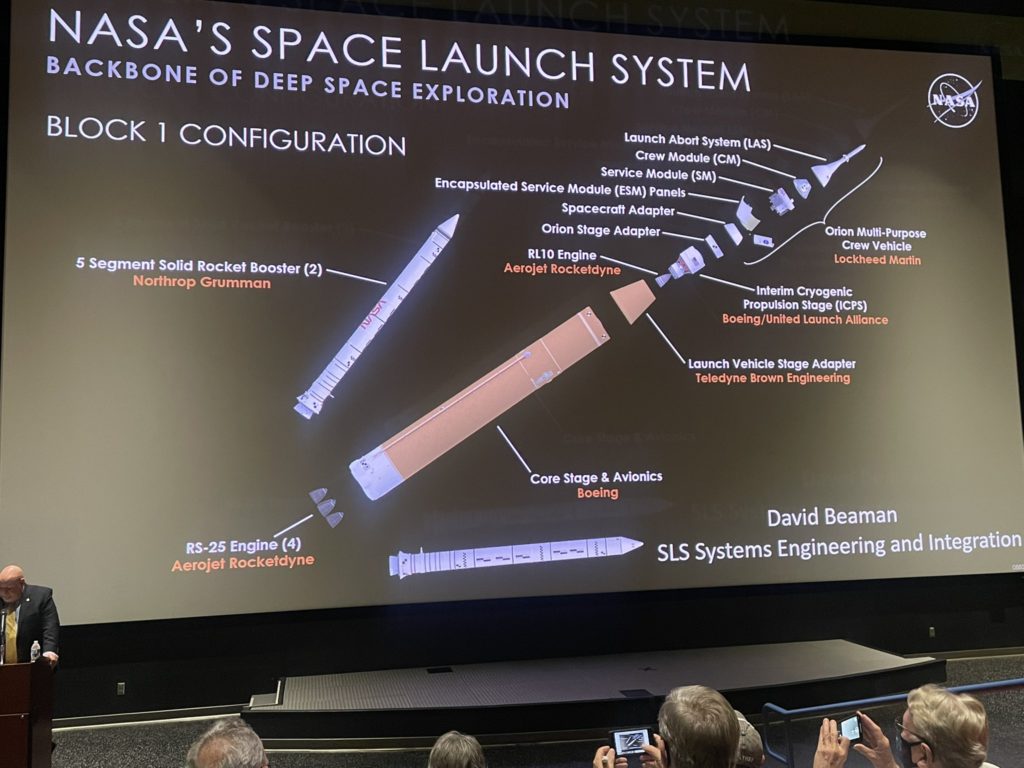
Aerospace industry giants such as Aerojet Rocketdyne, Boeing, Teledyne Brown, United Launch Alliance (ULA), Lockheed Martin and Northrop Grumman, all of whom conduct critical space-related operations in Huntsville, have played critical roles in ensuring the successful construction of the rocket.
Kimberly Johnson, CEO and executive director of the U.S. Space & Rocket Center touted the role Huntsville plays in leading the Artemis generation in 21st century space exploration.
“We’re going back to the moon to establish a long-term presence and to ultimately to understand what it takes to live off planet and to make our first great leap to Mars,” said Johnson. “It all begins right here in the Rocket City. As during Apollo, the Rocket City is leading the way in powering America’s return to the moon. The most powerful rocket ever developed, the Space Launch System will soon take its place alongside the iconic Saturn V, that has been such a symbol for our community, the Space & Rocket Center, and for the grand achievements of the American space program.”
Alongside the historic launch returning the United States to the moon and blazing a new trail of modern space exploration, it will see the first woman and person of color step foot on the lunar surface.
Dylan Smith is a staff writer for Yellowhammer News. You can follow him on Twitter @DylanSmithAL
The Space Launch System (SLS) core stage on Thursday arrived at NASA’s Kennedy Space Center in preparation for launch of the Artemis I mission, the first moon mission in nearly 50 years.
SLS is the world’s most powerful ever rocket that will power America’s next-generation moon missions and subsequent crewed missions to Mars. Alabama’s aerospace industry has led the effort to build the SLS, which stands 212 feet high and 27.6 feet in diameter.
Boeing is the core stage lead contractor, with the company’s Huntsville-based Space and Launch division managing its SLS work — which is the backbone NASA’s deep space exploration missions.
The SLS core stage has now been unloaded from a barge and moved to the Vehicle Assembly Building. This is the first lunar rocket to arrive at the facility since the Apollo program. (more…)
Boeing on Wednesday began delivery of the Space Launch System (SLS) core stage to NASA’s Kennedy Space Center in preparation for launch of the Artemis I mission, the first moon mission in nearly 50 years.
Boeing refurbished the stage after it successfully completed hot fire testing last month at Stennis Space Center, closing out the Green Run campaign on the B-2 test stand in impressive fashion. The flight hardware will now travel to Kennedy Space Center in Florida for integration with the Orion crew spacecraft, upper stage and solid rocket boosters in preparation for launch.
SLS is the world’s most powerful ever rocket that will power America’s next-generation moon missions and subsequent crewed missions to Mars. Alabama’s aerospace industry has led the effort to build the SLS, which stands 212 feet high and 27.6 feet in diameter. (more…)
NASA on Thursday successfully conducted a full hot fire of the core stage for the agency’s Space Launch System (SLS) rocket that is scheduled to launch the Artemis I mission to the moon, hopefully later this year.
The hot fire was the final test of the eight-part, 12-month Green Run series, conducted at Mississippi’s Stennis Space Center. This was the second hot fire attempt; the first go-around, which showed that the “core stage and the RS-25 engines performed perfectly,” ended prematurely out of an over-abundance of caution in testing parameters.
SLS is the world’s most powerful ever rocket that will power America’s next-generation moon missions and subsequent crewed missions to Mars. Alabama’s aerospace industry has led the effort to build the SLS, which stands 212 feet high and 27.6 feet in diameter.
Boeing is the core stage lead contractor, and Aerojet Rocketdyne is the RS-25 engines lead contractor. The SLS program is managed out of NASA’s Marshall Space Flight Center in Huntsville, while Boeing’s Huntsville-based Space and Launch division manages the company’s SLS work. (more…)
In a conference call with members of the press on Tuesday, NASA officials and private sector partners gave an update on this past Saturday’s hot fire of the core stage for the agency’s Space Launch System (SLS) rocket that is scheduled to launch the Artemis I mission to the moon later this year.
The hot fire was intended to be the final test of the eight-part, 12-month Green Run series, conducted at Mississippi’s Stennis Space Center.
SLS is the world’s most powerful ever rocket that will power America’s next-generation moon missions and subsequent crewed missions to Mars. Alabama’s aerospace industry has led the effort to build the SLS, which stands 212 feet high and 27.6 feet in diameter.
Boeing is the core stage lead contractor, and Aerojet Rocketdyne is the RS-25 engines lead contractor. The SLS program is managed out of NASA’s Marshall Space Flight Center in Huntsville, while Boeing’s Huntsville-based Space and Launch division manages the company’s SLS work. (more…)
NASA on Saturday conducted a hot fire of the core stage for the agency’s Space Launch System (SLS) rocket that is scheduled to launch the Artemis I mission to the moon later this year.
The hot fire was the final test of the eight-part, 12-month Green Run series, conducted at Mississippi’s Stennis Space Center.
SLS is the world’s most powerful ever rocket that will power America’s next-generation moon missions and subsequent crewed missions to Mars. Alabama’s aerospace industry has led the effort to build the SLS, which stands 212 feet high and 27.6 feet in diameter.
Boeing is the core stage lead contractor, and Aerojet Rocketdyne is the RS-25 engines lead contractor. The SLS program is managed out of NASA’s Marshall Space Flight Center in Huntsville, while Boeing’s Huntsville-based Space and Launch division manages the company’s SLS work. (more…)
NASA on Wednesday is targeting the final test in its Green Run series, the hot fire, for as early as January 17.
The hot fire is the culmination of the intensive, comprehensive Green Run test series, an eight-part campaign that gradually brings the core stage of the Space Launch System (SLS) — the world’s most powerful ever rocket that will power America’s next-generation human moon missions and subsequent crewed missions to Mars — to life for the first time.
Alabama’s aerospace industry has led the effort to build the SLS, which stands 212 feet high and 27.6 feet in diameter.
Boeing is the core stage lead contractor, and Aerojet Rocketdyne is the RS-25 engines lead contractor. The SLS program is managed out of NASA’s Marshall Space Flight Center in Huntsville, while Boeing’s Huntsville-based Space and Launch division manages the company’s SLS work. (more…)
Huntsville-based Teledyne Brown Engineering, Inc. (TBE), a division of Teledyne Technologies Incorporated, announced it has been awarded an $85 million contract modification to supply NASA two additional Launch Vehicle Stage Adapters (LVSA) for the historic Artemis II and III lunar missions.
The LVSAs are the largest pieces of the current configuration of the Space Launch System (SLS) to be built at Alabama’s Marshall Space Flight Center, which is playing a leading role in the Artemis program.
SLS is the most powerful rocket in world history scheduled to power Americans back to the moon in 2024 through the Artemis program.
Artemis II is the first scheduled crewed mission of NASA’s Orion spacecraft, currently planned to be launched in August 2023. The current plan is for a crewed Orion to perform a lunar flyby test and return to Earth. Scheduled for launch in October 2024, Artemis III is planned to be the second crewed mission of the program and the first crewed lunar landing since Apollo 17 in 1972. This mission will also include landing the first woman ever on the lunar surface. (more…)
NASA and Boeing are in the final days of testing on the core stage of Space Launch System (SLS), the rocket which will carry humans back to the Moon and beyond.
The entire SLS program is being managed from NASA’s Marshall Space Flight Center in Huntsville.
John Honeycutt, SLS program manager for NASA, confirmed the project’s progress during a conference call on Tuesday.
“Despite having to deal with the pandemic, SLS has made significant progress in 2020 on all the rockets that we need for the first three Artemis missions to send astronauts to the Moon,” detailed Honeycutt.
NASA’s Artemis program has three missions planned for lunar exploration, the first of which is set to launch late next year.
(more…)
Earlier this week, NASA and Northrop Grumman fired up a Space Launch System (SLS) support booster, producing more than 3 million pounds of thrust.
The full-scale booster test in the Utah desert lasted a little over two minutes and provided valuable insight into the performance of boosters which will power future Artemis missions, a series of flights to the moon and beyond powered by SLS.
The SLS program, which will result in the most powerful rocket ever built, is managed out of Marshall Space Flight Center in Huntsville.
(more…)
Governor Kay Ivey has proclaimed Friday, July 17, as Artemis Day in the state of Alabama, honoring the Yellowhammer State’s incredible contributions to the historic space program that will return Americans to the surface of the moon and eventually take the first humans to Mars.
An official proclamation signed by Ivey earlier this week highlighted Huntsville’s famed contributions to space flight and exploration since last century.
The Rocket City’s signature work is continuing on the Space Launch System (SLS), which is the most powerful rocket in world history scheduled to power Americans back to the moon in 2024 through the Artemis program; the mission will include landing the first woman ever on the lunar surface. (more…)
A major milestone was completed this week in Huntsville as NASA and Boeing continue preparations for the historic Artemis program.
Boeing and NASA engineers at Marshall Space Flight Center on Wednesday completed the structural test campaign for the Space Launch System (SLS), which is the most powerful rocket in world history scheduled to power Americans back to the Moon in 2024; the mission will include landing the first woman ever on the lunar surface.
SLS is part of NASA’s new backbone for deep space exploration, along with the Orion spacecraft and the Gateway in orbit around the Moon. Indeed, it is the only rocket that can send Orion, astronauts and supplies to the Moon in a single mission.
Alabama’s aerospace industry has led the effort to build the SLS, which stands 212 feet high and 27.6 feet in diameter. (more…)
Huntsville-based Dynetics has finished a critical hardware component for NASA’s Space Launch System (SLS).
As part of its effort to build the Universal Stage Adapter (USA) for SLS, the Dynetics/RUAG Space USA team recently completed the USA composite panel Manufacturing Test Demonstrator (MTD), according to a release from Dynetics.
The MTD is a full size USA panel, representing one of four panels that comprise a complete USA. The company noted that the demonstration panel is a significant step toward building the USA flight hardware at the Dynetics and RUAG facilities in Decatur.
“Our team has worked with the RUAG team to complete this MTD panel that will be used to validate manufacturing, handling and testing aspects of the design before steaming ahead to manufacture the flight hardware,” said Robert Wright, Dynetics’ USA project manager. “This panel is a result of our teams working closely with NASA to reach a high fidelity design baseline well ahead of the USA Critical Design Review, allowing us to purchase the long-lead bonding mold required to make full scale USA composite panels.”
(more…)
Launch of Space Launch System (SLS) got a little closer last week when Boeing and NASA announced the completion of a necessary avionics review.
The review enables testing on the first SLS core stage to continue when NASA reopens Stennis Space Center.
The key testing phase for SLS, known as “Green Run,” is series of tests that will examine many of the rocket’s systems together for the first time in preparation for launch, a sequence one of the Boeing team leaders compares to a symphony.
“The propulsion systems make up the orchestra, while avionics is the conductor, the stage controller command-and-control system is the conductor’s baton, and the music is the roaring engines of a perfect hot-fire test,” explained Boeing SLS Avionics Director Kevin Fogarty.
(more…)
NASA released a video this week providing behind-the-scenes footage of the final phase of testing and development of Space Launch System (SLS) and Orion.
Alabama’s aerospace industry has led the effort to build SLS, set to become the most powerful rocket ever built.
The SLS program is managed out of Marshall Space Flight Center. Developed by Boeing in Huntsville, and powered by four Aerojet Rocketdyne RS-25 engines, SLS stands 212 feet high and 27.6 feet in diameter.
SLS will power the Orion spacecraft into deep space for missions to the Moon. Built by Lockheed-Martin, Orion will carry up to four astronauts.
Watch:
(more…)
Production and testing on NASA’s Space Launch System (SLS) may be suspended, but progress continues virtually on the most powerful rocket ever built.
While NASA suspended operations at Stennis Space Center in Mississippi and Michoud Assembly Facility in Louisiana in response to the ongoing coronavirus (COVID-19) pandemic, remote work is still underway on the Boeing-built SLS core stage.
Many members of Boeing’s Stennis and Michoud teams are able to telework and continue to make progress on program documentation and design tasks, as well as process improvements for current and future activities, according to a release from the company.
Meanwhile, a Huntsville, Alabama-based Boeing team continues to design a bigger SLS variant with a more powerful Exploration Upper Stage that will be used to carry super-heavy cargo on missions to the moon and deep space. (more…)
NASA this week announced that the Orion spacecraft for the Artemis I mission achieved yet another step toward being ready for flight.
After four months of rigorous testing in the world’s premier space environments simulation facility at NASA’s Plum Brook Station, the spacecraft is now officially certified.
The test campaign, which was actually completed ahead of schedule in mid-March, subjected the spacecraft to the extreme temperatures and electromagnetic conditions it will endure during its uncrewed test flight around the moon and back to ensure the spacecraft will perform as designed. (more…)