On Tuesday, the Alabama House of Representatives overwhelmingly passed HB181, a measure aimed at limiting the disposal of dredged material in Mobile Bay while maintaining dredging operations critical to the Port of Mobile and Alabama’s coastal economy.
The bill, sponsored by State Rep. Rhett Marques (R-Enterprise), will restrict the practice of thin-layer dredge disposal, commonly referred to as “mud dumping,” while allowing continued dredging to keep the shipping channel navigable.
Then on Wednesday morning, the bill also cleared the Alabama Senate County and Municipal Government committee. Upstairs in the Alabama Senate, where it is expected receive a similar reception, State Sen. Chris Elliott (R-Josephine) is carrying the bill.
Environmental advocates have long argued that mud dumping harms the bay’s ecosystems, while lawmakers sponsoring the bill say it balances environmental protection with economic priorities.
In a statement following House passage, Marques said the legislation demonstrates Alabama can address environmental concerns without undermining commerce.
“Today’s unanimous vote proves we can stop irresponsible mud dumping in Mobile Bay while protecting our strong Alabama economy,” Marques said. “I am proud to sponsor this legislation and pass it through the Alabama House of Representatives.”
Environmental groups also welcomed the bill’s passage, citing concerns about damage to coastal habitats and fisheries.
“HB 181 just passed the House,” Mobile Baykeeper said in a social media post. “This is a major win for Mobile Bay and a real step toward ending mud dumping once and for all.” The group said dredged material disposal has “smothered oyster reefs and seagrass, damaging the very habitat our fisheries and coastal communities depend on.”
HB181 establishes new requirements for how dredged material from coastal waterways is handled, particularly in Mobile Bay.
Under the legislation, dredging would continue, but at least 70% of dredged material must be used for “beneficial use,” such as marsh creation, shoreline protection, habitat restoration, or industrial and commercial applications. Material deposited directly into public waters would not qualify as beneficial use unless tied to specific restoration projects.
Supporters say the measure closes a loophole in federal law that allowed dredged material to be classified as beneficial use even when disposed of in the bay.
Rep. Marques previously said he is committed to ensuring Alabama leads on coastal stewardship.
“I’m committed to protecting Mobile Bay and making sure Alabama leads on coastal stewardship,” Marques said. “This legislation reflects conservative principles: protect what drives our economy, use taxpayer dollars wisely, and follow the science on what works.”
State Sen. Chris Elliott (R-Josephine), who has partnered with Marques on the legislation, said the bill is intended to bring environmental and business interests together.
“Mobile Bay is one of Alabama’s greatest economic assets, and protecting it strengthens, not weakens, our business climate,” Elliott said. “These bills will ensure we maintain a navigable ship channel while adopting proven dredge-management practices that benefit our coast instead of harming it.”
Then on Wednesday morning, HB181 also cleared the Alabama Senate County and Municipal Government committee. It can be voted on and passed by the Alabama Senate as soon as Thursday.
State Sen. Elliot made a Facebook post on Wednesday about signing HB 181 out of committee saying, “Seeing this bill passed has been one of my top legislative priorities this session,” said Sen. Elliot. “Representative Rhett Marques has done a fantastic job shepherding this legislation through the House. We’ll get it across the line in the Senate.”
Supporters say the measure would place Alabama among several coastal states that have adopted policies regulating dredged material disposal, including Florida, Georgia, Louisiana, North Carolina, and Virginia.
Sherri Blevins is a staff writer for Yellowhammer News. You may contact her at sherri@yellowhammernews.com.
State and federal officials officially opened a new era for Alabama commerce on Monday. The ceremony opening the new 50-foot ship channel in the Port of Mobile happened to be held on Columbus Day, when shipping first began in the Americas.
The officials there had all played parts in the deepening of the Port of Mobile to 50 feet, enabling it for the first time to handle the largest container ships. The facility wasted no time in putting the $366 million channel to commercial use. On Friday, the first vessel with a 48.5-foot draft traversed the new channel.
Now, the Port of Mobile is the deepest channel on the Gulf of America.
One retired official there was recognized by all as the father of the port deepening – former longtime Alabama U.S. Senator Richard Shelby. The Republican from Tuscaloosa served as Alabama’s U.S. Senator from 1987 to 2023.
The ceremony was at APM Terminal’s pier. That location was about as close as the ceremony could be to the channel, as it is all underwater ending in the nearby Mobile River. The channel provides access for ships to Mobile Bay and into the Gulf of America and from there to the world.
Shelby was essentially the keynote speaker of the ceremony. He told the audience that he first envisioned the deepening of Alabama’s port when on a senatorial trip to Singapore about 20 years ago. Officials there pointed out to Shelby that their decision to deepen their port to 50 feet would “prevent their port from becoming irrelevant.”
He took that idea to Alabama’s port director, Jimmy Lyons, who pointed out the huge cost. That obstacle did not deter Shelby in the least.
Shelby had made the deepening of the port his top priority, according to his successor as U.S. Senator, Katie Britt (R-Montgomery).
Speakers credited Shelby with envisioning the project and obtaining the funds.
Alabama’s top elected officials were present:
U.S. Senator Tommy Tuberville
“This project to deepen the ship channel is a massive win for the state of Alabama, and we are proud to have the deepest container port in the Gulf of America. With a 50-foot channel, larger vessels carrying more cargo can call Mobile—growing the Port’s economic impact across our state and our country.”
U.S. Senator Katie Britt
“Today is a momentous occasion for Mobile, for Alabama, and for our nation. For many years and in several capacities, I have been honored to support the Port of Mobile’s success and help grow our vital state-federal partnership. I have also been a consistent advocate for balancing both the Port’s role as a vital channel for commerce in our state and the need to conserve our natural resources and protect Alabama the Beautiful through beneficial use dredging. The Port serves all 67 counties—connecting Alabama to the nation and the world—and now stands as the deepest container port in the Gulf of America. Together, we are growing good-paying jobs, opening new channels for commerce, and ensuring that ‘Made in Alabama’ goods can reach markets across the globe.”
Former U.S. Senator Richard Shelby
“Driving growth at Alabama’s Port has always been key to Alabama’s economic future. When I visited the Port of Singapore years ago, I saw how a relatively small geographic area leveraged its port system to drive incredible economic success, and I knew then that Alabama had the very same potential. The results so far are evidence of more success to come. From getting the authorization for the channel project to securing $438 million for the Port before I left office, this project has been years in the making, and I could not be prouder to see it completed for the people and the future of Alabama.”
U.S. Rep. Barry Moore
“This is a proud day for Alabama and a historic milestone for the Gulf Coast. The completion of the Mobile Harbor Modernization Project is the result of years of hard work, vision, and investment in our state’s future. By achieving a 50-foot channel depth, the Port of Mobile is now the deepest container terminal in the Gulf of America. That’s not just a statistic – it’s a game-changer for trade, commerce, and jobs right here in Alabama. With this expansion, larger vessels can now come directly into Mobile, boosting the Port’s competitiveness on the global stage and opening new opportunities for our farmers, manufacturers, and small businesses.”
U.S. Rep. Dale Strong
“From the Gulf Coast to the Tennessee Valley, we are one team, one economy, and one great state. This investment in the Port of Mobile strengthens Alabama’s position on the global stage— ensuring that whether it’s defense, manufacturing, or logistics, the world continues to do business with and through Alabama.”
U.S. Rep. Shomari Figures
“This project is a major win for Mobile and the entire state of Alabama. With the Port of Mobile now the deepest in the Gulf, we are creating more jobs, investments, and opportunities for communities across the Gulf Coast. I am proud to support infrastructure that delivers for people and moves Alabama forward.”
Mobile Mayor Sandy Stimpson
“This is a transformational milestone for the City of Mobile and the entire state of Alabama. The Port is essential to our local economy — it’s the foundation of what makes Mobile an unrivaled logistics hub, and it supports industries far beyond the waterfront. I want to commend the leadership of the Alabama Port Authority, Gov. Kay Ivey, former Senator Richard Shelby, and everyone else who bought into the vision of what the Port of Mobile could become. We’re already seeing the results today, and the best is still ahead of us.”
The theme of the ceremony was the continued growth of the port for the benefit of all of Alabama.
Could we soon see a renaming of “Port of Mobile” to “Port of Alabama?”
Jim Zig Zeigler is a contributing writer for Yellowhammer News. His beat includes the positive and colorful about Alabama – her people, events, groups and prominent deaths. He is a former State Auditor and Public Service Commissioner. You can reach him at ZeiglerElderCare@yahoo.com.
7. There was a good portion of Charlie Kirk news on the founder of Turning Point USA’s birthday as President Donald Trump posthumously awarded the Presidential Medal of Freedom, a memorial mural honoring the late conservative activist went up in Hanceville, and the State Department announced visa revocations for foreigners celebrating Kirk’s assassination.
6. A leaked private chat among Young Republicans revealed a treasure trove of racist, anti-semitic, and generally stupid comments that the media will insist represent the private feelings of every conservative-leaning in the country. Meanwhile network silence from ABC, CBS, and NBC on Virginia Democratic AG candidate Jay Jones’ violent text scandal has drawn criticism for media bias.
5. U.S. Rep. Jim Jordan (R-Ohio) endorsed U.S. Rep. Barry Moore (R-Enterprise) for Alabama’s open U.S. Senate seat, praising his conservative record and leadership on issues like border security and election integrity.
4. Alabama leaders celebrated the completion of a six-year, $350 million project by the U.S. Army Corps of Engineers to enlarge the Mobile Ship Channel, making it deeper and wider, and making the Port of Mobile the deepest container port on the Gulf of Mexico, which will have statewide economic benefits.
3. The Israel-Hamas ceasefire, brokered by President Donald Trump, entered its fifth day with all 20 living hostages released and four hostages’ remains returned; but issues with the return of the remains of hostages, Israel dialing back more aid, and Hamas killing Palestinians remain.
2. Chicago Mayor Brandon Johnson and the Los Angeles County Board of Supervisors have separately declared emergencies over anticipated ICE raids under President Trump’s mass deportation policy, with Johnson ordering city departments to limit cooperation with federal agents and LA County approving $2.5 million for legal aid and shelter to illegal immigrants.
1. Republicans are blaming the ongoing government shutdown, now in its 14th day, on the nationwide “No Kings” protests scheduled for Saturday, with events in 12 Alabama cities, including Huntsville, Montgomery, Birmingham, and Mobile, organized by groups like Indivisible to oppose President Donald Trump’s policies.
Dale Jackson is a thought leader for Yellowhammer News and hosts a talk show from 5-9 a.m. weekdays on WVNN.
Union Pacific and Norfolk Southern have unveiled a definitive merger agreement to create America’s first transcontinental railroad.
The two freight rail giants will combine coast‑to‑coast operations into a unified 50,000‑mile network spanning 43 states. The new system will connect approximately 100 ports, access 10 international interchanges, and serve nearly every corner of North America.
Combined, the railroads bring over 360 years of operating history, with NS’s origins dating to 1827, making it 35 years older than Union Pacific.
Union Pacific CEO Jim Vena will lead the consolidated railroad.
“Railroads have been an integral part of building America since the Industrial Revolution, and this transaction is the next step in advancing the industry,” Vena said.
“Imagine seamlessly hauling steel from Pittsburgh, Pennsylvania to Colton, California and moving tomato paste from Huron, California to Fremont, Ohio. Lumber from the Pacific Northwest, plastics from the Gulf Coast, copper from Arizona and Utah, and soda ash from Wyoming,” he said.
“Right now, tens of thousands of railroaders are moving almost everything we use. You name it, and at some point, the railroad hauled it.”
According to a 2024 report, Norfolk Southern operates 1,300 miles of track in Alabama, serves 565 customers and has over 1,500 employees.
RELATED: Norfolk Southern investing $200 million in Alabama rail infrastructure
NS has also long been a major economic player in Alabama.
Particularly through its investments in the 3B Corridor, which connects northern and central Alabama to the Port of Mobile. In 2024, NS committed over $200 million to upgrade 21 miles of track, terminal infrastructure, and yards across the state in a project that has already begun to deliver benefits.
Norfolk Southern has also invested $8.7 million toward the NEAR Megasite with additional help from the state through the Growing Alabama incentive.
That investment supported construction of a 70-acre rail-served, pad-ready industrial site, installation of a crossing, relocation of utilities, and a 500,000-gallon water tank, helping the region attract major industrial projects
RELATED: Norfolk Southern invests $8.7M in Etowah County megasite
All told, both rail carriers report they invest a combined total of approximately $5.6 billion annually in infrastructure, innovation, and network expansion.
“Norfolk Southern, like Union Pacific, is a railroad integral to the U.S. economy, with a storied 200-year legacy of serving customers across 22 states in the eastern half of the nation,” Mark George, CEO of Norfolk Southern said.
“Our safety, network, and financial performance is among the best we’ve had as a company, as is our customer satisfaction. And it is from this position of strength that we embark on this transformational combination. We are confident that the power of Norfolk Southern’s franchise, diversified solutions, high-quality customers and partners, as well as skilled employees, will contribute meaningfully to America’s first transcontinental railroad, and to igniting rail’s ability to deliver for the whole American economy today and into the future.
“Union Pacific is a true partner that shares our belief in rail’s ability to deliver for all stakeholders simultaneously, and we are excited for our future together,” George added.
The deal must clear the Surface Transportation Board (STB). The board currently holds a split political makeup and is expected to add a fifth member before the application is reviewed. The review period may extend up to 15 months, with a target closing by early 2027.
Union Pacific CEO Jim Vena described the merger as a transformational win for customers, workers and the American economy.
“It builds on President Abraham Lincoln’s vision of a transcontinental railroad from nearly 165 years ago and advances our Safety, Service and Operational Excellence Strategy,” Vena said.
Grayson Everett is the editor and chief of Yellowhammer News. You can follow him on X @Grayson270
Alabama State Sen. Greg Albritton made his case for bringing the nuclear industry to south Alabama during an address to the Mobile County Municipal Association’s Nov. 21 meeting at Steele Creek Lodge.
Albritton (R-Atmore) voiced opposition to the Mobile Chamber of Commerce’s fight against bringing the U.S.S. Enterprise, a nuclear-powered aircraft carrier, to Mobile for dismantling.
“The Chamber does not want this and that concerns me,” said Albritton, who served in the U.S Navy. “If Mobile chooses to ignore this power, we are giving up an opportunity to bring this new industry into our area. I feel strongly this is an opportunity Mobile may be closing its doors on.”
“Why not bring that ship here and get that process? It would add to our economic, educational and industrial base. If Mobile chooses to ignore this power, we are giving up an opportunity to bring up that new industry in our area.”
RELATED: Mobile Chamber opposes potential dismantling of USS Enterprise at port
Earlier this month, the Mobile Chamber voiced its opposition to the nuclear ship’s disassembly proposal, citing safety concerns and its fear of creating a negative public perception issue.
Albritton addressed the stigma often associated with nuclear power, saying, “I think we get scared from watching 1950 science fiction movies.” He also said no U.S. Navy ship has ever experienced a nuclear accident or disaster.
“Yes, accidents happen, but good procedures and training prevents those accidents and training and procedures are what we do well,” he said. “We need to bring this new industry to Mobile.”
Albritton also raised concerns about south Alabama’s representation in state government.
“We have a major problem in south Alabama,” he said. “We do not have the population base or votes in south Alabama. The speaker of the house is from Huntsville, the lieutenant governor is from Huntsville, the senate pro tempore is from Jasper. In south Alabama, we must be united, determined and have our own agenda.
The MCMA’s new officers for 2025 were sworn in at the meeting. They are Chickasaw’s Jennifer White (president), Saraland’s Dr. Veronica Hudson (vice president), Creola’s James Brown (secretary) and Saraland’s Newton Cromer (chaplain).
Courtesy of Call News.
A proposal to dismantle the world’s first nuclear-powered aircraft at the Port of Mobile has drawn opposition from the Mobile Chamber.
The opposition is in response to an announcement last week that NorthStar Maritime Dismantlement Services and Modern American Recycling and Radiological Services announced they have formed a team to pursue dismantlement of decommissioned Navy nuclear aircraft carriers at the Port of Mobile. NorthStar Maritime is a subsidiary of NorthStar Group Services; MARRS is a subsidiary of Modern American Recycling Services
According to a news release from the NorthStar Group, the NorthStar/MARS team will initially compete to win the Navy contract for dismantling the historic USS Enterprise, the world’s first nuclear-powered aircraft carrier. The ship served the Navy for more than 55 years before its decommissioning in 2017.
However, the Mobile Chamber said the proposed project would threaten the budding growth along the city’s waterfront and downtown.
“Downtown Mobile is experiencing significant growth, attracting new businesses, tourism and a thriving arts and entertainment scene, all of which contribute to our local economy and quality of life,” the chamber said in a statement Monday. “In just the next 12 months, we’ll see the start of construction of the new Civic Center and the new I-10 River Bridge and Bayway, the completion of Heroes Plaza, and the groundbreaking of the new River Walk Hotel. These projects will transform downtown for generations to come.
“Bringing a large-scale nuclear dismantlement operation to our downtown waterfront, risks undermining these efforts and creating a public perception issue, which could harm our city’s reputation as a vibrant, growing community.”
NorthStar is a New York-based company with large-scale facility decommissioning and demolition operations. Recent projects include decommissioning the Vermont Yankee and Crystal River Unit 3 nuclear power plants, large refineries, and complex urban facilities including skyscrapers.
MARS, a 53-year-old ship recycling and decommissioning company based in Louisiana, owns and operates five facilities on the Gulf Coast, including Mobile, and in Europe.
“Working with MARS, the most experienced maritime recycler in the U.S., competitively positions NorthStar for the opportunity to dismantle the ex-Enterprise,” said CEO Scott E. State. “We look forward to applying our well-honed commercial industry practices to this first-of-a-kind project and look forward to a long relationship with MARS and the Mobile community.”
Among the project highlights are:
- Environmental Responsibility: The NorthStar/MARS team is committed to the highest standards of safety and environmental protection throughout the dismantling process. The nuclear fuel was already removed from the reactors and sent to storage in 2017. All removal of other radioactive and hazardous materials will be conducted in fully-enclosed areas to eliminate any possible contact with the public or the environment. Comprehensive safety protocols and advanced recycling techniques will be employed for the responsible management and off-site disposal of all materials.
- Community Engagement: The NorthStar/MARS team will work closely with local authorities and community stakeholders to ensure transparency and address any concerns throughout the project.
- Economic Impact: The project will create jobs in the Mobile area, boosting the local economy and providing valuable opportunities for skilled workers. The presence of the Enterprise on the waterfront in the Port of Mobile is also likely to create a unique opportunity for folks to visit Mobile wanting to see this noteworthy ship one last time.
“MARS is excited to partner with NorthStar on this historic endeavor,” said Dwight “Butch” Caton Sr., CEO and President of MARS. “Together, we will ensure that the legacy of the ex-Enterprise is honored through a safe, efficient, and environmentally responsible dismantling process.”
However, the Chamber said the operation is “incompatible with our vision for a dynamic and sustainable downtown.
“The Mobile Chamber remains committed to supporting growth initiatives that align with our strategic objectives for economic development, environmental health and a vibrant downtown.”
The International Longshoremen’s Association (ILA) went on strike at midnight last night, halting operations at ports along the East and Gulf Coasts from Maine to Texas. The Alabama Port Authority, which oversees the Port of Mobile, is one of the many impacted.
The strike is the first major labor action by the ILA since 1977. The union’s opening offer is a 77% pay raise to make up for inflation, the Associated Press reports.
“The ILA is fighting for respect, appreciation, and fairness in a world in which corporations are dead set on replacing hardworking people with automation,” Mobile ILA President Mark Bass told WKRG 5.
With approximately 900 ILA members at the Port of Mobile, the strike’s impact is being felt close to home as operations come to a standstill — and the repercussions could be severe.
In Alabama alone, the daily cost of containers idling due to the strike is estimated at $10 million. Nationwide, these costs reach $500 million per day. Each day a ship sits at anchor costs between $80,000 and $120,000. The ultimate burden of these costs will likely fall on consumers, Axios reports.
More than half of the nation’s containerized cargo — 56% — moves through East and Gulf Coast ports. West Coast ports will be unable to absorb the sudden surge and disruptions could cause supply chain backups until mid-November if the strike lasts just one week.
A two-week strike could take until 2025 for normal operations to resume.
Grayson Everett is the state and political editor for Yellowhammer News. You can follow him on X @Grayson270
According to the Mobile Chamber and the company, Austal USA has been awarded a $450 million contract by General Dynamics Electric Boat to expand production capacity at its shipyard in Mobile shipyard in support of the U.S. Navy Submarine Industrial Base (SIB).
The contract will enable Austal to expand and enhance its existing infrastructure by designing, constructing and outfitting a new module fabrication and outfitting facility at its Mobile shipyard to support the U.S. Navy goal of delivering one Columbia-class and two Virginia-class submarines annually.
Construction will move fast, beginning this autumn, with an expected completion date in 2026. When fully operational, the building will support approximately 1,000 jobs and provide capability to fabricate, outfit, and transport submarine components.
“Austal USA’s $450 million contract to expand submarine module production is a game-changer for the Mobile region,” Mobile Chamber President and CEO Bradley Byrne said.
“This significant investment not only strengthens our local economy but also highlights the critical role Mobile plays in supporting U.S. naval defense. The expansion will create nearly 1,000 jobs, further cementing Mobile as a hub for innovation and industry. We are excited to see this project take shape and remain committed to supporting Austal USA’s continued growth and success.”
RELATED: Forbes: Alabama’s Port of Mobile is second fastest-growing in U.S.
Austal Limited Chief Executive Officer Paddy Gregg noted this contract award is a testament to the growing partnership with General Dynamic Electric Boat and demonstrates its confidence in Austal USA as a valuable industry partner for these two important U.S. Navy submarine programs.
“General Dynamics Electric Boat has recognised that Austal USA is a solid partner to deliver high-quality components for Virginia- and Columbia-class submarines. This growing partnership demonstrates confidence in Austal USA’s commitment to meet the needs of the U.S. maritime industrial base and support the most critical needs of the U.S. Navy,” Mr. Gregg said.
Just in recent months, Austal also announced plans to expand its Mobile shipyard with the construction of an additional waterfront assembly facility to support the growth of shipbuilding in Alabama’s Port City. The expansion project, fueled by a capital investment of more than $288 million, is set to create 1,032 new jobs over the next four years.
Grayson Everett is the state and political editor for Yellowhammer News. You can follow him on X @Grayson270
A groundbreaking event today in Baldwin County celebrated phase one of a 900-acre industrial development project that will eventually provide 12 million square feet of Class A industrial space to become the largest and closest site to the Port of Mobile. Elected officials and local business leaders shared the excitement today in Loxley as ground was broken on the Port Alabama Industrial Center.
According to Baldwin County economic development leaders, the site’s proximity to I-10 makes it an ideal location for industrial, light manufacturing, data, and distribution users, just twenty minutes from the Port of Mobile, Mobile International Airport, and I-65. Port Alabama Industrial Center is located within Loxley’s growing industrial corridor, which has added 350 new direct jobs and over $150 million of investment in the area within the last few years.
“The master plan for Port Alabama Industrial Center, which will initially offer abundant space to support significant new industry, is bringing the much-needed industrial product to our market,” said Baldwin County Economic Development Alliance President and Chief Executive Officer Lee Lawson.
“There has been increasing demand for Class A industrial space in our area for many years as Baldwin County continues to grow and as the Port of Mobile continues to expand. Having readily available sites like our site here is essential as we continue attracting businesses and economic projects to Baldwin County.”
RELATED: Belong in Baldwin: New campaign offers gold standard in economic development
Gulf Corporation, a Dallas-based real estate development firm, is developing the site. Austin Ames, CEO of the company, says they’re thrilled to bring the property to market.
“Gulf Corporation is excited to have the privilege to acquire such a special property in Baldwin County, a property that has not changed hands since the mid-1800s,” Ames said. “We believe our planned development activities will be the tip of the iceberg in the logistics and industrial capabilities of the entire Gulf Coast. The Port Alabama site is not only the premier industrial site of the Gulf Coast and Southeastern region, but one of the premier sites on the entire I-10 corridor from coast to coast.”
As the project moves forward, its one-of-a-kind advantages are expected to drive investment and provide a cutting edge for businesses across dynamic industries.
RELATED: Alabama solving manufacturing’s real estate problem
“With the migration shift to the southern region due to positive economic tailwinds as well as post covid ‘on-shoring,’ we are on the precipice of a major shift in how the nation and world view this region,” Ames said. “With the growth of the port in conjunction with the substantial growth of the area, Port Alabama Industrial Center is primed to become one of the nation’s major industrial centers.”

Local elected officials, including Baldwin County Commission Chair Billie Jo Underwood, say they’re looking forward to the caliber of business and industry the development will bring into the county — and ultimately — Alabama altogether.
“The close proximity to 1-10 and the centralized location in Baldwin County between Mobile and Pensacola will attract quality tenants that will provide good, high-paying jobs for the citizens of not only Baldwin County but of the entire Southwest region of Alabama,” Underwood said.
“These types of good, stable jobs will help increase the quality of life of the citizens of Baldwin County and help us continue to ensure a stable local and regional economy.”
Grayson Everett is the state and political editor for Yellowhammer News. You can follow him on X @Grayson270
Mobile Baykeeper, a coastal environmental group, praised U.S. Senator Katie Britt for her role in securing a $47 million federal appropriation for the U.S. Army Corps of Engineers to increase the use of dredged sediment from the Mobile Bay shipping channel for projects that benefit the coastal environments.
The Alabama Port Authority announced this week that the Corps is set to receive the additional funds thanks to Britt’s (R-Montgomery) efforts to advance key provisions through the Senate Appropriations Committee – including $47 million for operation and maintenance of the Mobile Ship Channel and a $400,000 study to analyze sediment flow.
The Corps is currently deepening the channel to 50 feet as part of a $366 million project expected to be completed early next year.
“Thank you to Senator Katie Boyd Britt and the Alabama Port Authority for advancing legislation to get the funding needed to stop federal mud dumping in Mobile Bay,” Mobile Baykeeper said on social media. “Now let’s get the Corps to agree to dispose of the dredge responsibly.”
The group has been vocal about the potential environmental impacts of the dredging project. In their message of appreciation for Sen. Britt’s effort, the Baykeeper reiterated hope that the additional funds would enable the Corps to manage dredged sediment the way they prefer.
Despite an ongoing legal challenge against the Corps over the project’s environmental impacts, the funding is a step toward the use of dredged material for “beneficial use” projects, such as wetlands restoration and oyster habitat restoration, which can help mitigate some of the environmental risks they view as being associated with the dredging.
U.S. Senator Katie Britt is working hard to make sure that the Port of Mobile is both a vital economic artery for the region and a place of protection for its natural resources.
Over the past year to achieve the goal, she has been working in conjunction with the Alabama Port Authority and the U.S. Army Corps of Engineers (USACE) to secure additional beneficial use opportunities to help to deepen and widen the Port of Mobile’s ship channel and also conduct ongoing ship channel maintenance.
To that end, Britt (R-Montgomery) has announced three major projects, satisfying both economic and conservatory interests. The projects include an additional $47 million for USACE operations and maintenance of the Mobile Ship Channel, funding for a federal study to analyze sediment flows to ensure that dredge material is used beneficially, and language in the 2024 Water Resources Development Act (WRDA) to ensure beneficial use of dredge material to protect Alabama’s natural resources.
RELATED: Alabama’s federal lawmakers connect infrastructure as key to economic growth at BCA conference
“Alabama has been blessed with incredible natural resources, and we need to make sure we are utilizing them to strengthen our state and our future,” said Britt. “Whether it’s sand to restore Dauphin Island or material for wetlands creation, it’s our responsibility to steward these resources and ensure their beneficial use at every opportunity. I’m proud to work with the Port of Mobile and U.S. Army Corps of Engineers to enact critical legislation and strategic investments to ensure that the Port’s vital work can continue to provide important conservation benefits while supporting economic growth and good-paying jobs across all 67 of Alabama’s counties.”
Alabama Port Authority Director and CEO John C. Driscoll thanked Britt for her continued efforts and noted the importance of the legislation.
“Senator Britt has always been a champion of the Port, and that work doesn’t stop in Mobile,” Driscoll said. “The growth of the Port statewide, and our inland intermodal facilities, in particular, are dependent on deeper water and keeping the Mobile Ship Channel open for business. We appreciate her leadership in ensuring that Port projects can move forward and benefit our entire state and its natural resources.”
The Port of Mobile has committed to using all eligible dredge material for beneficial use projects in and around Mobile Bay. Nationwide, the USACE is committed to placing 70% of usable material in beneficial projects by 2030.
Austen Shipley is a staff writer for Yellowhammer News. You can follow him on X @ShipleyAusten
Currently out for August recess, the majority of Alabama’s delegation to Washington joined state and business leaders for the Business Council of Alabama’s (BCA) annual Governmental Affairs Conference. Lawmakers offered updates and insight into a wide range of topics including the appropriations process, social media and the mental health of young Americans, creating wise regulations for name, image, and likeness (NIL) in college sports, as well as a central element to Alabama’s success in the 21st Century: Infrastructure.
In a panel moderated by Ted Hosp, Vice President of Governmental Relations for Blue Cross and Blue Shield of Alabama, lawmakers were asked to share their infrastructure priorities and how the state can collaborate more closely to achieve Alabama-driven goals.
U.S. Rep. Jerry Carl (R-Mobile) described the unique infrastructure needs of District 1 as it currently exists, particularly in Baldwin County, Alabama’s fastest growing county. He also emphasized that the enhancement of the Port of Mobile is vital to Alabama’s economy.
“We’ve got this little thing called the Bayway Bridge that we’ve had to focus on. We’re trying to improve the I-10, east and west. But then you get to Mobile, and you start looking at the port. The port is the bloodstream of Alabama — don’t ever forget that. And I told Governor Ivey, and I truly mean this. If she is remembered for nothing else in her legacy as governor, it will be for the infrastructure projects and road and bridge projects that she is supporting,” Rep. Carl said.
RELATED: Alabama officials celebrate securing $550 million for Mobile River Bridge and Bayway project
“We appreciate that. So, in Mobile, we’ve got a little bit of everything in District One—a little bit of everything. So we’re excited about what we’re seeing coming out of Washington through our appropriations projects that we’ve made some announcements on. But it’s a little bit of a different mix than probably the rest of the state.”
While much of the lawmakers’ discussion dealt with the crossroads between infrastructure and economic development, other officials also lauded the infrastructure gains in Mobile.
“You look at Mobile, Huntsville – that’s the bookends of Alabama. Mobile is ‘fixing to see something special happen, I’m telling you right now,” U.S. Rep. Dale Strong (R-Monrovia) said.
“You look at the dredging that we caught a lot of heck for, I’m telling you right now, you look at what’s going on with national security when we need to repair a ship or a submarine – we shouldn’t have to go to Virginia to do it, or to go to California – I believe Mobile, Alabama is where it ought to be done. And we’re all going to be fighting to make that happen,” Strong said to a room full of applause.
RELATED: Forbes: Alabama’s Port of Mobile is second fastest-growing in U.S.
U.S. Senator Katie Britt said it’s incredible that the widening of the Port should finish up by March-April, and should be commended for accomplishing the project on time and under budget.
“Our inland waterways is something that we also focus on,” Sen. Britt (R-Montgomery) said. “They use commerce. It’s part of national security. When we look at what happens in Demopolis, we’re not only looking at dredging, and what we need to be doing there, but we’re taking a look at our lock and dam system and saying, ‘How can we make sure that this doesn’t happen again? Where do we need to invest?’
“And so whether it’s Coffeeville or wherever we are, that’s also another infrastructure need, and that’s something that we value and we know our state does as well.”
U.S. Rep. Gary Palmer (R-Hoover) celebrated the long-awaited Northern Beltline project funded through the Appalachian Development Highway System. He said there is still $9.7 billion left to be appropriated out of the system and Alabama gets 30% of that.
“It’ll take about 20 years,” Rep. Palmer said. “I’ll be ninety years old, but I’m planning to drive on it.”
“One of the things that I’ve told people about how we need to be looking at infrastructure is that we need to be looking 25 years down the road. I say this a lot: Smart people learn from their mistakes, but great people learn from other people’s mistakes. We can develop our infrastructure in such a way that will allow us to have the economic growth we want without us becoming Atlanta or Nashville, where their traffic congestion has really diminished the quality of life in those cities. If we want to do things the right way, we can grow our economy and maintain our quality of life,” Palmer said.
U.S. Rep. Terri Sewell (D-Selma) said it takes a team effort. She said the Alabama delegation meets together once a month to collaborate on how to drive key state priorities forward.
“Let me just start by saying that infrastructure is the basic foundation for economic development and growth,” Rep. Sewell said. “I have to say that I was very pleased to vote in favor of the bipartisan infrastructure bill, which actually gave $1.4 trillion – it’s a once in a lifetime investment in our future – and the last time we spent that kind of money was Eisenhower in the development of the highway system.”
“But you know, for me, when you represent the black belt, as well as Birmingham, inner city and rural, I think that my priority has been water and sewer for the black belt. It’s been broadband for my whole district. It’s in roads and bridges. And you know when I think about the fact that over the next five years, the state of Alabama will get $5 billion from that bill for roads and bridges, million dollars our port, all of that is infrastructure. All that’s critical to the development and the growth in our area.”
U.S. Reps. Robert Aderholt and Barry Moore reflected the stewardship of infrastructure dollars rely on the state lawmakers and officials who decide where to ultimately appropriate them, particularly as it relates to one-time funding mechanisms such as COVID-19 relief funds. Long before the pandemic, Alabama lawmakers centralized a focus on equipping rural parts of the state with high-speed internet.
RELATED: $53.5 million awarded for ‘Middle-Mile’ broadband service across 24 Alabama counties
“Broadband is a new infrastructure, and getting broadband to our rural parts of the state of Alabama is crucially important,” Rep. Robert Aderholt (R-Haleyville) said. “I appreciate the work that State Legislature is doing, Speaker Ledbetter and Senator Reed, because leadership in the House and Senate, it takes a team effort.
“But really getting those federal dollars were important. Back when I chaired the House [Agriculture Committee] subcommittee on appropriations, we started the ReConnect program and putting federal dollars into this to help with rural broadband – that has been a tremendous shot in the arm.”
U.S. Rep. Barry Moore (R-Enterprise) said that a major vulnerability in day-to-day life for some Alabamians identified during the pandemic was, while many began working from home and students learned virtually, they needed access to high-speed internet.
“I congratulate Bill Poole and certainly the Governor, investing long term that money that gets poured into the states from Covid. A lot of states went into this temporary program, but we need to invest in long-term infrastructure. We can do broadband and sewer, water, highway, because down the road, that’s going to pay dividends for the state; that allows the U.S. economy to grow.”
Grayson Everett is the state and political editor of Yellowhammer News. You can follow him on X @Grayson270
Norfolk Southern announced it will invest over $200 million to expand capacity on a crucial rail line in Alabama, the 3B Corridor. The line connects markets in northern and central Alabama to the Port of Mobile and destinations worldwide. It serves critical industries such as agriculture, automotive, chemicals, forestry, and steel.
Expected to be completed in 2025, the project involves a mix of terminal and track-based infrastructure improvements, including capacity projects in central and southwest Alabama, customer-specific projects in north Alabama and locations north of Mobile, yard upgrades in Wilton, and a series of grade crossing improvements throughout the region.
Norfolk Southern is confident that the corridor will play a vital role in helping to solidify the Southeast as an “economic powerhouse.”
“Together with our customers, we are anticipating where markets are heading, and positioning to deliver on their supply chain needs now and into the future,” said Norfolk Southern President and CEO Alan H. Shaw. “These investments will bring immediate returns as they make rail an even more competitive part of our nation’s supply chain and expand our customers end-to-end solutions.”
RELATED: Norfolk Southern invests $8.7M in Etowah County megasite
With 1,300 miles of track operated, Norfolk Southern serves 565 customers in Alabama and has over 1,500 employees.

Secretary of the Alabama Department of Commerce Ellen McNair said Alabama’s pro-business environment is what drew Norfolk Southern to the state.
“We are grateful to Norfolk Southern for these investments in our state and for their support of our existing industries. This is proof that our open-for-business approach is attracting growth in our state among world-class businesses looking to locate or expand their operation.”
“We look forward to the positive impact these enhancements will have on Alabama’s economic competitiveness and on the nation’s supply chain more broadly.”
Austen Shipley is a staff writer for Yellowhammer News. You can follow him on X @ShipleyAusten
The Alabama Port Authority and a coalition of groups native to Coastal Alabama are demanding the Mobile Baykeeper and out-of-state environmentalist group, the Center for Biological Diversity, withdraw its intent to file a lawsuit against the U.S. Army Corps of Engineers, warning that the legal action threatens the state’s largest economic driver.
The lawsuit involves dredging activities for the Mobile Port expansion. It claims the Corps failed to protect the Gulf sturgeon and alleges that the disposal of 90 million cubic yards of dredge material into Mobile Bay will harm water clarity and marine life. Despite the Corps’ compliance, the Baykeeper is pursuing legal action to stall the project over claims of environmental impact.
The expansion, which has been meticulously planned and approved over many years, is set to widen and deepen the port, enabling it to accommodate larger ships and increase commerce through Alabama and across the United States. The U.S. Army Corps of Engineers and the State of Alabama have fully funded the $366 million harbor modernization program.
The letter charges that the Port has been working in good faith with Baykeeper and the U.S. Army Corps of Engineers on environmental priorities, including the safe use of dredge material.
“With this letter, the Port is again inviting Baykeeper and its out-of-state activists to stop pursuing litigation that could delay the most important economic development project in the State of Alabama,” a spokesperson for the Alabama Port Authority said. “The Port’s message is clear: drop the threat of a lawsuit, and let’s work together to achieve our shared goal of protecting Mobile Bay.”
RELATED: Bradley Byrne: Mobile Baykeeper lawsuit against U.S. Army supported by ‘very leftwing organization’
“Unfortunately, Baykeeper, in partnership with an out-of-state activist organization, has defaulted to a combative approach and now threatens to halt a project that has been thoroughly vetted and will bring both environmental and economic benefits to Mobile Bay and our region,” the letter reads.
“The Alabama Port Authority and its undersigned supporters strongly advise Mobile Baykeeper to formally withdraw its intent to file a lawsuit against the U.S. Army Corps of Engineers. This action is a direct threat to the State’s largest economic driver, the Port, risking the prosperity of Alabamians in each of our State’s 67 counties.”
John Driscoll, Director of the Alabama Port Authority lead the letter, which was also signed by the top officials of the Mobile Chamber, the Economic Development Association of Alabama, Manufacture Alabama, the Baldwin County Economic Development Alliance, the Business Council of Alabama, Coastal 150, Partners for Environmental Progress, and the Mobile Bay National Estuary Program.
“Although we appreciate Mobile Baykeeper’s recent public profession of the organization’s support for the harbor project and the economic prosperity it will bring, direct legal action – as described by Baykeeper – threatens to bring this to a halt. Quite simply, Mobile Baykeeper cannot claim to be for this project while also taking direct action to stop it.
“With the generational impact and importance of this project in mind, and along with our fellow signatories, the Alabama Port Authority implores you, leaders of Mobile Baykeeper, to rescind the organization’s threat of legal action against the Port’s Harbor Modernization Project and come to the table in a collaborative manner to achieve our shared goals of protecting our bay and our way of life.”
The Mobile Port expansion project concluded its General Reevaluation Report (GRR) over five years ago, a public process involving any interested entities, including the Mobile Baykeeper. The project received federal approval under 20 applicable environmental and endangered species protection laws. It also received thorough reviews by federal and state regulatory agencies, including the Alabama Department of Environmental Management (ADEM), U.S. Fish and Wildlife Services, Alabama Department of Conservation and Natural Resources (ADCNR), U.S. Fish and Wildlife Services, National Marine Fisheries Service, the Environmental Protection Agency (EPA), U.S. Coast Guard, and the Mobile Bay National Estuary Program.
Grayson Everett is the state and political editor for Yellowhammer News. You can follow him on X @Grayson270.
Life along Decatur’s waterfront is about to get a little more busier.
On Tuesday, the Alabama Port Authority announced that the River City will be the home of the authority’s third intermodal container transfer facility.
The facility is in partnership with CSX Transportation and will complete rail connectivity from the intermodal facility at the Port of Mobile to customers in the central and northern parts of the state.
The port will redevelop a portion of a CSX facility, which will expedite its ability to serve customers in North Alabama.
“We are excited to announce the location of our second inland rail facility in Alabama, furthering our dedication to advancing logistics infrastructure in the region,” said Alabama Port Authority Director and CEO John Driscoll. “This expansion not only signifies our confidence in the local economy but also reflects our ongoing efforts to meet the evolving needs of our customers while contributing to the growth of the communities we serve.”
The North Alabama ICTF marks the next step in the Port Authority’s inland rail expansion and follows the ongoing success of its first inland rail partnership with CSX in Montgomery. More than $2.28 billion in private investments have been announced in the area since the Montgomery intermodal project began in 2022.
“CSX is proud to be part of the strategic collaboration with the Alabama Port Authority in establishing the North Alabama ICTF in Decatur. This project demonstrates our commitment to foster growth, connect markets, and propel economic progress for the region,” said Maryclare Kenney, CSX Vice President of Intermodal & Auto. “The facility’s strategic location improves multi-modal flexibility throughout the state and creates sustainable, dynamic, rail-to-truck transportation solutions for our customers.
“The North Alabama ICTF is a testament to CSX’s focus on delivering innovative, value-added solutions for our partners and stakeholders.”
The Decatur announcement comes on the heels of news last week that the Port Authority had a nearly $100 billion statewide economic impact in a single calendar year. Additionally, the Port was recently named by Forbes as the second fastest-growing port of entry into the United States.
The new facility is expected to bring a myriad of benefits to the region. In addition to creating job opportunities, fostering economic development, and providing a boost to the overall transportation network in North Alabama, the facility will relieve truck traffic on interstate and highway systems. One intermodal train can take up to 250 trucks off the roads, getting cargo closer to its final destination.
“The partnership between the Alabama Port Authority and CSX Transportation to establish this facility in Decatur not only acknowledges our accomplishments but also signifies a momentous stride in shaping the trajectory of Decatur’s economic impact statewide,” said Decatur Mayor Tab Bowling. “The establishment of the North Alabama ICTF brings immense economic potential to Decatur and the entire North Alabama region, and I am thrilled to witness the realization of the North Alabama ICTF project in Decatur.
“This is a landmark achievement in bolstering our city’s economic vitality.”
The Port currently has more than $1 billion in capital projects underway statewide. The Port Authority will nearly double its cargo handling capacity upon completing an expansion currently underway at the container terminal.
In addition to the terminal expansion and the harbor deepening and widening project, the Alabama Port Authority plans to develop logistics facilities in Mobile and open an inland intermodal facility served by CSX in Montgomery. These projects are set to begin operation within the next two years and will provide new advantages and opportunities for shippers.
Other planned investments include constructing an inter-terminal connector bridge to create on-dock rail access at the container terminal, modernizing general cargo piers, and developing an inland intermodal facility in North Alabama.
“This facility not only enhances our connectivity within the region but also underscores Decatur’s commitment to fostering innovation and sustainable growth,” said Decatur City Council President Jacob Ladner. “We anticipate that this project will play a pivotal role in elevating Decatur’s standing as a key player in the Southeast’s economic landscape, bringing about increased opportunities and prosperity for our community and beyond.”
These projects are primarily funded through federal budget appropriations and grants championed by former Sen. Richard Shelby. In addition to federal funding, the Alabama State Legislature allocated $20 million in 2023 to modernize the Port’s McDuffie Coal Terminal.
Beyond these public funding sources, the Port reinvests all revenue outside of operating expenses in improving and expanding its facilities.
The Port of Mobile provides access to an international airport and two interstate systems, I-65 running north/south and I-10 running east/west. The intermodal facility provides access to five Class I and four short-line railroads. From Mobile, containers can reach Chicago in three days.
The Alabama Port Authority serves all 67 counties and oversees the deep-water public port facilities at the Port of Mobile. In addition to interstate, air, and rail, the Port Authority’s container, general cargo, and bulk facilities have immediate access to nearly 15,000 miles of inland waterways.
Once the channel deepening and widening project is completed, the Port of Mobile will be the deepest container terminal in the Gulf of Mexico.
The Port of Mobile’s growing economic impact on Alabama continues to multiply — with no sign of slowing down anytime soon. According to a study commissioned by the Alabama Port Authority, it generated a $98.3 billion economic impact for the state in 2023.
That represents a $13 billion jump from 2022’s impact.
“While our Gulf Coast port might be called ‘The Port of Mobile,’ what the staggering economic impact number of $98 billion means is that it is really ‘The Port of Alabama,’” Governor Ivey said from the steps of the State Capitol on Thursday.
“Whether it’s our booming automotive industry, exports of natural resources such as coal and limestone and countless other Alabama-made and Alabama-sourced goods, the Port of Mobile touches every corner and every industry in our state.”
“The future is bright for our port, and I look forward to seeing its growth continue to contribute and impact all of Alabama.”
RELATED: Forbes: Alabama’s Port of Mobile is second fastest-growing in U.S.
The Port supports 351,359 jobs in Alabama, representing one out of every 7 jobs statewide. These jobs amount to $22.5 billion in income for Alabamians across all 67 counties.

Senator Greg Reed (R-Jasper), President Pro Tem of the Alabama Senate, called the Port an “economic powerhouse” that is growing everyday.
“With coal being one of the largest exports of the port, and my district being the state’s largest producer of coal – the success of the coal industry in Alabama and the Port of Mobile are inextricably linked,” said Reed.
“I’m a proud supporter of the port and its mission, and I’m pleased but not surprised to see the incredible economic impact it has on our great state.”
Alabama State House Speaker Nathaniel Ledbetter, who lives in North Alabama several hours away from Mobile, said that he sees the Port’s influence in his home district.
“Geographically, my home district couldn’t be much further from the Port of Mobile, but the port’s impact on my district – and virtually all of my members’ districts in the Alabama House – is very present,” Ledbetter said. “It’s clear that our commitment to investing in the Port is netting remarkable returns for our state, and it’s vital we continue to support this economic engine for Alabama’s continued success.”
Port Authority leadership anticipates further, rapid growth.
RELATED: Sen. Reed highlights exceptional growth during Port of Mobile visit
“Alabama’s port has had tremendous growth – and we’re just getting started,” said Alabama Port Authority Director and CEO John Driscoll. “These impact numbers show both the benefit of Alabama’s port to our entire state, and the key role of state investments in helping achieve that growth.”
“With more than $1 billion in capital projects underway, we expect this growth to continue, and more importantly, keep making Alabama businesses more competitive globally.”
The Port currently has more than $1 billion in capital projects underway statewide. Many of which are primarily funded through federal budget appropriations and grants championed by former Senator Richard Shelby.

The Port Authority will expand its capabilities to one million TEUs (twenty-foot equivalent unit cargo container) upon completing the Phase IV expansion at the container terminal. In addition to the terminal expansion and the harbor deepening and widening project, the Alabama Port Authority plans to develop logistics facilities in Mobile and open a new inland intermodal facility served by CSX in Montgomery, Ala.
These projects are set to begin operation within the next two years and will provide new advantages and opportunities for shippers.
Other planned investments include constructing a fly-over bridge to create on-dock rail access at the container terminal, modernizing general cargo piers, and developing an inland intermodal facility in North Alabama. The Alabama State Legislature also allocated $20 million in 2023 to modernize the Port’s McDuffie Coal Terminal.
In 2022 alone, the Port and its related industries gave back $2.4 billion in taxes to the state, local governments, and the federal government.
Austen Shipley is a staff writer for Yellowhammer News.
In a recent visit to the Port of Mobile, State Senate President Pro Tem Greg Reed celebrated the strategic importance of the port as a “gateway for products to come into Mobile from the Gulf of Mexico — to go all over the United States.”
“I’m excited to be at Alabama’s Port in Mobile,” Reed (R-Jasper) said after a tour of the port.
“I learned today that containers, as you see behind me, which are products in these containers coming from all over the world to Mobile, has increased by 90% in the last five years – so we could not be any more excited about the growth of the port.”
In a recent report from Forbes, their research found that the Port of Mobile was the second fastest-growing port over the past 10 years.
“We’ve got a lot to be proud of with what’s going on at the port here in Mobile,” Reed said.
RELATED: Forbes: Alabama’s Port of Mobile is second fastest-growing in U.S.
“You know, the idea of these containers coming in on huge ships, and then being loaded on trucks or rail to go up through Montgomery and on to Huntsville,” Reed said.
“This is a gateway for products to come into mobile from the Gulf of Mexico to go all over the United States. So it’s a great opportunity for us, the state of Alabama has spent a lot of taxpayer resources in supporting the port because of all of the economic growth as a result of what we’ve seen.”
RELATED: Study: Port of Mobile holds $85B in statewide economic impact
The Port of Mobile, also recognized as the “Port of Alabama,” drives economic growth and job creation, handling over 55 million tons of cargo annually, contributing $85 billion in economic value and supporting nearly 313,000 jobs statewide.
Grayson Everett is the state and political editor for Yellowhammer News. You can follow him on Twitter @Grayson270
Forbes analyzed two decades of U.S. trade data and stacked up the fastest-growing points of entry to the country — including international airports, borders and ports.
They found that the Port of Mobile was the second fastest-growing port over the past 10 years.
“From Mobile to Huntsville, Alabama’s economy is booming, and the Port is proud to be a key player in this growth,” said Port Authority Director and CEO John Driscoll.
“With over $1 billion in capital investments planned over the next ten years and the benefits of major projects such as the deepening and widening of the ship channel yet to be realized, the sky is the limit for what the Port and the State of Alabama will accomplish in the coming years.”
Forbes reports the Port of Mobile imports over a billion dollars each in four categories: oil, motor vehicle parts, aircraft parts, and two types of steel.
RELATED: Study: Port of Mobile holds $85B in statewide economic impact
The report also noted the Port saw its trade more than double in the past decade.
U.S. Senator Katie Britt celebrated the reflection of the port’s impact as an economic engine felt in all 67 of Alabama.
https://twitter.com/SenKatieBritt/status/1743007207782776891
Grayson Everett is the state and political editor for Yellowhammer News. You can follow him on Twitter @Grayson270
U.S. Sens. Katie Britt and Tommy Tuberville applauded the National Oceanic and Atmospheric Administration rejecting a petition to establish a mandatory 10-knot speed limit and other vessel-related mitigation measures in the Gulf of Mexico.
“I was glad to see the NOAA come to their senses and reject this part of the Biden Administration’s overreaching regulatory agenda in the Gulf of Mexico,” said Tuberville (R-Auburn), who has written two letters to administration officials on the issue. “Unfortunately, we still have a long way to go. Designating a Critical Habitat for the Rice’s whale throughout this expansive area would impose undue burdens and restrictions on all vessel traffic, especially in and out of the Port of Mobile.”
Britt (R-Montgomery) led a letter joined by most members of Alabama’s U.S. House delegation to NOAA Administrator Richard Spinrad urging the denial of the petition.
RELATED: Save the whales? Gulf Coast officials warn of NOAA ‘overreach’
“I am happy to say that NOAA heard our request and today rejected the nonsensical Rice’s whale petition pushed by far-left activists,” said Britt. “This proposal would have significantly impeded operations at the Port of Mobile, damaged Alabama’s economy, and harmed commercial and recreational fishing operations off the Gulf Coast.”
Britt was joined in sending the letter by U.S. Reps. Jerry Carl (R-Mobile), Barry Moore (R-Enterprise), Mike Rogers (R-Saks), Robert Aderholt (R-Haleyville), Dale Strong (R-Huntsville), and Gary Palmer (R-Hoover).
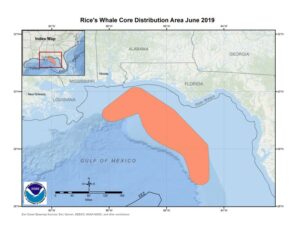
However, Friday’s announcement is not the final pending regulatory question related to NOAA’s treatment of the Rice’s whale. Britt and Tuberville are fighting a critical habitat designation of 28,000 square miles of the Gulf of Mexico for the Rice’s whale.
RELATED: Study: Port of Mobile holds $85B in statewide economic impact
“I will continue to fight for common sense to prevail, so that hardworking families in every corner of our nation have the opportunity to live their American Dream,” Britt said.
Critical habitat designation and the rules that could potentially result from that designation has the potential to adversely affect the Port of Mobile, the Alabama fishing industry as well as the oil and gas industry.
“Designating a Critical Habitat for the Rice’s whale throughout this expansive area will impose undue burdens and restrictions on all vessel traffic, especially in and out of the Port of Mobile,” said Tuberville. “The Port of Mobile covers over 4,000 acres, generates nearly 313,000 jobs, provides approximately $2 billion in state and local tax impacts, and $85 billion in economic value to Alabama as a whole.”
Britt and the other Congress delegation members cited the state’s reliance on commerce in their letter.
“As a coastal state, Alabama relies heavily on commercial activity in and out of the Gulf of Mexico,” they wrote. “The port handles more than 55 million tons of commercial goods each year, reaching every state in the nation and providing clothing, tools, construction materials, automobiles, and parts that Americans rely on each and every day.”
RELATED: Citing economic impact, Tuberville wants Rice’s whale designation voided
Environmentalist groups asked NOAA to set a 10-knot per-hour speed limit through the 28,000 square mile area, forbidding transit of the ships through the area after dark.
“Requiring all lessees and operators to comply with reduced speeds of 10-knots or less and preventing them from traveling after dusk and before dawn within the designated areas will detrimentally impact our nation’s ability to domestically produce oil and gas in hopes of becoming energy independent,” Tuberville said.
“I will continue to fight back against Joe Biden’s attempts to make us reliant on our enemies for energy when we can be producing it right here in the United States, and especially in Alabama.”
To connect with the author of this story or to comment, email brandonmreporter@gmail.com
A coalition of environmental groups filed a petition with the National Oceanic and Atmospheric Administration to establish year-round vessel speed restriction zones and other mitigation measures in the northern Gulf of Mexico to protect Rice’s whales — a whale that was only recognized by NOAA as a distinct species two years ago.
NOAA also proposed a rule to establish critical habitat for the whales where they acknowledged critical oil and gas and military activity occurs.
Sens. Tommy Tuberville and Katie Britt have signed onto legislation that protects Gulf Coast residents and businesses from what both Senators describe as a “leftwing agenda.”
RELATED: Save the whales? Gulf Coast officials warn of NOAA ‘overreach’
The Warding Off Hostile Administrative Lease Efforts (WHALE) Act would prevent the U.S. Departments of Commerce and the Interior from issuing maritime rules related to the Rice’s whale that would impede offshore energy development and military activities.
“We all want to protect wildlife and promote conservation efforts, but the Biden administration’s approach lacks transparency, scientific evidence, and excludes the voices of educated stakeholders and experts in favor of select activists,” Tuberville (R-Auburn) said.
The Bureau of Ocean Energy Management (BOEM) reached a sue and settle agreement with radical environmental interest groups to establish vessel transit restrictions and other obligations for offshore oil and gas leaseholders only including removing millions of unleased acres from leasing.
“The Biden Administration is continually putting a left wing agenda ahead of common sense and the wellbeing of hardworking American families,” Britt (R-Montgomer) said. “Prioritizing partisan activism over economic opportunity and domestic energy dominance is irresponsible and further fueling persistent inflation. I’ll continue to fight back against President Biden’s reckless regulatory regime.”
RELATED: Citing economic impact, Tuberville wants Rice’s whale designation voided
On Sept. 7, Tuberville wrote NOAA Director Richard Spinrad and Bureau of Ocean Energy Management Director Liz Klein, criticizing the decisions and calling attention to the severe economic impacts the rule would have for Alabama businesses and the gulf’s energy industry as a whole.
The full bill text of the WHALE Act can be found here.
Grayson Everett is the state and political editor for Yellowhammer News. You can follow him on Twitter @Grayson270
Officials along the Gulf Coast are warning against a potential move by the federal government to hang a “closed for business” sign on ports.
A regulation under consideration by the National Oceanic Atmospheric Association (NOAA) could impose regulations on navigable waters to restrict nighttime water travel to 10 knots within waters that are 100 to 400 meters deep.
Representatives from the Port of Mobile said the restrictions would result in large financial losses. The facility handles 55 million tons of domestic and international cargo annually with an $85 billion economic impact in Alabama.
RELATED: Port of Mobile holds $85B in statewide economic impact
A nighttime shutdown would also force cargo to become stagnant, which would harm businesses of all sizes that ship and receive goods through the Port of Mobile, they said.
“Literally every moment of every day shipping operations are taking place at our state docks, and any pause hurts our state’s economy and adversely affects the job of every Alabamian who works in the industry,” said State Rep. Chip Brown (R-Hollinger’s Island)
Brown is chairman of the Ports, Waterways & Intermodal Transit Committee in the Alabama House of Representatives.
“Alabama has spent millions of dollars to upgrade and improve our state docks and make them the finest facility on the Gulf coast, but now the federal government plans to forbid nighttime shipping operations because whales swim in the water.”
RELATED: Rep. Brown: A strong port makes a strong Alabama
He said he plans to work with Alabama’s congressional delegation to scuttle the planned restrictions and ensure operations at the port can continue unabated.
Florida’s Ports Council also said it would be damaged by the proposed rule using strong terms in a letter to NOAA, saying the proposal “calls into question whether this proposal is based on something other than scientific data.”
There are signs of hope the proposed restrictions will not go into effect, however.
Congress placed all agencies of the federal government on a six-year wait to enact any new regulations to protect North Atlantic right whales. While that stopgap doesn’t apply to Rice’s whales in the gulf, the Biden administration rejected a similar petition from the environmentalist group Oceana.
Brown said he cautions the public to see through political attempts to stifle business.
“The fact that the Biden administration and the NOAA are eager to bow to the demands of a handful of environmental leftists represents government overreach and liberal extremism at its worst,” Brown said. “Every few years the radical environmentalists attack the business sector by manufacturing a false crisis, and this is simply their latest attempt.”
Grayson Everett is a staff writer for Yellowhammer News. You can follow him on Twitter @Grayson270
As our state works to grow our economy and attract high-quality jobs, it is important to recognize and understand the tools we have at our disposal that can deliver the biggest impact.
Alabama has a wealth of such assets that, if leveraged correctly and given the attention and investment they need, can put us on the map for virtually any company across just about every industry. We have many of these assets to point to – whether that be Alabama’s strong workforce, friendly business environment, economic development incentives and great quality of life.
One of these assets our state has at its disposal – an asset of which has virtually unlimited potential – is the Port of Mobile.
The name itself, however – “the Port of Mobile” – can be misleading. Because it really isn’t the “Port of Mobile,” it really is the “Port of Alabama,” because the industry and jobs it supports affects every single corner of our state.
Let’s take a look at some of the numbers.
Activity at the port’s public and private terminals directly and indirectly generates nearly 313,000 jobs each year. The Port of Mobile handles more than 55 million tons of international and domestic cargo for exporters and importers, delivering $85 billion in economic value to the state each year. And the port has a $2 billion annual state and local tax impact.
These numbers are undeniable, and they exemplify the true success story that the “Port of Alabama” has on our great state. Simply put, a strong Port of Mobile means a strong state of Alabama.
Whether it be our auto manufacturing sector – which ranks third in the entire country, or our thriving coal and natural resources industries – and many others far too numerous to name, the Port keeps products and goods moving from Alabama companies to consumers across the entire globe.
That’s why it’s important for our state to support this incredible asset and to make sure it has the resources it needs to be successful.
And in the state legislature, we recognize this need and are taking ambitious steps towards making sure that happens. Last year we created a brand-new committee in the state legislature – the House Ports, Waterways, and Intermodal Transit Committee, which I am honored to serve as chairman – to focus on strengthening our import and export capabilities and opportunities across Alabama.
When people think about major Southeastern ports, the ports in Charleston, Savannah and New Orleans often come to mind. There is no reason why our state’s port shouldn’t be included on that list. We should all want as many goods being shipped in and out of our port as possible, and we want to take advantage of the jobs and economic impact that would be created by those increased inflows and outflows of goods.
The reason for this committee’s creation is to create an environment where our state can focus on allowing that to happen. And I should note – this committee’s focus isn’t just on the Port of Mobile, but also the Tennessee/Tombigbee Waterway, the ports of Huntsville and Birmingham, and the port being constructed in Montgomery. Creating an environment where it makes financial sense for companies to use this invaluable, uniquely Alabama asset is good for the port and its good for the state.
When it comes down to it, the Port of Mobile represents future opportunity and success for our state. And it is an Alabama resource that everyone in our state should be able to rally behind and be proud to claim as their own.
I look forward to seeing the impact that the legislative proposals that we consider in our committee make on our great state – and I look forward to the day when Alabama’s port is the envy of states from the Atlantic Ocean to the Pacific.
Rep. Chip Brown proudly represents District 105 and serves as the Chairman of the House Ports, Waterways, and Intermodal Transit Committee.
It’s no secret that Alabama’s economy is booming, and so is business at your Port.
In 2021 alone, the Port was responsible for $85 billion of economic impact and created nearly one-in-seven jobs statewide. On top of that, our economic activity sent more than $2 billion in tax revenue back to state and local governments.
What you may not know, however, is that our state’s coal industry is a key driver in this success. Alabama’s coal is sought after worldwide, and Alabama’s port is the fastest way to get it there.
Alabama’s coal is special. It is different from thermal coal, which has long been burned for energy. Instead, our coal is metallurgical, or “met” coal, a key component in steel making.
The chemical makeup of Alabama’s met coal is recognized industry-wide as some of the finest met coal in the world. From ships to scalpels, met coal is used to produce high-grade steel. You’ll find Alabama met coal in things like luxury cars, heavy construction equipment, and advanced manufacturing devices.
In fact, if you’re reading this on your phone, you’ve got met coal in your hand. Needless to say, Alabama’s coal is in high demand, and the Port’s coal terminal is shipping it out 24 hours a day, seven days a week.
That nonstop activity – while great for the economy – takes a toll on machinery. Built in the 1970s, the many mechanical components at McDuffie are simply worn out. Some of the parts are so old that our plant managers have to rebuild them from scratch – they’re just not made anymore.
Even with these challenges, McDuffie Coal Terminal was able to handle more than 11 million tons last year. We’re proud of the work we’re doing – and the Alabama workers and businesses who make it happen – but there’s more to be done.
With major coal industry expansions underway in the Birmingham and Tuscaloosa areas, exports are expected to double in the next five years. Alabama’s port needs to be ready.
That’s why Gov. Kay Ivey recommended $25 million in her budget request to support much-needed upgrades at McDuffie. This investment will complement improvements the Port is already making and speed up the modernization of our coal-handling equipment.
With the State’s assistance, McDuffie will reach its full potential of more than 20 million tons exported annually, ensuring the Port offers the efficiency needed to keep up with the growing demand for Alabama coal.
The complete lifecycle of Alabama met coal is as unique as it is impactful. On average, an underground mine worker can earn upwards of $130,000, and overall, Alabama’s coal industry has an annual economic impact of nearly $3 billion.
Met coal comes out of the ground in our state, is exported by McDuffie Coal Terminal in its original form, and comes back through your Port as rolled steel that is ultimately used on the production line for Alabama-made automobiles.
The many businesses and workers who make their living from mining, transporting, loading, and shipping this coal can only be successful if their products can get to market efficiently. They depend on McDuffie Coal Terminal to make that happen every day. But aged infrastructure at McDuffie makes this harder, and every hour spent on repairs is an hour that impacts the productivity of Alabama businesses.
At the Port, our mission is to help Alabama’s economy grow. We’re thankful for the support of legislators, local officials, and our federal delegation in helping us achieve this goal. But we can’t do it alone. Every day is a competition with other states and countries to attract high-caliber businesses.
Allocating this funding to the McDuffie Coal Terminal is a key component to our coal industry’s success, our port’s success, and, ultimately, Alabama’s success.
John C. Driscoll is the Director & CEO of the Alabama Port Authority
APM Terminals Mobile is expanding its rail infrastructure to meet the demand for increased supply chain gateway options and inland rail logistics by building a rail facility.
The expansion includes additional tracks, railyard storage space, and improved access from the berth at the Mobile location. These additions and improved accessibility will promote productivity and safety, as well as supply chain speed to market, officials said. It will take around two years to complete and will increase the length of the track to 1,200 feet.
“Our customers are looking for expanded options for their supply chains so we are focusing on faster connections to rail providers into inland markets,” said Leo Huisman, head of APM Terminals Americas.
The Alabama Port Authority will be making a roadway fly-over bridge to allow free railway
access both to and from the facility. This will allow APM Terminals Mobile to give on-dock rail service.
The new facility will eventually link APM Terminals Mobile to the future Alabama Port
Authority’s Montgomery inland port. That is expected to be completed in 2025.
Terminals Mobile will also be doubling its container capacity for future growth which is expected to be over 1 million TEU in 2025.