
Since the end of the Great Recession, just 20 of the United States’ more than 3,000 counties have generated half of the country’s new businesses and the better part of its economic growth. Most of these 20 are home to tech-intensive industries that employ skilled labor. Think Silicon Valley in California.
Understanding this dynamic, several cities, most notably Chattanooga, Tenn., have attempted to attract tech startups by building their own municipal broadband network. Opelika has done this, sinking more than $40 million—an enormous financial commitment for a town with less than 30,000 people—into becoming Alabama’s first “Gig City.” Consumers aren’t biting. As of late 2016, the network, provided through Opelika Power Services (OPS), had only one customer for its gigabit service.
Despite low demand, the state legislature is considering four pieces of legislation (HB 375, SB151, SB192, and SB228) that would allow OPS to extend the network to include all of Lee County and perhaps beyond.
As a citizen of Lee County, I have some concerns about these proposed bills.
First, is Opelika’s network financially viable even within its existing boundaries? OPS shows a sizable loss on its publicly available financial statements. These financial documents, however, don’t provide enough detail about the telecom aspect of Opelika Power’s business, and the shifting of costs ($28 million in debt) onto its electric ratepayers, to provide a measured assessment of future viability. If policymakers determine the existing municipal system is unable to pay for itself going forward—a situation most municipal systems find themselves in—then proposals to increase its coverage area should be rejected.
Second, how much will it cost to provide new fiber lines to the rural areas of Lee County that have a lower population density than Opelika? Will Opelika’s captive electric and sewer ratepayers, who already subsidize the city’s money-losing telecommunications division, bear this additional burden and temporarily or perpetually subsidize the rural residents of the county, the city of Auburn, and perhaps even other areas as well? It seems so. This is not a sound decision.
Before considering this legislation, legislators need to answer these questions. They also should evaluate how other municipal systems have fared and use the lessons learned from those experiences to inform their efforts.
Internet service has substantial benefits, but it is costly to provide. The “success” stories out of Chattanooga, for example, often do not mention that an enormous subsidy, $111 million from federal grants (approximately $2,000 per subscriber), was required for that system to be financially viable. Other municipal broadband systems have not gone out of business. For example, the city council of Provo, Utah sold its $39 million fiber network to Google for $1. In Groton, Conn., the city’s residents are still paying for a $38 million network sold for $550,000. Four city officials in Bristol, Virginia, home to the latest failed government Internet system, are serving time in the penitentiary.
The spillover benefits of better paying jobs and economic growth are used to justify municipal broadband networks even though many city systems serve areas already covered by the private sector (an inherently anti-competitive act). But even when Google Fiber installs and manages a fiber network in a new city, economic growth is lackluster. In 2012, Kansas City was the first city in the nation to deploy a Google Fiber network (the company has since stopped fiber deployment) and the city’s GDP growth has still lagged behind the national average. Even Chattanooga has not outgrown its peers.
Super-high-speed internet is no panacea for economic woes. And, as we know in Opelika, it is costly. That’s why tech hub Seattle actually rejected building a government fiber network.
Until our leaders can tell us how OPS’s system will avoid the fate of other municipal networks, and until they answer questions about the OPS network’s current financial situation, changes to state law allowing any city to further bury their constituents in debt trying to compete with private telecommunications companies should be tabled. Otherwise, we’re just trying to catch lightening in a bottle.
Alan Seals is an associate professor and director of graduate studies at Auburn University’s Department of Economics.
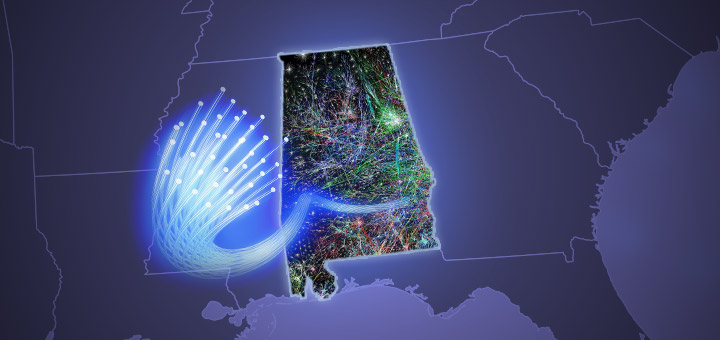
The Taxpayers Protection Alliance Foundation (TPAF) has unveiled Broadband Boondoggles, a comprehensive collection of information about taxpayer-funded government internet projects.
Broadband Boondoggles is an online interactive map displaying information such as cost to taxpayers, debt, revenues, number of customers, and other facts related to more than 200 municipal broadband internet projects across America, including Opelika Power Services (OPS), the municipal broadband network in Opelika, Alabama.
The data contained in Broadband Boondoggles indicates publicly funded internet projects are a universal failure.
Government broadband networks cost American taxpayers billions of dollars a year while failing to stimulate economic growth, falling short of projected customer and revenue numbers, struggling to keep up with advancements in technology, and using tax dollars to compete against existing private companies, TPAF discovered.

“The truth is out, taxpayer-funded broadband is a failure and a waste of valuable resources,” said TPAF president David Williams. “This map shows exactly where government internet schemes are located and how much taxpayers are on the hook for these projects.”
When Opelika, Alabama’s utility company, Opelika Power Services, decided to enter the broadband business in 2010, an initial $43 million was spent to build a network capable of 1 gigabit-per-second speeds. Since then, Opelika has been dubbed the state’s “Gig City,” but a recent Freedom of Information Act request has revealed the network only has one subscriber for its Lite Speed Gig service and is charged $500 a month.
The OPS Director never responded to a request to discuss how the network’s subscriber numbers line up with plans to fully pay off the network and similarly, Opelika Mayor Gary Fuller has acknowledged the network has yet to break even.
“This map should be a warning to all state and local legislators that taxpayer-funded internet projects are a waste of money that will threaten the financial well-being of state and local governments,” Williams said.
Broadband Boondoggles is available online at: www.munibroadbandfailures.com.
The Taxpayers Protection Alliance Foundation (TPAF) is a non-profit non-partisan organization dedicated to educating the public through research, investigative reporting, and analysis about the effects of excessive taxation and spending by all levels of government. TPAF will also educate the public about government transparency and openness in the United States and around the world. Through blogs, commentaries, special spending alerts, and media appearances, TPAF will publish timely exposés of government waste, fraud, and abuse. Recognizing the importance of reaching people through traditional and new media, TPAF will utilize blogs, Twitter, Facebook, and user-generated videos to reach out to taxpayers and government officials.
By Johnny Kampis / Watchdog.org
If you build it, sometimes they don’t come.
Opelika spent about $43 million to build a broadband network capable of 1 gigabit-per-second symmetrical speeds, financed by a bond issue backed up by the revenue of Opelika Power Services.
Four years later (as of Aug. 26), OPS has one subscriber for its Lite Speed Gig service and none for its next highest tier, Lite Speed Plus, with upload and download speeds of 300 megabits per second.
“You put in this expensive service and people aren’t going to pay $500 a month for a gig,” he said. “All that glitters is not gold. Just because you create the gig service doesn’t mean people are going to use it.”
“How do you justify the costs to taxpayers when one person is using the gig service?” Williams asked.
Sign-up for our Technology Watchdog email list to receive the latest news and in-depth coverage.
Watchdog.org received the subscriber numbers from OPS through a Freedom of Information Act request.
OPS Director Derek Lee, who emailed the numbers, didn’t respond to a request to discuss how subscriber numbers correlate with plans to pay back the bond debt.
Opelika Mayor Gary Fuller told Watchdog.org via email that “we’ll begin our 4th year of operation in October and we are on pace with our five-year plan to be at break even.”
Fuller also told Business Alabama in 2014 he thought the city would break even on its broadband over the next four years, with future profits being sent to the city general fund.
“It takes quite a bit of courage to take a $43 million bite out of that apple,” he told the media outlet.
Voters approved the plan via referendum in 2010.
OPS’s broadband service has 2,717 subscribers overall in a city of about 30,000 residents, with the majority of those subscribing to the $44.95-per-month Lite Choice service.
The breakdown is as follows:
-
• Lite Essential – 661 ($34.95 per month residential, 10 mbps download/5 mbps upload)
• Lite Choice – 1548 ($44.95, 30/15)
• Lite Ultra – 485 ($64.95, 50/25)
• Lite Speed – 22 ($99.95, 110/50)
• Lite Speed Plus – 0 ($249.95, 300/300)
• Lite Speed Gig – 1 ($499.95 1,000/1,000)
At residential broadband pricing, these numbers would represent about $127,000 in monthly revenue, or about $1.5 million per year, though many subscribers also likely bundle their internet with cable and/or home phone service. Cable packages range from $50 to $80 per month, and phone packages between $20 and $40 per month.
The total gross revenue could also be marginally higher because OPS charges more for business clients and Watchdog.org didn’t request subscriber numbers broken down by customer type.
But these numbers also don’t account for the costs of operating and maintaining the network.
Watchdog plans to file another FOIA to get more detailed numbers of how much OPS reaps in broadband revenue.
T. Randolph Beard, an Auburn University economics professor who has written op-eds opposing expansion of government broadband, told Watchdog that people can easily stream movies — one of the most data-heavy uses of home internet — on multiple devices at minimum broadband speeds.
“I’m not shocked [at the subscriber numbers] because those are enterprise services,” he said of speeds approaching a gig. “There are a very small number of customers who would need something like that.”
OPS marketing manager June Owens previously told Watchdog the utility charges $2,700 a month for business customers of the gig service, which may be pricing them out of the market.
Beard notes that governments say they need to build broadband networks to serve their citizens, but the very threat of a taxpayer- or ratepayer-backed network can easily scare off private providers from entering a market in the first place.
“There’s a kind of ironic self-fulfilling prophecy,” he said.
State Sen. Tom Whatley, R-Auburn, whose district includes Opelika, is likely to file legislation in 2017 that would allow OPS to expand into rural areas around the city. That bill would apply to any other municipal broadband network that wished to expand, as well.
Beard said that would be unwise.
“The track record is so bad,” he said. “I don’t think making the mistake bigger is a good idea.”

By T. Randolph Beard
In his recent “state of the state” address, Governor Robert Bentley pledged to reduce regulatory burdens on private broadband service providers (“BSPs”) as part of an “ambitious plan to provide rural and under-served communities access to broadband.” As an economist who studies telecommunications policy, I commend the Governor’s efforts. Easing regulatory approvals, speeding access to rights-of-way, using government as an anchor tenant to private providers, and reducing taxes on investment and services are reasonable ways the state can improve the economics of broadband’s buildout. While the Internet is a less effective development tool than many seem to think, broadband service deployment is an important goal, for many reasons.
Notwithstanding the Governor’s efforts to promote private sector deployment, there is a growing chorus (encouraged by the Obama Administration) calling for the public sector to enter into the broadband market by creating new government-owned BSPs that would compete directly with private firms. While there is no evidence the Governor is contemplating such an approach, I would urge all involved to view such plans with both skepticism and extreme caution.
History has shown that the government’s direct provision of broadband networks often becomes a burden to those it was meant to serve. Like it or not, government-owned networks require subsidies paid for by taxpayers (or, when operated as part of a municipal electric system, captive ratepayers). These government networks have a very poor track record of success; many are eventually sold to private sector providers for pennies on the dollar.

Consider, for example, the municipal network in Bristol, Virginia. Since 2014, the broadband network run by the Bristol Virginia Utilities Authority (BVU) has been mired in financial scandal and corruption, despite having received over $7,000 per subscriber in government subsidies. (The private sector often builds networks for less than a quarter of that amount.) It was recently announced that the network would be sold to a private company at a loss of tens of millions of dollars.
And, unfortunately, there are plenty of additional examples. In Groton, Connecticut, electricity customers are saddled with almost $40 million in debt after the city sold its municipal broadband network for $550,000. At least Groton fared better than Provo, Utah, which dumped its multi-million-dollar city network to Google for … $1.
Advocates for government-owned broadband services often claim that municipal networks will offer consumers better prices or faster speeds at lower prices than private providers. Although this sounds good, the reality is far less persuasive. First, it is a rare consumer who would benefit from extremely-high download speeds some public systems offer. For example, June Owens, marketing manager for Opelika Power Services, told Watchdog.org the utility has about 3,000 customers that subscribe to some combination of its Internet, cable and phone services, but “we don’t have that many, of course” that subscribe to the $500 per month residential pricing or $2,700 per month business pricing for 1 Gigabit per second data service.
Rather, typical consumer content such as streaming services or online games do not benefit from speeds past those usually available already. Second, research suggests that municipal systems often charge more when one looks at the typical “triple play” package of telephone service, video, and internet access. While some municipal systems do offer lower prices for some types of services, these are often specialty items of limited interest to the ordinary subscriber.
Such price comparisons, though, are generally wildly misleading: public broadband networks are parts of government, and are often subsidized in both obvious and subtle ways. The “price” of a public broadband service must include the economic costs of these subsidies for useful comparisons to be made. Too often, these sorts of subsidies are ignored by public network advocates, although they are not ignored by private network operators looking to invest. Few private firms want to invest in markets where they compete with subsidized government firms.
I urge Governor Bentley to resist any proposal for Alabama or its cities to get into the broadband business. The private sector already is providing these services and will continue to do so, and will do more if the government becomes a partner rather than a competitor. That’s the best course for consumers, taxpayers and our state.
T. Randolph Beard is a Professor of Economics at Auburn University where he teaches courses in Microeconomics, Industrial Organization, and Public Policy. His research has appeared in numerous academic journals and he has authored of three books.
OPELIKA, Ala. — A Republican senator is proposing a bill that would allow Alabama cities to build out their own fiberoptic internet access, sparking a debate between municipal leaders who tout the economic development possibilities and some conservatives who view it as government encroachment on private enterprise.
Sen. Tom Whatley (R-Opelika) has proposed nixing current restrictions on municipalities, so those towns and cities can enter the business of providing internet services to their more rural citizens. Currently, cities are allowed to provide communications services only to individuals inside the city limits.
In 2013, the city of Opelika, population 28,635, issued bonds to fund the installation of fiberoptic cable through its Opelika Power Services (OPS).
OPS already provides electric, cable, phone, and internet services to Opelikans, but the proposed bill would allow them to extend their offerings outside the city limits.
Because Opelika’s city limits directly abut Auburn’s, there are currently several parts of the town that have access to OPS on one side of the street, but not on the other side.
In one of the more extreme examples, the main building at the local airport has access to OPS fiberoptic internet because it is in Opelika, but the hangar does not, because it is within the City of Auburn.
June Owens, the OPS manager of marketing and communications, told Yellowhammer Friday that the city had attempted to negotiate with the local private cable and internet companies to provide service to some of their more rural citizens, but the companies refused.
Opponents of the proposal to allow cities to operate such utilities outside their limits argue that the government should not be in business competing against the private sector.
Chattanooga, Tennessee has been the highest-profile example of a city installing and running its own fiberoptic internet service, which it calls ChattanoogaGig, because of the 1 gigabit per second speeds offered—200 times faster than the national average. Chattanooga received a $111 million grant from the U.S. Department of Energy to complete the project.
The federal government has taken an interest in making sure every American has access to high speed internet. According to a 2013 census report, 73.4 percent of American households and and 68.7 percent of those in Alabama — the majority who do not live in rural areas — already have access to high speed internet.
Ms. Owens said that high internet speeds have become integral to the city’s efforts to attract businesses to the area.
“When you’re trying to recruit industry, back in the day they wanted to know about your road infrastructure, how close you were to the main highway, what was your water system and phone service. Today they want to know what is your communications infrastructure system like.”
Several other Alabama cities are also investigating the possibility of installing their own communications systems, should the bill pass.
Like this article? Hate it? Follow me and let me know how you feel on Twitter!
— Elizabeth BeShears (@LizEBeesh) January 21, 2015