Longtime GOP political consultant and chairman for President-elect Donald Trump’s successful 2024 election campaign committee, Chris LaCivita, recently called the Republican Attorney Generals Association (RAGA) a “joke” organization with incompetent leadership.
“If you are a GOP donor – or even an elected Republican Attorney General – you should know that politically speaking , @RepublicanAGs – the group you fund is a joke,” LaCivita posted last week. “They have been using a search firm that knows nothing of politics – for a new ED. You don’t need a bureaucrat – you need a warrior and a campaign pro – take control or your numbers will shrink and America needs more GOP AGs!”
https://x.com/ChrisLaCivita/status/1876453161315270887
RELATED: ‘Principled leadership’: Steve Marshall elected RAGA chair
RAGA was founded in 1999 as a subsidiary of the Republican State Leadership Committee (RSLC) but organized independently in 2014 under the same mission of shaping policy and upholding conservative legal principles. Since that time, two Alabama AGs have served as chairman of the group. Former Attorney General Luther Strange served as chair from 2016-2017 and current Attorney General Steve Marshall from 2022-2023.
Grayson Everett is the editor in chief of Yellowhammer News. You can follow him on X @Grayson270.
The 2025 Niche.com ‘Best Colleges’ list was recently released, featuring rankings for best value, best student life, academics — as well as for most conservative and most liberal campuses. The University of Alabama was ranked the No. 1 most conservative college in Alabama — and No. 14 most conservative nationwide.
After a recent visit from President Donald Trump and serving as the host for an official 2024 GOP presidential debate, it’s been a defining year for UA’s standing in this category. While the annual Niche.com rankings uses student self-reporting methodology to calculate its most conservative and liberal campuses, UA has built its conservative and political clout in recent years.
Last month’s visit by Trump was not the first time the former president wanted to experience a gameday on campus, first visiting UA while president in 2019. His former vice president, Mike Pence, spoke to a campus group in 2023. Former U.S. Senator Luther Strange joined UA School of Law’s faculty an adjunct professor after his time in the Senate and as Attorney General of Alabama.
RELATED: Alabama’s most influential leaders attended ‘incredible’ GOP debate at the University of Alabama
Recently, the Shelby Institute for Policy and Leadership, which just welcomed its inaugural cohort of scholars, has hosted U.S. Senator Katie Britt, U.S. Senator and Chairman of the National Republican Senatorial Committee (NRSC) Steve Daines (R-Mont.), Lt. Governor Will Ainsworth, as well as frequent visits with the institute’s namesake, former U.S. Senator Richard Shelby himself.
Other Alabama universities recognized in Niche’s ranking of most conservative colleges nationwide include Auburn University at No. 18, the University of Alabama in Huntsville at No. 51, and Auburn University at Montgomery at No. 81.
Grayson Everett is the state and political editor for Yellowhammer News. You can follow him on X @Grayson270
From childhood, Sen. Luther J. Strange knew he was in good hands with the care he received from UAB’s surgeons.
Emergency Surgery at Children’s Hospital
While biking with friends during his seventh-grade year in Homewood, Alabama, Strange was thrown from his bike after being hit by a traveling sedan. After the collision, Strange remembers collapsing near the intersection and his mother waiting beside him for an ambulance to take them to Children’s Hospital moments later.
“I will never forget a young resident holding my hand to put me at ease while they did their examination. I was very fortunate that the renowned pediatric surgeon Dr. Marshall Pitts happened to be on call that day,” Strange remembers.
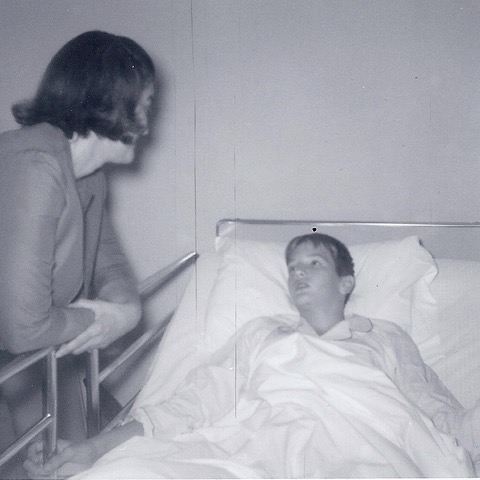 Luther Strange with his mother in Children’s Hospital. And truly fortunate, Strange was to have arrived when he did. Upon intake, his care team determined that he had severely damaged his left hip upon impact with the sedan’s hood, sustained a deep cut on his right knee, and displayed signs of internal bleeding from bruising in the incident.
“After a full examination and evaluation of my injuries, Dr. Pitts said I’d require surgery and I was wheeled into the operating room that night. I remained in Children’s Hospital for a week or so to let all the stitches and internal bruises mend,” says Strange.
In total, Strange received 70 stitches from his injuries – requiring extreme care and multiple follow-up appointments in the healing process.
Thanks to the excellent care he received, Strange was soon back in tip-top shape and could go back to biking with his friends after school and playing basketball – a sport that would eventually lead to his college scholarship at Tulane University where his career in public policy and law would begin.
Another Lifesaving Operation with UAB Cardiovascular Institute
Many years later, Strange found himself back at UAB’s Department of Surgery for a different procedure altogether. Scheduled for a repair of his mitral heart valve, Strange got ready for surgery and completed all of his pre-operation screenings. Upon further inspection, Dr. James Davies and his care team noticed that Strange also had an aortic aneurysm, which is characterized by a weakness in the artery wall of the heart. They decided the best course of action would be to repair both findings at the same time.
With UAB’s Cardiovascular Institute (CVI), Strange knew he would be receiving treatment from surgeons who have performed many cases like his, and he was exactly right. In 2022, physicians with the CVI performed over 536 complex aortic cases and 1,755 open-heart cases – that adds up to about five heart surgeries a day!
“The care I received here at UAB absolutely put my mind at ease. I knew Dr. Davies had seen many cases like mine and could navigate my surgery to give me the best quality of life possible,” adds Strange. “Had his exceptional care team not noticed my aneurysm, I may not be here today to share the story.”
After surgery, Strange felt better than ever and ready to resume his full life as a husband, father, grandfather, attorney, and adjunct professor at the University of Alabama School of Law.
“Whenever I get the chance, I tell my friends and neighbors about the impact UAB has directly had on my life, several times over,” says Strange. “We have world-class care right in our neighborhood from dedicated, expert medical providers. We couldn’t be more fortunate.”
A Full-Circle Moment in Medicine
Inspired by the care his father received in childhood and the significant impact that pediatric physicians have on our most vulnerable and impressionable population, Strange’s son, Keehn Strange, ultimately decided to pursue a career in medicine.
A current resident in UAB’s pediatric residency program, Keehn was selected for the 2023 Joe LaRussa Intern of the Year award.
“I couldn’t be more proud of Keehn or for his interests in medicine. I know he’ll change lives and impact children across the Southeast through the compassionate care he’s learning right here at UAB – just like the resident who comforted me many years ago,” he adds.
A Legacy of Gratitude
The profound impact that UAB has had on the Strange family has inspired them to give back to the faculty of the UAB Department of Surgery for their many contributions to the community.
With their support, the Strange Family Endowed Professor in Surgical Sciences Research at UAB was recently established as an expression of their gratitude and desire to contribute to the continued excellence of the institution, with the inaugural awardee being UAB Division of Gastrointestinal Surgery Associate Professor Karin Hardiman, M.D., Ph.D.
As a principal investigator in her NIH-funded laboratory at UAB, Hardiman conducts basic and translational research related to colon cancer. She also studies multidisciplinary cancer care, survivorship care, and the role of intra-tumor genetic heterogeneity in colorectal cancer metastasis and response to therapy.
Courtesy of the University of Alabama at Birmingham Heersink School of Medicine Department of Surgery.
During his farewell address on the floor of the United States Senate in 2017, Luther Strange said he approached the end of his service in the world’s greatest deliberative body with “both the optimism of a young student and the battle scars of a man in the arena.”
Now young – and maybe not so young – students at the University of Alabama School of Law are benefiting from the experiences and “battle scars” of the former U.S. senator and Alabama attorney general.
Strange is serving as an adjunct professor this semester and teaching a course called “Litigating with the Power of the State: The Role of the State Attorney General.”
“It’s really a unique class,” said William S. Brewbaker, III, the dean of the University’s law school. “The particular course he is teaching on the role of the state attorney general is a great introduction to the intersection of politics and law.”
Lauren Chambliss, a third-year law school student and editor-in-chief of the Alabama Law Review, agrees.
“Senator Strange’s class, and its exploration of real-world examples and challenges, certainly has the potential to inspire students to consider and pursue impactful roles in public service post-law school,” Chambliss said. “We are blessed with wonderful professors at Alabama Law, but not many have spent extensive time in government. Senator Strange offers advice and guidance to students who might be interested in that route based on his own experience.”
That experience for Strange has included earning Eagle Scout at the age of 13, service in the U.S. Merchant Marine, and practicing law in Birmingham where he was regularly featured on various lists of the state’s and the nation’s best lawyers. In 2010, he was elected Alabama’s attorney general and re-elected four years later.
RELATED: Bell: University of Alabama’s ‘fundamental’ mission is student success
Strange’s tenure as attorney general was marked by a strong emphasis on fighting public corruption and opposing the expansion of the federal government’s authority and power at the expense of the states.
As attorney general, he argued a case before the U.S. Supreme Court and served as Coordinating Counsel for the Gulf Coast States in the Deepwater Horizon disaster. Strange’s work on the case against BP led to a landmark settlement agreement that compensated Alabama for both economic and environmental damages.
Strange’s course at the UA School of Law focuses on the powers and responsibilities of state attorneys general, the limitations of those powers under state and federal law, and litigation with the federal government.
“Luther has argued before the U.S. Supreme Court and stood in the well of the U.S. Senate. We’re naturally pretty delighted when someone with a background like this is willing to take time to teach our students,” said Brewbaker.
Strange says being around the students has renewed his optimism for America’s future.
“I know many Americans today are nervous about our country’s future. But the students in this class are so impressive, thoughtful and engaged. They are remarkable and a credit to the University of Alabama,” said Strange. “It’s made me feel more hopeful and confident that America’s best days still lie ahead of us.”
Grayson Everett is the state and political editor for Yellowhammer News. You can follow him on Twitter @Grayson270
“Hey, I wonder what disgraced convicted felon and embarrassed former Governor Robert Bentley thinks about Amy Coney Barrett’s Supreme Court nomination?”
This, of course, is a question no one has asked — or will ask.
However, Bentley apparently felt like answering it anyway. (more…)
With a Supreme Court confirmation fight looming in the throes of a presidential election cycle, former Gov. Robert Bentley argues it did not have to be this difficult for Republicans to get President Donald Trump’s picks confirmed.
Bentley spoke about the decision by his successor, Gov. Kay Ivey, to hold a special election for the U.S. Senate seat he appointed then-Attorney General Luther Strange to fill the after Jeff Sessions resigned the seat to take the U.S. Attorney General post under President Donald Trump.
Bentley made mention of that 2017 special election, in which Democratic Party nominee Doug Jones defeated Republican Roy Moore to give Democrats an additional vote for Republicans to overcome in the U.S. Senate, during an interview with Mobile radio’s FM Talk 106.5 on Friday. He argued had the election been held in 2018, the outcome would have been in favor of a Republican.
Religion and politics have always been linked. No party has a lock on the faithful, but one party definitely has a lock on the non-faithful.
Because of this, the media and their Democrats’ hostility towards people of faith has increased in recent years.
But this week we watched as President Donald Trump attacked House Speaker Nancy Pelosi (D-CA) and U.S. Senator Mitt Romney (R-UT) for referencing their faith in their attacks on him. Channeling an MSNBC host, he referred to religion as a “crutch” for Romney; it is all a bit unseemly. (more…)
Judge Andrew Brasher, who was confirmed earlier this year to serve on the U.S. District Court for the Middle District of Alabama, on Wednesday was nominated by President Donald J. Trump to the U.S. Court of Appeals for the 11th Circuit.
Before being nominated by Trump for his current federal judgeship, Brasher was serving as solicitor general of Alabama.
Senator Doug Jones (D-AL) voted against Brasher’s confirmation to the district court, while Senator Richard Shelby (R-AL) voted affirmatively to confirm.
Upon hearing the news on Wednesday, Shelby voiced his support for Brasher’s new nomination, as did two other major supporters of his — Attorney General Steve Marshall and former Senator Luther Strange (R-AL). (more…)
Corey Maze of Montgomery on Wednesday was confirmed by the U.S. Senate in a 62-34 vote to be a federal District Judge for the Northern District of Alabama.
Maze, a native of Centre, was nominated for the judgeship by President Donald Trump in May 2018. In October, he appeared before the Senate Judiciary Committee for consideration of his nomination and was favorably reported out of the committee.
Sens. Richard Shelby (R-AL) and Doug Jones (D-AL) voted “yea” on Maze’s confirmation on the floor Wednesday.
In a statement afterwards, Shelby lauded the successful outcome.
“Corey Maze’s confirmation to be a district judge for the Northern District of Alabama is another important step in the shaping of our courts,” Shelby said. “His strong commitment to the rule of law and ability to adhere to the highest standards of judicial efficacy will allow him to excel in this esteemed role. Corey Maze exemplifies all of the characteristics of a model judge, and I am honored to have played a part in his confirmation today.” (more…)
Former United States Attorney General Jeff Sessions has returned home to Alabama, but it remains unclear as to whether or not he will return to the Senate seat he once held in the Yellowhammer state.
After Sessions’ exit from the Department of Justice, several Alabama Republicans floated his name as a potential contender to challenge Doug Jones (D-AL) for United States Senate.
In several Politico conducted interviews with Republicans from across Alabama, one thing is clear: Opinions of Jeff Sessions are not what they once were after President Donald Trump fired him. (more…)
In a press release on Monday, the Republican Attorneys General Association (RAGA) announced that Alabama Attorney General Steve Marshall has been named to its executive committee for the 2018-2019 term.
RAGA is dedicated to electing Republican attorneys general across the nation, with the ultimate goal of supporting “the rule of law, limited government, cooperative federalism, legal reform, free enterprise, aggressive crime fighting, equal opportunity, and the preservation of conservative values.”
In his brief time in office, Marshall has already been a leading conservative voice when it comes to national issues such as illegal immigration, abortion, violent crime and the opioid epidemic. He has been involved in small-group White House and DOJ working groups and panels, with his star clearly still on the rise. (more…)
In a tweet on Wednesday, former Alabama Attorney General and United States Senator Luther Strange called for Attorney General Jeff Sessions to run against Senator Doug Jones (D-Mountain Brook) in 2020.
Jeff Sessions for Senate in 2020! #alpolitics
— Luther Strange (@lutherstrange) November 7, 2018
Strange was appointed to Sessions’ former Senate seat after he became attorney general in February 2017. Jones currently occupies this senate seat after Strange was defeated by Roy Moore in the special election’s Republican primary runoff, and Moore then lost to Jones in the December 2017 general election. (more…)
Jalen Drummond, who graduated from the University of Alabama this past May and is a native of the state, is facing racial abuse from the “tolerant left” after he interned for President Donald Trump over the summer.
In a recent viral post from from the liberal “comedy” website “Funny or Die,” Drummond’s picture was replaced with the fictional character from the movie “Get Out,” which won the Academy Award last year with its take on racism in modern America.
On Saturday, Drummond reaffirmed that he considered it “an incredible honor and privilege serving as one of [President Donald Trump’s] White House interns this summer,” while calling out the shameful behavior by Funny or Die and individuals who shared their original post. (more…)
“Big Luther” might be out of office, but he hasn’t finished towering over environmental activists.
The former United States Senator is known for his staunch opposition to job-killing Obama-era regulations and mandates as Alabama’s Attorney General and was a key ally to President Trump in Strange’s brief tenure on Capitol Hill.
Now, back in the private sector, Luther Strange is still advocating for Alabama jobs and President Trump’s agenda. (more…)
Alabama has been through a lot over the last few years. A speaker of the House was convicted and a governor lost his office over an affair with a political operative/concubine provided by a shady special interest group.
It hasn’t been great and the attorney general of the state has been absent in most of these issues through recusals. Now, as we look for our next AG, one of the candidates is former District Attorney Alice Martin, who until recently was running around the state claiming she never sought an appointment from Robert Bentley and implying current Attorney General Steve Marshall was tarnished for doing so.
This argument doesn’t really make sense because Marshall recused himself, clearing the way for Gov. Robert Bentley to be taken down. Also, because this is Alabama, Martin obviously sought the appointment as well and wrote e-mails to the governor’s office:
I trust the Governor will consider my qualifications and experience to serve as the first female and 50th Attorney General for the state of Alabama should the seat be vacated,” she wrote. (more…)
Tuesday on Talk 99.5’s “Matt and Aunie Show,” show co-host Matt Murphy and Republican Alabama Attorney General hopeful Alice Martin had a heated back-and-forth over Martin’s claim she had not “interviewed” for the Alabama attorney general vacancy that opened up after then-Attorney General Luther Strange was appointed to the U.S. Senate.
Martin had raised the issue about the merits of current Attorney General Steve Marshall’s appointment by then-Gov. Robert Bentley, who at the time was under an investigation headed by Martin by the Alabama Attorney General’s office.

According to a story from Politico’s Alex Isenstadt, a group is seeking a censure resolution from the Alabama Republican Party’s executive committee against Sen. Richard Shelby (R-Tuscaloosa) for declining to support Roy Moore in last month’s special election against Doug Jones.
Jones defeated Moore by a 1.7 percent margin, nearly 23,000 votes, to become Alabama’s junior U.S. Senator.
NEWS: Roy Moore allies pushing censure + robocall campaign targeting SHELBY. Looking to retaliate https://t.co/FJehf4hkL1
— Alex Isenstadt (@politicoalex) January 13, 2018
“This week, three Moore supporters submitted a resolution to the Alabama Republican Party executive committee calling for Shelby to be censured,” Isenstadt wrote. “It argues that Shelby ‘publicly encouraged Republicans and all voters to write in a candidate instead of voting for the Republican Candidate Judge Roy Moore,’ and that his ‘public speech was then used by the Democrat Candidate in robocalls to sway voters to not vote for Judge Roy Moore.'”
According to Isenstadt, the effort is being financed by Dallas investor Christopher Ekstrom. Isenstadt describes Ekstrom as “a prolific GOP donor who has contributed nearly $300,000 to conservative and anti-establishment causes since 2012, according to federal records.”
Shelby’s decision to publicize his decision not to vote for Moore last month was used by Jones’ campaign in online, radio and TV ads against Moore.
According to the bylaws set by ALGOP’s executive, the rule governing support of candidates is as follows:
“Denying Ballot Access: This Committee reserves the right to deny ballot access to a candidate for public office if in a prior election that person was a Republican office holder and either publicly participated in the primary election of another political party or publicly supported a nominee of another political party. The provisions of this Rule shall apply for a period of six years after such person so participated. (This rule does not include all of the reasons for denying ballot access.)”
Shortly before the election, ALGOP party chairwoman Terry Lathan described Shelby as “a very good and supportive friend to the Alabama Republican Party,” adding that he was “a staunch conservative on issues.”
Jeff Poor is a graduate of Auburn University and works as the editor of Breitbart TV. Follow Jeff on Twitter @jeff_poor.

More than 20,000 write-in votes were cast on Dec. 12 for Alabama’s special Senate election, along with the expected names of Luther Strange and Alabama football coach Nick Saban.
Republicans Martha Roby (Montgomery), Bradley Byrne (Mobile), Mike Rogers (Tuskegee), Robert Aderholt (Gadsden) and Gary Palmer (Vestavia Hills) all received votes to be Alabama’s next senator.
Of the delegation, Roby claimed the most with at least 15 votes.
Birmingham radio hosts Rick Burgess and Bill “Bubba” Bussey both received several votes.
While Bussey earned 5 votes, Burgess was the choice of the duo with 7 votes.
Dianne Bentley, ex-wife of former Alabama Gov. Robert Bentley, who resigned in April over allegations of finance and ethics violations, beat out her former husband 4 votes to 2.

The final House-Senate tax-reform bill unveiled on Friday does indeed include extra energy-royalty payments to Gulf of Mexico states, as originally inserted into the Senate version of the bill by Alabama’s U.S. Sen. Luther Strange and Louisiana’s Bill Cassidy.
Yellowhammer reported on the battle for this extra funding earlier this week when U.S. Rep. Bradley Byrne of Mobile spearheaded a letter to House leaders urging that they accept the Senate language.
The Cassidy-Strange language will allow the Gulf States (all but Florida, which allows no drilling off its shores) to collect a combined $150 million more in each of the years 2020 and 2021, to make up for a shortfall of $300 million in recent years. It is not clear exactly how much that will mean for Alabama, but the total extra revenue in those years from the Yellowhammer State should easily exceed $50 million.
The money comes under the provisions of the Gulf of Mexico Energy Security Act (GOMESA) of 2006.
So important was this provision that it was included in the House Ways and Means Committee’s official summary of the bill — not just the fine print somewhere, but the announcement of the bill’s key highlights. To wit: “Provides a temporary increase in offshore revenue sharing for the Gulf Coast in 2020 and 2021, allowing those states to invest in priorities such as coastal restoration and hurricane protection.”
Word of this Gulf state policy success first came to Yellowhammer News from Seth Morrow, press aide for Rep. Byrne.
Alabama Republicans are leading a last-ditch, regional fight to secure some extra money from federal oil revenue from drilling off the coasts of Alabama, Mississippi, Louisiana and Texas. Their attempt is both reasonable and admirable.
The Gulf Coast House and Senate members want the major tax reform bill pending in Congress to include a provision to temporarily increase payments to the states via the Gulf of Mexico Energy Security Act (GOMESA). That was the 2006 law, a huge victory for Gulf states, that governs the oil-and-gas revenue-sharing arrangement between the states and the federal government.
GOMESA sets the payments in terms of a percentage of the energy revenues, but puts a “cap” of $500 million in combined payments to the states in any one year. The problem is that low oil prices combined with Obama-era restrictions on drilling have kept payments well below that $500 million level. New drilling promoted by the Trump administration is expected in future years to solve the states’ annual shortfall – but that still would leave the states $300 million short of expectations from these lean years.
To make up for the 2017-18 shortfalls, Alabama’s U.S. Sen. Luther Strange and Louisiana’s Sen. Bill Cassidy sponsored an amendment to the tax-reform bill that would allow the cap to rise from $500 million to $650 million for each of two future years when drilling revenues are heavier. This would be entirely fair, as the “caps” on revenues weren’t good policy in the first place, but merely a necessary compromise to pass GOMESA at all against opposition from non-Gulf states.
(For some reason, states where drilling occurs on federal lands always had received a larger percentage of the royalties than states where the drilling was offshore. GOMESA rightly corrected that imbalance after many years of unfairness to Gulf states, and there’s no good reason for the Gulf states to be shortchanged again just because a liberal administration hobbled offshore leasing programs.)
The Cassidy-Strange amendment – paid for by a tiny, later-year sale from the Strategic Petroleum Reserve – was included in the Senate version of tax reform, but not in the House’s bill. As the House-Senate Conference Committee entered its final deliberations (to produce a bill acceptable to both chambers) earlier this week, House members led by Mobile Republican Bradley Byrne sent a letter to House leadership asking that the House accept the Cassidy-Strange Amendment.
“This money is critically important to our coastal communities, which provide a significant share of the infrastructure and workforce for the oil and gas industry,” they wrote. “Our states also assume much of the risk that comes with the industry.”
That last sentence, of course, was proved true during the 2010 BP oil spill.
Republicans from Mississippi, Louisiana and Texas also signed the letter, which was spearheaded by Byrne.
U.S. Sen. Lisa Murkowski, Alaska Republican, who was part of the Conference Committee, was a champion of the Cassidy-Strange Amendment. No House conferees were especially known as major advocates of the amendment, but House Ways and Means Committee chairman Kevin Brady is from Texas and presumably supportive.
House Majority Whip Steve Scalise of Lousiana, not a part of the Conference Committee but obviously in good position to influence the final bill, also is known as a strong proponent of the amendment. He and Byrne are friends and close political allies.
Congressional leaders on Wednesday announced tentative agreement on a joint bill produced in conference, but it is not yet known if the Cassidy-Strange amendment made the cut. If so, Byrne’s late letter, along (of course) with Strange’s signal leadership in the Senate, might deserve some credit. Alabama state budgeteers a few years from now should then be quite grateful for the efforts of Strange and Byrne.
Again, the Cassidy-Strange provision isn’t some attempt at special treatment for Gulf states, but merely insistence on fair treatment well within the original spirit and intentions of GOMESA. And for a cash-strapped state like Alabama, it amounts to a big deal indeed.
We should know by sometime Thursday whether the provision made the final cut.
Yellowhammer Contributing Editor Quin Hillyer, of Mobile, also is a Contributing Editor for National Review Online, and is the author of Mad Jones, Heretic, a satirical literary novel published in the fall of 2017.
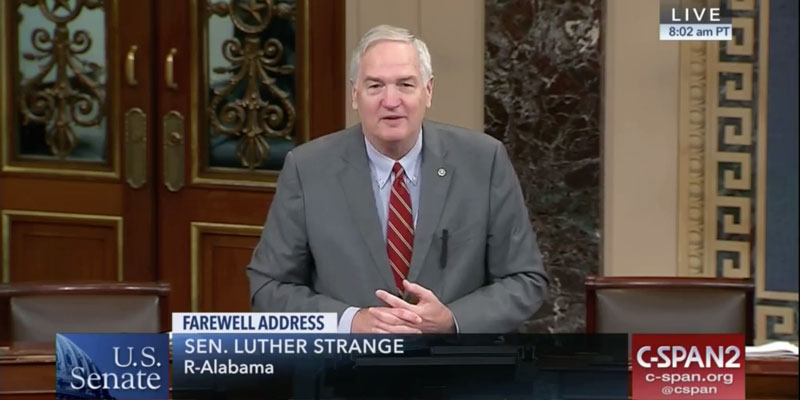
Sen. Luther Strange addressed his fellow senators for the final time Thursday.
“After nearly a year in this chamber, I am both its newest member and the next to depart. As such, I have both the optimisim of a young student and the battle scars of a man in the arena.”
Strange offered this praise of his Alabama role models:
“Together, Jeff Sessions and Richard Shelby represent the finest Alabama has to offer to our nation. Following in their footsteps here in the Senate is an honor I will forever treasure.”
Read the entire speech below and watch the video here:
Senator Luther Strange Dec. 7 Farewell Address:
Mr. President, I rise today to address my colleagues for the last time. After nearly a year in this chamber, I am both its newest member and the next to depart. As such, I have both the optimism of a young student and the battle scars of a man in the arena. Today, I’d like to offer my colleagues some observations from the perspective of my unique circumstances.
My fellow Senators and I come from different places. We were raised differently, and we have lived differently. In coming to serve in the world’s greatest deliberative body, we have carried and tested different notions of America.
There is, however, one reality that transcends our individual experiences. In this room, we are each humbled by history. The Senate has been a forum for some of the great debates of our Republic. It has shaped, and been shaped by, citizen legislators from every state of the Union. We are awed by the strength of an institution that has weathered great challenges, and the wisdom of those who first envisioned it.
As I rise today in that spirit, I’d like to shed light on a page of Senate history that bears great significance in our current political climate.
Mr. President, across the hall behind you is a space known as the Marble Room. In a building that is home to so many breathtaking historic sights, this alcove has a singular beauty, and a story worth telling.
As part of the 1850s expansion of the Senate’s chambers, the Marble Room began as a public gathering place, and has been frequented over the decades by politicians and protesters alike. When the Union army camped on the grounds of the Capitol during the Civil War, soldiers even used its fireplaces for cooking.
For over sixty years, the Marble Room was steeped in the life of the American citizen. It hosted meetings with advocates, constituents, and the free press. It became a very tangible example of our nation’s experiment in representative government.
In March, 1921, it took on a new, equally important purpose. The space was reserved by the Rules Committee as an escape for Senators from the crowded halls of the Capitol, and the windowless, smoke-filled rooms where they often gathered off the floor.
It became the place where Senators of all stripes would come to catch their breath and take their armor off. Some would nap, some would eat lunch, and all would end up forming bonds that rose above politics.
Today, the Marble Room is nearly always empty. This emptiness symbolizes something that worries me about today’s politics. It is likely both a symptom and a cause of the partisan gridlock that often dominates this chamber.
But the story of that room – the interplay between citizen and institution; between pragmatism and principle – is the story of the Senate, and in some ways the story of republican government in America.
Mr. President, what was once an incubator for collegiality and bipartisanship has become a glaring reminder of the divisions that we have allowed to distract us from the business of the American people.
We each remain humbled by the history of the Marble Room. We stand in awe of the traditions of this hallowed body. But too often we fail to let this history be our guide through today’s political challenges.
Mr. President, my time in the Senate has reinforced for me what it means to balance principle and pragmatism, to serve the people of my state honorably, and it has taught me how to navigate the turbulent waters of Washington.
I imagine that our predecessors who spent time together in the Marble Room wrestled with similar questions. After all, the issues we face today are not all that different. This body has been strained before – it has bent, but not broken.
Finding lasting solutions to our nation’s problems does not require reinventing the wheel. Our forefathers have done it before, and they’ve done it right across the hall.
—
Mr. President, I spent my early years growing up in Sylacauga, Alabama, about 40 miles outside of Birmingham. My first hometown is known as “the Marble City” for the swath of high-quality stone it sits on, 32 miles long and as much as 600 feet deep.
Sylacauga marble is widely recognized for its pure white color and fine texture, and here in Washington, we are surrounded by it. It is set into the ceiling of the Lincoln Memorial, the halls of the Supreme Court, and was used by renowned sculptor Gutzon Borglum to create the bust of Abraham Lincoln on display in the crypt downstairs.
Sylacauga marble is used in places infused with tradition and deep history. It is used to enshrine important landmarks. It ensures that memories of the past will stand the test of time to inform the decisions of the future.
In a small house in the Marble City, I was raised by a family that instilled in me a deep and abiding reverence for history and tradition.
My father was a Navy veteran and my only uncle, a West Point graduate killed in service during World War II, was actually born on the 4th of July.
As you can imagine, Mr. President, I didn’t need fireworks or parades to understand the significance of our Independence Day – the look in my mother’s eyes as she remembered her brother’s birthday was enough.
Forged in service and sacrifice, my family understood the blessing of living in America, and the price of passing its freedoms on to the next generation.
Thanks to this generation before me – the greatest generation – I grew up strong in Alabama. At a young age, I was introduced to the Boy Scouts of America. From volunteer troop leaders to the older scouts I would look to as examples, the Boy Scouts created an environment of selfless service. As a Scout, I learned to appreciate the institutions of American society, and my role as a citizen.
By age thirteen, I was an Eagle Scout traveling to Washington on a school trip to see this great experiment in representative government up close. As I tell every young person who has visited my office this year, that experience gave me an appreciation of the value of public service.
Mr. President, I often wonder, if we all approached our duties here with the unblemished optimism of a young student on a field trip, whether we couldn’t accomplish more in Congress.
Of course, the strength of this body and the remarkable foresight of our Founders run deeper than an elementary school civics class. For me, the next pivotal moment came as an undergraduate at Tulane University in the spring and summer of 1973.
Some of you may be surprised to learn that I played basketball in college. In between practice and part-time jobs, I found time to watch the newly-formed Senate Select Committee on Presidential Campaign Activities begin its investigation of the Watergate scandal.
In that moment, our nation stepped into uncharted territory. The strength of our Constitution was tested like never before. Would the pursuit of justice overcome politics? Would the institution of the Presidency be forever changed? What are the responsibilities of citizens of a republic, when the republic’s institutions are tested?
It was during that spring semester of 1973 that I began to understand the tremendous power of the rule of law. It is guarded by representatives who swear to preserve, protect and defend the Constitution of the United States.
When my basketball playing years ran out, it was this realization that led me to go to law school. My new game would be learning the ins and outs of this system that ensured the rights our Founders envisioned. My new team would be my fellow students, who would go on to practice law and serve our nation at all levels of government.
Mr. President, as so many of our colleagues know, the path from practicing law to writing it is well-traveled. I was fortunate to travel it with the help of some of Alabama’s finest public servants.
As a young attorney, I first met one of them for breakfast in the cafeteria of the Department of Justice. When I realized I had forgotten my wallet, he paid for my meal. Jeff Sessions has continued to pay it forward to this day as a dear friend and mentor of mine.
Mr. President, Jeff Sessions is both a gracious statesman and a man of principle. It is not far-fetched to say that some of this temperament rubbed off on him from our state’s senior Senator, Richard Shelby.
Over thirty years ago, I was introduced to then-Congressman Shelby by my friend, former Secretary of the Senate Joe Stewart. As a young lawyer, I learned from a man fast-becoming a legendary legislator. He would become one of my most treasured friends, sharing many days hunting together in the fields of Alabama and elsewhere, and many more stories shared here in the halls of the Capitol.
Together, Jeff Sessions and Richard Shelby represent the finest Alabama has to offer to our nation. Following in their footsteps here in the Senate is an honor I will forever treasure.
The example of these men inspired me to get involved in public service. As the Attorney General of Alabama, and Senators, they approached elected office with an unparalleled reverence for the rule of law.
I spoke earlier about the balance of pragmatism and principle, and in doing so I had my friends in mind. When I was elected Attorney General of Alabama in 2010, I drew heavily on their examples of principled conservative leadership.
Mr. President, in this body we are too often convinced that standing for deeply-held principles is incompatible with pragmatism. In the six years I served as Attorney General, I learned that this could not be further from the truth.
Serving my state in that capacity required balance above all else. I had an obligation to the people of Alabama who elected me to fight for the conservative victories they were counting on. I also had a solemn duty to rise above politics and follow the law and the truth wherever they led.
Make no mistake – during my two terms as Attorney General, I took every opportunity to defend the Constitution, the rule of law, and the people of Alabama against federal government overreach.
Together with other state Attorneys General, I worked to protect farmers and ranchers from an EPA rule that would turn puddles in their fields into federally-regulated ecosystems. We stood up against threats to religious liberty and the Second Amendment, and took the fight over an illegal executive amnesty program all the way to the U.S. Supreme Court. On these, and many other issues, we stood for the rule of law and we won.
So, Mr. President, I don’t have to prove my commitment to conservative principles.
At the same time, I have a record of upholding the rule of law even when my own party goes astray. I have the scars to show for it. Over my six years in the state capitol of Montgomery, I assembled a nationally-renowned team of prosecutors behind a common goal: to root out public corruption.
This pursuit led to the convictions of several corrupt public officials in the state of Alabama, including a county sheriff complicit in human trafficking – the first successful prosecution of its kind in decades.
My team took on Alabama’s Republican Speaker of the House for ethics violations, leading to his removal from office and a prison sentence. As you might imagine, we didn’t make many friends in the political establishment by doing so, but we shored up public trust in our representative government.
For their commitment to fighting public corruption, my team has been recognized by the National Association of Attorneys General as a gold standard. I’ve personally had the opportunity to address my former colleagues from both sides of aisle who are focusing on the same goal in their own states. More than any fleeting partisan achievement, it is work like this of which I am the most proud.
When faced with crises, we rose to a calling higher than politics. After the tragic Deepwater Horizon oil spill of 2010 decimated communities and ecosystems along the Gulf Coast, I was appointed by the Court as coordinating counsel for the Gulf Coast states in the historic litigation. My team won the trial and negotiated a $2.3 billion dollar settlement for the state of Alabama.
Our work on the spill case built consensus and found common ground. It brought together the interests of fiscal conservatives and environmental advocates, and we delivered results because it was the right thing to do. While victims of the Alaska spill in 1989 waited 22 years for settlement, the Attorney General’s office delivered justice and set a gold standard for responding quickly and effectively to the needs of Gulf Coast communities.
After all, Mr. President, the institutions our founders laid out in the Constitution are only as strong as the people’s belief in their strength. When America no longer trusts that its representatives are remaining true to their oaths, the entire system loses its value.
As the most recent Senator to take the oath, I remember the feeling of the Bible under my left hand. I remember reflecting on a verse it contains that has brought me peace in times of challenge. Proverbs 19:21 says “Many are the plans in a person’s heart, but it is the Lord’s purpose that prevails.”
I remember raising my right hand, here in the well where so many others have gone before – many of whom likely found it difficult to discern what exactly the Lord’s purpose was in that moment.
Each of them came to this body in the face of significant national challenges. Some faced violent conflict, others an economic crisis.
Our forebears would not be surprised by the issues before this body today. But I do believe they would be surprised, and discouraged, by the emptiness of the Marble Room.
—
Mr. President, the policy challenges we face are not new ones. This body debates a budget resolution every single year. Many years, it also faces questions of war and conflict overseas. At least once every decade or so, it faces some tectonic crisis of the economy.
As a lifelong student of history, I am reassured by stories of the grave crises that have been addressed on this very floor. In this chamber, the post-Civil War Senate ensured that the nation stayed the course of healing and reunification. In this chamber, the Senate put politics aside to defeat the rise of fascism in Europe, and guided the creation of a new 20th century world order.
On this floor, long-overdue support for civil rights was won, vote by vote. This struggle is held vividly in the memory of my home state. In the early 1960s, my elementary school outside Birmingham was segregated. By 1971, I was taking the court with three young black men – teammates, classmates and friends – to play for the state basketball championship.
As our nation evolves, the traditions and history of the Senate demand that this institution meet each new challenge, armed with the will of the American people.
And as I watched with the rest of the country, it was on this floor that the Senate restored faith in our institutions by delivering justice after Watergate.
The idea that the chaos and upheaval that we see today are somehow unique falls flat in the face of monumental history. Pundits and politicians alike are too quick to speak in superlatives, but chaos and change are nothing new.
The Senate was designed to endure, and rooms of marble are built to last.
Studying Senate history puts the issues of today in perspective, but it also sheds light on the true challenge of our generation – a newer, more serious threat to the future of this institution and its traditions.
You see, the Senate was designed to accommodate conflict and profound disagreement. It was not, however, designed to tolerate the entrenched factionalism that dominates today’s proceedings. It was not designed for the people’s representatives to hunker down in private rooms, emerging only long enough to cast votes.
There are a hundred seats in this chamber. Each was contested and hard-earned, but they are rarely all occupied. The cameras likely don’t show it from this angle, but many of them before me today are empty.
The less time we spend in the same room, the easier it becomes to view our colleagues on the other side of the aisle as obstacles instead of opportunities.
What do I mean by opportunities?
Mr. President, our generation of leaders will be judged by history on whether we strove to heal the divisions of this body and our nation. In pursuit of that goal, every member of this body is an opportunity to grow in understanding.
And yet, compromise has become a dirty word in American politics, and it’s a serious threat to our hopes of advancing meaningful policy.
It seems that reasonable Americans understand what we are called to do better than we do. A farmer in Alabama once told me that “if my wife sends me to the store to buy a dozen eggs and there are only a half dozen left, I’ll come home with a half dozen.”
On this floor, we have the power to bring home a half dozen eggs, and even make it a dozen for the American people. We have the power to be a profound force for good.
After all, compromise was baked into the Founders’ design. At the heart of our system of checks and balances is an understanding that no one branch, and certainly no one partisan faction, will get everything it wants, all the time.
From the very beginning, compromise allowed our nation to embrace both the republicanism of Thomas Jefferson and the federalism of Alexander Hamilton. The very structure of this body is a result of the Connecticut Compromise of 1787, which accommodated proponents of both equal and proportional representation.
The authors of this pragmatic solution, Roger Sherman and Oliver Ellsworth, are depicted on the wall outside this chamber, not far from the Marble Room, where their example of finding common ground would be practiced for years to come.
Mr. President, in the shadow of these founding debates, political voices today are arguing louder and louder about smaller and smaller things. It is easy for those outside this chamber to insist that they know what should be done. As long as we remain so deeply divided, these outside voices will always win.
When I leave the Senate, I hope to have lived up to the words of a different voice. On April 23, 1910, in a time of change, as the United States was coming to define a new world order, President Teddy Roosevelt delivered a now-famous message, which bears repeating:
“It is not the critic who counts; not the man who points out how the strong man stumbles, or where the doer of deeds could have done them better.
“The credit belongs to the man who is actually in the arena, whose face is marred by dust and sweat and blood; who strives valiantly; who errs, who comes short again and again, because there is no effort without error and shortcoming; but who actually strive to do the deeds; who knows great enthusiasm, the great devotions; who spends himself in a worthy cause; who at the best knows in the end the triumph of high achievement, and who at the worst, if he fails, at least fails while daring greatly, so that his place shall never be with those cold and timid souls who neither know victory nor defeat.”
Here today, our nation faces challenges like it did during Watergate 43 years ago, and like it did in the time of Roosevelt 107 years ago. When we have each left this great body, I know we would like to be remembered as men and women in the arena – as people who spent themselves in worthy causes.
I am convinced – the worthiest cause we can join today is a return to the collegiality, the pragmatism, and yes, the compromise, of the Marble Room.
—
Mr. President, as I leave the Senate, I am indebted to so many – to those who have helped me become the man I am today, to the colleagues who have welcomed me as a partner in the people’s business, and to the great state of Alabama which I have had the immense honor to serve.
I thank God every day for the blessing of my wife, Melissa, my children and grandchildren. Greeting every day assured by their love and support has made my work here possible.
I thank my staff in Alabama and here in Washington, who have risen to the task of serving our great state through troubling times. Their tireless dedication reminds me that there is a bright future within reach.
I thank the staff of the Senate serving here on the floor and in the cloakrooms, the U.S. Capitol Police, and all those who preserve, protect, and defend this hallowed institution.
I thank each of my colleagues for the privilege of joining them in service. The friends and working partners I have found here in the Senate give me great hope that in the right hands, this experiment in representative government will long endure.
I thank the men of principle who have served Alabama with honor for years before me – Jeff Sessions, for his example of deep reverence for this institution, and Richard Shelby, especially for his friendship and guidance during my time in the Senate.
Finally, Mr. President, I thank the people of my state. Alabama is a beautiful place, and millions of hardworking people call it home. As I look back on my career, I am most proud of the last seven years I have spent working on their behalf, both in Montgomery and here in Washington.
—
Mr. President, in preparing my remarks for today, I spent a lot of time in the Marble Room. I reflected on the stone that built it, and the bedrock of my hometown.
I thought about the lawmakers who frequented it years ago. I thought about the challenges they faced – their own principled stands and pragmatic negotiations. Most importantly, I thought about the common ground they found there. Off the record and away from the cameras, this space presents us with an opportunity to once again find balance.
Balance between principle and pragmatism in the Senate would reflect the very spirit of America, which is defined by balance.
The zeal for adventure that won the West and put human footsteps on the face of the Moon is balanced by a reverence for tradition and our founding principles – individual liberty, the rule of law, and the pursuit of happiness.
The entrepreneurial drive that built great cities and today drives innovators to ask “what’s next” is balanced by a solemn remembrance of the struggle and sacrifice that have paved the way.
The Senate is the sacred place that was designed to embrace this spirit of America; to lose the art of balance and compromise in this body is to lose something essentially American.
If we cannot find shared cause – shared purpose – in the quiet corners of that space across the hall, then we may never find it here on the floor of the Senate, where the critics are so quick to point out how “the doers of deeds could have done them better.” As I prepare to leave this esteemed body, I urge my colleagues, who will face many more challenges ahead, to take these words to heart.
For the sake of our nation, I urge them to return to the Marble Room.
Mr. President, I yield the floor.
Did you see the Sunday guest column at al.com by Alabama’s temporary U.S. Sen. Luther Strange? It would be risible if it weren’t also so insulting to readers’ intelligence.
Entitled “The importance of taking on corruption,” Strange’s column bragged (in effect) that “the National Association of Attorneys General asked me to deliver the keynote speech to their National Anticorruption Academy,” and then detailed all the reasons why fighting corruption supposedly is “a subject I know a lot about.”
To an extent, it’s true: Strange organized a task force that – often without his direct involvement – did prosecute, and win convictions of, a number of corrupt public officials.
The obvious reality that Strange’s column ignores is that Strange then completely undermined public confidence in the political system’s freedom from corruption. Just by allowing himself to be considered for appointment to the U.S. Senate by the same governor his own office was investigating, Strange did as much to promote public cynicism as anything in recent memory.
Even if there was no “deal,” no quid pro quo, or even no “wink and a nod,” between Strange and then-Gov. Robert Bentley, the appearance of a corrupt bargain was so obvious, so strong, and so toxic that Strange should have avoided it like the Ebola virus.
The rule is simple, indeed as simple as the rule governing sexual harassment: If you wield great authority over a person, then don’t ask, much less accept, favors from that person.
It’s even worse when you hold authority over someone who himself wields great power. Your ability to receive a truly significant favor, in such a case, is especially large – and the temptation for you to adjust accordingly how you exercise your authority over him grows tremendously.
And if it all involves public office in a republic, then the effect on public trust of any such situations should be a very large part of one’s behavioral considerations.
In his column, Strange completely, almost obtusely, misrepresented the nature of the issues at play in the Senate appointment. Here’s what he wrote:
When Jeff Sessions became United States Attorney General, I was faced with a dilemma. Governor Robert Bentley asked me to fill his seat in the Senate. I believe in serving when called and I wanted to do what was best for the people of Alabama, but Bentley was under an investigation for ethics violations. In some circumstances, I might have worried that leaving the job of Attorney General would undermine that investigation.
Earth to Strange: That wasn’t what the “worry” should have been. The assumption was not that the investigation would be undermined because Strange left it; the assumption was that the investigation would be undermined – or that Bentley would hope it would be undermined – because Bentley gave to Strange the plum job Strange seems to have wanted for his entire adult life.
People didn’t see Strange’s acceptance of the Senate job as “serving when called” but as “taking when offered.” And they certainly didn’t think it was obvious that such a problematic appointment was “what was best for the people of Alabama.”
That paragraph of Strange insults our intelligence.
Again, let’s avoid assuming there really was a corrupt bargain. Even so, for Strange to still refuse to acknowledge the serious problem of appearances here, and the importance of restoring public faith in the system at the very time when the system has been repeatedly rocked by corruption, is for him to fail to credit the essential role public trust plays in a vibrant representative democracy.
Rather than penning this column, Strange for now should have just faded into the political evening. We’re still dealing with the unwanted fallout from the Strange assumption of the Senate seat, and we aren’t yet ready to offer the temporary senator a benediction.
Yellowhammer Contributing Editor Quin Hillyer, of Mobile, also is a Contributing Editor for National Review Online, and is the author of Mad Jones, Heretic, a satirical literary novel published in the fall of 2017.
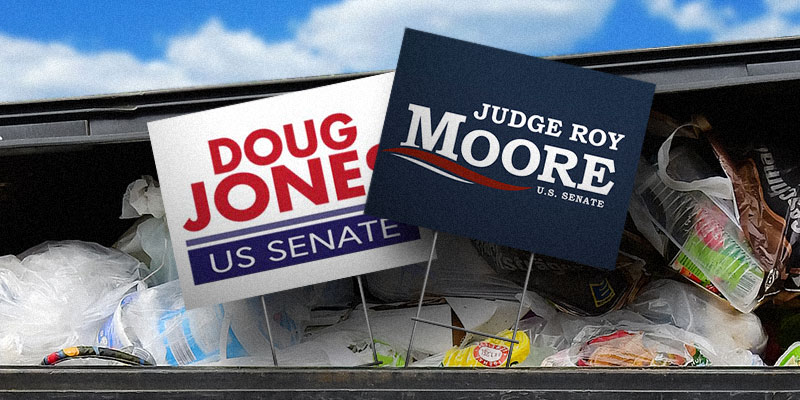
The people of Alabama would be well served if both Roy Moore and Doug Jones withdraw from the December 12 election, with both major parties formally acquiescing, effectively forcing the election to be postponed until November of next year.
Both candidates, or either, could run again next year, but without the circus atmosphere, confusion, and doubts engendered by post-primary allegations of super-serious moral transgressions by Moore.
Elections are meant to serve the public interest, not the ambitions of candidates.
Yet if the election is held in three weeks, almost any result will be seen as at least a somewhat illegitimate reflection of the actual will of the Alabama majority.
For purposes of this thought experiment, let’s assume that the two worst allegations against Moore – the disrobing and sexual touching of a 14-year-old, and the forceful groping and threatening of a 16-year-old – are not true. What remains is the likelihood, not even directly denied by Moore, that when he was in his late 20s and early 30s he regularly trolled the mall at least for older teens, whom he persisted in pursuing even after some of the girls/young women initially demurred. So many sources have independently described these habits of Moore’s that the odds they are untrue are very low.
If so, several considerations apply. First, even apart from what some describe as “creepiness” (a subjective standard indeed), behavior can be seriously wrong, and perhaps disqualifyingly immoral, without being illegal. It is one thing for a 32-year-old to happen to be impressed with a single 18-year-old who seems emotionally and intellectually mature, and to ask her out with her parents’ permission, and treat her like a gentleman treats a lady. (Such was one of the stories told about Moore.)
It is another thing entirely to regularly target girls or young women in that age range, including perhaps those under 18 even if technically over the legal “age of consent.” The latter behavior, if true, is quite arguably categorizable as predatory.
These highly credible stories (again, making no judgment on the two worst allegations) were completely unknown to almost every Alabama Republican voter during the two primary elections. They are of a nature disturbing enough that a sizable percentage of such voters might have voted differently if they had known. Back then, they did not have a full picture of Roy Moore. If indeed the new picture is true, it is not fair to those voters to present them with an entirely different choice than the one they thought they were giving themselves when they cast primary votes.
(And, of course, if the story involving the 14-year-old is true, then that alone should be utterly disqualifying of Moore. If it and some of the other more serious allegations are false, though, they are collectively one of the most horrid smears in American political memory.)
The only way to be sure voters have a fair choice is for Moore to run again in a new primary under his own power (or to choose not to do so), after having plenty of time to clear his name, and with voters having the chance to weigh all the information over a significant period of time.
Otherwise, Republican voters will have been unfairly treated, with their choices limited under less-than-fully-true pretenses. And they now face a choice between a nominee they now may believe is morally disqualified and a Democratic nominee whose beliefs they find utterly untenable.
That’s why it would be fair and reasonable for Moore to pull out of this election.
By logical extension, Jones would be right to do the same.
In considering this second assertion, let’s stipulate that if the election were only about what’s fair to Jones, the assertion isn’t entirely valid. It is decidedly not Jones’ fault that his opponent’s campaign may be imploding. Jones has run a marvelously astute political campaign with a brilliant series of TV ads, and he does seem to have an admirable record of public service. Serious candidates considered long shots enter races like this one hoping and knowing that their only likelihood of success will come from extraordinary luck joining their own competent campaigns – so of course they shouldn’t be punished when such luck does break their way.
On the other hand, this isn’t just ordinary luck, and his opponent isn’t facing just the ordinary sort of political allegations. No possible issue is more fraught with moral revulsion than the sexual abuse of a minor. If you’re Doug Jones, how could you live with yourself in knowing that a primary factor in your election is that a substantial portion of voters who otherwise would never vote for you are doing so because they believe (accurately or not) that your opponent is… well, a child molester?
And if you are Jones and you truly mean the election to be not about what is fair for you, but instead about doing right by the voters, then how can you countenance making Alabamans vote under such duress, without having a straight-up choice between two men and governmental philosophies hindered by accusations of ephebophilia?
If Jones really is who Alabamans want for their senator, he should be able to win in a “normal” election in 2018, not just in a morally compromised special election on December 12 of this year.
The only people who really ought to matter here are the ordinary citizens of Alabama. The “win-win” call is for both current nominees to pull out; for the election to thus be cancelled by mutual consent; for current appointee Luther Strange to serve through 2018 but promise that he won’t himself run next year (because he already has been rejected by the voters); for Jones to run again in 2018; and for Moore and state Republicans to decide what is best for themselves once the immediate smoke has cleared.
Is this practical? In today’s political world, not really. But would it be the best scenario for Alabama? Most certainly.
If Jones and Moore are true statesmen, they’ll both withdraw.
Yellowhammer Contributing Editor Quin Hillyer, of Mobile, also is a Contributing Editor for National Review Online, and is the author of Mad Jones, Heretic, a satirical literary novel published in the fall of 2017.
The Washington Week in Review highlights some of what Alabama’s congressional delegation has been saying and doing this week:
— Senator Luther Strange (R-Birmingham), who sits on the Senate Energy and Natural Resources Committee, announced the adoption of an amendment that he co-sponsored alongside Senator Bill Cassidy (R-LA). The measure amends the Arctic National Wildlife Refuge (ANWR) Reconciliation Bill, increasing caps on revenue distributed to coastal states in FY 2020 and FY 2021 from $500 to $600 million.
“Today’s vote by the Energy and Natural Resources Committee provides a unique opportunity to address a challenge facing energy producers in Alabama and across the Gulf Coast,” Strange said on Wednesday. “By raising revenue sharing maximums, our amendment would give future security to the thousands of Alabamians touched by the energy sector along our shore. I am proud to join Senator Cassidy in this effort, and look forward to our colleagues’ support on the Senate floor.”
— Senator Richard Shelby (R-Tuscaloosa) celebrated the passage of the National Defense Authorization Act for 2018, giving credit to his fellow Senator from Alabama for his efforts.
“I commend Senator Luther Strange for his work in the final Conference negotiations,” Shelby said. “This legislation not only strengthens our military, but it also provides our troops a pay raise and authorizes increased funding for many missile defense, aviation, and ground vehicle and Navy fleet modernization programs in Alabama. I am pleased to support the NDAA and will continue the effort to ensure that the brave men and women of our Armed Forces remain well-equipped, highly trained, and properly funded.”
— Congresswoman Martha Roby (R-Montgomery) in a House Judicial Oversight hearing this week raised concerns about the legal liability of websites whose users publish advertisements for prostitution and prostitution of children.
“I’m really interested in finding the right balance between protecting the freedom of expression and protecting the rights of young children, who are victims, who are being abused, without impacting the innovation of the internet,” Roby said.
— Congressman Bradley Byrne (R-Fairhope) voted on Thursday for the Tax Cut and Jobs Act, which passed with a vote of 227 to 205.
Byrne pushed back against claims that the bill is a giveaway to the wealthy.
“My colleagues on the other side like to say this bill helps the 1% and they vehemently defend the current tax code,” Byrne said in a speech on the House floor. “You know who benefits from the current code? The 1%. People who can hire lawyers and lobbyists to help them get a special tax break. People who can spend thousands of dollars a year on specialty accountants. If you want to help the 1%, then keep the current, complicated, and confusing tax code that only helps the elite and well-connected. We can do better than that.”
— Congressman Mike Rogers (R-Saks) also celebrated the House’s passage of a tax overhaul.
“I am proud this legislation passed the House today with my support,” Rogers said. ” This bill will help families across East Alabama and the nation keep more of their hard-earned paychecks and will help small business thrive and create new jobs. The bill will also close loopholes, end the Death Tax and protect folks’ IRA and 401k plans. I appreciate President Trump’s leadership on tax reform and am thrilled to see the House pass this important legislation today.”
— Congressman Gary Palmer (R-Hoover), who serves as chairman of the House Subcommittee on Intergovernmental Affairs, led a hearing last week examining the Trump Administration’s efforts to decrease the regulatory burden on vendors and the public. The committee heard from staff of the Department of Education, Department of Agriculture, and the Department of Health and Human Services, and members asked them what they and their agencies are doing to reduce the federal government’s regulatory footprint.
— Congressman Mo Brooks (R-Huntsville) voted for the passage of FY18 National Defense Authorization Act this week and celebrated the bill as a victory for both the nation and his district.
“As a member of the House Armed Services Committee, I was pleased to vote in support of the FY18 National Defense Authorization Act last night which authorizes America’s national defense programs,” Brooks said on Facebook. “Of particular interest to Redstone Arsenal and the Tennessee Valley, the NDAA includes significant funding increases for missile defense and allows Decatur’s United Launch Alliance to continue investing to replace the Russian RD-180 engine. The NDAA takes an important step toward restoring vital funding, modernizing equipment, and providing our warfighters with the weaponry needed to protect America.”