Grayson Everett is the editor in chief of Yellowhammer News. You can follow him on X @Grayson270.
The 2026 election season is upon us — and so is campaign fundraising.
According to filings with the Alabama Secretary of State’s Fair Campaign Practices Act (FCPA) database, no Democrats in the Alabama Senate have yet filed their June 2025 monthly reports for the 2026 cycle.
These reports, due on June 3, are the first monthly disclosures of the new election year and offer a real-time look at each candidate’s financial standing heading into the campaign season.
All members of the Alabama Senate filed year-end reports due in January 2025 to account for all raising and spending throughout 2024. This week, we got a glimpse into where their war chests stand with one year remaining in the current quadrennium.
“2024” accounts for the cash-on-hand totals reported in the 2024 annual reports filed while “Cash on Hand” designates where candidates reported standing in their June 2025 monthly report.
Republicans
Greg Albritton (District 22)
2024: $233,361.41 | Cash on Hand: Not yet filed
Gerald Allen (District 21)
2024: $164,274.22 | Cash on Hand: $163,290.73
Will Barfoot (District 25)
2024: $297,130.09 | Cash on Hand: $305,725.88
Lance Bell (District 11)
2024: $234,917.06 | Cash on Hand: $253,457.39
Tom Butler (District 2)
2024: $37,000.99 | Cash on Hand: $33,275.99
Josh Carnley (District 31)
2024: $177,645.80 | Cash on Hand: Not yet filed
Clyde Chambliss (District 30)
2024: $170,253.62 | Cash on Hand: Not yet filed
Donnie Chesteen (District 29)
2024: $294,893.34 | Cash on Hand: Not yet filed
Chris Elliott (District 32)
2024: $240,213.61 | Cash on Hand: $270,567.56
Sam Givhan (District 7)
2024: $475,090.47 | Cash on Hand: $481,315.20
Garlan Gudger (District 4)
2024: $246,423.75 | Cash on Hand: $203,784.98
Jay Hovey (District 27)
2024: $324,310.81 | Cash on Hand: $319,432.03
Andrew Jones (District 10)
2024: $223,406.33 | Cash on Hand: $284,449.12
Keith Kelley (District 12)
2024: $269,020.69 | Cash on Hand: $273,434.89
Steve Livingston (District 8)
2024: $268,797.01 | Cash on Hand: $258,963.01
Tim Melson (District 1)
2024: $344,231.27 | Cash on Hand: Not yet filed
Arthur Orr (District 3)
2024: $1,127,774.79 | Cash on Hand: $1,135,481.76
Randy Price (District 13)
2024: $217,427.94 | Cash on Hand: Not yet filed
Matt Woods (GOP nominee — District 5)
2024: $329,031.14 | Cash on Hand: $330,616.79
Dan Roberts (District 15)
2024: $447,181.66 | Cash on Hand: $449,326.87
David Sessions (District 35)
2024: $327,732.30 | Cash on Hand: $325,422.30
Shay Shelnutt (District 17)
2024: $307,859.02 | Cash on Hand: $314,198.57
Larry Stutts (District 6)
2024: $51,167.80 | Cash on Hand: Not yet filed
J.T. “Jabo” Waggoner (District 16)
2024: $455,142.31 | Cash on Hand: $448,818.76
April Weaver (District 14)
2024: $240,376.35 | Cash on Hand: $250,286.81
Wes Kitchens (District 9)
2024: $49,872.97 | Cash on Hand: $82,427.15
Democrats
Billy Beasley (District 28)
2024: $111,240.53 | Cash on Hand: Not yet filed
Merika Coleman (District 19)
2024: $61,667.67 | Cash on Hand: Not yet filed
Linda Coleman-Madison (District 20)
2024: $280,845.70 | Cash on Hand: Not yet filed
Vivian Davis Figures (District 33)
2024: $2,197.55 | Cash on Hand: Not yet filed
Kirk Hatcher (District 26)
2024: $86,850.88 | Cash on Hand: Not yet filed
Bobby Singleton (District 24)
2024: $312,978.54 | Cash on Hand: Not yet filed
Rodger Smitherman (District 18)
2024: $144,244.84 | Cash on Hand: Not yet filed
Robert Stewart (District 23)
2024: $14.15 | Cash on Hand: Not yet filed
Riley Gaines, a former University of Kentucky swimmer turned conservative activist, is setting her sights on some Alabama lawmakers’ ongoing effort to reform the practice of pharmacy benefit managers (PBMs) within the state.
This morning, Gaines utilized her platform to argue current proposed reform measures will levy a prescription tax at the expense of consumers. On Wednesday, members of the Alabama Senate Banking and Insurance Committee will consider SB99 and SB93.
RELATED: Debate over independent pharmacy closures, costs intensifies at public hearing
“The Alabama Legislature is pushing a prescription tax that will pad Big Pharma’s pockets while costing consumers and businesses millions,” Gaines wrote.
“Instead of letting President Trump and RFK hold Big Pharma accountable, these so-called ‘Republicans’ are doing their bidding.”
https://x.com/Riley_Gaines_/status/1902004297916612683
To her point about President Trump and Health and Human Services (HHS) Secretary Robert Kennedy Jr. making PBM reform a federal priority, she reshared news coverage regarding a timely push to overhaul pharmacy benefit managers at the federal level.
President Trump recently expressed optimism about federal reform, confirming that both the U.S. House and Senate are progressing with bipartisan legislation to address PBMs’ role in drug pricing. The legislation aims to decouple PBMs’ compensation from drug prices, ban spread pricing for Medicaid, and introduce several measures to rein in the power of PBMs, which Trump has vowed to “knock out.”
Last month, Gaines also posted her support for Alabama lawmakers’ effort in passing State Sen. April Weaver (R-Briarfield) and State Rep. Susan Dubose’s (R-Hoover) ‘What is a Woman Act’ to protect women’s and girls athletics and public spaces within the state.
https://x.com/Riley_Gaines_/status/1887587676381127121
Grayson Everett is the editor in chief of Yellowhammer News. You can follow him on X @Grayson270.
As Alabama lawmakers are debating major legislation to reform pharmacy benefit managers within the state — President Trump recently confirmed that federal-level reform is imminent.
During an interview with the president last week, Matthew Foldi reported, “President Trump sounded optimistic on the prospects of getting it done before the end of the year, saying “I know [the Senate] is looking at it very very strongly.”
Trump has repeatedly vowed to “knock out the middleman” in drug pricing.
Both the U.S. House and Senate are now moving forward with bipartisan legislation aimed at delinking PBMs’ compensation from drug prices, banning spread pricing for Medicaid, and a range of other measures to accomplish Trump’s mandate.
Last week, House GOP leaders announced they will re-include PBM reform in their reconciliation bill after efforts broke down in the 118th Congress last year, while the Senate formally revived their efforts last week as well in the form of a bipartisan bill that would overhaul the business practices of PBMs.
RELATED: Debate over independent pharmacy closures, costs intensifies at public hearing
Impending federal reform might complicate efforts on the state legislative level to address PBMs as strongly as two proposals before the Alabama Senate currently intend.
Two competing bills — SB93 and SB99 — are expected to come up for debate and a vote in the Alabama Senate Banking and Insurance Committee after an initial public hearing in February drew testimony in support and opposition to the proposals.
SB93, sponsored by State Sen. Andrew Jones (R-Centre), seeks to prohibit PBMs from reimbursing pharmacies below their actual acquisition costs and to ban hidden fees related to claims processing and network participation. It would also allow pharmacists to refuse dispensing medication if reimbursement rates are too low.
SB99, sponsored by State Sen. Larry Stutts (R-Tuscumbia) takes a far more aggressive approach with a mandated dispensing fee on every prescription filled and a requirement for PBMs to reimburse pharmacies based on the national average drug acquisition cost.
Lawmakers will return to session on Tuesday for day fourteen of the 2025 legislative session.
Grayson Everett is the editor in chief of Yellowhammer News. You can follow him on X @Grayson270.
Lawmakers, advocates and opponents converged for a public hearing today on a controversial topic in the Alabama Senate today over two competing bills proposing to reform pharmacy benefit managers (PBMs) within the state.
Independent pharmacists and supporters of reform flooded the State House today advocating primarily for SB99.
No vote was held today, but members of the Alabama Senate Banking Committee heard from independent pharmacists themselves and opponents from employer groups one after another.
Bobby Giles of the Alabama Pharmacy Association told lawmakers, “A pharmacy cannot sell a medication at or below cost and continue to serve patients. That is as simple as it gets.”
Giles and other advocates argued that reform is needed to enhance transparency and fair reimbursement, preventing PBMs from paying their own pharmacies more than they pay independents. For Giles, SB93 specifically is the correct way to accomplish that.
SB93 is sponsored by State Sen. Andrew Jones (R-Centre) while SB99 is backed by State Sen. Larry Stutts (R-Tuscumbia), both attempting to overhaul how PBMs operate in Alabama.
However, their approaches differ, and the battle lines were drawn as pharmacists, business leaders, and lawmakers were curious to hear their merits.
SB99 is backed by a larger group of 21 senators and takes a tougher stance: Requiring PBMs to reimburse pharmacies based on the National Average Drug Acquisition Cost (NADC) plus a mandated dispensing fee.
Despite some disagreement over which bill best accomplishes the goal, all pharmacists advocating for reform each argued that the need is urgent.
Anna Nugent, a second-generation pharmacist, fought back tears as she described the dire state of independent pharmacy in Alabama. “We are in a crisis, and our time is running out. Many will close their doors if help isn’t granted this legislative session.
Greg Raybould of the American Pharmacy Cooperative showed legislators a chart that demonstrated how PBMs reimburse independent pharmacies less than they pay themselves through their mail-order services. “They are forcing patients to their own mail-order pharmacies, and then charging thousands of dollars more. It’s price manipulation,” he said.
RELATED: Alabama healthcare group pushes back against pharmacy reform bill, citing costs
Representatives of major employers and business groups pushed back against both bills, particularly SB99, which includes a $10.64 dispensing fee per prescription — a provision they say unavoidably will drive up healthcare costs for consumers and businesses.
Robin Stone, director of the Alliance of Alabama Healthcare Consumers cited an analysis estimating $347 million in new prescription spending in the first year alone if either bill passes.
“These fees will be passed down,” he said. “Employers will have to pay more, and ultimately, employees will see higher premiums and out-of-pocket costs.”
RELATED: Independent pharmacies continue push for reforms to combat PBM practices in 2025
Senators wrestled with competing data, arguments and emotional testimonies.
State Sen. Chris Elliott (R-Josephine) pressed opponents on their claims that PBMs save money, pointing to the independent pharmacists’ data showing the opposite. State Sen. Rodger Smitherman (D-Birmingham) pushed back against the idea that businesses would simply absorb higher costs, saying, “We want our pharmacists to survive. But we also have to ask: Where does this cost land?”
State Sen. Dan Roberts (R-Mountain Brook) challenged business leaders to propose a real solution instead of just opposing reform: “We know independent pharmacies are getting crushed. What do you think the solution is?” he asked opponents.
State Sen. Merika Coleman (D-Birmingham) requested to see hard data from opponents. “We have data from pharmacists showing their losses. You’re citing $347 million in new costs — can you provide the breakdown of that?” Stone promised to send it to her office.
At the end of over an hour-long hearing, Stutts urged passage of his version of the legislation, and said he was confident the committee should be in a position to do so next week. If passed, that bill would go to the floor of the Alabama Senate.
Wednesday was day eight of the 2025 state legislative session.
Grayson Everett is the editor in chief of Yellowhammer News. You can follow him on X @Grayson270.
Two bills have been filed in the Alabama Senate that would reform the practice of Pharmacy Benefit Managers (PBMs) within the state, as federal lawmakers consider a path forward as well.
The fight over PBM reform at the State House has lurched throughout the current quadrennium after a similar measure died in the Alabama House last year. Now, it’s heating up again in the 2025 session.
SB93, filed by State Sen. Andrew Jones is viewed as a milder option to SB99, filed by State Sen. Larry Stutts, as the full-scale alternative.
SB93, sponsored by Jones (R-Centre) and eight other lawmakers, would prohibit PBMs from reimbursing pharmacies less than their actual acquisition costs and ban hidden fees related to claims processing and network participation.
The bill would also enable pharmacists to disclose drug pricing information to consumers and allow them to refuse to dispense medication if reimbursement rates are too low.
SB99, sponsored by Stutts (R-Tuscumbia) and backed by a larger group of 21 senators, takes a tougher stance: It requires PBMs to reimburse pharmacies based on the National Average Drug Acquisition Cost (NADC) plus a mandated dispensing fee.
RELATED: Debate over pharmacy reimbursement bill expected to intensify (2024)
Jones said legislation is needed to curb what he calls “unchecked” practices by PBMs, which he argues are hurting independent pharmacies across the state.
“Independent pharmacies all across Alabama are closing their doors because of unchecked corporate greed by PBMs. In many cases, these PBMs pay pharmacists less than the cost of the drugs they prescribe,” Jones said in a statement to Yellowhammer News.
“SB 93 will stop this by mandating fair payments. These payments are prohibited in law from being charged to the patient. The bill also empowers pharmacists to reject prescriptions that lose money and enables them to have honest conversations with their patients.
“PBMs know that what they are doing is wrong, that’s why they’ve been hitting pharmacists with gag clauses and stifling free speech. It’s time to put that to an end,” Jones said.
RELATED: Independent pharmacies continue push for reforms to combat PBM practices in 2025
Stutts framed the issue in broader terms, arguing that PBMs function as unnecessary middlemen.
“The independent pharmacists across the state are really struggling,” Stutts said Monday morning on FMTalk 106.5’s The Jeff Poor Show. “PBMs don’t really bring anything to the system. There are only so many healthcare dollars that are split up between pharmacists, doctors, hospitals, nursing homes, whatever, and the PBMs are an unnecessary middleman that does not save anybody any money.
“If you look back several years, PBMs started vertically integrating their system where they own pharmacies,” he said. “The pharmacies that they own are competing with independent pharmacies, and the PBM gets to set the price for all of the pharmacies within their network. They set the prices for independent pharmacies below what the acquisition costs are on many of their claims,” Stutts said.
RELATED: Alabama healthcare group pushes back against pharmacy reform bill, citing costs
The most active industry group on the issue, Alabama Alliance of Healthcare Consumers (AAHC), says both bills will not solve the problem at the core of the debate: Rising healthcare costs and skyrocketing drug prices from national manufacturers.
“Imposing a permanent fee on every prescription filled in Alabama is not a solution to the problem of rising drug costs; the new $10.64 dispensing fee designated for pharmacy owners is a costly burden that will ultimately create more problems for consumers and employers,” says Robin Stone, president of AAHC said on Monday.
“Families and employers need help to reduce their prescription drug costs; new fees will add more costs. Both bills fail to address the exorbitant drug prices set by drug manufacturers. This approach ignores the real driving source of rising healthcare costs – skyrocketing drug prices from national manufacturers.
“If this new proposed $10.64 dispensing fee for pharmacy owners is approved, it will be forced down the supply chain and will be paid by employers, families, and other consumers, and not Pharmacy Benefits Managers. These proposals will cost Alabamians at least an extra $900 per person or $3,600 for a family each year.”
Tuesday will be day four of the 2025 state legislative session.
Grayson Everett is the editor in chief of Yellowhammer News. You can follow him on X @Grayson270.
On Thursday, the Alabama State Senate and House of Representatives passed legislation to protect in vitro fertilization (IVF) therapy in the state. One of those proposals is expected be agreed upon by both chambers of the Alabama Legislature and signed by Governor Kay Ivey as soon as Wednesday.
The approach taken by Republican lawmakers will offer criminal and civil immunity to doctors and other medical professionals performing IVF treatments. The timely effort came after an Alabama Supreme Court ruling on February 16 stating that embryos produced by IVF legally constitutes a person under the Alabama Constitution.
Clinics across the state suspended their IVF services out of concern over potential civil and criminal liability.
“This bill — the provisions only relate to in-vitro fertilization,” State Sen. Tim Melson explained on Thursday. Melson is a practicing physician in Alabama. It’s now known he, along with another physician legislator, State Sen. Larry Stutts (R-Tuscumbia) played a key role in lawmakers’ effort to safeguard protections.
“They provide civil and criminal immunity to a point and the immunity does not provide for damage or death of an embryo; so we are not going to give those coverage,” Melson said. “Only in normal standard way of handling them. They are still going to be susceptible to be – I will just call it malpractice if something happens. It doesn’t give them coverage for that.”
“There is no expiration on the date of this bill,” Melson said. “I don’t want people to get into the procedures or the process and fear they may have to stop again.”
RELATED: Reed, Ledbetter detail Alabama lawmakers’ approach to IVF: ‘Be very focused, get wise counsel’
Senate Minority Leader Bobby Singleton (D-Greensboro) blamed Republicans for creating this situation by passing a 2019 amendment to ban abortion.
“This is one of those I told you moments that you were trying too far,” Singleton said.
“You were going too far trying to define what life is, going too far trying to get ahead of Roe versus Wade. Something that we didn’t have anything to do with here in the state of Alabama and that was going to have to be dealt with at the national level. All we had to do was stand and wait. Roe versus Wade got overturned; and yet we wanted to make sure that we had our states right to do what we want. Now we have these mothers, these precious mothers, now sitting in prayer not knowing what is going to happen to their babies. Those babies that are sitting somewhere in a freezer because the Supreme Court of the State of Alabama has said that it is life and they are now babies.”
Singleton suggested that under Alabama law killing an IVF embryo could be prosecuted.
Melson responded, “Under Alabama law it is not murder if it is not in utero.”
Meanwhile on Thursday, the Alabama House of Representatives also ushered a safeguard for the practice and accessibility of IVF to passage. The House version of the bill was sponsored by State Rep. Terri Collins (R-Decatur).
“This is an agreed upon bill that will open the clinics and let the process that those women are already in the middle of proceed,” Rep. Collins said. “This bill would provide civil and criminal immunity for death or damage to an embryo to any individual or entity when providing or receiving goods or services related to in-vitro fertilization and this bill would provide for retroactive effect.”
“This is about a liability immunity,” said Collins. “It is not where we want to do it. It is not going to long term do it. We will need to work together to continue to work on this problem. But right now, we wanted to get the clinic open for the families that were using them. It does not have a sunset date.”
Four Democrats voted against the bill, arguing they want to revisit the Alabama Constitution and change the life begins at conception principle enshrined there, as agreed upon by voters in a 2018 statewide referendum.
Rep. Juandalynn Givan (D-Birmingham) expressed concern about giving the clinics immunity.
“When I came here in 2010, and that’s been almost 14 years ago, I noticed a trend here in the State House — and every bill that we had for a period of years was giving someone immunity in this state,” said Givan.
“I am not in favor of giving a doctor immunity for anything. One of these women could die. Could die just trying to figure out a pathway to give life. What we are going to pass right now gives a pathway for a doctor to commit an act and as we term it – as long as he is exercising best practice. That is a dangerous term in the medical field.”
Rep. Ernie Yarbrough (R-Trinity) argued that the Legislature should pause IVF treatments in Alabama until the Legislature can figure out how to let the clinics proceed.
“My conscience is absolutely on fire about this,” Yarbrough said.
“I asked our visitors the other day, ‘what about embryos?’ – children – that are left over? I was told we need to be able to discard embryos that parents do not want. I was told by doctors in lab coats that we need to be able to destroy embryos that we think may have genetic issues. You mean genetic issues like downs syndrome babies, like special needs babies?”
Yarborough submitted an amendment to the bill, triggering an extreme pro-life vote for state lawmakers, which became the subject of negative advertising against them over the weekend.
RELATED: Trump calls on Alabama lawmakers to ensure IVF availability – ‘I strongly support’
Some Republicans were concerned that the effort to reopen the IVF process would have unintended consequences and legally jeopardize the state abortion ban.
Rep. Jim Carns (R-Vestavia Hills) expressed concerns that removing the sunset date of June 1, 2025 provision from the first version of the bill could, “lock us into unintended consequences.”
“I think we all want to keep the clinics open,” Carns said. “I wasn’t aware of this two weeks ago, and suddenly this becomes the biggest problem facing the state.”
Rep, Mark Gidley (R-Gadsden) said, “Alabama is probably one of the most pro-life states in the nation. We cannot allow anything to interfere with our pro-life stand and the fact that life begins at conception. That is not just a moral principle; but a biblical principal as well.”
“I am very concerned about us removing the sunset,” said Gidley. “Two weeks ago none of us realized that we were going to have this issue.”
“One of my main concerns is the fate of the embryos that are not used,” said Gidley. “I am not pleased with taking out the sunset.”
Gidley wanted to add language so that the unused embryos could not be used for scientific and medical research.
“I think it is very important that we have some regulation on these facilities,” Gidley said. “That embryo would not grow if it was not alive. It is a life.”
RELATED: Governor Kay Ivey: In vitro fertilization ‘fosters culture of life’
Reps. Givan and Moore voted “No” along with Rep. Barbara Boyd (D-Anniston) and Patrick Sellers (D-Birmingham) on the Democratic side. Yarbrough and Ben Harrison (R-Elkmont) also voted “No.” Carns, Gidley, and Phillip Rigsby (R-Huntsville) voted to abstain.
HB237 passed the House 94 to 6. It now goes to the Senate, which passed its own version also on Thursday.
On Friday, Alabama Speaker of the House Nathaniel Ledbetter (R-Rainsville) said that the Legislature will continue to allow fertility clinics to operate in the state. “I’m proud the House voted to pass HB237,” Speaker Ledbetter said.
“Alabama’s IVF clinics play a crucial role in our state’s commitment to fostering a culture of life. Ensuring they have the necessary protections to continue serving hopeful parents is what’s right for our state.”
To connect with the author of this story, or to comment, email brandonmreporter@gmail.com
Yellowhammer News hosted its annual panel discussion Wednesday with the President Pro Tempore of the Alabama Senate and Speaker of the Alabama House of Representatives.
Now in year two of the quadrennium, it was the second installment of the event featuring Pro Tem Greg Reed and Speaker Nathaniel Ledbetter alongside one another as leaders of their respective chambers.
Also on Wednesday, both House and Senate committees overseeing health-related legislation advanced bills designed to safeguard families and providers of in vitro fertilization (IVF) in the days following an Alabama Supreme Court ruling that called the legality of the process into question.
Pro Tem Greg Reed offered a play-by-play of how GOP senators handled the gravity of the situation as it unfolded last week and the process by which they furnished a solution.
“This was a very significant issue to me and Alabamians,” said Reed (R-Jasper). “It was a very emotional topic, and rightfully so. But I don’t have, we don’t have, many of our members do not have, a medical background. We have two medical doctors that are in the Senate: Tim Melson, Larry Stutts.
“We had a section in our caucus meeting where we stopped everything we were doing in the caucus meeting. Those two men took over the conversation, and for 20 minutes, explained what is going on here and why this is such an important issue – what happens with the procedures, why the procedures are done the way they are, all the elements associated with it – which was exactly what we need to do on that topic.
“First off, what we tried to tell our members was, ‘slow down, even though it’s very emotional, we can’t make a bad decision on something just over the weekend.’ So, we slowed down and we took a look at it.”
Ledbetter shared that a neighbor’s family member called him to say she and her husband were about to start the clinical process just a week after the ruling was handed down.
“All the money that they had spent, and all the shots and everything she had taken to get ready, if she couldn’t do that, she loses all of that,” Ledbetter (R-Rainsville) said. “All of us have been affected by it, including myself, and families that have went through the process. I had calls from a number of our members saying, ‘hey, what are we gonna do? This is important to people in my district, and important to the families, important to my family.’
“We knew we had to do something.”
RELATED: Governor Kay Ivey: In vitro fertilization ‘fosters culture of life’
Reed and Ledbetter offered assurance that further action will take place in the coming days, and commended their members for prioritizing it during a busy session. Each leader also expressed why untangling the ruling from well-established principles around the sanctity of human life in the state is a worthy task for lawmakers.
“Alabama’s a pro-life state,” Reed said. “Our people voted on a constitutional amendment to say, ‘that’s who we are.’ At the same time, we want Alabama families to grow and flourish. Alabama is the best place in the world to be able to raise a family. We just needed to slow down a little bit, be very focused, get wise counsel.
“I think we’ve done that to be able to make a good decision.”
Ledbetter said, “It’s important to this state – and it’s as pro-life as anything we can do.”
Grayson Everett is the state and political editor for Yellowhammer News. You can follow him on Twitter @Grayson270.
State lawmakers from both parties introduced bills this week with the goal of protecting in vitro fertilization (IVF) providers from legal liabilities following a February 23 ruling by the Alabama Supreme Court that defined frozen embryos as “children” – leading many clinics to suspend their services to families in the days following the ruling.
State Sens. Tim Melson and Larry Stutts, two North Alabama doctors who serve over the Senate Healthcare Committee are carrying two bills to shield entities and individuals involved in providing IVF services from criminal and civil actions except in cases of intentional misconduct unrelated to IVF services.
RELATED: Governor Kay Ivey: In vitro fertilization ‘fosters culture of life’
On Wednesday, State Sen. Larry Stutts (R-Tuscumbia), led members of the Senate Healthcare Committee to move forward those bills, which have crystallized as the official GOP legislative solution to concerns from both patients and providers.
“You know, I have practiced OBGYN For 31 years in Alabama and have referred many, many patients for infertility treatment and have delivered many babies that are a result of IVF treatment,” Sen. Stutts said. and “I have, I think, a unique understanding and position of what these issues are.”
The committee approved both SB159 and SB160, which could be signed by Governor Kay as soon as next week if agreed on by both the House and Senate.
“We simply need to say what you’ve been doing is working and you were doing it before a couple of weeks ago, and you can start back doing it now because we’re going to protect you from that civil and criminal liability,” Stutts said.
“I don’t think we ought to legislate a standard of care,” Stutts said. “The American Fertility Society takes care of that. The practice of infertility medicine has evolved over the years, and is better now than it has been.”
Senate Republicans also advanced HB160 by State Sen. Tim Melson (R-Florence), which was substituted with language removing a retroactive provision and an automatic repeal provision. Melson said, with those changes made, and this bill in place, patients are the highest priority.
“My bill, I vetted it through UAB and Cooper Surgical, which makes the supplies – and also the trial lawyers – to make sure that we got to a spot that not all of them were completely happy, but they realized they had to give and take to help these individuals, which is the whole goal, is to help the patients of Alabama,” Sen. Melson said.
RELATED: Trump calls on Alabama lawmakers to ensure IVF availability – ‘I strongly support’
In the lower chamber of the Alabama Legislature, support for a much heavier-handed solution to the Alabama Supreme Court ruling is being promoted by Democrats.
On Tuesday, House Minority Leader Anthony Daniels (D-Huntsville) introduced legislation that would overturn the ruling through a constitutional amendment designed to entirely redefine the status of extrauterine embryos in contrast to a 2018 amendment that affirmed the sanctity of unborn life. Such an amendment would require Alabama voters to again decide on the issue.
Daniels’ bill would amend the Alabama Constitution to define that an extrauterine embryo, fertilized or not, is not considered to be any form of personhood for any purpose under law.
That proposal signed onto by all members of the House Democratic Caucus.
“I think anything short of actually pausing the Supreme Court decision is not something that I am particularly excited about,” Daniels told Yellowhammer News.
“Because I think that if there’s still these questions, and uncertainty, then it causes more confusion long term. The Supreme Court decision can’t be any more anti-life, right? It’s the opposite,” Daniels said. “Because if life is what we’re focusing on, and this is the last, best option for parents and families to give them hope of having a child one day, I can’t see how anyone would want this decision to stand.”
RELATED: Britt says in vitro fertilization is pro-family, ‘deserves protection’
In the House, State Rep. Terri Collins (R-Decatur) is carrying the companion bill to Republicans’ fix, as advanced by the Senate Healthcare Committee today. Changes made by Senators are expected to be adopted by the House Health Committee later today.
“From the moment the House became aware of the recent Alabama Supreme Court Ruling, we made it a priority to take the steps necessary to protect our IVF clinics and allow them to continue assisting hopeful parents,” Alabama Speaker of the House Nathaniel Ledbetter said. “Providing temporary immunity to IVF clinics gives them the security and assurances needed to reopen immediately while also allowing the House and Senate ample time to develop an airtight, permanent solution.”
Grayson Everett is the state and political editor for Yellowhammer News. You can follow him on Twitter @Grayson270.
Alabama is a conservative state, and the citizens of our state have never shied away from standing up for their values.
In Alabama, there are bedrock principles by which we live and govern.
We’re steadfast in our faith in God. We defend the rule of law. We protect individual freedoms and innocent life. We work to ensure safe communities for our families. For these reasons, we have earned the distinction of being the nation’s most conservative legislature.
These are Alabama’s priorities, and they are the priorities of Republicans in the Alabama Senate.
No greater priority exists than ensuring the integrity of our elections. That’s why our chamber plans to fix the problem of ballot harvesting when we convene for the regular session on February 6. We want to make sure that absentee ballots are handled and cast the right way.
Senator Garlan Gudger is sponsoring a bill which will be a priority for Republicans in the Alabama Senate. His bill will end the cottage industry of absentee ballot collection in our elections.
Voting is a right that is foundational to our democracy, and we need to make sure that legitimate votes are not being diluted by fraudulent votes. That is why we need stricter laws preventing the unscrupulous pursuit of absentee votes for financial gain.
Legitimate use of absentee ballots will fully remain an option, and there is current federal law that outlines specific protections for veterans and people with certain disabilities that our legislation will not affect. The main goal of these efforts will be to make sure that your vote counts, and that those who try to cheat our system are held accountable. We want Alabama’s election laws to be the strongest in the country.
The time is also now for impactful school choice in Alabama. Senator Arthur Orr and Senator Larry Stutts have spent considerable time looking at our state education budget and researching this issue in order to give Alabama families the ability to make decisions regarding their children’s educations.
Children are gifts from God, and they are the future of our great state.
It is important for us as legislators to allocate resources in fiscally responsible ways to ensure that kids in our communities have every opportunity to be successful. A family’s zip-code should not be the primary indicator of a child’s educational outcome, and we are committed to giving families in Alabama the ability to make decisions regarding their child’s schooling.
It has become increasingly clear that unanticipated property tax hikes have burdened Alabama families and businesses. Senator David Sessions has dedicated much effort to solve this problem.
Under Joe Biden’s administration, inflation has been debilitating to many families, and unexpected property tax increases only further affect Alabamians’ ability to maintain their current quality of life. Senator Sessions has been working hard to come up with a plan to place some limits how much local authorities can increase property taxes.
Alabama families work hard each day to provide for their families, and we are committed to continuing to provide ways that they can keep their hard-earned dollars.
The Alabama Senate is committed to conservative governance. Alabama families and future generations deserve nothing less. Alabama is the best state in the country to live, work, and raise a family, and I am excited to help shepherd these impactful pieces of legislation forward.
Greg Reed is President Pro Tempore of the Alabama State Senate, representing the people of District 5.
In a Senate meeting Tuesday that overcame a bipartisan filibuster, lawmakers gave the green light to modify and reinvest in the Alabama Accountability Act. The legislation was initially passed in 2013.
Sen. Donnie Chesteen (R-Geneva) ultimately led the chamber to passage in a 26-7 vote. His bill proposes enlarging the educational tax credit program that aids students in underperforming schools to transition to a better-performing public or private schools.
It would raise the household income limit for scholarship recipients from $55,500 to $75,000 to expand the number of students eligible. The proposed eligibility would also include students with learning and physical disabilities.
Addressing a feature of critical feedback of the act, the bill would redefine the terms “failing school” and “non-failing school” to “priority school” and “qualifying school.”
Democrats and Republicans took turns filibustering the bill – each for their own reasons. The debate came to an end following a cloture motion passed shortly before 9 p.m.
While Democrats revived arguments about a diversion of public education funding bill, Sen. Larry Stutts (R-Sheffield) made an extensive case for his own school choice legislation.
Ultimately, all Republican senators voted in favor of the bill.
“The expansion of the Alabama Accountability Act opens the doors for more students to participate in this already successful tax credit program,” Senate Pro Tem Greg Reed said following passage. “Creating and expanding educational opportunities for our state’s children has been and will continue to be a top priority for the Alabama Legislature.”
Chesteen remained positive, noting the Alabama Accountability Act has been on the books for 10 years now.
“Senate Bill 263 is a victory for all Alabamians, especially our school-age children,” said Chesteen. “By expanding access to scholarships, and enhancing tax credits, my hope is that this bill paves the way for greater educational opportunities and empowers families to ensure their children’s success.”
It now heads to the Alabama House of Representatives for further consideration.
Grayson Everett is a staff writer for Yellowhammer News. You can follow him on Twitter @Grayson270 for coverage of the 2023 legislative session.
This was a big week in the Legislature for education and, in particular, school choice.
With only 10 days of the regular session remaining and state budgets still to be authorized by their corresponding chambers – lawmakers are becoming increasingly focused on what’s attainable.
Advocates and lawmakers identified school choice as a priority going into the regular session – seeking to make further gains in a state that ranks 16th in educational freedom, according to a Heritage Foundation index.
As their scorecard puts it, “Alabama could improve its ranking by establishing K-12 education savings accounts, expanding eligibility for, and boosting participation in, its private-school-choice program, making it easier for more charter schools to open and operate; and giving families more choices among traditional public schools.”
Even as the 2013 Alabama Accountability Act approaches a 10-year landmark as the basis for Alabama’s school choice inventory, it’s still a work in progress.
Sen. Donnie Chesteen (R-Geneva) has a bill that would increase the scholarship amount for elementary and middle school aged students to $10,000 per year for transfer from a “failing” public school to private.
Currently, there are two school choice proposals moving through the Legislature that address an education savings account (ESA) – a framework in use by Florida, Tennessee, Mississippi and Georgia. Generally speaking, ESAs are designed to provide parents more control and flexibility in their children’s education by purposing state funds for use outside the public school system.
This week, the Legislature advanced two school choice proposals and introduced another into the mix. In the Senate, the PRICE Act was given a favorable report in committee, the SUN Act was approved by a full vote of the House, and the Alabama Fits All Scholarship Program was introduced.
Student with Unique Needs (SUN) Act
Passed by the House on Thursday, the SUN Act would create a $5,600 ESA for parents of children enrolled in public school who meet a particular criteria, such as those who have an individual education plan or recognized disability. Other criteria include children of active, former or fallen armed service members, and foster or adopted children.
In its initial year, the program would be limited to 500 scholarships, set to increase by an additional 500 scholarships each subsequent year, beginning in 2024. It comes with a fiscal note of $3 million.
The SUN Act is one of two school choice bills brought by House Education Budget Chairman Danny Garrett. He said it’s in line with Florida, Mississippi and Tennessee’s versions of school choice.
“Some of the public schools, like in my district, we have a public school that does an outstanding job in our system with special needs children,” Garrett (R-Trussville) said. “But then I also have systems in my district where that’s not the case. And there’s a lot of children who are just in a place where parents really have a lot of burden, and a lack of resources to help.”
Among all school choice bills, educational benchmarks are a topic of discussion. The SUN Act received an amendment by Rep. Terri Collins requiring recipients to undergo standardized tests administered by their respective resident school districts.
“This is the more fair and accurate thing,” Collins (R-Decatur) said. “And that’s why I want those parents to have that accountability. I want prospective parents to be able to see how is this private school doing, how is this different program doing?”
Parental Rights in Children’s Education (PRICE) Act
Introduced by Sen. Larry Stutts (R-Tuscumbia), the PRICE Act would establish a universal educational savings account eventually available to all students in Alabama. As outlined in the bill, ESAs could be utilized for various educational options, including private, online or home schooling.
That account would offer parents up to $6,900 per child of state education money to pay for educational-related expenses like tuition, textbooks and tutoring. The Alabama Department of Revenue would administer the program with a 13-person advisory board.
On Wednesday in committee, Stutts amended the bill to cap the impact on the Education Trust Fund to $50 million during the initial three-year period. Prior to the amendment, the bill came with a $576 million fiscal note.
“That’s one of the beauties of the details of the act is that it’s universal. You can participate, you can not participate. If you don’t participate, then nothing changes,” Stutts said. “If you do participate, then you could be a homeschooler. You could be in charter school, you could be in private school. But there’s a long list of things that are approved educational expenses. But tuition is obviously the first one.”
The Alabama Republican Party released a statement supporting the bill.
“School choice legislation like the PRICE Act will give Alabama students the opportunity to reach their full potential by allowing their parents the ability to choose an academic environment where their child can best thrive,” party Chairman John Wahl said.
After the price cap amendment was introduced, Senate Education Budget Chairman Arthur Orr (R-Decatur) said Wednesday he wanted to get the bill through the committee, recognizing progress had been made.
“Before it hits the floor, we still have a lot of work to do,” Orr said. “I’m also interested to see what Chairman Garrett in the House has filed, based on the Utah model.”
Alabama Fits All Scholarship
As the SUN and PRICE Act advance through the process, another proposal by Garrett will quickly enter the conversation. The Alabama Fits All Scholarship Program would create a scholarship program for eligible students to pay for private school tuition and education-related expenses.
Garrett said it’s very imilar to Utah’s landmark legislation expanding school choice.
“It’s universal school choice,” Garrett told Yellowhammer News. “I filed the same bill for Alabama and the Alabama version of that with a $45 million cap, which will benefit about 6,000 students.”
It would be overseen by the State Board of Education, which would establish scholarship accounts on behalf of eligible students and distribute scholarship funds.
“When I did the research and looked, I found there were only 100,000 ESAs in the entire United States. And being a data guy, I want to understand why is that?” Garrett said. “Even though we’ve heard a lot with the school choice bills, and the universal choice bills, we had not seen a growth in ESA.
“Now, if you look at the 100,000 ESAs in the country, I think about 60,000 of those are in Arizona, so that’s been where most of the growth in the ESAs has come. But the other states tend to have universal choice to the extent that everybody qualifies for it, but it’s not available to everybody.
“It’s going to be a discussion that continues and evolves.”
Grayson Everett is a staff writer for Yellowhammer News. You can follow him on Twitter @Grayson270 for coverage of the 2023 legislative session.
Today begins the ninth full week of the 2023 regular session; there are 12 legislative days remaining.
Here are some things to watch this week:
Education Budget
After a unanimous passage by the Senate, the $8.8 billion Education Trust Fund budget and its $2.8 billion supplemental makes its way to the House. The base budget varied slightly from the version sent by Gov. Kay Ivey, while the supplemental spending proposal, dealing with the historic surplus, changed drastically. Senate Finance Committee Chairman Arthur Orr (R-Decatur) hands the process off to House Ways & Means Education Committee Chairman Danny Garrett (R-Trussville).
It’s not a given the budget will make an appearance in House Ways & Means Education this week — much less land on the floor for full passage. There’s still talk of zeroing out the $275 million appropriation for $100 direct rebates to taxpayers to make way for alternate funding discussions that began in Senate deliberations.
Grocery Tax
Expect further movement on grocery tax cuts to be a post-ETF undertaking. Lt. Gov. Will Ainsworth and Sen. Andrew Jones (R-Centre) proposal to gradually eliminate the tax is signed onto by all members of the Senate. Other variations of a grocery tax cut exist, but it’s currently unclear which House version will emerge as a winner.
Healthcare Workforce
Adding to the stack of legislation introduced this session to address the healthcare professional shortage in the state, Sen. April Weaver (R-Briarfield) has another proposal making its debut in House committee this week. The Loan Repayment Program for Nursing Education would create another opportunity to attract and retain healthcare professionals in Alabama. This proposal starts earlier in the lifecycle of medical professionals with nursing students.
School Choice
The PRICE (Parental Rights in Children’s Education) Act will see daylight in Senate committee Wednesday after an initial public hearing last month. Sen. Larry Stutts (R-Tuscumbia) says efforts to create an Educational Savings Account (ESA) of $6,900 for families is being stalled. Rep. Danny Garrett has a different definition in mind for ESAs in his proposed SUN (Students with Unique Needs) Act.
Divisive Concepts
Rep. Ed Oliver’s bill setting standards for CRT and divisive concepts being taught in classrooms is encountering a back-and-forth between chambers. It received favorable reports from both the House and Senate state government committees. But neither the House nor the Senate seem to be eager to devote an entire calendar day to debate on the issue — despite fundamental support from members of the majority. The next action will take place on the Senate floor.
Countering China
Expect Chinese influence to be a topic of discussion this week. Majority Leader Scott Stadthagen (R-Hartselle) is taking on China’s ability to own land in Alabama — which has been backed by Attorney General Steve Marshall.
Overtime Tax
A proposal by Rep. Anthony Daniels (D-Huntsville) to eliminate the state income tax on money earned by individuals working overtime will be referred to a Senate committee after bipartisan support moved the idea through the House (105-0). It might face a roadblock from Sen. Arthur Orr, who said he’s generally hesitant on tax cuts this session and that “hard choices” are ahead.
Financial Literacy
Legislation brought by Rep. Andy Whitt (R-Harvest) to require financial literacy be taught in Alabama high schools received a fast-track embrace by both chambers. It’s only a matter of time before getting a final authorization from Ivey.
Grayson Everett is a staff writer for Yellowhammer News. You can follow him on Twitter @Grayson270 for coverage of the 2023 legislative session.
School choice is being killed by incompetent failures.
Dale Jackson is a contributing writer to Yellowhammer News and hosts a talk show from 5-9 a.m. weekdays on WVNN and on Talk 99.5 from 10 a.m. to noon.
Multiple school choice proposals made their debut in committee meetings across both chambers at the state house on Wednesday.
Three committees that took up the bills also served as public hearings, meaning no votes were taken. The hearings drew turnout from educators, advocates and insiders — who are all gauging the tone of the Legislature’s definition of school choice.
One of the bills would reupholster the existing framework of school choice afforded by the Alabama Accountability Act and charter school options. The other two bills deal with an education savings accounts — a kind of program not currently in the state’s school choice arsenal.
Parental Rights in Children’s Education (PRICE) Act
In the Senate Education Policy Committee, Sen. Larry Stutts (R-Tuscumbia) carried a bill that would give parents up to $6,900 per child through education savings accounts (ESA) to pay for educational-related expenses like tuition, textbooks and tutoring.
“I think this bill has the potential to make changes faster than the Alabama Accountability Act and those other things that we’ve done,” Stutts said. “This has an opportunity to change the direction of education in the state.”
Parents could use the ESA money to put their children in a private school or to put toward homeschooling. The proposed legislation is recognized as a ‘comprehensive” or “universal” school choice option. ESA programs are in 11 states, with several of them limited to certain categories of students such as those with disabilities.
Groups speaking in favor of the bill had a large showing.
“We trust that parents know the needs of their children better than any government,” former ALGOP Chair and teacher Terry Lathan said, also speaking on behalf of Chairman John Wahl. “And we support returning control of Alabama’s educational system back to the mothers and fathers of our state.”
Jonathan Butcher, a senior fellow at The Heritage Foundation, shared a story about a child from North Carolina with a rare degenerative disorder whose quality of life was improved dramatically when she became the beneficiary of an ESA.
“Libby could use an education savings account where her mom could pick a private school that could meet her needs along with educational therapies that were specifically suited to her unique condition,” Butcher said. “With an account, parents removed their children from an assigned school and the state deposits a portion of a child’s funds in a private account that parents use to buy into education products and services for a child.”
Opposing groups expressed themselves as well.
“The Educational Trust Fund is a necessary lifeline for public schools in Alabama,” Albertville Schools Superintendent Dr. Boyd English said. “In fact, we need more funding, not legislation that would take funding away from public schools in Alabama.”
The bill now goes to the Senate education budget committee.
Students with Unique Needs (SUN) Education Scholarship Account Act
On the House side, another ESA proposal was rolled out in the Ways & Means Education Committee. Chairman Danny Garrett (R-Trussville) presented a bill that he says more case studies exist for.
“This is actually doing what states surrounding us have done, what Mississippi, Florida and Tennessee have done,” Garrett said.
The bill would create a $6,900 ESA for parents of children enrolled in public school who meet a particular criteria, such as those who have an individual education plan (IEP) or recognized disability. Other criteria include children of active, former or fallen armed service members — as well as children who have been fostered or adopted.
“Parents would be able to create an educational savings account where the state money, the $6,900 of state funding, would go to that account that they could use for an alternative choice of education for their child,” Garrett said.
“In Mississippi, there are about 300 children that take advantage of this. In Tennessee, there’s less than 500. In Florida there’s 18,000 — a lot more population down there, but percentage wise, it’s not a huge population — but it’s definitely a group that is in need of some alternative education.”
The proposal would come with a cost of $3 million in the first year.
Like the public hearing upstairs, Garrett’s idea of advancing school choice in Alabama was both praised and criticized by advocates.
“When you look at our total enrollment for the state of Alabama, approximately 12% receive special education services,” said Bart Reeves, assistant e. “Of that 12%, when you’re looking at their disabilities, 39% are specific learning disability — which is 6% higher than the national average.
“So I would ask you, why would we pull money from public education and not put it toward at-risk and special ed when we already know it’s underfunded?”
Members of the committee also sounded off on the legislation, ranging from curiosity to appreciation.
“There are kids who are not getting what they need,” Rep. David Faulkner (R-Mountain Brook) said. “This is not against public schools. This is kids that have tried and are unable to get the help they needed and are asking for help.”
What’s Next
Rep. Terri Collins (R-Decatur) also presented a bill to the House Education Policy Committee, which she chairs. The proposal would provide start-up funds to public charter schools and reforms the Charter School Commission. Charter schools are in the inventory of ‘school choice’ for Alabama.
“The charter school legislation we passed in 2015 was recognized as some of the strongest, most transparent and most accountable in the country. We’ve had a lot of success with the charters we have right now,” Collins said. “But we learned lessons after 2015, trying to fix some of the governance issues has been a priority.”
Gov. Kay Ivey said in her State of the State Address that she wants to increase charter school funding and expand the range of options available to parents.
“It’s important we continue to have meaningful discussions on school choice,” Ivey said last month. “That must begin with improving the school choice we already have: Our charter school options and the Alabama Accountability Act.”
Thursday was the 15th day of the 2023 legislative session.
“The school choice topic is something that we’re going to continue be dealing with and wrestling with,” Garrett said.
Grayson Everett is a staff writer for Yellowhammer News. You can follow him on Twitter @Grayson270 for coverage of the 2023 legislative session.
The Parental Rights in Children’s Education (PRICE) Act, which would allow parents to get $6,000 in state tax dollars to put in an education savings account (ESA), has been filed in the Alabama House and Senate
Parents would be able to use the ESA money to put their children in a private school of their choice, or put it toward homeschooling.
State Sen. Larry Stutts (R-Tuscambia), who is sponsoring the bill in the Senate, said school choice will make education better for everyone is the state.
“Competition makes everybody better,” Stutts said in a press conference Tuesday. “When you look at the data from other states, most people are satisfied with their school. There’s not going to be a mass exodus from public schools to this. Approximately 2% of students usually move when a freedom bill like this is passed. And so we’re not looking at a mass exodus from one school to another, but it simply gives parents the freedom and the choice to do it.
“The parents that are already making that choice, it gives them the additional resources to improve their child’s education.”
Becky Gerritson, executive director of the Eagle Forum of Alabama, also promoted the bill during the press conference.
“What we love about this is that this won’t turn into some bureaucratic nightmare where the government is just controlling what’s happening with private schools and home schools,” Gerritson said. “These people that are using the program actually have a voice and will be helping the Department of Revenue run this program.
“In Alabama, we have wonderful laws that regulate homeschooling in Alabama. We have laws that regulate private schools in Alabama. Eight times in this bill it reiterates that those laws remain unchanged and this is just a funding bill that helps put the parent’s money that the state has already taken from them to educate their child, it now goes back into an account to be used for that child.”
State Rep. Ernie Yarbrough (R-Trinity) is sponsoring the bill in the House.
Yaffee is a contributing writer to Yellowhammer News and hosts “The Yaffee Program” weekdays 9-11 a.m. on WVNN. You can follow him on Twitter @Yaffee
State Rep. Ernie Yarbrough (R-Trinity) is hopeful that his school choice bill will be able to make its way through the legislature this year, but admits it won’t be easy.
Yarbrough is carrying the Parental Rights in Children’s Education (PRICE) Act in the State House, which would allow parents to get $6,000 in state tax dollars to put in an education savings account.
While Gov. Kay Ivey mentioned school choice in her State of the State speech, it’s unclear whether she would support vouchers or an education savings accounts.
Recently on WVNN’s “The Yaffee Program,” Yarbrough discussed why he thinks his school choice bill can pass.
“I think we’ve got a better chance now than we’ve ever had,” Yarbrough said. “Whether that’s enough for it to pass, only God knows the future, but I feel like the momentum is on our side, and when I say our side I just mean the side of freedom and liberty. So I am cautiously optimistic. There’s no question there’s going to be a battle, but it’s a battle I wholeheartedly embrace and welcome.”
The lawmaker said that parents should have more options when it comes to their children’s education.
“The fundamental idea behind school choice is the idea that parents ought to have their hands on the financial and ideological steering wheel of their children’s education,” he argued, “For too long it seems like that has not really been the case in terms of parents really having a real seat at the table and really having their hands on the steering wheel to help guide and direct the financial, and therefore the content of the education that affects the souls and minds of their kids.”
The state representative responded to some of his critics and those against school choice generally.
“It seems like these days,” he continued, “a lot of times when true freedom, liberty type of legislation comes to the forefront, sometimes you get crazy accusations like ‘you’re a radical,’ or ‘you’re a racist,’ or in this case ‘you want the rich kids to get their education paid for,’ but not of that is true at all, those are all just red herrings.”
He also believes many parents are not happy with the values being taught in many of the public schools.
“Education isn’t just the learning of facts, it’s the passing down of a way of life,” he said. “And that way of life and those values and not that woke indoctrinating curriculum that is frankly evil and wrong, but passing down that historical way of life that we value and that carries freedom with it is under attack.”
Yarbrough reiterated that he’s ready for the fight to get this accomplished.
“As one man said, ‘if difficulty has to come, let it come in my time that my children might be free.’ So I’m up for the battle and I am in it for the people of Alabama and my own family.” he said, “And I look forward to see what happens.”
Yaffee is a contributing writer to Yellowhammer News and hosts “The Yaffee Program” weekdays 9-11 a.m. on WVNN. You can follow him on Twitter @Yaffee
State Sen. Larry Stutts (R-Tuscambia) is confident that his school choice bill can pass this next legislative session.
The state lawmaker is the cosponsor of the Parental Rights in Children’s Education (PRICE) Act, which would allow parents to get $6,000 in state tax dollars to put in an education savings account. Parents would then be able to use the money to put their children in a private school of their choice.
Thursday, Stutts discussed his bill on WVNN’s “The Dale Jackson Show.”
“I just think it makes common sense,” Stutts said. “A lot of other states are doing it, and it gives parents freedom to choose what’s best for their children. I think that is the fundamental responsibility, to make choices for their children, and they make a lot of important choices, but at or near the top of that list has to be educational choices.”
The senator believes now is the time to get this kind of education reform through the Legislature.
“I think it’s very possible,” he argued. “I’m not introducing the bill to talk about it, I’m introducing the bill to pass it. And I think the attitude has shifted, not only in this state, but nationwide.
“And I think that when you look at where we are ranked in education, you don’t need to keep doing the same thing over and over. Competition makes everybody better, and if this gives parents freedom to make choice for their children, then it’s something that we absolutely need to do.”
Stutts also talked about why he supports education savings accounts as a key part of his his bill.
“A couple of things that are unique about this bill and the educational savings accounts is not only the freedom of it, but we encourage wise spending because if you don’t spend all the money in your education savings account, it can roll over from one year to the next and still be used for educational purposes,” he said. “And no more money is added after you are graduated from high school. But if you have money left over in your account, you can use it for trade school or college.”
Despite what he hears from school choice critics, the lawmaker does not think school choice will cause major problems for public schools.
“I don’t think there will be a mass exodus,” he said. “If you ask people, a vast majority of people are probably satisfied with where their children are at school. So I don’t expect a huge shift in the numbers, but that is why it’s being phased in over a three-year period, so that neither side of the equation will be overwhelmed with students coming in or students going out.”
Yaffee is a contributing writer to Yellowhammer News and hosts “The Yaffee Program” weekdays 9-11 a.m. on WVNN. You can follow him on Twitter @Yaffee
Move this school choice bill NOW.
Dale Jackson is a contributing writer to Yellowhammer News and hosts a talk show from 5-9 a.m. weekdays on WVNN and on Talk 99.5 from 10 a.m. to noon.
7. This would never happen to a black student at a predominantly white school
- Student Michael Newman attended Howard University for two years (2020-2022) before being expelled. Now he is suing the school for $2 million because of their “hostile learning environment” and for the “pain, suffering, emotional anguish and damage to his reputation.”
- Newman was reportedly banned from online chat forums for asking to discuss “whether (1) Black voters didn’t question turning to government for solutions, and (2) reliably voting for the same party every election disincentivized both parties from responding to the needs of the black communities.” He was verbally abused despite apologizing and releasing a statement trying to clarify his good intentions, blocked from all online methods of defending himself, then expelled.
6. South Carolina proposes “Yankee Tax”
- South Carolina is not happy about the millions of northeasterners moving to their state and apparently reducing their quality of living. So they’ve proposed a “Yankee tax” which would require those moving in from out of state to pay a one-time fee of $500: $250 for new driver’s licenses and $250 for vehicle registrations.
- State Sen. Stephen Goldfinch claims this fee is to make new residents “catch up with the rest of us” and that he thinks $500 won’t stop people from moving to the state. He just wants them to contribute to the state’s infrastructure upfront. Meanwhile, California and New York have proposed legislation to tax people for trying to leave the state.
5. Virginia trying to stop China from buying farmland near military bases
- Republican Virginia Gov. Glenn Youngkin wants to sign a bipartisan bill that would ban the Chinese Communist Party from buying farmland in the state, especially near military installations such as Quantico and the Pentagon.
- Recent U.S. Department of Agriculture records reveal that Chinese companies and private citizens own an estimated 14,000 acres of Virginia farmland and 1.6 million acres across the country. They’re also investigating a partnership between Ford and a Chinese-owned company, which they’re calling a “Trojan Horse” infiltration of American supply chains.
4. Britt and Tuberville seek to extend Medicare program to rural hospitals
- Sens. Katie Britt (R-Montgomery) and Tommy Tuberville (R-Auburn), along with a bipartisan group of senators, are seeking to extend the Wage Index Hospital Policy, which offers aid to rural hospitals. The senators have asked Medicare and Medicaid for a 4-year extension, in large part because COVID disruptions made it impossible to evaluate the impact of the program.
- Britt said, “Every Alabamian deserves access to quality care and the opportunity to thrive in safe, strong communities – no matter their ZIP Code.” This request comes despite the recent discussion of Medicare’s impending insolvency. On the other side, Alabama has come under criticism for being the only state in the country to not cover genetic breast cancer screenings through Medicaid.
3. Let’s roll on the executions
- On Friday, The Alabama Department of Corrections announced it is as “prepared as possible” to resume executions. The Alabama Department of Corrections finished its review of the execution process under Gov. Kay Ivey’s order and now the moratorium on executions is over. Attorney General Steve Marshall is clearly ready to get these executions started again.
- Now, a new rule which would prevent criminals from abusing last-minute appeals that call off their executions. The ADOC is also seeking to increase the number of medical professionals who can oversee executions, following issues with attaching IV lines to inmates. Opponents of capital punishment are claiming that the internal review did not identify or seek to fix any problems.
2. REAL school choice options are here
- The Parental Rights in Children’s Education Act (PRICE Act) could provide about $6,000 a year in tax dollars for each child in Alabama. The money would be put into an educational savings account (ESA) which could then be applied to private schools, church-based schools, homeschooling, or a public school outside their zoned district. Alabama would phase this system in over four years, with families under an income cap eligible to apply for the first two years, and everyone eligible by the fourth year.
- “Number one, it’s the parents’ responsibility to determine what is best for their child,” said State Sen. Larry Stutts (R-Tuscumbia). “Number two, the money ought to follow the child. And number three main point, if you don’t want to participate, you don’t have to participate.”
1. Energy Department says COVID-19 leaked from a lab
- The Energy Department revised its stance to state that COVID-19 likely came from a Wuhan lab leak after all. The report, shared with the Wall Street Journal, did not share the new evidence that led them to this “low confidence” conclusion. This was dismissed as a “conspiracy theory” and there are still some in the highest level of government who won’t admit it.
- Back in 2021 the FBI already said they thought with “moderate confidence” that COVID-19 came from a lab leak. The CIA is still being cagey, but naturally emerging animal sources have never been definitively identified.
The 2022 primary election cycle saw great success for University of North Alabama (UNA) graduates.
Multiple alumni of the institution secured their respective parties’ nominations and advanced to November’s general election in their bids for federal and state offices.
In a release touting the candidates’ electoral success, UNA president Dr. Ken Kitts praised the individuals for placing their names forward to serve the citizenry.
“We are very proud of these individuals and their commitment to serve and their willingness to allow their names to go forward,” expressed Kitts. “UNA’s alumni base is strong, and we are proud of all of those who are making a difference in their cities and communities across the state, region, and the country.”
The following UNA graduates were victorious in the 2022 primary election cycle:
- U.S. Rep. Robert Aderholt (R-Haleyville) — Alabama’s fourth congressional district
- State Rep. Andrew Sorrell (R-Muscle Shoals) — State auditor
- State Sen. Tim Melson (R-Florence) — Alabama Senate, District 1
- State Sen. Larry Stutts (R-Tuscumbia) — Alabama Senate, District 6
- State Rep. Phillip Pettus (R-Killen) — Alabama House of Representatives, District 1
- Mike Kirkland (R) — Alabama House of Representatives, District 23
- Wesley Thompson (D) — Alabama House of Representatives, District 3
- Kerry Underwood (R) — Alabama House of Representatives, District 3
Jay Cochran, UNA executive director of Governmental Relations and Economic Development, indicated that the institution having an extensive network among policymakers would serve to benefit the university.
“Having UNA alumni in elected positions in Montgomery is vital for the university,” noted Cochran. “As we all know, important funding and policy decisions affecting UNA are made on a daily basis in our state’s capitol and having individuals in Montgomery, familiar with UNA and the region we serve, can only benefit our mission and goals.”
“We have been fortunate to have great representation in Montgomery, and when looking at the list of Senators, House Members, and statewide office holders, that representation will only grow stronger,” he added. “Most importantly, our long-term allies will have additional support to see UNA finally receive equitable funding, something that is needed and deserved when looking at our performance with enrollment and the workforce demands from the state.”
Dylan Smith is a staff writer for Yellowhammer News. You can follow him on Twitter @DylanSmithAL
The Alabama Farmers Federation (ALFA) on Tuesday announced an additional round of endorsements for incumbents seeking reelection to the state legislature.
ALFA announced the endorsements through its political arm, FarmPAC. The federation is the largest agricultural advocacy organization in the state as it holds more than 350,000 members. ALFA advised that it employs a grassroots approach in making its preferred candidate selections by receiving feedback from local federation representatives.
The following candidates now officially hold an endorsement from FarmPAC:
- State Sen. Tom Butler (R-Madison)
- State Sen. Larry Stutts (R-Tuscumbia)
- State Sen. April Weaver (R-Brierfield)
- State Rep. Terri Collins (R-Decatur)
- State Rep. Arnold Mooney (R-Indian Springs)
- State Rep. Jamie Kiel (R-Russellville)
The endorsements were accompanied by statements from local federation leaders praising each candidate for their support of issues relating to the state’s agriculture industry.
Limestone County Farmers Federation president Jeff Peek stated of Butler, “Sen. Butler has been a hard-working senator who knows the needs of farmers and represents them in Montgomery. We need his continued support in Montgomery.”
Luther Bishop, Colbert County Farmers Federation president, spoke to Stutts’ leadership as head of the upper chamber’s committee on forestry.
“Sen. Stutts has done an excellent job as chairman of the State Senate Agriculture and Forestry Committee,” said Bishop. “He has worked hard for us in the Senate and has represented our entire district well.”
Chilton County Farmers Federation president Lynn Harrison said of Weaver, “Sen. Weaver is a commonsense conservative who represents the needs of District 14. We share a common goal of ensuring that Chilton County is a great place to live and work.”
Mark Byrd, Morgan County Farmers Federation president, described Collins as “a tremendous attribute to the citizens of House District 8.”
He added, “We know she will continue to represent the needs of our farmers and all the people of this district well in Montgomery.”
Shelby County Farmers Federation president John DeLoach advised of Mooney, “Rep. Mooney is a hard-working representative who takes our voices and our concerns to Montgomery. He shares our values and our work ethic, and we fully support him.”
Franklin County Farmers Federation president Derek Jackson sang the praises of Kiel for his years of service to the community.
“Jamie Kiel is a business owner and leader who works for the needs of the people of District 18,” proclaimed Jackson. “He is a conservative businessman who has represented us well in Montgomery just as he has been doing in our community for years.”
The latest string of endorsements comes after the federation announced its third round of endorsements last week. ALFA’s first and second string of endorsements announced last month can be found here and here.
In late September, FarmPAC rolled out its official endorsements for candidates seeking election to federal and statewide offices.
Dylan Smith is a staff writer for Yellowhammer News. You can follow him on Twitter @DylanSmithAL
Last week, the Alabama Legislature passed a bill prohibiting companies from firing an employee for refusing to take a COVID-19 vaccination if that employee claimed a medical or religious exemption.
The bill, SB9, passed the Alabama Senate by a 23-2 vote. The two “no” votes were State Senate Minority Leader Bobby Singleton (D-Greensboro) and State Sen. Larry Stutts (R-Tuscumbia).
During an appearance on Mobile radio FM Talk 106.5’s “The Jeff Poor Show,” Stutts explained his opposition to the bill.
The Colbert County lawmaker saw it as difficult to balance the mandate with the legislation and said the mandate was the problem.
“[T]he reason I was a ‘no’ vote is we were trying to strike a balance between the rights of the employee and the rights of the employer, and if you were going to appeal the objection to the vaccine, whose responsibility was it to appeal the objection to the vaccine. The whole problem is there is not really a balance there,” Stutts said. “The mandate is the problem. There are some things you just can’t polish.”
“And to try to fix the mandate, which I think is unconstitutional, and I’m hopeful that the courts are going to rule it is unconstitutional,” he continued. “But the problem is the mandated vaccine. You can’t fix that because that is just a fundamental problem. An employer has a right to hire or fire who they want to hire or fire. And they have a right if they own a private business to set the rules for the employees within that business. And then, the flipside of that is the employee has an inherent right to make their own health care decisions, and they should not be mandated to take the vaccine as a requirement of their employment. There’s really no middle ground there, and I don’t think that the bill really fixed that.”
“I think the courts are going to end up having to overturn the mandate and say this is an intrusion in one’s private rights that cannot be mandated,” Stutts added.
@Jeff_Poor is a graduate of Auburn University and the University of South Alabama, the editor of Breitbart TV, a columnist for Mobile’s Lagniappe Weekly, and host of Mobile’s “The Jeff Poor Show” from 9 a.m.-12 p.m. on FM Talk 106.5.
With more than 23 million acres of timberland in Alabama driving a $28 billion industry, proper forest management is an essential element of the state’s economic policy.
Seven members of the Alabama Legislature gained first-hand experience last week in carrying out one of the most important parts of managing the state’s forests: the controlled burn.
As part of an event hosted by the Alabama Forestry Association (AFA), and labeled as a “Legislative Learn and Burn,” industry officials instructed the legislators on the need to burn and how to safely go about the task. The seminar concluded with members having the opportunity to try their hand at burning a small stand of pines at Little River State Forest.
The seminar was part of the association’s “Woods to Goods Week” activities.
Among those in attendance were State Sens. Larry Stutts (R-Tuscumbia), Clay Scofield (R-Guntersville), Steve Livingston (R-Scottsboro), Donnie Chesteen (R-Geneva), Garlan Gudger (R-Cullman), Will Barfoot (R-Pike Road) and Andrew Jones (R-Centre).
Stutts, who serves as chairman of the Senate Agriculture, Conservation and Forestry Committee, emphasized to Yellowhammer News the contribution the state’s vast timber reserves make to Alabama’s economic well-being.
“The majority of the land in our state is in trees,” Stutts explained. “It’s a renewable resource and a vital part of our economy.”
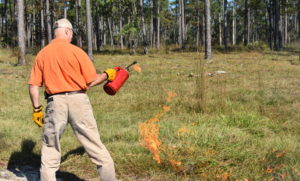
The timber industry is responsible for 49,000 direct jobs and 131,000 indirect jobs, according to AFA president Chris Isaacson.
Isaacson spoke about numerous companies which are looking at building forest products facilities in Alabama and what they need for their operations.
“The number one criteria is sufficient wood supply,” remarked Isaacson. “That’s the first thing that they start with: an analysis of the availability of timber in a particular area. Our industry is uniquely tied to the raw material that fuels it.”
He said that typically there is a 60-75-mile radius around every mill supplying the necessary wood.
“You’ve got to take the industry to the wood,” asserted Isaacson.
Isaacson outlined the economic impact on communities across the state when trees are grown by Alabama landowners, harvested by Alabama loggers, delivered by Alabama truckers, processed at mills by Alabama workers, and then consumed across the country.
“At every cycle of that supply chain, that revenue that is generated by each of those people cycles back through the community at every step,” Isaacson said. “All of that starts with raw material.”
The agency tasked with protecting that raw material is the Alabama Forestry Commission (AFC). Created in 1924, its primary mission is to protect forests from fire, insects and disease. AFC is also charged with managing forest land and educating the public and policy makers.
Rick Oates, who serves as Alabama State Forester, highlighted his agency’s role in deploying across the state to combat fires in forested land.
“When Alabama has a fire going, our guys are out there fighting those fires,” he said. “They will drop anything else and get out and fight the fires.”
Approximately 180 certified wildland firefighters are employed at the AFC, according to Oates.
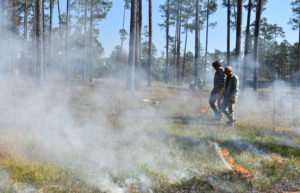
And AFC officials underscored repeatedly that “fire beats fire.”
They explained that the benefits of controlled burns include improving wood quality, promoting plant diversity, controlling insects and disease, and improving wildlife habitat.
In addition, reducing the fuel located within the state’s forests can limit damage from uncontrolled fires. It is a lack of frequent, low-intensity fire which leaves pine stands unhealthy and at risk for catastrophic fire.
For Alabama’s economy, that is a dangerous proposition.
The state has the third most timberland acreage in the 48 contiguous states, behind only Georgia and Oregon. It has gained timber volume at a higher rate than most all other Southeastern states. From 2001 to 2019, Alabama enjoyed a 37.3% increase in timber volume.
Alabama is second in pulp production and second in paper and paperboard production.
With so much at stake, Stutts believes Alabama is well-positioned to grow its timber industry.
“As far as the future, we’re in better shape now than we’ve ever been because of forestry practices and because of replanting and the plan that the state has,” he noted.
Stutts sees the fires out West as a lesson for how not to manage forest resources.
“Look no farther than California,” he stated. “A sensible plan makes all the difference. The overall most important thing is to manage the forests where they can be profitable for the state.”
In the midst of continuing wildfires, California has been criticized for its refusal to prescribe preventative burns.
The policy against preventative burning is one championed by California’s radical environmentalist movement and one in which Stutts does not agree.
“Controlled burns are an important part of the plan for timber and wildlife,” he concluded. “Controlled burns revive our forests by making them much more desirable for wildlife and creating greater sustainability for our timber.”
Tim Howe is an owner of Yellowhammer Multimedia
The Alabama Forestry Association (AFA) on Tuesday announced its endorsement of State Sen. Larry Stutts (R-Tuscumbia) in his reelection campaign for the Alabama State Senate, representing District 6.
Stutts is a graduate of Auburn University’s School of Veterinary Medicine. Upon practicing as a veterinarian for five years, the Colbert County native was accepted into the University of South Alabama College of Medicine. While attending medical school at USA, Stutts served as student representative throughout his tenure and was elected president of the medical student body his senior year.
Upon completing his residency in obstetrics and gynecology in 1992, Stutts and his family moved back to the Shoals area and opened Colbert OB/GYN, where he presently practices medicine. His practice has served over 23,000 patients including 12,600 gynecologic surgeries. He and his wife live on their farm in Tuscumbia and raise timber and livestock.
AFA president and CEO Chris Isaacson praised Stutts for his service in both his professional career and the legislature’s upper chamber.
“Dr. Stutts has dedicated his life to serving others through his work as a veterinarian, medical doctor and now as a Senator representing the people of district 6,” stated Isaacson. “His values align well with those of our organization and he has been successful in defending the conservative principles that we are dedicated to preserving. We are proud to give him our continued support.”
Stutts, in 2014, defeated an incumbent Democrat state senator who had served in the body for nearly three decades.
The AFA says Stutts has maintained one of the most conservative voting records in the Senate. The organization cites his fight to reduce the size of government, work to enact pro-life policies, stance to protect the Second Amendment and efforts maintain low taxes. Stutts serves as chairman of the Senate Agriculture and Forestry Committee.
The two-term senator thanked the AFA for their continued political support.
“It is an honor to have the endorsement of the Alabama Forestry Association,” said Stutts. “They were the first to support me when I ran for election seven years ago and I am grateful to once again have their support in this upcoming election.”
Senate District 6 covers Colbert, Franklin, and parts of Marion, Lawrence and Lauderdale Counties. The primary election will take place on May 24, 2022.
Dylan Smith is a staff writer for Yellowhammer News. You can follow him on Twitter @DylanSmithAL