Grayson Everett is the editor in chief of Yellowhammer News. You can follow him on X @Grayson270.
54 workers at a Dothan cigar manufacturing facility learned this week their jobs are going away, but the global tobacco company closing its doors in Houston County isn’t leaving them empty-handed.
On Wednesday, PMI U.S. announced they will wind down operations in the Wiregrass in the coming months as part of their public health mission to pivot toward a smoke-free future. Roughly 20 employees will stay on to support ongoing needs of the facility and community.
According to the company, all those impacted by the closure will receive a top-notch severance package that includes extended salary continuation, company-paid health insurance for a period after departure, and help finding their next job.
“Everyone impacted will receive strong support,” the company said in a news release today.
Cigars were not actually originally part of PMI’s core business — the Dothan facility came to the company through its 2022 acquisition of Swedish Match, and the site itself has operated as a cigar maker for roughly 25 years.
But today’s announcement is part of a broader shift toward smoke-free, FDA-authorized nicotine products, such as Zyn, which the company says is intended to help the nearly 30 million American adults who still smoke move away from cigarettes.
“The decision to close our manufacturing operations in Dothan reflects our focus on operating efficiently and sustainably across all aspects of our business and on accelerating the growth of our smoke-free business in America,” Peter Luongo, Managing Director of PMI’s cigar business said Wednesday.
“This change does not diminish the pride we have in the work done in Dothan. The dedication, craftsmanship, and teamwork of our colleagues here have had a meaningful impact on our business.”
PMI said its broader U.S. commitment remains unchanged, having invested more than $1 billion in American manufacturing and workforce development since 2022.
The company said those investments are generating thousands of jobs and more than $800 million in annual economic impact nationwide.
Sherri Blevins is a staff writer for Yellowhammer News. You may contact her at sherri@yellowhammernews.com.
Lockheed Martin will invest more than $150 million in its Pike County production facility over the next five years under a new incentive agreement with the state of Alabama, a move expected to create additional full-time positions and strengthen the Lockheed Martin Pike County workforce pipeline.
The agreement supports the company’s operations in Pike County, where Lockheed Martin manufactures hardware for several major U.S. missile and weapons systems. The expansion reflects rising demand for munitions production and reinforces the company’s long-term presence in southeast Alabama.
“Lockheed Martin has been a longtime pillar of Alabama’s aerospace industry, and we are thrilled to see the company’s continued investment in our state,” said Governor Kay Ivey. “This latest expansion is a testament to the hard work of the highly skilled workforce in Pike County, and the innovative, Alabama-made products that keep turning heads on the global stage.”
Lockheed Martin’s Pike County operations are located on approximately 3,800 acres in northern Pike County and employ more than 800 workers. Since 2019, the facility has added more than 300 full-time positions.
The site produces and supports components for several key defense systems, including the Terminal High Altitude Area Defense (THAAD) weapon system, the Javelin missile, the HELLFIRE missile, the Joint Air-to-Surface Standoff Missile (JASSM), and the Long Range Anti-Ship Missile (LRASM).
Company officials credited the expansion to the performance of the local workforce and long-standing partnerships across Alabama.
“This continued investment in Pike County Operations is a credit to the long history of partnership across every level of government within the state of Alabama, and more importantly, the phenomenal performance of the Alabama workforce that produces a quality product for our customers that perform when it matters most,” said Jen McManus, vice president, site production operations at Lockheed Martin Missiles and Fire Control.
State leaders say the announcement underscores the continued growth of Alabama’s aerospace and defense sector.
“Alabama’s aerospace industry continues its impressive growth trajectory, thanks to companies like Lockheed Martin that have set a standard of excellence in manufacturing products that are in high demand in markets around the world,” said Ellen McNair, secretary of commerce. “The success shows that the company’s strategic vision, an expert workforce and supportive community partnerships are a winning combination.”
Workforce development has also played a role in supporting the facility’s growth. Alabama Industrial Development Training has worked with Lockheed Martin’s Pike County operations for more than 30 years and opened a $2 million, 7,000-square-foot Advanced Training Center on its campus in 2017 to provide hands-on training solutions for the growing workforce.
In 2019, Lockheed Martin also launched a program designed to train local high school students for career opportunities through hands-on classroom instruction. The program is now active in three local school systems, helping build a pipeline into STEM careers.
Lockheed Martin’s Pike County facility first opened in 1994 and has grown into a major contributor to southeast Alabama’s economy while supporting the production of advanced defense technologies used by the U.S. military.
Alabama will play an even bigger role in America’s missile-defense industry after Lockheed Martin announced today they will quadruple production of THAAD interceptor missiles.
Lockheed reports the company reached a framework agreement with the U.S. Department of War to increase THAAD interceptor production from 96 per year to 400 per year over the next seven years, as part of its broader effort to accelerate munitions production and strengthen deterrence capabilities.
The interceptors are made in Troy, Alabama — and Governor Kay Ivey quickly celebrated the move as a double-win for national security and Alabama manufacturing.
“Lockheed Martin will QUADRUPLE production of the THAAD interceptors for the [U.S. Department of War],” Governor Ivey said Thursday.
https://x.com/GovernorKayIvey/status/2016869644129247615
THAAD is a cornerstone U.S. missile-defense system designed to intercept incoming ballistic missiles, and Lockheed’s expansion reflects a broader push to speed up production of high-demand air-and-missile defense inventory.
Separately from THAAD, Lockheed is also expanding its footprint in North Alabama for other missile-defense program, including ongoing work in Courtland tied to the Next Generation Interceptor (NGI).
While Thursday’s announcement is specifically focused on the THAAD interceptor production surge, it means big things for Alabama’s missile-defense sector.
Sherri Blevins is a reporter for 256 Today.
Courtesy of 256 Today.
Toyota Alabama announced the start of production for three cutting-edge differentials during an event Wednesday at its manufacturing facility off Pulaski Pike.
The announcement marks a major expansion of its Huntsville operations and signaling a new chapter for one of the state’s most significant manufacturers
The new assembly lines are part of a previously announced $282 million investment that brings 350 additional high-quality jobs to the facility. The expansion allows Toyota Alabama to move beyond engine production, adding differential assembly for Toyota’s Tacoma, Tundra and Sequoia models.
Toyota Alabama President Marc Perry said the new differential line represents innovation and adaptability.
“Today, we’re expanding beyond engines,” Perry said. “We’re taking on a new challenge and a totally new product line. This highlights Alabama’s flexibility and reinforces our commitment to our team members in Huntsville.”
Perry said getting the new production line added to the Alabama plant required quick coordination and creativity.
The facility had space available from a retired six-cylinder engine line, and Toyota Alabama leaders worked with corporate teams to propose installing the new differential operation there on an accelerated timeline.
Normally, a project of this scale takes about two years to complete, he said, but the Huntsville team met the challenge in just 18 months.
“By doing that, we got the project and put it in,” Perry said. “It was a challenge, but these teams got up to it. We had a great group who made it happen.”
The new lines are among the most technically advanced in the plant, machining and assembling differentials and axles to microscopic precision.
The facility’s 2,000-plus team members already produce engines for seven of nine Toyota vehicles assembled in North America, accounting for nearly half of all Toyota engines built in the region.
“For nearly 25 years, Toyota has been part of Huntsville’s story, building engines, building careers and building a community,” said Huntsville Mayor Tommy Battle. “We’re here to mark another exciting step forward. This investment means more opportunity for skilled workers and more economic strength for North Alabama.”
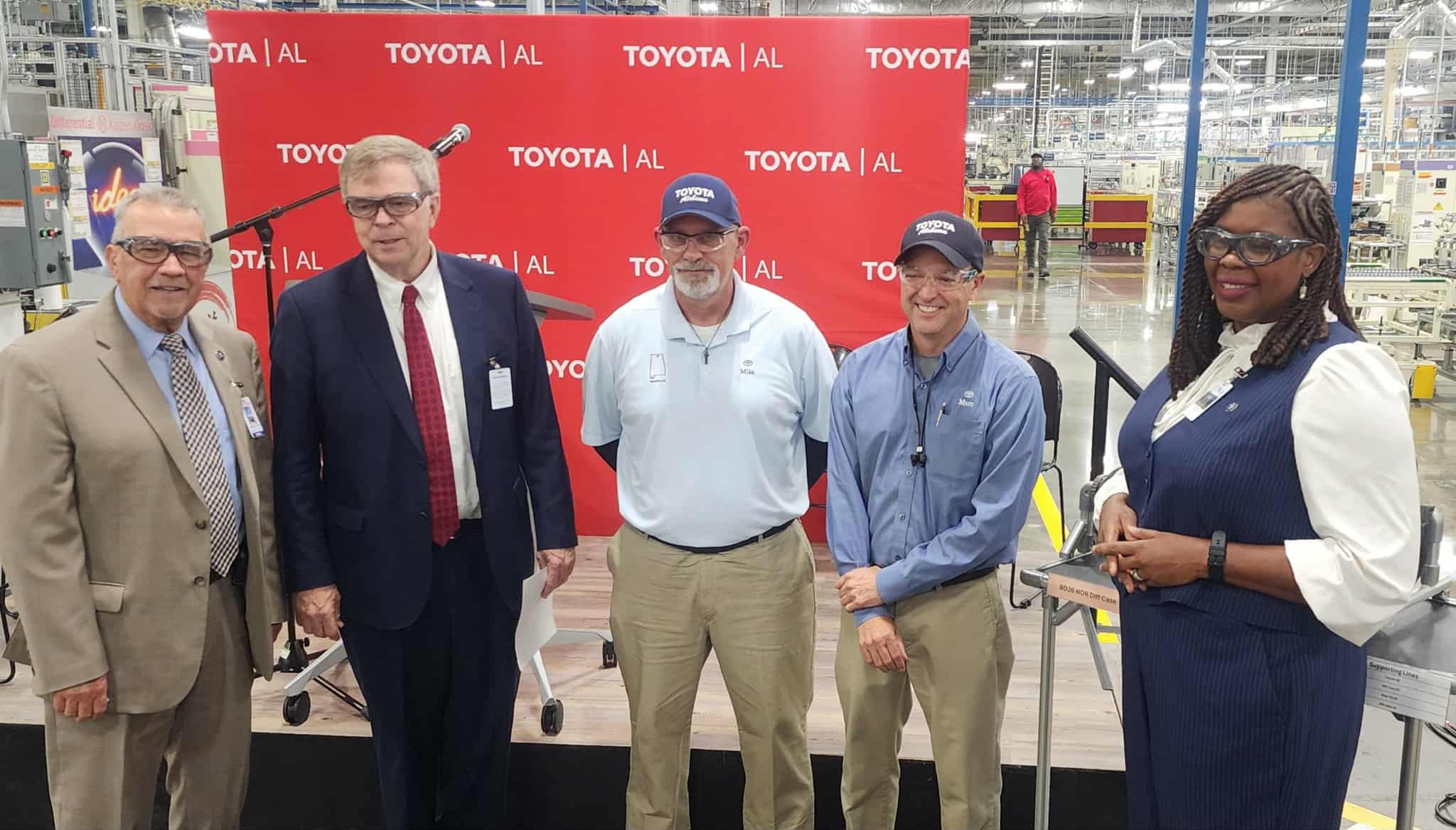
Madison County Commission Chairman Mac McCutcheon said the expansion reinforces Toyota’s long-standing partnership with the community.
“The investment that Toyota has made on this property is very significant,” McCutcheon said. “Toyota is a very special partner for Madison County. When we’ve had tornadoes or tragedies in our community, Toyota employees have stepped up to help.
“That’s a reflection of Toyota and also of the workforce and their commitment to where they live, raise their families, and work.”
District 6 County Commissioner Violet Edwards said the economic ripple effect will reach every part of her district.
“Toyota has been a fantastic partner not only in manufacturing but in community service,” Edwards said. “When you add 350 new jobs, you’re adding 350 people who will be out in the community supporting schools, businesses and local families. That’s a great day for District 6 citizens.”
Toyota’s total investment in its Huntsville plant now exceeds $1.7 billion. The company assembled more than 895,000 engines in 2024 alone and continues to play a key role in North Alabama’s advanced manufacturing economy.
Beyond the plant, Toyota is investing in the next generation of workers through its Driving Possibilities initiative, which has provided nearly $11 million in grants to Huntsville City Schools over the past two years to expand access to STEM education and career pathways.
Battle said the expansion reflects not only economic growth but also the city’s relationship with one of its most important partners.
“This is more than an investment in an automotive plant,” Battle said. “It’s an investment in our people and our community.”
Courtesy of 256 Today.
Alabama business and economic development leaders traveled to Washington, D.C. to meet with members of Alabama’s Congressional delegation and administration officials.
The meetings highlighted the importance of ongoing collaboration to attract investment, grow the workforce, and drive sustainable economic development across the state.
During group sessions and individual meetings, representatives from industry, workforce development organizations, public-private partnerships, as well as state officials, shared perspectives on opportunities and challenges facing Alabama.
“One of the most powerful tools we have is maintaining a constant pipeline of feedback between Alabama’s job creators and our federal delegation,” U.S. Senator Katie Britt (R-Montgomery) said.
“I’m proud to be a partner in Washington fighting for pro-Main Street policies that strengthen Alabama families, communities, and workers.”
U.S. Rep. Mike Rogers, Chairman of the House Armed Services Committee, emphasized the role of Alabama’s growing aerospace and defense sectors.
“We have a tremendous opportunity to grow Alabama’s economy, create jobs, and position our state for the future,” Rogers (R-Saks) said.
“Leaning on our state’s private sector and industry groups is critical to develop a workforce and environment that will attract industries from across the country and the world. With generational opportunities such as the U.S. Space Command headquarters coming to Huntsville, we will need to rely on our state’s business community, education systems, and workforce development programs to facilitate this growth. Alabama is the best place to do business, and we would not be here without the private sector.”
Representing Alabama Power, Clay Ryan, senior vice president of External Affairs, emphasized the value of constructive dialogue and between business and federal leaders.
“Alabamians are fortunate to have a congressional delegation that works together to create jobs and enhance our quality of life,” Ryan said.
“Visits with our leaders on Capitol Hill are essential to align our shared vision for growing Alabama’s economy. We appreciate their service and leadership.”
Discussions also addressed:
- Workforce development, particularly STEM education and retention of skilled labor
- Infrastructure investments in broadband, transportation, and energy
- Strengthening supply chains and Alabama’s defense and aerospace sectors
- Federal regulatory policies and their impact on Alabama businesses
- Inclusion of rural and underserved Alabama communities in economic growth plans
Leaders from Governor Kay Ivey’s office, the Alabama Department of Commerce, the Business Council of Alabama, Innovate Alabama, the Economic Development Partnership of Alabama and others joined the trip.
They stressed that strong communication with Washington is key to ensuring federal policies align with Alabama’s priorities and assets.
The meetings are part of ongoing efforts to build long-term collaboration between Alabama’s business community and its federal representatives.
In Alabama, we understand what it means to build things that matter. We’ve long been home to builders and winners – our steel won wars and built the skyscrapers of American prosperity.
Now, we are a top state for automotive manufacturing and the No. 1 automotive exporter in the U.S.
That’s why it’s no surprise that our state is quickly becoming a hub for one of the most important industries of the future: Electric vehicles (EVs).
Now, I know the term “electrical vehicle” is wrapped in a lot of rhetoric and politics. But this isn’t about politics. It’s about our economic future, national security and keeping America globally competitive. Electric vehicles are no longer a “green industry.” They are a strategic industry – the big game we can’t afford to lose.
Competing with China
Right now, the Chinese Communist Party is pouring billions into dominating the global EV market. They’re building the cars, the batteries, and the supply chains – not to save the planet, but to control this strategic industry of the future.
China’s automakers are expected to account for nearly a third of the entire global auto market by 2030, according to Bloomberg. When it comes to EVs, China already accounts for nearly two-thirds of global sales.
History has taught us that today’s innovation leads to tomorrow’s success. If America sits on the sidelines, we’re not just giving up market share. We’re surrendering our economic and technological leadership for the future. China’s investment and innovation in EV automaking will lead directly to domination of critical industries such as generative AI and quantum computing.
We can’t let that happen. We wouldn’t let China control our food supply or our defense infrastructure, and we shouldn’t let China corner the market on the vehicles driven by our children and grandchildren. Competing in this space is not optional – it’s essential to our economic security and sovereignty.
Alabama jobs and American energy
Alabama’s automotive manufacturers are responding. Since 2020, more than $2.1 billion has been invested in EV-related projects in Alabama, creating nearly 2,500 new jobs.
Mercedes-Benz U.S. International in Tuscaloosa County is producing all-electric SUVs like the EQS and EQE, with a nearby battery plant in Bibb County and a $1 billion investment driving their EV production.
Hyundai is also producing electric and hybrid models in Montgomery, backed by a $300 million investment, and its supplier Hyundai Mobis is building a $205 million EV battery module plant expected to bring up to 400 new jobs to the region.
AIDT, Alabama’s workforce development agency, is constructing a $30 million training center in Decatur focused on electric vehicles and emerging technologies.
From EV charging technicians to parts development specialists, these careers are taking root here and supporting families. Alabama is also actively expanding its EV charging infrastructure, with more than 270 public EV charging stations now in place around the state.
Most recently, Drive Electric Alabama held a ribbon-cutting for one of the newest, located at Love’s Travel Stop on the busy U.S. 280 corridor between Auburn and Columbus, Ga.
Freedom, not mandates
Last year I bought an EV. I bought it because it was a great car and fit my needs. And yes, it’s a really cool car, too! I think everyone should have that same freedom to choose their car.
This isn’t about forcing anyone to drive an EV. I believe in consumer choice and free market innovation – not government mandates.
However, the free market works best when we have the infrastructure and the competition to give people real options.
Today’s investments in EVs expand choice, empower consumers and promote American-made energy. We’ve seen what happens when we rely too heavily on critical things like foreign oil and foreign chip-making.
It leaves us vulnerable on the global stage. EVs give us a path toward greater technological and energy independence, powered by tech and electricity made right here at home.
Driving electric means fewer dollars going to governments that are openly hostile to our people and our freedom.
As a conservative pro-growth legislator, I’m proud to support industries that make America stronger and our state more prosperous. In Alabama, we understand what it means to build.
But we also understand what it means to build a legacy of winning. EVs are not a fad or political statement.
They are the next step in Alabama’s legacy of manufacturing success and a critical component in the future of our security as a nation.
Mike Shaw represents Alabama’s 47th district in the Alabama House of Representatives. Elected to the State House in 2022, he previously served on the Hoover City Council.
Loftis Steel & Aluminum, a family-owned steel fabrication company based in Nashville, Tennessee, is expanding its footprint with the launch of a new high-tech operation in Decatur with a $6.5 million investment.
The growth project will create 20 new jobs in Limestone County, reinforcing Alabama’s strong position in advanced manufacturing.
Loftis Steel & Aluminum produces custom metal components for a wide range of commercial and industrial applications. Its new Alabama facility will be equipped with advanced manufacturing technologies, including state-of-the-art fiber lasers, nitrogen generation systems and other precision cutting systems.
“Loftis selected Decatur for our second base of operation due to it’s strategic proximity to our Nashville operations,” said Tom Russell, President & CEO of Loftis Steel & Aluminum.
“It provides a springboard for us to more effectively service the ever expanding North Alabama market,” he added
By bringing cutting-edge capabilities to Decatur, Loftis will be better positioned to serve regional clients and support supply chains in key industries. The new operation will generate high-quality jobs with an average wage nearing $28 per hour, contributing to workforce growth in one of Alabama’s fastest-growing industrial corridors.
“Loftis Steel & Aluminum’s decision to invest in Decatur highlights the strategic advantages of doing business in Alabama,” said Ellen McNair, Secretary of the Alabama Department of Commerce. “This project brings together innovation, craftsmanship, and opportunity — all qualities that define our state’s manufacturing sector.
“We welcome Loftis to Limestone County and look forward to their growth here.”
The Decatur facility adds to Alabama’s expanding base of metal fabrication and industrial construction assets, reinforcing the state’s reputation as a hub for precision manufacturing and skilled labor.
Loftis joins a growing number of companies choosing North Alabama for advanced production operations, thanks to the region’s strong infrastructure, workforce pipeline and pro-business environment.

Local impact
Mayor Tab Bowling and other area officials welcomed Loftis’ planned growth in the North Alabama city, which sits in both Morgan and Limestone counties.
“This investment will allow Loftis to better serve the business growth they are experiencing in North Alabama,” Bowling said.
“Their decision to establish a new facility in North Alabama is a testament to the strength of our workforce, the quality of our infrastructure and the pro-business environment we continue to foster,” added Jeremy Nails, President and CEO of the Morgan County Economic Development Association.
Collin Daly, Chairman of the Limestone County Commission, said the company’s investment plans will be impactful.
“Their $6.5 million investment and 20 new jobs averaging nearly $28 per hour showcase our county’s appeal to quality manufacturers,” Daly said. “This expansion strengthens our industrial base and demonstrates confidence in our skilled workforce.”
Bethany Shockney, President & CEO of the Limestone County Economic Development Association, said the project demonstrates the area’s ability to attract established manufacturers seeking growth opportunities in Alabama.
“Their investment in advanced manufacturing technology and creation of well-paying jobs reinforces our position as a premier industrial location in North Alabama,” she said.
Courtesy of the Alabama Department of Commerce’s Made in Alabama website.
The signing into law of the Alabama Development Fund (ADF) is a pivotal moment for economic growth and prosperity in our state.
For the rural Alabama communities served by Southeast Gas, this fund represents an unprecedented opportunity to compete on a more level playing field for economic development projects that have historically been out of reach.
Economic development in Alabama has long been driven by a mixture of incentives, infrastructure improvements, and strategic partnerships. However, rural communities often find themselves at a disadvantage when it comes to accessing the necessary funding and resources to attract and retain businesses.
The formation of the ADF is a long-overdue remedy that will provide much-needed financial support to regions that have struggled to justify or access traditional economic development funding mechanisms.
Quality of Place: The Key to Talent Recruitment
One of the most critical factors in attracting business investment today is the concept of “quality of place.” Companies looking to relocate or expand their operations evaluate not only tax incentives and site readiness but also the overall attractiveness of a community.
This includes schools, healthcare access, housing, and entertainment options—all of which influence a company’s ability to recruit and retain a skilled workforce.
Historically, rural areas in Alabama have faced significant challenges in enhancing their quality of place due to limited resources.
The ADF addresses these challenges by creating a dedicated funding source that will empower local communities to make necessary infrastructure improvements, support workforce development initiatives, and enhance community amenities. This new level of investment will make rural Alabama more competitive when vying for large scale economic development projects.
Rural Tech Assistance: Empowering Local Economic Developers
Another transformative component of the ADF is the inclusion of Rural Tech Assistance, which will provide critical resources to local economic developers who are often understaffed and underfunded. Unlike larger metropolitan areas, rural communities typically lack the financial and human capital to aggressively pursue economic development opportunities.
With the creation of the Alabama Development Fund, local economic developers will now have access to additional tools, data, and expertise to strengthen their recruitment efforts and better position their communities for investment.
Rural Tech Assistance will also help bridge the digital divide, ensuring that rural communities are equipped with the latest technological advancements and support services necessary to attract modern businesses.
By investing in digital infrastructure and workforce training, Alabama will be better positioned to attract high-tech industries, further diversifying our state’s economic landscape.
How the Fund Works: A Sustainable and Fair Funding Model
The Alabama Development Fund is structured as a “pay-for-play” funding source, meaning that the revenues generated will directly support the expansion of existing economic development initiatives while also allowing for the creation of several new programs.
This innovative approach ensures that businesses benefiting from Alabama’s economic incentives are also contributing to the state’s broader economic development goals.
The fund will be supported by a carve-out of 0.75% from the State Sales Tax Abatements and 1 mill from the State Property Tax Abatements.
These revenues, which would no longer be abatable, will flow directly into the fund, generating an estimated $24 million annually from sales tax and $4.5 million from property tax based on past years’ data. This model provides a sustainable funding mechanism that does not require additional taxpayer burden but rather reallocates a portion of incentives that were previously forgone entirely.
By leveraging these resources, Alabama will be able to fund initiatives that directly contribute to economic growth, job creation, and improved community infrastructure. More importantly, it ensures that rural communities—often left behind in traditional economic development strategies—receive equitable access to these resources.
A Win for Rural Alabama and the Entire State
The establishment of the Alabama Development Fund is more than just an economic policy change—it is a strategic investment in the future of Alabama.
By prioritizing rural economic development and ensuring that all communities have the tools necessary to attract business and talent, this legislation will drive long-term prosperity across the state.
Southeast Gas has long been an advocate for rural economic development, and we are excited about the opportunities this fund will create. We understand that a strong economy is built on a foundation of equitable growth, and this legislation is a crucial step toward ensuring that rural Alabama has the same opportunities as its urban counterparts.
The Alabama Development Fund represents a new era of economic empowerment for our state.
By providing sustainable funding, enhancing quality of place, and equipping local economic developers with the tools they need, this legislation sets Alabama on a path toward greater economic diversification and resilience. For rural communities, this is not just an opportunity—it is a lifeline.
And for the state as a whole, it is a critical step toward a brighter, more prosperous future for all Alabamians.
Jimmy Black is the Director of Community Development with Southeast Gas. He has served the natural gas industry for over 20 years, driving growth through strategic partnerships, regional outreach, and workforce development in Southeast Alabama.
Alabama’s forestry industry is a vital economic engine, particularly for the state’s rural areas. By generating billions in economic activity, creating thousands of jobs and promoting sustainable practices, the industry not only supports local economies but also positions Alabama as a leader in forestry and natural resource management on a national and global scale.
The forestry industry’s scope is massive in Alabama, with its total annual economic impact calculated at $36 billion. The state is home to over 110 manufacturing facilities including sawmills, paper mills and other production sites, supporting more than 40,000 jobs directly in the sector.
The industry’s average annual investment in Alabama has been pegged at $840 million, with $300 million in new investment in the state’s rural regions announced during 2023 alone.
“Alabama’s forestry industry is a lifeline for our rural communities, providing stable jobs, generating significant economic activity, and supporting local businesses,” said Brenda Tuck, Rural Development Manager for the Alabama Department of Commerce. “With much of the industry rooted in rural regions, forestry helps sustain families, fund public services and create new opportunities for growth.
“Its impact goes beyond economics — it’s about preserving the way of life in Alabama’s small towns and ensuring a bright future for these communities,” she added.
Tuck said the forestry industry is a top employer in Alabama’s rural areas, where many timberland operations, sawmills, and paper mills provide well-paying jobs.
In addition, forestry-related activities such as logging, lumber production and paper manufacturing drive growth in rural communities by supporting secondary industries like transportation, equipment manufacturing and bioenergy production.
New developments in rural Alabama reinforce the industry’s impact:
- Last October, California-based Sierra Pacific Windows officially opened a new manufacturing campus in Phenix City, where it will create 300 jobs, with plans for more. The Alabama facility will significantly expand Sierra Pacific’s manufacturing capacity, enabling the company to meet rising demand for its premium products used in both residential and commercial projects.
- Two Rivers Lumber Co. LLC last year announced plans to invest $115 million to build a state-of-the-art sawmill in Coosa County, creating 130 jobs. The facility will be its second operation in Alabama, following the opening of its first sawmill in Marengo County in 2017 with a $65 million investment.
- Rural regions continue to attract new investments from major industry players, including Georgia Pacific, which is investing $159 million in its paperboard mill in Brewton, and Boise Cascade, which is expanding its Thornsby manufacturing facility with a $50 million investment.

Across the state, Alabama’s forestry sector emphasizes sustainable practices, with nearly 94% of its forests privately owned. Landowners work with industry groups and state programs to ensure sustainable harvesting and replanting, preserving the state’s forests for future generations while supporting economic growth.
The forestry industry is also increasingly leveraging technology for precision forestry, enhancing productivity and sustainability. Emerging markets, such as wood-based bioenergy and biochemicals, are creating new opportunities for growth, particularly in rural regions.
SmartLam, an innovator in the mass timber industry whose operations in Alabama play a major role for the company, exemplifies this trend.
SmartLam is the largest North American producer of cross-laminated timber, or CLT, with one of its two factories located in Dothan. It’s also investing $62 million at the Alabama site to build a new glulam manufacturing facility that will produce large beams and columns for the construction industry.
“With 23 million acres of timberland, sustainable practices, and a growing focus on innovation, the forestry sector not only drives economic growth but also is vital to the prosperity of the state,” said Ellen McNair, Secretary of the Alabama Department of Commerce.
“To put it simply, Alabama’s forestry industry is a cornerstone of our state’s economy, providing opportunities for landowners, manufacturers and families across the state,” she added.
This story originally appeared on the Alabama Department of Commerce’s Made in Alabama website.
Energy security means national security, plain and simple.
Access to abundant natural resources that can be used for energy generation gives us the ability to keep the lights on and power our society. Without access to cheap, reliable and consistent energy sources, it becomes increasingly difficult to give communities, employers, local businesses, schools, churches, law enforcement and countless other institutions the power they need to thrive.
There is obviously a large push both nationally and globally for “green energy” – I believe that is a fine and acceptable goal for entities and individuals to pursue, as long as it doesn’t come at the cost of traditional, baseload energy resources such as natural gas, coal, and hydroelectric energy generation.
What is baseload power? Baseload power is the minimum level of demand on an electrical grid over a span of time. With emerging green energy technology, solar and wind being primary examples, power generation is entirely dependent on the sun shining and the wind blowing.
In my experience, weather can be an unpredictable factor when planning something as simple as a Saturday picnic, much less with a power grid.
Conventional powerplants, notably coal, natural gas and hydro-powered plants do not have that problem. They generate power rain or shine, giving our economy and our communities the dependable – and affordable – power needed to thrive.
There is nothing wrong with adding certain forms of green energy to that conventional energy mix – but it should not be viewed as a replacement. As we have seen in other states who have dived too ambitiously into the deep end of renewable energy, dependance on unreliable power sources has caused major disruptions and problems on a large scale.
A few key problems that arise are blackouts when there is not enough energy production to power the electric grid, which wreaks havoc on not just local economies as businesses can’t power their operations, but also schools, hospitals, law enforcement capabilities and really just life in general.
This is especially true when communities are faced with extreme weather temperatures and are unable to cool or heat their homes when they need to the most. That can be fatal.
The rise of blackouts are also often paired with often exorbitant prices that are simply untenable for many consumers. That is tough to justify when looking at the far more affordable energy sources that we in America have available in droves.
Given the obvious downsides of being overly reliant on green energy, those who push for policies such as the “Green New Deal” need a way to justify their proposed transitions in the energy sector, and many have identified labeling the pursuit of renewable energy to fight climate change as “a national security issue.”
Let’s be honest with ourselves – it is quite obvious that climate change it is not a legitimate national security concern and should not been prioritized as such.
Energy independence and having a strong and secure power grid, on the other hand, certainly is.
The campaign against coal and natural gas does not only put thousands of American jobs at risk, and would bring detrimental harm to the countless families who sustain their livelihoods in those related industries, once we forgo our plentiful domestic natural resources for unreliable, unaffordable “green energy,” we also become dependent on foreign nations and foreign actors who don’t have America’s best interests in mind.
We have all seen the impact of reliance on Russian energy in several European nations since the war in Ukraine broke out – we need to make sure that we don’t expose ourselves to such risks domestically.
Again, if an entity wants to invest in renewable energy that is their prerogative, but it would be simply unthinkable to do that at the expense of our most efficient energy resources. That would not improve national security, it would diminish it.
In order to remain energy independent and power our communities big and small in an affordable way for consumers, we need to unleash and support our domestic energy production and ensure that we have a grid that can sustain an economy of the future.
To not do so would be a mistake with wide-ranging consequences for our economy and way of life for generations to come.
Gerald Allen represents Alabama’s 21st District (Tuscaloosa, Pickens & Lamar Counties) in the Alabama State Senate.
In the summer of 2013, I had the opportunity to intern in the Office of Mayor Tommy Battle. Like many interns, I found myself tasked with a variety of “other duties as assigned,” one of which was standing along Memorial Parkway during press conferences promoting Mayor Battle’s Restore Our Roads initiative—a major infrastructure project aimed at improving and expanding Huntsville’s road network to support future growth and development.
At the time, my thoughts were mostly occupied with escaping the relentless Alabama heat. But looking back, those scorching press conferences marked the unveiling of one of Mayor Battle’s many visionary projects for Huntsville–projects whose positive impacts are undeniable today.
The City of Huntsville held its municipal elections last week, where Mayor Battle was originally set to be on the ballot. However, since he ran unopposed, he was declared the winner at the close of the qualifying period and is now set to begin his fifth term as Mayor. Since taking office in 2008, Mayor Battle has overseen the creation of tens of thousands of new jobs and billions of dollars in investment in this city, all while guiding Huntsville as it grew to become Alabama’s largest city.
These achievements are not by accident. They are the result of focused, visionary leadership. While Mayor Battle consistently and rightfully acknowledges the contributions of others—leaders like Shane Davis and John Hamilton, and organizations like the Huntsville Madison County Chamber—his ability to articulate a bold vision and drive key initiatives has been essential. This consistent leadership from the top has been instrumental in transforming Huntsville into one of the nation’s fastest-growing and most prosperous metropolitan areas.
Looking back to 2013, it’s clear that without bold action to tackle infrastructure challenges through initiatives like Restore Our Roads, our roads and commute times would undoubtedly be far worse today. Without the Battle administration’s strategic focus on building the region’s manufacturing sector, we likely would have missed out on the Mazda-Toyota project, which brought over $2 billion in direct investment and thousands of good-paying jobs to the area. And without Mayor Battle’s vision to conduct a music audit, transformative projects like the Orion Amphitheater, which has greatly enhanced our quality of life and added a powerful marketing tool for the community, might never have come to fruition. These are just a few examples of how Mayor Battle’s leadership has yielded tangible results for our community.
There are many factors behind Huntsville’s success and that of its surrounding communities, but in my view, it’s hard to overlook Mayor Tommy Battle’s visionary leadership and his ability to execute as a central driving force. I’ve been fortunate to witness this leadership firsthand, and I’m excited to see what another four years of focused, strategic leadership will bring to our community.
John Roberts recently ran for Alabama’s 5th Congressional District, is a real estate and development manager, a family man, and proud Republican.
Alabama Lt. Governor Will Ainsworth flexed his Birmingham roots in an address last week to the Birmingham Business Alliance. He overviewed a wealth of legislative accomplishments during the 2024 legislative session and spoke to the opportunities that are being created for the region’s business community and residents.
Ainsworth praised the strides Birmingham and Jefferson County has made in collaborating with statewide economic development and workforce initiatives. He said the opportunity is also the goal in the region: Attract corporate headquarters, boost educational opportunities, enhance infrastructure, create jobs, and drive economic growth across the entire state.
“Birmingham is doing well. You look at it, one of the best cities to live in,” Ainsworth said. “Just thinking about growing up, I remember coming to the NCAA Tournament games here. And the fact we brought those back. You talk to people about what recruits talent – you’ve got to make sure you have things for young people to do. I think obviously the music scene’s getting a lot better, the food scene’s good – there’s things for people to do downtown.”
RELATED: Lt. Governor Ainsworth ‘terrific’ at promoting Alabama at industry airshow, Bradley Byrne says
“Over $375 million in economic development projects in Jefferson County. One of the things I’m working on right now is downtown – ‘how do we bring corporate headquarters back to Birmingham and white collar jobs?’ I’m working with Greg Barker, working with your leaders here, to have real corporate headquarters here. One of the things that certainly was highlighted during the pandemic was UAB, Southern Research – what a jewel we have here be able to recruit other companies on the research side. Not only that, but even on the aerospace side – there’s a tremendous opportunities there. But just know that we’re going to make sure Birmingham will continue to go out and recruit and be active on getting corporate headquarters here and great white collar jobs for the students of today and tomorrow. That’s important.”
Ainsworth passionately promoted the expansion of school choice in Alabama, which now allows parents to choose from a variety of educational options, including public, private, charter, and homeschooling through the CHOOSE Act, passed earlier this year. Particularly in a region like Central Alabama, Ainsworth spoke to the difference it makes to give parents the freedom to select the best educational path for their children and praised the success of public charter schools in the state, like the Aerospace and Aviation High School in Birmingham.
RELATED: Go Wide I-65 Coalition launches statewide campaign, billboards blanket Alabama
On the subject of infrastructure, Ainsworth linked the Northern Beltline project and the expansion of I-65 to the future economic vitality of the region. He noted that the Beltline project is fully federally-funded and that state leaders are exploring opportunities to expedite the completion of the project.
“The other thing is, I-65,” Ainsworth said. “My vision is for I-65 to be six lane from the state line to Mobile. We’ve got to make sure we get that done. I drive it all the time,” adding that’s the issue Alabamians ask him about the most.
“That’s the main artery, it’s so important to Birmingham, so important to our businesses. We’re going to keep pushing and make sure we get I-65 done. I appreciate Governor Ivey’s leadership, she’s already started that. It’s probably going to take about 10 years to get it done. The great thing about that is it’s an 80-20 match from the federal government, so we’ll be able to draw a lot of federal dollars down to get that done,” he said.
Ainsworth also outlined measures to support small businesses through the elimination of the business privilege tax for small businesses, families through a new cap on property tax increases, and Alabama servicemembers through a package of pro-military bills passed earlier this year.
Grayson Everett is the state and political editor for Yellowhammer News. You can follow him on X @Grayson270
In October 2025, Alabama’s workforce development efforts will be led by a newly appointed Secretary of Workforce. Ahead of that, the Alabama Workforce Council and State Workforce Development Board were combined into the newly established Alabama Workforce Board — which Governor Kay Ivey made appointments to today.
The activation of industry and business leaders through the Alabama Workforce Board and its Executive Committee is a key component of the Alabama Workforce Transformation Act and the broader Working for Alabama package of legislation signed into law earlier this year.
“I am pleased to appoint Jeff Peoples, president & CEO of Alabama Power, to chair the Executive Committee of the Alabama Workforce Board, and to appoint Phil Webb, president & CEO of Webb Concrete, to chair the newly established Alabama Workforce Board. We are stronger together by joining forces with private sector leaders to ensure our workforce needs are prioritized,” Governor Ivey said.
The Executive Committee of the Alabama Workforce Board will provide a strategic vision and plans for all of Alabama’s workforce development programs, including those funded with state and federal sources.
“Activating Alabamians with meaningful career opportunities and providing the necessary training and resources to get them there, helps strengthen our communities,” Jeff Peoples said. “Today, Alabama is taking steps to reorient our state’s workforce development system to better serve people and grow our state. I am pleased to work with Governor Ivey and other state leaders in that effort.”
RELATED: ‘Working for Alabama’ signed into law as state sets course for economic, workforce growth
The Executive Committee will also provide an annual budget recommendation and an annual plan for coordinating Alabama’s workforce development activities with the education and economic development systems. The Alabama Workforce Board also includes one member of the Alabama Senate appointed by the presiding officer of the Senate and one member of the Alabama House of Representatives appointed by the Speaker of the House.
Executive Committee of the Alabama Workforce Board
- Jeff Peoples, Chair
- Dr. Cathy Randall, Vice-Chair
- Dawn Bulgarella
- Tom Hand
- Phil Webb (Ex-Officio member of Committee as Chair of the Workforce Board)
- Lamar Whitaker
Alabama Workforce Board
- Phil Webb, Chair
- Jimmy Baker
- Stanley Batemon
- Harolyn Benjamin
- William “Bill” Blackman, Jr.
- Miranda Bouldin-Frost
- Bredgitte Braddock
- Nancy Buckner
- Jane Elizabeth Burdeshaw
- Shelly Chavira
- Chris Comstock
- Reid Dove
- Matthew Dudley
- Brandon Glover
- Andre Harrison
- Harry Hobbs
- Ron Houston
- Christy Knowles
- Julie Kornegay
- Dr. Neil Lamb
- Richard Landolt
- Jon Macklem
- Brooks McClendon
- Nick Moore
- Margaret Morton
- Joseph B. Morton
- David Niesen
- Joe Patton
- Stacia Robinson
- Kevin Savoy
- Chandra Scott
- Peggy Sease-Fain
- Charisse Stokes
- Gordon Stone
- Chris Stricklin
- David Walters
- Lamar Whitaker
- Rolf Wrona
Governor Ivey spoke with members of the Executive Committee Monday and expressed her confidence and appreciation in the group she assembled. The appointments are effective October 1, 2024.
“Throughout my tenure as governor, no matter what it is we are trying to accomplish, I ask what we can do today to prepare our state for success in the future. No doubt, ensuring we have an equipped workforce is critical as we look to fill jobs today – and in the future,” said Governor Ivey.
“I am proud to assemble a group of some of our state’s business and industry leaders to work with us as we streamline our workforce development efforts. While we have made progress in increasing our state’s low labor force participation rate, there is still much to accomplish, and we are well on our way to doing that.”
Grayson Everett is the state and political editor for Yellowhammer News. You can follow him on X @Grayson270
As the Working for Alabama legislative package moves through the process, Speaker of the House Nathaniel Ledbetter addressed the wide range of Alabamians the bills stand to serve.
“Session after session, the men and women of the Legislature come together and pass pro-business legislation that helps Alabamians thrive,” Ledbetter said. “We’re not hanging our hats on success in the years past — we still have a lot of work ahead of us and the Working for Alabama package is the next step.”
“We’re making our state an even better place to call home. We’re addressing critical issues facing our workforce, developing strategy and developing an education plan that allows high school students to pursue in-demand trades, and we’re helping parents overcome the rising cost of childcare, so they can get back to the workforce.
“Working for Alabama proves we’re not only a pro-business state — but we’re also a pro-family state.” WATCH:
https://twitter.com/BCAToday/status/1784945682152886355
RELATED: Working for Alabama: Lawmakers advance bills to position state workforce, economy for gains
Earlier this month, lawmakers embraced the six-bill package by passing the Alabama Workforce Housing Tax Credit, the Childcare Tax Credit, the Alabama Growth Alliance Act, the Alabama Workforce Transformation Act, and the Alabama Career Pathways Act out of one or both chambers.
Later this week, the Alabama Childcare Tax Credit will be taken up in the Senate Finance & Taxation Education Fund Committee.
RELATED: Top industry, elected officials urge full support for Alabama childcare tax credit
Ledbetter, along with bill sponsor State Sen. Garlan Gudger (R-Cullman), business leaders and advocates, held a press conference, urging the passage of the tax credit for working parents as it was unanimously approved by the lower chamber.
Several of the bills, including the Alabama Growth Alliance Act, the Alabama Career Pathways Act and the Workforce Transformation Act have all been authorized by the Legislature, and await Governor Kay Ivey’s signature.
Tuesday will be Day 26 of the 2024 state legislative session.
Grayson Everett is the state and political editor for Yellowhammer News. You can follow him on Twitter @Grayson270
Alabama has become the nation’s No. 1 auto-exporting state, with international vehicle shipments surging past $11.2 billion in 2023 to overtake long-time leader South Carolina, according to new trade data.
Alabama’s auto exports have climbed 45% in value since 2021, when they totaled $7.7 billion, according to figures from the Alabama Department of Commerce.
“Alabama’s auto industry has become an exporting powerhouse, with vehicles produced in the state finding markets around the world,” said Ellen McNair, secretary of the Alabama Department of Commerce.
“This creates jobs in our state and solidifies the position of the Alabama auto assembly plants in a global business.”
As Mayor of Mobile, I have witnessed firsthand the challenges Alabama faces in attracting and retaining a strong workforce. Local businesses are eager to expand, and others are interested in locating to Alabama. However, our state’s critical shortage of affordable housing often stands in the way.
In the Mobile area alone, 6,362 new jobs are expected to be created over the next five years. Those new employees will need housing, preferably in our community, but rising housing and rental prices make affordable options challenging to find. Interest rates are also continuing to reduce the purchasing power of most families. In coastal communities like ours, the increased cost of homeowner’s insurance due to wind coverage is also a compounding factor. This isn’t just a Mobile problem, though. It’s a statewide issue that is hindering economic growth across Alabama.
The lack of adequate workforce housing – safe and affordable homes for working families – discourages people from entering the workforce or relocating for job opportunities. Housing is the largest expense for most families, and when it becomes a significant burden, career decisions can become much more complex. Thankfully, there is a possible solution on the horizon.
Rep. Cynthia Almond of Tuscaloosa and Sen. Chris Elliott of Josephine have proposed the Workforce Housing Tax Credit Act. If passed, this tax credit would incentivize the development of affordable housing units specifically for working-class families. That is why this bill has bipartisan support.
At its core, the program leverages the existing federal Low-Income Housing Tax Credit (LIHTC) program. By offering an additional state tax credit, Alabama can capitalize on untapped federal resources and unlock additional private investment. This would make workforce housing projects financially viable for more developers and maximize the impact of public resources by attracting private capital.
Here’s how the program would work. The state tax credits would be available to investors in multifamily developments that commit to capping rental rates at 30 % of the eligible income for working-class families. That rate would be established by 60% of the area’s median income. To receive the federal and state tax credits, private investors would put capital into these critical projects. Ordinary mortgage financing would be used, too. Think of it as a partnership – the state and federal governments offer a tax incentive, and developers invest in much-needed affordable housing.
The program is designed to be responsible and efficient. It avoids creating more bureaucracy because the administrative pieces are already in place. The Alabama Housing Finance Authority (AHFA) already administers federal tax credits, making it the perfect agency to manage this initiative. Additionally, the program would sunset after a pilot period, ensuring its effectiveness is evaluated before the state makes any long-term commitment. It should be an easy decision for Alabama.
The benefits are undeniable. Economic impact studies show that for every dollar invested by the state, there’s a return of $7.30 in economic activity. That translates to over 3,100 new jobs and $1.1 billion in economic growth that would be spurred by the development of much-needed workforce housing. Early projections indicate that this program could also create as many as 2,500 new or rehabilitated housing units across Alabama — directly addressing our workforce housing shortage. Twenty-nine other states, including Georgia, South Carolina, and Texas, have adopted similar programs. Ours should be next.
It’s not just about numbers; it’s about people. It’s about families being able to afford to live near good job opportunities so they can contribute to our communities and build a brighter future for themselves. By working together, we can create a thriving Alabama where businesses flourish and our workforce has the housing they need to succeed.
I commend Governor Ivey, Lt. Gov. Ainsworth, President Pro Tem Reed, and Speaker Ledbetter for their collective leadership in providing solutions to Alabama’s workforce challenges. Let’s join forces to support the Workforce Housing Tax Credit Act. It’s a responsible investment in Alabama’s future.
Now is the time to support the workforce our state desperately needs by building more workforce housing.
Sandy Stimpson has served as the Mayor of Mobile, Alabama since 2013.
Governor Kay Ivey announced on Monday that the State Industrial Development Authority (SIDA) has approved over $30 million in grants under the new Site Evaluation and Economic Development Strategy Act (SEEDS) to speed the development of much-needed industry-ready sites across the state, according to her office.
A key portion of the “Game Plan” package of economic development bills authorized by the Alabama Legislature in 2023 will take aim at the urgent need for quality industrial sites in Alabama at a time when other states are spending heavily to expand their site programs.
A total of $30.1 million in SEEDS funding will be matched with $38.4 million in local funds at 29 different industrial sites encompassing nearly 8,400 acres.
“SEEDS represents an important tool that will allow us to keep winning those economic development projects that trigger lasting impacts for Alabama citizens,” Governor Ivey said.
“The awarding of the first grants under the program represents a milestone in our efforts to make sure Alabama remains competitive for game-changing growth projects.”
SIDA approved 14 site assessment grants valued at $1.1 million, chiefly for environmental and geo-tech surveys of early-stage industrial sites at communities including Ashland, Sulligent, Hamilton, Prattville and Montgomery. Local matches totaling a combined $629,000 are pledged, the governor’s office reported on Monday.
SIDA also approved 15 development grants valued at $29 million for purposes such as infrastructure improvements, land purchases and site grading. Communities including Jasper, Atmore, Opelika and Mobile will provide matching funds totaling $37.8 million.
“We’ve been very successful in economic development during Governor Ivey’s tenure — so successful, in fact, that we find ourselves with a shortage of fully developed sites,” said Ellen McNair, secretary of the Alabama Department of Commerce. “The SEEDS Act is allowing us to identify and develop sites as a critical function of our ability to recruit new industry and jobs. We must have to product to sell.”
SIDA has contracted with the Economic Development Partnership of Alabama (EDPA) to administer the SEEDS grant programs. Greenville, South Carolina-based Global Location Services (GLS) assisted in the evaluation process.
After the SEEDS application process opened in October 2023, organizations across the state requested a combined total of $42 million in funding. Those not chosen for funding can apply for future funding, and some of them benefited from free feedback from GLS as part of the evaluation process.
Alabama Power Vice President of Governmental Affairs, Houston Smith, who serves as chairman of the Energy Institute of Alabama, said that the state’s electric utilities are ready to service these new industrial sites.
“The SEEDS Act was a critical piece of the ‘Game Plan’ package that the Legislature passed and Governor Ivey signed last year, and it will be a true game changer in positioning Alabama to compete with neighboring states in industrial recruitment,” said Smith. “Alabama’s public utilities are ready to serve these industrial sites with the clean, affordable and reliable power needed to operate and contribute to our state’s economy.”
“Over the past 10 years, economic development projects in Alabama have resulted in the creation of over 167,000 new jobs and $67 billion in capital investment. To maintain this level of success, it is crucial that Alabama communities continuously work to identify, assess, and develop their inventory of sites toward investment-readiness,” said Cedric Colbert, senior consultant at GLS.
“By enabling proactive site improvements that will minimize risk to future investment projects, these SEEDS Act grants will directly improve Alabama’s ability to compete for economic development projects on a national scale,” he added.
RELATED: Reed details legislative approach to building the Alabama workforce of tomorrow in BCA talk
The approved SEEDs grants will help facilitate the development of industrial sites in both large Alabama cities and small, rural communities. Both large-scale sites and smaller industrial parks will benefit from funding.
“Alabama is the best place in the country to develop and grow a business. As legislators, it is our job to make sure people and businesses have the resources they need to make a meaningful impact for their families and communities,” said Pro Tem Greg Reed.
“The SEEDS Act does just that by allowing local economic development organizations the opportunity to help cultivate economic sites across our great state. I look forward to seeing how this exciting and groundbreaking legislation helps better Alabama so we can continue to be the best state to call sweet home,” he added.
“Our goal with the Game Plan was to ensure Alabama continues to have the necessary tools to compete and win on the national stage. The SEEDS Act positions our local developers to stand out from out-of-state competitors and is vital to our long-term economic development strategy,” said Speaker Nathaniel Ledbetter. “This legislation is already proving to be transformative for Alabama’s economy, and I look forward to continuing to watch it work for our state.”
Grayson Everett is the state and political editor for Yellowhammer News. You can follow him on Twitter @Grayson270.
$42 billion.
That’s the figure Governor Kay Ivey referenced as she announced the departure of Alabama Department of Commerce Secretary Greg Canfield secured in investment during his time with her administration alone. Over his total tenure in the role, that figure is $70 billion.
Canfield has led the department responsible for the recruitment of businesses to Alabama since 2011. He put his extensive private sector experience and tenure serving in the Alabama Legislature to work for that mission.
“Throughout my time as governor, we have proudly solidified Alabama as a top state for doing business, and no doubt, Greg has been a key part of that success. Together, we have secured more than $42 billion in new investments in our state, which has created 78,000 good-paying jobs,” Governor Ivey said.
“Greg will go down as one of Alabama’s best economic development heads, and he will be noted for projects like Mazda Toyota and credited for branding the Made in Alabama name worldwide. I will forever be grateful for all that Greg has accomplished for our state, and I know he will continue having great success in his career.”
RELATED: ‘Made in Alabama’ brand marks 10 years of sharing state success stories
Under Secretary Canfield’s tenure, Alabama launched its first-ever strategic economic development plan, Accelerate Alabama, established new records in international exports, capital investment and job creation. Secretary Canfield represented Alabama on business and trade missions to 30 countries across the globe and is credited for launching Commerce’s successful rural development strategy.
The Governor’s office praised Canfield, in both his role at Commerce and in the Legislature, for being a champion for pro-business legislation.
Most recently, The Game Plan, Alabama’s economic incentive package, passed in 2023 and will help the state continue attracting businesses and industry, as well as support existing companies for years to come.
RELATED: Economic ‘Game Plan’ put into play by Ivey, Legislature
Ivey tapped Ellen McNair, an economic development veteran, to serve as the next secretary of Commerce. She’s currently the chief economic development officer with the Montgomery Area Chamber of Commerce. Canfield will continue serving until the end of the year. McNair’s appointment is effective January 1, 2024.
“I am proud to have been a part of Governor Ivey’s cabinet, and I am proud of the team of professionals we have assembled at Commerce,” Sec. Canfield said on Friday.
“I am more confident than ever that Alabama is poised for a robust era of economic expansion that will transform the trajectories of communities and families across the state,” said Secretary Canfield. “I am honored to have made a contribution to the effort to improve Alabama’s future, and I know that the momentum we’ve built will continue to grow in the capable hands of Ellen McNair.”
RELATED: Alabama scoops up Silver Shovel Award again
McNair, who is taking the helm in the new year, has successfully worked on almost 600 national and international projects with a capital investment of over $8 billion, resulting in almost 30,000 new jobs for the Montgomery community.
“I have known Ellen since my days at the Alabama Development Office, and I know she will be of tremendous value to the state of Alabama,” said Governor Ivey.
McNair was the senior project manager and a member of the negotiating team that brought Hyundai Motors Corporation to Montgomery.
“I am extremely honored to have been selected by Governor Kay Ivey for this very important role. Economic development has been a passion and focus for the governor her entire career,” said McNair. “The success of the state under Governor Ivey’s and Secretary Canfield’s leadership is unprecedented. These will certainly be big shoes to fill.”
“I have great respect for Secretary Canfield and the Commerce team, and we will work together for a smooth transition,” McNair continued.
“The state of Alabama is blessed with many strong local and regional economic development professionals, and I look forward to working closely with them and the entire state team to continue Alabama’s smart and strategic economic development.”
Grayson Everett is the state and political editor for Yellowhammer News. You can follow him on Twitter @Grayson270
Shinhwa Auto USA is investing $114 million to bolster its manufacturing presence in Auburn, Gov. Kay Ivey announced today. The expansion is expected to create 50 jobs.
The project will see a 170,000-square-foot production building emerge on Shinhwa’s campus at Auburn Technology Park West. This will mark the third expansion for the South Korean company in Auburn since the city was chosen as its inaugural U.S. plant site in 2019.
“Shinhwa’s constant growth in Auburn demonstrates Alabama, through high levels of innovation and technical prowess, is preparing for an evolving future,” Ivey said. “It’s a testament to the Auburn area’s workforce that this world-class company has once again decided to launch growth plans in Lee County.”
RELATED: Alabama produced nearly 1M cars last year; $14.2B in new investment
After the Auburn facility opened in 2020 following a $42 million investment, it manufactured drive shafts for Hyundai Motor Manufacturing Alabama in Montgomery and the Kia plant in West Point, Ga.
The company has since announced two expansion projects in Auburn, adding 90 jobs and an additional investment of $148 million to expand output of aluminum parts and meet demands stemming from EV production.
Auburn Mayor Rob Anders said the partnership continues to be good news for the region.
“Shinhwa’s story here in Auburn is evidence of the work generations of leaders have done to make our community not only welcoming to but also fertile ground for businesses,” Anders said. “We’re grateful for Shinhwa’s investment in Auburn and look forward to seeing them continue to thrive.”
RELATED: Alabama solving manufacturing’s real estate problem
Shinhwa is committed to creating 50 jobs over the next three years, with an average annual salary of around $48,000, according to the Alabama Department of Commerce.
“Alabama’s auto sector is experiencing a major growth spurt as the industry accelerates the transition toward an electric future,” said Greg Canfield, secretary of the Alabama Department of Commerce.
“We look forward to working with Shinhwa to advance its expansion plans and fully develop the growth potential of its Auburn manufacturing operation.”
Grayson Everett is a staff writer for Yellowhammer News. You can follow him on Twitter @Grayson270
According to CNBC’s “10 worst states to live and work in for 2023,” Alabama is tied with South Carolina for being the fourth worst.
The network based its findings based on measuring “quality of life issues including crime, health care, childcare and health care, as well as inclusive policies on discrimination and reproductive rights.”
CNBC said the Yellowhammer State is unhealthy, makes it hard to vote, doesn’t have enough protections for workers, and scores poorly when it comes to inclusiveness.
The study’s authors admitted their left-wing bias and abortion restrictions played a role in the rankings.
“Casting the widest possible net for workers means not turning anyone away,” the report said. “So we consider inclusiveness in state laws by measuring protections against discrimination, as well as voting rights. And with surveys showing a substantial percentage of women considering abortion restrictions when making a choice of where to live in the wake of the Supreme Court overturning Roe v. Wade, reproductive rights are part of this year’s equation as well.”
Texas ranks at the top of the list, while Florida is 10th.
The only positive mentioned about Alabama is the state’s “air quality.”
Yaffee is a contributing writer to Yellowhammer News and hosts “The Yaffee Program” weekdays 9-11 a.m. on WVNN. You can follow him on Twitter @Yaffee
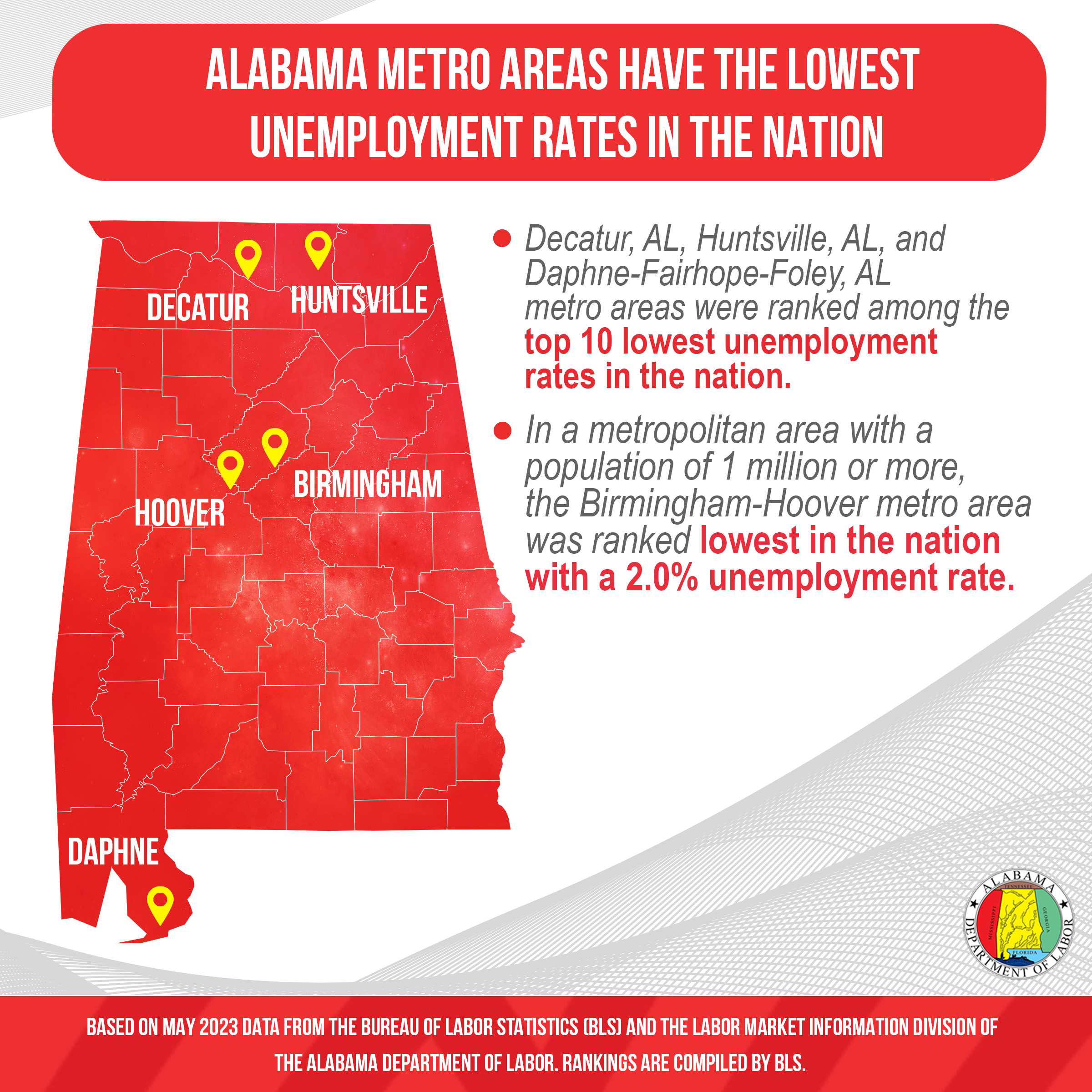
Gov. Kay Ivey announced Friday four of Alabama’s metropolitan areas are ranked among the lowest in the nation in unemployment for May 2023.
For the third consecutive month, the Birmingham–Hoover metro area was ranked the lowest in the nation in unemployment – at 2.0% – for a metro area with a population of 1 million or more.
Three other state metro areas, Decatur, Huntsville and Daphne-Fairhope-Foley, were ranked among the top ten overall in the country at 1.7%, 1.8% and 1.9% in unemployment, respectively.
RELATED: Alabama unemployment holds steady at record low 2.2%
“It is no surprise that Alabama continues to experience unemployment rates below much of the rest of the nation,” said Ivey. “Our laser focus on growing Alabama’s economy, combined with our world-class employers and a dedicated workforce, is making a positive difference. Our pursuit of investments of future industries will create even more high-paying jobs.”
Alabama’s unemployment rate for May remained at a record low of 2.2%, the same as April’s rate, and significantly lower than the 2.5% reported in May 2022
“Alabama’s metro areas continue to shine as for the fourth consecutive month we have multiple metro areas ranking in the top 10 for lowest unemployment rates,” said Alabama Labor Secretary Fitzgerald Washington. “It’s just a further example of how successful Alabama’s economy has rebounded and how we are showing the nation how great Alabama can be.”
The rankings are compiled by the U.S. Department of Labor’s Bureau of Labor Statistics and can be found here.
Grayson Everett is a staff writer for Yellowhammer News. You can follow him on Twitter @Grayson270
In demand, no-cost, rapid training — is starting this week on 24 campuses across the state.
That’s the message Alabama’s Community College System wants to get across to students and job-seekers alike.
Salaries and demand for fiber optic technicians and installers are on the rise. Thanks to funding from the Alabama Legislature, the Skills for Success program is working to get them qualified.
RELATED: C Spire expands ‘fiberhoods’ in south Alabama
The training can be completed quickly because part of the course is done online with interactive learning that is self-paced. Upon completing the online portion of the course, trainees then complete two days of hands-on training with qualified instructors at any of the 24 community and technical colleges around the state.
Salaries for fiber technicians have increased by 12 percent in the past five years and demand for these professionals is expected to increase by eight percent by the year 2031, according to the U.S. Bureau of Labor Statistics.
Participants who complete the training also earn an ACCS Credential, which signals to businesses that the individual has mastered the skills taught in the program and is immediately ready for employment.
The ACCS Credential can also be used as a foundation for additional classes and training at Alabama community colleges.
RELATED: Alabama a model in broadband expansion

“Today’s communication networks depend on fiber optic connectivity, so the demand for a skilled fiber optic workforce is critical and growing,” said Jimmy H. Baker, chancellor of the Alabama Community College System.
Related: ‘Skills for Success’ aims to cut butcher shortage
Those interested in learning more and signing up for the training can go online at innovation.accs.edu
Grayson Everett is a staff writer for Yellowhammer News. You can follow him on Twitter @Grayson270 for coverage of the 2023 legislative session.
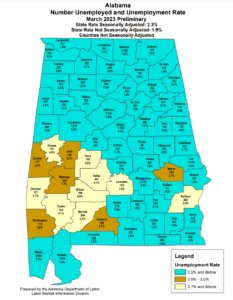
The latest unemployment rate hit a record low of 2.3% for March, Gov. Kay Ivey announced today. That figure is down from February’s 2.5% and also below March 2022’s rate of 2.5%.
“We’re almost a quarter into 2023, and we are already seeing record-breaking success when it comes to Alabama’s economy,” said Ivey.
March’s rate represents 53,053 unemployed people, compared to 56,166 in February and 58,074 in March 2022. The number of people counted as unemployed also sets a new record low.
RELATED: Alabama generated $10.1B in capital investment last year
RELATED: Economic ‘Game Plan’ put into play by Ivey, Legislature
“We have been enjoying a period of low unemployment, high wages and high jobs count for some time now, and I believe that even greater economic achievements are on their way,” Ivey said. “We will not back down on our commitment to continue bringing quality, high-paying jobs to Alabama.”
According to the state Labor Department, over the year, increased 47,200, with gains in the professional and business services sector (+10,000), the private education and health services sector (+8,900), and the government sector (+8,400), among others.
RELATED: Economic ‘Game Plan’ put into play by Ivey, Legislature
“Along with today’s great unemployment rate news, we’re also proud to announce that our economy is continuing its trend of gaining jobs,” said Alabama Department of Labor Secretary Fitzgerald Washington.
Wage and salary employment increased in March by 3,400. Monthly gains were seen in the government sector (+2,100), the leisure and hospitality sector (+1,700), and the financial activities sector (+800), among others.
Counties with the lowest unemployment rates are: Shelby County at 1.4%, Morgan and Cullman Counties at 1.5%, and Blount, Elmore, Limestone, Madison, Marshall, and St. Clair Counties at 1.6%. Counties with the highest unemployment rates are: Wilcox County at 6.9%, Greene County at 4.4%, and Clarke and Dallas Counties at 4.1%.
Major cities with the lowest unemployment rates are: Hoover, Madison, Trussville, and Vestavia Hills at 1.3%, Alabaster, Homewood, and Northport at 1.4%, and Athens and Prattville at 1.6%. Major cities with the highest unemployment rates are: Selma at 5.3%, Prichard at 3.9%, and Bessemer and Gadsden at 2.9%.
“Our economy is supporting nearly 48,000 more jobs now than last year. This is amazing growth, especially since there are pre-existing labor concerns nationwide.” Washington said.
Grayson Everett is a staff writer for Yellowhammer News. You can follow him on Twitter @Grayson270 for coverage of the 2023 legislative session.
7. Former President Donald Trump gave a wide-ranging interview to the Daily Caller on his way to Iowa for a campaign event where he made the most straight-up attacks on Florida Gov. Ron DeSantis yet. Trump explained the “DeSanctimonius” nickname, his thoughts on loyalty, and other subjects.
6. The ALGOP Winter Dinner broke fundraising records last week when they brought in $700,000. ALGOP Chairman John Wahl thanked Florida Gov. Ron DeSantis for headlining the event, “I am thankful to have had so many wonderful guests join us. I think this was the perfect opportunity for Gov. DeSantis to get to know Alabama a little better.”
5. Still maturing Huntsville City Councilman Devyn Keith pleaded not guilty to four misdemeanor charges for shoplifting. Adorable, however, Keith is also allegedly on tape committing multiple other shoplifting crimes.
4. Alabama’s unemployment rate continues to hold steady in January at 2.6% while the state added 54,100 jobs last year. Gov. Kay Ivey reacted to the good news by noting, “We have been enjoying a period of low unemployment, high wages and high jobs count for some time now, and I believe that more is yet to come.”
3. When people talk about letting criminals out of jail and being lenient, State Rep. Matt Simpson (R-Daphne) disagrees. Simpson told APTV’s “Capitol Journal,” “Some people need to be put out of the streets so they can’t hurt anybody else.”
2. The oddly named program, “Odds Are Alabama,” is an awareness campaign aiming to warn people that all it takes is one exposure to fentanyl to kill you. Dr. Bobby Lewis, an emergency room physician at University of Alabama at Birmingham Hospital, spoke about how UAB sees multiple fentanyl fatalities weekly and overdoses every day.
1. The markets and the banks are reacting to two major bank failures as fear of rippling impacts are still yet to be felt in the form of more bank failures. Alabama U.S. Sen. Katie Britt (R-Montgomery) is not happy with how the Biden administration is handling this and took to Twitter to say so, “it is unacceptable that this Administration excluded Senate Republicans, including those on the Senate Banking Committee, from Sunday night’s bicameral Member briefing.”
LISTEN HERE:
Dale Jackson is a contributing writer to Yellowhammer News and hosts a talk show from 5-9 a.m. weekdays on WVNN and on Talk 99.5 from 10 a.m. to noon.