Grayson Everett is the editor in chief of Yellowhammer News. You can follow him on X @Grayson270.
State Sen. Jabo Waggoner (R-Vestavia Hills), Alabama’s longest serving lawmaker in history, announced on Monday that he will seek a new term in the State Senate during the 2026 campaign cycle.
“I’ve devoted a lifetime to serving my state, my community, and my neighbors, but there is still much work to be done and many goals to accomplish before all the hay is in the barn,” Waggoner said.
“Though we’ve made tremendous progress over the years in education, economic development, and ensuring Alabama’s morals and values are protected, I remain committed to making our already great state even better.”
When the GOP won a legislative supermajority following the 2010 statewide elections, Waggoner’s years of dedicated service were recognized by his colleagues when he was selected as the first Republican Majority Leader in Alabama history.
He was also selected as Chairman of the powerful, agenda-setting Senate Rules Committee, an influential post Waggoner has held throughout the past 15 years.
Waggoner, 88, represents Senate District 16, which includes portions of Jefferson and Shelby counties in the Birmingham suburbs. He has served in the Alabama Senate since 1990 following 17 years in the Alabama House, first elected in 1966.
He was elected to the State Senate in 1990 and continues to serve in the upper chamber today.
Waggoner’s already record-setting 53-year legislative tenure at the end of this quadrennium will continue to grow with a new term and is likely to remain unmatched in history.
Among the hundreds of honors he has received is the Ronald Reagan Lifetime Achievement Award, which was presented for his commitment to conservative principles and his dedication to serving the people of Alabama.
Waggoner and his wife, Marilyn, have been married for 67 years, and they are devoted members of the Homewood Church of Christ.
Earlier this year, Waggoner was honored byYellowhammer News as the 2025 recipient of the Power of Service Award, a lifetime achievement distinction awarded annually to one individual.
Grayson Everett is the editor in chief of Yellowhammer News. You can follow him on X @Grayson270.
The 2026 election season is upon us — and so is campaign fundraising.
According to filings with the Alabama Secretary of State’s Fair Campaign Practices Act (FCPA) database, no Democrats in the Alabama Senate have yet filed their June 2025 monthly reports for the 2026 cycle.
These reports, due on June 3, are the first monthly disclosures of the new election year and offer a real-time look at each candidate’s financial standing heading into the campaign season.
All members of the Alabama Senate filed year-end reports due in January 2025 to account for all raising and spending throughout 2024. This week, we got a glimpse into where their war chests stand with one year remaining in the current quadrennium.
“2024” accounts for the cash-on-hand totals reported in the 2024 annual reports filed while “Cash on Hand” designates where candidates reported standing in their June 2025 monthly report.
Republicans
Greg Albritton (District 22)
2024: $233,361.41 | Cash on Hand: Not yet filed
Gerald Allen (District 21)
2024: $164,274.22 | Cash on Hand: $163,290.73
Will Barfoot (District 25)
2024: $297,130.09 | Cash on Hand: $305,725.88
Lance Bell (District 11)
2024: $234,917.06 | Cash on Hand: $253,457.39
Tom Butler (District 2)
2024: $37,000.99 | Cash on Hand: $33,275.99
Josh Carnley (District 31)
2024: $177,645.80 | Cash on Hand: Not yet filed
Clyde Chambliss (District 30)
2024: $170,253.62 | Cash on Hand: Not yet filed
Donnie Chesteen (District 29)
2024: $294,893.34 | Cash on Hand: Not yet filed
Chris Elliott (District 32)
2024: $240,213.61 | Cash on Hand: $270,567.56
Sam Givhan (District 7)
2024: $475,090.47 | Cash on Hand: $481,315.20
Garlan Gudger (District 4)
2024: $246,423.75 | Cash on Hand: $203,784.98
Jay Hovey (District 27)
2024: $324,310.81 | Cash on Hand: $319,432.03
Andrew Jones (District 10)
2024: $223,406.33 | Cash on Hand: $284,449.12
Keith Kelley (District 12)
2024: $269,020.69 | Cash on Hand: $273,434.89
Steve Livingston (District 8)
2024: $268,797.01 | Cash on Hand: $258,963.01
Tim Melson (District 1)
2024: $344,231.27 | Cash on Hand: Not yet filed
Arthur Orr (District 3)
2024: $1,127,774.79 | Cash on Hand: $1,135,481.76
Randy Price (District 13)
2024: $217,427.94 | Cash on Hand: Not yet filed
Matt Woods (GOP nominee — District 5)
2024: $329,031.14 | Cash on Hand: $330,616.79
Dan Roberts (District 15)
2024: $447,181.66 | Cash on Hand: $449,326.87
David Sessions (District 35)
2024: $327,732.30 | Cash on Hand: $325,422.30
Shay Shelnutt (District 17)
2024: $307,859.02 | Cash on Hand: $314,198.57
Larry Stutts (District 6)
2024: $51,167.80 | Cash on Hand: Not yet filed
J.T. “Jabo” Waggoner (District 16)
2024: $455,142.31 | Cash on Hand: $448,818.76
April Weaver (District 14)
2024: $240,376.35 | Cash on Hand: $250,286.81
Wes Kitchens (District 9)
2024: $49,872.97 | Cash on Hand: $82,427.15
Democrats
Billy Beasley (District 28)
2024: $111,240.53 | Cash on Hand: Not yet filed
Merika Coleman (District 19)
2024: $61,667.67 | Cash on Hand: Not yet filed
Linda Coleman-Madison (District 20)
2024: $280,845.70 | Cash on Hand: Not yet filed
Vivian Davis Figures (District 33)
2024: $2,197.55 | Cash on Hand: Not yet filed
Kirk Hatcher (District 26)
2024: $86,850.88 | Cash on Hand: Not yet filed
Bobby Singleton (District 24)
2024: $312,978.54 | Cash on Hand: Not yet filed
Rodger Smitherman (District 18)
2024: $144,244.84 | Cash on Hand: Not yet filed
Robert Stewart (District 23)
2024: $14.15 | Cash on Hand: Not yet filed
Across Alabama, hardworking families, veterans, small business owners, and farmers form the backbone of our economy and our way of life. From our rural communities to our growing towns and cities, these Alabamians create opportunities, strengthen our communities, and drive our state forward.
As Washington debates this significant reconciliation package, it is vital that we do not lose sight of where our prosperity truly begins — and who relies on smart, targeted investments to succeed.
Congress has a real chance to enact lasting reforms based on sound principles: easing the tax burden on families, being responsible with spending, and building a stronger, more resilient economy for everyone.
But in doing so, they also must be careful not to undermine the essential investments that help Alabama’s communities, especially our rural areas, compete and thrive.
Federal programs supporting agriculture, forestry, and rural development are not handouts. They are targeted investments that strengthen local economies. Through USDA Rural Development initiatives, Alabama’s small towns have expanded water systems, broadband networks, and transportation links.
Programs like EQIP and the Conservation Stewardship Program have helped farmers conserve resources and improve productivity. And as the second largest timber-producing state in the nation, Alabama relies on strong forest management programs to sustain jobs, protect property, and ensure responsible growth.
During my time chairing the Senate Rules Committee and serving on finance and infrastructure committees, I have seen how investments in rural Alabama, from broadband expansion in Walker and Fayette counties to road improvements across Jefferson County, lay the foundation for long-term economic growth.
These investments are critical to keeping small towns viable, ensuring family farms endure, and helping rural businesses grow.
Congressional Republicans are leading efforts to restore fiscal discipline, and I fully support a focus on cutting waste and making government more efficient. But true fiscal responsibility is not just about reducing spending, but it is about investing taxpayer dollars where they make the most difference.
Protecting key programs that support farmers, working families, and rural businesses is part of that responsibility.
Senator Katie Britt has been a strong voice for Alabama’s rural communities and understands the critical importance of these investments to the future of our economy and our nation.
Her voice and leadership will be crucial in making sure Alabama’s needs are not forgotten in these important discussions.
If we want communities across Alabama to stay strong, we must protect the smart, proven programs that allow these communities to grow, compete, and contribute to our broader economy. The decisions made in the coming weeks will have a lasting impact. I urge Congress to keep our rural communities at the forefront of these reconciliation efforts.
Jabo Waggoner is a member of the Alabama State Senate, representing the 16th District since 1990.
In recognition of tonight’s annual Power of Service event and the release of the final Power & Influence Top 50, Yellowhammer News is proud to award our most distinguished lifetime honor to Jabo Waggoner.
RELATED: 2025 Power & Influence: Who’s Next?
RELATED: 2025 Power & Influence: 50-41 / 40-31 / 30-21 / 10-1
When historians, political observers, and public officials across Alabama think of “service,” two words quickly come to mind:
Jabo Waggoner.
Elected to the Alabama House in 1966, when Lurleen Wallace became governor and an Auburn University coed named Kay Ivey was still a year away from college graduation, he launched a public service career that would span a half-century and continues today.
Not yet 30-years-old at the time of his election, Waggoner would serve in the House until 1983, when he announced his switch to the Republican Party and launched an unsuccessful congressional campaign against Democrat Ben Erdreich.
Winning election to the Alabama State Senate in 1990, Waggoner was in the body’s decided minority as a Republican, but his friendly nature and easy-going style hid a competitive streak honed during his years as high school and college athlete, and he soon became known as one of the most effective lawmakers in Montgomery.
When the GOP won a legislative supermajority in the 2010 election cycle following 136 consecutive years of Democrat Party rule, the stature, respect, and relationships Waggoner had banked during decades of public service resulted in his election as Alabama’s first Republican majority leader, a post that did not exist during the Reconstruction era.
He also assumed the chairmanship of the powerful, influential, agenda-setting Senate Rules Committee, a position he has continued to hold throughout the past 15 years.
A list of the significant bills he has passed, the committees he has chaired and sat upon, the honors he has been awarded, and the lives he has positively impacted is much too long to fit in the space provided here and would fill a book. By coincidence, that very book — “Jabo Waggoner: An Alabama Political Legend” — was recently published and released in his honor.
While the names of countless past political leaders who once commanded great respect and prestige have long been forgotten with the passage of time and the transfer of power, Waggoner’s will always be celebrated and remembered, especially since he holds the record for longest-serving legislator in Alabama history with no contender even close on his heels.
Waggoner’s impact and lasting legacy was perhaps summed up best when one of his colleagues, Sen. April Weaver (R-Brierfield) wrote these words about him:
“Imagine being taught the principles of team building by Coach Bear Bryant and Coach Shug Jordan.
Consider being schooled in dedication, tenacity, and perseverance by Lou Gehrig and Cal Ripken.
Envision Ronald Reagan providing you a personal education in public service, patriotism, and bedrock conservative principles.
For those of us in the Alabama Legislature, we have essentially experienced all of these things simply by serving alongside Sen. Jabo Waggoner.”
Today has proven to be a pivotal day in the Alabama Legislature. Lawmakers in both chambers issued final passage on some of the session’s biggest bills, while others hang in the balance.
After completing their primary constitutional duty Tuesday night by sending finalized general fund and education trust fund budgets to Governor Kay Ivey’s desk, several major pieces of legislation today made it over the finish line, under threat of filibuster from Democrats at times, and cloture from Republicans at others.
As of the close of the journal last week, lawmakers in both chambers have introduced a combined total of 961 bills. Among those, the House has passed 323 and the Senate has passed 164.
After adjournment today, only three days will remain in the 2025 legislative session.
Birmingham Water Works in House
The House issued final passage on a long-awaited reform bill opposed that would overhaul governance of the Birmingham Water Works Board.
SB330, sponsored by State Rep. Jim Carns (R-Vestavia Hills) in the House and State Sens. Dan Roberts (R-Mountain Brook) and Jabo Waggoner (R-Vestavia Hills) in the Senate, will address longstanding concerns about mismanagement and ratepayer accountability by replacing current board appointments with a more regionally representative structure.
RELATED: Birmingham Water Works overhaul bill clears House committee, awaits final passage
The bill also caps board members’ terms, implements mandatory training requirements, and adds new financial oversight provisions.
The proposal was vehemently opposed by Democrat members from Jefferson County, however cloture was not needed. It now heads to Governor Ivey’s desk for her signature.
ALFA in Senate
The Senate issued final passage to a proposal that would allow the Alabama Farmers Federation (ALFA) to offer health benefit plans to its members outside the scope of traditional insurance regulations – known as a farm bureau health plan — after several failed attempts by Senate Democrats to amend the bill.
HB477 by State Rep. David Faulkner (R-Mountain Brook) passed the House earlier in the session with unanimous support. It is far and beyond the political powerhouse’s top legislative priority. It could come to fruition today and be sent to Governor Ivey’s desk.
RELATED: ALFA health plan legislation passes Alabama House with added oversight, protections
The proposed plans are modeled after a similar concept in 10 other states and are aimed at providing more affordable coverage options for farmers and rural residents who often lack access to employer-sponsored insurance. The Federation argues that these plans could save families up to 60% on health care costs.
To address concerns from healthcare groups and insurers, lawmakers added several amendments to the bill, including provisions that prohibit coverage from being canceled or premiums increased due to a medical diagnosis, require coverage for prescription drugs, mental health care, and substance abuse treatment, and set a minimum annual benefit cap of $2 million per enrollee.
Today, it is being carried by State Sen. Arthur Orr (R-Decatur) upstairs in the Senate.
RELATED: Arthur Orr predicts all remaining Senate votes in 2025 will be done through cloture
The bill ultimately passed and now heads to Governor Ivey’s desk for her signature.
Powering Growth in House
The House issued final passage today on the Powering Growth package — a three-bill initiative with the uniformed goal of modernizing Alabama’s energy infrastructure and speeding up industrial development.
RELATED: As Trump champions energy dominance, Alabama lawmakers double down with ‘Powering Growth’ package
SB304, carried by State Sen. Arthur Orr and State Rep. James Lomax (R-Huntsville), creates the Alabama Energy Infrastructure Bank to finance projects like substations and power lines.
The package passed the Senate last week and passed the house overwhelmingly today, with only one ‘no’ vote from State Rep. Ben Harrison (R-Elkmont). The proposal came with the full endorsement of the Alabama Growth Alliance and Department of Commerce.
It now heads to Governor Ivey’s desk for her signature.
Smith Lake Resort in House
The House issued final passage today to SB322, by Senate Pro Tem Garlan Gudger (R-Cullman) and Sen. Jabo Waggoner (R-Vestavia Hills), which would allow certain community development districts — like one proposed near Smith Lake — to be annexed into nearby wet municipalities, even if non-contiguous.
The bill passed the Senate 27-1, but initially drew opposition from the Cullman County Commission, which warned it could disrupt local planning and infrastructure management. Gudger pushed back against those claims, arguing that annexation would be voluntary and that the legislation is enabling, not authorizing a specific development.
Supporters say the proposal could unlock $1.15 billion in investment for Cullman County. It was carried in the House today by State Rep. Bryan Brinyark (R-Tuscaloosa).
Updated 1:04 p.m. to reflect final passage of HB477 by the Alabama Senate.
Grayson Everett is the editor in chief of Yellowhammer News. You can follow him on X @Grayson270.
A bill that would overhaul the governance structure of the Birmingham Water Works Board cleared a key House committee Tuesday and now awaits a final vote in the Alabama House of Representatives.
SB330, sponsored by State Sen. Dan Roberts (R-Mountain Brook), would dramatically reshape the Water Works Board, reducing the City of Birmingham’s control and converting the board into a regional entity representing multiple counties served by the system. The measure passed the House Commerce and Small Business Committee after a public hearing and committee discussion.
The legislation comes in response to years of complaints about customer service, billing inaccuracies, water quality concerns, and a backlog of infrastructure investment. Supporters argue that the changes are necessary to professionalize board operations, improve accountability, and ensure that the entire customer base — not just the City of Birmingham — has appropriate representation.
Under the bill, the current nine-member board would be restructured into a regional board. Birmingham’s mayor and city council would each appoint one member, while Blount and Shelby counties would gain seats alongside appointees from the governor and lieutenant governor. The measure also sets new professional qualifications for board members, imposes ethics and training requirements, and mandates more rigorous financial reporting.
RELATED: Alabama lawmakers op-ed: Why we must reform the Birmingham Water Works Board
During Tuesday’s committee hearing, opponents, including current Birmingham Water Works officials and Democratic lawmakers, argued that the bill amounts to a state takeover of a locally controlled utility and could jeopardize ongoing projects, including major bond-funded upgrades.
Proponents, including Sen. Jabo Waggoner (R-Vestavia Hills), defended the bill as a long-overdue reform to address systemic issues, citing repeated complaints from customers across Jefferson and surrounding counties.
“What we have is a system that is broken” Roberts told committee members during closing remarks. “All this is what I think leads to where we are: trying to put together a great board who will make the right decisions.”
SB330 has already passed the Senate and is now poised for final passage by the full House. If approved, it would mark one of the most significant structural changes to the Birmingham Water Works in decades.
Today is day 26 of the legislative session. There are four legislative days remaining.
Grace Heim is a state and political reporter for Yellowhammer News. You can follow her on X @graceeheim or email her at grace@yellowhammernews.com.
The time has come for decisive reform of the Birmingham Water Works Board (BWWB). For the purpose of accomplishing such reform the undersigned have prepared and are sponsoring in the Legislature of Alabama Senate Bill 330.
This is not a matter of local governance, or an isolated issue confined simply to the City of Birmingham. It is a matter of regional and state-wide concern.
Water is one of the most important resources we have. Water utility companies are at the heart of public health sustainability as they provide communities access to reliable distribution of a substance critical to life itself.
The Birmingham Water Works is THE largest water utility in the state of Alabama, providing life sustaining water to over 775,000 residential and commercial customers in five (5) counties.
While the City of Birmingham is home to only 25% of the Water Board’s customer base, it disproportionally controls the Board through its power to appoint two-thirds of the directors. That means that 75% of customers, residents and businesses alike, have no meaningful representation or voice in the operation and management of this utility.
This is taxation without representation, the same complaint that led to the Boston tea party, the ride of Paul Revere, the Declaration of Independence, and the leading motive behind the creation of the United States of America.
Perhaps the inadequate representation of the vast majority of the customer base would be overlooked if the BWWB were properly managed using industry best practices. However, the record of the BWWB is a shameful history of corruption, incompetence, and fiscal irresponsibility.
Here are a few facts:
For starters, the BWWB bills and collects for only about half (50%) of the water it treats, a level of inefficiency that is unheard of in comparison with other water systems. This “missing” treated water doesn’t just vanish into thin air; it leaks from crumbling, outdated infrastructure and goes unbilled because of outdated and inefficient systems. “Gross mismanagement” are the only words adequate to describe this startling fact.
We have been told that the BWWB is on a 300-year replacement cycle for its pipe infrastructure while industry best practices call for 100 years. At the current rate, some of our children’s great-grandchildren will still be drinking from the BWWB’s current failing and already outdated water mains.
While other water systems modernized with remote meter-reading technology over a decade ago, thus maximizing efficiencies by cutting labor costs, vehicle costs, and billing errors, BWWB still relies on manual meter reading. The improved technology has been available for more than fifteen years, and the delay in adopting it has only made it more expensive. The BWWB’s failure to act in time has made this no-brainer “fix” more costly and the benefits harder to realize.
The rates charged by the BWWB are among the highest in the Southeast which creates an unacceptable barrier to economic growth. Companies looking to invest in Central Alabama are deterred by these unnecessarily high utility costs. Simply put, high water rates make Alabama less competitive.
Appointments made by the City of Birmingham have often led to scandal. Three former board members—Joe W. Reid, Horace Parker, and Sherry Lewis—were each convicted of crimes related to their service on the Board. The BWWB’s poor governance has permanently stained the reputation and betrayed the public trust of the local communities across the region that it serves.
And how has the Board responded to its critics? By spending exorbitantly on lawyers, lobbyists, PR consultants, at times employing multiple law firms, public relations outfits, and lobbyists simultaneously.
Senate Bill 330 will correct the imbalance in the governance of the BWWB. It will bring fairness by accurately reflecting the true makeup of its customers and the communities it serves and finally put an end to a long legacy of inefficiency, waste, and scandal by requiring appointees to actually have qualifications and experience necessary to oversee and lead a utility of BWWB’s size and importance. Reform isn’t just overdue, it is essential to avoid the type of crisis which recently occurred in Jackson, MS, or even worse.
This is not just about Birmingham. It is about protecting Alabama’s economy, the reputation of our State and local governments, and being responsible to customers as well as taxpayers. We urge our colleagues in the Legislature to support SB330, not because it is easy, but because it is right.
State Sens. Jabo Waggoner (R-Vestavia Hills), Dan Roberts (R-Mountain Brook), Shay Shelnutt (R-Trussville), and State Rep. Jim Carns (R-Vestavia Hills) each represent portions of Jefferson County, where the Birmingham Water Works Board operates and serves a significant portion of their constituents.
When the 2025 legislative year begins in February, State Senator Jabo Waggoner (R-Vestavia) will begin his 52nd year in the Alabama Legislature. He is the longest-serving legislator in Alabama history. Jabo Waggoner is more than a senior member of the State Senate; he is one of the most accomplished senators in state history.
Jabo Waggoner has done a lot for Alabama, but especially for his native and beloved Jefferson County. I said words to this effect in a column in May of 2023 and stated that it would take a book to chronicle his legislative accomplishments. Some people came to me afterward and asked me to write Jabo’s biography. I accepted the challenge and have written Jabo Waggoner: An Alabama Political Legend.
At the beginning of the 2025 legislative session, the biography will be commemorated with a ceremony and book signing event at the Capitol. It will be attended by every major officeholder in the state, including Governor Ivey, all members of the Alabama Senate and House of Representatives, numerous judges, and throngs of lobbyists and admirers.
In all my years of following Alabama politics, I have never seen a more modest or amicable leader than Jabo Waggoner. I have never seen or heard of anyone who has ever met Jabo who did not like him. He will be recorded as not only the longest-serving legislator in state history but also the most beloved and greatest state senator in Alabama history.
Therefore, it goes without saying that Jabo Waggoner is the greatest and most accomplished state senator in the history of Jefferson County, Alabama’s largest and most populous county. The theme of this book, Jabo Waggoner: An Alabama Political Legend, is that over his five decades of leadership, his influence is inextricably tied to the transformation of Birmingham and Jefferson County from a blue-collar steel city to a high-tech international UAB medical mecca and economic center of our state.
He is not the only reason Jefferson County has been transformed into one of the nation’s premier medical and economic centers, but there is a distinct correlation between Jabo’s 51 years of legislative leadership and the transformation of Birmingham since 1966.
In the 1970s, Waggoner sponsored legislation that spearheaded the purchase of 45 blocks in downtown Birmingham for UAB’s expansion. UAB purchased this property, which was valued at $8.5 million at that time. That land is worth well over $300 million today. That legislative act has enabled UAB to grow into one of the premier medical and research institutions in America and the “Crown Jewel” of Alabama.
Jabo Waggoner served 17 years in the Alabama House of Representatives before being elected to the Alabama Senate in 1990. During his 35 years in the Senate, he has held most major leadership posts, including his current chairmanship of the powerful Rules Committee. Jabo was the Minority Leader of the State Senate from 1999 until the Republicans gained the legislative majority in 2010. He was the first Republican Majority Leader, then relinquished that role to be the Rules Chairman, where he currently serves.
Jabo is revered in Jefferson County, but his popularity extends beyond Jefferson and Shelby counties. When Kay Ivey was running for Governor for her first full term in 2018, she asked Jabo to be her titular campaign manager. He introduced her as she announced her candidacy.
Jabo is adored by his senate colleagues, especially the younger state senators. He has mentored dozens over the years.
Jabo has been married to his high school sweetheart, Marilyn, for more than 66 years. I have never met a more beautiful or sweeter lady than Marilyn Waggoner. She and Jabo have lived in the same home in the heart of Vestavia for 58 years. They raised their four children there. They love Vestavia, and Vestavia loves them.
The Mayor of Vestavia, Ashley Curry, and city fathers have built a showcase museum of Jabo Waggoner and his achievements for Vestavia in the City Hall administrative building on Highway 31, which is adjacent to the magnificent Civic Center. It is worth viewing. In addition, the city recently named the Vestavia Hills High School baseball field “The Waggoner Family Field.” There is a chapter in the book titled “Mr. Vestavia.”
Jabo and Marilyn are ardent members of the Homewood Church of Christ. They attend almost every Sunday and sit with their best friends, Dr. Swaid and Christy Swaid. Some of Jabo’s and Marilyn’s children attend the same church. Jabo is a devout member of the Church of Christ. He is on the Board of Trustees of Faulkner University.
Jabo Waggoner’s over 50 years of legislative service will probably never be matched. He has served with eleven governors.
Jabo Waggoner is an icon of Alabama’s political history.
See you next week.
Steve Flowers is Alabama’s leading political columnist. His weekly column appears in over 60 Alabama newspapers. He served 16 years in the state legislature. Steve may be reached at steve@steveflowers.us.
The SEC Baseball Tournament will continue to be held at the Hoover Metropolitan Stadium through at least 2028, conference and city officials announced jointly on Thursday.
An agreement between the Southeastern Conference, the City of Hoover, and the Public Park and Recreation Board of the City of Hoover ensures that the stadium, which has been a premier venue for college baseball since 1998, will remain the tournament’s home for at least four more years. There are also options to extend this arrangement for 2029 and 2030.
The last two tournaments held in Hoover set new attendance records, with over 180,000 attendees in 2024 alone.
“The SEC Tournament has become one of the premier events in college baseball and the Hoover Met is a special venue for our fans,” said SEC Commissioner Greg Sankey. “We look forward to continuing a positive relationship with the City of Hoover as the home of our baseball tournament.”
The Hoover Met, which has hosted the tournament since 1998, except for 2020 due to COVID-19, recently underwent renovations, including upgrades to the entrance and parking lot. More improvements, like new stadium seats and hospitality spaces, are set for completion before the 2025 tournament.
RELATED: SEC releases game windows for ’24 CFB season to ease travel plans for fans
“The state really stepped up to help us keep this great event in Hoover and in the state of Alabama,” Hoover Mayor Frank Brocato told Yellowhammer News. “I’m grateful for the efforts of State Senator Jabo Waggoner and House Representatives David Faulkner, Rex Reynolds, Leigh Hulsey, Mike Shaw, Susan DuBose, and Arnold Mooney for helping to make this happen.”
The 2025 tournament will also feature all SEC teams, including newcomers Oklahoma and Texas in a single-elimination format. Tickets go on sale in March at SECsports.com. The SEC’s baseball success continues with five consecutive national titles since 2019 and SEC teams making the College World Series finals 15 out of the last 16 years.
“For the past 27 years, the City of Hoover has been pleased to host the SEC Baseball Tournament,” Brocato said. “Over those years, we’ve developed a great partnership with the SEC. The City has worked extremely hard to provide stellar customer service, and make sure we understand what players, coaches, fans, and the SEC expect from us. Working as a team, we believe we’ve built a brand and with all our members, we have created what we believe is the best environment in college baseball. We are so grateful that the SEC continues to support hosting the SEC Baseball Tournament in Hoover.”
Michael Brauner is a Senior Sports Analyst and Contributing Writer for Yellowhammer News. You can follow him on Twitter @MBraunerWNSP and hear him every weekday morning from 6 to 9 a.m. on “The Opening Kickoff” on WNSP-FM 105.5, available free online.
Although State Sen. Jabo Waggoner (R-Vestavia Hills) is set to have a biography out about him later this year, he remains among the most active and connected members of the higher chamber. A forthcoming book, “Jabo Waggoner: An Alabama Political Legend” written by author and columnist Steve Flowers, is in the final stages of its publishing process. His previous book cataloguing the most iconic political stories in state history, “Of Goats & Governors”, has now been in circulation for nearly ten years.
Flowers’ next book details the history-defining career of Alabama’s longest-serving state lawmaker and the ways in which he has never slowed down.
It covers Jabo Waggoner’s political career, which spans over five decades in the Alabama Legislature. It includes a collection of tributes from current and former U.S. Senators, Congressmen, Governors of Alabama, virtually all state constitutional officers, and a who’s-who of state politics past and present. The book also details accounts of capstone legislation passed by Waggoner, such as the acquisition of 40 blocks for the University of Alabama at Birmingham in 1975 — which he considers his most prominent legislative achievement.
RELATED: Flowers: Jabo Waggoner – Political icon
Still today, Waggoner carries most of the bills from his regional colleagues in the House and remains the go-to sponsor when Alabama agencies and departments require an act of the Legislature.
Workforce development, the distracted driving / hands-free bill, and a salvaging of Birmingham-Southern College’s institutional legacy were all among the most senior senator’s agenda in the past two legislative sessions. He’s active at the mic, chairman of the rules committee, and has an influential role in setting the agenda in the Senate.
Lobbyists and lawmakers alike know he’s a must-have seal of approval for their legislation to pass. In terms of the demography he represents – he might arguably have the most important constituency in the entire state.
One insider to the Alabama Statehouse noted: “Jabo’s still got it. This year, he achieved one of his best sessions yet. He successfully advanced the innovation district bill when it was declared dead by everybody but him and even secured alcohol sales on Smith Lake—an outcome I never expected to ever see.
“Remarkably, he accomplished all this without seeking credit or fanfare. His reforms have transformed the Birmingham Water Works Authority board, and the chairman now employs those changes to instill accountability to the public trust. Jabo truly embodies skillful and powerful governance at a very, very high level.”
Flowers’ book, “Jabo Waggoner: An Alabama Political Legend” goes to print July 1 with an official release date expected no later than September 30, 2024.
Grayson Everett is the state and political editor for Yellowhammer News. You can follow him on Twitter @Grayson270
Today, we’re proud to introduce the fourth installment of the 2024 Power & Influence 50 – the twelfth annual tradition from Yellowhammer News.
As the dust settles from this year’s legislative session, our team has spent time talking with key leaders and operatives across state government to offer an inside look into the top individuals who are leveraging their power and influence for those they represent in the Yellowhammer State. The list factors recent policy and political developments and includes Alabama business leaders, lobbyists, consultants, and elected officials.
2024 Power & Influence numbers 30-21 can be found here, 40-31 can be found here, and 50-41 can be found here. Our 2024 ‘Who’s Next?’ list can be found here.

 Tim Howe, Office of the Senate President Pro Tem
In his first legislative session as Chief of Staff to Senate Pro Tem Greg Reed, the higher chamber served up a conservative agenda and delivered on it immediately. Howe took on the role with greater wisdom of the true mechanics of the Alabama State House than virtually all its frequent customers. He leveraged that experience to benefit Reed, Senate Republicans, and ultimately, the people of Alabama. In terms of political cooking, Tim Howe is a Michelin-star chef. How many stars exactly? Depends on who you ask. What’s certain is that Howe is on top of his game like never before. In his first-ever installment to Power & Influence, he’s politely underrated.


 Steve Windom, Windom, Galliher & Associates
Nothing happens in Alabama politics without Windom having a seat at the table. He’s served as a State Senator, the Lieutenant Governor, and yet he has more power and influence today than ever before. He founded one of the most successful lobbying practices in Alabama, and he might be one of the state’s best businessmen and entrepreneurs as well. He’s assembled one of the best benches of talent in Montgomery in his partners, associates and contacts. When the Legislature is in session, Windom has total coverage. Outside of session, whether he’s appreciating Lake Martin, classic cars, gardening or plotting his client’s next move, Windom is always up to something.

 Twinkle Cavanaugh, Alabama Public Service Commission President
Twinkle Cavanaugh is on the Mount Rushmore of Alabama Republican politics. No Statewide official gets along better with local GOP groups than she does. She was the first female Chairman of the Alabama Republican Party and one of the original retail politicians. The left despises her, which is good in any primary fight. She still holds the record for earning the most votes for a non-presidential candidate in the history of Alabama. Twinkle Cavanaugh has solidified herself at the top of the potential candidates for Lieutenant Governor in 2026.

 Arthur Orr, Alabama State Senate
When Arthur Orr finishes his current term, he’ll have been a member of the Alabama Senate for 20 years. He’s been in the minority, he’s been in the majority. He was the general fund budget chairman during a time of proration. Now, he’s the education budget chairman in a time of surplus. Years ago, he was the most powerful legislator north of Birmingham. Now, many of the most powerful legislators are north of Birmingham. At one time, Orr picked his battles wisely. He still picks them calmly and methodically but now wages them more often and effectively. Of course, it’s not the amount of time he’s spent in office that has placed him atop our list for the past 12 years. It’s the leverage he accrues year after year.

 Houston Smith, Alabama Power Company
Years ago, we wrote that it was Houston Smith if there were ever a public servant in the private sector. He is consistently described as a visionary leader who cares more for others than he does himself – two distinct traits that rarely, if ever, go hand-in-hand with one another. His vision is to make Alabama as great as it can be. He leads the governmental affairs division of a company better equipped than any to advance that mission. His ability to activate others, lift them up, and find a win for them in the process is essential to the reputation he’s built. He gets to think big. But he closes the gap between ideas and action. We’re not sure Houston Smith has ever heard the word “no.” Some have said they’ve heard it said in his presence before. But it never really seems to land on him. For someone who has accomplished so much for economic development, infrastructure, innovation, and unlocking Alabama’s potential – we’re fortunate he’s persistent.


Jabo Waggoner, Alabama State Senate
Last year, we marked Jabo Waggoner’s 50 years of service to the state and people of Alabama in elected office. At fifty plus one – he’s still at the top of his game. Plenty of lawmakers say they have an open-door policy. But Waggoner is still one of the few to mean it truly. As Chairman of the Senate Rules Committee, he’s still the agenda-setter. As the coolest state senator, he still exercises his power most effectively through friendship and conversation. Representing his conservative, business-focused district of Jefferson County, he is still highly responsive to his constituents, who are key players in Alabama’s economy. After all these years, Waggoner is still a master at work. Year after year, session after session, the mark he makes on his district and the entire state through his power and influence continues to be new.

 Steve Raby, Direct Communications
Steve Raby is the ultimate political and governmental affairs consultant. His career dates back to being Chief of Staff for the powerful U.S. Senator Howell Heflin. Today, Steve runs the political orbit for Speaker Ledbetter. His continued vantage of the lower chamber keeps him on our list year after year. He’s got his eye on the map in 2026 and will be a powerful friend to House incumbents. Steve Raby is an elite operator, and an even better advisor and friend to many in the State House. This session, Raby was out in full force. Taking a wild-west approach to certain issues and topics, he came equipped for a full-blown gunfight. By all accounts, he’s reloading and will continue climbing this list.

 Steve Marshall, Alabama Attorney General
The State of Alabama has one of the nation’s most powerful and influential state attorneys general. Marshall is trusted to routinely lead other senior-most conservative authorities in exacting a vision for the country through what he knows best: The law. He recently reflected that a good day in his book is one in which he can sue the Biden administration. We take him at his word. During his time as Chairman of the Republican Attorney Generals Association, Marshall not only multiplied his ability to take bad policies to court with authority – he also multiplied the leverage his office and the state as a whole are capable of speaking and acting with. This combination makes him a force to be reckoned with, whether as opposing counsel in court or an opposing candidate on an election ballot.

 Liz Filmore, Office of the Governor of Alabama
Liz’s name has become synonymous with the governor’s office. When people in Montgomery talk about the governor and her office, they don’t do so without mentioning the simple name “Liz.” Liz Filmore leads a large staff and does so with ease. Many in the Governor’s staff admire her and genuinely enjoy her as a boss. Liz is punctual and is known for her reliability for someone as busy as the Governor’s Chief of Staff. When she says she’s going to do something — she does it. As a young person, serving as a Governor’s chief is a powerful and significant career launchpad. Her current role as chief has positioned her for continued advancement and success. Look to her to continue to rise on the list.


Ted Hosp, Blue Cross Blue Shield of Alabama
Among the truest policy experts featured on our list year after year, Ted Hosp towers. His mastery of healthcare-related issues has positioned him as the go-to source for public policy guidance, not just internally to the state’s preeminent insurer, but for lawmakers and agency leads throughout the legislative and executive branches. There isn’t an issue too complicated for Hosp. An accomplished attorney by trade, his experience leading the Maynard governmental affairs shop in private practice works to benefit more than 3 million BCBS members. As healthcare policy becomes increasingly complex, Hosp delivers clarity. It’s what he’s known for.
RELATED: 2024 Power & Influence 50: Numbers 30-21
After a prolonged struggle to secure financial support, Birmingham-Southern College will officially close on May 31, 2024 after a vote from the 168-year-old university’s board of trustees.
“The Board of Trustees voted unanimously today to close the College after a 2024 bill designed to amend the 2023 legislation that established the loan program on which our future depended failed to win sufficient support in the Alabama House of Representatives. Without that funding, the College does not have the resources to continue,” BSC Board of Trustees Chairman Rev. Keith D. Thompson wrote in a letter on Tuesday.
BSC’s campus, located on the west side of Birmingham, opened its doors to students for its final semester this spring, following the latest attempt by some members of the Alabama Legislature to offer financial relief to the school in the amount of $30 million to be paid back to the state over time. BSC’s most powerful advocate, State Sen. Jabo Waggoner (R-Vestavia Hills) argued recently that such a loan program would generate a $2 billion return within 20 years.
In 2023, state lawmakers approved a higher education revolving loan program to effectively bailout the private university, which was founded in 1856 and remained a distinctly-Alabama institution throughout its history. That loan program was to be overseen and delivered by the Alabama State Treasurer, given that a financially-distressed university meets certain criteria, such as having assets to pledge as collateral and offering a substantial impact on its local community.
RELATED: Alabama lawmakers advance effort to financially support BSC by sidelining state treasurer
Young Boozer, the current State Treasurer, rejected Birmingham-Southern’s loan application under that program – later publicly citing a “dismal financial track record” that included management instability, miscalculation of federal funds, declining enrollment and the depletion of an endowment fund that stood at $130 million two decades prior.
In 2024, lawmakers returned to Montgomery awaited by a proposal from State Sen. Waggoner to remove Boozer, from the process of administering the loan – instead placing the control with Dr. Jim Purcell, executive director of the Alabama Commission on Higher Education.
“As all of you remember last year, we passed the bill and designated the State Treasurer as the one to administer the $30 million loan program for Birmingham-Southern,” Waggoner told the Legislature last month.
“But, he (Boozer) refused and now we’ve had another bill to designate the administrator of the Commission on Higher Education as the one to administer this loan program. Basically the bill is the same except who’s going to administer the program.”
As Waggoner’s bill advanced through the process, which awaited a vote from the Alabama House after passing the Senate, the school’s officials learned the legislation did not have the support required to get across the finish line. On Tuesday, the university’s Board of Trustees met to formalize an announcement that has remained on the verge of reality for several years now: BSC will close for good.
Grayson Everett is the state and political editor for Yellowhammer News. You can follow him on Twitter @Grayson270
Over the weekend, the Mid-Alabama Republican Club hosted state lawmakers to offer an update on the 2024 legislative session, currently on a week-long break.
State Sen. Jabo Waggoner (R-Vestavia Hills) said that he opposed House version of the gambling legislation received by the Senate, believes their revisions were productive, and ultimately thinks some form of the proposal will be passed.
“It was a far-reaching bill,” Waggoner said. “Something most of you would have not voted for. We knew we had to change it.”
“You would not believe how much illegal gaming is going on in Alabama. There are over a thousand illegal casinos going on in Alabama.”
“In the bill we capped it,” Waggoner said of the Senate version. “It prohibits any new casinos.”
“What we are going to do is legalize the existing places – seven of them,” Waggoner said. “It allows people to vote for a paper lottery.”
In February, House lawmakers advanced a proposal that would have authorized seven additional casinos in Alabama, a state lottery, sports gambling in person and online and instituted an Alabama Gaming Commission authority over gambling in the state.
“I have never placed a dime betting,” Sen. Waggoner said. “Right now, the state is receiving no revenue from those illegally operating,” estimating that the Senate bill would bring in $350 to $400 million.
RELATED: Alabama Senate passes toned-down version of gambling legislation
The Senate bill stripped Class III gaming, sport betting, and electronic bingo, kept the potential compact between Alabama and the Poarch Band of Creek Indians, the historical horse racing machines, and the creation of a new state agency to oversee operations. The Senate bill also moved the vote on ratification from the November 5 general election to a September special election..
“It goes back to the House to either concur or nonconcur,” Waggoner explained.
If the House does not vote to concur with the Senate bill, then gambling will go to a conference committee between both chambers.
“I think eventually something will pass,” Waggoner said. “Do we keep allowing all of this illegal gambling and not getting anything from it? My big issue is that they wanted to put a second casino in Birmingham. here ain’t going to be a casino in downtown Birmingham. The only casino will be on the existing dog track (the Birmingham Race Course).”
RELATED: Alabama House advances legal gaming, education lottery, statewide vote
State Senator Dan Roberts (R-Mountain Brook) said one hang up revolved around sports betting.
“That is the most addictive form of gambling,” Roberts explained. “The Senate version does not have sports betting.”
State Rep. Jim Carnes (R-Vestavia Hills) said he’s fundamentally opposed to legalization of gambling and that it has the potential to change the state forever.
“On gambling we disagree,” Carns said. “I am going to do everything in the House that I can to defeat it. There is a strong chance that we can stop it.”
“I don’t want to see my grandchildren driving down the road and the state of Alabama encouraging them to gamble,” said Carns.
To connect with the author of this story, or to comment, email brandonmreporter@gmail.com
On Tuesday night, the Alabama Senate voted to authorize a loan program to Birmingham Southern College, currently in financial crisis. Last year, the Alabama Legislature approved a similar measure under the distribution authority of State Treasurer Young Boozer, however he cited concerns over the school’s unlikelihood of being able to meet the conditions of loan payback.
SB31 is sponsored by State Senator J.T. “Jabo” Waggoner (R-Vestavia Hills) – a Birmingham Southern alum.
The legislation to provide a bailout for distressed institutions of higher education is a controversial topic. Birmingham Southern administrators originally sought a $30 million bailout from the state using COVID relief funds. That proposal was rejected.
Last year, Waggoner was able to usher through a piece of legislation that would allow the State Treasurer to loan the university $30 million so that it can keep its doors open. That passed both Houses of the Legislature and was signed by the Governor. After a careful examination of Birmingham Southern’s finances, State Treasurer Young Boozer rejected.
RELATED: Alabama lawmakers advance effort to financially support BSC by sidelining state treasurer
BSC initially sued to force Boozer to give them the loan arguing that it was the legislative intent of the legislation for them to get the money. That claim was rejected by the courts.
SB31 replaces that bill with new legislation that would give the Director of the Alabama Commission on Higher Education the authority to make the bridge loan to effectively bail out the school.
“I represent Stillman College which is a private college like Birmingham Southern. It was losing its accreditation, it was losing its student body, its finances were in disarray,” Senate Minority Leader Bobby Singleton (D-Greensboro) said on the Senate floor, Like Birmingham Southern it went to the state to ask for help and was denied.
That was a historically black college and university, an HBCU. As soon as this came out with Birmingham Southern everybody jumped on board to do what they can to save poor Birmingham Southern.”
Singleton credited then-Congressman Bradley Byrne and the Trump and Biden administrations with coming to Stillman’s aid — but the state said that they could do nothing to help Stillman.
“Why is the state of Alabama is getting in the lending business?” Singleton said. “I am going to vote for this bill to allow it to happen, but I would be remiss if I did not point out that HBCUS do not get the same treatment by this body.”
Singleton said that the Senate is pushing this loan through, “Evern after our state treasurer said this was a bad deal.”
“Yes, every child that goes to Birmingham Southern deserves an education, but so do the students at HBCUs. This legislation is drafted carefully so that no one other than Birmingham Southern can qualify.”
Singleton said that Stillman is still in trouble.
“This is an issue that has been well vetted,” said Waggoner. “It passed last year giving the state treasurer the authority to vette the loan. That did not work out.”
“We have talked about this,” Waggoner said. “I will be honest if this does not pass they probably are cutting their doors this spring.”
“We have already spoke on this issue,” said Sen. Rodger Smitherman (D-Birmingham). “This school has met every circumstance that was laid out for them.”
If we don’t get this done and get this done in a timely manner this institution will close,” Smitherman said. “If Birmingham Southern is not able to continue Jefferson County will lose $100 million out of its GDP.”
“I still have some issues,” said Sen. Arthur Orr (R-Decatur). “I can’t support the bill, because who’s next? What’s next?”
RELATED: Young Boozer: If Birmingham-Southern College closes, it’s on them – not the State Treasurer
Orr said that the 2.7% interest rate is below market. There is no ability for the director to set a payment schedule. This says that they have to pay the loan back in twenty years but there is no mechanism to see that that is done.
“This is something that does not make good fiscal policy for the state,” said Orr who chairs the Senate Finance & Taxation Committee that prepares the education budget.
“If there is a default then Alabama would own Birmingham Southern?” Singleton asked.
“In my opinion that is correct,” Waggoner answered.
“This bad publicity hurt their enrollment,” Waggoner said. “Right now they probably have 750 students. It has never been a big Auburn, Alabama, or UAB type college.”
“We are still not out of the woods at Stillman,” said Singleton. “We would lose that same kind of economic engine in Tuscaloosa” if Stillman closes.
SB31 passed in a 22 to 5 vote. The bill now goes to the Alabama House of Representatives for its consideration.
To connect with the author of this story, or to comment, email brandonmreporter@gmail.com
Members of the Shelby County delegation to the Alabama House introduced a bill in the first week of the 2024 legislative session to make the election of board members for the North Shelby County Library Board consistent with the expectations of residents in their community and the procedures in place for boards across the state.
The local library, enacted by the Alabama Legislature in 1988, is a dynamic resource for the area. It serves portions of Shelby County that had no library and no municipality to support one.
Under the current code, the North Shelby County Library board is mandated to conduct elections for its members every even year. However, records indicate that since 1998, no such election has been held – and board members have faced no opposition.
“We hope the selection of library board members every four years by the legislative delegation will actually give more residents in the district an opportunity to serve,” State Rep. DuBose (R-Hoover) said.
“This proposed amendment to the legislation has been years in discussion, we did not make this decision lightly but consulted with Shelby County officials and employees, former legislators involved in the original legislation and our legislative services agency in Montgomery. HB 89 was unanimously recommended by the Shelby County legislative delegation for the reasons noted above which bring the North Shelby County public library governance in line with every public library in the state of Alabama.”
RELATED: Rep. DuBose: Alabama Public Library Service taking ‘a step in the right direction’
Public library boards on both the local and state levels have been entrenched with controversy stemming from left-wing influence pushed by activists who have worked their way into elected positions that typically don’t receive attention from parents and constituents. Last year, state lawmakers sounded the alarm on “toxic” influences into Alabama libraries, Governor Kay Ivey empowered their calls, and a push to put parents back in charge of their local libraries was ignited.
In Shelby County, as officials move to revise outdated portions of the law, officials hope to do just that – put stakeholders back in charge. DuBose also underscored the underrepresented importance of the business community in library governance.
“The collection of library dues, fines, penalties and liens on homes has been a source of concern for residents and businesses in the library district since the formation of the district,” she said. “Residents and business owners in the community expect financial transparency and financial accountability from the library board.”
The legislative delegation representing the North Shelby County library district, who will select the five board members are State Reps. Jim Carns, Susan DuBose, Arnold Mooney, along with State Sens. Jabo Waggoner and Dan Roberts.
Grayson Everett is the state and political editor for Yellowhammer News. You can follow him on Twitter @Grayson270
A year ago, State Senator James “Jabo” Waggoner (R-Vestavia Hills) and his bipartisan allies in the Jefferson County Legislative Delegation began a determined effort to find emergency financing that would allow Birmingham Southern College (BSC) to stay open. Now it appears those efforts have likely failed.
“I’m hearing from a lot of people,” Sen. Waggoner—one of BSC’s most prominent alums—told the Associated Press. “Some are crying. Some are angry,” said Waggoner. “Of course, I’m very disappointed too, and I don’t understand it.”
Waggoner thought his efforts had been successful. He and his fellow Jefferson County legislators originally asked the Legislature to appropriate $30 million in American Rescue Plan Act (ARPA) dollars to the 167-year-old institution of higher learning.
Fellow legislators balked at gifting a one-time appropriation to the college, even though the state was flush with cash from federal COVID dollars and record budget surpluses.
RELATED: BSC fate hangs in balance after Boozer denies loan request
Waggoner responded to those concerns by introducing the Distressed Institutions of Higher Education Revolving Loan Fund Act. That legislation would allow the State Treasurer to make a $30 million loan to distressed institutions of higher education. The Legislature agreed and passed the bill. Waggoner believed he had saved the school. BSC would get the money it needed and time to launch a two-year capital campaign to raise $100 million for the school’s endowment. The state would eventually get their money back with interest when the school was able to pay it back.
“I can say unequivocally that this enabling legislation was conceived, written, and designed to make it possible for Birmingham-Southern College to obtain a bridge loan that will allow it to operate while the College rebuilds its endowment,” Sen. Waggoner wrote in a column.
All those dreams came crashing down on Senator Waggoner and the rest of the BSC family.
On October 18, the College received a letter from State Treasurer Young Boozer (R) stating he had denied their loan application. Boozer had been given the power to loan BSC the money, but in his judgment, the failing college was not a good credit risk.
RELATED: Hearing set for Birmingham-Southern suit against Treasurer Boozer
“I am deeply disappointed by the failure of State Treasurer Young Boozer III to execute the Distressed Institutions of Higher Learning Revolving Loan Fund Act, which I co-sponsored with my colleague Sen. Rodger Smitherman,” Waggoner wrote. “The Act was passed unanimously by the Alabama Senate, by a bipartisan supermajority in the House, and was signed by Gov. Kay Ivey on June 16.”
BSC filed a suit to force Boozer to loan them the money, citing legislative intent and other factors.
Alabama Attorney General Steve Marshall’s (R) office filed a motion with the court to dismiss the BSC lawsuit. Montgomery Circuit Court Judge James Anderson granted the AG’s request and dismissed the lawsuit, agreeing with the state that the legislation gave Boozer the discretion to deny the loan.
BSC is considering appealing to the Supreme Court. Meanwhile, rumors are rampant that the college could close as soon as Christmas.
RELATED: State treasurer seeks AG opinion on loans for ‘distressed’ colleges
“Since receiving word that our lawsuit against the State Treasurer was dismissed on Wednesday afternoon, we have been working nonstop to explore every option for the future of this College,” BSC President Daniel Coleman said in a statement on Friday. “While we cannot disclose the details of those options, we share your sense of urgency, and we remain focused on finding a solution.”
State Rep. Neil Rafferty (D-Birmingham) carried the bill in the Alabama House of Representatives.
“I don’t think this fight’s over, no,” Rep. Rafferty told CBS Channel 42 in Birmingham. “The legislature may need to return to the power of the pen and the authority we’re given by the people to ensure a more positive outcome by rewriting a piece of legislation.”
BSC’s 781 current students and 284 employees are left wondering about their futures.
“Please be assured that however this situation plays out, we will do everything we can to ensure that our students, faculty, and staff are taken care of,” President Coleman wrote. “We are lining up resources that we hope we never need, including direct coordination with other institutions to ease the transfer process. We are continuing to make our case both publicly and privately to people and organizations who can help.”
To connect with the author of this story or to comment, email brandonmreporter@gmail.com
In 2022, Birmingham-Southern College officials announced that the school was nearly $38 million in debt and in imminent danger of shutting down.
Since then, BSC Board Chairman Rev. Keith D. Thompson announced the school would remain open – contingent on bridge funding from state and local government.
That funding was expected to be secured after the Alabama Legislature authorized the Distressed Institutions of Higher Education Revolving Loan Program, which was discussed by lawmakers as tailor-made for BSC’s financial and institutional standpoint.
The bill, backed by State Sen. Jabo Waggoner from Vestavia Hills, was signed into law by Gov. Kay Ivey in June.
RELATED: With BSC in mind, Legislature OKs loan program
Last week, State Treasurer Young Boozer denied Birmingham-Southern’s loan request, stating the college did not meet the requirements for receiving a loan under the program.
This decision spurred BSC to file suit against Boozer for his denial of the bridge loan, calling the move, “sudden and unwarranted.”
BSC President Daniel Coleman said the college had engaged in good faith discussions with Boozer for several months.
“Unfortunately, our good faith has been betrayed,” he said. “After several additional attempts over the last two weeks and up through today to get Treasurer Boozer to execute the will of the Alabama Legislature, we have no other choice but to seek remedy from the court.”
BSC asserts the college does in fact meet the requirements for this loan. Coleman says that the refusal from the State Treasurer’s office is a refusal to carry out the law as written by state legislators.
RELATED: Hearing set for Birmingham-Southern suit against Treasurer Boozer
BSC has operated for more than 50 years and contributes a significant economic impact on its community, generating $70.5 million in Jefferson County and $97.2 million statewide.
Another key requirement to receiving this loan is having collateral to repay the state. BSC has sufficient assets to pledge as collateral, officials say.
“It is an undisputed fact that Birmingham-Southern College has met each and every requirement of the law,” said Coleman. “Boozer’s refusal to uphold a state law that was passed with bipartisan support in the Alabama Legislature and was signed into law by the governor brings significant cost to the state.”
Waggoner said Boozer should uphold the law.
“I am deeply disappointed by the failure of State Treasurer Young Boozer III to execute the Distressed Institutions of Higher Learning Revolving Loan Fund Act, which I co-sponsored with my colleague Sen. Rodger Smitherman,” Waggoner wrote in an opinion column. “The act passed unanimously by the Alabama Senate, passed by a bipartisan supermajority in the House, and was signed by Gov. Kay Ivey on June 16,”
RELATED: State treasurer seeks AG opinion on loans for ‘distressed’ colleges
Waggoner said the collateral offered by BSC for the loan exceeds “several times over” the amount of the proposed loan, arguing that keeping their doors open is a matter of economic development.
“When one considers the economics of the situation, there is simply no way the State can fail to benefit from the approval of this loan. I call upon Treasurer Boozer to approve it without further delay so that BSC can continue its storied 167-year history of improving our state’s economy and preparing Alabamians for lives of meaning and purpose.
“There is absolutely no compelling reason, either from a financial or policy standpoint, why a loan should not be extended. I hope and trust the situation can be resolved in a manner that protects this immensely valuable educational and economic asset.”
Grayson Everett is the state and political editor for Yellowhammer News. You can follow him on Twitter @Grayson270
State Treasurer Young Boozer has requested guidance from Attorney General Steve Marshall for the loan program for “distressed” colleges and universities. The program was enacted by the Alabama Legislature this year.
The Distressed Institutions of Higher Education Revolving Loan Program Fund would offer temporary aid to successful applicants through a state loan program, overseen by the state treasurer’s office. In total, $30 million was approved for distribution to universities that meet certain criteria.
“We have been developing the application and procedures to administer this program,” Boozer said in a statement Friday. “In addition, we have sought an opinion of the Attorney General on the constitutionality of such a loan program.
“Once we have received the opinion, we plan to proceed as expeditiously as we can, taking into account the findings of the Attorney General’s opinion. We will make more information available about the Program on the State Treasurer’s website.”
RELATED: With BSC in mind, Legislature OKs loan program
According to the law, to qualify for a loan, an institution – any public or private college or university in Alabama – must have been in operation in Alabama for more than 50 years, have a substantial impact on its local community, and be in danger of closing due to financial distress.
It must continue operations, commit to fundraising efforts during the loan period, and have assets to pledge as collateral.
Boozer’s office specified that each applicant will be required to submit information and documentation in support of the application. The applications will be reviewed and vetted to determine each applicant’s qualifications and ability to repay.
Proposed by Sen. Jabo Waggoner (R-Vestavia Hills), the loan program legislation received strong approval from lawmakers and was backed by a bipartisan effort from Waggoner and Sen. Rodger Smitherman (D-Birmingham).
Jefferson County legislators advocated for keeping Birmingham-SouthernCollege, a private liberal arts college that grappled with severe financial issues, open for the long haul.
Throughout the process, lawmakers such as Sen. Bobby Singleton (D-Greensboro), said the program should be enacted to apply to similarly struggling institutions, including Miles College and Stillman University.
Grayson Everett is a staff writer for Yellowhammer News. You can follow him on Twitter @Grayson270
There is already a no-texting while driving law in Alabama.
Now, the state has prohibited talking on phones while driving.
Gov. Kay Ivey signed legislation this week outlawing using a phone while driving. It goes into effect immediately.
While Alabama law already prohibits texting while driving, this new law expands that prohibition to holding a device. The use of hands-free devices, such as Bluetooth, earphones or voice-activated devices, remains permissible.
Importantly, it makes holding a phone while driving a secondary offense. Meaning, law enforcement cannot pull a driver over solely for using a phone – but if a driver is speeding or seen to be driving unsafely with a phone in hand – they can also be charged with distracted driving.
RELATED: Unpaid traffic tickets? New law offers grace
The first time a driver is charged under the law within a 2-year period, they could be fined up to $50. If they’re caught a second or third time or more within that 2-year period, the fine can increase up to $150. Multiple violations will impact your driving record.
The bill’s author, Sen. Jabo Waggoner (R-Birmingham), has a personal connection to the issue: His son died in a car wreck in 1979.
Some legislators argued the bill was too strict, while others expressed concerns the ban would not address other forms of distracted driving, such as eating or putting on makeup while driving.
Waggoner has already shared his intention to strengthen the bill in the coming year to make it a primary offense.
RELATED: Grocery tax cut goes into effect in September
The law includes exceptions, such as when a driver is parked, using the phone to call emergency services, or if the driver is law enforcement, emergency medical services, firefighters, or utility workers responding to an emergency.
A CDC study found that more than 3,100 people were killed and about 424,000 were injured in crashes involving a distracted driver in 2019. One in five of those fatalities were pedestrians – not drivers.
Grayson Everett is a staff writer for Yellowhammer News. You can follow him on Twitter @Grayson270
Welcome back to the fifth and final installment of the Yellowhammer Multimedia 2023 list of Alabama’s most powerful and influential political leaders.
It’s been great to get your feedback all week on the rankings. This list is drawn from myriad conversations, as well as recent political and policy developments. It recognizes the top individuals in government and politics who leverage their power and influence for those they represent and the Yellowhammer State.
The first four installments can be found here: Numbers 50-41, Numbers 40-31, Numbers 30-21, and Numbers 20-11.
Enjoy Alabama’s top 10.

Jabo Waggoner, Alabama State Senate
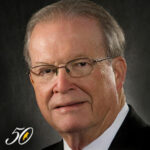 In Alabama politics, power has a name. And that name is Jabo Waggoner.
This year marks his 50th serving in the state Legislature. He was a member of the House from 1966-86. He’s been a member of the Senate since 1990. He was a minority leader, a majority leader, and now holds the title of longest serving lawmaker in Alabama history.
But for Waggoner, we bet it’s not as much about that milestone itself as it is the outsized impact he continues to make, and in particular, the people he helps in doing so: His friends, his district, and those who come to him with good intentions and a good story.
There’s plenty of corollaries to be made between his friend and former colleague Richard Shelby. In terms of a fundamental respect to the power of appropriations, Waggoner is to the Birmingham region what Shelby was for the State of Alabama. UAB is just one example. Their use of power and influence is synonymous with growth and prosperity.
Waggoner is still very much the coolest guy in every room. Not only is he the most important conversation to have if you hope to get anything on the Senate calendar – it could also be the most interesting and enjoyable one you’ll have all day.
He’s someone who also exercises his power through friendship. It’s no coincidence the most important man is also the one everyone wants to be around.

Robbie McGhee, Poarch Band of Creek Indians
 Wherever Robbie McGhee goes in the state of Alabama, he invariably gets cornered by legislators, mayors, city council members or county commissioners seeking local investment by the Poarch Band of Creek Indians.
These occurrences are never a surprise given PCI’s place as one of the Yellowhammer State’s leading job creators and investors in local communities.
McGhee is in his fourth term on the PCI Tribal Council, where he serves as vice chairman. In this role, McGhee is responsible for all governmental affairs at the federal, state and local level.
PCI is engaged in a diverse portfolio of business ventures. This includes gaming, hospitality, engineering, technology, manufacturing, construction and business consulting. The tribe’s federal services division has been the recipient of major contracts in recent years.
McGhee has prepared his entire professional career to carry the weight of PCI’s governmental relations responsibilities. He worked at the Department of the Interior, in the United States Senate and at a multinational law firm prior to returning home to Atmore.
Nevertheless, McGhee’s legacy in Alabama is cemented by his ability to leverage PCI’s strength so that all gaming legislation in the state goes through the tribe.
McGhee is a power player in every sense of the phrase.

Steve Windom, Windom Galliher & Associates
 Steve Windom gains ground each and every year. It’s no wonder. The man is a machine.
As the lieutenant governor who brought Alabama into the 21st century, he’s been pulling the levers of power for a long time. He’s still a lawmaker in some ways. At least in terms of his ability to raise money, set meetings and get bills passed.
But that doesn’t even get at the core instinct that continues to multiply his power as a contract lobbyist. Windom is everywhere. He knows everyone. And everybody knows him. Especially during session, he’s an early bird and a night owl. It’s truly impossible to outwork someone who never stops working.
Like the ’63 Corvette he has parked in his garage, Windom is timeless. But when he takes off, he absolutely books it.
Steve Windom’s longevity as the tie that binds his clients to the ruling class in Alabama offers a masterclass in influence.
Quadrenniums come and go. But Windom remains.

Quentin Riggins, Alabama Power
 We challenge anyone to show us a better fit between corporate culture and the personality of a senior member of management than exists between Alabama Power and Quentin Riggins.
Riggins serves as senior vice president of Governmental and Corporate Affairs for Alabama Power. This means Riggins is in charge of all state and federal government relations for one of the Yellowhammer State’s largest employers. He is also tasked with coordinating the company’s grassroots and corporate relations programs.
With so much at stake in so many communities across the state, the job of running point on all of the interactions with governmental entities would seem overwhelming.
But Riggins takes on the challenge the same way he played as an All-American linebacker at Auburn University. He is determined to succeed and relentless in his pursuit of Alabama Power’s objectives.
It is the perfect match of personality and approach at a company which fosters competition internally as well as part of its external goal to grow economic opportunity for the state of Alabama.
Riggins’ rather exceptional sphere of power and influence extends into his service on Auburn University’s Board of Trustees. This seat is undoubtedly special to Riggins. But his service extends to so many other endeavors they are too many to count.
The SEC Legend has a gravitational pull. Success seems to find Riggins. And so does power and influence.

Arthur Orr, Alabama State Senate
 Law No. 11 in Robert Greene’s “The 48 Laws of Power” states, “Learn to keep people dependent on you.”
Arthur Orr has employed this principle in reaching heights of power and influence reserved for a select few in Alabama.
He currently serves as chairman of the Senate Finance and Taxation Education Committee. This makes him the signator on Alabama’s largest bank account – the education budget. Orr holds the checkbook for an account exceeding $8 billion.
Power and influence has always been a measure of willingness to exercise the tools at one’s disposal. Just because someone may sit in a position of power does not guarantee influence if they are not willing to use it.
In Orr’s case, he boldly uses the leverage afforded him as chief appropriator of education dollars to achieve an array of outcomes in the Alabama State Senate.
He has established himself as one of the strongest voices in the room when it comes to setting the calendar of legislation in the upper chamber, and he has shown time and again he can effectively whip votes for or against a piece of legislation from members keenly interested in the distribution of education dollars for their districts.
Orr’s steep climb has been to the benefit of his home region of North Alabama and his relative position among power players in Montgomery. As outlined in Law No. 11, “To maintain your independence you must always be needed and wanted. The more you are relied on, the more freedom you have.”
Orr is utilizing that freedom to gain a nearly immeasurable amount of power and influence.

Will Ainsworth, Lieutenant Governor

Will Ainsworth doesn’t just set the agenda, he creates the entire narrative.
This is the year we discontinue the line of thought that Ainsworth is successful relative to his role as lieutenant governor. It’s no longer that he has “reinvented the office’s authority” or that he is “active and out front” – it’s Ainsworth himself generating power.
As evidenced in the 2022 cycle, if you’re running for office just about anywhere in Alabama, Ainsworth’s attention and endorsement is becoming more of a requirement than a plus. A master strategist and perhaps the state’s best communicator, he knows where the votes are and how to get them. He’s eager to get involved with any election in any corner of the state on any level of the ticket – if he believes you’re a good candidate.
Ainsworth’s political vision speaks to the effectiveness he brings to his legislative and administrative duties. Whether it’s cutting taxes at the grocery store or widening roads on the way to the beach, Ainsworth knows what we really want. And clearly, how to get it done.
And he’s also led on substance. He’s worked to make Alabama a better home for service members and veterans as chair of the Military Stability Commission, he was a leading voice for reopening the state after lockdowns, and most recently oversaw the Fconomic Incentives Review Committee.
In a state that enjoys picking a winner, we don’t suspect Ainsworth has any trips to Buck’s Pocket in his future.

Nathaniel Ledbetter, Speaker, Alabama House of Representatives
 Those who know Nathaniel Ledbetter had a good idea he’d be effective in his first session presiding over the House as speaker. No one knew he’d demolish expectations the way he has.
A clear tempo has been set in the ‘people’s house’ with Ledbetter as conductor. This is no small feat considering just under one-third of its members are freshman. Through a reinvention of the committee process and empowerment of his chairmen, the House has democratized decisions to the benefit of its members and their districts. He’s putting his reps outfront to lead on the substance they bring.
Ledbetter is humble and reserved. But when he speaks – everyone listens – and he means every word. Since his first day at the statehouse, it has been this quiet strength that has cultivated the trust of his colleagues. That presence is playing out powerfully in the lower chamber. If this session is any indication of what’s in store for the quadrennium, the House is back on time.
Elected to the House in 2014, made majority leader in 2017, and unanimously chosen as Speaker in 2022, the gentleman from Rainsville is on a lightning-streak. Prior to that, he was a three-term city councilman and mayor. While he now influences a far wider area than his district, the support he sees at home would be similar to many areas like it across Alabama that end up counting as the majority of ballot boxes on election day.
We suspect the more people who meet Ledbetter, the more his influence stands to grow.
In the meantime, expect him to continue running the House like clockwork.

Greg Reed, President Pro Tempore, Alabama State Senate
 For 335 days out of the year, Greg Reed is one of the most powerful and influential people in the state of Alabama.
During the remaining 30 days which constitute the annual legislative session in the Yellowhammer State, Reed is THE most powerful and influential person in the state. In his role as President Pro Tempore of the Alabama Senate, it is Reed who single-handedly determines the fate of any and all legislation introduced at the State House.
Alabama’s constitution ensures that the Alabama Legislature enjoys a special function among the three co-equal branches of government. And the rules within that branch empower the President Pro Tempore.
Reed has used the capacity of his office to its fullest.
He is a true statesman, and he carries a palpable presence whether in a room of two people or 200. Reed employs a smart formula which includes relationship building and reliance on process and structure. This is essential to leading 35 people who each represent a separate piece of Alabama’s geography and have a singular set of interests. There may only be two sides of the aisle in the upper chamber but there are not two sets of interests which are the same.
That’s why Reed is a master at taking on the disparate roles of being the state’s finest diplomat and a sledgehammer within minutes of each other.
Reed has all the tools to go down in the history of the state as one of our finest public servants. Lauded for his grasp of public policy and his ability to convey a disciplined message, he is a gifted retail politician and has undertaken a successful career in business.
And, yet, it still always comes down to those few moments each legislative session which determine the direction of the state of Alabama. Those moments, and that direction, sit in the palm of Reed’s hands.

Zeke Smith, Alabama Power
 Zeke Smith leads the most robust and effective governmental affairs operation in not just Alabama, but the entire Southeastern United States.
To illustrate recognition of that fact, we frequently point out that at political events involving his peers, it is Smith who clearly has the longest line of people wanting to speak with him.
Alabama Power services more than 1.5 million homes, businesses and industries. It employs more than 6,000 Alabamians. The company maintains more than 8,000 miles of power lines in order to achieve a power delivery rate exceeding 99%. So there is a lot the company has to tell people about.
That falls under Smith’s purview as executive vice president External Affairs. Governmental relations, corporate affairs, regulatory affairs, environmental affairs, public relations and charitable giving all fit under the umbrella of Smith’s office.
Smith is a savant when it comes to Alabama Power’s business and the regulatory climate within the structure of Alabama state government. At this point in his career, he is both a celebrity and cerebral and always mindful of his company’s brand. At the same time, he allows his team to think boldly about the possibilities for the company and the state.
There is not enough room in this space to list the initiatives in which Smith is involved in the areas of economic development and philanthropy. Notably, though, he serves on the Board of Trustees at Auburn University, where he and his wife, Darlene, have endowed multiple scholarships.
Smith will be talked about by generations of Alabama Power employees, governmental affairs professionals, people in his own community and those in Alabama communities miles from his home.

Kay Ivey, Governor of Alabama
 In 2019, we wrote that “Governor Kay Ellen Ivey will go down as one of the most consequential leaders in Alabama history.”
That’s been substantiated.
While it’s a plain fact that Ivey has won the hearts and minds of Alabamians with one of the highest and longest running favorability rates, after the last election cycle, we think she won the whole game.
From the renewal and expansion of economic incentives, to direct taxpayer relief for hardworking families, to the wise appropriation of federal funds investing in the current needs and future challenges of counties across the state, to so many other landmark victories – all Ivey has to do is point to the scoreboard.
Anyone surprised isn’t playing close enough attention.
We think she was simply following the playbook she wrote. Time and time again, Ivey leverages the trust she’s built over her career to accomplish a clear vision that’s communicated just as clearly. On the other side of leading Alabama through compounding world crises with calm, decisive judgment – both voters and lawmakers alike are invested in that reliability.
At this point, Ivey has become more than just Alabama’s “right the ship” governor. She’s also Alabama’s jobs governor, infrastructure governor, Alabama’s pro-military governor, and far more.
Ivey’s journey from Camden to Auburn to the summit of power she’s reached in Montgomery will be held up for years to come as the blueprint of an Alabama governor.
More than anything, Ivey’s politics is a reflection of her love for Alabama. It’s that simple.
As I stroll down the halls of the Alabama Senate during this current regular session of the
Alabama Legislature, I will stop and visit in the offices of my favorite legislative buddies. My
favorite and first stop is with my longtime friend Jabo Waggoner. Jabo, being the dean of the Legislature, has the first prime corner office. He also chairs the agenda setting Rules Committee.
Therefore, there is a throng of high-price lobbyists camped outside the door trying to get Jabo to put their bills on the Special Order Calendar.
Jabo and I will swap stories of bygone years and reminisce about past experiences. Jabo is a big sports fan and was a great college basketball player .In fact, Jabo was one of the founders and remains on the Board of the Alabama Sports Hall of Fame, which is located in downtown Birmingham. Jabo, Gene Hallman, and Edgar Welden were the pillars and founders of this prestigious institution. One of Jabo’s and my favorite remembrances is going together to the Olympic Soccer Games at Legion Field in Birmingham.
Recently while visiting Jabo, I thought, “I am with an Alabama political icon.” Jabo Waggoner has been in the Alabama Legislature for 50 years this year. Folks, that is an Alabama record.
Jabo Waggoner is the longest serving legislator in Alabama history. He served 17 years in the Alabama House of Representatives and is in his 33rd year in the Alabama Senate.
Jabo was first elected to the Alabama Senate in 1990. The heart of his district has always been the entire city of Vestavia. He also represents parts of Homewood and Hoover. This is a very Republican area and therefore, Jabo is an arch Republican.
Jabo is revered in Jefferson County, but his popularity extends beyond Jefferson and Shelby
counties. When Kay Ivey was running for Governor for the first time in 2018, she asked Jabo to be her titular campaign manager. He introduced her as she announced her candidacy.
Jabo is adored by his Senate colleagues, especially the younger state senators. They throng to him for tutoring and mentoring. The Senate leaders, Greg Reed of Jasper and Clay Scofield of Arab, seek his guidance on tricky Senate maneuverings.
Jabo was the Republican Minority Leader of the State Senate from 1999 until the Republicans gained a legislative majority in 2010. He was the first Republican Majority Leader, then relinquished that role to be the Rules Chairman where he currently serves.
Jabo is married to his high school sweetheart Marilyn. They have been married for over 60
years. I have never met a more beautiful or sweeter lady than Marilyn Waggoner. They had four children, three sons and a daughter. One of their sons, Scott, died at an early age in an automobile accident.
Jabo and Marilyn are ardent members of the Homewood Church of Christ. They attend almost every Sunday and sit with Jabo’s best friend, Dr. Swaid Swaid and his wife, Christy. Jabo’s and Marilyn’s children attend the same church.
Jabo Waggoner has done a lot for Jefferson County for over 50 years. It would take a book to chronicle his legislative accomplishments and good deeds. In the 1970’s Waggoner sponsored legislation which spearheaded the purchase of 45 blocks in downtown Birmingham for UAB’s expansion. UAB purchased this property, which was valued at $8.5 million at that time. There is no telling what that land is worth today – probably well over $200 million to $300 million.
Jabo was first elected to the Legislature in 1966. It is no coincidence that UAB has grown into one of the premier medical and research institutions in America and the Crown Jewel of Alabama during that same period. Although Jabo is an arch-conservative Republican, he has forged a close working relationship with his fellow Democratic Senate leader Roger Smitherman to work across the aisle for the good of Jefferson County.
In closing, in all my years of following Alabama politics, I have never seen a more modest or amicable leader than Jabo Waggoner Jr. I have never seen or heard of anyone who has ever met Jabo that did not like him. Jabo Waggoner is an icon of Alabama political history.
See you next week.
Steve Flowers’ weekly column appears in more than 60 Alabama newspapers. He served 16 years in the state Legislature. Steve may be reached at www.steveflowers.us.
Yellowhammer Multimedia is publishing its list of Alabama’s most powerful and influential political leaders.
Taking into account conversations with political insiders, as well as the most recent developments in politics and public policy, the list is meant to recognize the top individuals in government and politics who leverage their power and influence on behalf of those they represent and the Yellowhammer State.
The ranked list is being released in five segments. Numbers 41-50 came out on Monday, 31-40 came out on Tuesday, 21-30 came out on Wednesday, and 1-10 will publish tomorrow.

Clay Scofield, Majority Leader, Alabama State Senate
 What we said in 2021: The reality is that the newly-installed Senate Majority Leader will see himself included in any sort of list judging stature among the Yellowhammer State’s political leaders.
Scofield’s meteoric ascension to majority leader of the Alabama Senate, at just the age of 40, is a highly impressive feat. What’s more impressive are the legislative accomplishments Scofield has been able to rack up in the prominent role.
Even as he has achieved great success early in his promising political career, Scofield has been anything but complacent.
Scofield’s leadership as it relates to broadband expansion has been an absolute game changer. By all accounts, Alabama now leads the nation in broadband planning due in no small part to the Marshall County senator.
Leading on an issue as vital to the state’s economic growth as this, alongside leading the Senate’s majority party, has thrust Scofield’s name into the mix alongside the Alabama political arena’s heaviest hitters, and deservedly so.

Twinkle Cavanaugh, Alabama Public Service Commission
 What we said in 2021: Twinkle Cavanaugh has built one of the most trusted brands in Alabama politics. In 2020, she received 1.38 million votes, the most by a non-presidential candidate in Alabama history. Few things send a stronger signal of a formidable statewide presence than that kind of stout vote tally.
As part of her resounding election victory in 2020, Twinkle Cavanaugh ran an ad campaign with the predominant theme being “Twinkle means tough.”
The campaign was obviously effective. She garnered a record number of votes. And it has stuck. Nearly two years later, she is still known to run into people around Alabama reciting the “Twinkle means tough” tagline back to her.
It is also how she has governed.
As president of the Alabama Public Service Commission, she has made drastic cuts to the size of her own agency and returned tens of millions of dollars back to the state general fund, a rarity in politics.
Then there is her annual pitched battle against environmental lobbyists who march into her agency demanding Green New Deal-type policies.
Pay close enough attention, and you will realize that Twinkle means power and influence.

Houston Smith, Alabama Power
 What we said in 2021: If there were ever a public servant in the private sector, it is Houston Smith. Take his mindset toward service and blend it together with Alabama Power’s sustained strength in the governmental affairs realm, and you get one of the 20 most powerful and influential people in the state.
Houston Smith serves as vice president for governmental affairs at Alabama Power. Yet, his efforts and influence extend in numerous different directions.
He maintains a vast network both in Alabama and across the country, maintaining a watchful eye on trends in innovation and ways in which his home state can diversify its economy.
In his role as lead state government lobbyist for the Yellowhammer State’s largest taxpayer, he runs advocacy and outreach to elected officials and agency heads across the political spectrum. This is no small task considering the myriad of ways in which Alabama Power is affected by state policy.
Add in Smith’s deep involvement in groups like the Business Council of Alabama and the Birmingham Business Alliance, and his power and influence becomes obvious.

Greg Albritton, Alabama State Senate
 What we said in 2021: He’s tough and fair and a conservative reformer at heart. Alabama is in a better place with Albritton in charge of its general fund budget.
If someone assembled a focus group in South Alabama and asked them to list out the ideal qualities they wanted to see in a state senator, our guess is they might say crafty, loyal, stubborn, thoughtful and hard working.
And that’s why the voters in Greg Albritton’s district send him to Montgomery.
Being in charge of the general fund, which supports all of the non-education components of Alabama state government, is a powerful, influential and thankless job. Yet, Albritton relishes the role.
He is thorough in his oversight of that big pot of money. Much to the discomfort of lobbyists and agency leadership, every program and appropriation gets a little extra scrutiny at his desk.
Combine his position as a budget chairman with a willingness to fight tooth and nail for the interests of his district, and you get a formidable presence in the Alabama Legislature.

Danny Garrett, Alabama House of Representatives
 There is power in not needing the job that you have. There is power in knowing more about your subject matter than everyone else. There is even greater power in overseeing the distribution of $8.2 billion.
Danny Garrett finds himself in exactly that position of power and influence following his first legislative session as chairman of the Alabama House of Representatives Ways and Means Education Committee.
A rock-solid conservative, Garrett entered public service following a stellar career in the private sector. He accumulated decades of experience as a chief financial officer for companies which included Birmingham Steel, Nabi, Progress Rail, Summit Products and Vulcan Steel Products.
In addition to being a financial wizard, the Trussville resident has been a skilled legislator on issues dealing with jobs and economic development.
Garrett could be doing a lot of different things, right now. The fact that he is willing to serve the Yellowhammer State in his current capacity is a huge win for parents and our future workforce.

Steve Marshall, Attorney General of Alabama
 What we said in 2021: He has surrounded himself with a talented, highly qualified team inside the attorney general’s office, and he is predictably popular in the law enforcement community and among his conservative base. Yet, he is not the least bit scared to take a principled stand in the face of criticism.
Steve Marshall has throughout his term been unyielding in his fight to protect Alabama values from his position as the state’s attorney general.
He has been on the forefront of national court clashes on issues involving unborn children, COVID mandates, Second Amendment rights, illegal immigration, censorship, consumer protection and victims’ rights.
Occupying the position of Alabama’s chief law enforcement officer inherently brings with it a high level of power and influence. However, when the attorney general is also chasing the Biden administration up and down America’s judicial system, that becomes a next-level opportunity to increase his standing.
Challenging the federal government, cracking down on corruption and supporting law enforcement, Marshall has done everything needed to maximize his power and influence.

Arthur Orr
 What we said in 2021: Orr is the state senate’s chairman overseeing the nearly $7.7 billion education budget. Carrying the weight of that checkbook around in his suit pocket affords him an elite level of power and influence.
The weight of Alabama’s education checkbook has gotten heavier, and so has Orr’s influence.
Through the Morgan County senator’s leadership, the Alabama Legislature passed a historic $8.26 billion education trust fund budget during this year’s regular session.
Orr, who is known to be one of the upper chamber’s chief finance gurus, chairs the powerful Senate Finance and Taxation Education Committee.
In a state were one of the most politically powerful forces is the education lobby, Orr faces one of the most daunting annual legislative tasks of shaping the state’s massive education budget.
Orr’s ability to not only ensure proper fiscal management of the state’s largest budget, but successfully navigate the political hurdles associated with it, have proven his ranking on this list is more than deserved.

Joe Perkins, Matrix
 What we said in 2021: One cannot help but marvel at the depth and breadth of Joe Perkins’ impact on Alabama politics. It is especially remarkable considering his specialized approach. In practical terms, it is difficult to describe what he does because discretion is so fundamental to his business model.
Joe Perkins is the most successful consultant in the history of Alabama politics.
Now, we choose to define the term “consultant” in the same spirit as Perkins articulates the mission of his storied firm. We imagine a consultant used in this manner is different than a lobbyist, a campaign operative or a public relations professional – and at the same time combines all three.
Accordingly, Perkins provides research, strategy and tactical advice to an elite stable of clients.
There is no shortage of elected officials seeking to tap into his deeply analytical approach to politics. There are few organizations or associations in which he does not have a foothold.
Frankly, at this stage of his career, Perkins’ level power and influence is simply up to him.

Steve Windom, Windom Galliher & Associates
 What we said in 2021: Windom’s connections to elected officials are deep given his prodigious fundraising abilities. Go to an obscure office in any state agency, and you will probably find someone whom he knows and with whom he has banked a relationship — just in case.
Most marketing materials contain some amount of puffery in their statements. The target audience comes to expect it, and it can add some color to any ad campaign.
In the case of the Windom Galliher & Associates slogan, no truer words have ever been written, and nothing could better describe the firm’s founder: “Trusted. Respected. Never outworked.”
That’s Steve Windom in a nutshell.
A former state senator and lieutenant governor, Windom has earned every bit of his reputation as a tenacious lobbyist who delivers on a daily basis for his clients. He never stops working, either. If the man makes a quick run to the store at night for a gallon of milk, he is working on the way there — and back.
Windom is in his own tier of power player in Alabama.

Jabo Waggoner, Alabama State Senate
 What we said in 2021: The reality is that as much as everyone wants to be like him, none of us are. You can’t force cool. You can’t fake importance. As much as young legislators want to grow up and be like Jabo, it is just never going to happen. Waggoner is simply one of one.
Grab ‘em up. Gather your kids, your grandkids, your friends, your neighbors or anyone else you can get your hands on.
Grab them up and carry them to the Alabama State Senate to watch a master at work.
The state of Alabama and the people of his Jefferson County district get at least one more term to soak in representation by a legend in Alabama politics.
Jabo Waggoner has attained iconic status in the lexicon of Alabama politics. Now it’s time to appreciate it.
Serving as chairman of the powerful Senate Rules Committee is all fine and dandy, but Waggoner would be sitting here on this list whether that was the case or not.
No one in either chamber legislates quite like Waggoner. He is smooth and cool – and effective.
Don’t miss out on history being made.
Yellowhammer will host a reception to honor the Power & Influence 50 on May 12th at 6pm in Montgomery. Email Courtney@yellowhammernews.com for details.
A bill making its way through the Alabama Legislature would regulate wake surfing throughout the entirety of Alabama’s vast public waters.
Senate Bill 281, sponsored by State Sens. Garlan Gudger (R-Cullman) and Jabo Waggoner (R-Vestavia Hills), would prohibit wake surfing in a public body of water that is less than 50 acres in size. Additionally, wake surfing would be forbidden in any portion of public water where the width of the portion is less than 400 feet.
Wake surfing would also be disallowed within 200 feet of a shoreline, dock, pier, boathouse or any other structure.
After a full year upon the bill’s enactment, a first-time offense of the law would be considered a Class B misdemeanor and carry a fine of at least $150. A subsequent violation would carry a fine of at least $250 and could result in the individual losing certain boating privileges for the rest of the calendar year.
The full language of the bill can be found here.
Last week, Senate Bill 281 passed the Senate by a vote of 26-0 with nine abstentions. The bill currently sits in the House Public Safety and Homeland Security Committee, chaired by State Rep. Allen Treadaway (R-Morris).
Treadaway tells Yellowhammer News that the he has not fielded much feedback from the public concerning opposition or support of the bill. He says those in favor of the bill cite instances where boats have driven in close proximity to private docks.
However, Treadaway says that committee members have asked for the names of lakes that the bill would affect. Committee members could possibly offer amendments adjusting the size of the public bodies of water where wake surfing would be prohibited, Treadaway says.
The bill is set to be considered by the committee at 9:00 Wednesday morning. The committee hearing can be livestreamed on the legislature’s website.
Dylan Smith is a staff writer for Yellowhammer News. You can follow him on Twitter @DylanSmithAL
BIRMINGHAM — Rallying her supporters in a packed room at Lloyd’s Restaurant in Birmingham, Gov. Kay Ivey kicked off her bid to maintain her residency at the governor’s mansion for an additional four years.
The rally began with opening remarks by long-serving State Sen. Jabo Waggoner (R-Vestavia Hills), who touted the leadership Ivey had demonstrated since assuming the governor’s office in 2017.
“Governor Ivey has been a fantastic governor for Alabama and I’m grateful for her leadership and navigating the ship of state through the various challenges that comes with having that job,” Waggoner told the crowd. “Anyone who has listened to Washington, D.C. or the mainstream media knows the threats that our country faces. Everything from reckless, unconstitutional COVID-19 mandates, calls to defund the police, critical race theory, and the list goes on and on.”
“People are concerned in this state and all over this nation,” added Waggoner. “That is why it is so critically important to have a strong, capable leader like Governor Kay Ivey serving as the head of state.”
Prior to introducing Alabama’s 54th chief executive to event attendees, Lt. Gov. Will Ainsworth took the podium to deliver a fiery speech lambasting President Joe Biden and hailing Ivey for what he asserted to be her willingness to combat his administration’s progressive policies.
“Governor Ivey loves Alabama. Alabama’s economy is on fire – one of the best economies in the U.S.,” said Ainsworth. “The lowest unemployment in Alabama’s history, she’s created over 44,000 new jobs – the best business climate in all 50 states. Think about this: $19 billion in new business investment in Alabama.”
Ainsworth went on to proclaim, “[President Biden] will go down as the worst president in my lifetime. You better believe states are important. We’ve got to fight back and it’s important that we support a governor that’s going to stand up for our conservative values. She’s done that, she’ll continue to do that. We need her back in office. We need everyone working hard to get her reelected.”
I appreciated all my supporters and friends who made it out for my official campaign kickoff event last night. It was an honor to share with everyone my conservative record and vision for the future of our state #alpolitics. pic.twitter.com/XyAlhMPHpj
— Kay Ivey (@kayiveyforgov) February 11, 2022
In opening her remarks, the governor took aim at her GOP primary opponents by saying that they would make disparaging claims about the present condition of the state.
“Y’all, we’re going to hear a lot of talk with this campaign from politicians making lofty promises. A lot of talk from politicians who want to run down Alabama and talk bad about our state – we’re not going to have it,” Ivey declared. “If they don’t like Alabama, they can head on to New York or California, or even Illinois.”
“I’m proud of my conservative record. We’ve already done what others are only talking about doing,” added Ivey, before touting the economic growth the state had experienced under her administration.
The governor continued, “While others in the country were caving into Washington and flip-flopping Fauci, here in Alabama we did what we needed to do to make sure we stayed open during this awful pandemic and keep our young people in school where they belong.”
“And speaking about the pandemic, let it be crystal clear on one thing: Joe Biden will never tell Alabama what to do,” said a defiant Ivey. “Not ever will he tell us what to do. His mandates are dead in Alabama. We’ve sued him and we’ve won. And folks, I’m standing like a brick wall against Joe Biden and his outrageous, unconstitutional overreach. I’m continuing to fight Washington with every fiber in my being and I say bring it on, Joe!”
The governor slammed Critical Race Theory teachings and the Obama-era federal educational standards of Common Core.
“Here in Alabama, ya’ll we don’t teach hate. Critical race theory is racist and its hateful. And here in Alabama, it’s dead as a door nail,” said Ivey. “We banned it and it’s not coming back. Common Core is a bunch of no good nonsense, that’s why we don’t teach it here in Alabama. We teach the basics and we’re focused on preparing our children for the real world.”
She added, “Speaking of the basics, we all know that gender is straightforward. It’s about biology, not feelings. That’s why I banned transgender sports in our schools. Lieutenant Governor Ainsworth said ‘here in Alabama, boys play boys’ sports, girls play girls’ sports.’ It’s just Alabama commonsense.”
The governor went on to say that she signed the “strongest pro-life bill in the country” and pledged to continue protecting “every single unborn life.” She then turned her attention to the issue of election integrity.
“Right here in our sweet home Alabama, our elections are safe and secure. Look at Joe Biden – we all know something was up in other states in 2020. But here in Alabama, we got it right,” said Ivey, before touting legislation that she had signed to “make sure no election is stolen here.”
Ivey concluded in part, “Y’all, if you pay too much attention to Washington, D.C. you’ll go insane. And sometimes it really seems like really the world’s gone crazy. But not here in Alabama – we’re in great shape. And we’re using Alabama commonsense to lead us to even better days.”
Watch:
The primary election will take place on May 24, 2022.
Dylan Smith is a staff writer for Yellowhammer News. You can follow him on Twitter @DylanSmithAL