
MONTGOMERY, Ala. — One year ago today the venerable Paul Hubbert, founder and longtime leader of the Alabama Education Association (AEA), passed away only a few years after officially retiring. Under his leadership the teachers’ union was unarguably the most powerful force in Alabama politics, but since Hubbert’s retirement and death the once formidable organization’s influence has significantly waned.
Though the AEA’s slide truly began in November 2010 when a Republican majority was elected to the Alabama Legislature for the first time since Reconstruction, overwhelming evidence of the organization’s unraveling come to the forefront just a month before Hubbert’s passing.
“With great reluctance, but with absolute conviction of its necessity, I write this letter to you to inform you of the immediate danger, in fact crisis, in which our association finds itself,” Hubbert wrote to the AEA Board in September of 2014. “AEA has been a strong organization for many years because of its large membership and its strong financial position. Both of these appear to be under threat now.”
Hubbert said the problems facing the AEA came from both inside and outside the organization. The external challenges, he believed, were posed by the Republican supermajority in the legislature and the strain on the AEA’s finances brought on by a new law prohibiting them and other politically active organizations from using taxpayer resources to collect membership dues.
Internally, Hubbert pointed the finger directly at his successor, Dr. Henry Mabry, who took over the post when Hubbert retired in 2012.
“The style, personality and performance of the Executive Secretary have created intolerable friction between AEA and members of both parties in the Legislature with resultant loss of respect, standing and influence,” Hubbert bluntly wrote of Mabry. “Legislators and others complain that telephone calls are not returned during the session. The Executive Secretary’s style has been described as a ‘bull in a china shop who carries the shop with him wherever he goes.’ The Executive Secretary has been advised to ‘stay out of the Legislature.’ Specific comments and questions from members of the Legislature include, ‘How long is AEA going to keep Mabry?’ to ‘Mabry is killing AEA in the Legislature.'”
Two months later the 2014 elections only strengthened Republican majorities, despite an estimated $20 million in teachers’ dues being used to support failed candidates.
“The AEA’s days are done,” said Senate President Pro Tem Del Marsh (R-Anniston) on election night. “We want to work with the education community to establish good education policies. We’re committed to that. We want to make sure our teachers are paid well. We want to make sure they have great benefits. But we can do all of that without the AEA union. Their mentality is ‘attack, attack, attack.’ I want to work with our state’s teachers directly, not with the AEA.”
Hubbert’s concerns coupled with the union’s defeat at the ballot box proved too much for Mabry, when in February of this year he was summarily fired by the AEA board. The board also requested that the National Education Association, the AEA’s even more liberal umbrella organization, intervene to implement the regime change.
This summer that national-level intervention was called into question by longtime leaders within the AEA, who said the organization is being “occupied” by the NEA.
“This letter comes to express our deep concern over the current ‘Takeover’ of the Alabama
Education Association (AEA) by the National Education Association (NEA) in the name of Trusteeship,” wrote former AEA leaders and current Alabama Democratic Party bosses Joe Reed and Nancy Worley. “Under the facts and circumstances of the current ‘Takeover,’ there are no grounds for NEA to occupy AEA.”
“Don’t force us to fight an organization we love, respect and support,” the authors continued. “This is an ‘internal family issue,’ but the House is severely Divided. We all know that a House Divided cannot stand. It is going to take many years to repair the damage already done.”
Where the once-powerful AEA goes from here remains to be seen, but members say one thing is for certain: not much will improve until it can find a leader that balances the disparate interests of its leaders while working with the Republican supermajority and maintaining what’s actually best for education professionals.
Like this article? Hate it? Follow me and let me know how you feel on Twitter!
— Elizabeth BeShears (@LizEBeesh) January 21, 2015

MONTGOMERY, Ala. — Former Alabama Education Association (AEA) leaders are lashing out at the teachers’ union’s current trusteeship under its parent organization, the National Education Association (NEA), saying in a letter that the AEA is being “occupied” by the NEA.
The letter, dated July 2nd, is signed by former AEA leaders Joe Reed and Nancy Worley—who are both currently leaders within the Alabama Democratic Party—as well as four former AEA presidents.
“This letter comes to express our deep concern over the current ‘Takeover’ of the Alabama
Education Association (AEA) by the National Education Association (NEA) in the name of Trusteeship,” they wrote. “Under the facts and circumstances of the current ‘Takeover,’ there are no grounds for NEA to occupy AEA.”
“Don’t force us to fight an organization we love, respect and support,” the authors continued. “This is an ‘internal family issue,’ but the House is severely Divided. We all know that a House Divided cannot stand. It is going to take many years to repair the damage already done.”
That damage is a tumultuous change in leadership after longtime power broker and boss Paul Hubbert retired, then passed away, coupled with drastic changes in the state legislature—where Hubbert wielded unprecedented power—the AEA’s 2014 was disastrous.
Even after spending approximately $20 million during the primary and general elections, the AEA’s PAC, A-VOTE, failed to win a single seat for the candidates it supported. According to their most recent 990 form, the AEA spent $8.5 million more than it took in during Fiscal Year 2014.
“Finally,” the letter concludes, “NEA is occupying our organization illegally and without justification. NEA should call the Special Trustee home because if the NEA continues to trespass, the AEA, the strong organization we built over the past 45 years, will be DEAD! We do not concede that the NEA Trusteeship is legal and we are determined to take our association back!”
Both Reed and Worley told the Montgomery Advertiser they had not received a reply from the NEA.
Reed highlighted his particular concern that the NEA’s Trustee would dissolve the AEA’s 46-year-old merger with the predominately black Alabama State Teachers’ Association.
“There are certain things that are there and ought to stay there, for instance, the First Amendment to the U.S. Constitution,” he said. “The merger agreement we have has got to stay.”
AEA president Sheila Hocutt Remington said in a statement Tuesday that the letter was “inaccurate” and “designed to divert attention from the positive direction AEA is taking to support educators and Alabama schools.”
“AEA is successful because it has been a member-driven association for more than 150 years,” she said. “While some people will always be uncomfortable with change and will cling to vestiges of the past, AEA and its membership is focused on what matters most – preparing students for a new school year that will begin throughout Alabama next week.”
While the AEA and the Alabama Democratic party were virtually synonymous for years, the NEA often tacks even further left than its Alabama affiliate.
Last fall NEA President Lily Eskelsen García hailed President Obama’s controversial executive actions on immigration as “bold,” “necessary” and “morally right,” and pledged that educators in Alabama and around the country will continue pushing for Congress to expand on what the President has done.
“(A) growing number of public school students live in fear that our nation’s immigration policies will break up their families, forcing them to choose between their country and their loved ones,” said García. “That’s why we welcome the president’s proposal to expand Deferred Action for Childhood Arrivals (DACA).”
Like this article? Hate it? Follow me and let me know how you feel on Twitter!
— Elizabeth BeShears (@LizEBeesh) January 21, 2015
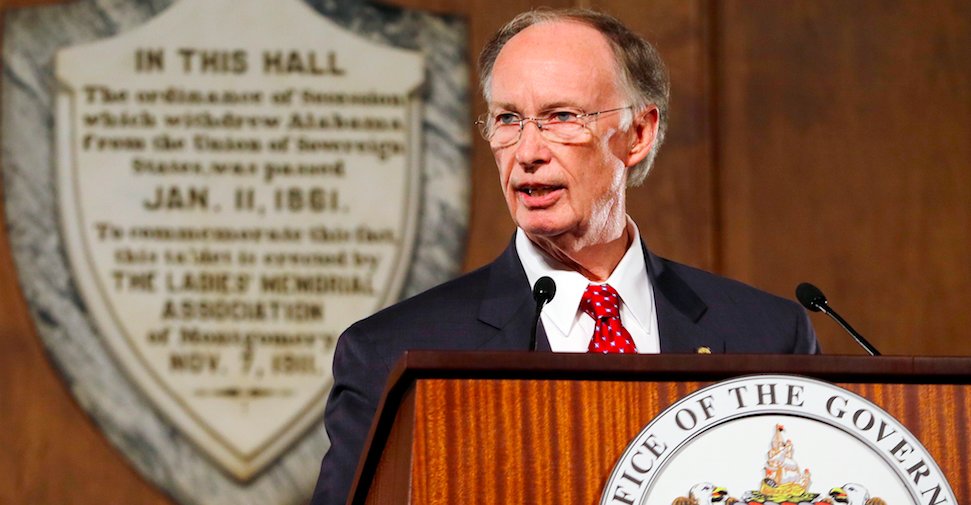
MONTGOMERY, Ala. — Public campaign finance disclosures show Governor Robert Bentley (R-AL) received $45,000 in combined donations from groups affiliated with Alabama Education Association and Alabama Hospital Association on the same day he announced his $541 million tax increase plan in early 2015.
A February 27th, 2015 finance report filed by Governor Bentley’s campaign shows it received $25,000 from A-VOTE, the AEA’s Political Action Committee (PAC) and $20,000 from the Alabama Hospital Association PAC.
According to a campaign finance legal expert Yellowhammer spoke with on background, it is perfectly lawful and not unusual for elected officials to continue raising campaign funds after their elections, as long as they are working to retire debt incurred by the campaign. In Governor Bentley’s case, he loaned his campaign around $500,000 during the 2014 cycle. His campaign account currently contains $604,260.
The excess between his debt and what he has left in his war chest cannot be used for a future federal campaign, or be given to other candidates or PACs in the state.
So, besides paying back his debt, what can the governor put the surplus toward? Not a whole lot, apparently.
Allowed expenses could include Christmas cards and other letters or cards to supporters, political trips the state cannot pay for (e.g. if the governor wanted to go to the 2016 Republican Nominating Convention in Cleveland), or paying political consultants for work concerning the wrapping up of the campaign.
Rebekah Mason, a spokesman for the governor’s campaign, told the Anniston Star the timing of the donations is purely coincidental; reports for any campaign contributions are due the last Friday of the month.
However, both organizations are major stakeholders in the two most prominent issues currently facing state government — the General Fund budget debate and a potential Medicaid expansion.
The $25,000 check from the AEA was reportedly written and approved on February 13th by the teachers’ union’s recently-ousted leader Henry Mabry. A representative from the AEA told reporters she didn’t know “what the thought process was about that led to this $25,000.”
The AEA, though it has lost much of its clout, is still an ardent opponent of conservative budgeting reforms, including consolidating the General Fund and Education Trust Fund or eliminating or reducing the vast number of earmarks in the state’s budgeting process. Alabama is one of only three states with two separate budgets and earmarks by far the highest percentage of its tax revenue (91 percent) of any state in the country. The AEA pushed to put the current budgeting system in place and has fought to maintain it for decades.
According to a spokesperson for the Hospital Association, their PAC made the donation on February 11th after a telephone conversation with Governor Bentley on the need to retire his campaign’s debt.
The Hospital Association is a significant proponent for Medicaid expansion, having funded studies and campaigns looking to sway the state’s leaders toward expanding the program by increasing the number of people on taxpayer-funded health insurance.
Throughout his first term, Governor Bentley assured voters he would not expand Medicaid, but has softened his stance somewhat in recent months, intimating that he is open to a modified version of the expansion similar to what a handful of other Republican-lead states have attempted.
Pennsylvania and Arkansas, which are also led by Republican governors, expended the program by funneling federal tax dollars through the state government and into private insurers. They then use those taxpayer dollars to cover uninsured individuals up to 138 percent of the federal poverty level, the same ultimate outcome as Medicaid expansion under ObamaCare. The difference is that by receiving a “waiver” from the Obama administration, Republican governors have been able to participate in ObamaCare’s Medicaid expansion while selling to their conservative constituents as something completely different. In Pennsylvania they call it the “Healthy PA” plan. In Arkansas it’s commonly referred to as the “private option.”
Governor Bentley signed an executive order in early April creating the Alabama Healthcare Improvement Task Force to “address ways to improve the health” of Alabamians. A cursory look at the 38 men and women appointed to the task force shows it to be stacked with advocates for Medicaid expansion.
While the majority of Republicans stand adamantly against expanding the already-beleaguered Medicaid program, the governor has perhaps grown accustomed to advocating what he believes to be best for the state, despite pushback from other members of his party.
Like this article? Hate it? Follow me and let me know how you feel on Twitter!
— Elizabeth BeShears (@LizEBeesh) January 21, 2015
MONTGOMERY, Ala. — Yellowhammer learned Tuesday morning that the Alabama Education Association (AEA), whose precipitous fall from power over the last few years has shocked many longtime observers of Alabama politics, has been placed under trusteeship by the teachers’ union’s national umbrella organization.
After spending roughly $20 million in the 2014 election cycle with little success, the AEA fired its executive secretary Henry Mabry in February after the National Education Association came in to take over operations.
Now, the NEA not only has control over the day-to-day operations of the AEA, it has also placed it under the authority of a trustee. A source with knowledge of the situation says the shift happened because “The NEA recognizes that AEA bet on politics, lost big and is now on organizational life support. They are taking over because AEA can’t support itself.”
The AEA is only the third NEA affiliate in history to be taken over by the national organization, after South Carolina’s and Indiana’s were placed under trusteeship in 2010 and 2009, respectively.
Yellowhammer reached out to the NEA for comment, but had not heard back as of press time. AEA manager of research Amy Marlowe told Yellowhammer Tuesday afternoon that, “Nothing has changed at AEA since Dr. Mabry was placed on leave by the AEA board of directors. The AEA board made that decision and every decision since that night.”
While the AEA and the Alabama Democratic party were virtually synonymous for years, the NEA often tacks even further left than its Alabama affiliate.
Last fall NEA President Lily Eskelsen García hailed President Obama’s controversial executive actions on immigration as “bold,” “necessary” and “morally right,” and pledged that educators in Alabama and around the country will continue pushing for Congress to expand on what the President has done.
“(A) growing number of public school students live in fear that our nation’s immigration policies will break up their families, forcing them to choose between their country and their loved ones,” said García. “That’s why we welcome the president’s proposal to expand Deferred Action for Childhood Arrivals (DACA).”
The NEA takeover also brings into question the AEA’s ability to adapt to Republican control.
Despite decades of warnings to their members that education funds would dry up without their advocacy in Montgomery, the Fiscal Year 2016 eduction budget passed by the GOP supermajority and signed into law by Governor Robert Bentley (R-AL) is among the highest appropriations for education in the state’s history.
Like this article? Hate it? Follow me and let me know how you feel on Twitter!
— Elizabeth BeShears (@LizEBeesh) January 21, 2015
MONTGOMERY, Ala. — The Democratic Party may be all but defunct in the state of Alabama, but Democrats in the state legislature — and a handful of more liberal Republicans — were still able to count on their closest ally during the 2014 election cycle.
A list of Alabama’s largest Political Action Committees (PACs) compiled by the Birmingham Business Journal shows that the Alabama Education Association’s (AEA) A-VOTE PAC had the most cash to work with in 2014 — and it wasn’t even close.
At $4.62 million, A VOTE piled more money into its coffers than the next four largest PACs on the list combined.
1) AL Voice of Teachers for Education- $4.62 million
2) Alabama Republican Executive Committee- $846,556
3) Trust Representing Involve Alabama Lawyers – $837,461
4) Progress PAC (Business Council of Alabama) – $816,761
5) Stop Common Core PAC – $725,035
Interestingly, the 5th PAC on the list, Stop Common Core PAC, is widely believed to have been little more than a front group for AEA as well.
In 2014, the AEA and its tangled web of affiliated PACs and interest groups, spent upwards of $20 million in a desperate attempt to oust incumbent Republicans around the state. But in spite of their unprecedented expenditures, the group only won a handful of victories in the primaries, then were unable to claim a single victory on election night in November.
Remember that time AEA spent like $20 million of teachers' money in a scorched earth campaign and didn't win, like, anything? #alpolitics
— Cliff Sims (@Cliff_Sims) November 5, 2014
Much of A VOTE’s contributions come from the dues of teachers, which until 2014 were automatically deducted from teachers’ checks each month. Last year the 11th Circuit Court of Appeals ruled that the AEA could no longer use state resources to collect those donations.
Despite this ruling, the AEA campaigned in teachers’ lounges and in schools to get a large percentage of their members signed up through automatic bank account withdrawal.
But after their millions of dollars in donations were squandered without much success in 2014, it is unclear whether or not the group will ever be able to recover.
The Republican-lead legislature was recently able to pass charter schools legislation for the first time in history, dealing yet another blow to the beleaguered union.
Like this article? Hate it? Follow me and let me know how you feel on Twitter!
— Elizabeth BeShears (@LizEBeesh) January 21, 2015

MONTGOMERY, Ala. — The Alabama Education Association (AEA) board voted to fire Executive Secretary Henry Mabry Saturday, after reports that teachers’ union cleaned house during a closed door executive meeting late last night, ousting Executive Secretary Henry Mabry and revoking building access to former Associate Executive Secretary Joe Reed.
The AEA Board reportedly voted to request assistance from the National Education Association (NEA) in implementing the regime change.
This was a difficult decision by the Board but one that was necessary to close a difficult chapter in AEA’s recent past and turn to meet the challenges and opportunities ahead,” AEA President Anita Gibson said. “We cannot and will not dwell on the past but must move forward and build for the future.”
Gibson said Mabry will have a termination hearing.
Reed has been a mainstay at the AEA since the black teachers’ union he led, the Alabama State Teachers Association, and the late AEA boss Paul Hubbert merged to create the modern AEA in 1969. Though he retired in 2011, he was still a frequent presence at the union’s headquarters.
The firing was prompted by an audit conducted by the organization after a letter from Hubbert raised the alarm of misspent funds, an unhealthy work environment, and “intolerable friction between AEA and members of both parties in the Legislature.”
The AEA came under additional fire after a disastrous 2014 election season in which they spent approximately $20 million of teachers’ money without winning a single targeted election in November.
Once considered the single most powerful group in Alabama politics, the AEA’s influence began to wane as the state turned more and more Republican leading up to the 2010 elections, when the GOP took the state legislature for the first time since Reconstruction.
The retirement, and subsequent death of long-time AEA Executive Secretary Paul Hubbert, seemingly sealed the union’s fate, as new leadership struggled to maintain Hubbert’s loyal network and stranglehold on the inner workings of state politics.
The AEA has yet to appoint a new executive secretary, though with the legislative session approaching quickly, we expect them to name a new leader soon. Gibson indicated the AEA will still make the defeat of charter school legislation a top priority during the session.
This story is still developing and will be updated as more details emerge.
Like this article? Hate it? Follow me and let me know how you feel on Twitter!
— Elizabeth BeShears (@LizEBeesh) January 21, 2015

After spending millions of dollars to influence Alabama’s Republican legislative primaries, and in spite of the state’s increasingly conservative electorate, it appears that the Alabama Education Association’s (AEA) present — and likely future, as well — will continue to be in the hands of Democrats.
First, here’s what we know for certain:
On Monday, the eight Democrats remaining in the 35-member Alabama Senate elected four-term senator Quinton Ross of Montgomery to the position of Minority Leader.
Ross, who was first elected in 1998, has long been a close ally of the AEA. Perhaps most notably, he got into a shouting match with Senate President Pro Tem Del Marsh (video below) on the Senate floor during debate over the Alabama Accountability Act, a school choice bill that the AEA vehemently opposed.
(More after the video)
Ross was at one point a principal at BTW Magnet School in Montgomery and worked in Alabama’s two-year college system as director of adult education at Trenholm State Community College. But when Republicans took the majority in the Alabama House and Senate in 2010, one of the first laws they passed prohibited legislators from holding two state jobs, a practice commonly referred to as “double dipping.” The law finally went into effect Nov. 5 of this year, the day after the General Election. So Ross and other legislators who held two state jobs had to choose which paycheck they wanted to keep.
Ross chose his legislative job, but was quickly able to land a position with his allies at the teachers union. He is currently employed as a consultant for the AEA. It could be argued that taxpayer dollars are continuing to flow to Ross — since taxpayers pay education employees and their dues are paying Ross — but it does not appear to violate the law.
With an AEA employee heading the Democratic minority in the Senate, it is unlikely they will be making any attempts to build bridges to the Republican supermajority any time in the near future. But if recent comments from GOP leadership are any indication, they’re probably not interested anyway.
“The AEA’s days are done,” Sen. Marsh said on election night. “We want to work with the education community to establish good education policies. We’re committed to that. We want to make sure our teachers are paid well. We want to make sure they have great benefits. But we can do all of that without the AEA union. Their mentality is ‘attack, attack, attack.’ I want to work with our state’s teachers directly, not with the AEA.”
Now, here’s some speculation:
After spending somewhere in the neighborhood of $20 million of teachers’ dues on a disastrous election strategy, most people assumed AEA head Henry Mabry was on the way out. How could he not be? But we are now coming up on a month since election day and he still has a job.
There could be several reasons for that, none of which include anyone actually believing he’s done well since taking over for the late Paul Hubbert, who turned the organization into the most powerful force in Alabama politics over his four decades of leadership.
Democrat Roger Bedford, who had served in the Alabama Senate since 1982, was finally beaten this year by Republican Dr. Larry Stutts by just 66 votes. The race was so close that it triggered an automatic recount that finally concluded this week with Bedford conceding defeat.
As it became apparent that Bedford might be going down on election day, speculation immediately began to spread that he would be in the running to succeed Mabry at the top of AEA. He’s long been considered one of the savviest operators in the Senate and in spite of their constant disagreements on policy, he’s managed to maintain a solid working relationship with Republicans. With Bedford’s tenure in the senate finally officially over, will the AEA now turn to him to lead the organization forward?
And what about Ross? Is the decision to bring him in as a consultant a concrete step toward grooming him for a more elevated position within the organization?
The AEA’s initial founding took place when the traditionally white teachers organization under Hubbert joined forces with the traditionally black teachers organization under Joe Reed. Could Bedford and Ross be the AEA’s new Hubbert and Reed?
Regardless of how it plays out, it has become clear that the AEA has no plans to shift its overall direction, even with a leadership change. That means it won’t be addressing the fundamental problem — its liberal agenda is out of step with the state, and increasingly out of step with its members.
Follow Cliff on Twitter @Cliff_Sims
If June 4, 2014, the day after Alabama’s Primary Elections, was considered “rock bottom” for the Alabama Education Association (AEA), its embattled leader, Henry Mabry, must have immediately found a jackhammer and started digging, because five months later, the once powerful organization has somehow managed to reach a new low.
Remember that time AEA spent like $20 million of teachers' money in a scorched earth campaign and didn't win, like, anything? #alpolitics
— Cliff Sims (@Cliff_Sims) November 5, 2014
After spending roughly $7 million in the primaries, the AEA won zero statewide races, zero state senate races and only a handful of state house seats. They were successful in taking down incumbent Republican House members Richard Baughn (HD14), Wayne Johnson (HD22), Charles Newton (HD90), Bill Roberts (HD13) and Kurt Wallace (HD42), but it’s hard to see how AEA members could consider spending that much of their money to take out a few rank and file members of the House to be a reasonable return on their investment.
But after the General Election results started flowing in Tuesday night, the disastrous Primary suddenly started looking like a massive success in comparison.
The AEA did not win a single targeted race on Tuesday night. Not one.
They poured resources into taking out incumbent Republicans, including representatives Ken Johnson (HD7), Terri Collins (HD8) and Alan Booth (HD89) and senators Phil Williams (HD10) and Gerald Dial (SD13). They failed.
They pursued open seats in HD24 and HD37. They failed.
They spent well over a million dollars against each of the GOP’s top legislative leaders, House Speaker Mike Hubbard (HD79) and Senate President Pro Tem Del Marsh (SD12). They failed.
They tried to fight off Republican challengers to Democratic state representatives Daniel Boman (HD16) and Greg Burdine (HD1). They failed.
The tried to defend one of their most reliable allies in the senate, 7-term incumbent Democrat Roger Bedford, in a race that few people thought was truly in play. They failed.
What's the over/under on amount of time it takes Bedford to make his first call openly pursuing Mabry's job at AEA? 3 minutes? #alpolitics
— Cliff Sims (@Cliff_Sims) November 5, 2014
Combine the $10+ million of teachers’ dues AEA spent directly with the $4 million in loans they took out from Regions Bank and the untold millions they are widely believed to have funneled into so called “dark money” groups that did not disclose their donors, and what do you get?
Apparently not much.
But Tuesday night was even bigger than just the AEA’s spending, as obscene and ultimately ineffective as it was.
With the Alabama Democratic Party all but defunct, the AEA has long been the organization that other liberal groups looked to to lead the charge.
This election cycle, groups like Organizing for Action, formerly President Obama’s campaign operation; Empower Alabama, a voter engagement group manned by former Obama staffers; and Southern Progress Action Fund, an Arkansas-based liberal group bent on returning Democrats to power in the South, all followed AEA’s lead in Alabama, only to see their money and efforts wasted.
Not only did Republicans hold their supermajorities, they made them bigger. The Republican majorities in the House and Senate are now so large, in fact, that conservative reforms once considered unthinkable — even under Republican control — are now very likely to become policy priorities in the next legislative session.
More school choice? It’s coming. Teacher tenure reform? Here we go.
Alabama has what could be a once-in-a-generation opportunity to be a true model of conservative governance, and ironically, it might all be thanks to the scorched earth tactics the AEA and its affiliated organizations used, which ended up doing little more than banding together most of the Republicans in the Legislature in an unprecedented way.
Yellowhammer spoke with Sen. Del Marsh, the Republican leader of the senate, Tuesday night, and he made it clear that he wants to work closely with educators to improve schools in Alabama, but he sees no reason to include the AEA in that process.
“They AEA’s days are done,” he said bluntly. “We want to work with the education community to establish good education policies. We’re committed to that. We want to make sure our teachers are paid well. We want to make sure they have great benefits. But we can do all of that without the AEA union. Their mentality is ‘attack, attack, attack.’ I want to work with our state’s teachers directly, not with the AEA.”
With the AEA’s standing in the legislature in shambles, and internal dissent already spilling out publicly, the calls for new leadership inside the group are sure to be louder than ever, especially in the wake of Tuesday’s electoral disaster.
But considering the the success Republicans just had at the ballot box, they might end up rooting for Henry Mabry to stick around a while longer.
All I have to say after tonight is #KeepHenryMabry.. Good job, @myAEA!
— Dale Jackson (@TheDaleJackson) June 4, 2014
Follow Cliff on Twitter @Cliff_Sims
There’s very little drama at the top of the ticket this year in Alabama, but that doesn’t mean there isn’t a storyline worth watching.
That storyline is math, simple math. And no, believe it or not, it has nothing to do with Common Core.
Here are a few reasons why math is the storyline worth following when it comes to Alabama’s 2014 General Elections.
1. The Makeup of the Legislature

There’s no doubt there will be Republican supermajorities in both chambers of the Alabama legislature once all the votes are totaled Tuesday night. However, you can bet your bottom dollar Republican leaders are keeping a close watch on the final tally, and not just because they want to run up the score for bragging rights.
Although the Republican primaries held earlier this year were an unmitigated disaster for The Alabama Education Association (AEA) — the state’s de facto Democratic Party — they did manage to get a handful of their choice candidates elected. In fact, some of them have already been meeting separately from the full GOP caucus.
If Democrats manage to peel off a couple more Republican candidates in the General Election, the AEA could be positioned to block some of the “heavier lifts” Republicans try to make by combining the AEA-aligned Republicans with their Democratic allies to erode the GOP’s filibuster-proof majority.
A few races to watch where Democrats are hoping to take out a Republican incumbent include House District 7 (Ken Johnson), HD 8 (Terri Collins), HD 89 (Alan Boothe), Senate District 10 (Phil Williams) and Senate District 13 (Gerald Dial).
The open seats the two parties are battling over are HD24 (Republican Nathaniel Ledbetter vs. Democrat David Beddingfield) and HD37 (Republican Bob Fincher vs. Democrat Josh Burns).
The AEA has also spent well over a million dollars against each of the GOP’s top legislative leaders, House Speaker Mike Hubbard (HD79) and Senate President Pro Tem Del Marsh (SD12). They should be able to hold off their challengers, but they’ve had to fight, and it’s worth watching any time a group spends that much money in a state legislative race.
But while a lot of the attention is being paid to whether Republicans can hold on, there are a few Democrats who are fighting for their political lives, as well, most notably state representatives Daniel Boman (HD16) and Greg Burdine (HD1).
2. Can $1.5 million+ make a Democrat viable in Alabama?

The electoral math is heavily stacked against any Democrat runnings statewide in Alabama, but is $1.5 million spent on a scorched earth campaign enough to make a Democrat viable? Probably not, but the Poarch Band of Creek Indians has donated that stunning sum to Democrat Joe Hubbard, basically single-handedly funding his effort to unseat Republican Attorney General Luther Strange.
The Cook Partisan Voting Index rates Alabama as a “R+14” state, meaning a generic Republican running statewide starts with a 14-point lead against a generic Democrat. The deluge of negative ads might make this one closer than it should be, but it’s still hard to imagine Hubbard pulling off the upset.
3. Can $20 million buy you, well, anything?

Since we’re already having so much fun with math, how about a word problem?
Combine the $10+ million of teachers’ dues AEA has spent directly with the $4 million in loans they’ve taken out from Regions Bank and the untold millions they are widely believed to have funneled into so called “dark money” groups not required to disclose their donors, and what do you get?
That’s the question the AEA’s board will get an answer to on Tuesday night. Their total expenditures on this election cycle are so obscene that one would expect them to regain their stranglehold on the state. Yet, even in the AEA’s best case scenario, they only stand a chance at picking up a handful of legislative seats.
We’ll have more on this in our election postmortem, but a lot of folks in Montgomery are watching this one closely.
4. Bentley’s pursuit of 57.45%

The perceived rift between Gov. Bentley and the so called “Riley” faction of the Alabama Republican Party has been overblown a lot over the last few years, especially when it comes to the governor’s relationship with GOP legislative leadership. However, don’t think for a second that Bentley’s camp isn’t trying to eclipse former Gov. Bob Riley’s performance in his 2006 re-election bid.
Riley bested Democrat Lucy Baxley with 57.45% of the vote that year, which was a disastrous cyle for Republicans around the country. The electoral dynamics are reversed this year, which looks like it might be a banner year for the GOP.
Most projections suggest Bentley will outperform Riley in his bid for a second term. With the results of the gubernatorial race a forgone conclusion, this is the closest thing Alabama’s got to drama at the top of the ticket in 2014.
RELATED:
Everything you need to know about voting in Alabama
9 quotes that will inspire you to go vote today
Follow Cliff on Twitter @Cliff_Sims

Alabama Republican Party Chairman Bill Armistead slammed Democratic gubernatorial candidate Parker Griffith on Wednesday for being “a one trick pony” who would “would only perform” for the Alabama Education Association (AEA) if elected.
“It was not surprising when Parker Griffith took the first $300,000 campaign contribution from the state teachers union (AEA) because they have bankrolled practically every Democrat candidate this year,” Armistead said. “But when it was recently revealed that Griffith has received another $300,000 from AEA it makes his campaign finance report look more like a bill of sale. If he were to be elected Governor he would be indebted to the AEA and would only perform for them. In my book that makes Parker Griffith a one trick pony.”
Armistead noted that Griffith’s financial support has come almost exclusively from the AEA and out of his own pocket.
“This financial backing from the AEA, plus the roughly $400,000 Griffith has personally loaned his campaign, makes up over 95 percent of all the money that has gone into Griffith’s campaign war chest,” Armistead said. “Voters in Alabama are not going to vote for a liberal like Parker Griffith anyway, so why is the AEA burning through hundreds of thousands of dollars on a wasted effort? I think it is a childish ploy by AEA Chief Henry Mabry to get even with Governor Bentley for not kowtowing to every whim of the AEA. I’ve known Henry for years and that is the way he operates.”
The ALGOP chairman also criticized the AEA’s current leadership for being poor stewards of teachers’ dues, something about which former AEA chief Paul Hubbert has also expressed concerns.
“I really don’t think this reckless spending by the paid AEA staff is fair to the teachers who are contributing their union dues to AEA each month,” said Armistead. “If the AEA members understood how their dues were being squandered, they would run Mabry out of town. And, that may actually happen before the end of the year.
“The people of Alabama have a fine, upstanding conservative incumbent in Governor Robert Bentley, who Alabamians trust. Governor Bentley enjoys broad support from across the political spectrum. So the choice could not be clearer for the voters of Alabama on November 4,” he continued. “They can elect a one trick pony who will be beholden to the union bosses at AEA, or they can reelect Governor Bentley, an honest man who will represent all of the people of this great state.”
Follow Cliff on Twitter @Cliff_Sims

A couple of weeks after donating $300,000 to Democratic gubernatorial candidate Parker Griffith, the Alabama Education Association (AEA) is doubling down with another $300,000 donation.
The organization’s increased financial backing for Griffith, which makes up almost all of his donations outside of the roughly $400,000 he personally loaned his campaign, is sure to raise eyebrows among teachers and longtime AEA supporters who have already expressed concerns that AEA chief Henry Mabry is a poor steward of their money.
The AEA has spent somewhere in the neighborhood of $9 million on the current election cycle, and taken out millions of dollars in loans from Regions Bank to prop up their organization.
And in spite of spending more on Alabama legislative races than the American Federation of Teachers (AFT), a nationwide teachers’ union, spent to elect President Obama and Democrats all over the country during the 2008 election cycle, they have so far won zero statewide races, zero state senate races and only a handful of state house races.
AEA spokesperson Amy Marlowe told AL.com recently that the organization chose to back Griffith after Gov. Bentley did not follow through on his threat to veto any budget that did not include a pay raise for education employees.
“He made a statement he would veto any budget that did not include the raise,” she said. “Then he didn’t do that.”
Bentley pushed for a two percent pay raise, but Legislative leaders said it was not possible to do that and also cover the spike in education employees’ healthcare costs brought on by ObamaCare.
Even with Griffith’s recent influx of cash from the AEA, Gov. Bentley still holds a massive fundraising advantage. AEA’s latest donation takes the Griffith campaign over the $1 million mark, but Bentley has raised well over $6 million, and according to the latest campaign finance disclosures has over $3.25 million cash on hand.
Griffith and Bentley are set to square off in Alabama’s General Election on Tuesday, Nov. 4.
Follow Cliff on Twitter @Cliff_Sims
The Alabama Education Association (AEA) has become the de facto Alabama Democratic Party in recent years as the traditional party apparatus has all but collapsed. But realizing that the Republican primary is the only game in town in most legislative districts, the group spent $7 million in the months leading up to June’s primary, much of it in support of Republican candidates they had recruited to run.
On top of that, the AEA has taken out a total of $1.7 million in loans from Regions Bank to unleash another tsunami of negative advertising ahead of November’s general election.
It appears the group will spend somewhere in the neighborhood of $10 million on the 2014 election cycle in the state of Alabama — a significant amount of money by any measure.
But to fully understand the magnitude of the AEA’s massive, but so far largely unsuccessful effort to unseat as many Republican incumbents as possible, some context is needed.
On Monday, Randi Weingarten, the head of the American Federation of Teachers (AFT), a nationwide teachers’ union with more than 1 million members across the U.S., stated publicly that his organization would spend more on Democratic candidates during this election cycle than ever before.
That prompted several news organizations to look back at the group’s past political spending.
According to OpenSecrets.org, AFT spent about $8.2 million in the 2008 election cycle to elect President Obama and a host of other Democratic candidates around the country.
In other words, the AEA is spending more on a relatively small number of Alabama legislative races (and the governor’s race) than the national teachers’ union did on every single election in the entire United States of America in 2008.
Let that sink in for a second.
So far the AEA’s $7+ million in spending has gained them zero statewide races, zero state senate races and only a handful of state house races.
But the latest Regions loan has suddenly refilled the group’s coffers, making it the most well-funded PAC in the state once again.
Former AEA chief Paul Hubbert accused the current AEA leadership of ruining the organization’s standing in the state, being fiscally irresponsible and creating an unhealthy work environment for employees.
Those accusations combined with a series of high profile defeats in the Legislature and at the ballot box make the AEA’s big bet on 2014 races one that teachers around the state will be watching closely.
And Alabama Republicans should be watching closely as well. After all, the only way the AEA will be successful is if the GOP’s base stays home on election day Nov. 4 thinking their vote won’t really matter.
Follow Cliff on Twitter @Cliff_Sims
Imagine if Paul “Bear” Bryant wrote a letter saying the University of Alabama’s football program is doomed. That’s basically what just happened to the Alabama Education Association (AEA).
Fiscal irresponsibility. Dwindling membership. Loss of respect. Unhealthy work environment.
Those are just four of the accusations being hurled at the AEA and its leadership in a letter to the organization’s board on Tuesday. But while those phrases are nothing new — many of them having been frequently used by Republicans in the Legislature — this time it’s different. This time it’s coming from one of their own — former AEA Executive Secretary Paul Hubbert, the man who in his forty-plus-year career built the AEA into the most powerful force in Alabama politics.
In a letter dated Sept. 10, 2014, Hubbert took four-and-a-half pages to lay out in great detail a stunning critique of the current status of the organization he built.
“With great reluctance, but with absolute conviction of its necessity, I write this letter to you to inform you of the immediate danger, in fact crisis, in which our association finds itself,” Hubbert wrote to the AEA Board. “AEA has been a strong organization for many years because of its large membership and its strong financial position. Both of these appear to be under threat now.”
Hubbert said that the current problems facing the AEA come from both inside and outside the organization. The external challenges, he believes, are posed by the Republican supermajority in the legislature and the strain on the AEA’s finances brought on by a new law prohibiting them and other politically active organizations from using taxpayer resources to collect membership dues.
Internally, Hubbert pointed the finger directly at his successor, Dr. Henry Mabry, who took over the post when Hubbert retired in 2012.
“The style, personality and performance of the Executive Secretary have created intolerable friction between AEA and members of both parties in the Legislature with resultant loss of respect, standing and influence,” Hubbert bluntly wrote of Mabry. “Legislators and others complain that telephone calls are not returned during the session. The Executive Secretary’s style has been described as a ‘bull in a china shop who carries the shop with him wherever he goes.’ The Executive Secretary has been advised to ‘stay out of the Legislature.’ Specific comments and questions from members of the Legislature include, ‘How long is AEA going to keep Mabry?’ to ‘Mabry is killing AEA in the Legislature.'”
In addition to Mabry’s actions that have damaged the AEA’s standing with state leaders, Hubbert said his management of the staff has left morale at an all time low.
“Currently, the work environment within AEA is not healthy,” he continued. “Internal communication is absent or non-productive, an atmosphere of intimidation exists. Specifically, the Executive Secretary is isolated, by choice and design, non-communicative, secretive, and relies, in large part, on external consultants rather than the internal professional staff. Access to the Executive Secretary is limited primarily to e-mail or telephone exchanges, most often through his assistants. There are no staff meetings. The Executive Secretary’s office is dark, cluttered, uninviting and essentially not usable except for the desk of the Executive Secretary… The atmosphere of secretiveness, bullying and admonishments has resulted in an atmosphere of intimidation and mistrust.”
But as stinging as Hubbert’s indictment of Mabry’s leadership is, the most damning portion of the letter — the part that will likely have AEA members calling for his job — deals with Mabry’s handling of the AEA’s finances.
Membership dues have dropped precipitously over the last couple of years, from $15 million in 2011, to $13.7 million in 2013. Over that same time period, AEA’s $13 million reserve fund has plummeted to $6 million.
On top of that, Hubbert describes Mabry as a something like a riverboat gambler, throwing away teachers’ dues in high-risk stock market trades.
“Of specific and serious concern is the expenditure of remaining reserve funds to invest in high risk stock market ventures,” Hubbert wrote. “The demand to participate in highly aggressive stock trades forced Merrill Lynch to refuse to service the remaining AEA investments and the investments were moved to Stern Agee to engage in highly volatile trades. A full audit of these strategies and actions is warranted. High risk trading in the market is no way to use member dues money.”
Although he was a political enemy of most conservatives, Hubbert is revered by many Alabama teachers and support personnel for what they consider to be decades of service to their cause. Mabry has been able to brush off criticism from Republicans by demonizing them as the enemy of public education. He’ll have a lot harder time pulling that off with Hubbert, and it may ultimately cost him his job.
To read the full letter, click here.
Follow Cliff on Twitter @Cliff_Sims
The Foundation for Accountability in Education has just gone up on statewide TV with a crushing anti-Alabama Education Association (AEA) ad driving home conservatives’ belief that the AEA is the biggest obstacle to improving education in Alabama, and noting that the liberal group is now running candidates in Republican primaries.
Here’s the transcript of the ad titled, “If I Wanted Our Children to Fail…” which can be viewed above.
If I wanted our children to fail …
… I’d need a stranglehold on the public schools.
And I’d use the power of liberal big government unions to get it.
I’d fill their coffers with your tax dollars …
… And bankroll politicians who’d block reform.
Then, I’d make it impossible to pay our best teachers more money …
… And equally impossible for our poorest families to escape the schools that are failing them.
I’d call myself the “Alabama Education Association.”
But I wouldn’t fight for education. Or students. Or parents. Or our best teachers.
I’d fight for mediocrity over merit and seniority instead of success.
If I wanted our children to fail …
I’d even slip liberal politicians into our primaries, pretend they were conservatives
… and hope you didn’t notice.Sponsored by Foundation for Accountability in Education.
Let’s take a minute to dissect the ad, breaking down what real-world situation each line is probably describing.
Line:
If I wanted our children to fail …
… I’d need a stranglehold on the public schools.
Explanation:
From The Daily Caller —
For much of the last four decades, the Alabama Education Association has risen to become one of the most powerful teachers’ unions in the country. As odd as it may seem in a dark red state, over the years long-time AEA executive director Paul Hubbert, oftentimes described as the “shadow governor” of Alabama, has earned his union the distinction of being one of the most politically involved organizations of its type in the country.
Line:
And I’d use the power of liberal big government unions to get it.
I’d fill their coffers with your tax dollars …
… And bankroll politicians who’d block reform.
Explanation:
The AEA is the Alabama affiliate of the National Education Association, America’s largest teachers’ union.
The NEA and their affiliates spent $2,475,284 on lobbying in 2013. They have so far in the 2014 election cycle been the top contributing group of any organization in the US, making $17,627,865 in political contributions (ranked #1 of 12,890 groups tracked by OpenSecrets.org). And the overwhelming majority of that money goes to liberals.
This bar shows the difference in the number of Democrats the NEA has donated to this cycle, compared to the number of Republicans (Blue = Dem, Red = GOP).

Students, teachers, parents, and hardworking Americans are all victims of what the video below describes as a “political machine” that takes money out of taxpayers’ wallets and gives it to union bosses, who turn around and put it in the pockets of politicians. This video is the best explanation we’ve seen of how the teachers’ union coffers are being filled with our tax dollars.
Line:
Then, I’d make it impossible to pay our best teachers more money …
… And equally impossible for our poorest families to escape the schools that are failing them.
Explanation:
Here’s what the AEA’s own website says about paying teachers based on how well they perform in the classroom:
“The idea of merit pay, also called pay for performance, in public schools is destructive.”
The AEA also fought tooth and nail to stop Alabama’s landmark school choice bill, which allows students in chronically failing schools to transfer to successful schools and offers scholarships to students from low-income families.
AEA boss Henry Mabry called this “insanity.”
Line:
I’d call myself the “Alabama Education Association.”
But I wouldn’t fight for education. Or students. Or parents. Or our best teachers.
I’d fight for mediocrity over merit and seniority instead of success.
Explanation:
The AEA fought a bill in the Alabama Legislature this year that would have made teacher effectiveness a consideration when school districts are forced to make layoffs due to tight budgets. Many districts currently use seniority as the deciding factor in which teachers stay. The last teacher hired is the first teacher fired, regardless of his or her impact on students. This is called “last in first out,” or simply “LIFO.”
Line:
If I wanted our children to fail …
I’d even slip liberal politicians into our primaries, pretend they were conservatives
… and hope you didn’t notice.
Explanation:
The Alabama Education Association has been the single biggest contributor to Democrats in Alabama for Decades. That continues now, even though Republicans took the majority. But the AEA realizes that Democrats can’t win in many areas of the state, so they are donating massive sums of money to candidates they have recruited to run in GOP primaries.
Follow Cliff on Twitter @Cliff_Sims

Yellowhammer has already given you the big picture lay of the land for this year’s legislative races, now let’s take a look at some of the most hotly contested House and Senate districts to watch in 2014.
Remember, with Alabama having become a bright red state in 2010, it is fairly rare for there to be a general election fight between Republicans and Democrats. The battle is almost exclusively in the Republican primary, with a few notable exceptions.
That means that traditionally Democrat-aligned powerhouses like the Alabama Education Association (AEA) are planning to spend millions of dollars in Republican primaries this year, so hang on to your hats.
Here’s our take on what to look out for:
Republican primary fight in Senate District 30

When Sen. Bryan Taylor, R-Prattville, announced in late October of last year that he would not seek re-election in 2014, candidates quickly began lining up for this safe GOP seat.
Suzelle Josey of Deatsville, a former spokesperson for Chief Justice Roy Moore, had already announced plans to challenge Taylor, and Millbrook’s Harris Garner, owner of Garner Electric Company, wasn’t far behind her. They have since been joined in the Republican primary by insurance agent Bill Harris and Prattville City Councilman Clyde Chambliss, Jr.
As with any open seat, this one’s going to be hotly contested, and a prime opportunity for the AEA to infiltrate the Republican primary. AEA-aligned operatives are running Harris Garner’s campaign, which should be a huge red flag to any Republican primary voters.
Chambliss is the early favorite. He has already been endorsed by The American Council of Engineering Companies and The Homebuilders’ Association of Alabama. Early polling shows he has strong positive name ID, and he’s a strong fundraiser. Expect AEA to dump a ton of money in this race, either through direct candidate contributions to Garner or through ads running under the name “Alabama Values Education” — or both.
Key potential pickups for Republicans in the Senate
Yellowhammer has focused a lot on the battle between Republicans trying to maintain their supermajority in the Senate and the AEA trying to chip away at it, either in the general election or Republican primary, but there are also a few opportunities for Republicans to take out some sitting Democrats.
Sen. Tammy Irons, D-Florence, announced last week that she’s not seeking re-election. That makes Senate District 1 a likely pickup for the GOP. Three Republicans have already qualified for the seat, including small businessman Jonathan Berryhill, Dr. Tim Melson, and early favorite Chris Seibert, an Athens City Councilman and former Univ. of Alabama football player.
Sen. Marc Keahey, D-Grove Hill, qualified for re-election at the last minute in his south Alabama senate district, but rumor has it that he may just be a placeholder while Democrats search for a candidate to take his place. Since the senate districts were redrawn after the 2010 elections, Keahey’s district has become significantly more Republican-leaning. Five Republicans are vying for the seat.

Independent Sen. Harri Ann Smith of Dothan might as well have a “D” beside her name, as she sides with the Democratic minority on most tough votes. The former Republican, who was denied ballot access by Republicans after she endorsed a Democrat for Congress, has done a masterful job over the years of portraying herself as the victim. She was the victim of Gov. Bob Riley and the anti-gambling crowd; she was the victim after former Rep. Jay Love bested her when she ran for Congress; and she was the victim when the Republican Party disowned her. She’s going to have a much harder time playing the victim when her opponent is another woman, Houston County Commissioner Melinda McClendon. Republicans are excited about McClendon’s candidacy, and will spend heavily to pick up this seat. But the AEA won’t make it easy. Expect them to pump big bucks into protecting one of their biggest allies in the senate.
House District 91

Enterprise attorney Josh Pipkin has already gone hard negative against Moore. This will likely end up being one of the nastiest Republican primaries in the House.
General election battle in Senate District 10
Yellowhammer last year named incumbent Republican Sen. Phil Williams, R-Gadsden, one of the “Top 7 most conservative Alabama legislators.” But he represents one of the few legislative districts in the state that could actually have a competitive general election race. Williams is being challenged by former Democratic Senator Larry Means, who represented the 10th District from 1998 until 2010. Means was arrested on corruption charges only about a month before the 2010 general elections, but was ultimately acquitted and is now trying to return to the Senate at the age of 66.
The 10th District will be one of the Alabama Education Association’s (AEA) top targets. There is a pretty sizable union population in the district, a constituency that tends to favor Democrats. But Williams is well liked among conservatives, who appreciate his no-nonsense approach. His early polling numbers are strong as well. This race is shaping up to be a real battle.
AEA taking aim at Republican leadership
The word around Montgomery is that the AEA will spend $500k against each of the top Republicans in the Alabama legislature — Senate President Pro Tem Del Marsh, R-Anniston, and House Speaker Mike Hubbard, R-Auburn.
Rainy Day Patriots Tea Party member Steven Guede is challenging Marsh, who has come under fire from some grassroots conservatives for his support of Common Core. Fred “Sandy” Toomer, founder Toomers Coffee Roasters Company, is challenging Hubbard.
These races are extremely personal for AEA Head Henry Mabry, who plans to spend big bucks in these races, whether it makes tactical sense or not.
Senate District 8
Sen. Shad McGill opted not to run for re-election, opening up a two-man race for the Republican nomination in this safe GOP district.
State Rep. Todd Greeson, R-Ider, is running for the seat and starts with a name-ID advantage after being in the legislature for over 15 years. His campaign has already received tens of thousands of dollars from the AEA.
Businessman Steve Livingston is the other Republican in the race. He is the owner and manager of Dicus Oil Company, has served as president of Jackson-Scottsboro Chamber of Commerce, Scottsboro Rotary and is a founding member of Leadership Jackson County.
Senate District 17

Here’s the list of candidates who qualified for the Republican primary in SD11:
Shay Shelnutt
Jim Murphree
Gayle H. Gear
Brett King
Adam Ritch
Joe Cochran
Jim Roberts
Murphree and Gear are the two candidates with AEA ties, but this race is so crowded it’s tough to say who should be the early favorite to survive the free for all.
Senate District 11
Democrat-turned Republican Sen. Jerry Fielding, R-Sylacauga, was hoping to avoid a primary challenger after he switched parties in 2012. But State Rep. Jim McClendon, R-Springville, decided in June of last year that he was going to jump in the primary against Fielding, who is still serving in his first term in the senate.
There are three big keys to look at in this race. First of all, the new district lines make St. Clair County the majority of the district. That is a huge advantage for McClendon. Secondly, McClendon holds a fairly substantial fundraising advantage over Fielding at this point. But finally, the real albatross around Fielding’s neck may be his vote against an anti-ObamaCare bill in 2012. It is tough to justify that in any Republican primary at this point.
That said, Fielding has been an extremely reliable vote for Republicans since he switched parties. We’ll see if that proves to be enough.
Independent candidates still have time to qualify
Although major party qualifying closed Feb. 7, Independent candidates have until June 3 to round up enough signatures to get on the ballot.
In order to gain ballot access, an Independent candidate must get the signatures of 3% of the total votes cast in the 2010 gubernatorial race in the district in which they want to run. For example, if 30,000 votes were cast in your district during the 2010 general election for governor, you would have to get 1,000 signatures in order to get your name on the ballot. An influx of Independent candidates could put a strain on the Alabama Secretary of State’s office, which is charged with verifying signatures. With limited manpower, that could be a daunting task.

Two races that could potentially end up with Independent candidates are Senate District 27, where former Democratic Sen. Ted Little may try to challenge incumbent Sen. Tom Whatley, R-Auburn, and Senate District 2, where former Republican Sen. Tom Butler may challenge incumbent Sen. Bill Holtzclaw, R-Huntsville.
The AEA’s candidate recruitment efforts were somewhat of a flop in the GOP primaries, but with almost four months until June 3, there is a good chance they will round up some Independents to jump in and shake things up.
Follow Cliff on Twitter @Cliff_Sims
On Wednesday, the 11th Circuit Court of Appeals ruled that the Alabama Education Association (AEA), the state’s teachers’ union and most powerful liberal political organization, can no longer receive dues from their members by automatic payroll deduction.
When Republicans came into power in 2010, they passed a bill stopping government employees from arranging for a salary deduction to pay dues that would go to fund partisan political activity. Alabama’s state government was essentially saying, in an effort to purify the governing process, we — the state government of Alabama — are going to separate ourselves from partisan political activity and stop collecting money for organizations who use that money to influence elections.
The law applied equally to all organizations, not just the AEA, but the teachers’ union felt like the law would be particularly damaging to their ability to fund their political operation. They also felt like they were being targeted by Republicans, who they had fought tooth and nail for decades. As a result, AEA sued in state court to preserve its ability to collect dues by payroll deductions.
The past three years have been filled with a complicated sequence of court rulings and legal maneuvers.
A federal judge blocked enforcement of the new law in 2010, allowing the AEA to continue on business as usual. Then a federal appeals court gave the green light for the state to enforce the law in 2011. But when the Alabama state comptroller initiated the process to stop salary deductions, AEA sued again, this time in state court. A Montgomery Circuit judge at that point issued a ruling preventing the comptroller from halting the payroll deductions. Once again, the AEA was allowed to continue on business as usual.
At that point, the Alabama Supreme Court was given two questions to answer with regard to interpreting the law:
1. Does the law prohibit private giving by state employees, in addition to halting the salary deductions?
And 2. Does it apply only to organizations who use their dues to influence elections, or does it also apply to influencing ballot referenda?
The answers to those two questions about how the Alabama Supreme Court interpreted the law were very important to the 11th Circuit Court of Appeals on the federal level. For instance, if the highest court in Alabama interpreted the law to mean that private giving by government employees was not allowed, there would be potential First Amendment issues with the law.
About four months ago, the Alabama Supreme Court finally answered those two questions. They said the law still allowed private giving by state employees, but there was some ambiguity as to whether or not it applied to organizations who seek to influence ballot referenda, in addition to elections.
After reviewing the state Supreme Court’s answers, the 11th Circuit Court of Appeals this week gave the full green light for the law to fully go into effect.

But in spite of all that, the Montgomery Court’s injunction blocking enforcement of the law is still in place. And for the past 3 years, the AEA has been fillings its coffers with money from salary deductions for the 2014 election cycle.
However, the federal court’s ruling likely signals the beginning of the end of business as usual for the AEA. The law still needs to work its way through the painfully slow Alabama judicial branch. But the AEA’s complicated and effective legal strategy is probably doomed to fail in the end.
There will soon be a day in Alabama when the state government no longer collects dues for any organization who uses those dues for electioneering.
So what does that mean for the Alabama Education Association?
For years, the AEA’s tens of thousands of members have had a few dollars each month extracted from their paychecks without even having to pay any attention to it. Once the new law goes into effect and they have to actually “opt in,” will many of them simply never get around to doing it? Or even worse for AEA, will many of the conservative teachers around the state realize they don’t want their money going toward advancing the AEA’s leftwing political agenda and purposefully stop paying?
Many conservative teachers have said for years that the only reason they maintained their membership was for the liability insurance. But that’s no longer necessary since the State of Alabama recently began providing public school employees the same liability coverage they had been giving other state workers for years.
When Republicans first passed the law prohibiting the AEA’s payroll deductions in 2010, then-AEA head Paul Hubbert orchestrated a massive mobilization of grassroots workers to flood teachers’ lounges around the state and implore educators to sign up with AEA on a bank draft. The National Education Association, the AEA’s national partner, helped fund and staff the operation. Over the course of a couple of months with hundreds of field staffers, the AEA was able to sign up somewhere around 90 percent of their members to maintain their affiliation with the group.
That suggests that the AEA could potentially survive with only minimal financial damage after the new law goes into effect. But even a 10-25% decrease in dues could cost the AEA’s political arm millions of dollars.
On top of that, many political observers question whether Hubbert’s successor, Dr. Henry Mabry, could field such a well organized grassroots effort. The staff turnover at the AEA has been significant since Mabry took over, and many of the experienced field operatives have moved on after growing frustrated with their new leadership.
But even if the AEA can successfully get many of their members to once again opt in to having their union does extracted each month via bank draft, that is still a far less stable stream of income than AEA’s current system of relying on payroll deductions.
Rather than signing up for an entire year, public school employees will be paying their dues on a month to month basis and could drop out at any point. If their account briefly has insufficient funds, the bank draft stops. If they get upset with something the AEA does, they immediately stop paying each month.
AEA’s income could suddenly become a roller coaster that rises and falls with the political tide.
So even if the new law doesn’t ultimately decimate their bottom line overnight, it will almost certainly force them to be more responsive to their members. And that alone could force the AEA to rethink their political strategy. And maybe, just maybe, the state’s most powerful liberal force would have to finally begin moving to the right, or face irrelevance.
Follow Cliff on Twitter @Cliff_Sims

Last week, I spent Thursday night at a Teacher Town Hall hosted by StudentsFirst and the Alabama Black Alliance for Educational Options (BAEO).
Before the event began, the Alabama Education Association (AEA) was out in force protesting the event. I spoke to several of the protesters who said they opposed StudentsFirst’s stance on charter schools. When I suggested that they come inside and be part of the conversation, they informed me that they knew “what they were going to say in there.” AEA Executive Secretary Henry Mabry’s remarks about Michelle Rhee, the Founder of StudentsFirst, gave the distinct impression that Rhee has the same effect on public education that Godzilla has on Japanese cities.
No sooner had members of the AEA gathered than a smattering of Tea Party activists also appeared to protest the event, presumably because of StudentsFirst’s support of Common Core education standards.
What happened outside the town hall is what we have grown to expect in Alabama. Pick your team, pick your side, and fire away at the other. If the discussion about ideas is too complicated, simply go with character assassination accompanied by a side of fear.

Why bother discussing the merits of solutions that have clearly been identified with the “enemy?”
What happened inside the town hall was nothing short of impressive. The panel of Rhee, Dr. Steve Perry, founder and principal of Capital Preparatory Magnet School, and George Parker, former Washington, D.C. Teachers Union president engaged in a constructive dialogue and fielded questions from the audience of around 150 attendees.
Even more notable were the few AEA and Tea Party members who chose to be in the same room asking tough questions, engaging the dialogue and maybe even hearing workable ideas for the first time. They clearly did not agree with the panelists on several items, but their disagreement was civil and beneficial to the conversation.
As I watched and listened, I noticed in particular how much all the teachers in the room truly cared about their students. It did not matter that they were out front wearing their AEA t-shirts proudly; they were willing to listen to ANY idea that might help their students succeed. In a room with a diverse audience, a common ground was clear: Education reforms in Alabama must focus on providing opportunities for children.
Civil conversations are no silver bullet for improving public education in Alabama, but learning to appreciate and consider different perspectives is a great place to start.
Cameron Smith is vice president and general counsel for the Alabama Policy Institute an independent, non-partisan, non-profit research and education organization dedicated to the preservation of free markets, limited government and strong families. He may be reached at camerons@alabamapolicy.org
(Above: post-event interviews with Alabamians who attended last week’s Teacher Town Hall in Birmingham)
Some of America’s leading education reform advocates hosted a town hall meeting in Birmingham last week that was promoted as an opportunity for Alabamians to come together and discuss ideas to improve our state’s education system.
StudentsFirst Founder Michelle Rhee, former Washington, D.C. Teachers’ Union President George Parker, and Steve Perry, Founder and Principal of Capital Preparatory Magnet School, were the featured panelists.
Teachers and parents from all backgrounds and perspectives were invited to participate.
Here are some excerpts from interviews done after the event:
Chasidy White — Teacher
When people are passionate about discussing education, that’s a great thing…
I don’t think there is a clear answer on how [school choice] is going in our state, but I think the conversation was definitely on the table tonight. There were some thought-provoking questions. I think it was all productive.
Temani Beck — 8th grade teacher from Tuscaloosa
I came here tonight to get more involved in the education reform conversation. This is only my second year teaching… There are a lot of things changing in the system and I want to be a part of that change full force.
As a teacher and a person who came from a low-income environment, I didn’t necessarily go through all the best schools. It’s because of phenomenal teachers that I am the woman that I am… Because of those phenomenal teachers… I decided to become a teacher.
There’s a lot more discussion that has to be had… a lot of parties have to come to the table in order for that discussion to take place, but I want to be a part of that conversation, and that’s why I came tonight.
David Holt — Former teacher
The group of people who were here were supportive of the discussion, but didn’t have total agreement about everything. I was disappointed that the place wasn’t absolutely packed… Everybody in the state needs to be in this discussion.
Trisha Powell Crain — Parent and education blogger
It was good to hear the panelists’ discussion on how we need to know how the money is spent in order to figure out if it’s being spent wisely. That’s difficult here in Alabama…
The more we know, the better prepared we’ll be… I really appreciated them answering my questions.
Common themes that emerged during the post-event interviews were that people came to hear different ideas, they wanted to engage in a discussion and they wanted a broad range of groups and individuals to be involved in the conversation about the future of education in Alabama.
Teachers, parents, concerned citizens, school choice advocates, administrators, policy analysts, tea party activists, and individuals on both sides of contentious issues like charter schools and Common Core Standards all came together in a room and hashed it out for over 90 minutes on a weeknight.
That’s encouraging.
Meanwhile, Alabama Education Association boss Henry Mabry protested the event outside and refused to come in once it started, even when personally invited.
“Nah, I’m good,” Mabry told an education policy expert who asked if he’d be willing to come inside and participate in the discussion.
A lot of the teachers who attended the event were AEA members. Many of them represent the best Alabama has to offer. Even after spending all day in the classroom pouring themselves into the lives of Alabama’s next generation, they still made time on a school night to participate in a town hall meeting.
They care.
Unfortunately, their so-called representation is more concerned with making a scene outside and vilifying anyone who dares to challenge the status quo the AEA has maintained for decades.
In short, the Alabama Education Association is just about the most egregious misnomer imaginable. It has absolutely nothing to do with education and everything to do with power, money and control.

Alabama’s brilliant educators are ready for a real discussion about the future of our education system. They proved that at last Thursday night’s town hall.
But the AEA leadership proved once again that all they’re interested in is pointing fingers and making noise.
Alabama’s educators deserve better.
Trisha Powell Crain, one of the parents interviewed in the video above, said, “I wish that the folks outside had come in when they were invited. It’s always a better discussion when you have various voices represented at the table.”
Actually, Trisha, everyone who’s serious about education is already at the table — educators, parents and concerned Alabamians from all backgrounds.
If we’re waiting for the obstructionists leading the AEA to get involved, the status quo will never change — and it’s obvious that’s exactly what they want.
[Editor’s note: To watch the full Birmingham town hall event click here.]
Follow Cliff on Twitter @Cliff_Sims

Alabama Education Association (AEA) political operatives, including AEA chief Henry Mabry, spent this past Saturday and Sunday in Birmingham attending Democracy for America’s “Campaign Academy,” a workshop for liberal-progressive community organizers.
Democracy for America (DFA) was founded in 2004 by former Democratic National Committee Chairman Howard Dean.
According to Wikipedia, “Democracy for America has helped elect over 600 progressives into office, including President Barack Obama, while building their membership to over a million like-minded progressives across all fifty states.”
Other candidates DFA has heavily backed in the past include Minnesota Sen. Al Franken, who narrowly missed being named the U.S. Senate’s most liberal member by the National Journal, and the U.S. Senate’s first self-proclaimed socialist, Vermont Sen. Bernie Sanders.
Here is some background on a few of the DFA representatives who were brought in to train the AEA:
Matthew “Mudcat” Arnold:
According to his bio, Mudcat has “designed sophisticated organizing operations for MoveOn.org, the Sierra club, and a host of other non-profit and labor clients.”
Michael Cook:
Cook is a former member of Bill Clinton’s campaign staff. He has also been executive director of the Arkansas Democratic Party and chief of staff to a Democrat Lt. Governor of Arkansas.
Franco Caliz
Caliz’s bio proudly states that he was “a passionate progressive even at age 14,” at which point he cut his teeth in the “world of political organizing with John Kerry’s presidential campaign.”
Breakout sessions during the workshop included finance strategy, developing a campaign message, targeting your universe, get out the vote (GOTV).
The AEA’s partnership with Democracy for America comes on the heels of their decision to work with Obama’s political operation to help them turn out voters in legislative races in 2014, even in Republican primaries where AEA is actively recruiting and funding candidates.
Follow Cliff on Twitter @Cliff_Sims

You remember Henny Penny, better known as Chicken Little, right?
Henny Penny was a chicken who believed the world was coming to an end.
“The sky is falling! The sky is falling!” He would scream in agony.
According to Wikipedia, that phrase “has passed into the English language as a common idiom indicating a hysterical or mistaken belief that disaster is imminent.”
Our story today doesn’t have a Henny Penny, but we do have a Henry Mabry — head of the Alabama Education Association (AEA), the public school employees union.
Mabry and other members of Alabama’s education establishment began screaming “The sky is falling!” the evening of Feb. 28, when Republicans in the Alabama legislature passed a bill creating a way for students in habitually failing schools to transfer to good schools in their area.
The logic was simple: why should any child, regardless of their race or socioeconomic background, be stuck in a failing school? Every parent deserves a choice, and every child deserves a chance.
But that’s not how the defenders of the status quo saw it.
The education establishment warned that students would flood out of public schools and into private schools.
Mabry called it “insanity.”
The sky is falling!
“The people of Alabama will not forget about this,” House Minority Leader Craig Ford said ominously.
The sky is falling!
“They know it’s wrong, the people know it’s wrong,” Mabry added.
The sky is falling!
Only it wasn’t.
According to an AL.com article posted yesterday, only 52 students in the entire state left their failing public school to attend a nearby private school. 33 of those students were in Montgomery County, so only 19 students across the rest of the state took advantage of the tax credits offered by the Accountability Act to attend a private school.
Meanwhile, almost 700 students were rescued from their failing public school and transferred to a successful public school in their area.
Throwing a lifeline to even one child would make all of this worth it. But this year over 700 Alabama children will receive a quality education, in places where they didn’t previously have access to one.
“It’s encouraging to see so many children taking advantage of the opportunity to leave a failing school in favor of a better education thanks to Alabama’s school choice law,” Sen. Del Marsh, President Pro Tem of the Alabama Senate, told Yellowhammer today.
“All schools are now held accountable to provide the best education possible for all students,” Rep. Chad Fincher, the Accountability Act’s House sponsor added.
The Accountability Act is not a silver bullet. We should not stop considering reform measures until every single son and daughter of our state has access to the highest quality education.
But the sky is most definitely not falling.
As a matter of fact, it’s looking a lot brighter now than it did in years past, especially for the children and families taking advantage of the opportunities provided to them by the first school choice reform Alabama has ever seen.
Follow Cliff on Twitter @Cliff_Sims
A bad session got even worse for teachers’ union leader Henry Mabry Thursday evening as he was removed from the Teachers Retirement System board.
Republicans have been considering bringing the bill up for some time now. They have long characterized Mabry’s presence on the board as a conflict of interest because of his position as the AEA union boss — a paid lobbyist.
There’s an inherent conflict of interest and breach of fiduciary duty in a paid lobbyist having a guaranteed seat on TRS.
— Bryan Taylor (@SenBryanTaylor) May 9, 2013
Republicans and Democrats in the House are said to have come to an agreement that the bill would not be brought to the floor until the final day of the session. However, when Democrats began moving toward filibustering the proposed House special order calendar, going back on their end of the deal, Republican leadership decided to bring the bill up.
After Democrats did all they could to stop it, the House passed the bill 61-42. It was then sent up to the Senate.
But before the House had even passed the bill, insiders say that RSA head David Bronner was working the phones to rally the votes in the Senate to secure the bill’s passage.
Bronner and Mabry engaged in a fierce covert battle earlier this year after Mabry attempted to takeover of the Teachers’ Retirement System board. The two Mabry-backed candidates were trounced in Board elections, but clearly there is still bad blood between the two men.
When the Senate took up the bill, Democrat Senator Roger Bedford immediately went to the mic to tote the AEA’s water.

“It shocks me the hatred that comes forth from the GOP toward teachers and support personnel in this state,” Senator Roger Bedford said. The bill actually added a support personel representative to the TRS Board.
Bedford also blamed the “Tea Party crazies,” for being a perverse influence on Senate Republicans. He suggested Republican Senators stop looking at their Twitter to see what their “GOP Master” wants them to do.
After Bedford’s rant, Republicans got the exact number of votes they needed to invoke cloture (21) and ultimately passed the bill 17-14.
“Bronner still has some stroke,” an insider quipped to Yellowhammer after the bill passed. “Whoever told Mabry to take him and the entire GOP on gave him some bad advice.”
Here’s the bottom line though, folks: the AEA boss had no business being on that board, just like his predecessor had no business getting $1.374 million dollars of taxpayer money from the DROP program.
What else is going on?
1. Bonner defends Alabama-built Littoral Combat Ship in appropriations hearing
2. Recap from the Alabama Power PSC Hearings
3. Undercover inside a late-term abortion clinic
4. Rumors & Rumblings
5. Internet sales tax bill advancing in D.C.

“Rumors and Rumblings” is a weekly feature that runs each Wednesday. It includes short nuggets of information that we glean from conversations throughout the week. Have a tip? Send it here. All sources remain confidential.
AEA Gets beat again
One of the most-discussed topics on the seventh floor of the State House Tuesday night was that AEA got beat again in spite of spending hundreds of thousands of dollars in March and April hammering Republican Senators for passing the Accountability Act.
“They tried to intimidate legislators into submission and it didn’t work,” a lobbyist texted Yellowhammer after the Senate voted to provide state-funded liability insurance to teachers. “They blew a million bucks they won’t have in 2014.”
But a few Republican senators did side with AEA on the issue. The liability insurance amendment passed by a razor thin margin of 18-16.
One senator told Yellowhammer he believed it was “unnecessary,” another said it was a “swipe at the AEA.”
First of all, if the teachers’ union doesn’t want to get swiped at, maybe they should consider not carpet bombing Republican districts with disingenuous negative robocalls and radio ads.
But on top of that, I would encourage everyone to put down the AEA tabloid and consider this:
If the AEA was truly doing their “job” instead of trying to hold teachers hostage for their union dues, would they not have for years been demanding the state provide liability insurance for teachers like they do for every other state employee?
Regardless, union boss Henry Mabry took another loss in what for him must seem like the session that would never end.
Rep. Barry Mask making a move?
Rumors have been quietly making their way around the fifth floor of the State House that Rep. Barry Mask may be interested in making a move out of the legislature.
Some insiders have speculated that he might fill the open executive VP slot at the Realtors’ Association.
Others have speculated that if Perry went to Finance, and Galliher moved to chief of staff, Mask could be a candidate for legislative director… But that’s speculating about speculation, which is kind of like dreaming inside a dream — at some point it becomes impossible to tell what’s reality.
The legislative director angle, while it’s fun to try to map out, is highly improbable.
The only thing we are fairly certain about is that Mask is at least entertaining the idea of making a move, and the Realtors’ position is the most likely scenario as of right now.
Everyone and their mom is looking at running for the PSC
What’s the quickest way to get yourself challenged in a GOP primary in Alabama? Apparently it’s align yourself with leftwing environmentalists… then double and triple down on your position when you’re challenged. At least that’s what Republican Public Service Commissioner Terry Dunn seems to be finding out.
Republicans are coming out of the woodwork to challenge Dunn in the 2014 GOP primary.
Names in the rumor mill over the last couple of months have included journalist Steve Flowers and former College Republicans national chairman Alex Schriver.
But the lastest names are Beeker and Barbee.
Chris “Chip” Beeker ran for the PSC back in 2010, and it looks like he’s throwing his hat in the ring again.
Jonathan Barbee is a Birmingham-area communications consultant who most recently served as interim press secretary for the Alabama Republican Party. Barbee’s position was eliminated as the state Party’s finances made it necessary to cut some staff. But sources say he’s ready to jump in the PSC race as well.
Boehner not rushing Internet Sales Tax
After the Senate moved the Marketplace Fairness Act through the body fairly quickly, it looks like Speaker Boehner is planning to slow things down in the House.
When Boehner was asked about the bill earlier this week he said, “I would probably refer you to Chairman [Bob] Goodlatte of the Judiciary Committee. They have jurisdiction over this. I have not talked to him about it. I don’t know what his intent is in terms of whether he’s interested in moving it through his committee or not.”
Boehner is clearly in no rush to get it to the floor, but instead will allow the bill to be vetted through the Committee process.
This bill poses an interesting challenge for House Republicans. A decent sized group of them are privately supportive of the measure, but are concerned with the political ramifications of voting for a new tax.
Comprehensive immigration reform bill gaining unlikely supporters?
According to POLITICO, leaders from Tea Party Express, TheTeaParty.Net and Revive America, as well as Americans For Tax Reform’s Grover Norquist, are expected to be among the more than two dozen grassroots leaders huddling with the Florida Senator Marco Rubio in an effort to build conservative support for the Gang of Eight’s comprehensive immigration reform bill.
Here in Alabama, Tea Party leaders want no part of it.
“My understanding is that POLITICO has misrepresented the national Tea Party groups’ standing on this issue,” Rainy Day Patriot founder Zan Green told Yellowhammer. “Don’t misunderstand the Rainy Day Patriots stance. Secure the border, build a proper fence, find the trespassers and send them packing.”
“No self-respecting Tea Party member supports this bill. Our government has no idea of what this is going to cost,” added RDP member Ann Eubank.
The Heritage Foundation released a controversial report earlier this week that claims immigration reform could cost U.S. taxpayers upwards of six trillion dollars.
Heritage’s study has been heavily criticized by some groups who they would usually count on to be allies.
These groups, like the libertarian-leaning Cato Institute and anti-tax champions Americans for Tax Reform, point out Heritage’s use of “static scoring” rather than “dynamic scoring.” We won’t even get into what that means right now, but the immigration debate will hinge in part on whether or not Rubio & co. are able to drive home their “dynamic scoring” narrative to conservatives.
Other top conservative groups, including Freedom Works and Club for Growth, have been largely silent on the immigration debate to this point.
What else is going on?
1. Internet sales tax bill advancing in D.C.
2. Alabama delegation punches above its weight
3. Who will be the next finance director?
4. Heritage Foundation report eviscerates Gang of Eight immigration reform bill
5. So what should we expect this week in the legislature?
“Rumors and Rumblings” is a weekly feature that runs each Wednesday. It includes short nuggets of information that we glean from conversations throughout the week. Have a tip? Send it here. All sources remain confidential.
1. Alabama Democrats dividing an ever shrinking pie
Alabama Democrat Party Chairman Mark Kennedy and long-time Democrat Party power broker Joe Reed are increasingly at odds according to sources close to the Party. “My expectation is cooler header will prevail, but ouster is possible. The friction is real. It’s mostly related to Kennedy ignoring Reed.” one of the sources told Yellowhammer.
Simmering tensions boiled over recently when Kennedy fired Democrat Party field operative Felix Parker without checking with Reed first. Kennedy blamed the firing on the Party’s dire financial situation. What’s interesting though is that the Party Board turned around and doubled a travel budget from $15,000 to $30,000 and hired a new staffer. It’s widely believed that the Party is having serious financial problems, so it’s unclear where the money came from.
Reed is generally believed to control a majority of the Democrat Party Committee, so if he wants Kennedy out badly enough, he has the votes to pull it off. Birmingham attorney Giles Perkins is said to be a possible candidate for next Party chairman — whenever there’s a vacancy.
“Reed is in an interesting position right now,” a lobbyist told Yellowhammer over the weekend. “He could realistically make a move inside the Party or inside the AEA. With the Party crumbling, I’d be looking over my shoulder if I were Mabry.”
2. State-funded liability insurance for teachers?
The fine folks over at the Alabama Education Association are going all-in against a bill that would provide state-funded liability insurance for teachers. They’re telling people that it failed in 2011, and that it will fail again. But there are a couple of key differences this time around. First of all, the liability insurance provision is tied to this year’s proposed teacher pay raise. Secondly, the AEA has spent the past month attacking Republican legislators by name all over the state. “AEA didn’t scare them, they just made them mad,” one Montgomery insider told Yellowhammer Tuesday night. It goes without saying that the union reps are not finding many sympathetic ears in the GOP caucuses right now.
3. Religious Liberty Act ready to pass out of committee
After a brief hold up it looks like the Religious Liberty Act will pass tomorrow out of the Senate Banking and Insurance Committee. The bill allows employers who are religiously affiliated or motivated to exclude health insurance coverage for contraceptives or abortifacient drugs to its employees. It passed out of the House back in February by a vote of 67 to 28. After a lengthy discussion in committee prior to spring break, all signs point to it passing out tomorrow without much trouble. It will then head on to the full Senate for final passage.
4. Long-time Democrat angling for GOP statewide primary?
Here’s a quick flashback to Rumors & Rumblings from July 18 of last year: “Crenshaw County Probate Judge Jim Perdue is rumored to be considering a run for Secretary of State in 2014. The long-time Democrat is weighing a run as a Republican. ‘He knows he can’t win statewide office as a Democrat,’ a source with knowledge of Perdue’s thinking told Yellowhammer.”
Flashback to the present… Perdue is expected to announce today that he is switching parties. Will he follow that announcement up by revealing his 2014 intentions? We shall see.
State Representative John Merrill is the only Republican at this point who has thrown his hat in the ring for Secretary of State, and he’s done a pretty good job of clearing the field. It’s unlikely that Perdues entry into the race would erode much of Merrill’s early support from his House colleagues and other interested parties in Montgomery.
5. Radio silence…for now
The ad war sparked by the Alabama Accountability Act has gone quiet for the time being, but don’t expect it to last long. AEA reps have told radio stations they’re waiting to see what Republicans do next. With the liability insurance provision included in the teacher pay raise bill, radio silence probably won’t last long. In the mean time, unconfirmed rumors are that the proponents have built up a 6-figure war chest as a result of their fundraising push.
What else is going on?
1. The Least Business-Friendly Cities in Alabama
2. How Business-Friendly Are Alabama’s 50 Largest Cities?
3. Chapman Will Not Seek Elective Office in 2014
4. BCA & NRA Square Off
5. Rep. Joseph Mitchell: Some white people have the power to kill us

Alabama Accountability Act:
We’ve talked about it ad nauseum, but how often do you get to tweet something like this?
AEA Head Henry Mabry curses as he walks out of the room. “SH**” Just witnessed history. Major ed reform coming to Alabama today. #alpolitics
— Yellowhammer (@YHPolitics) February 28, 2013
“Every parent deserves a choice, and every child deserves a chance,” has become the rallying cry for education reform advocates across the state. The ramifications of this bill’s passage are huge from a policy perspective, but the immediate effect has been more political. For all intents and purposes, the 2014 election cycle began the evening of February 28 when this bill was passed. Hundreds of thousands of dollars have already been spent by both sides — well ahead of the usual timetable.
ATF Repayment
Those of us in the “Don’t Bust the Trust!” camp lost last year’s Amendment 1 fight on Sept 18th, but we can take solace in the fact that Republicans have at least delivered on their repayment promise. The first bill passed this session put the state on a schedule to repay the money that was borrowed from the Alabama Trust Fund as a result of the Sept. 18 vote.

Common Core
The repeal of Common Core standards has for the last several months been the top priority for many grassroots conservatives around the state. At one point it appeared that their efforts had swung the momentum in favor of repeal. The Rainy Day Patriots’ Legislative Watchdogs group and several other Tea Party organizations were omnipresent in the halls of the State House during the week before the Common Core repeal bill was to come up in committee. Unfortunately, the public hearing on the bill stopped the momentum in its tracks.
The biggest disappointment of the first half of the session is that the repeal of Common Core was stalled in Senate Committee. The Alabama Policy Institute called Common Core “the next step in the federalization of Alabama’s education system.” I agree.
The action on Common Core now moves back over to the State Board of Education. If they don’t act, I will encourage legislative leaders to readdress this issue.
Pro-Life bill moving slower than expected
When the Women’s Health and Safety Act passed out of the House several weeks ago, it was the first major step forward for the pro-life community in Alabama in a long time. The bill passed out of the Senate Health Committee, and had made its way onto the Special Order Calendar just before Spring Break, but it didn’t come up for a vote. The Senate was cranking out efficiency measures and passed a general fund budget while the House was taking up the pro-life bill and other “We Dare Defend Our Rights” agenda items. Their legislative tracks will now be somewhat reversed after Spring Break.
It’s a disappointment that the Women’s Health and Safety Act didn’t become law during the first half of the session, but it will almost certainly be first up after the legislature returns next week. Pro-life advocates are watching this bill closely.


First half MVP: Del Marsh
Marsh masterminded the biggest legislative victory in recent memory. The idiom “herding cats” has many times been used to describe the job of Senate leadership, but Marsh has held his caucus together while dealing with an increasingly militant minority party. He’s far and away the star of the first half of the 2013 session.
Biggest underachiever: Henry Mabry
Mabry led his team to the biggest legislative defeat in their history. In spite of having about 50 lobbyists on the payroll and millions of dollars at his disposal, he allowed himself to be blindsided. Rumors have been swirling about his job security, although it’s not the first time that’s happened. But he has been on the losing end of several high-profile battles, including a failed takeover attempt of the Teachers Retirement System board — a move that was thwarted by his own membership. The perception of AEA among legislators, the general public, and even AEA members has been damaged greatly on his watch.
What else is going on?
1. Norquist releases NCAA brackets based on competitive tax climates
2. Elementary School Principal Calls AEA Vindictive and Embarrassing
3. Sessions Leads Budget Fight for Conservatives
4. Shelby Holds 1,800th Town Hall
5. Rumors & Rumblings