Birmingham-based Regions Financial Corp. is accelerating its Regions branch expansion, Southeast strategy, planning to build between 135 and 150 new locations over the next five years as competition intensifies across the region, according to Banking Dive.
The move comes as Alabama-based financial institutions continue adapting to growth across the region and evolving customer needs, a trend reflected in previous Yellowhammer News coverage of banking and economic development across the state.
Speaking at a recent investor conference, Regions CEO John Turner said the move shortens a strategy that was originally expected to take seven years, with the possibility of moving even faster depending on how quickly properties can be secured.
The expansion will focus on high-growth markets across Florida, Georgia and Tennessee, while maintaining Regions’ overall branch count at roughly current levels. The bank expects to close approximately the same number of locations as it opens, consolidating some branches as it adapts to shifting population patterns.
Regions currently operates about 1,250 branches across 15 states.
Turner emphasized that even as digital banking evolves, physical branches remain essential for customers seeking guidance—especially during major financial decisions. He added that branches also serve as a key reinforcement of the company’s brand identity.
The strategy prioritizes growth within existing markets, which the company has found to be more profitable than entering entirely new ones.
The accelerated push comes as major financial institutions—including JPMorgan Chase, Bank of America, PNC Financial Services, Fifth Third Bank and Huntington National Bank—expand their presence across the Southeast alongside regional competitor Truist Financial.
Turner pointed to increasing pressure from JPMorgan, which continues growing its branch network in markets where Regions already operates. Federal data shows JPMorgan currently has 14 branches in Alabama and is working toward a goal of 35 statewide by 2030.
In response, Regions is leaning into its “hometown bank” identity, focusing on building long-term customer relationships rather than simply expanding deposits.
While much of the expansion activity will occur outside Alabama, the strategy reinforces Regions’ role as a Birmingham-headquartered institution competing for market share across a rapidly evolving Southern banking landscape.
Sherri Blevins is a staff writer for Yellowhammer News. You may contact her at sherri@yellowhammernews.com.
Lockheed Martin will invest more than $150 million in its Pike County production facility over the next five years under a new incentive agreement with the state of Alabama, a move expected to create additional full-time positions and strengthen the Lockheed Martin Pike County workforce pipeline.
The agreement supports the company’s operations in Pike County, where Lockheed Martin manufactures hardware for several major U.S. missile and weapons systems. The expansion reflects rising demand for munitions production and reinforces the company’s long-term presence in southeast Alabama.
“Lockheed Martin has been a longtime pillar of Alabama’s aerospace industry, and we are thrilled to see the company’s continued investment in our state,” said Governor Kay Ivey. “This latest expansion is a testament to the hard work of the highly skilled workforce in Pike County, and the innovative, Alabama-made products that keep turning heads on the global stage.”
Lockheed Martin’s Pike County operations are located on approximately 3,800 acres in northern Pike County and employ more than 800 workers. Since 2019, the facility has added more than 300 full-time positions.
The site produces and supports components for several key defense systems, including the Terminal High Altitude Area Defense (THAAD) weapon system, the Javelin missile, the HELLFIRE missile, the Joint Air-to-Surface Standoff Missile (JASSM), and the Long Range Anti-Ship Missile (LRASM).
Company officials credited the expansion to the performance of the local workforce and long-standing partnerships across Alabama.
“This continued investment in Pike County Operations is a credit to the long history of partnership across every level of government within the state of Alabama, and more importantly, the phenomenal performance of the Alabama workforce that produces a quality product for our customers that perform when it matters most,” said Jen McManus, vice president, site production operations at Lockheed Martin Missiles and Fire Control.
State leaders say the announcement underscores the continued growth of Alabama’s aerospace and defense sector.
“Alabama’s aerospace industry continues its impressive growth trajectory, thanks to companies like Lockheed Martin that have set a standard of excellence in manufacturing products that are in high demand in markets around the world,” said Ellen McNair, secretary of commerce. “The success shows that the company’s strategic vision, an expert workforce and supportive community partnerships are a winning combination.”
Workforce development has also played a role in supporting the facility’s growth. Alabama Industrial Development Training has worked with Lockheed Martin’s Pike County operations for more than 30 years and opened a $2 million, 7,000-square-foot Advanced Training Center on its campus in 2017 to provide hands-on training solutions for the growing workforce.
In 2019, Lockheed Martin also launched a program designed to train local high school students for career opportunities through hands-on classroom instruction. The program is now active in three local school systems, helping build a pipeline into STEM careers.
Lockheed Martin’s Pike County facility first opened in 1994 and has grown into a major contributor to southeast Alabama’s economy while supporting the production of advanced defense technologies used by the U.S. military.
Toyota Alabama announced the start of production for three cutting-edge differentials during an event Wednesday at its manufacturing facility off Pulaski Pike.
The announcement marks a major expansion of its Huntsville operations and signaling a new chapter for one of the state’s most significant manufacturers
Toyota Alabama President Marc Perry said the new differential line represents innovation and adaptability.
“Today, we’re expanding beyond engines,” Perry said. “We’re taking on a new challenge and a totally new product line. This highlights Alabama’s flexibility and reinforces our commitment to our team members in Huntsville.”
Perry said getting the new production line added to the Alabama plant required quick coordination and creativity.
The facility had space available from a retired six-cylinder engine line, and Toyota Alabama leaders worked with corporate teams to propose installing the new differential operation there on an accelerated timeline.
Normally, a project of this scale takes about two years to complete, he said, but the Huntsville team met the challenge in just 18 months.
“By doing that, we got the project and put it in,” Perry said. “It was a challenge, but these teams got up to it. We had a great group who made it happen.”
The new lines are among the most technically advanced in the plant, machining and assembling differentials and axles to microscopic precision.
The facility’s 2,000-plus team members already produce engines for seven of nine Toyota vehicles assembled in North America, accounting for nearly half of all Toyota engines built in the region.
“For nearly 25 years, Toyota has been part of Huntsville’s story, building engines, building careers and building a community,” said Huntsville Mayor Tommy Battle. “We’re here to mark another exciting step forward. This investment means more opportunity for skilled workers and more economic strength for North Alabama.”
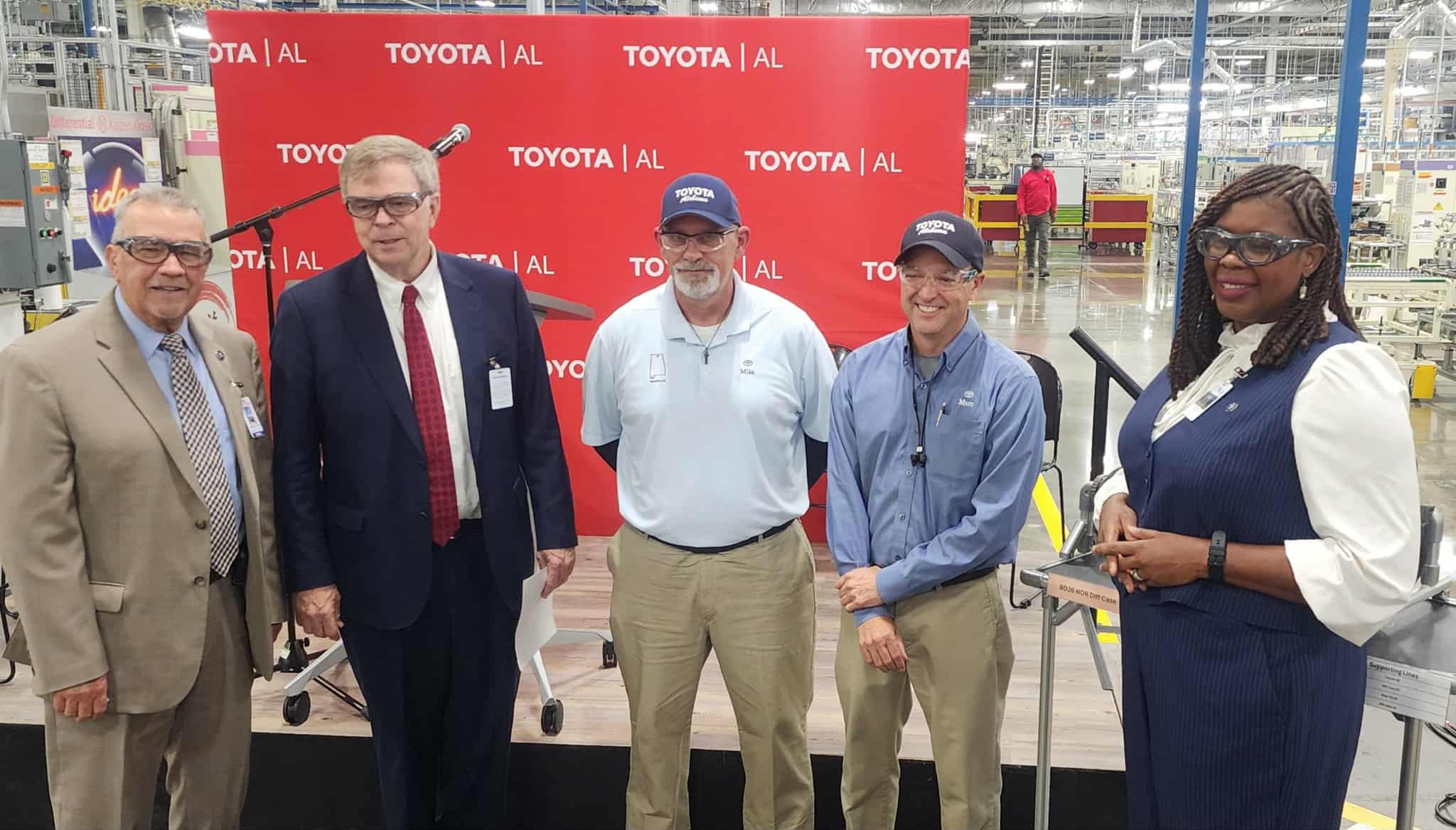
Madison County Commission Chairman Mac McCutcheon said the expansion reinforces Toyota’s long-standing partnership with the community.
“The investment that Toyota has made on this property is very significant,” McCutcheon said. “Toyota is a very special partner for Madison County. When we’ve had tornadoes or tragedies in our community, Toyota employees have stepped up to help.
“That’s a reflection of Toyota and also of the workforce and their commitment to where they live, raise their families, and work.”
District 6 County Commissioner Violet Edwards said the economic ripple effect will reach every part of her district.
“Toyota has been a fantastic partner not only in manufacturing but in community service,” Edwards said. “When you add 350 new jobs, you’re adding 350 people who will be out in the community supporting schools, businesses and local families. That’s a great day for District 6 citizens.”
Toyota’s total investment in its Huntsville plant now exceeds $1.7 billion. The company assembled more than 895,000 engines in 2024 alone and continues to play a key role in North Alabama’s advanced manufacturing economy.
Beyond the plant, Toyota is investing in the next generation of workers through its Driving Possibilities initiative, which has provided nearly $11 million in grants to Huntsville City Schools over the past two years to expand access to STEM education and career pathways.
Battle said the expansion reflects not only economic growth but also the city’s relationship with one of its most important partners.
“This is more than an investment in an automotive plant,” Battle said. “It’s an investment in our people and our community.”
Courtesy of 256 Today.
The FBI will bring hundreds of jobs to an Army base in Alabama as part of an expansion including the agency’s first large-scale operations support building.
News outlets report the FBI announced the expansion Thursday at Redstone Arsenal just outside Huntsville. (more…)
Koch Foods has announced an $80 million expansion at an Alabama plant that is expected to bring around 200 jobs to the area.
The Gadsden Times reports that company announced the move Tuesday. (more…)
Hyundai Power Transformers has announced a $33 million expansion of an Alabama facility with plans to hire more than 80 workers.
News outlets reported Tuesday that Hyundai Power Transformers USA Inc. will begin the expansion of its Montgomery facility in July, which is expected to create 86 jobs. Company officials said in a statement that the expansion will increase production of its power transformers by more than 60 percent.
Hyundai Power Transformers was built in 2011 and employs 300 people. The expanded facility is expected to be operating by December 2019.
State Commerce Secretary Greg Canfield says the expansion will help deepen the South Korean company’s roots in Alabama.
J.S. Kim, Hyundai Power Transformers president and chief operating officer, says the state’s two and four-year colleges have helped developed its workforce.
(Associated Press, copyright 2018)

Milo’s Tea has reached a huge milestone as they announce the continued growth of their Alabama operation and a newly expanded 15.5-acre headquarters in Bessemer. The new campus includes 150,000 square feet of production, shipping, storage, and office space.
That’s tremendous growth compared to the 30,000 square foot facility on 3.5 acres that opened just 15 years ago.
The new facility allows the company to fresh brew and bottle over 250 gallons of all-natural beverages per minute. Those beverages are housed in a 30,000 square foot cooler before they are shipped to over 13,000 retailers in 42 states.
The Milo’s Tea company has seen tremendous growth over the past few years. In 2013, it had just 56 employees. Four years later, that number has nearly tripled, as they now employ more than 150 full-time staff.
“When my grandparents Milo and Bea Carlton founded their restaurant, Milo’s Tea, in 1964 after my granddad returned from serving in World War II. The company’s philosophy was simple – use high-quality, natural ingredients, listen to your customers, and never sacrifice taste,” said Patricia Wallwork, CEO of Milo’s Tea Company. “This vision still guides the company today as we source natural ingredients, fresh brew all our award-winning beverages in Bessemer, and never uses added colors or preservatives.”
Milo’s Tea began the expansion project in 2014 by purchasing a building on Dublin Lane from the Bessemer Industrial Development Board. New 30,000 square foot coolers and shipping facilities were added to the property, enabling the company to store over 300,000 bottles of Milo’s Tea beverages. The company now has the capacity to promptly ship 100 trailers per day to ensure that the freshest products are on the shelves. The upgrades also included new water treatment technology, allowing employees to filter City of Bessemer water for the best-tasting result.
In addition to brewing their refreshing beverages, Milo’s Tea has had a long-standing commitment to the community.
“As a Certified Zero Waste Manufacturer, we have invested in research on reusing spent tea for more than 10 years and we are a leader in sustainable manufacturing. This is a direct result of our innovation and ongoing commitment to aggressive recycling programs which have a significant impact on our environment. The community of Bessemer is our home and we are dedicated to making a positive impact here. We currently donate tons of spent tea to the City of Bessemer golf course and area composting sites, diverting thousands of tons of waste from local landfills each year.”
Milo’s Tea thanks the City of Bessemer, Jefferson County, and the entire state of Alabama for their support and contribution to the company’s growth. City of Bessemer Mayor, Kenneth E. Gulley said, “Milo’s success is the city of Bessemer’s success, and we’re honored to know as they expand into new markets across the country their product is stamped as ‘Made in Bessemer, Alabama.’”

HUNTSVILLE, Ala. — After nixing plans to expand into eight other major U.S. cities, Google Fiber confirmed that the tech giant still intents to offer the service in Huntsville as initially planned.
According to a report from Al.com, Huntsville Utilities spokesman Joe Gehrdes said the project is “Still good to go.”
Google Fiber is the ultra-high speed internet service offered in select cities by Alphabet, inc., the parent company of the Google search engine. The connection provides an Internet speed of up to one gigabit per second for both download and upload, which is roughly 100 times faster access than what most Americans have. To put that in perspective, such speed allows for the download of a full movie in less than two minutes.
In February, Huntsville Mayor Tommy Battle announced that his town would become a “Gig City” and be one of the select places across the country to have access to Google Fiber. Only seven other cities have access to the service, and big markets such as Dallas, Los Angeles, and Phoenix were just cut out of the expansion picture due to Google Fiber’s rollback.
“Google’s entrance into our market bolsters our high-tech legacy, energizes our entrepreneurs, tinkers and engineers, and supports the high quality of life Huntsville is known for delivering,” said Mayor Battle. “Fiber to the home is the Internet infrastructure for the 21st century. It is as vital to our quality of life as roads, water, sewer and electricity. It will become the benchmark for cities vying for talent.”\
Google also has one of its nine U.S. data centers in Jackson County, and the facility operates out of a converted Tennessee Valley Authority plant.
“We’re not here by accident,” said Google Data Center Energy and Location Strategy director of operations Gary Demasi at the announcement last year. “We found the right partners and the right community to meet our long term needs.”
RELATED: STUNNER: Google to invest $600M in Alabama, build enormous data center
Google Fiber will be ready for use in Huntsville as early as March of 2017.

GULF SHORES, Ala. — The City of Gulf Shores and Auburn University announced a partnership yesterday that will bring a new satellite campus to the south Alabama beach town. Auburn’s $12 million expansion will include a new college facility featuring the College of Veterinary Medicine, studies on marine fisheries, and studies on organic horticulture.
Gulf Shores will construct the 24,000 square foot property and lease it out to the University. The satellite campus will sit on 26 acres directly northeast of the city’s business district.
“From the education component of our world, it means a lot,” Gulf Shores Mayor Robert Craft said on Monday. “To have a brand name partner like Auburn to initiate our campus plan as discussed is a significant step forward. It should make the rest of this easier, I would hope.”
The city will pay for the project using funding from revenue bonds to be repaid by Auburn through the lease agreement, and no “cash incentives” were included in the agreement approved by the city council.
University officials noted the desire to establish a coastal presence, and that they viewed an expanding Gulf Shores as an opportunity to do so.
“We looked at what is not just the potential today, but what will be the growth potential for the next five to 10 years,” Auburn Provost Tim Boosinger told Al.com. “The experts tell us this is the fastest growing area in the state and will continue to be. We want to have an opportunity to better serve people in the southern half of the state, especially along the coast. We don’t have that presence.”
Since the year 2000, Baldwin County is second only to Shelby County in overall population growth within the state of Alabama. According to U.S. Census data, from 2000 to 2010, Gulf Shores alone experience a population increase of over 93 percent.
Project construction for the satellite campus will begin in the spring or summer of 2017 and is expected to be finished 18 months from the start date.
TUSCALOOSA, Ala. — Dr. David Bronner, head of the Retirement Systems of Alabama, has had some harsh words for Alabamians critical of Obamacare. Over the years, Bronner expressed his frustration with Alabama’s refusal to expand Medicaid under the Affordable Care Act, commonly known as ObamaCare.
“These 330,000 Alabamians don’t have adequate health care,” Bronner said. “They get their arm cut off, they get sick … what are we saying to them by refusing to take this money?”
Despite ObamaCare’s continued unpopularity, Bronner has said that those in the fourteen states that have not accepted Medicaid expansion are “idiots.” He said this despite personally acknowledging that 60 percent of Alabamians still oppose the law.
While many of Alabama’s state and local officials have been fighting tooth and nail to limit and ultimately repeal the act, the unelected RSA head believes they should just quit trying.
“Get over it. It’s the law of the country,” he said. “Back in the 1930’s social security had its critics but today it is maybe the most popular federal program we have.”
In a speech last October, he lashed out against those with a small-government preference stating, “I’ve yet to figure out why Alabamians hate the federal government…What I say to Alabamians is, you want football to be the best, why won’t you fund anything else to at least be normal?”
RELATED: RSA CEO David Bronner unloads on Alabamians for opposing tax hikes and ObamaCare (Video)
Dr. Bronner did not mention in either of his speeches, however, that Alabama taxpayers currently fund his organization far above what many analysts would describe as “normal.” The RSA manages the pension fund for employees of the state of Alabama, including teachers, and is supposed to create a return on investment for members.
The RSA’s investment returns are not sufficient to cover its obligations to retired state employees, leaving Alabama taxpayers to prop up the fund to the tune of almost $1 billion per year.
A state legislative committee is currently researching reforms tried by other states in an attempt to get the burgeoning costs of the pension system under control.
But efforts to stabilize the system in the long term have been met with fierce opposition by Dr. Bronner, who dismisses calls for reform as a conspiracy by billionaire conservative industrialists the Koch Brothers, the favorite boogeymen of many Democrats on the federal level.
In the midst of it all, Dr. Bronner has built for himself a lavish lifestyle that far exceeds his roughly $600,000 taxpayer-funded salary.
RELATED: How an Alabama state employee built a billionaire’s lifestyle in a taxpayer-funded job (opinion)
An avid golfer, he has used RSA funds to build golf resorts around the state, which lose roughly $20 million per year. Resort employees told Yellowhammer on condition of anonymity that Dr. Bronner is a frequent and demanding guest in the hotels’ priciest suites.
Dr. Bronner has dismissed the financial losses by saying the golf courses and resort hotels attract tourism dollars to the state that are not directly reflected in their bottom line. Critics have responded by saying that even if that is true, it is his job to get the largest return possible for state employees, not to use their pension fund as an economic development loss leader.
The golf courses’ logo also appears on two private jets that Dr. Bronner uses to travel all over the country, rather than flying commercial.
Recently, the Alabama legislature has wrestled with much-needed reforms to the state’s public pension system, and some lawmakers are considering legislation that would make the RSA a much more open and transparent entity. But for now, the RSA remains under Bronner’s tight control.

MONTGOMERY, Ala. — The Alabama Senate on Tuesday passed a resolution expressing its intention to not expand Medicaid, and urged Gov. Robert Bentley to refrain from pushing for such an expansion.
“The state should pursue reforms based on reducing Medicaid dependence, rather than increasing dependence,” the resolution states. “Expansion of Medicaid would further strain the state General Fund, where Medicaid is already the largest line-item… We express our intention that the State of Alabama not expand Medicaid above its current eligibility levels.”
The resolution, which was sponsored by Sen. Trip Pittman (R-Montrose) and co-sponsored by 20 other Republican senators, was passed on a vote of 22-8 along party lines.
“This resolution expresses my resolve to be fiscally responsible and protect taxpayer funds,” Sen. Pittman told Yellowhammer. “Medicaid reform legislation has already been put in place, and we need to measure the outcome of those reforms before rashly expanding Medicaid. Right now, we simply can’t afford to expand Medicaid.”
The full text of the resolution expresses concerns that an expansion of the program, whether under ObamaCare or via “waivers,” would dramatically increase the number of Alabamians dependent upon public assistance and would not offer the state any meaningful control over eligibility requirements.
“I have worked tirelessly on Medicaid reform, and there are more reform proposals coming this session,” said Senate Majority Leader Greg Reed. “We are only 18 months into our major shift away from a fee-for-service model. I support Senator Pittman’s resolution because now is not the time to look at a full expansion of Medicaid, because it could be detrimental to our current reforms.”
Similar to Pennsylvania and Arkansas, which are also led by Republican governors, Gov. Bentley has suggested he would like to be able to funnel federal tax dollars through the state government and into private insurers. The private insurers would then use those taxpayer dollars to cover uninsured individuals up to 138 percent of the federal poverty level, the same ultimate outcome as Medicaid expansion under ObamaCare. The political benefit is that by receiving a “waiver” from the Obama administration, Republican governors have been able to expand the program while selling it as something completely different. In Pennsylvania they call it the “Healthy PA” plan. In Arkansas it’s commonly referred to as the “private option.”
Gov. Bentley has insisted that he would only pursue such a plan as a “block grant” from the federal government. Block grants are federal funds granted to states that include more flexibility in how they are spent than traditional “categorical grants.”
“It would have to be in the private sector and there would have to be some requirements on it,” Bentley told reporters in December. One specific requirement he mentioned was that he’d like to see the system tied to employment. “(Recipients) need to be working on getting a job, or having a job.”
Other states that have tried to tie work requirements to Medicaid benefits have been denied. In rejecting such a proposal from Utah earlier this year, U.S. Health and Human Services Department spokesman Ben Wakana said, “encouraging work is a legitimate state objective. However, work initiatives are not the purpose of the Medicaid program and cannot be a condition of Medicaid eligibility.”
Conservative groups in Alabama, including the Alabama Policy Institute, Alabama Free Market Alliance, Alabama Forestry Association and the Foundation for Government have urged the governor to refrain from expanding Medicaid under any circumstances. Republicans in the Alabama Senate added their voices to that chorus today.
The Joint Resolution will now be sent to the Alabama House of Representatives.
Like this article? Follow me on Twitter and let me know what you think.
— Cliff Sims (@Cliff_Sims) December 3, 2014

TUSCALOOSA, Ala. – Mercedes-Benz, which launched Alabama’s auto industry nearly two decades ago, plans to sharply increase production at its Tuscaloosa County plant over the next two years, boosting annual capacity to 300,000 vehicles from the 185,000 produced there in 2013.
Daimler AG and Mercedes executives said at the Vance plant on Friday that the automaker plans to begin producing a compact sport utility vehicle called the ML Coupe in Alabama beginning next year. Earlier this year, Mercedes began mass production of the redesigned C-Class in Vance, the first time it has produced a sedan in Alabama.
Daimler Chairman Dieter Zetsche told auto journalists Friday that the SUV market is expected to outpace growth in the overall automotive market, according to a report in the Wall Street Journal. Production plans for the compact SUV had been previously announced.
“We’re calling 2015 the Year of the SUV for Mercedes and Tuscaloosa,” Zetsche said. “The market for these vehicles is only getting stronger.”
Mercedes has prepared for increased output in Alabama with a $2.4 billion investment that includes plans to increase its workforce in Vance by 1,400 employees. The automaker also added a $70 million logistics center on its campus.
In addition to the C-Class, the Alabama plant produces M-Class and GL-Class SUVs, along with the R-Class crossover.
Alabama Governor Robert Bentley, who was at the plant Friday, said Mercedes’ latest expansion in Tuscaloosa County is a tribute to both the state and its workers.
“When we see a business continuing to invest in Alabama and the people of Alabama, that’s the greatest compliment we could receive,” Bentley said. “Most jobs are created by existing businesses, and when businesses grow here, we don’t forget about them.”
RELATED: Mercedes Alabama staffs up with nation’s leading ‘Mechatronics’ program
In the second half of Yellowhammer’s two-part interview with state senator Phil Williams (R-Rainbow City), the conservative stalwart discussed the issues he expects to come to the forefront during the next legislative session.
“Some of the biggest issues we’re going to face are going to be budgetary,” he said. “A lot of people don’t realize that Alabama’s one of only three states that has two split budgets. We have everything education in one budget and everything else in the world that it takes to run the state in the other. The General Fund — all the ‘other’ — is woefully underfunded.”
But in spite of the budgetary challenges, Williams said his Republican colleagues are not even entertaining the idea of raising taxes.
“We’re fiscal conservatives. We’re going to balance the budget,” he said. “D.C. can’t even propose a budget, much less vote on one. In Alabama the last four years we’ve been passing balanced budgets. You’ve seen no proration. If you’re budget goes into proration it was unbalanced to begin with… We’ve been streamlining government, making cuts. We’ve saved over a billion dollars to our taxpayers.”
Williams said that in addition to tax hikes, he expects Democrats to propose a variety of ways to raise revenue and avoid shrinking the government, including the legalization of marijuana.
He also believes there will be a continued push to legalize same-sex marriage in the state.
“We’re going to have to have those debates and stand our ground,” he said.
RELATED: Alabama is headed for gay marriage showdown
But the issue that has dominated the political debate in Alabama this year more than any other is the expansion of Medicaid.
Gov. Robert Bentley has been adamant that his administration will not expand the government healthcare program, a position that has drawn fire from his Democratic challenger, Parker Griffith.
Yellowhammer’s Cliff Sims asked Sen. Williams if he thought it would be a major issue in the next session of the legislature, and he gave an emphatic answer.
“Nope,” he said without hesitation. “And I say that because we’re not going to wind up expanding it. There’s no way in the world someone can look at that and say in the long term that Alabama can afford that. Currently Medicaid, by itself, consumes 33 percent of our General Fund Budget. Now, the big storyline that I’m hearing from the liberals and the Democrats on that side of the aisle is, ‘Well just take it, the federal government’s going to pay for it anyway.’ No they’re not, they’re going to pay for it in full for just three years. And the projections are that if we expand Medicaid under ObamaCare the way they’re calling for, then we would see an addition $220 million obligation to the state’s taxpayers by 2019.”
Williams said that Republicans have implemented Medicaid reforms over the last several years that are starting to go into effect.
“I think we have to continue to stand our ground and take care of taxpayer dollars and be good stewards of what we have,” he said.
Check out the full interview in the video above. And click here to see Part 1 of the interview on the gun range.
Follow Yellowhammer on Twitter @YHPolitics

In a meeting with the Alabama Media Group editorial board Tuesday, Jesse Jackson slammed Alabama Gov. Robert Bentley’s decision to not expand Medicaid under ObamaCare, and compared it to George Wallace trying to stop black students from enrolling at the University of Alabama.
“Wallace blocked the school door based on race,” Jackson said. “[Bentley is] blocking the hospital door based upon class. Blacks were locked out of the schools, and black and whites have been locked out of access to medical care, and he should be judged as such.”
Bentley responded to Jackson’s comments on Wednesday, saying that he has made it a point as governor to represent all Alabamians, regardless of their race, income-level or party affiliation.
“That was somewhat offensive,” Bentley said of Jackson’s remarks. “Let me tell you, I was there in Tuscaloosa when Wallace stood in the schoolhouse door to keep two young black individuals from enrolling. I was there as a student. I have been involved so much in the celebration of our 50th year of civil rights in Alabama. We are proud of how far we’ve come in this state. And let me tell you, we have come a long way and I want to be the governor who represents all people in this state. I don’t care what color they are, I don’t care what Party they’re in, I represent everybody.”
Bentley has become a frequent target of various special interest groups, editorial writers and policy makers for his unwillingness to expand Medicaid.
He devoted a large portion of his 2014 State of the State address to defending his decision, saying, “We will never see an end to the plague of poverty by offering a deeper dependence on a flawed government system.”
Critics of Bentley’s decision point out that the Federal government had agreed to pay for 100 percent of the expansion through 2016, before decreasing its share of the costs down to 90 percent in the years to come.
Bentley responded by pointing out that whether the Federal government pays for it or not, it’s all “your dollars, your hard-earned tax dollars.”
The federal government has said they will give us money to expand. But how can we believe the federal government will keep its word? The anything but Affordable Care Act has done nothing to gain our trust.
First, they told us we could keep our doctor – that turned out not to be true. Next, they told us we could keep our policy – that’s not true. Then they told us our premiums would not go up – nothing could be further from the truth. Now they are telling us we’ll get free money to expand Medicaid.
Ladies and Gentlemen, nothing is free. The money the federal government is spending with wild abandon is not federal dollars – those are your dollars, your hard-earned tax dollars. There is no difference between federal money and your money.
Our great nation is 17.2 trillion dollars in debt and it increases by 2-billion dollars every single day.
That is why I cannot expand Medicaid in Alabama. We will not bring hundreds of thousands into a system that is broken and buckling.
Jackson discussed a wide range of issues during his Alabama Media Group interview, including prison reform, compensation for college athletes (during which he says field goals are worth “2 points”!) and the current conflict in Israel. Click here for a full write up over at al.com.
Follow Cliff on Twitter @Cliff_Sims
(Above: Indiana Gov. Mike Pence defends his “Healthy Indiana” plan in an interview with Yellowhammer’s Cliff Sims)
While Indiana Gov. Mike Pence was in Birmingham to speak at the Alabama Republican Party summer dinner, he sat down with Yellowhammer News CEO Cliff Sims to film an episode of The Exchange, Yellowhammer’s weekly interview feature.
Rather than releasing the entire interview at once, Yellowhammer is rolling it out in pieces throughout this week, an approach we will be trying out with future Exchange interviews as well.
Previous portions of the interview:
1. Indiana Gov. Mike Pence in Alabama discussing opting out of Common Core
2. Gov. Pence: Gary Palmer ‘man of integrity, strong conservative views’
After becoming Governor of Indiana in January of 2013, Pence drastically cut taxes and implemented school choice reforms, both of which earned him the praise of conservatives in his state. But his decision to expand Indiana’s Medicaid program raised some eyebrows, especially as many other Republican governors, like Alabama’s Robert Bentley, refused to add more people to the government’s healthcare rolls under ObamaCare.
“A decision you made as governor that surprised some folks was that you expanded Medicaid,” Sims said. “How do you reconcile the conservative approach that you’ve taken with some of these other issues with expanding what a lot of people would say is a giant government entitlement program under ObamaCare?”
Pence contended that his plan is actually a Medicaid expansion alternative that would expand the program using a state plan that promotes personal responsibility.
“When I was in the Congress, I was one of the leading opponents of ObamaCare,” Pence said. “I think ObamaCare should be repealed lock, stock and barrel. But any sensible repeal of ObamaCare should be accompanied with free market reforms that give people more choices in the purchase of health insurance, and it should be paired with block granting Medicaid back to the states so that states like Indiana and Alabama can craft Medicaid programs that’ll meet the unique needs of their population.”
But Pence’s critics say that is not what his plan does.
“By definition, Medicaid block grants give states a fixed, lump sum of federal dollars in exchange for broad autonomy in providing Medicaid benefits. Pence’s plan features neither of these elements,” a Forbes op-ed recently stated. “Under Pence’s ObamaCare expansion, Indiana will draw down increasing amounts of ObamaCare in exchange for adding more people to the Medicaid rolls.”
Pence contends, however, that his plan, dubbed Healthy Indiana, has been extremely successful and now boasts over 40,000 enrollees.
“We actually have people who are eligible for Medicaid who have health savings accounts, that choose preventative care, that move from emergency room to primary care,” he said. “It’s been an unqualified success in Indiana.”
Pence also said that he ruled out a state-based healthcare exchange, which ObamaCare called for, and did not expand “traditional Medicaid.”
“I think traditional Medicaid is a deeply flawed program that ill-serves people that are enrolled in it,” he said. “In Indiana we won’t expand traditional Medicaid. But if we can empower individuals through these health savings accounts known as ‘power accounts’ to take greater ownership in their own healthcare, I think it’s going to be right for Hoosiers. I think consumer-driven healthcare is the future of healthcare in this country.”
Pence’s Medicaid plan will no doubt be a major point of debate if he decides to run for President in 2016.
Alabama Gov. Robert Bentley has said he will continue to oppose expanding Medicaid.
For more episodes of The Exchange, check out Yellowhammer TV.

Ever since the U.S. Supreme Court provided states with the opportunity to reject the Affordable Care Act’s (ACA) Medicaid expansion without jeopardizing existing Medicaid funds, the expansion has become a political football.
Governor Bentley has called the ACA Medicaid expansion “a federal government dependency program for the uninsured.” On the other end of the political spectrum, Democratic gubernatorial candidate Parker Griffith claims that growing Medicaid will generate “30,700 new jobs, [a] $2.1 billion economic boost, plus 500 lives saved every year.”
RELATED: Hold the line on Medicaid expansion, Gov. Bentley, we’ve got your back
If even the most ardent proponent of the Medicaid expansion in Alabama advocates the economic stimulus of the ACA Medicaid expansion ahead of improving healthcare outcomes, the debate over Medicaid has clearly become more about money and politics than helping vulnerable Alabamians.
For a minute, turn the focus to the Alabamians stuck between Medicaid and being able to afford private health insurance or even subsidized health insurance under the ACA exchange. Providing healthcare access to those Alabamians is the challenge the ACA’s Medicaid expansion is theoretically designed to address.
So far, supporters of the ACA Medicaid expansion have been able to claim that their opponents either reject the “gap” problem or simply fail to have a better solution. Some GOP governors and state legislators have tried to put a different face on the Medicaid expansion, but most have struggled with developing real alternatives.
It might come as a surprise that Alabama is home to at least one effective healthcare model specifically designed to serve the “gap” population.

Last year, Victory Health Partners, a nonprofit based in Mobile, provided medical, dental and vision care to 15,800 patients in their service area. They also administered $4.4 million worth of prescription medications through partnerships with pharmaceutical companies.
Victory Health boasts an amazing range of services with an average expense for care of a little more than $70 dollars per patient file in 2013. In a political climate largely conceding that heavy government support is necessary to care for the health of low-income families, Victory Health provides their services without government funding.
A brief visit to their offices sheds light on the truly innovative aspects of their healthcare delivery system. They are equipped for dental, vision, and general medicine in the same facility, a unique feature for any healthcare system. For more specialized services, they have a network of over 150 doctors who extend Victory Health’s reach. These specialists care for Victory Health patients for a modest co-pay consistent with those charged by Victory Health.
Their comprehensive approach to patient care not only improves health outcomes, but it changes lives. Patients are not another number under Medicaid or viewed as second-tier customers by their care providers. Patients own their healthcare, they build relationships with their physicians, and many develop positive healthcare habits conspicuously absent in underserved communities throughout Alabama.
Given the choice between falling under Medicaid and receiving care at Victory Health, the choice for Victory Health patients is clear. “Your personal healthcare is their number one priority,” said patient Ursula Powell. “The services of Victory Health Partners would be my one and only option.”
More on Medicaid expansion in Alabama:
- Ala. Economist: pro-Medicaid expansion studies ‘don’t pass the smell test — they stink’
- [Infographic] Medicaid Overdose: Bigger is not Better
- Troy Univ. professors eviscerate ‘bogus’ UAB study touting benefits of Medicaid expansion
- Medicaid is devouring Alabama’s budget, but Democrats still want more
Cameron Smith is vice president and general counsel for the Alabama Policy Institute, an independent, non-profit research and education organization dedicated to the preservation of free markets, limited government and strong families. He may be reached at camerons[at]alabamapolicy.org or on Twitter @DCameronSmith.

Most of the action during Alabama’s 2014 election cycle is taking place in Republican legislative primaries. With the exception of a highly competitive race for Place 2 on the Public Service Commission, Alabama’s statewide elected officials are either running unopposed, facing weak primary opposition, or even weaker Democrats.
At the top of the ballot, Alabama Gov. Robert Bentley falls into both of the latter categories. His primary challenger has raised less money than some people walk around with in their wallet, and his Democratic opponent, Parker Griffith, is a cursing party-switcher who says the Tea Party is ‘worse than you think.’
Griffith is running on the familiar Democratic platform of legalizing the lottery, but has also added the national Democratic talking point of expanding Medicaid as a plank in his platform.
Bentley, on the other hand, has endured intense criticism from various special interest groups, editorial writers and policy makers for his refusal to expand the costly program. It’s also been the rumor du jour among insiders that the governor would bide his time, get re-elected, then expand Medicaid to placate some of his advisers and Montgomery lobbyists.
He’s kept mostly quiet as his critics piled on, but he unloaded during the State of the State:

The Affordable Care Act – or Obamacare and Medicaid expansion is taking our nation deeper into the abyss of debt, and threatens to dismantle what I believe is one of the most trusted relationships, that of doctors and their patient.
Essential to Obamacare is Medicaid expansion – a federal government dependency program for the uninsured, which is administered by states. Since 1980, Medicaid spending has increased nationally by over 1,500-percent.
Here in Alabama, Medicaid takes up 35% of our General Fund.
Under Obamacare, Medicaid would grow even larger… Here in Alabama alone, an estimated 300,000 more people would be added to the Medicaid role, to a system that by our own admission is absolutely broken and flawed.
The federal government has said they will give us money to expand. But how can we believe the federal government will keep its word? The anything but Affordable Care Act has done nothing to gain our trust.
First, they told us we could keep our doctor – that turned out not to be true. Next, they told us we could keep our policy – that’s not true. Then they told us our premiums would not go up – nothing could be further from the truth. Now they are telling us we’ll get free money to expand Medicaid.
Ladies and gentlemen, nothing is free. The money the federal government is spending with wild abandon is not federal dollars – those are your dollars, your hard-earned tax dollars. There is no difference between federal money and your money.
Our great nation is 17.2 trillion dollars in debt and it increases by 2-billion dollars every single day.
That is why I cannot expand Medicaid in Alabama. We will not bring hundreds of thousands into a system that is broken and buckling.
That is some pretty strong language that for several months put to bed any rumors that the governor was leaving himself wiggle room to expand Medicaid after getting re-elected.
But the rumor mill in Montgomery and among some executives in Alabama’s healthcare industry has cranked back up recently. And now Griffith is seeking to use it to his campaign’s advantage, alleging that Bentley is “quietly promising” to expand the program.
“Either Governor Bentley has been lying about his strict opposition to Medicaid expansion or he is allowing his political associates and government insiders to lie to health care professionals all across Alabama,” Griffith said in a statement. “It can’t be a coincidence that I have had numerous people tell me that they have been assured that Governor Bentley will expand Medicaid after the election.”
Yellowhammer reached out to Bentley campaign spokesperson Rebekah Mason and asked her if she would put the speculation to rest.
“Medicaid is still draining the state budget. It’s a huge expense for taxpayers. The reform measures we wanted were just initiated in 2013 and were put in place because Medicaid is weighing down the state. As far as adding more people to the rolls, no, we’re not going to do that,” Mason said. “There is no intention to add more people to the Medicaid system. We’ve just started the reform process. There’s no way the governor is going to consider expanding Medicaid within the ObamaCare structure. He’s philosophically opposed to ObamaCare, and Medicaid as it is currently constituted comes in under ObamaCare.”

Yellowhammer responded by pointing out that by qualifying their statements with “under ObamaCare” or under the current “structure” leaves them a crack in the window. After winning re-election, the governor could conceivably come back and say their reform measures worked and made Medicaid expansion possible.
“There were no windows left open in the governor’s State of the State address on January 14, and nothing has changed since then,” Mason said in reply. “That is exactly where we are today. His philosophy has not changed. He has not and is not changing his mind on expanding Medicaid.”
“Do we have problems with healthcare in Alabama? Yes,” she continued. “Do we have children and elderly people in Alabama — the most vulnerable among us — who need help? Yes. How we are going to fix that is being studied, but it certainly isn’t ObamaCare or putting more people on the government’s healthcare rolls.”
Yellowhammer asked, then, if the headline “Bentley spokesperson says Gov. will not, under any scenario, expand Medicaid if given a second term” would be accurate.
“The quotes I gave you are the definitive ‘no’ you’re looking for,” Mason replied.
Follow Cliff on Twitter @Cliff_Sims

Dr. Scott Beaulier’s résumé is nothing if not impressive. It reads something like this…
• Ph.D in Economics from George Mason University
• Distinguished Fellow at The Laffer Center for Global Economic Growth (You remember Art Laffer, right? Ronald Reagan’s top economic policy adviser? Yea.)
• Economics Department Chair and Distinguished Professor of Capitalism at Mercer University
• Editorial Board Member, Journal of Entrepreneurship & Public Policy
• Adams-Bibby Chair of Free Enterprise, and now Executive Director of Manuel H. Johnson Center for Political Economy at Troy University
…The list could go on and on.
So when Beaulier earlier this week waded into the ongoing debate over what kind of economic impact expanding Medicaid under ObamaCare would have on the State of Alabama, it was kind of a big deal.
Not only did Beaulier and fellow Troy professor Phillip Mixon lay out in great detail the detrimental impact expanding Medicaid would have on the state, they also placed some of their colleagues at the Univ. of Alabama and UAB directly in their crosshairs.
This wasn’t your typical nerd fight.
For some background, The Alabama Hospital Association commissioned UAB and UA to do studies on what type of impact expanding Medicaid under ObamaCare could have on Alabama.
UAB said the state could gain nearly $1 billion in new tax revenue if the state would expand the program. UA then based their study on UAB’s findings and said that 30,700 new jobs could be created in the state over the next several years, and as many as 51,918 if all eligible individuals enrolled in an expansion.
Gov. Bentley called the studies “bogus” and said he would continue holding the line against an expansion. But the propaganda war continued.
UAB followed up their “study” by releasing a “survey” claiming Alabamians overwhelmingly supported expanding Medicaid. Most of the mainstream media — who ideologically support Medicaid expansion — played along.
RELATED: Hold the line on Medicaid expansion, Gov. Bentley, we’ve got your back
Then this week the Troy economists came along and dropped the political equivalent of an atom bomb on the pro-Medicaid expansion campaign.
The Troy study, titled “The Feasibility of the Medicaid Expansion in Alabama,” explains in very simple terms the numerous errors and logical fallacies contained in the UAB and UA studies.
UAB was completely wrong about how Medicaid expenditures are taxed in the state of Alabama. They included local taxes as a funding source for Medicaid, which they are not. And they grossly underestimated the administrative costs of adding 500,000 individuals to the government’s healthcare rolls. Add all of that together and you’ve got a final product that the Troy study asserts doesn’t even come close to reality. To make matters worse, UA then used UAB’s study as the starting point for their economic impact projections.
Yellowhammer caught up with Dr. Beaulier from Troy University earlier this week to find out what compelled him and his team to take on the Medicaid issue.
“All of this came out of frustration with a lot of the mainstream media coverage we were seeing about Medicaid expansion,” Beaulier told Yellowhammer by phone. “This idea that it could increase state GDP by 50 percent — the assumption that taking all of this federal money is a good thing, that it is ‘free money’ — so much of what we were seeing just didn’t meet the standard of basic economic reasoning. When you pick it all apart, Medicaid expansion is not so great for Alabama.”
RELATED: Bogus Medicaid expansion stats continue to spread via complicit Alabama media
In fact, the Troy study found that even under the best-case scenario, the revenue gained by expanding Medicaid would only outpace the added costs for the first three years of the expansion when the federal government would be picking up 100 percent of the tab. After that, Medicaid would continue to devour more and more of Alabama’s General Fund Budget, exacerbating its already serious problems. They also found that the state would face a significant shortage of medical professionals, especially in rural areas.
So how could the UAB and UA studies get it so wrong?
“I assume it has to do with who commissioned the study” Beaulier said. “They were well paid and knew what their clients were looking for. I think most economic development studies are biased. What typically happens is a group comes in and they say, ‘Ok, here are our targets. These are the numbers we want to hit.’ They pay in advance and they explain what they are looking for. So the researchers being paid to do the study makes sure they get the numbers to work and hit those targets.”
Yellowhammer asked Dr. Beaulier if Troy had been commissioned by an outside group to conduct their study and he said they had not.
“Look, they could have come in and said, ‘we believe more people should be covered by Medicaid and this is a cost worth baring,'” Beaulier continued. “But that’s not what they did. They said it would be good for Alabama’s budgets, too. That’s absurd. A lot of the things they are saying are unreasonable. The other studies just don’t pass the smell test. They stink.”
Dr. David Becker of the UAB School of Public Health told the Birmingham Business Journal that they stand by their study and downplayed the concerns raised by the Troy economists as simply differences of methodology. If that’s any indication, the debate over expanding Medicaid in Alabama will likely continue to rage on.
This will be a nerd fight worth watching.
Follow Cliff on Twitter @Cliff_Sims

Much has been made about the continual refusal by Governor Robert Bentley to expand Medicaid. In the push to pass the Patient Protection & Affordable Care Act (Obamacare), President Obama explained in 2009 that “we can’t simply put more people into a broken system that doesn’t work.” Medicaid was originally created to provide healthcare to pregnant women, children, and the disabled. Instead of reforming the broken system, Obamacare simply expanded Medicaid to include all able-bodied adults earning up to 138% of the federal poverty line.
In Alabama, hospitals that stand to reap massive windfalls have published studies touting the supposed economic benefits and job creation effects that expansion will have, according to their data.
A newly released study by the Manuel Johnson Center for Political Economy at Troy University (the Troy study) explores key areas that the earlier studies missed or ignored. Chief among them is the fact that there is an acute doctor shortage in Alabama, specifically in rural areas where a large proportion of the State’s uninsured live. States that have expanded will also have a higher need for doctors, further exacerbating the doctor shortage.
The Troy study also proved the earlier studies’ economic impact estimates to be inaccurate. Previous studies claimed that Alabama stood to gain a billion dollars in economic impacts from expansion. Troy’s research pointed out that those earlier studies disregarded Alabama’s unique tax structure and high concentration of rural areas which would significantly reduce any positive economic impact; assumed a large decrease in administrative costs which will likely not materialize; and did not account for Medicaid fraud, which currently costs the State of Alabama up to $5 million a year in improper payments.

Supporters of the Medicaid expansion in Alabama also maintain that our leaders have a “moral imperative” to add to Medicaid’s rolls. Would it be moral to legislate that everyone must have the best healthcare possible? Absolutely. Just the same that it would be moral to pass a law that everyone must have a house, a vehicle, and a full-time job. But, morality does not exist in a vacuum. It has to operate within financial realities, namely an ailing General Fund budget that already devotes over a third of its expenses to Medicaid. In fact, Medicaid’s rolls in Alabama have increased nearly 25% since 2008 – adding about 220,000 more people – and show no signs of slowing down.
Not only is Medicaid expansion fiscally irresponsible, but, more importantly, the health of patients is not improved. A recent study in Oregon found that when uninsured citizens were put on Medicaid, they increased their Emergency Room usage by 40%. Less than half of doctors in America’s largest cities accept Medicaid, which increases ER wait times to those that do. Because of those wait times, those on Medicaid may forgo normal doctor visits and check-ups when medical issues could be caught and given preventive attention. Further, The New England Journal of Medicine discovered that two years after Oregon’s 2010 expansion, no significant improvements in measured physical health outcomes were attained.
Increased wait times should come as no surprise as doctors who accept Medicaid are reimbursed approximately only 55% of what private insurers pay. As such, there is little financial incentive to continue to accept Medicaid and the numbers of doctors accepting it will likely continue to dwindle. The quickest route to ensuring “two Americas” within our health system is to expand Medicaid, forcing those with state-funded insurance to one class of medicine, and those with private insurance to another.
Healthcare in America is a complicated, complex subject. Our leaders must continue to develop and experiment with alternatives that deliver Alabama solutions for Alabama problems instead of a one-size-fits-all directive issued by Washington bureaucrats.
President Obama was correct in 2009 when he said “we can’t simply put more people into a broken system that doesn’t work.” Today, in 2014, he is more right than ever.
Here’s a look at Medicaid expansion in Alabama by the numbers
(Click image to enlarge)

Brandon Demyan serves as policy counsel for the Alabama Policy Institute (API), an independent non-partisan, non-profit research and education organization dedicated to the preservation of free markets, limited government and strong families, which are indispensable to a prosperous society.
Troy University professors today provided research supporting Gov. Bentley’s previous claim that a UAB study touting the benefits of expanding Medicaid under ObamaCare was “bogus.” Scott Beaulier and Phillip Mixon of Troy’s Manuel H. Johnson Center for Political Economy assert that the UAB and Univ. of Alabama studies on Medicaid expansion relied on faulty assumptions to reach their rosy conclusions.
Previous studies have claimed that expanding Medicaid under ObamaCare would have as much as a $20 billion total economic impact on the state and increase state tax revenue by a billion dollars by 2020. The two Troy scholars lay out in very simple terms why those numbers are completely out of the realm of possibility.
Here are the three primary flaws with the UAB study that, if corrected, would result in Medicaid expansion clearly costing the State of Alabama far more than it would bring in:
1. UAB’s study treats Medicaid expenditures as taxable. They are not. Therefore the federal government money flowing into the state to cover 500,000 new Medicaid enrollees would not directly increase tax revenue one cent.
2. The UAB study uses an 8.6% tax rate to reach its conclusions. That means they included local taxes in their assumptions, which are not a funding source for Medicaid. The Troy study says 5.4% would be more accurate. Strike two.
3. Finally, the UAB study grossly underestimates the administrative costs of adding 500,000 individuals to the government’s healthcare rolls. UAB assumes administrative costs of 2.25%, which would be the lowest in the history of Medicaid. Alabama currently has 3.3% administrative costs, which are some of the lowest in the nation. To assume adding a half a million people to the rolls would somehow slash administrative costs to unprecedented levels is absurd. Three strikes and you’re out.
RELATED: Hold the line on Medicaid expansion, Gov. Bentley, we’ve got your back
The University of Alabama used UAB’s numbers as a starting point for their study on the economic impact of Medicaid expansion, so their findings were sure to be skewed before they even got started.
On top of that, they assume that that there are tens of thousands of healthcare workers just sitting around waiting to treat the half million new Medicaid patients. The Troy University study expresses serious concerns that expanding Medicaid would only exacerbate Alabama’s long-time problem of not having enough qualified medical professionals to meet the need, especially in rural communities.
“The media and some state officials have taken the results of the aforementioned studies and rushed to political conclusions,” Beaulier said in a blog post today. “Our study raises concerns about the expansion and creates an opportunity for dialogue about how to improve the health and well-being of all Alabamians. Offering healthcare to more people is an important goal, but claiming this potential expansion of Medicaid will create revenue is false. Taxpayers will pay billions for this new program over time, both through state and federal taxes, and thus we should all be engaged in an honest dialogue about its costs and benefits.”
To read Troy University’s full study titled “The Feasibility of the Medicaid Expansion in Alabama,” click here.
Yellowhammer will follow up soon with more on these important developments in the debate over expanding Medicaid in our state.
Follow Cliff on Twitter @Cliff_Sims
Alabama’s state budgets are making their way through the house and senate this week as legislators scramble to appropriate the state’s limited resources.
Much of the public debate has centered around the roughly $6 billion education budget, by far the largest pot of money in state government. The Alabama Education Association (AEA) called for an implausible 6 percent pay raise for teachers. Republican legislators found that a 1 percent bonus was likely the only economically feasible option this year.
The AEA will undoubtedly blame Republicans, per the usual. But they’d be more accurate if they pointed the finger at their Democratic allies in Washington, D.C.
PEEHIP, which provides health insurance benefits for Alabama’s active and retired education employees, is facing a $220 million shortfall in the coming year. That’s largely due to the enormous financial burden of ObamaCare, which was passed with exactly zero Republican votes.
Related: ObamaCare could keep Alabama teachers from getting a raise
“The budget before us has been a tremendous challenge, the biggest challenge I’ve faced as ETF chairman,” said Sen. Trip Pittman, the Senate Education Budget Committee chairman. “The reason for that is the economy has remained stagnant and has not rebounded.”
But while the education budget has sucked up most of the headlines, the state’s $1.8 billion General Fund budget is in far worse shape. It lacks the revenue streams of the education budget, which is the unfortunate result of decades of control by the state’s teachers’ union bosses and a complicit Democrat-controlled legislature.
Alabama’s cash-strapped General Fund is under tremendous pressure to increase funding to the Department of Corrections. Highly publicized revelations that prisoners have been abused for years at Tutwiler Women’s Prison were gut-wrenching and exacerbated the PR nightmare. But the the most pressing longterm issue is that the federal government could intervene if Alabama doesn’t do something about its prisons, which are currently filled to double their capacity.
The legislature increased the Dept. of Corrections’ appropriation last year by $14 million, but were unable to find the money to do more this year.
RELATED: Legislators must reform Alabama’s prisons or risk a federal judge doing it for us
As dire as the prisons situation sounds, it pales in comparison to the budgeting nightmare that Medicaid has become.
In 2003, Medicaid consumed 18 percent Alabama’s General Fund budget. In 2014, that number skyrocketed to an incredible 35 percent. The legislature appropriated an additional $70 million to the program this year to help fund it, but that hasn’t stopped the Obama Administration and their allies in the state from ramping up the calls for “more, more, more!”
Bogus stats touting the benefits of expanding Medicaid under ObamaCare have been propagated by special interest groups who stand to gain financially from the expansion and by the state’s liberal media.
Obama’s HHS Secretary Kathleen Sebelius has publicly blamed Republican governors, specifically in the south, for the ObamaCare disaster because they refuse to expand the broken system. Never mind the fact that several Democrat governors have refused expansion to this point as well.
Alabama Senate Democrats have made Medicaid expansion their top priority this session. Senate Minority Leader Vivian Figures penned an open letter to Gov. Bentley touting the benefits of making the ever-growing program even larger.
“I plead with you to reconsider your stance on Medicaid expansion,” she wrote.
But the Democrats’ cries have fallen of deaf ears to this point, in the executive branch as well as the legislature.
“The Democrats’ only approach to Medicaid is to throw millions upon millions of dollars at the broken, flawed, inefficient and overly expensive liberal social program,” said House Speaker Mike Hubbard. “Republicans are focused on saving taxpayer dollars by reforming Medicaid and helping individuals move off of the government dole through growing the economy and creating more jobs.”
Yellowhammer will have more on Alabama’s budgets as they are finalized in the coming days.
In the mean time, here’s a chart that shows how Alabama currently spends all its money from both the Education Budget and the General Fund.

Follow Cliff on Twitter @Cliff_Sims

Sen. Clay Scofield, R-Arab, rose for a point of personal privilege on the floor of the Alabama Senate today and offered a blistering critique of the impact expanding Medicaid under ObamaCare would have on the state.
“ACA expansion does not include ‘free money,’ as some say,” Scofield said. “It is our money taxed and borrowed by the Federal Government.”
Scofield pointed out the stunning rise in Medicaid spending in recent years, which has been a significant contributor to the skyrocketing national debt.
“Federal debt is currently $17.2 Trillion,” he said. “Nationally, Medicaid has increased 180 percent since 1980, adding an additional 35 million people to its rolls. Medicaid spending has increased 1,1519 percent over that same period. Medicaid and Medicare now consume 23 percent of federal spending, and experts estimate that 30 percent of health care spending is waste.”
Scofield then laid out the detrimental impact expanding Medicaid would have on small businesses in Alabama.
“Employers with 50 or more employees may cut back on number of full-time employees or conduct layoffs to stay below the 50 employee threshold,” he said. “That suppresses growth. Penalties will be assessed on employers who do not provide ‘affordable’ coverage, as defined by the federal government… A survey of Alabama small businesses indicated that 84 percent of them believe the state should not expand Medicaid as envisioned by the Affordable Care Act. They are confused by the constant changes from the White House. Business owners can’t even get a straight-forward indication of the actual costs.”
RELATED: Hold the line on Medicaid expansion, Gov. Bentley, we’ve got your back
Scofield closed by discussing the stunning impact that Medicaid expansion would have on Alabama’s General Fund Budget. Expanding Medicaid would increase the General Fund by $15 million in 2015, but that number shoots up to $189 million by 2020, due to the fact that the state takes on a greater burden of the costs as time goes by.
“The only way to expand Medicaid is to raise taxes on hardworking Alabamians, and they’re taxed enough already,” Scofield said.
Alabama Gov. Robert Bentley has consistently said that he will continue to hold the line against expanding the broken program.
Follow Cliff on Twitter @Cliff_Sims
(Above: Gov. Bentley receives a standing ovation before delivering the 2014 State of the State address)
Thinking back over the last couple of years, I’d guess I’ve seen Alabama Gov. Robert Bentley deliver somewhere in the neighborhood of 25 speeches to large crowds — from Chambers of Commerce to College Republicans, Rotary Clubs to ALGOP banquets. I’ve also been in the Old House Chambers to witness three of his State of the State addresses firsthand.
Last night’s State of the State — his fourth — may have been his most impressive effort yet.
The only new initiative mentioned in the speech was the creation of a “Small Business Advisory Council” to provide resources and support to small business owners trying to expand their operations.
Bentley touted Alabama’s unemployment rate, 6.2%, which is the lowest in the southeast. But some economists are quick to point out that Alabama’s shrinking workforce is contributing to that number. The governor also ran down an extensive list of companies that have either come to Alabama or significantly expanded their footprint in the state since he took office in 2011.
But that’s the kind of stuff that politicians talk about everywhere they go, and it’s certainly not what made last night’s speech particularly compelling.
What set last night’s speech apart was that after three years in office, Gov. Bentley finally gave us peek into the core belief system that informs every decision he makes as the state’s chief executive. This was him laying out his philosophy of governance, rather than discussing the politics of governing.
Want to know why he’s got a borderline obsession with pre-k programs? Trying to figure out why he keeps hammering on the need to better train Alabama workers? Confused about his staunch opposition to expanding Medicaid? Last night’s speech puts it all in perspective.
Not to skip to the last page of the book, but everything comes back to Bentley’s belief that access to education and job opportunities will break the crippling cycle of poverty in this state far more effectively than any government program ever could.
With that in mind, here are three key moments from Gov. Bentley’s fourth State of the State Address:
1. Resolve to Reverse
The poorest county in the United States of America is located just 73 miles from where we sit tonight. If we were to drive a little over an hour from this historic hall we would find ourselves in Wilcox County where the median household income is below that of any other county in this nation. 11-thousand of our fellow Alabamians live in Wilcox County where the unemployment rate is chronically in double digits and consistently ranks above the national average.
That was the first paragraph of Gov. Bentley’s State of the State. And with that, the tone was set.
The governor immediately laid out some stunning statistics, including the fact that one in four Alabama children live in poverty and nearly 1-million Alabamians depend on food stamps.
Then Bentley delivered the sentence that set up the entire rest of the speech.
We recognize the challenges that we face and we resolve to reverse the trends that have troubled our state for decades.
2. Channeling Reagan
After Bentley directly addressed the issue of poverty in Alabama and committed to taking it head-on, the 53rd Governor of Alabama delivered seven sentences that could have come directly out of the mouth of America’s 40th president.
We will never see an end to the plague of poverty by offering a deeper dependence on a flawed government system. We will never help our poorest citizens, or our future generations by casting over them the net of federal government giveaway programs.
We can break the cycle of poverty, but not with programs that drag our communities and our people into the downward spiral of dependence.
That is why we will not expand on a flawed and broken system that encourages greater reliance, not on self, but on government, pulling even more of our vulnerable citizens into what President Ronald Reagan called the “spider’s web of dependency.”
We will help no one if we continually make decisions that ultimately offer little hope for our citizens while driving this great nation deeper into debt.
There is never freedom for the breadwinner who is dependent on the government.
Freedom is only found in the land that offers opportunity. That comes from hard work and sacrifice.
This was a Bentley that I don’t think we’ve seen before. This wasn’t the hometown, grandfatherly doctor telling the sick state to “take two and call me in the morning.” This was a governor with a fire in his belly delivering a full-throated indictment of government dependency.
3. The Final Word on Medicaid Expansion
This is where the rubber met the road last night. The soaring rhetoric was used to illustrate the thought process behind the governor’s position on expanding Medicaid under ObamaCare.
Bentley has endured intense criticism from various special interest groups, editorial writers and policy makers for his refusal to expand the costly program. It’s also been the rumor du jour among insiders that the governor would bide his time, get re-elected, then expand Medicaid to placate some of his advisers and Montgomery lobbyists.
He’s kept mostly quiet as his critics piled on, but last night he unloaded.
The Affordable Care Act – or Obamacare and Medicaid expansion is taking our nation deeper into the abyss of debt, and threatens to dismantle what I believe is one of the most trusted relationships, that of doctors and their patient.
Essential to Obamacare is Medicaid expansion – a federal government dependency program for the uninsured, which is administered by states. Since 1980, Medicaid spending has increased nationally by over 1,500-percent.
Here in Alabama, Medicaid takes up 35% of our General Fund.
Under Obamacare, Medicaid would grow even larger… Here in Alabama alone, an estimated 300,000 more people would be added to the Medicaid role, to a system that by our own admission is absolutely broken and flawed.
The federal government has said they will give us money to expand. But how can we believe the federal government will keep its word? The anything but Affordable Care Act has done nothing to gain our trust.
First, they told us we could keep our doctor – that turned out not to be true. Next, they told us we could keep our policy – that’s not true. Then they told us our premiums would not go up – nothing could be further from the truth. Now they are telling us we’ll get free money to expand Medicaid.
Ladies and Gentlemen, nothing is free. The money the federal government is spending with wild abandon is not federal dollars – those are your dollars, your hard-earned tax dollars. There is no difference between federal money and your money.
Our great nation is 17.2 trillion dollars in debt and it increases by 2-billion dollars every single day.
That is why I cannot expand Medicaid in Alabama. We will not bring hundreds of thousands into a system that is broken and buckling.
And as if that wasn’t enough, Gov. Bentley came back later in the speech to hammer the point home one more time.
Nearly 1 million people in Alabama are on Medicaid. It is not my goal to put more people on Medicaid but to have less. It is not my intent to put able-bodied individuals on a government dependency program.
Yellowhammer created a word cloud that highlights the words Gov. Bentley used the most during his State of the State address. It can be seen below. To read the entire text of the speech, visit the Governor’s website.

Follow Cliff on Twitter @Cliff_Sims
The Alabama Hospital Association commissioned a “study” last year claiming that 30,700 jobs would be created in Alabama if Gov. Bentley would just relent and agree to expand Medicaid under ObamaCare. Gov. Bentley, realizing that the Association’s member organizations stand to gain financially more than anyone from the expansion of Medicaid, astutely called the study “bogus.”
“The jobs are already there,” Bentley said. “You’re not creating new jobs. You’re not creating new people by bringing this money in. You have the doctors are already there. The nurses are already there. You don’t produce a new doctor in a year. I went to school 24 years to become a doctor. You don’t produce these type people immediately.”
That hasn’t stopped the mainstream Alabama media — who ideologically support Medicaid expansion — or others who stand to gain from the expansion from continuing to cite the study ad nauseam over the last several months.
RELATED: Hold the line on Medicaid expansion, Gov. Bentley, we’ve got your back
And they’re back at it again today. AL.com posted, without critique, a survey commissioned by UAB — which also stands to gain a significantly from Medicaid expansion — that says… wait for it… Alabamians REALLY want to expand Medicaid!
That’s right, Alabamians absolutely love the idea of piling more people onto the government’s healthcare rolls.
According to the survey, a small majority of Alabamians oppose ObamaCare (53%), but a whopping 63% said Alabama should expand Medicaid under the president’s healthcare law.
A “diverse sample” of Alabamians were polled in October of last year, according to UAB’s Lister Hill Center for Health Policy.
But CNN, hardly a bastion of conservative ideology, polled over that same time frame and found 56% of Americans disapproving of the Affordable Care Act nationally.
So you’re telling me that Alabama is more supportive of ObamaCare than the rest of the country?
The UAB analysis of their survey also noted that “Affordability of health insurance seems to be the key to the law’s success.”
Remember, this survey was in the field before Alabamians all over the state got letters informing them that their health insurance premiums were going through the roof — if they were going to be able to keep their current health insurance plan at all. So by UAB’s own logic, the law as a whole is undoubtedly even more loathed around the state today than it was in Oct. of last year when they polled it.
As a matter of fact, CNN polled again in December and found 62% of Americans disapproving of ObamaCare, up six points from October.
In short, just like the “study” last year, this “survey” is bogus.
The coalition of organizations who stand to gain financially from the expansion of Medicaid and their ideological supporters are waging a well-financed, organized public relations campaign to pressure Gov. Bentley to cave and expand Medicaid under ObamaCare. And the state media are going right along with it.
As I said in November, hold the line, Governor Bentley. Conservatives are behind you.
Follow Cliff on Twitter @Cliff_Sims