MONTGOMERY, Ala. — A study from the Education Intelligence Agency revealed that union membership for Alabama teachers is down 31.6 percent over the last five years, and 16 percent in the 2014-2015 school year alone.
The MacIver Institute of Wisconsin noted that the trend is reflective of what is occurring nationwide. According to MacIver, twenty-eight states reported union membership losses in 2015. More then 12,000 active members left the National Education Council last year, a 0.5 percentage drop. Since 2011, the organization’s active membership across the country has dropped by almost 10 percent.
More than 10,000 members left the Alabama Education Association (AEA) in the previous school year, yet another in a series of recent indicators signaling the group’s precipitous decline.
The first cracks in the group’s armor became evident after the 2014 election cycle. Despite spending roughly $7 million in the primaries, the AEA won zero statewide races, zero state senate races and only a handful of state house seats.
RELATED: AEA spends roughly $20 million of teachers’ money on disastrous election strategy
That election cycle forced the AEA “out of the [campaign] business” and the group is now spending every dollar it earns paying down its massive debt. According to campaign finance reports filed earlier in 2016, it spent $2.1 of its $2.2 million in 2015 revenue paying off loans. AEA spent a total of $12 million on races in 2014, far more than any other organization in the state.
RELATED: Collapse of Alabama teachers union complete as AEA officially halts political donations
In light of the AEA’s implosion – and now evident mass exodus – a coalition of education leaders announced in December the formation of Alabama Unites for Education (AUE), an advocacy group that appears poised to fill the void.
RELATED: Launch of new education group could signal seismic shift in Alabama politics’ power structure
The announcement received scant media attention late last year, but beyond the group’s relatively vague description and the broad statements of support from education leaders, Alabama United for Education could bring on a seismic shift in Alabama politics, impacting both policy debates and electoral fights for years to come.
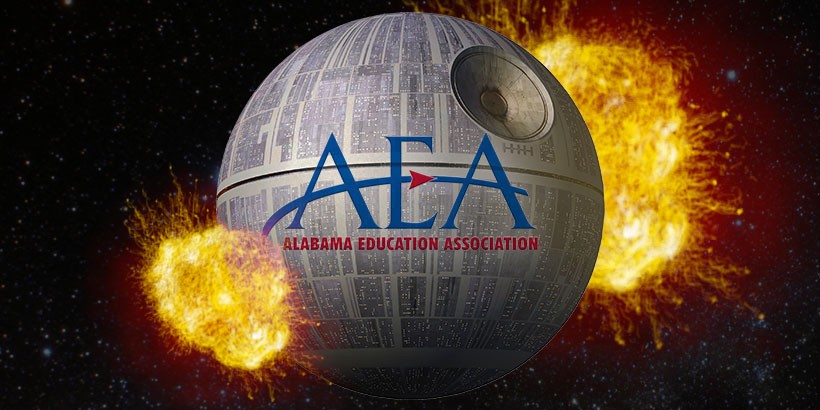
Conservatives had long viewed the AEA as the “Dark Side” in Alabama politics, and not only because of its liberal political leanings, but also because the state’s education system continued to rank 49th or 50th year after year, in spite of the AEA’s total control.
The traditionally white Alabama Education Association’s rise to power began when it merged with the traditionally black Alabama State Teachers Association in 1969. Paul Hubbert was named executive secretary of the newly-formed group and Joe Reed was named associate executive secretary.
For much of the next four decades, Hubbert was widely considered the most powerful political figure in the state, and he ruled with an iron fist. Hubbert was known for sitting in the gallery overlooking the Legislature and giving hand signals indicating which way he wanted lawmakers to vote on whatever bill was being considered.
But the group’s stranglehold on the state began to loosen in 2010 when Alabama voters elected Republicans to their first legislative majority in 136 years. Hubbert retired in 2011, but the organization he built continued to be a major player in state politics, at least for a period of time.
Now, with numbers plummeting and influence almost non-existent, the AEA is only a shell of its former self, and many across the State of Alabama think that change is for the better.
These policy initiatives were bad. So bad, in fact, that they either never came to fruition, or were abandoned over time.
5. Double-dipping
Allowing legislators to hold down two state jobs enabled the Alabama Education Association to set up an unprecedented system of cronyism throughout state government. The two-year college system was the primary vehicle for the scam in which lawmakers were given cushy state jobs to subsidize their legislative pay.
Some people called double-dipping the last bastion of political feudalism in Alabama. Most citizens simply called it corruption.
Republicans rode into power in 2010 on a wave of public backlash against such practices. The ban on double-dipping was one of the first things the GOP put in place once they took over the majority.
But old habits die hard.
After receiving complaints from Democratic Senators, legislation was introduced during the 2013 session that would have “grandfathered in” those who were double-dipping before the ban. That legislation was DOA.
The double-dipping ban has gone a long way in helping Alabama shed its reputation for maintaining one of the most ethically challenged state governments in the country.
4. Siegelman’s lottery

The “Education Lottery,” as it was billed, was sold as a program to provide scholarships to the state’s universities. In reality, the AEA saw a chance to rake more money into their coffers and balloon the size of the state’s budget.
They ran into a buzz saw from conservatives — particularly the Christian right.
Siegelman may have made a strategic error when he decided to put the initiative up for a statewide vote during the fall of 1999, an off-year for elections. Opponents turned out en masse and defeated the amendment 55% – 45%.
Could the initiative have passed if they waited until the 2000 elections to put it on the ballot? Possibly. But the conservative base was motivated that year to turn out for Bush to beat Gore, so the defeat could have potentially been even worse.
3. Terry Dunn’s enviro invasion
Few Alabama policy initiatives have been so misguided as Public Service Commissioner Terry Dunn’s environmentalist push. Dunn’s Chief of Staff, a long time friend to Alabama’s budding environmentalist movement, successfully convinced Dunn to go all-in with the global warming crowd in 2012.
It has backfired in a major way.
Dunn failed to help environmental groups advocate for closed-door legal proceedings to go after Alabama’s utilities. Then, the open process his Commission colleagues opted for resulted in a major rate decrease for Mobile Gas customers, debunking Dunn’s publicly stated rationale for holding closed hearings in the first place.
Closed legal proceedings were used in Georgia, resulting in environmentalists successfully shutting down 15 coal-fired plants. Dunn has been unsuccessful in gaining those same groups a seat at the table in Alabama.
Dunn may have cloaked his environmental advocacy in consumer friendly rhetoric, but no one stands to lose more from his policy initiatives than Alabama consumers whose bills would skyrocket if the enviros got their way.
However, unlike the rest of the “worst failed policy initiatives” on this list, this fight isn’t completely over.
2. DROP
Alabama’s two top teachers’ union bosses were given millions of dollars in taxpayer money upon their retirement.
Wait, what?
The AEA, the State Employees Union and the Retirement Systems of Alabama (RSA) suggested Alabama could save money by adopting a Deferred Retirement Option Program (DROP) for state workers. The program allowed state and education employees who are 55 years old and have 25 years of service to receive their salary and retirement benefits, while continuing to work. The stated goal of the program was to retain more top flight state employees as they neared retirement. But in the end, it was abused and turned into little more than a mechanism for corruption and cronyism… Oh, and it cost the state a fortune.
According to the Alabama Policy Institute, DROP was “in essence, a way to turn highly-paid, long-term state and education employees into millionaires prior to their retirement.”
AEA bosses Paul Hubbert and Joe Reed, who weren’t even state employees, road off into the sunset with $1.3 million and $1.4 million in taxpayer money before the DROP program was dismantled by Republicans in 2011. That’s an impressive feet, even for Alabama’s two most successful public leeches.
1. Riley’s Amendment 1

Upon taking office, Governor Riley was confronted with massive looming deficits leftover from the Siegelman Administration. Rather than making significant budget cuts, Riley offered a $1.3 billion tax increase on everything from oil changes to land and personal property.
Conservatives, led by an anti-tax coalition consisting of ALFA, the Forestry Association and Grover Norquist’s Americans for Tax Reform, among others, went nuclear.
The ballot initiative went down in flames by a wide margin — 68% – 32%.
Three years after proposing the biggest tax increase in Alabama history, Governor Riley ran on a platform of tax cuts for small businesses and won re-election by a wide margin in an impressive feet of political resiliency.