In today’s rapidly evolving security landscape, the threat from unmanned aircraft systems (UAS), or drones, is no longer hypothetical – it’s here, and it’s growing.
Protecting the people I serve – and ensuring the safety of Americans across the country – will always be my top priority.
As our adversaries swiftly advance their drone capabilities, America cannot afford to fall behind.
Every weekend in the fall, tens of thousands of fans pour into stadiums across the South.
This week alone, as the nation turns its attention to major college football championships – from the SEC Championship in Atlanta, to the Big 12 Championship in Arlington, and the ACC Championship in Charlotte – millions of spectators will gather in some of the highest-profile venues in the country.
With crowds of this size, each of these gatherings carries real security considerations that we cannot ignore.
We have already seen what our adversaries are capable of with drones on the battlefield. The threat landscape has shifted as commercial drone technology has become widespread, and now we must take action to safeguard our large-scale events.
With the 2026 FIFA World Cup, 2028 Los Angeles Olympics, and America 250 approaching, the United States must build a stronger, faster, and more flexible posture to protect the public from hostile or reckless drone activity. At last year’s Paris Olympics, over 300 drones were intercepted before they could disrupt events – a clear reminder that the threat is real, persistent, and rapidly growing.
As Chairman of the Homeland Security Subcommittee on Emergency Management and Technology and a member of the Task Force on Enhancing Security for Special Events in the United States, I have seen firsthand how quickly our adversaries adapt.
Our response must be faster still. That starts with giving our law enforcement, intelligence, and security professionals the tools, training, and authorities they need to act in real time. Outdated regulations and limited authorities cannot be allowed to slow our defenses at a time when threats are accelerating.
North Alabama is leading the way.
Huntsville has long served as a center of gravity for America’s defense and aerospace innovation. The work at Redstone Arsenal and by industry partners across the region is providing the technology that keeps Americans safe – from advanced missile defense to next-generation counter-UAS systems that detect, track, and neutralize hostile drones before they become a danger. Our community has the proven ability to jam, drop, and intercept drones of every caliber.
That commitment to readiness is why I was proud to join the Federal Bureau of Investigation, Trump Administration officials, and law enforcement leaders at Redstone Arsenal as they celebrated the opening of the National Counter-Unmanned Training Center (NCUTC) and the graduation of its inaugural class.
This new facility positions Alabama at the forefront of the fight against malicious drone activity and stands as a powerful example of proactive defense. The security professionals trained here will deploy to stadiums and major national events across the country, protecting crowds at events just like the ones taking place this week.
The Trump administration deserves tremendous credit for prioritizing this mission and accelerating the policies and investments needed to counter emerging aerial threats.
Their leadership helped take solutions like the NCUTC from concept to reality, ensuring that America is not merely reacting to evolving technology but staying ahead of it.
Moving forward, I will continue to work with my colleagues on both sides of the aisle and with the Administration to strengthen and expand the legal and operational framework needed to counter drone threats as they arise.
Protecting Americans from aerial threats is not a partisan issue – it is a shared national responsibility. Our goal is simple: ensure our agencies and security professionals have the authority and capabilities necessary to stop attacks before they happen.
Our enemies do not wait, and neither can we.
As millions of Americans tune in to the World Cup draw, fill stadiums for championship weekend, and gather for major events throughout the year, they should have confidence that our nation is prepared.
With continued leadership, strong investment, and a unified strategy, we can ensure that America remains two steps ahead – protecting our people, our infrastructure, and our way of life. That is the mission before us, and it is one that starts right here in North Alabama.
Our time is now.
Congressman Dale W. Strong represents the Fifth District of Alabama and is a member of the House Committee on Appropriations and the House Committee on Homeland Security.
The “future of warfare” is being assembled on the factory floor of PDW’s newly opened Drone Factory 01 in Research Park.
The 90,000-square-foot manufacturing complex will deliver tactical drones at a speed and scale company leaders say is no longer optional, but a matter of national survival.
“This is the end of the exquisite. It’s the end of the slow aerospace, where single systems now should cost a fraction of today’s, where systems can be distributed and scaled to all individual operators on all front lines,.”
At full capacity, the Huntsville plant will produce 350 C100 multi-mission UAS and 5,000 AM-FPV attritable munitions per month, a build rate to meet what PDW calls the new realities of combat.
PDW co-founder Matt Higgins issued a stark warning when describing the importance of building America’s drone industry to meet modern warfare needs.
“The next 9/11 will not arrive by plane. It will arrive by a swarm of drones,” Higgins said. “And we need to make sure we understand every aspect of this technology and build the greatest drone companies in the world right here.”
Celebrity chef and entrepreneur Robert Irvine, a PDW investor, spoke at the event to praise the company’s mission.
“They see the greatest opportunity we have here is to give our fighting forces every conceivable battlefield advantage to win and win quickly,” Irvine said. “This is the future of warfare. There is no way to overstate what is happening here.”
Irvine, founder of the Robert Irvine Foundation, a nonprofit supporting the physical and mental well-being of U.S. service members, veterans, first responders, and their families, also highlighted the long-term significance of PDW’s work.
“The work PDW is doing will shape, and you can quote this twice, will shape the future of our world that we live in for years to come,” he said.
Designed for speed
PDW was built on speed, Chief Strategy Officer Trevor Smith, said “the story of PDW begins well before PDW ever existed.”
“Back in the days of drone racing, we were building the fastest, most agile drones in the world, not for the battlefield, but for the racetrack,” he said. “Along the way, we realized something important. That same speed, precision and resilience we engineered for sport could save lives on the battlefield and give our operators the decisive edge.”
Unlike traditional aerospace programs that measure progress in years, PDW says its new facility is built to collapse development and deployment timelines to months and in some cases, weeks.
“When we say built for speed, we mean it not just in our drones, but in our culture. From concept to field deployment, we’re collapsing timelines from years to months to weeks,” Gury said.
By uniting design, manufacturing, flight testing and delivery under one roof, Drone Factory 01 is designed to rapidly iterate and field systems at the speed of battlefield demand.
“Our flagship drone manufacturing facility here in Huntsville is not just a building, it’s a signal to our allies and to our adversaries,” Gury said. “America will not fall behind and PDW will continue to deliver mission critical systems rapidly at scale as long as they are needed.”
The C100, a modular reconnaissance drone, has already drawn Army contracts under the Medium Range Reconnaissance program and Transformation in Contact initiative. Its modular design allows dozens of interchangeable payloads, maximizing flexibility for surveillance, targeting and communications missions.
The AM-FPV, a low-cost attritable drone, reflects PDW’s bet that future conflicts will demand massive quantities of expendable systems.
Economic boost
The new factory will add more than 500 jobs and spur an economic impact totaling over $81 million per year, executives said.
“This isn’t just an announcement of a company, this is an announcement of a mission, deciding to put a flag in the ground in Huntsville and saying we are going to build a massive US domestic drone industry,” said Higgins.
Alongside fast-paced production lines and advanced quality engineering, DF01 features Lit Thinking’s Visium Far-UVC pathogen reduction devices, which provide 99.9% sterilization, making it one of the cleanest engineering facilities in the world.
A shift in defense philosophy
For PDW, the Huntsville launch isn’t just about opening a building. It’s about redefining how the U.S. responds to rapidly changing threats. The company’s leaders say the days of relying on a few exquisite, billion-dollar platforms are over.
In their place: swarms of affordable, agile, American-made drones designed to be fielded in numbers large enough to change the balance on the battlefield.
“Our whole paradigm is we need to build products that the government is even asking for yet. And we need to be able to withstand the pain of waiting for that market to come. That’s our specialty,” said Higgins.
“PDW’s growth rate will be exponential and we are committed to Alabama. We’re excited to be the new kids on the block in Research Park,” said Gury, highlighting PDW’s ambition to challenge established defense industry leaders.
“Companies like AeroVironment and Raytheon should be a little afraid, because we’re going to come for their markets.”
U.S. Rep. Dale Strong (R-Monrovia) is calling for the use of AI and drones to deal with the drug problem at the southern border.
During a Tuesday House Homeland Security Committee hearing about using unmanned aircraft systems for DHS, Strong discussed the use of drones and AI to target drug cartels who bring fentanyl over the border.
“In the previous administration, for every drone flown by border patrol, the Mexican cartel flew 17,” Strong explained, “many times entering us airspace to land and offload pounds of fentanyl in an attempt to kill a generation of Americans.”
The congressman said that much of the technology that could be used to stop drones at the border is being developed in Huntsville.
“What is most interesting in Huntsville, Alabama, we have the proven technology to neutralize that drone threat. We can intercept and do forensics, we can block their flight, or we can drop and destroy them. Our time is now.”
Jerry Hendrix, who is the Director of UAS Programs at the University of Alabama in Huntsville, testified in front of the committee and answered questions by Strong and other members of Congress about this issue of drones.
Hendrix said there needs to be some regulatory reforms dealing with use of drones for national security.
“If you look at the county UAS side, for example, we deal with, and I mentioned these in the testimony, the different types of regulations that need to be adjusted to allow us to do a full set of testing in the county UAS area, whether it also be detection or mitigation,” Hendrix said.
President Donald Trump signed an Executive Order designating the drug cartels as Foreign Terrorist Organizations.
Yaffee is a contributing writer to Yellowhammer News and hosts “The Yaffee Program” weekdays 9-11 a.m. on WVNN. You can follow him on Twitter @Yaffee
7. A mysterious object streaked across Alabama’s night sky, which meteorologist James Spann identified as likely the disintegrating Chinese satellite GaoJing 1-01. The satellite, used for Earth imaging, may have re-entered Earth’s atmosphere as part of orbital decay, sparking awe and speculation statewide. This incident has reignited public curiosity about aerial phenomena and raised calls for greater transparency in monitoring such events, and more conversation about the increase in the number of items being seen in the sky.
6. As murders spiral out of control in Birmingham, Attorney General Steve Marshall is quite ecstatic about putting killers down as the AG celebrated the state’s status as the national leader in executions in 2024, describing it as a “team effort” delivering justice to victims. Marshall and Alabama put down six individuals this year, including three using the controversial nitrogen hypoxia method, which has drawn international criticism for its potential to cause inhumane suffering of convicted killer scumbags.
5. The 2026 governor’s race might already be over if new polls are accurate showing Lt. Gov. Will Ainsworth holding a commanding early lead over Agriculture Commissioner Rick Pate in polls, with 34% support compared to Pate’s 5%, while 61% remain undecided. Ainsworth outperformed Pate across major cities and congressional districts, bolstered by a 30% statewide favorability rating versus 11% unfavorable. But, it is not even 2025 yet, so many things can change.
4. Alabama Crimson Tide fans, and others who rightfully noted that Alabama should have made the College Football Playoff, were right and the beatdowns of SMU, Clemson, and Indiana only proved those criticisms are correct. Alabama missed the inaugural 12-team College Football Playoff after a 9–3 season, sparking controversy over their exclusion despite a No. 11 ranking in a much tougher schedule in a much tougher conference. But in the end, the College Football Playoff is accomplishing its main mission, making people care, watch, and discuss college football.
3. Alabama fans REALLY want to give Alabama money after University of Alabama Athletics Director Greg Byrne’s plea for increased NIL contributions sparked debate but delivered results, with nearly 800 new members joining the Yea Alabama collective in just two days. Byrne defended his approach, emphasizing that Alabama does not have “unlimited funds” and that competitive fundraising is essential in modern college sports. The surge in support underscores the effectiveness of Byrne’s call to action in rallying fans to secure top talent for Tuscaloosa.
2. U.S. Rep. Terri Sewell (D-Birmingham) embarrassed herself as she joined the chorus of the media and their Democrats believing suggesting that DOGE committee chairman Elon Musk was acting as Trump’s “co-President.” The unclever claim is that he was controlling President Donald Trump and unduly influencing House Republicans to abandon a bipartisan funding deal, pushing the U.S. closer to a government shutdown, that did not happen. Sewell, however, had no response to reports that President Joe Biden has not been able to effectively act as president in years, nor is she concerned as to who is actually acting a co-President for him.
1. Government remains open after Congress narrowly avoided a government shutdown by passing a bipartisan bill that funds the government through mid-March, provides disaster relief, and extends the farm bill. The initial bipartisan deal collapsed under criticism, forcing Speaker Mike Johnson (R-La.) to present a revised bill that stripped out a President-elect Donald Trump-backed debt ceiling extension after significant GOP opposition. The Senate passed the bill early Saturday morning, and President Biden promptly signed it, highlighting ongoing partisan tensions likely to persist into the new Congress. Every Alabama U.S. representative voted “YES.”
Dale Jackson is a thought leader for Yellowhammer News and hosts a talk show from 5-9 a.m. weekdays on WVNN and from 10-11 a.m. on Talk 99.5 and News Radio 1440, with a rebroadcast Talk Radio 103.9 FM/730AM WUMP from 3-4 p.m.
7. A school shooting at Abundant Life Christian School in Madison, Wis., left two people dead, including a teacher and a student, and six others injured, with two in critical condition. Police identified the shooter as a juvenile, Natalie Lynn Rupnow, who was found dead at the scene and are working with the shooter’s family to determine a motive. In her reported manifesto Rupnow, who went as Samantha online, said, “Every single male must be wiped out, from babies to the elderly. Only then will women be free to create a new world.”
6. President-elect Donald Trump has urged Florida Gov. Ron DeSantis to appoint his daughter-in-law, Lara Trump, to replace Sen. Marco Rubio (R-Fla.), who is expected to become Secretary of State. While Lara Trump has expressed interest in the Senate role, DeSantis is considering other candidates, including Florida Attorney General Ashley Moody, and is weighing how the decision could affect his political future and relationship with Trump. However, Trump commented on the matter saying he does not expect Lara Trump to get the nod but added, “Ron’s doing a good job, that’s his choice — nothing to do with me.”
5. A Baldwin County man, Alexander Hilton Randles, was shot and killed by the FBI while they executed an arrest warrant for him related to interstate threats. Randles had called for a militia to suppress “insurrected” government officials and claimed he would lead efforts to restore government control if officials did not act. Court records revealed that Randles believed he was being targeted by a domestic terrorist group and that government corruption was being covered up, prompting him to share his manifesto online.
4. President-elect Donald Trump dismissed a reporter’s question about the possibility of preemptive strikes on Iran, calling it unrealistic to answer such queries before any action is considered and noted that it is not an appropriate time for him to speak on that matter. Speaking at Mar-a-Lago during a press conference, Trump emphasized the impracticality of discussing military strategies publicly and avoided giving a direct response about supporting an Israeli strike on Iran. He reiterated his administration’s focus on assisting Israel and working toward securing the release of hostages in the Middle East.
3. Reports of mysterious drone sightings across the county have made their way to south Alabama and have sparked public reactions, with some residents threatening to shoot down drones despite warnings from officials. Foley Mayor Ralph Hellmich emphasized the dangers and legal consequences of shooting drones, as federal law prohibits damaging aircraft, including unmanned ones, and local laws restrict firearm use in certain areas. While some social media reports in Alabama have been investigated, such as one misidentified as a military helicopter, the origins of similar drone activity in the Northeast remain undisclosed by authorities. In California, an investigation into Yinpiao Zhou, a Chinese national and lawful U.S. resident, is underway for potentially more serious offenses after he was arrested for allegedly flying a drone over Vandenberg Space Force Base in California and taking aerial photos of the base.
2. Alabama U.S. Sen. Tommy Tuberville (R-Auburn) believes the Republican Party could have secured a bigger Senate majority than the 53-47 outcome in the 2024 elections, citing strategic missteps in key races. He pointed to close losses in Nevada, Arizona, Michigan, and Wisconsin, emphasizing that Republicans had leads in some of these contests before losing in the final days. Despite this, Tuberville expressed optimism about the Republican-controlled Congress and President-elect Donald Trump’s potential to deliver relief and change for American taxpayers in the coming years.
1. Alabama’s overtime pay tax exemption has cost the Education Trust Fund $230 million in its first nine months, surpassing expectations and raising questions about its future as it approaches a June 2025 expiration. While proponents argue the policy boosts workforce participation and benefits hourly workers, critics worry about its impact on public school funding, especially as federal COVID relief funds dwindle. Lawmakers are considering extending the exemption, capping it, or letting it expire, with further analysis planned to determine its long-term economic effects.
Dale Jackson is a thought leader for Yellowhammer News and hosts a talk show from 5-9 a.m. weekdays on WVNN and from 10-11 a.m. on Talk 99.5 and News Radio 1440, with a rebroadcast Talk Radio 103.9 FM/730AM WUMP from 3-4 p.m.
The DCH Regional Medical Center in Tuscaloosa announced they will utilize drones for window washing, ironically just one day after an incident in Mobile where a window washer had to be rescued.
Vice President of construction and engineering for DCH David Roberts talked about the idea.
“The old way with cantilevering off the side of the building with swing stages with men hanging off these stages, swinging from ropes and cables, we’re getting away from that because it’s expensive and the liability is too great,” said Roberts. “The weekend of Augusr 24 and 25, we have a company we’ve contracted out of Atlanta, Georgia called Sun Brite that will be washing all four faces of the medical tower with drones.”
Roberts added that residents of Tuscaloosa should be patient, as the process gets underway. He said some parking lots would be blocked in order to ensure a seamless transition.
Michael Brauner is a Senior Sports Analyst and Contributing Writer for Yellowhammer News. You can follow him on Twitter @MBraunerWNSP and hear him every weekday morning from 6 to 9 a.m. on “The Opening Kickoff” on WNSP-FM 105.5, available free online.
The construction industry has experienced both the good and the bad in the past decade. It’s an industry that’s always on the rise, despite dealing with labor shortages and material costs. Yet, the biggest mark of growth for the industry has been the evolution of technology, including solutions that promote efficiency and yield better results.
While implementing new technology can seem daunting, experts believe it’s essential to continue thriving in the industry. There are solutions and tools for nearly every level of use, whether your company wants to go completely digital or ease into the tech world. The bottom line is that technology isn’t going away. It’s important for your company to figure out what solutions work best for you and decide the most beneficial ways to implement them.
“You want to get to the root of what the apprehension is,” explained Kit Dickinson, industry executive, business development at ADP. For many, the apprehension simply lies in fear of change. When someone has been doing something one way for years, it can feel uncomfortable and maybe even pointless to make a change. The fear could also lie in safety. Is the company’s data safe when it’s put into a cloud-based application rather than at the local business? It’s important to determine why someone feels weary about implementing new technology and then work to alleviate that fear. “The irony is that the apprehension is actually, in many ways, causing more risk to your business than adopting a new technology.”
Addressing Labor Shortages with Technology
Implementing new technology can also help alleviate the labor shortages that have been plaguing the construction industry. Younger generations now entering the workforce have grown up using technology their entire lives. Making sure that your company is staying up to date can help attract these younger workers to your field. There’s often a misconception that you have to pursue higher education to learn about different types of technology. However, construction technology such as drones, AI, or 3D imagery can still expand your workers’ skill sets.
Using Technology to Minimize Cyberattacks
In addition to labor shortages and material costs, one of the biggest issues hurting the industry is the increase in ransomware and data breaches. An estimated 50,000 to 60,000 companies are running their business on legacy financial systems or enterprise resource planning (ERPs), or even running them locally on-premise, said Dickinson. That carries a significant risk for cyberattacks versus going with a proven cloud-based offering.
Dickinson shared a story about a construction company that had to go completely dark after a ransomware attack. They couldn’t pay people for up to two weeks nor run their operations. It’s crucial to partner with technology providers who have proven, established security measures as part of their offering to keep your data and operations safe. ADP Workforce Now® for Construction automates construction payroll to help construction firms manage the industry’s nuances.
The Unique Nature of Construction
“Construction is extremely unique in the nature of the business in that the work is performed at job sites that could be in different cities and states. Then when you factor in that you might be receiving government funding to work on those jobs, you have very unique reporting requirements that are specific to the industry … it’s at a higher compliance burden, further reinforcing the need to partner with a Human Capital Management (HCM) provider that has the ability to support that complexity,” said Dickinson.
The Truth Behind Artificial Intelligence
Artificial intelligence, or AI, is a term seen everywhere. But what does this mean for construction? In short, AI is nowhere near dominating the industry. In fact, it’s still not as prevalent as one might think. Yet, using AI can bring more benefits to your company than you might think.
“Where the biggest impact is going to be is data analytics,” said David Pratt, director of corporate and operational technology at Robins & Morton. “You’re going to have predictive maintenance. You’re going to be able to optimize project schedules. You’re going to be able to aid in risk management.” Construction companies, particularly managers, are collecting a vast amount of data. With AI, they can make this data digestible and streamlined, as well as problem solve potential issues.
There’s now takeoff software for preconstruction, where AI is implemented to analyze drawings of buildings or interiors and estimate the types and amounts of materials needed. Pratt said he’s seen team members utilize AI to grab the material hardware for specs. “Let’s say you put that into some kind of generative AI like ChatGPT — you can go ahead and ask it, ‘Quantify all of the parts I need for this based off of this spec and put it into a table format to help me create my parts list, my cost.’ This eliminates the potential hours of research spent trying to find this information. With AI, constructors can have a table completed in minutes. This also applies to Standard Operating Procedures (SOPs). By having AI do the work, workers can spend more time in the field and less time doing manual tasks.”
Pratt stressed that your team should always check the AI’s work. Copy it into a Word document, reread it several times, and modify it if needed. Make sure that it also matches your company’s compliance standards and brand standards. While AI is a great tool and saves a lot of time, it’s still not perfect.
Maximizing Digital Solutions
“It all goes back to data. What do you do with all the data that we currently have? In the past 10 years, that’s been the biggest question.” This has been evident with the introduction of Revit back in the early 2000s, which was bought out by Autodesk, and all the way to 3D models. All of these tools use data analytics to create more efficiency when completing projects.
The Impact of Drones
What’s really changed the industry, however, are drones. Drones are now essential for site surveys and inspections. They can even simply be used to provide a bird’s eye view of your project. Prior to drones, companies had to hire helicopters to fly out and offer a top-down perspective. Now, you can use a drone, along with digital platforms like Procore, Plan Grid, or Autodesk Field, to do data management on an iPad out in the field. You can now have the full 3D project model on your mobile device. Data transfers are quick and practically instantaneous.
The Role of Sensors
Sensors can also be used in multiple ways. You can wear them to determine your health. Or you can use sensors on concrete to alert you when your concrete is secure. Everything is now virtual, Pratt explained. You can use technology to locate pieces of equipment on your job site, connect delivery schedules to your crane operation, or more recently, for automation.
Creating Efficient Models
The industry has also utilized 3D printers for construction models. For example, the printer could make a model of a 10-story building that’s dividable by layer, meaning that each piece could be removed to look inside the facility. In a digital world, 3D printers still provide something tangible and physical. “3D printers make it easy to print models of a facility. We print them, and we can give them to our clients and give them to our job sites. People can have full conversations about the constructability based off a 3D model,” said Pratt. Virtual and augmented reality is also huge in the industry. In the past, construction teams would build physical mockups to establish a visual representation of a space. Now, with virtual reality, this can be done digitally, promoting sustainability and reducing costs.
Conclusion
Implementing technology requires initial upfront costs, as well as a learning curve, but the payoff is insurmountable. Your team can save hours of time by taking advantage of digital solutions; you can minimize the risk of cyberattacks; and you can continue attracting a younger workforce to your company.
To begin your technology journey or to obtain information about the Associated Builders and Contractors Tech Alliance or the Alabama Chapter’s yearly Technology Summit, visit www.abc-alabama.org.
Courtesy of Alabama Construction News.
U.S. Rep. Dale Strong introduced the “National Training Center for Counter-Unmanned Aircraft Systems Act” to establish a dedicated counter-UAS training program. Unmanned Aircraft Systems are also known categorically as drones.
Such a program would train personnel to operate counter-UAS detection and mitigation systems, equipment, or technology that helps to lessen the credible threat posed by UAS systems to the safety or security of a covered facility or asset.
The increasing use of unmanned systems poses security challenges. Due to their size, flying capabilities, and the ease with which they can be operated, drones are particularly appealing for illicit uses by hostile actors, including terrorists, drug cartels, and criminals.
Rep. Strong (R-Monrovia), who represents a large defense base in North Alabama, says there is a pressing need for specialized training and resources across the emerging field of unmanned threats.
“In recent years, we have witnessed a surge in threats posed by UAS, both from incursions across our Southwest border and within the interior of the United States. I have seen firsthand during trips to the border – hostile actors such as terrorists, cartels, and criminal organizations exploiting UAS to carry out illegal activities, including the transportation of weaponized payloads, surveillance, and attacks on domestic critical infrastructure,” said Rep. Strong.
RELATED: Tax dollars are funding EV charging stations. Dale Strong says at least make them in America
“I am proud to represent a community that both understands the urgency of the threat posed by unlawful unmanned aircraft systems and possesses the capability to defend against these attacks. The Fifth District of Alabama is home to some of the brightest minds in the world, solving complex issues and forging new defense technologies every day.”
“This emerging threat to our homeland presents a need for robust training on UAS detection and counter-UAS operations. More must be done to ensure that our authorized law enforcement officers and personnel are equipped with the resources and tools needed to respond to these threats in real time and guarantee the safety of our communities.”
“It is vital that our nation remain at the forefront of technology and training and use every tool at our disposal to protect against those who seek to undermine our national security through the nefarious use of drones.”
China is currently the world’s number one manufacturer of drones and unmanned aircraft technology. The United States ranks a distant second.
Austen Shipley is a staff writer for Yellowhammer News. You can follow him on X @ShipleyAusten.
The University of Alabama in Huntsville (UAH) announced Thursday that it has received $1.1 million in grant funding to study how unmanned aircraft can aid the response to both manmade and natural disasters.
The money comes from the Federal Aviation Administration (FAA), who granted a total of $3.3 million to the 24 universities in that comprise an Alliance for System Safety that focuses on unmanned aircraft systems (UAS).
“These grants will help develop a greater array of innovative strategies to more effectively deploy drones during emergency response situations,” said U.S. Transportation Secretary Elaine L. Chao.
(more…)
(Video above: “Science fiction no more.” Jeremy Clarkson explains Amazon Prime Air)
Amazon, the world’s largest retailer, raised some eyebrows earlier this week when it released a video declaring its drone delivery service “science fiction no more.”
“We’re excited about Prime Air — a future delivery system from Amazon designed to safely get packages to customers in 30 minutes or less using small unmanned aerial vehicles, also called drones,” the company explained. “Prime Air has great potential to enhance the services we already provide to millions of customers by providing rapid parcel delivery that will also increase the overall safety and efficiency of the transportation system. Putting Prime Air into service will take some time, but we will deploy when we have the regulatory support needed to realize our vision.”
In other words, drone delivery technology is pretty much ready to go, but government regulators are playing catchup.
The realization that drone package delivery is no longer just a distant possibility sparks both excitement and anxiety. Privacy advocates have raised obvious concerns. A Kentucky man was arrested earlier this year for shooting down a drone hovering over his property. But the benefits and convenience of drone delivery, once fully considered, are undeniable as well.
Alabama has taken steps to position itself as a possible leader in the drone revolution. There are still some barriers to drone delivery becoming a reality, much less a common occurrence, but the sight and sound unmanned aerial vehicles buzzing through the skies is probably going to happen faster than many Alabamians expect.
HOW WILL IT WORK?
Amazon already has fulfillment centers (i.e. giant warehouses) located within 20 miles of 31 percent of the nation’s population, so as soon as the government puts a regulatory structure in place, a big chunk of Americans will immediately be well within range of Prime Air delivery.
This lightning-fast system — as fast as 30 minutes from the moment Amazon receives the order — will make delivery of even perishable items possible to a large swatch of the country.
Alabama does not currently have an Amazon fulfillment center, but they already exist in three neighboring states (Florida, Georgia and Tennessee). With Amazon rapidly expanding its physical infrastructure, it is only a matter of time before the company comes to the Yellowhammer State and drones are buzzing across the Birmingham skyline.
Amazon and other companies (e.g. Google) in the process of developing drone delivery capabilities view the sky similar to a layer cake, with certain altitudes carved out for different types of flight.
Delivery drones would fly between 200 and 400 feet, manned aircraft like helicopters would be required to stay above 500 feet, and so on.
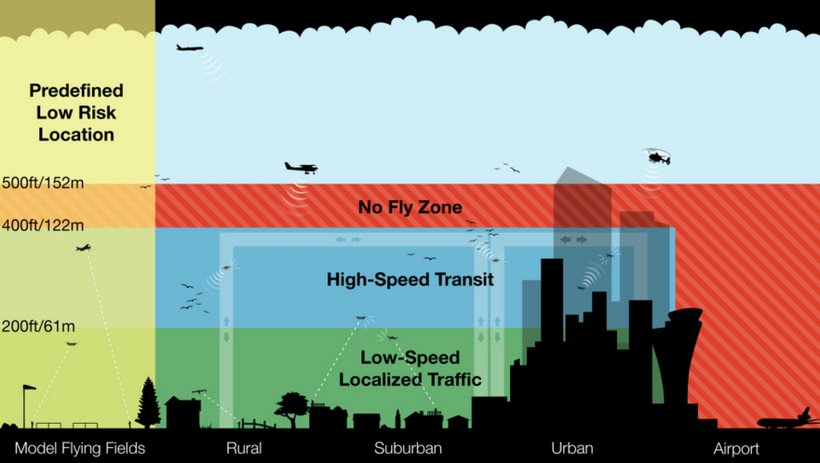
One issue with this system, however, is that it assumes the federal government is essentially going to seize control of all the air space over private property. Legal challenges would undoubtedly emerge, especially considering the U.S. Supreme Court in 1946 essentially agreed with historic common law that private property owners control their property “from the depths to the heavens.” And in Alabama, it is not hard to imagine drones serving as target practice at one point or another.
Another concern is that drones could run into each other, buildings or people. Landing has proven to be a challenge for drones, especially in inclement weather, but the technology already exists to nearly eliminate these issues as a major concern.
“Prime Air vehicles will take advantage of sophisticated ‘sense and avoid’ technology, as well as a high degree of automation, to safely operate beyond the line of sight to distances of 10 miles or more,” Amazon explained this week. “Safety is our top priority. Our vehicles will be built with multiple redundancies… (But) we will not launch Prime Air until we are able to demonstrate safe operations.”
Amazon presented its vision for delivery by drone earlier this year at NASA’s Unmanned Aerial Systems Traffic Management (UTM) Convention. And NASA has been working on completing an air-traffic control system for drones since 2013.
THE UPSIDE
The downside of drones — including privacy concerns, noise pollution and safety issues — are well documented. But the upside to their proliferation could be significant.
America’s population is expected to jump by 70 million over the next thirty years, to 390 million residents. The U.S. Department of Transportation expects freight volume to grow by 45 percent, to 29 billion tons per year, over that same time period. America’s transportation infrastructure is already crumbling and trucks, which currently carry roughly 70 percent of American freight, are not going to be able to keep up with the increase in volume. According to Wired, trucks already waste $27 billion per year being stuck in traffic.
“The stress on our freight system is increasing,” US Secretary of Transportation Anthony Foxx told Wired earlier this year. “We have to look at other ways to move,” including “the potential commercial uses of drones as a reliever of the surface transportation system.”
DRONES’ POTENTIAL IMPACT ON ALABAMA
Alabama has already taken small steps to position itself at the forefront of the drone revolution.
Auburn University launched the nation’s first FAA-authorized drone flight school.
This time last year, Alabama Gov. Robert Bentley also announced the creation of the Alabama Drone Task Force. The task force was created to review the necessary requirements to further Alabama’s potential use of drones in the areas of agriculture, conservation and law enforcement.
The implications for Alabama agriculture — the state’s largest industry — are huge.
“Unmanned aerial vehicles (UAVs), or drones, have the potential to help farmers better manage crops and livestock,” said Alabama Farmers Federation President Jimmy Parnell. “We appreciate the governor’s proactive efforts to explore how we can best use this technology while protecting private property rights.”
The Alabama Drone Task Force is chaired by Commissioner of Agriculture and Industries John McMillan and includes Alabama Department of Transportation Director John Cooper, Department of Conservation and Natural Resources Director Gunter Guy, Alabama Law Enforcement Agency Secretary Spencer Collier and Montgomery Airport Authority Board Member Jimmy Reynolds.
In a release, Bentley said, “I believe drone use can benefit the state now and for generations to come, because drones offer many advantages to help our farmers and law enforcement agencies be successful.”
Agricultural researchers have worked with Alabama farmers to demonstrate how drones can be paired with video cameras and sophisticated mapping software to provide producers better information about irrigation, soil conditions, plant health, animal care and pest management.
“The thing about a UAV is that it gives you a whole new perspective when we talk about agriculture,” said John Fulton, former Alabama Farmers Federation professor in the Department of Biosystems Engineering at Auburn University. “There’s a tremendous amount of opportunity to collect data or images, check cows or go out after a rain to see where water is standing.”
But in addition to UAV’s potential impact on Alabama’s massive agriculture industry, the state has a unique opportunity to position itself at the forefront of the inevitable evolution in the way drones impact our everyday lives.
With Amazon and other companies racing toward the future of drone package delivery, Alabama leaders would be smart to stay ahead of the curve.
Package delivery by flying drone is coming to Alabama faster than you think https://t.co/0ZS8cPCjFs pic.twitter.com/ATGaZRJUEJ
— Yellowhammer (@yhn) December 2, 2015
(Video Above: Alabama Power uses UAVs to access dangerous and difficult locations)
Who knew that such a small motor could generate so much buzz?
Alabama Power’s newest equipment might look like a toy. In fact, it very much resembles unmanned aircraft that many purchased as gifts for children. But the implications are big, and could lead to cost savings, faster storm recovery and increased safety.
Company engineers are looking at how unmanned aerial vehicles (UAV) can be used to inspect damaged lines after storms, and perform the routine inspections that help maintain a reliable system.
“There are literally dozens of things these vehicles could do for us,” said Engineering Manager Bobby Hawthorne, who is tasked with evaluating the field tests. “It’s just a matter of figuring out which ones provide the greatest benefit, and proving their value.”
Federal Aviation Administration restrictions govern who can fly UAVs. Alabama Power and Southern Company applied for and received a special FAA exemption to test the capabilities of the aircraft. The permission allows for flights of up to 400 feet above ground and only within line of sight of the operator.
So far, the company has flown more than a dozen tests, simulating the work that would be required for post-storm evaluations and other tasks.
“We are excited, as there are a number of potential uses in our field for these aircraft,” said Alabama Power Vice President Danny Glover. “I’m confident in the ingenuity of our system engineers and employees to find good uses for this technology. It will translate directly to improvements in safety, efficiency and production.”
(Video Above: Aerial photography footage of the University of Alabama’s campus)
TUSCALOOSA, Ala. — Alumni and state residents alike often take the University of Alabama’s gorgeous, historical campus for granted, but using new drone camera technology, even lifelong visitors of the Capstone cannot help but marvel at the school’s beauty.
UA published the short video to showcase some of the most recognizable spots on campus. With the drone, Alabama takes you above the trees and streets to provide a clear view of campus we don’t often don’t see.
Drones have become increasingly popular and have been used to capture other Alabama events such as the Snowpocalypse 2015 and tornado damage from 2014.
Enjoy!
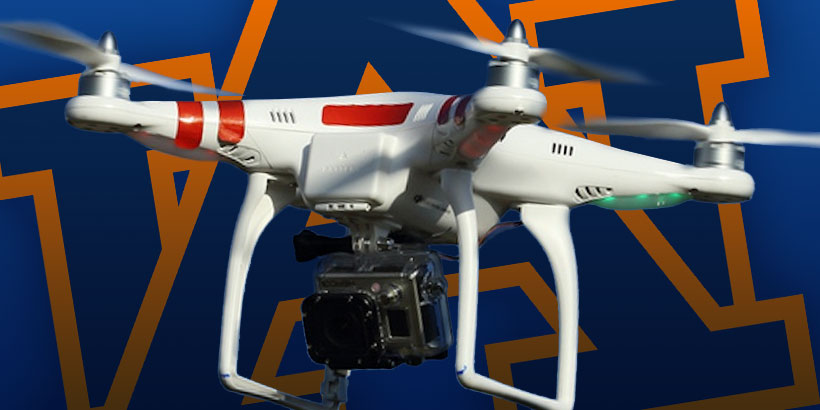
AUBURN UNIVERSITY — Auburn University has received the nation’s first FAA approval to operate a new Unmanned Aircraft Systems Flight School as part of the Auburn University Aviation Center.
“This is an honor for Auburn University,” said Bill Hutto, director of the Auburn University Aviation Center. “We will conduct commercial flight training for operators of unmanned aircraft systems outdoors and untethered. We will have the ability to offer training courses at different locations here and around the state for Auburn students, faculty, members of other public agencies and the general public.”
Unmanned aircraft systems, or drones, are expected to be a key component of the state’s and nation’s economy as opportunities continue to arise in business and industry, as well as in research areas such as engineering, building science and agriculture.
“It’s a major win for the state,” Alabama Lt. Gov. Kay Ivey said. “We’re building off Alabama’s already rich history and robust industry in aerospace and aviation and now leading the nation in an area of emerging technology that’s critical to our success in future economic opportunities.”
The FAA approval requires that operators of unmanned aircraft pass a written exam and a flying test, both of which Auburn will administer. “It ensures that the operators have a good understanding of how to safely and properly operate an unmanned aircraft system,” Hutto said.
Auburn University has been involved in aviation education for more than 80 years and has been providing fight training for pilots for nearly 75 years. Auburn offers three aviation/aerospace degrees: aviation management, professional flight management and aerospace engineering.
“I commend Auburn University on obtaining the new FAA approval,” said Seth Hammett, a member of the Auburn University Aviation Center Steering Committee. “It is another step in continuing the long-time educational excellence in aviation and aerospace at the university. Our state will benefit by having unmanned aircraft system operators trained in the safe, effective use of these aircraft.”

Follow Scott on Twitter @SStantis