
Alabama Congressman Mo Brooks has been one of Capitol Hill’s most outspoken critics of the President’s refugee resettlement plan. He says local governments deserve to have more control over those who are placed in their state. Now, he’s signed on to a bill that would grant states the power to approve refugee resettlements.
The Allow State Sovereignty Upon Refugee Entry Act (ASSURE) responds to an Obama Administration order that would allow an additional 110,000 new refugees into the country over the next year. Already, the President has reported that 324,000 have been admitted into the United States throughout the past five years.
Rep. Brooks says the President’s action is costing taxpayers billions each year, and believes Congress must push back.
“Unsurprisingly, this Administration has shunned and disregarded as irrelevant all thought to how its dangerous policies impact local communities, threaten American lives, and drive up our nation’s exploding $19 trillion debt,” Rep. Brooks told Yellowhammer.
Pointing to a study from the Center for Immigration Studies, he says that each refugee from the Middle East will costs American taxpayers $64,370 within the first five years of their resettlement.
“That amounts to 12 times what the UN estimates it would cost to care for one refugee in neighboring Middle Eastern countries,” he added.
More than a being a threat to America’s pocketbook, Rep. Brooks believes refugees could also pose a security risk.
“This Administration has shown a pattern and practice of discriminating against peaceful Christian and other non-Muslim immigrants in favor of unvetted and potentially dangerous Muslim immigrants,” Rep. Brooks said. “Remarkably, so far this year more than 99% of the Syrian refugees admitted to the United States have been unvetted Muslims.”
If passed, the ASSURE Act would require the U.S. Department of Health and Human Services to submit a report to each state with detailed information about proposed refugee resettlements, as well as the cost of housing, education, health care, and more.
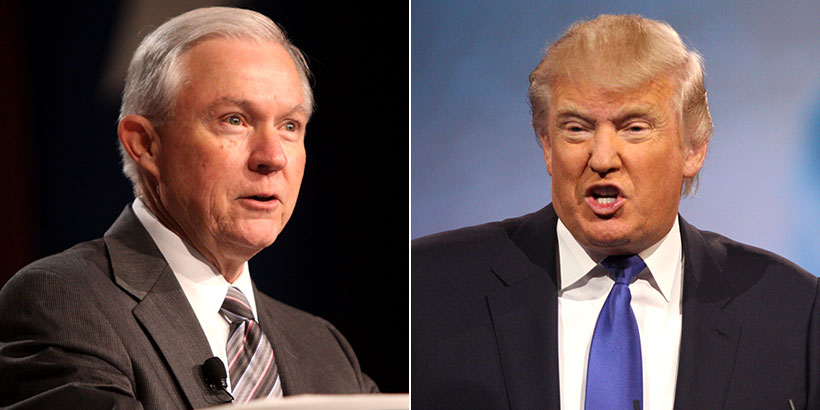
From the moment Donald J. Trump became a presidential candidate, he has carved out a position as the hardest of immigration hardliners.
“When Mexico sends its people, they’re not sending their best. They’re sending people that have lots of problems. They’re bringing drugs. They’re bringing crime. They’re rapists,” he said in his campaign announcement speech. “I will build a great wall — and nobody builds walls better than me, believe me —and I’ll build them very inexpensively. I will build a great, great wall on our southern border, and I will make Mexico pay for that wall. Mark my words.”
In addition to border security, Trump has also insisted he would stem the flow of legal immigration and put an end to abuses of H1B visas. The program is designed to bring immigrants into the country to work in specialized fields, usually in science, technology, engineering, and math (STEM) jobs, but has been used by some large companies to lay off American workers after forcing them to train their foreign replacements.
RELATED: Sessions was right: Thousands of Americans laid off after training their foreign replacement
Trump’s position has earned him the support of Senator Jeff Sessions (R-Ala.) the leading conservative voice against both illegal immigration and the H1B visa program.
Sessions endorsed Trump at a massive Alabama rally two weeks ago, the first time the Alabama senator has officially thrown his support behind any presidential contender. He was subsequently named chairman of Trump’s National Security Advisory Committee.
But in the most recent presidential debate, Trump suddenly changed course.
“I’m changing,” Trump said. “I’m changing. We need highly skilled people in this country, and if we can’t do it, we’ll get them in. But, and we do need in Silicon Valley, we absolutely have to have.”
“So, we do need highly skilled,” Trump continued, “and one of the biggest problems we have is people go to the best colleges. They’ll go to Harvard, they’ll go to Stanford, they’ll go to Wharton, as soon as they’re finished they’ll get shoved out. They want to stay in this country. They want to stay here desperately, they’re not able to stay here. For that purpose, we absolutely have to be able to keep the brain power in this country.”
When asked by debate moderator Megyn Kelly if he was “abandoning the position on (his campaign) website,” Trump said, “I’m changing it. And I’m softening the position because we have to have talented people in this country.”
Then, less than an hour after the debate, Trump’s campaign released a statement apparently reverting to his previously-held position.
“Megyn Kelly asked about highly-skilled immigration,” Trump said. “The H-1B program is neither high-skilled nor immigration: these are temporary foreign workers, imported from abroad, for the explicit purpose of substituting for American workers at lower pay. I remain totally committed to eliminating rampant, widespread H-1B abuse and ending outrageous practices such as those that occurred at Disney in Florida when Americans were forced to train their foreign replacements. I will end forever the use of the H-1B as a cheap labor program, and institute an absolute requirement to hire American workers first for every visa and immigration program. No exceptions.”
In a subsequent report in the Washington Examiner titled “Confusion follows Trump flip-flop on key immigration issue,” Byron York spoke with numerous immigration hardliners from the Sessions wing of the GOP who were left befuddled.
Mark Krikorian, head of the Center for Immigration Studies, which favors stemming the flow of immigration into the U.S., told York he was disappointed.
“[Trump] made clear in October he didn’t believe what’s in his immigration paper about skilled immigration,” he said, “and at the last debate he showed he buys the ‘jobs Americans won’t do’ line on unskilled workers too… His embrace of foreign tech workers is particularly shocking given that just days ago he featured American workers replaced by Disney at one of his rallies.”
Writer Mickey Kaus agreed with Krikorian’s assessment.
“I’ve heard from enough tech workers displaced by H-1Bs that Trump’s apparent answer very dispiriting,” he tweeted.
Trump’s rivals have seized the opportunity as well. Senator Marco Rubio (R-Fla.), who has advocated expanding the H1B visa program and been an opponent of Sessions’ on the issues of immigration and trade, said Trump is “totally clueless,” even on “his signature issue” of immigration.
Whether he’s “clueless” or a “con man,” as others have suggested, Trump’s flip-flopping on the immigration issue has left many in the large and growing Jeff Sessions wing of the Republican Party wondering, “Is Trump really one of us?”

Since the year 2000, all of America’s employment growth has gone to immigrant workers — both legal and illegal — while the total number of working-age Americans without a job increased by 17 million over the same time period.
That is the stunning conclusion of a just-released report by the Center for Immigration Studies (CIS). The study was released Friday on the one-year anniversary of the Senate’s passage of so-called “comprehensive immigration reform,” also referred to as the Gang of Eight’s proposal.
Here are five key statistics contained in the CIS study:
1. In the first quarter of 2000, there were 114.8 million working-age natives holding a job; by the first quarter of 2014 that number had actually dropped to 114.7 million.
2. Because the population was rising over that same time period, there were 17 million more working-age Americans not working in the first quarter of 2014 than in 2000.
3. The employment rate of immigrants increased from 2000 to 2007 and has recovered more quickly from the Great Recession than natives.
4. Since the jobs recovery began in 2010, 43 percent of employment growth has gone to immigrants.
5. The supply of potential workers is enormous: 8.7 million native college graduates are not working, as are 17 million with some college, and 25.3 million with no more than a high school education.

Sen. Jeff Sessions (R-Ala.), who has been the Senate’s most vocal opponent of the Gang of Eight’s proposal, released a lengthy statement today in response to the CIS study.
“The findings in this report are shocking, and represent a dramatic indictment of immigration policy in Washington D.C. This report also underscores the economic catastrophe that would have ensued had the Gang of Eight’s legislation, passed in the Senate one year ago today, been moved through the House and signed into law,” he said. “Not only did the Gang of Eight plan provide amnesty to illegal workers (and help entice a new wave of illegal immigration), but it surged the rate of new low-skilled immigration at a time of low wages and high unemployment. Such a proposal would have hollowed out the middle class.”
Session said that in spite of the CIS study’s findings, President Obama continues to push immigration reforms that would drive American wages down even further.
“President Obama and congressional Democrats remain focused on the demands of activist CEOs who want new labor at the lowest price,” he said. “Republicans must sever themselves from these demands and present themselves to the American public as the one party focused on everyday working people. The sensible, conservative, fair thing to do after 40 years of record immigration is to slow down a bit, allow assimilation to occur, allow wages to rise, and to help workers of all backgrounds rise together into the middle class.”
Along with The Center for Immigration Studies’s report, CIS also released three conclusions they took away from their study:
First, the long-term decline in the employment for natives across age and education levels is a clear indication that there is no general labor shortage, which is a primary justification for the large increases in immigration (skilled and unskilled) in the Schumer-Rubio bill and similar House proposals.
Second, the decline in work among the native-born over the last 14 years of high immigration is consistent with research showing that immigration reduces employment for natives.
Third, the trends since 2000 challenge the argument that immigration on balance increases job opportunities for natives. Over 17 million immigrants arrived in the country in the last 14 years, yet native employment has deteriorated significantly.
The White House and Congressional Democrats have given House Republicans until July 31st to decide what they want to do with the Gang of Eight’s bill. In the mean time, pro-immigration reform lobbying efforts backed by major tech executives continue to target House Republicans.
Sessions has urged the House to reject the proposal.
“Republicans in the House need to stand up for the American worker,” Sessions said on Fox News in January. “Their interests are being ignored. The big government groups, the special interest groups, the lobbying groups — they’re all out in full force. Somebody needs to stand up for [the workers]. The Party that does that will be rewarded by the American people in elections.”
Follow Cliff on Twitter @Cliff_Sims