Michael Brauner is a Senior Sports Analyst and Contributing Writer for Yellowhammer News. You can follow him on Twitter @MBraunerWNSP and hear him every weekday morning from 6 to 9 a.m. on “The Opening Kickoff” on WNSP-FM 105.5, available free online.
As one of the first people to experience Alabama’s incredible diversity of landscapes and wildlife, 18th century explorer William Bartram traversed much of central and south Alabama during a three-year period of exploration from 1775-1778. He extensively documented the plants, animals and native tribes in what is now the Southeast U.S.
To commemorate that period of discovery and the vast contributions of this early adventurer, the Alabama Department of Conservation and Natural Resources’ State Parks Division is teaming up with Auburn University to highlight Bartram’s travels through Alabama with a traveling display that will be showcased at 12 Alabama State Parks, starting at Lake Guntersville State Park, where the exhibit is currently on display until February 1, 2026.

“Alabama State Parks are living classrooms,” said Alabama State Parks’ Chief Naturalist Renee Raney. “This has been our theme over the past few years as we increase our education outreach and bring more field trips and K-12 teachers into our parks.
“Bartram’s story belongs in the landscape that shapes those discoveries, and I believe our public lands are those landscapes. Hosting this exhibit allows guests to encounter Bartram, not as some distant, historic figure, but as a fellow explorer or naturalist to walk many of our rivers, forests and ridges. I really think our parks provide the perfect settings to connect observations from more than 250 years ago to the living ecosystems you can experience in our state parks today.”
Raney said Dr. Mark Wilson invited Alabama State Parks to host “William Bartram and Alabama.” Raney and her team then developed a program to enhance the exhibit at State Parks. In addition to Alabama, Bartram’s travels included North and South Carolina, Georgia and Florida.
“Bartram’s work not only helped lay the foundation for the study of natural history in America, his observations in 1775 as he traversed Alabama inspired the very roots of our own interpretive program and the mission of our state park naturalist team,” Raney said. “As we approach the 250th birthday of our nation in 2026, I can’t imagine a better way to celebrate our country’s natural history and Alabama’s Year of Trails than by sharing this remarkable exhibit and its companion program, ‘In the Footsteps of Bartram: Discovering Alabama’s Natural Heritage,’ with visitors across our state parks.
“Bartram’s legacy of curiosity and wonder, whether he was ‘paddling through innumerable millions of mating mayflies, marveling at the gilded coat of mail of the yellow bream or observing the frog whose call resembles the barking of little dogs’ continues to inspire how we interpret and protect Alabama’s natural treasures today. We look forward to welcoming the public as the exhibit travels to 12 state parks from December 2025 through January 2027 and as our statewide education team leads special programs ranging from hiking to kayaking to nature journaling to Junior Ranger activities and beyond!”
Raney said Auburn’s Bartram exhibit will visit many cultural venues around the state, while the exhibit at Alabama State Parks will be in the midst of the landscapes that Bartram discovered and documented.
“The Parks-based exhibit will be history unfolding where it happened,” she said. “We’re inviting visitors to stand in the same ecological story that Bartram helped record.”
The State Parks’ Bartram exhibit expands the experience with the “In the Footsteps of Bartram” programming that allows visitors hands-on involvement developed by State Parks naturalists.
“The programming invites guests to slow down and observe the world the way Bartram did,” Raney said. “Through guided hikes, interpretive kayaking, nature journaling, immersion programs and place-based adventures, participants engage their senses and curiosity. These experiences transform visitors from spectators into naturalists, echoing Bartram’s restless spirit of inquiry. Not only was he exploring, he was deeply documenting what he found, like the experience near Meaher State Park (at the head of Mobile Bay) where he commented that the little frogs remind him of barking puppy dogs. I just love that he took the time to write that down.
“I also hope the exhibit helps visitors see Alabama State Parks differently. So many of our visitors are repeat customers. They love our parks as they are, but they enjoy diverse experiences. Through this exhibit, I feel like Bartram gives us a lens of wonder and attention. His writings encourage visitors to notice the texture of bark, the scent of wildflowers, the movement of birds and the sound of frogs. Through his eyes, familiar places become layered with history, science and storytelling. My personal desire is that it will reveal the parks as both natural sanctuaries and cultural landscapes.”
Visitors headed to Lake Guntersville State Park to view the Bartram exhibit will also be able to visit during peak eagle-viewing season as well.
“The Alabama State Parks Division is continuously striving to enhance the opportunities for our visitors to experience our beautiful parks,” said State Parks Director Matthew Capps. “The Bartram exhibit is just one example of how our team goes beyond expectations to share the story of the discovery of Alabama’s biodiversity and natural wonders. Take advantage of this opportunity when the exhibit comes to a park near you.”
For those who want to follow the route of Bartram’s exploration in southwest Alabama, the Bartram Canoe Trail traverses the Mobile-Tensaw Delta, also known as “America’s Amazon” because of its amazing flora and fauna. The Bartram trail allows paddlers to experience our nation’s second largest river delta, a vast wetland of estuarine marsh, swamps rife with tupelo and cypress trees and stands of bottomland hardwoods. More than 50 rare and endangered plant and animal species can be found in the Delta, which encompasses 250,000 acres, 100,000 of which are publicly owned and managed.
ADCNR’s Alabama State Lands Division opened the Upper Bartram Canoe Trail system in 2003, followed by the Lower Bartram Canoe Trail system in 2018. Day-use and overnight trails with land-based campsites and floating or elevated platform campsites are available. Visit www.alabamacanoetrails.com/bartram for more information about the paddling and camping opportunities available.

Raney said Bartram’s adventurous science mirrors the mission of Alabama State Parks: discovery, conservation and connection.
“His desire to understand nature through direct experience is the same spirit we cultivate in our interpretive programs,” Raney said. “As Chief Naturalist for Alabama State Parks, I believe his work continues to inspire how we invite guests to learn from the land, enjoy it, protect it and feel a sense of belonging within Alabama’s natural heritage.”
The Bartram exhibit will be displayed at Gulf State Park February 6-28, followed by Meaher State Park from March 3-30, Rickwood Caverns State Park April 2-23, DeSoto State Park April 29-May 28, Chewacla State Park June 3-24, Monte Sano State Park July 1-29, Joe Wheeler State Park August 4-18, Cheaha State Park September 1-22, Lakepoint State Park October 1-23, Oak Mountain State Park October 27-November 30, and Wind Creek State Park December 3-Janaury 15, 2027.
Visit https://reserve.alapark.com/register/ for a list of upcoming events at Alabama State Parks.
David Rainer is an award-winning writer who has covered Alabama’s great outdoors for 25 years. The former outdoors editor at the Mobile Press-Register, he writes for Outdoor Alabama, the website of the Alabama Department of Conservation and Natural Resources.
Madison and Jared Powell arrived in Auburn as newlyweds with different dreams and separate career goals. Now, they will walk across the same graduation stage as Dr. Powell and Dr. Powell, earning Ph.D.s. Their fields could not be more different, but a shared Auburn experience turned two individual journeys into a milestone achieved together.
Jared came to Alabama to pursue a dream tied to Auburn since childhood. Though raised in Michigan, he grew up cheering for the Tigers because his father played baseball here in the late 1980s. Discovering Auburn’s strong experimental plasma physics program confirmed that this was where he belonged.
“I’ve been an Auburn sports fan my entire life,” he said. “When I found out how good the plasma program was here, it sealed the deal.”
Madison planned to complete a master’s degree in education administration, not a doctorate. She wanted to impact students and teachers, but the support she found at Auburn led her toward a bigger opportunity. Professors encouraged her to continue, and a close cohort made the work meaningful.
“I just enjoyed it,” she said. “They told me I was seven classes and a dissertation away from a Ph.D., and I thought, ‘That’s just eight things. I can do eight things.’”
Madison’s research focuses on authentic leadership in education and how momentous experiences, such as nature-based learning trips, help build stronger school leaders. She hopes her work will support teachers, students and future administrators in developing transparent, empathetic leadership. Her path in school leadership has now led her to serve as an assistant principal in Opelika.
Jared’s research tackles the “radio blackout” problem that affects spacecraft when they re-enter Earth’s atmosphere at hypersonic speeds. His dissertation explores how radio waves travel through plasma and how to improve communication during re-entry. “I’m proud to make one small contribution to a problem people have worked on for more than 60 years,” he said.
Like many graduate students, both Powells spent late nights writing, revising chapters and preparing for their defenses. They understood each other’s workload because they were living it at the same time. Their dog, they joked, deserves an honorary degree after sitting through every practice presentation.
Outside of academics, they protected their time together by never skipping daily workouts. OrangeTheory became their shared escape. “It’s guaranteed time we can spend together,” Jared said.
Auburn soon became more than a place to study. Community, opportunity and small traditions, like Toomer’s lemonade or spotting toilet paper in downtown streets after a big win, made it home. “Auburn people love Auburn,” Madison said. “Not just the winning or just sports. All of it.”
Jared will begin a postdoctoral research appointment at Auburn in January, working on additional experiments and publications before pursuing a career in industry. Madison hopes to one day become a principal, and maybe even a superintendent, focusing on leadership that supports students and teachers. Both careers look outward, toward impact far beyond campus.
A single Ph.D. represents persistence and long nights of work. Two Ph.D.s under one roof represent something deeper, devotion not only to their fields but to each other. As Auburn welcomes the Powells across the graduation stage, the community celebrates not just two new doctors, but a family whose Auburn story is just beginning.
Courtesy of Auburn University
The Auburn Tigers are laying the groundwork for a new era this offseason led by a new head coach in Alex Golesh, and the first order of business for the new head man on The Plains is to assemble a staff that will give the program the best chance for success.
Golesh is known around the country as one of the sharpest young offensive minds in the sport, but no coach can do it without a top notch group of assistants around him. It just so happens that at South Florida, one of Golesh’s most trusted coaches was a national champion and offensive standout during his playing days at Auburn, and Golesh is bringing him back home.
It was announced in a release by the program former Tiger Kodi Burns is being hired by Auburn with three different titles including Associate Head Coach, Co-Offensive Coordinator and Wide Receivers Coach.
“I’ve been fortunate to work with Kodi three times in my career, and there was no question that I would bring him back to his alma mater,” Golesh said.
“KB is one of the top offensive coaches and recruiters in the country and is a true man of integrity. I know he will help us lead our team to where it needs to go and be a tremendous resource to me as associate head coach. I am thankful he trusts me, and that he is ready to take on this challenge with our players and staff at a place that is so special to him.”
Burns coming back will mark his third coaching stint at Auburn, serving both as a graduate assistant in 2013 and the wide receivers coach from 2016-2018 under Gus Malzahn. He worked with Golesh both at Tennessee as the wide receivers coach and at South Florida with a stint even in the NFL with the New Orleans Saints in between.
Playing at Auburn from 2007-2010, Burns played both quarterback and wide receiver for the Tigers, starting seven games at QB in 2008 before making the switch the following season. He finished his playing career with 1,312 passing yards, seven touchdowns and 10 interceptions along with nearly 800 rushing yards, 223 receiving yards and another 16 total touchdowns.
Now, he makes his most important coaching stop yet and looks to be taking on a major role at Auburn again. Clearly, Golesh trusts him immensely, so it should be a special ride with the pair working together yet again.
Michael Brauner is a Senior Sports Analyst and Contributing Writer for Yellowhammer News. You can follow him on Twitter @MBraunerWNSP and hear him every weekday morning from 6 to 9 a.m. on “The Opening Kickoff” on WNSP-FM 105.5, available free online.
A packed Neville Arena fell into chants of “U-S-A” on Wednesday night as President Donald Trump called in live during Eric and Lara Trump’s conversation at Turning Point USA’s campus tour visit at Auburn University.
The spontaneous call came near the close of a program that affirmed the life and legacy of late TPUSA founder Charlie Kirk, who was politically assassinated nearly two months ago, and his message to students about faith, family and defending American values.
Trump opened immediately with love for Auburn University and the State of Alabama.
“Auburn’s a special place. I’ve been there many times. I know many people from that area, number one, and from that school. It’s a great school. We love Alabama,” President Trump said over speakerphone.
“But I just want to pay my respects to Charlie and Erika [Kirk]. These are two incredible people. And Erika, I’ve spoken to her often. She’s just a spectacular person, and she’s going to start where Charlie left off. And we should never, we should never allow this to happen. One of the greatest people we’ve ever known and was so responsible for our win. And we love Charlie. He’s looking down on us right now, all of us,” Trump said.
“As President of the United States, I love you all. Our country is doing great. We’ve never been in a position like this – the investments being made, all of the money coming in – and a lot of it’s responsible that our great Charlie. I’ll tell you what, he was the first in line, always the first in line to help. So I just want to pay my respects to Charlie and everybody, and we love you all. Thank you very much, everybody.”
The Auburn stop of TPUSA’s “This Is the Turning Point Tour” drew thousands of students and fans of Kirk to hear Eric and Lara Trump, U.S. Senator Tommy Tuberville (R-Auburn), and conservative host Benny Johnson for an evening to celebrate and spread the values Kirk championed.
An estimated attendance nearing 6,000 filled the arena.
Grayson Everett is the editor in chief of Yellowhammer News. You can follow him on X @Grayson270.
Micah Messer, a former candidate in the Republican Primary for House District 38, has endorsed Garrett Dixon in the upcoming runoff election against Kristin Nelson.
GOP voters in east Alabama’s House District 38 will return to the polls on November 18 after no candidate cleared 50% in the October 21 special primary. Chambers County GOP Chair Kristin Nelson led the first round with 46.8% (1,226 votes), followed by Garrett Dixon at 33.38% (847) and Micah Messer at 20%
Messer, who finished third, announced his support in a Facebook post, calling Dixon “the kind of conservative leadership Alabama needs.”
A Dothan native and First Lieutenant in the Alabama Army National Guard, Messer has served both in law enforcement and the private sector. After earning a degree in Computer and Information Systems from the University of South Alabama, he became a police officer in Columbus, Georgia, gaining firsthand experience in public safety. Today, he operates Messer Technologies, an IT and audio/visual services company, while remaining active in community service through the Civil Air Patrol and his Auburn church.
Dixon, whom Messer is now backing, is a lifelong resident of House District 38 and a cotton and peanut farmer from Salem. His family has called the area home for more than 160 years. A graduate of Auburn University and Smiths Station High School, Dixon and his wife, Robin—a public school teacher at Smiths Station High—are raising their children, Chandler Jane and James Cash, with the same values of integrity, faith, and service that have long guided his family.
Following Messer’s endorsement, Dixon expressed his gratitude and outlined his priorities for the district.
“I want to thank Micah Messer for his endorsement and for his commitment to the people of House District 38,” Dixon said. “Micah is a strong conservative and ran a great campaign. Like Micah, I believe we need leaders who will put Alabama families first. Our communities deserve representatives who will get tough on crime, make life more affordable, and ensure every child has access to a quality education. I’m honored to have Micah’s support.”
The Republican Primary Runoff Special Election for House District 38 is scheduled for November 18.
Sherri Blevins is a staff writer for Yellowhammer News. You may contact her at sherri@yellowhammernews.com.
Alabama is mourning the loss of a Huntsville family after a tragic plane crash in Montana claimed the lives of a father and his two daughters.
According to the Powell County Sheriff’s Office, the agency received a report of a possible downed aircraft at approximately 4:30 p.m. Friday in the Bob Marshall Wilderness of northern Powell County.
Air resources from Malmstrom Air Force Base in Great Falls searched the remote area through the night, and a volunteer aircraft under the Montana Department of Transportation Aeronautics Division located the plane the following morning using a weak ELT signal.
The wreckage was found in a heavily wooded area in Youngs Creek northeast of Seeley Lake. All three occupants were pronounced dead at the scene.
Authorities identified the victims as Mark Anderson, the pilot, and his daughters Lainey and Ellie Anderson, all from Huntsville.
The investigation into the cause of the crash has been turned over to the Federal Aviation Administration and the National Transportation Safety Board, which will lead efforts to determine what caused the twin-engine aircraft to go down.
Lainey Anderson was a Certified Flight Instructor (CFI/II) with Sanders Aviation in Jasper.
In a statement posted to social media, the flight school called Lainey “an exceptional and skilled aviator” who was “a beloved flight instructor at our Jasper Campus.”
The school shared that Lainey had graduated from Auburn University’s Professional Flight program and was a member of Alpha Chi Omega.
“It is with great sadness and broken hearts that we share the passing of our Certified Flight Instructor Lainey Anderson while she was on a family vacation in Montana,” the statement read. “She was dedicated to her craft and students. Please pray for her mother, Misty, and all of her family and friends.”
The family’s home church, Monte Sano Baptist Church in Huntsville, had shared updates during the search and later expressed heartbreak upon confirmation of the crash. In a public message, church leaders asked for continued prayers for Misty Anderson and the entire family.
The loss has prompted an outpouring of condolences from Alabama’s aviation and faith communities. Sanders Aviation remembered Lainey as “an exceptional and skilled aviator” and “a beloved flight instructor … dedicated to her craft and students,” while Monte Sano Baptist Church and local outlets shared calls for prayer and tributes to the family.
A prayer vigil will be held on Wednesday, October 22, at 6:30 p.m. at Milton Frank Stadium in Huntsville.
No additional details about the cause of the crash have been released. Federal investigators are expected to issue a preliminary report in the coming weeks.
Sherri Blevins is a staff writer for Yellowhammer News. You may contact her at sherri@yellowhammernews.com.
Turning Point USA is hoping their headlining speakers will draw a big crowd at their event at Auburn University in November.
U.S. Sen. Tommy Tuberville (R-Auburn), Benny Johnson, Eric Trump, and Lara Trump will be speaking at Auburn on November 5th as a part of TPUSA’s “America Comeback Tour.”
View this post on Instagram
Following the assassination of TPUSA founder Charlie Kirk, the group announced in September that they plan to continue the tour on college campuses across the country.
Kirk was posthumously awarded the Presidential Medal of Freedom by President Donald Trump on Tuesday.
“Charlie was one of the most influential people in America. He was an extremely effective teacher—a mentor to millions of young men and women across our country,” Tuberville said.
“The outpouring of love and support after he was assassinated speaks for itself. Charlie lives on through his wife Erika, his two beautiful children, and the millions of patriots across America that he impacted and taught to stand for family, faith, and freedom.”
https://x.com/SenTuberville/status/1978135660893528087
View this post on Instagram
Yaffee is a contributing writer to Yellowhammer News and hosts “The Yaffee Program” weekdays 9-11 a.m. on WVNN. You can follow him on X @Yaffee
I was first elected to the Alabama Legislature in 1982. George Wallace had been elected to his last term as governor that year. Therefore, my first term as a legislator was Wallace’s final and fifth term as governor.
I had met Wallace during his first term as Governor in 1963. I was a 12-year-old Legislative Page and he was an energetic young governor. He never forgot that day and always reminded me of it in most of our visits.
In 1983, Wallace would have good days and bad. He was in constant pain from six bullet wounds from a crazed would-be assassin who shot him in a Maryland parking lot while he was running for President in 1972. His memory and demeanor were quite diminished from his earlier years. He was also almost completely deaf. A lot of men his age who had fought in World War II had diminished hearing due to excessive exposure to fighter planes and bombings. Wallace’s deafness had become so pronounced that I wondered on my visits down to his office if he ever heard a word that was said. It really did not matter much anyway, because he usually did most of the talking.
My best legislative friend and seatmate was the legendary Mr. Pete Turnham from Auburn. Mr. Pete came to the House in 1958 and served for 40 years from 1958 through 1998. He was the Dean of the House and had a prime seat on the House floor. Like Wallace, Pete remembered me from my youthful Page days and he adopted me as his protégé. Pete prevailed on the venerable House Clerk, John Pemberton, to give me a seat next to him, which was usually reserved for more veteran members. Mr. Pete and I sat together through 1998. I loved Mr. Pete like a father.
Pete Turnham loved and cared for Auburn and Auburn University more than any other legislator in history. Like Wallace, Pete was a veteran of World War II. Unlike Wallace, Pete had a very important and highly decorated world war experience. He was an officer, who had actually been one of Patton’s lieutenants in Europe. However, like Wallace the bombings had rendered Pete deaf in one ear. So, Pete was hard of hearing like Wallace.
Pete, like most men of his generation, loved agriculture and gardening. Mr. Pete graduated from Auburn and majored in Agricultural Science. Pete’s home was on a large tract of land on Moore’s Mill Road in Auburn. He had a tremendous, well-known garden next to his house. He had a green thumb that was unbelievable. He would feed almost half of Lee County out of his garden. Folks who were down on their luck in Auburn and Opelika would awaken to a week’s worth of fresh vegetables left on their doorstep, left anonymously by Pete. His garden was truly legendary.
One day Wallace had asked me and Pete down for a visit together. I am pretty sure Wallace did not know Pete and I were best friends and seatmates. I do not think Pete knew why Wallace wanted to talk with him. I sort of thought Wallace wanted to inform me and Pete of his plans for an educational initiative. Pete was an educational advocate and Wallace knew that.
Well, Pete and I arrived to visit with Wallace who was in his wheelchair with the ever-present cigar. You could tell by the gleam in his eyes that he adored and admired Mr. Pete. They immediately engaged in conversation, and I stood aside and witnessed one of the funniest conversations in my life. These two World War II legends began their conversation and ended their conversation with neither knowing what the other one was saying and totally agreeing with the other.
Wallace was extolling some education matter and Pete nodded in agreement. Pete was thinking Wallace was asking about his garden and he responded by telling Wallace how his peas and tomatoes were doing. They continued their diatribe for 15 minutes. Each time both nodded and smiled while Wallace was telling Pete about how much good his program was going to help the poor little school children and Pete smiling in agreement telling Wallace how his corn was doing.
See you next week.
Steve Flowers is Alabama’s leading political columnist. His weekly column appears in over 60 Alabama newspapers. Steve served 16 years in the state legislature. Steve may be reached at steve@steveflowers.us.
The recent slaying of Charlie Kirk, founder of Turning Point USA and known for his Christian testimony and conservative viewpoints shared at universities across the U.S. and the world, has deeply impacted Americans of all ages.
His death has inspired renewed calls for an end to violent rhetoric and a return to messages of faith, hope, and kindness.
Moved by the tragedy, Sylvania resident and Auburn University senior Maddie Jackson has once again used her creativity to make a statement of support and encouragement. Jackson, an Agricultural Business major, created a new hay sculpture to honor Kirk and his ministry. The display carries a heartfelt message that reads:
“This is the turning point! In memory of Charlie Kirk. Tell someone about Jesus today!”
This is not Jackson’s first time using hay bales to share her beliefs with the community. In 2024, she crafted her first hay figure in support of President Donald Trump, which stood proudly in a field along Highway 75 in Sylvania. That original creation brought smiles to passersby and reflected Jackson’s desire to bring a little lightheartedness to a tense political season.
Though the first structure was later lost in an unexplained fire, Jackson refused to give up. She rebuilt the figure, showing the same determination and spirit that now fuels her latest tribute to Kirk.
RELATED: North Alabama Trump hay bale display set on fire in arson attack
As an aspiring agricultural professional, Jackson continues to find creative ways to combine her passion for farming with her love for community and country.
Her work reminds us that there are still ways to stand for one’s beliefs — boldly, peacefully, and with compassion.
Maddie Jackson’s hay sculptures are inspiring conversations — and smiles — across North Alabama.
Sherri Blevins is a staff writer for Yellowhammer News. You may contact her at sherri@yellowhammernews.com.
Alabama A&M University President Daniel K. Wims testified before Congress recently, urging lawmakers to strengthen America’s agricultural defenses against emerging threats.
Wims appeared before the House Homeland Security Subcommittee on Emergency Management and Technology during a hearing titled “Surveying the Threat of Agroterrorism: Perspectives on Food, Agriculture, and Veterinary Defense.”
He was introduced by Subcommittee Chairman and Alabama Congressman Dale Strong (R-Huntsville), who called Alabama A&M and Auburn University “pillars of strength” in the state.
Asked about foreign acquisitions of U.S. farmland, Wims warned about the vulnerability of southern farmers.
“Our farmers and producers throughout the Southeast are very open and very vulnerable. If they lose a season, they essentially lose the means to support their families and maintain their farms,” he said. He added that “awareness, education, and technical assistance are essential through our Cooperative Extension System, but that requires funding and stronger collaboration between research and extension, particularly against the terrorism dangers we face.”
Wims pressed for greater resources and time to protect the food supply, calling for strategies that integrate agriculture with modern technology.
“We think that awareness as well as education and technical assistance, with very clear and concise research to produce data-driven information from our researchers, but as my colleague on the panel said, that requires funding, and there has to be a better and closer collaboration between research and extension, particularly relative to terrorism dangers that we face,” he said.
“The challenge with us is being able to marry the agricultural sciences and research extension agents with our computer scientists and those professionally prepared in artificial intelligence and cybersecurity. We have not done a good job with that.”
He also pointed to vulnerabilities in how food is produced, processed, and stored.
“We need systems in place – artificial intelligence, cybersecurity – to protect not just production but also the distribution, dissemination, and storage of food,” Wims said. “I also think that the type and way that we produce, process, and then distribute food has to be carefully studied in terms of the dangers that we face relative to a potential threat having access to food systems and the way that we distribute and store food.”
Rep. Strong noted the significance of the testimony.
“I am grateful to Dr. Wims for his participation in our hearing, marking the first time in Alabama A&M University’s history that a president has appeared before Congress,” Strong said. “His testimony before the Homeland Security Subcommittee offered valuable insights on the threat of agroterrorism both to me and other members of the Subcommittee.”
The panelists collectively called for expanded research, stronger partnerships, and sustained investment to protect the nation’s food supply.
Auburn University is receiving praise from some of Alabama’s political leaders Wednesday after the school announced the firing of some their employees who “made social media posts that were hurtful, insensitive and completely at odds with Auburn’s values of respect, integrity and responsibility in violation of our Code of Conduct,” in relation to the recent assassination of conservative activist Charlie Kirk.
“We are terminating the employment of those individuals. We unequivocally condemn this conduct, which is antithetical to values we hold dear in the Auburn Creed,” Auburn University president Christopher Roberts said in a statement.
“Every member of the Auburn Family has a responsibility to help foster a civil, respectful and supportive campus environment. Actions that endorse, glorify or trivialize violence undermine that responsibility, have no place at Auburn and fall short of the community of respect and integrity we work hard each day to uphold. We take that responsibility seriously.”
https://x.com/AuburnU/status/1968375216717103539
While Roberts didn’t specify which employees he was referring to in the statement, the announcement came after a social media post from employee Seth McCollough mocking the death of Kirk was syndicated online.
McCollough is a drag queen who also goes by the name “Colana Bleu.” He previously worked for Drake Middle School, but was also effectively terminated after being exposed for saying he used his platform as a teacher to coach children on gender and sexual topics.
“His children will hopefully be better people now their dad isn’t around to spew his hateful nonsense,” McCollough said on Facebook. “He literally hated me first and you want me to feel empathy for him when he hated empathy. Said so himself? Stay mad I do not care.”
U.S. Senator Katie Britt (R-Montgomery) said Auburn made the right decision.
https://x.com/SenKatieBritt/status/1968381719737991501
U.S. SenatorTommy Tuberville (R-Auburn), who is also a former Auburn football coach and current candidate for governor, thanked the school for the action against those employees.
https://x.com/SenTuberville/status/1968377760679870908
Alabama Attorney General Steve Marshall, who is currently running for U.S. Senate, commended the school as well.
https://x.com/AGSteveMarshall/status/1968394287533461982
Yaffee is a contributing writer to Yellowhammer News and hosts “The Yaffee Program” weekdays 9-11 a.m. on WVNN. You can follow him on Twitter @Yaffee
Dr. Julie Gard Schnuelle, 59, was found dead Saturday about 2:07 p.m. in Auburn’s Kiesel Park. The recently-retired Auburn veterinary professor and researcher had been walking her dog in the park, and her body was spotted by a passerby who called 9-1-1.
They quickly issued a lookout for Dr. Schnuelle’s red Ford F-150 truck, which was found off Wire Road, about five miles away from the park.
A person of interest was later taken into custody by Auburn Police.
Kiesel Park became a crime scene and remains closed at the time of this report. The park is widely used by walkers, joggers, and dog walkers and is reputed to be a safe area.
Auburn PD spokesmen said Dr. Schnuelle’s injuries were consistent with an assault and the case is being conducted as a homicide investigation.
Dr. Schnuelle’s body has been taken to the Alabama Department of Forensic Sciences in Montgomery for an autopsy. Updates and a news conference will be conducted by Auburn PD.
Information about the incident can be submitted to Auburn PD at 334-501-3100 or the tip line at 334-226-1391 or emailed to police@auburnalabama.org.
Dr. Schnuelle recently retired from Auburn University’s College of Veterinary Medicine where she was a professor of Large Animal Medicine and Food Animals.
Her dog was found unharmed on Sunday.
Dr. Schnuelle was on familiar ground. Her wedding had been in Kiesel Park. She was known to frequently walk her dog there.
Kiesel Park contains gardens, a pond, a pavilion, a 2.5 mile walking trail and the historic Nunn-Winston Home. It has been regarded as a safe place for walkers, joggers and dog walkers. It is also a popular wedding venue.
Dr. Schnuelle’s death in the park sparked an avalanche of social media posts offering shock and condolences.
The affectionate nickname for Dr. Schnuelle from her hundreds of students over the years was “Dr. Guard,” a play on her middle name of Gard. That nickname seems terribly ironic since she needed a guard Saturday just to walk her beloved dog in a park that had always been safe.
One of those former students is Landon Marks, now County Extension Direct of for Cherokee County, Alabama. After learning of her death, he said:
“Dr. Gard was a student-centered professor who impacted many lives. The first time I ever palpated a cow, her arm was over mine while she was on her stool. Pray for the Auburn Community as we mourn the loss of a beloved professor, colleague and friend.”
Laura Kennedy Braswell, a retired second-grade teacher and frequent user of Kiesel Park, said:
“Praying for her family. This park has been my happy place for over 30 years. I know every inch of every path and my husband planted many of the trees at the park in the early ‘90’s. On holidays as a “thank you mom for cooking,” my husband and boys would go for a walk on the 2 and 1/2 mile path with me. John would for the hundredth time point out each tree he planted and give details.”
“I came here to talk to God. To me it is a sacred place that I could go to and enjoy His creation, walk and leave better minded. My friends and I have solved a lot of the world’s problems on these sandy gravel paths.”
“I have always felt safe at this park. I also pray our city officials will take great measures to again make Kiesel park a safe sanctuary for her citizens.”
This is a developing story. Yellowhammer News will report further information as details are known.
Jim Zig Zeigler is a contributing writer for Yellowhammer News. His beat includes the positive and colorful about Alabama – her people, events, groups and prominent deaths. He is a former State Auditor and Public Service Commissioner. You can reach him at ZeiglerElderCare@yahoo.com.
According to newly released 2026 rankings by rating and review website Niche, Auburn University and Samford University rank among the top conservative colleges in America.
The list ranks Samford at #20 and Auburn at #22, marking a dramatic change from last year’s list, which ranked The University of Alabama at #14 and Auburn at #18.
The rankings for the most conservative and liberal schools are a subset of the website’s annual ‘Best Colleges‘ list, which ranks colleges and universities across the nation on value, campus life, and academics, among other things. The various rankings are drawn from statistics from the U.S. Department of Education and reviews posted to the site.
The new list ranks UA at #29, even after President Donald Trump visited the campus in May to deliver the commencement address for the University’s spring class of 2025. Trump previously attended the Alabama-Georgia football game in Bryant-Denny Stadium last fall.
Riley McArdle is a contributor for Yellowhammer News. He is a Senior majoring in Political Science at the University of Alabama and currently serves as Chairman of the College Republican Federation of Alabama. You can follow him on X @rileykmcardle.
Auburn University’s McCrary Institute for Cyber and Critical Infrastructure Security is bringing two heavyweight national-security figures onto its advisory board.
Former U.S. Department of Homeland Security Secretary under President Donald Trump, Kirstjen Nielsen, now president of Lighthouse Strategies, and Auburn alumnus James Hoskins, a former U.S. Air Force intelligence leader who built Scitor Corporation into a mission-critical intelligence firm later acquired by SAIC, will join the board.
According to the institute, as board members, Nielsen and Hoskins will serve as senior advisors, bringing deep experience from the highest echelons of national security and private-sector leadership.
They join an already distinguished roster of advisors, including corporate executives, senior government officials and Auburn University leadership.
From its policy hub in Washington, D.C., the Institute works closely with federal agencies, Congress and industry leaders to shape actionable public policy in a rapidly evolving digital landscape. In Auburn and Huntsville, its applied research teams develop and deploy practical solutions that help safeguard critical infrastructure systems across the Southeast and the nation.
“It’s a pleasure to welcome former Secretary of Homeland Security Kirstjen Nielsen and Auburn’s own renowned engineer James Hoskinsto our advisory board,” said Lt. Gen. Ronald L. Burgess Jr., McCrary Institute Advisory Board chairman and former director of the U.S. Defense Intelligence Agency.
“Bringing on these renowned leaders in homeland and national security will only further our ability to help the McCrary Institute have a meaningful impact on our nation.”
“I am deeply honored to join the board of the McCrary Institute, a dynamic and mission-driven institution that not only leads in cybersecurity innovation and education but also stands as a national resource, shaping the future of policy, research and resilience,” said Kirstjen Nielsen, the sixth Secretary of the U.S. Department of Homeland Security.
“The McCrary Institute stands out because it does not stop at ideas or theory — it ensures that innovation is tested against the realities of the field. By bringing operational context and real-world requirements into its work, the Institute grounds cyber policy, research and innovation in the challenges faced every day by operators and defenders of critical infrastructure. This ‘policy informed by practice’ approach ensures that strategies are not only conceptually sound but also executable, scalable and relevant. It is a privilege to contribute to such a unique and vital institution.”
“It’s an honor and privilege to serve Auburn University’s McCrary Institute,” said James Hoskins, former chairman and CEO of the Scitor Corporation.
“The cybersecurity mission of the McCrary Institute is national in scope and priority. America’s future is in great hands considering the capabilities, personnel and facilities that have been assembled by McCrary with the aim to make a landmark difference.”
Frank Cilluffo, director of the McCrary Institute, praised the additions, saying the pair’s experience will strengthen the institute’s mission and its roster of national security leaders.
“I’m thrilled that Kirstjen and James are joining the McCrary Institute’s advisory board,” said Cilluffo. “They bring deep experience in national security, cybersecurity and public service — adding invaluable perspective to an already exceptional group. Their advice and counsel will help us strengthen our efforts to protect the critical infrastructure that underpins our nation’s security, economy and communities.”
Grayson Everett is the editor and chief of Yellowhammer News. You can follow him on X @Grayson270.
The Auburn University Samuel Ginn College of Engineering will soon be offering a new scholarship program thanks to a $30 million commitment from its namesake and the Ginn Family Foundation. According to Auburn, the gift represents the largest commitment to scholarships in school history, establishing 40 awards annually, covering tuition, fees, room, and board for up to five years.
“When I was accepted into Auburn, the affordability issue was front and center, but a college education was important to my parents,” said Samuel Ginn, a native of Anniston and 1959 graduate. “My hope is that this program will lessen the financial burden of a higher education and help families in our state. There are so many students with strong family value systems, and they deserve an opportunity to focus on their studies instead of focusing on their financial situation.”
RELATED: Auburn University engineering alumnus makes $10 million scholarship pledge to his alma mater
Mario Eden, dean of engineering at Auburn University, noted Ginn’s first gift to the department in 2001 and the significance of the most recent commitment.
“Twenty-five years ago, Dr. Ginn made an investment in Auburn engineering that has propelled us to levels of achievement and excellence that previously we could only have dreamed of,” said Eden. “This new investment in the Ginn Scholars Program will provide access to hundreds of students from the state, further cementing our mission as a land-grant institution.”
To qualify for the scholarship, Ginn Scholars must demonstrate need, graduate from a Title I high school in Alabama, and be admitted to the College of Engineering.
RELATED: Auburn University secures $11.4 million DoD contract for critical space defense project
Following his service in the Army Signal Corps, Ginn worked at AT&T and its affiliates for more than thirty years. After his time as CEO of Pacific Telesis, an affiliate of the global telecommunications corporation, he built AirTouch, the largest cellular company in the world. In 1999, the company was sold for $65 billion. After the multi-billion dollar deal, Ginn took part in several start-ups.
Additionally, Ginn has served on several corporate boards and is a member of the Wireless Hall of Fame, the State of Alabama Engineering Hall of Fame, and the Alabama Business Hall of Fame.
Austen Shipley is the News Director for Yellowhammer News. You can follow him on X @ShipleyAusten
Auburn University has signed on to a multi-year agreement with Peachtree Entertainment that will annually bring five multi-genre concerts to the campus. According to the school, the events will either be hosted at Jordan-Hare Stadium or Neville Arena.
“We are elated to partner with Peachtree Entertainment and Elevate to bring nationally renowned artists and entertainers to Jordan-Hare Stadium and Neville Arena, further expanding Auburn’s place as an entertainment destination,” Auburn deputy athletics director for external affairs Rhett Hobart said in an official release. “This collaboration will bring many additional memorable events to the City of Auburn each year for students and the entire Auburn-Opelika community alike to enjoy, while also growing essential revenue for our department in this new era of college athletics.”
RELATED: The 20th anniversary lineup of Huntsville’s Concerts in the Park has arrived
The CEO of the company issued a statement as well, noting his excitement about the new partnership.
“This is an incredibly exciting opportunity for Peachtree to help shape a new era of live entertainment at Auburn,” said CEO Nathan Baugh. “We’ve had great success producing shows across Alabama, and this partnership allows us to expand our footprint in a state that’s already a core part of who we are. We can’t wait to deliver unforgettable nights of music in two of the most iconic venues in college sports.”
Peachtree will lead the booking efforts. The concerts will reportedly be composed of a “mix of nationally-touring country, rock, pop, and genre-defying artists.”
The goal is for the concerts to get kicked off this fall.
Yellowhammer News proudly presents the 2025 edition of the Power & Influence Top 50 list – the most candid and comprehensive annual index of who is moving the needle in Montgomery.
This year marks the thirteenth installment – and the stakes have never been higher.
With a monumental 2026 election cycle already taking shape, the men and women on this list are positioning their constituencies and clients for success in the next era.
RELATED: 2025 Power & Influence: Who’s Next?
RELATED: 2025 Power & Influence: 50-41
Taking into account conversations with insiders, as well as the most recent developments in politics and public policy, the list is meant to recognize the top individuals in government and politics who leverage their power and influence on behalf of those they represent.
We will host our annual ‘Power of Service’ event in Montgomery this week on Thursday, May 15th to coincide with the release of our final list of this year’s honorees.
Welcome to the class of 2025.

40. Greg Jones
The Jones Group
Greg Jones did it again. We won’t go as far as to say that if you want a bill killed in the Alabama Legislature, call Greg. Because that would downplay what a skilled bipartisan operator he is.
But the man does know how to kill a bill.
Jones has built a career on connections and learning how to use them. His finesse, strategic instinct, and proximity to leadership offices make him almost essential if you want to get legislation through both chambers in a regular session.
Jones is a textbook example of a contract lobbyist. His firm’s portfolio of clients is vast and important, and they trust him to protect and expand their interests in the state.
Whether you’re on his side or the other side of that speeding train, you must admit, he is consistently one of Montgomery’s best-dressed lobbyists.

39. Chase Wright
Spire Energy
Chase Wright is a company man through and through – and a fiercely effective one at that.
Seventeen years into his tenure at Spire Energy, Wright has become the point person for the company’s government affairs strategy.
He’s the kind of operator who doesn’t just keep track of moving pieces – he knows where they’ll land. That instinct has served him well in a sector where every vote counts and every conversation has the potential to keep the gas on for thousands of Alabamians.
He’s respected by his peers, trusted by lawmakers, and known as someone who not only remembers names but also remembers what they care about.

38. Jess Skaggs
Office of the Lt. Governor of Alabama
Some chiefs of staff measure success by the stack of papers on their desk. Jess Skaggs measures his by the speed at which his boss, Lt. Governor Will Ainsworth, can move from idea to execution. Which, to be clear, is unbelievably fast.
Jess knows the Alabama Senate as well as anyone who isn’t actually elected to it. For several years, he has been an operational force behind Alabama’s most effective and least conventional politician. And from all of his tireless work, the people of this state have him to thank for dividends that will be paid to them many years down the road. But Jess is not interested in the credit.
Whether earned in Montgomery or Washington, he will remain a servant to Alabama. Jess is young, charismatic, and undeniably effective. That combination makes him one of the most valuable operators in Alabama politics today.

37. Tim Howe
Office of the Alabama Senate Pro Tem
When Secretary Greg Reed moved to lead the Alabama Department of Workforce, many asked: ‘What’s Tim going to do?’ The answer to that question quickly became evident.
He stayed on as Chief of Staff to incoming Pro Tem Garlan Gudger and continued leading the most effective and conservative Alabama Senate operation in the chamber’s history. And he did so in his trademark way – with class, kindness, and precision.
Tim has some of the most extensive conservative credentials in the Alabama State House. But he stands out for his ability to effectively act on them.
Tim continues to be a Michelin-star chef as he begins selecting the ingredients for next year’s session. It’s no wonder he’s already a fixture on this list, despite being one of its newest faces.

36. Jared White
Auburn University
As Vice President of Government Relations for Auburn, White is the connective tissue between Auburn’s academic and economic mission – and the policymakers who shape its future in Montgomery and Washington and beyond.
And few people carry that weight with the discipline, drive, and strategic vision that he does. White’s path in life has been anything but ordinary.
Before he was navigating the Auburn University Board of Trustees’ relationship with policymakers, he was a standout student-athlete.
A two-time first-team All-SEC swimmer and five-time NCAA All-American, White’s competitive edge, forged in the SEC, still defines his approach today: He’s a fighter, a tactician, and a relentless worker who out-prepares his competition at every turn.

35. Twinkle Cavanaugh
Alabama Public Service Commission
In Alabama politics, there are household names – and then there is Twinkle Cavanaugh.
She’s an original retail politician who knows everyone everywhere she goes; she doesn’t just speak the language of Alabama’s conservative movement – she helped write its grammar, and she remains one of the most popular figures in the Alabama Republican Party today.
As President of the PSC, Twinkle has had a tough job for the past four years: Being Alabama’s chief watchdog against radical left-wing energy policies emanating from Washington.
Thankfully for us, she never gave a single inch. With 2026 on the horizon, Cavanaugh finds herself again in a familiar position: A favorite in any primary she enters.
Cavanaugh has repeatedly proven that Twinkle means tough, and tough means power.

34. Scott Stadthagen
Alabama House Majority Leader
Scott Stadthagen isn’t just the House Majority Leader. He’s a walking blueprint for how to build political capital in Alabama.
Back home in his district, Stadthagen is a sure thing. His House seat is his as long as he wants it. Many freshmen lawmakers watch how he moves.
And the Senate? They seem to like him too – an encouraging signal for a third-generation builder with upward mobility.
Stadthagen knows the difference between power and popularity and is not afraid to share the stage when it matters.
Because his leadership style has been as much about what he builds as he defends, he’s made many friends along the way.

33. Philip Bryan
Swatek, Vaughn, and Bryan
Philip Bryan remains one of the most influential operators in Alabama politics. He’s been a fixture on this list since his days running the Alabama Senate under Pro Tem Del Marsh.
Bryan moves at a velocity few can match. His path from the Alabama Republican Party’s 2010 takeover to his current status as Montgomery’s go-to contract lobbyist is the stuff of legend.
A natural disruptor, Bryan is capable of turning the mechanics of state government into his own kind of chaotic art form.
While others less effective try to play it cool, he leans into the mayhem. And that is someone you want on your team in any fight.
So, yes, we’ve had Bryan on this list for years. And yes, we’ll keep him here for as long as he remains in a class of his own.

32. Dave Stewart
Bradley
Dave Stewart has been a power player in Alabama politics for so long that the question isn’t whether he belongs on this list, but how high up.
We’ve called it from the very beginning: Stewart wrote the playbook on turning a government affairs practice within a major law firm into a powerhouse of influence, and he continues to prove that year after year.
Under his direction, Bradley’s lobbying arm has become one of the Southeast’s most respected, trusted by everyone from Fortune 500 companies to industries that now call Alabama home thanks to their efforts.
As chief of staff to Governor Bob Riley, Stewart oversaw an era of record-breaking economic development. He was the one flipping the switches, moving the pieces, and crafting the incentives that still drive Alabama’s economy today.
As we’ve said before, in a business that rewards outcomes over optics, Stewart delivers every single time.

31. Josh Blades
Bradley
Every session, the Alabama Legislature eventually becomes chaotic for most lobbyists. Shifting vote counts, last-minute changes, procedural curveballs – or worse.
But not for Josh Blades. He has a degree of immunity to the mayhem that most of his age are incapable of.
You can chalk that up to many ingredients at play in his career. Blades is a true student of the process – he doesn’t make the same mistake twice.
He brings to bear experience not only from the highest levels of the executive and legislative branches – he’s also naturally savvy with media and campaigns.
That balance proved to be a rare and valuable asset for his portfolio of some of the state’s largest industries in this year’s session. But ultimately, his focused and enterprising mentality proves to be a reminder that in Alabama politics, hustle always matters – so long as it’s matched by integrity, foresight, and execution.
A first cohort of students from a new program created to address Alabama’s science teacher shortage, AUTeach, will graduate in Auburn University’s upcoming spring commencement ceremonies.
Among that group will be Auburn University students Austin Broom, Charity King and Jackson Belcher—all of whom praise the new program that they say has helped set their course as future educators.
“This program has transformed how I teach science!” exclaimed Broom, a double major in Interdisciplinary Health Sciences and Science Teaching. “I have learned to be responsive, adaptable, patient, and refine my communication skills. Especially during this last semester during my apprentice teaching, I truly feel more prepared than ever to handle any situation that comes my way.”
Broom added that “being a teacher is challenging but equally as rewarding. I’m so grateful to all the wonderful people in AUTeach who have made my experience here so fun!”
Professors from Auburn University’s College of Education and College of Sciences and Mathematics joined forces in 2023 to help reverse the glaring shortage of K-12 science, technology, engineering and mathematics, or STEM, teachers throughout the state of Alabama. The interdisciplinary team from both colleges has used a $3 million grant from the Alabama Commission on Higher Education to develop the AUTeach program, which allows COSAM students to explore the profession of science teaching through a hands-on approach.
“The program enables undergraduates majoring in a science discipline to also major in science teaching,” said Christine Schnittka, a professor of science education in Auburn’s College of Education and a co-director of the AUTeach team. “Graduates are certified to teach science in grades 6–12. Conceptualized in summer 2023 and modeled after a successful program launched at the University of Texas at Austin over 25 years ago, AUTeach began in fall 2024 with 16 students and has since grown to enroll more than 100.”
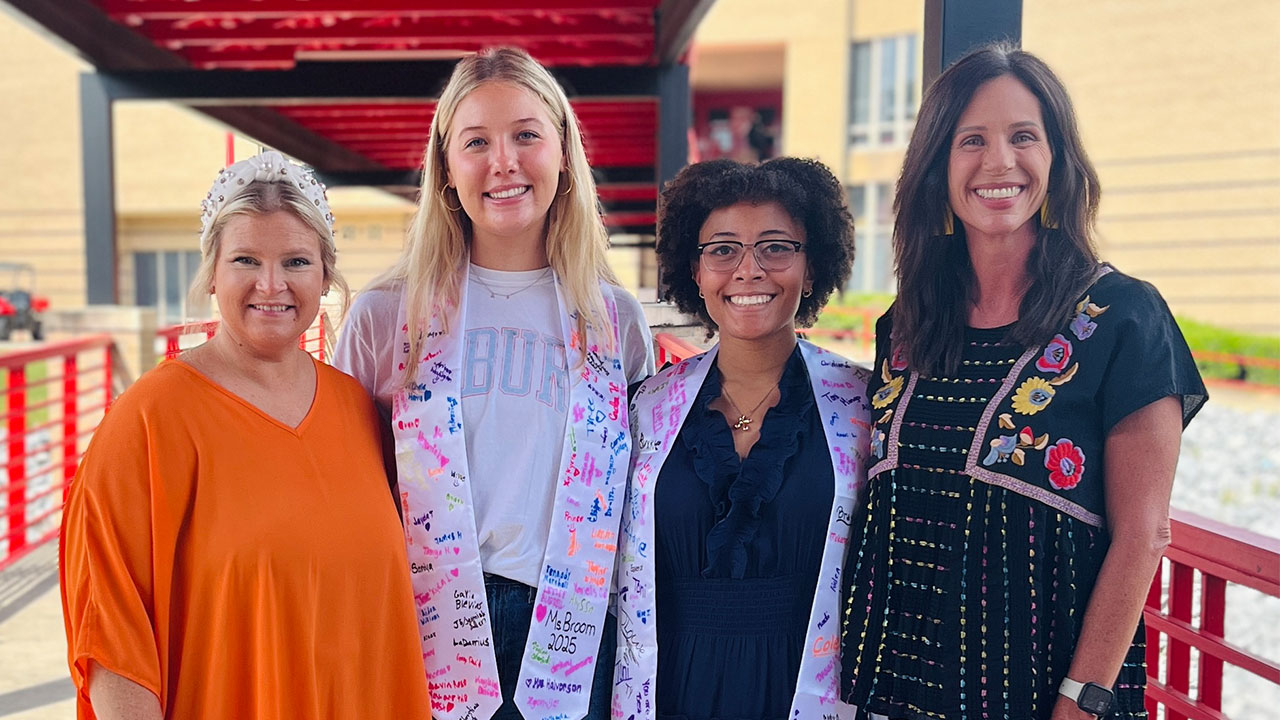
The first cohort of three will now graduate during Auburn’s May commencement from May 9-12. Schnittka said Broom will be certified to teach biology, while King—also double majoring in Interdisciplinary Health Sciences and Science Teaching—will be qualified to teach all science subjects. Belcher, a double major in Physics and Science Teaching, will be certified to teach physics and physical science. All three are completing their apprentice teaching semester at Central High School in Phenix City, Alabama.
“To prepare for the classroom, AUTeach students complete a diverse curriculum that includes coursework in science research and history, pedagogy, classroom management, educational technology, instructional design, and teaching students with special needs,” Schnittka said. “They complete four different school placements prior to the culminating semester of apprentice teaching with a mentor teacher.”
King said the experience was life-changing and allowed her to view teaching from a different lens.
“As a non-traditional science major, I never thought about pursuing education,” she said. “I always felt that education wasn’t for me because I never got the ‘call’ as many educators before me have described as their reason for choosing education. However, through AUTeach I was able to discover that teaching isn’t just a calling—it’s a call to action. Through AU Teach, I learned that a passion for science is only the beginning when it comes to teaching. You don’t have to be special or get a ‘call.’ And that true impact happens when we step beyond the lab and into the classroom, using our knowledge to inspire the next generation of thinkers, problem-solvers, and leaders.”
Belcher said the program helped him discover his passion for teaching as well.
“The faculty in AUTeach make the program worth having,” he said. “Their dedication to supplying the community with developed and well-prepared science teachers is that of no other instructors I’ve met at Auburn University. While the state of Alabama is desperate for great science teachers, the instructors and faculty of AUTeach consistently provide support for their students in both majors they are in. This program is perfect for students who are curious about the possibilities in science education, while still retaining their chosen field of science.”
Those interested in learning more about AUTeach can do so online through the program’s official website.
Courtesy of Auburn University
Samantha Sampson’s deep love for Hashbrown started in the wee hours of the night as she formula-fed the tiny orange kitten. She did her best to keep the baby and his brother, Tater Tot, nurtured.
But, despite her efforts, Tater Tot grew stronger while Hashbrown struggled.
RELATED: Alabama cat survives 14-month trip to Las Vegas
A visit to Sampson’s primary vet confirmed a serious heart issue for the small feline, and he recommended Dr. Randolph Winter at Auburn University’s College of Veterinary Medicine for continued care.
Winter would eventually perform the first surgery of its kind to treat Hashbrown’s heart disease.
A dedicated pet owner
Sampson and her husband take care of feral cats in their neighborhood, but by trying to do good, they embarked on an unexpected medical journey.
“Hashbrown’s mother was a feral cat. It took months to catch her, and when we did, we learned she was pregnant,” Sampson said. “Only two kittens from her litter survived: Hashbrown and Tater Tot.”
When the kittens were six weeks old, Sampson brought them to her veterinarian, Auburn alumnus Dr. Cody Bryan of Eastside Animal Hospital. He heard a heart murmur in Hashbrown, confirmed his lungs were filled with fluid and referred the kitten to see Winter, with whom Bryan worked during vet school.
Hashbrown’s diagnosis, supravalvular mitral stenosis, meant he had a ridge of tissue above the mitral valve that prevented blood from moving from the top of his heart to the bottom.
“I knew Hashbrown couldn’t keep up with his brother, but he could still be a spunky, playful kitten. I had to help him,” Sampson said.
Working as a team
When Winter started working with 4-month-old Hashbrown last fall, the kitten relied on medications to breathe comfortably and struggled to run and play like a normal kitten. Winter had treated similar conditions, but because supravalvular mitral stenosis was so rare, he’d never seen a patient quite like Hashbrown.
Winter normally performs minimally invasive surgeries alone, but, due to Hashbrown’s size, he needed another surgeon, Dr. Michael Tillson, to help him gain access to the heart to perform the cardiological procedure.
“We needed a team-based surgical cardiology approach,” Winter said. “Dr. Tillson and I had worked together before on many patients, but not on a cat as severe, small and young as Hashbrown.”
Confident in care
Sampson immediately appreciated Winter’s communication.
“Dr. Winter explained everything to me. He was confident in his abilities, so I had no doubts,” Sampson said. “Dr. Winter said, ‘I know I can do this, but it’s up to Hashbrown to fight during recovery.’”
Sampson knew Hashbrown would fight.
Winter felt confident because the cardiology and surgical teams considered logistics and identified steps for a successful procedure. He admitted that hybrid procedures are not common but confirmed proven teamwork exists between the two fields.
“This is part of what we do at Auburn,” he said. “The surgical team is great to partner with, and we collaborate in a way that works.”
A pioneering surgery
The surgery involved a hybrid balloon valvuloplasty, which meant Winter inflated a balloon across the obstructed area around Hashbrown’s heart, making a larger opening. Once the balloon was deflated and removed, blood could flow properly.
Rightfully anxious about the surgery, Sampson’s worry was eased by Winter’s bedside manner.
“Dr. Winter explained the surgery in layperson’s terms,” she said. “There were even whiteboards in the exam room on which he drew pictures, so we could fully understand what would transpire. The level of care the Auburn team provided was amazing, from the surgeons to the medical students to the scheduling desk.”
Making up for lost time
Following surgery, Hashbrown acted like the kitten Sampson knew he could be.
“As soon as Hashbrown had the surgery and recovered, it’s like he is making up for lost time,” Sampson said. “He is a fighter and has a will for life.”
Following his post-op appointment in March, Winter confirmed Hashbrown’s prognosis is strong.
“He is running and playing like a normal cat, climbing the walls and having energy,” he said.
The hole near Hashbrown’s heart remains open, and the doctors are hopeful it will stay open for the cat’s lifetime.
Sampson is optimistic, too, thanks to Auburn.
“The team at Auburn gave us hope, and, honestly, I do not think any other place could do what they have done,” she said.
Courtesy of Auburn University
Brilyn Hollyhand, youth advisory council chairman of the Republican National Committee (RNC), has announced that he will attend Auburn University this fall—a major decision for the Tuscaloosa native who has spent his teenage years at the center of conservative politics.
Hollyhand, 18, has served as chairman of the Republican National Committee’s Youth Advisory Council and is the author of the bestselling book One Generation Away. He is also the host of The Brilyn Hollyhand Show, where he’s interviewed political heavyweights from across the country.
But when it came time to choose a college, he made a decision rooted in his vision for the state he calls home.
“Being born and raised in Tuscaloosa, we’re trained that Auburn’s the bad guys,” Hollyhand said. “But when I started thinking about where I wanted to spend the next four years, I thought about broadening my horizons… trying somewhere else, at least for four years.”
During the 2024 election cycle, Hollyhand spoke at 10 college campuses across the country. Auburn stood out — not just for its academic offerings, but for the people.
“I fell in love with Auburn,” he said. “I spoke there twice last fall, and the second time I was there, it really, really sold me. I got to speak to both their Turning Point chapter and the [College Republicans] chapter. And something special is happening at Auburn, and I just want to be a part of it.”
One of the key moments came during a sit-down interview with Auburn men’s basketball coach Bruce Pearl, whom Hollyhand describes as a mentor and major influence. The two connected after Pearl emerged as a growing voice in political discourse.

“Coach Pearl told me I was an Auburn man. I laughed at the time—I’m from Tuscaloosa,” Hollyhand said. “But that conversation stayed with me. And he’s stayed in touch ever since.”
Though he’s spent his high school years embedded in politics and cheering for the Crimson Tide — “I haven’t missed an Alabama home game in three seasons” — Hollyhand said he was looking for something different in a college environment.
“What I saw on campuses when I was tailgating… that’s not the culture nor the community nor the family that I really want to be a part of here in Tuscaloosa,” he said. “When I went and visited Auburn… that is the vibe and the family and the community that I want to be a part of.”
Hollyhand plans to major in political science, a decision he said was solidified after spending time with Auburn faculty.
Though he’s aware his national profile may draw attention, Hollyhand said he’s focused on contributing to the community, not disrupting it.
“I want to be as involved as I can be in a helpful way—not in a harmful way,” he said. “I’m not slowing down at all with my career… But the Auburn Family that I’ve come to know and love in the past few months is a loving, compassionate group of people that—even the ones that disagree with me—are still saying ‘War Eagle’ and welcoming me to campus.”
With this next chapter on The Plains, Hollyhand said he hopes to continue serving Alabama—and shaping the future of conservative leadership from right here in his home state.
Grace Heim is a state and political reporter for Yellowhammer News. You can follow her on X @graceeheim or email her at grace@yellowhammernews.com.
The first time N.L. Hart drove through the gate at Crooked Oaks, past stands of Japanese maples, a tranquil pond, and a wide-open, big-sky horse pasture, her mind raced with ideas for the property’s future.
“I’d seen pictures, but getting into the building and looking around, I thought, ‘OK, this can be done. We can do this,’” Hart recalled. “It was just creativity running wild. When it comes to the possibilities for Crooked Oaks, we and our guests are only limited by our imagination.”
Hart joined Auburn University’s College of Forestry, Wildlife and Environment (CFWE) in September to manage the 415-acre site in ways that not only support hands-on learning experiences for students but also honor the legacy of the property’s former owner, the late Auburn football coach Pat Dye.
RELATED: Dye’s Crooked Farms donated to Auburn University
As head coach from 1981 until 1992, Dye led the Tigers to four Southeastern Conference (SEC) championships, won SEC Coach of the Year three times, and was named National Coach of the Year in 1983.
The Roots of Crooked Oaks
Dye began developing the property in Notasulga, Alabama, in 1998, and he lived there with his longtime partner and now-retired Auburn nursing educator Nancy McDonald.
Together, they offered the site as a venue for weddings, and they frequently hosted events that raised hundreds of thousands of dollars for Auburn scholarships.
Following Dye’s death in 2020, the property was gifted to the CFWE in 2023.
College leaders saw the gift as an occasion to provide expanded educational opportunities for students, especially those studying wildlife enterprise management, and a new development campaign is underway to support such opportunities.
What Crooked Oaks offers the community
Hart said that as more people in the community and at the university are imagining Crooked Oaks’ potential, demand for the site is increasing.
“Since November, our calendar has been filling up with private events, including Auburn Panhellenic formals,” she said.
About 25 miles south of Auburn’s main campus, Crooked Oaks can host events ranging from board meetings and staff retreats to alumni get-togethers and weddings with up to 400 guests.
Facilities include Dye’s main house, guest cabins, and a lodge with a full-service kitchen. In all, there are enough beds for up to 28 adults. There’s also a 10,000-square-foot lighted pavilion,a gazebo, and a formal ceremonial garden and lawn.
Nestled in a rolling, forested landscape, Crooked Oaks’ still, rustic environments make for relaxing, photo-worthy settings, Hart said.
For wedding proposals, Hart recommends a dock at Dye’s former lake house, as well as what she and her staff call “the secret spot” – a peaceful place along a creek with natural waterfalls. Another of her favorite places at Crooked Oaks is a clearing where deer run through.
There also are peaceful walking paths that lead visitors alongside the creek and through some of the hundreds of now-mature Japanese maples that Dye planted on the property.
Dye’s love of Japanese maples led him to create a nursery at Crooked Oaks, which the CFWE is using to propagate both maples and camellias. The maples include an array of cultivars with different light needs, growth habits, and coloration.
“We are rebuilding the grafting side of that business, and we have cultivars on the property that Coach had planted that we’ll be selling as well,” Hart said.
Branching out
As Hart looks to the future, she sees lots of other opportunities for the site to benefit the college, its university partners and those they serve.
While the college holds pistol and archery classes at the property, it also is exploring the possibility of working with the faculty of Auburn’s Parks and Recreation Management program to develop small-scale campsites, she said.
Meanwhile, Hart sees the potential for offering programs at Crooked Oaks that would allow members of the public to learn about land management. Such educational programs would not only further the college’s educational mission, Hart said, but they would also honor Dye’s legacy and his commitment to stewardship.
As Dye once wrote of Crooked Oaks, “The good Lord created it, and then I just put a few touches on it, so I can enjoy it and appreciate it. Because no one can paint a picture like Mother Nature.”
This story previously appeared on Auburn University’s website.
Artificial intelligence (AI) is rapidly transforming industries, businesses, and how we live our daily lives. From streamlining operations to improving services, AI’s potential to enhance local government functions is an exciting prospect for Opelika.
As mayor, I am eager to explore how we can responsibly and effectively integrate AI-driven solutions to improve efficiency, responsiveness, and accessibility for our residents.
Opelika is uniquely positioned to be at the forefront of AI adoption thanks to the cutting-edge research happening right here at Auburn University. The Artificial Intelligence at Auburn (AI@AU) initiative is leading groundbreaking work in AI applications across multiple fields, from cybersecurity to healthcare and smart infrastructure.
As a city, we have an incredible opportunity to collaborate with these experts to explore how AI can improve municipal operations, enhance public services, and drive economic growth.
Beyond our city, Auburn University is also playing a key role in a broader regional effort to advance AI innovation.
Auburn, along with other SEC universities, is a member of the SEC Artificial Intelligence & Data Science Consortium, which brings together institutions across the conference to collaborate on AI research and best practices – and using athletics as a platform for innovation, data-driven decision-making, and performance optimization.
This kind of partnership reflects the growing recognition that AI is not just a tool for the future, it is something we need to understand and integrate today.
Much like these universities are learning from one another, cities like Opelika can look to other communities that are successfully leveraging AI to improve services and governance.
As Opelika continues to grow, I look forward to learning from other cities—both in Alabama and across the country—that are leading the way in adoption of AI.
One of AI’s most useful applications in local government that I look forward to exploring is streamlining and improving basic city services. Streamlining trash pickup and permitting, traffic signals that adjust in real time to reduce congestion, and sensors that can detect road damage before potholes form – we owe it to Opelika residents to leave no stone unturned when it comes to these new advancements that improve city services.
And of course, let us not forget about the incredible workforce and economic development potential offered by responsible integration of AI. As industries innovate, and small businesses increasingly adopt this technology, we are all better off.
Throughout my years of service as mayor, I have seen how innovation and strategic planning can shape a city’s future. Opelika has always embraced forward-thinking solutions, whether in economic development, infrastructure, or public safety.
AI presents a new frontier of possibilities, and by embracing it responsibly, we can improve services, create efficiencies, and build a smarter, more connected city.
This is an exciting time for Opelika. As we continue this journey, I invite residents to share their thoughts and ideas on how AI could help shape Opelika’s future. Let us explore these possibilities together.
Gary Fuller has served as the Mayor of Opelika since 2004. He’s a businessman with an extensive record of public service and community involvement.
Backed by a recent $11.4 million Department of Defense (DOD) contract through the Missile Defense Agency (MDA), Auburn University’s Applied Research Institute (AUARI) in Huntsville’s Cummings Research Park is establishing a cutting-edge radiation hardening, or rad hardening, facility — the only university-led facility of its kind in the nation — to help ensure the reliability of military technology in the harsh radiation environments encountered in space.
That’s good news for Auburn. That’s good news for Huntsville. It’s great news for the future of American military operations in the final frontier.
“The capacity to test the microelectronics necessary for sustaining and improving MDA’s space assets is crucial to the future of national defense,” said Steve Taylor, senior vice president for research and economic development. “This new facility will provide testing that will allow us to evaluate the possible effects of extreme radiation exposure.”
The significant shortage of rad hardening infrastructure articulated in recent reports by government agencies like NASA, the National Academies of Sciences and the Office of Secretary of Defense is something that AUARI stands ready to tackle.
“Establishing a radiation hardening test facility just outside the gates of Redstone Arsenal will provide a regional testing capability to address this national shortage,” said Melanie Baker, AUARI principal research scientist. “Auburn University has a long history and continued commitment to supporting our DOD and NASA customers and we are extraordinarily proud to partner with MDA on this critical need.”
Baker was a part of the Auburn team that recently traveled to Boston to purchase a multi-million-dollar cyclotron necessary for simulating space radiation. Previously used for therapy in cancer treatment, the particle accelerator will be the centerpiece of the institute’s rad hardening arsenal.
“We’re at a critical juncture, but whether we’re talking expertise or resources, filling that gap — and quickly — is exactly why the Applied Research Institute was established,” Baker said.
Taylor agrees.
“It’s really exciting seeing all of the university’s assets coalescing to make it a success,” he said. “AUARI is leading the charge, but we’re also taking advantage of our already established focus areas with faculty within both the College of Sciences and Mathematics and the Samuel Ginn College of Engineering.”
Taylor said the project benefited from the efforts of Congressman Mike Rogers, who represents Alabama’s Third Congressional District and serves as chairman of the House Armed Services Committee.
“I’m proud to support Auburn’s role in a project so crucial to national security, and so pivotal for the future of the American space program,” Rogers said. “That this will be the only university in the nation doing this incredibly important work reinforces the state of Alabama’s reputation — and particularly Auburn University’s reputation — as a leader in aerospace and defense research.
“I think it’s safe to say that few schools are better positioned for this sort of project.”
The MDA certainly seems to think so.
“The Missile Defense Agency values our research partnership with Auburn University’s Applied Research Institute as they are bringing needed expertise to radiation hardened testing for key components for MDA,” said Scott Shifrin, the MDA’s acting director for innovation, science and technology. “This robust testing will ensure future capabilities are successful operating in a wide variety of environments.”
Courtesy of Auburn University.
Artificial intelligence (AI) is making its way into nearly every aspect of life, and college football is no exception.
Auburn University is leveraging this advanced technology to create a more engaging experience for fans and enhance performance on the field. WBRC 6 has reported that before the Auburn Tigers take the field at Jordan-Hare Stadium, fans are treated to an exciting hype video that features head coach Hugh Freeze and the players walking through a snowy landscape.
According to university officials, this winter wonderland is not real—it’s generated with AI-powered tools to produce visually stunning graphics.
“A lot of the visual effects you see, such as the snowy scenes, are created using AI tools to make the videos more immersive and entertaining,” explained Dr. Asim Ali, Executive Director of Auburn University’s Biggio Center for the Enhancement of Teaching and Learning.
Ali, who participated in a panel discussion about AI in sports during last year’s SEC Media Days, pointed out that AI is also being utilized for coaching and player development. Coaches use AI to analyze data and predict game scenarios, which helps players mentally prepare for different situations they might encounter on the field.
“They’re able to play out various scenarios and anticipate what might happen during a game,” said Ali. “It gives them an advantage in their preparation and decision-making.”
The NFL is also adopting AI. For instance, Prime Video uses AI along with NextGen Stats to help fans better understand the game by tracking player movements and predicting strategies like quarterback blitzes.
“This technology makes the game more engaging for fans and pushes teams to think creatively to outsmart these predictions,” Ali added.
Even professional athletes are turning to AI for an edge. Former LSU quarterback and current Washington Commanders player Jayden Daniels reportedly uses virtual reality and AI tools to simulate game situations and improve his performance.
As AI continues to evolve, it’s clear that both fans and athletes stand to benefit from its growing role in sports.