For Alabama’s economic future, the pivotal moment came on Sept. 30, 1993, when executives of Mercedes-Benz arrived in Tuscaloosa with an announcement that shocked the global business community.
In the months leading to that day, a Mercedes team had explored potential sites in at least 30 states as a home for the automaker’s first U.S. manufacturing facility. Company officials came to Alabama that day to announce their decision.
For many, the news was a lightning bolt out of the blue. After all, Alabama had never produced an automobile and barely had any presence in the industry.
But Mercedes found what it wanted in a rolling 900-acre site, lined with pine trees, just outside Tuscaloosa.
The initial investment in 1993 was $400 million, with plans for 1,500 workers. The project quickly became much more than that; in fact, it came to represent a dividing line for Alabama.
For many, it became “before Mercedes” and “after Mercedes.”
Flash forward to 2023. Mercedes has invested more than $7 billion in its Alabama operation through repeated expansions that have seen its workforce in Tuscaloosa County swell to more than 6,300 people. More than 4 million vehicles have rolled down its assembly lines.
Critically, Mercedes’ arrival in Alabama opened the door for other automakers, which were also attracted by the state’s low-cost environment, first-class worker training programs, a large available workforce and its status as a right-to-work state, among other factors.
Today, Honda, Hyundai and the Mazda-Toyota partnership have joined Mercedes to operate large-scale assembly plants in Alabama, with Toyota also operating an engine plant. That concentration has solidified the state’s reputation as an auto industry powerhouse.
“The auto industry has been the primary driver of economic growth across Alabama for over two decades, providing high-paying careers for our citizens and first-class workplaces for our communities,” Gov. Kay Ivey said. “The industry’s impact on Alabama has been massive, but what really excites me is how its future is going to be even brighter in our state.”

Led by Mercedes-Benz, Alabama’s five automakers have combined to invest around $15 billion in their assembly operations in the state. (Mercedes)
Growth engine
The industry’s ascent has been rapid.
Automakers have assembled more than 15 million vehicles in Alabama since the first Mercedes M-Class rolled down the line in February 1997. Combined production capacity at the state’s auto plants now tops 1.3 million vehicles annually, earning the state a Top 5 ranking in the U.S.
Direct employment in Alabama’s automotive manufacturing sector has surpassed 50,000, surging from just a few thousand back in 1997.
Motor vehicles rank as Alabama’s No. 1 export category. Exports of Alabama-made automobiles totaled $11.2 billion in 2023, earning Alabama the No. 1 ranking among the states for vehicle exports.
Alabama’s five automakers have combined to invest around $15 billion in their assembly operations in the state, according to data from the Alabama Department of Commerce.
With capital investment of that magnitude, it’s obvious that Alabama’s auto industry functions as a dynamic growth engine for the state’s economy. Meanwhile, investment by the auto industry continues to grow across Alabama — and much of that is related to EV production.
Auto industry manufacturers with factories in the state have invested approximately $2.1 billion in EV-production infrastructure since 2020, according to the Department of Commerce, resulting in the creation of close to 2,500 new jobs.

Alabama Robotics Technology Park in Decatur will be the site of a $30 million workforce training center focused on electric vehicle technology. (AIDT)
Preparing the workforce
Alabama’s commitment to workforce development has been a factor in the auto industry’s growth in the state — and that commitment is unwavering.
In November 2023, AIDT, Alabama’s primary workforce development agency, announced plans to build a $30 million workforce training center in Decatur that will focus on electric vehicles and emerging technologies to fully position the state’s auto industry for the next chapter of its growth.
The facility will be on the campus of the Alabama Robotics Technology Park, a unique $73 million center operated by AIDT that helps companies train workers on advanced R&D and manufacturing technologies.
“Our main goal is to help the state’s automakers continue to grow during the transition to electric powertrains and assist them as they embrace new technologies that are evolving all the time,” AIDT Director Ed Castile said. “We just want to make sure we have a workforce that has the ability to thrive in this new environment, so it’s a natural extension of what we do at the Robotics Park.”
AIDT has been involved in the growth of Alabama’s auto industry since the early days, when it assisted Mercedes in assembling and training its original workforce. Over three decades, AIDT has completed automotive training for more than 125,000 people.
“We are full partners with all of our auto OEMs and almost all their suppliers in the workforce space, having recruited, assessed and trained workers for many years and through all their expansions,” Castile said. “Our auto companies continue to invest in their Alabama operations. We’re a real player in the industry now, and we’re just going to keep becoming a bigger player in this influential global business.”

Hyundai’s Alabama plant celebrated the production launch of the first Genesis Electrified GV70 SUV at a ceremony in Montgomery last year. (Hyundai Motor Manufacturing Alabama)
The EV evolution
In Alabama, the industry is making major moves to capitalize on the evolution toward EVs.
It’s starting with Mercedes, which is steering Alabama into the future again thanks to a $1 billion investment to launch EV production. The project upgraded a plant that the company already described as one of the world’s “smartest” manufacturing facilities.
In August 2022, just months after opening a sprawling battery assembly plant in Alabama, the German automaker celebrated the production launch of its luxury EQS sport utility vehicle at its Tuscaloosa County factory. Another EV, the EQE sport utility, is also being built there.
In another milestone, Hyundai’s Alabama assembly plant is now producing its first EVs — the electrified Genesis GV70 and a plug-in hybrid electric Santa Fe SUV. To get ready for that production launch, Hyundai pumped a $300 million investment into its Montgomery plant.
To advance future EV production plans, supplier Hyundai Mobis is embarking on a project to open a $205 million EV battery module plant in Montgomery that will employ as many as 400 people.
The increasing activity in the EV supply chain transmits the signal that Alabama’s auto sector is fully concentrating on tomorrow, according to Ellen McNair, secretary of the Alabama Department of Commerce.
“Alabama’s auto industry has long been a dynamic growth engine for the state’s economy, and I’m confident that it will be ready for its next chapter as the EV evolution continues to reshape automakers’ strategies,” McNair said.
“Our auto manufacturing sector boasts some serious horsepower, and it’s just getting started in this new age for the industry,” she said.
This story originally appeared on the Alabama Department of Commerce’s Made in Alabama website.
AIDT, Alabama’s primary workforce development agency, is accelerating its efforts to expand employment in the state’s auto industry by reviving a multistate campaign to attract a new generation of workers for the fast-growing sector.
AIDT is relaunching its Shift campaign, which debuted in March 2022, to help fill more than 11,000 career opportunities now available at automakers’ Alabama facilities and the extensive network of suppliers stretching across the state.
“The Shift campaign’s No. 1 goal is to get people interested in automotive jobs, even those people who already have jobs,” said Ed Castile, AIDT’s long-serving director. “We think when they see the possibilities, it will grab their interest enough for them to consider a career in the auto industry.
“Alabama is home to five of the top automotive companies in the world and their suppliers, so there are plenty of good jobs available,” he said.
Working in concert with key industry players, Castile said the Shift campaign seeks to help fill all types of positions, from management to production, that can become rewarding career pathways.

‘Ground floor’
The campaign’s centerpiece — a website called shiftinalabama.com that allows job seekers to apply for open positions throughout the industry — rolled out last year alongside a five-month digital campaign that reached more than 1 million people and generated thousands of applications.
Castile said the second Shift campaign aims to reach potential workers both in Alabama and in other states, including Georgia, Mississippi and Tennessee. It will specifically target people who are underemployed or who recently entered the workforce.
The auto industry jobs now available in Alabama offer above-average pay along with robust benefits packages that can include health insurance, an annual bonus, a matching retirement plan, paid holidays and tuition reimbursement.
In general, no college education is necessary, though manufacturing or industrial experience may be required for some positions.
“This is a chance to get in on the ground floor as a new wave of technologies such as electric powertrains and artificial intelligence are reshaping the auto industry,” Castile said.
“Technology is radically changing the cars we drive, as well as the factories where they are built — it’s phenomenal what is happening in these places,” he said.
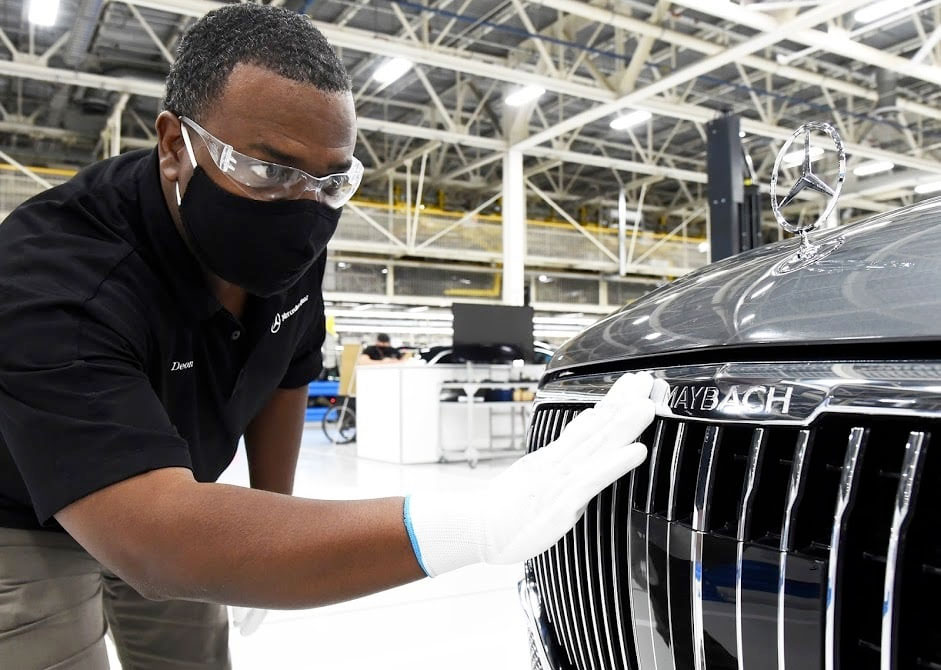
Alabama’s auto manufacturing industry has become a key driver for the state’s economy, with 47,000 direct jobs as of May 2023, according to the Alabama Department of Labor. About 21,300 of those jobs are in auto assembly plants, an increase of 2,200 in one year.
The automakers operating in Alabama generate compensation topping $5 billion each year while contributing $12.6 billion in economic activity and $2 billion in taxes, according to Autos Drive America, an industry organization representing foreign automakers in the U.S.
And there’s room for growth. Alabama’s automakers produced nearly 1 million vehicles in 2022 — a figure that’s expected to rise to as many as 1.3 million vehicles annually, reflecting the production capacity of the state’s assembly plants.
“Alabama’s automakers are forging ahead with ambitious growth strategies, with innovations that signal promising futures for their products, employees and the communities they call home,” said Greg Canfield, secretary of the Alabama Department of Commerce. “These companies have a proven track record of success — of adapting, reimagining and transforming what they offer to customers — and Alabama workers are helping to fulfill that mission in markets around the world.”
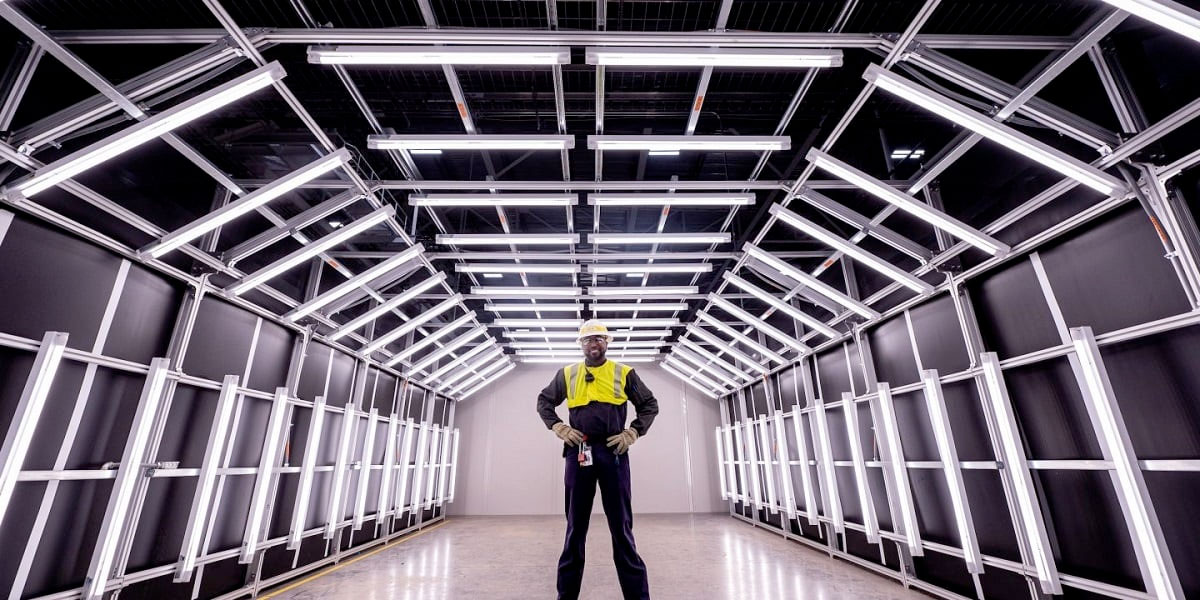
Growing industry
Mercedes-Benz, Honda, Hyundai, Toyota and Mazda have invested $15 billion in their Alabama assembly operations. In addition, more than 150 suppliers have set up shop in the state, according to Alabama Department of Commerce data.
Castile said Alabama’s automakers (OEMs) are considered top employers in the state, with a strong focus on training, job satisfaction, upward mobility and environmental stewardship.
Over three decades, AIDT has built a solid partnership with the industry, completing automotive training for more than 125,000 people.
“We are full partners with all of our auto OEMs and almost all their suppliers in the workforce space, having recruited, assessed and trained workers for many years and through all their expansions,” said Castile, who also serves as deputy secretary of the Alabama Department of Commerce.
“Our auto companies continue to invest in their Alabama operations. We’re a real player in the industry now, and we’re just going to keep becoming a bigger player in this influential global business,” he said.
The Shift campaign was developed by Big Communications, a Birmingham advertising and marketing firm that also created the “Made in Alabama” brand for the Alabama Department of Commerce more than a decade ago.
This story originally appeared on the Alabama Department of Commerce’s Made in Alabama website.
Alabama is recognized as a great place to start, grow, and nurture a business, to get an education, to build a career, to put down roots, and to thrive.
As many global brands, homegrown startups and Fortune 500 companies have discovered, Alabama is a Sweet Home for families and businesses alike.
Alabama has been recognized as a “Top State for Business” by Area Development. The state is listed among the top 10 in 10 categories: business cost, business incentive programs, cooperative and responsive state government, favorable regulatory environment, speed of permitting, prepared site program, favorable utility rates, competitive labor environment, leading workforce development programs, and most improved economic development policies.
We have a diverse industrial base, a low tax burden, and a robust logistics infrastructure, including a major seaport on the Gulf of Mexico. Alabama Industrial Development Training, hailed as one of the nation’s most effective state-sponsored workforce training programs, has provided state-of-the-art industrial training to the thousands of workers in Alabama’s diverse industries.
Businesses are interested in everything Alabama has to offer, but our recent economic development success has created a challenge regarding the availability of suitable industrial and business parks and sites.
Having well-documented, easily developable sites is one of the most important pieces of infrastructure Alabama can provide to compete for future economic development projects and the related growth.
Competition across the Southeast is intense. There are approximately 9,500 economic development organizations in the United States, and all of them are diligently working to prepare their community for economic development by working to build an adequate labor force, shovel-ready sites, and fiscally responsible incentives.
Every state contiguous to Alabama has either recently enacted or renewed funding for site development initiatives including Georgia, Florida, Mississippi, and Tennessee. In the last six months, Kentucky announced a $100 million program for development of industrial sites, and Virginia recently announced a $90 million site development initiative.
North Carolina appropriated $1 million to evaluate up to five megasites best positioned to serve major advanced manufacturing projects. These megasites would receive increased development and marketing support from the State and the Economic Development Partnership of North Carolina.
The state of Tennessee invested approximately $170 million to develop the megasite that Ford ultimately selected as the location for their newest truck plant.
Having more industrial and business sites is critical if Alabama expects to remain competitive for more higher paying jobs for our citizens, in particular spurring new investment and growth in Alabama’s rural areas.
As part of the Alabama Renewal Act, the Growing Alabama Credit is an incentive to provide a source of funds for site preparation and public infrastructure improvements of existing industrial sites. At least 25% of the credit is reserved for targeted, rural counties which will improve our entire state’s economy.
Alabama’s legislative leaders’ foresight when creating the Growing Alabama Credit has rewarded Alabama communities and citizens with thousands of new jobs; and renewing the Tax Credit, along with other initiatives designed to support the development of quality industrial and business sites and parks will do the same.
Greg Barker is the President of the Economic Development Partnership of Alabama.
For the second consecutive year, the Regional Workforce Development Rankings have placed Alabama the No. 1 state in the South Central region for overall employment climate.
The rankings are conducted by Site Selection magazine, an international business publication reporting on economic development within the U.S. The analysis recognizes states that performed well in a set of measures that gauge workforce-related aspects of states’ overall employment climate.
In a statement to Yellowhammer News, Alabama Department of Commerce Secretary Greg Canfield said the Alabama Industrial Development Training (AIDT) department plays a major role in the rankings.
“One of Alabama’s key advantages in economic development is our workforce training programs, which provides a foundation for the support system we have in place to help companies in many different industries find and develop the skilled workers they need to achieve success,” he said. “AIDT is at the core of our workforce development efforts, and its contribution to the state’s economic growth over the decades has been immense.
“Fortunately for us, AIDT’s culture of innovation will carry that impact forward far into the future.”
The criteria Site Selection uses to rank the states includes:
- CNBC’s America’s Top States for Business, 2022 Workforce sub-ranking;
- U.S. News’ 2021 Best States for Education ranking;
- ACT National Career Readiness Certificates for 2021;
- Workforce Preparation and Development component of the Council for Community and Economic Research’s State Economic Development Program Expenditures Database; and
- Meeting or exceeding the requirements of the Workforce Innovation and Opportunity Act of 2014.
Austen Shipley is a staff writer for Yellowhammer News.
MONTGOMERY, Alabama — The Alabama Department of Commerce, along with AIDT, conducted a book drive as part of National Reading Month, collecting about 200 books for donation to help advance a reading initiative organized by Montgomery Public Schools.
The gift benefited the Montgomery school system’s Home Instruction for Parents of Preschool Youngsters (HIPPY) program, which puts books into the homes of parents of preschool and young students and helps them prepare their kids for reading in the classroom. The books were presented to HIPPY this week.
“As a former teacher, I know there is nothing more paramount in our state than our children’s education. I have made early childhood literacy a major focus of my education initiative to ensure our youngest learners are given a strong start to their educational journeys,” Governor Kay Ivey said.
“I commend the Alabama Department of Commerce and AIDT for partnering together to promote one of our administration’s main priorities by hosting this book drive. I know the Montgomery Public Schools’ Home Instruction for Parents of Preschool Youngsters program will greatly benefit from these efforts, ultimately passing a love of reading on to our youth,” she added.
Commerce organized the book drive after Governor Ivey encouraged her Cabinet to support National Reading Month in March.
“Literacy is a top priority for Governor Ivey, and we at Commerce and AIDT wanted to embrace this worthy cause by putting books in the hands of eager young learners and encouraging an appreciation for reading,” said Greg Canfield, Secretary of the Alabama Department of Commerce.
“Education is the primary driver to move Alabama forward, and it all starts with our young students reading books.”
(Courtesy of Made in Alabama)
MONTGOMERY, Alabama – AIDT, Alabama’s primary workforce development agency, marked 50 years as a central player in the state’s economic growth through its mission of connecting and training Alabama workers with companies across the state.
The milestone was marked with a ceremony at Riverwalk Stadium in Montgomery, attended by Governor Kay Ivey and representatives of companies assisted by AIDT.
“Fifty years is an incredible milestone,” said Ed Castile, director of AIDT and deputy secretary of the Alabama Department of Commerce. “A group of people had a vison to modernize the workforce development model.
“Fifty years later and we must be doing something right,” he added. (more…)
AIDT, Alabama’s official state workforce development agency, on Thursday morning announced the selection of its virtual reality training program as the 2021 Workforce Program of the Year award by the National Association of Workforce Development Professionals, the association that represents more than 3,000 state and local workforce leaders in all 50 states.
The prestigious distinction recognizes innovative workforce programs that are creating new ways of delivering high-quality workforce training services. The selection specifically recognized AIDT for working to make job training in one of Alabama’s fastest-growing industries accessible to thousands of unemployed workers and aspiring manufacturing professionals across the Yellowhammer State.
“During this period of change and uncertainty in the labor market and broader economy, it’s essential that we use every tool at our disposal to rethink workforce development and training, and our investments in immersive learning technology are reflective of that belief,” stated Ed Castile, deputy secretary of the Alabama Department of Commerce and executive director of AIDT. (more…)
MONTGOMERY, Alabama — AIDT, Alabama’s primary workforce development agency, is teaming with Hyundai Power Transformers USA and a firm specializing in virtual reality technologies on a revolutionary jobs training program.
The collaboration with immersive learning startup TRANSFR stands to make cutting-edge job training accessible to thousands of unemployed workers and aspiring manufacturing professionals across the state.
“By putting this powerful solution in the hands of employers like HPT, we’re helping them to make good on their commitment to hire Alabama residents for good-paying manufacturing jobs,” said Ed Castile, deputy secretary of the Alabama Department of Commerce and executive director of AIDT. (more…)
HUNTSVILLE, Alabama – Mazda Toyota Manufacturing, the joint-venture automotive plant between Mazda Motor Corp. and Toyota Motor Corp., plans to resume the hiring of production positions at its Huntsville assembly facility on Monday.
The company will make its public announcement during a Facebook event on at 3:30pm Thursday.
“When you join the Mazda Toyota Manufacturing team you become a part of something bigger. Our production team member positions are career opportunities on a world-class team of highly-skilled, high-trained coworkers supported by leadership committed to the individual success of each employee on our team,” said Janette Hostettler, vice president of production at MTM.
“We looked forward to launching this next phase of hiring and encourage all interested in joining our team to tune into the Facebook Live event to learn more,” she said. (more…)
Business Facilities magazine has ranked Birmingham and Huntsville as two of the most business-friendly cities in the United States.
Birmingham was ranked as the number one most business-friendly mid-sized city, and Huntsville took the number one ranking for small cities.
The same magazine ranked Alabama as the fourth-most business-friendly state in the nation, behind Texas, Virginia and Tennessee.
(more…)
MONTGOMERY, Alabama – AIDT announced today that Jacqueline Allen has been promoted to assistant director of communications and external affairs at Alabama’s premier workforce development agency.Allen has over 30 years of experience in communications and marketing, with nearly 20 years of that experience at AIDT. Her new responsibilities include overseeing the Communications, Marketing & Research, and Training Development departments, as well as the agency’s newest department dedicated to recruiting candidates for AIDT training opportunities. (more…)
Alabama’s workforce programs have undergone several changes in the past couple years and to say that this has caused some confusion would be a huge understatement!
I liken it to the 1956 Federal-Aid Highway Act which created the beginnings of the Interstate system that focused on building a system of connected roads that would funnel traffic from smaller roads into safer, more efficient “Super Highways.”
When we look at workforce development in Alabama over the last 50 years, we’ve been a mishmash of programs or smaller roads all leading to the same goal, but having to travel those roads on a wildly divergent path.
In a few words, I’d like to clear up the confusion and untie the knot related to the programs housed within the Alabama Department of Commerce.
(more…)
Airbus said it is working with AIDT to seek candidates to fill the first manufacturing positions at a new assembly line for A220 aircraft at the company’s production facility in Mobile. In addition, Airbus said it is hiring for production positions at its existing A320 Family aircraft manufacturing line on its Alabama campus.
Altogether, Airbus plans to add 600 new employees in Mobile over the next 18 months.
(more…)
Alabama Commerce Secretary Greg Canfield and Huntsville area officials engaged in meetings this week with executives of Mazda and Toyota to expand relationships as the automakers prepare to officially launch construction on a $1.6 billion Alabama assembly plant.
The mission began Monday, when the Alabama group traveled to Toyota’s Motomachi assembly plant and held talks with members of the Toyota USA executive team. Today, the group was in Mazda’s hometown of Hiroshima to learn more about Alabama’s newest automotive manufacturer.
(more…)
The Alabama Department of Commerce and AIDT announced that Chuck Ernst, a former Honda manufacturing executive, has been appointed to lead Alabama Robotics Technology Park (RTP) as it embarks on a strategic plan to prepare the training facility for new technologies and additional capabilities.
The goal of the “RTP 2.0” initiative is to ensure that the $73 million center in Tanner is positioned to meet the evolving workforce development needs of Alabama companies as technology brings radical changes to manufacturing techniques.
(more…)
Governor Kay Ivey on Friday released a statement highlighting Alabama’s ranking atop “Global Trade” magazine’s list of the best nine states for manufacturing in the nation.
“Alabama has a strong heritage in manufacturing, which remains a key pillar in the state’s growing economy,” Ivey said. “Alabama workers have shown the world that they have the expertise to manufacture high-quality products that set industry standards, and this ranking is more confirmation of that fact.”
There are over 270, 000 manufacturing workers in the state, representing over 13 percent of Alabama’s workforce. That’s the fifth highest concentration in the country, according to data from the National Association of Manufacturers. (more…)
Alabama’s two main economic development leaders urged state economic developers to continue to evolve and advance to help keep the momentum Alabama has enjoyed in landing and expanding industry. Alabama Gov. Kay Ivey and Alabama Commerce Secretary Greg Canfield addressed the 2018 Summer Conference of the Economic Development Association of Alabama Monday. Both had much to brag about.
Alabama’s economy has roared back since the Great Recession a few years ago to post the lowest unemployment in state history and some of the biggest names in business now — or soon will — have significant operations in the state.
(more…)
Governor Kay Ivey said that meetings with high-level executives from Mazda, Toyota and Honda in Japan helped to fortify the state’s relationships with the global automakers and will facilitate their growth plans in Alabama.
Governor Ivey, Commerce Secretary Greg Canfield and a team of Alabama economic development specialists returned home Thursday after talks with the automakers and an appointment with Bill Hagerty, the U.S. Ambassador to Japan. The group traveled to Tokyo on Tuesday.
“Creating jobs is a team effort built upon solid relationships with business and industry leaders. When Mazda Toyota Manufacturing announced they were coming to Alabama, they chose to make this announcement in Montgomery, a sign of their support for the current direction of our state and a clear indication of the quality of our relationship,” Governor Ivey said.
(more…)
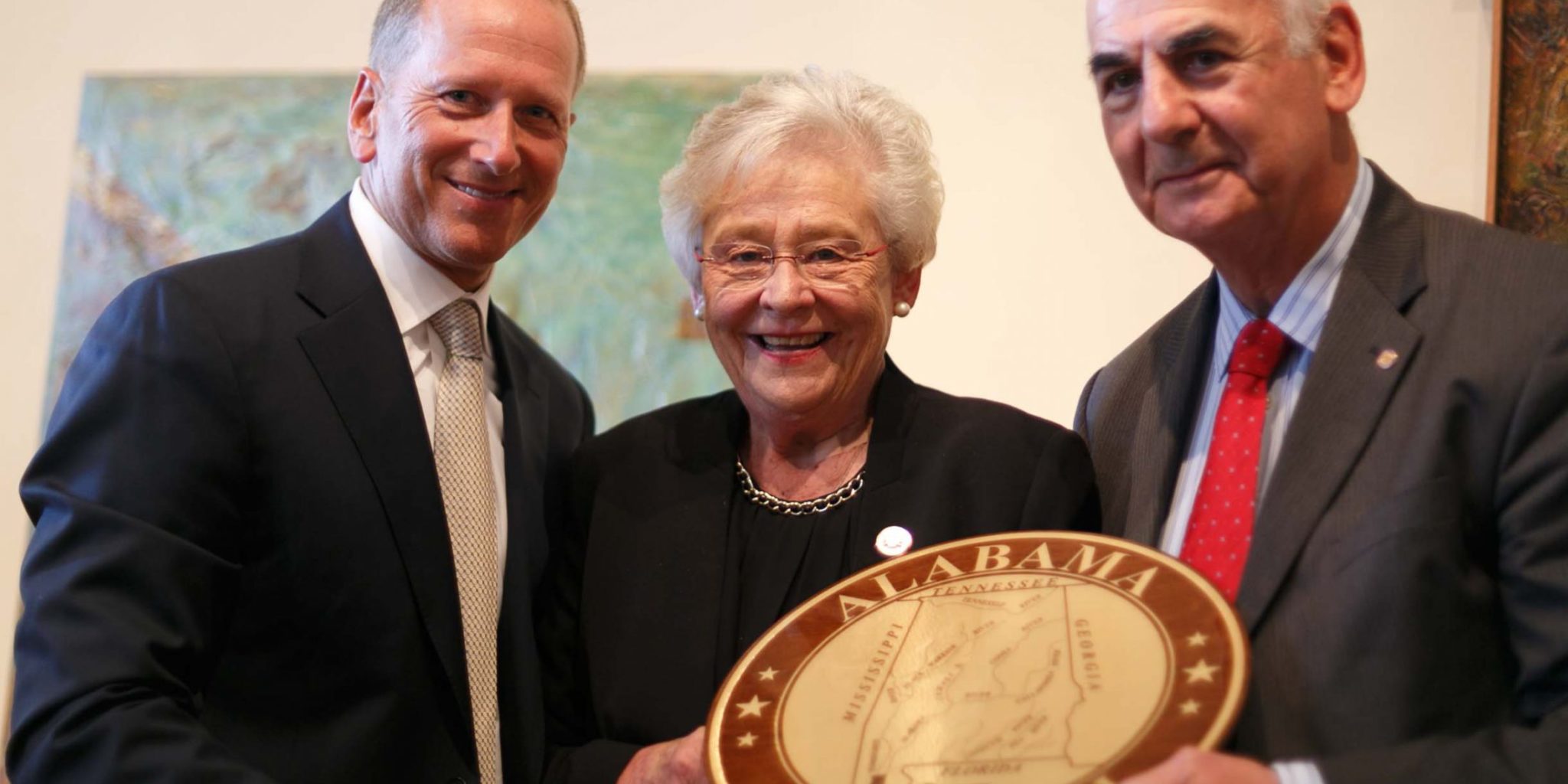
Area Development, a national publication focused on economic development, has once again ranked Alabama as one of the top states for doing business. The Yellowhammer State ranks sixth overall in the magazine’s 2017 “Top States for Doing Business” analysis. It is the second year in a row the state has been ranked No. 6 and the eighth year it has been included in the top ten.
According to Made in Alabama, the honor highlights a years-long emphasis on economic development throughout the state. Alabama scored in the Top 10 in nine different categories, including improved economic development policies, workforce development programs, and shovel-ready sites initiative.
“These high rankings indicate that Alabama offers the advantages that companies are searching for when they are making decisions about opening new facilities or expanding existing operations,” said Greg Canfield, secretary of the Alabama Department of Commerce. He continued, “Alabama has the skilled workers, effective training programs, and the low-cost business environment that companies from around the world need to compete and succeed.”
Economic development activity brought $28.5 million in new capital investment and 107,000 new jobs to the state from 2011 to 2016. Last year alone, Alabama saw an increase totaling $4.2 billion in capital investment and 14,700 anticipated new jobs.
Area Development’s top six states did not change from last year’s rankings. All six states are located in the south, with Georgia taking the top spot. Alabama trounced Indiana, North Carolina, Mississippi, and Ohio, which rounded out the top ten. Area Development praised each of the top states for their commitment to economic development.
“They commit to adding value as an economic development leader and problem-solver, even during lean economic times. Any manufacturer will tell you that a big indicator of quality — and sound management — is consistent, repeatable results. This is also true for state government.”
Here’s how Alabama stacked up in the various rankings:
- Leading workforce development programs: No. 3
- Most improved economic development policies: No. 3
- Shovel-Ready Sites program: No. 3
- Speed of Permitting: No. 5
- Favorable Regulatory Environment: No. 6
- Favorable utility rates: No. 7
- Cooperative and responsive state government: No. 7
- Overall Cost of doing business: No. 7
- Competitive Labor environment: No. 8
- Business incentive program: No. 10
The magazine acknowledged two specific Alabama programs that have led to its great economic success. The state’s AdvantageSite Program has brought in more than 20 projects and $1 billion in investment since its inception in 2008. AIDT, Alabama’s primary workforce development agency, has also been a leading contributor to economic development. Earlier this year, Alabama was also awarded with a Silver Shovel Award from Area Development, highlighting the state’s economic success in 2016.

COTTONDALE, Ala. — Alabama’s growing automotive industry will get a little bigger this year, with a new company bringing 650 more jobs to the state.
SMP (Samvardhana Motherson Peguform Automotive Systems Alabama Inc.), an India-based automotive parts supplier, is getting ready to break ground on a new 100-acre site in the Cedar Cove Technology Park in Cottondale, right outside Tuscaloosa. The 700,000-square-foot factory, which will cost $154 million, was originally announced in August last year, but now the groundwork is finally getting started.
SMP is also starting to hire the first team of employees for the new facility. The first round of employees will include of industrial engineers, robotics technicians, administration, and managers in logistics, supplier quality, maintenance, and other areas of plant production.
These employees will have the opportunity to receive special training in other SMP facilities in Mexico and Germany.
“Due to the fact that this plant will be newly established, it will be a great opportunity for employees to be part of it from the beginning and help shape the business,” said a statement from Kenneth Suda, the Tuscaloosa plant’s general manager.
The first round of employees will primarily be salaried, and the hourly workers will be hired later, with the help of AIDT.
The facility will primarily make bumpers, interior and exterior door panels, and other parts for Mercedes-Benz.
SMP is one of the 50 largest automotive suppliers in the world and has factories on four continents. It is the largest auto supplier to come to Alabama since Mercedes-Benz came to Tuscaloosa nearly 20 years ago.
Since then, Alabama has become a national leader in the automotive industry. Last year, the state’s three global automakers – Mercedes-Benz, Honda, and Hyundai – produced over 1 million vehicles. Alabama is now the fifth largest auto producing state, and employment in the sector is approaching 40,000. Vehicles and parts have become the state’s top export category, reaching $6.6 billion in 2014. New auto-related investment in the sector during the past four years tops $5.5 billion.
SMP’s decision to join Alabama’s dominant auto industry was made easy by the staggering numbers the state has already produced and the lure of a willing and skilled workforce.
“The Alabama economic development team has targeted growth in the state’s auto supply chain because it serves to strengthen the industry’s foundation here,” said Greg Canfield, secretary of the Alabama Department of Commerce. “Developing partnerships with global suppliers like SMP reflects this strategy and sets the stage for additional job-creation and growth in Alabama’s advanced manufacturing sector.”
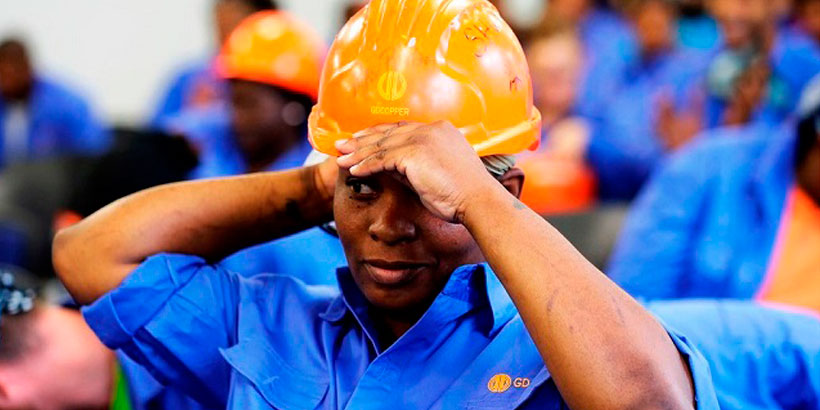
DON’T MISS: These issues and more will be discussed at Yellowhammer’s upcoming Alabama Economic Growth Summit
In order to keep pace with demand, employers across the eight counties spanning southwest Alabama estimate a need for 4,851 skilled workers during the next 12 months.
That figure, reported in the Southwest Alabama Workforce Development Council’s (SAWDC) 2015 Year End Industry Survey, reflects a roughly 8 percent increase compared with projections for the year just ended.
SAWDC Executive Director Laura Chandler said the annual survey allows the council to “ensure that strategic objectives are aligned with industry needs.” She cautioned anyone crunching the numbers provided to remember, however, that participation in the survey varies from year to year, meaning the figures reported do not reflect accurate “apples-to-apples comparisons.”
“Many of the questions are subjective in nature and, as an example, more rural employers participated in 2014, while many of our larger employers participated in 2015. That said, we wouldn’t consider any year-over-year changes to be statistically significant, but they do provide us with actionable measurements,” Chandler said.
Twenty-two employers representing nearly 34,000 employees took part in the most recent survey, and their responses indicate continued concern regarding the immediate availability of skilled workers for entry-level positions.
“Although employers indicated a slight improvement in the quality, stability and availability of the workforce, the percentage of qualified candidates for entry level positions remained low at 20 percent, or approximately one in five applicants,” Chandler said.
Meanwhile, more than 80 percent of respondents confirmed experiencing recruitment problems with one-quarter noting unfilled positions were increasing, compared with one-third in 2014.
Chandler said although respondents experiencing recruitment issues appear evenly split between community and industry as the source of the problem, nearly 60 percent of those surveyed reported increasing investments in training to address the shortfalls.
“I think these are great measures for us to say are we moving the needle,” she said.
Nine of the 22 responding companies represent the general manufacturing sector, followed by four aviation companies, three maritime companies, two healthcare employers and one construction firm. The remaining three respondents categorized themselves as “other.”
Despite the increasing skilled labor demand across the eight-county region, Chandler said she is confident the council’s methods are achieving the desired results.
“We have a wonderful, rare situation where we have a lot of demand. To say it isn’t a challenge would be misrepresentative. It is a challenge, but there have been a lot of great things – particularly at the state level – that have allowed us to reap some major benefits locally and that ultimately allow us to be more effective in how we serve our customer,” she said.
RELATED: How Alabama is matching workforce needs with state education
Chandler pointed to the recent establishment of a separate board of trustees for Alabama’s community college system and efforts at that level to get rid of duplication while working to accentuate each institution’s strengths.
“The community colleges in our region are already at the table with industry. That’s what we facilitate, and we have all the ingredients to be successful,” she said.
SAWDC represents Mobile, Baldwin, Washington, Choctaw, Clarke, Monroe, Conecuh and Escambia counties, which comprise Region 9 of the state’s 10 regional workforce development councils, established to stimulate economic and job development at the local level.
In addition to facilitating industry-specific training by collaborating with the region’s community colleges and employers to identify and address skills gaps, the council works in partnership with such organizations as the AIDT program and the Central Gulf Industrial Alliance to organize key stakeholders and maintain persistent attention to the needs of both employers and workers.
“I think we’re leveraging just about every resource we possibly can. I don’t think there’s any rock unturned,” Chandler said.
Above all, she said the survey results provide a solid framework to inform and guide the council’s efforts for the next 12 months, but listening to the ever-evolving needs of employers is what ultimately gets results.
“What we know from talking with our employers is that there’s a lot of investment in remedial skills required, and that’s nothing new, just like the maritime and industrial construction sectors are always going to have entry-level positions to fill. But what we’re hearing more and more is the discussion shift toward upskilling the current workforce. There’s a lot of talk of incumbent worker investment, and I am comfortable saying that we are absolutely moving in the right direction to be able to help those employers address those needs,” Chandler said.
“This isn’t a foot race, though. It’s a marathon. Are we there yet? Absolutely not, but we have the right people at the table, and that’s a formula for success,” she said.
It’s taken four decades, but Birmingham now has its own permanent Alabama Workforce Training Center (AWTC) and it’s unlike any in the state.
AIDT held an open house earlier this month, declaring the 56,000-square-foot former warehouse at 3500 Sixth Ave. S. open, although it is already training workers for construction, manufacturing and other industries.
Ed Castile, director of AIDT, the state’s leading workforce training agency, said although it has been a long time coming, the Birmingham AWTC is a welcome addition to the 11 other AIDT training sites around the state.
“This is our first time in our 40-plus years at AIDT to have a facility in Birmingham,” Castile said. “We’ve rented space for years off and on, but this is now a fixed-base facility. There is just such a need.”
Castile said the AWTC was put together with partners in the construction and manufacturing industries along with Jefferson State and Lawson State community colleges, the Alabama Technology Network, the Alabama State Education Department and area high schools. It houses representatives of those agencies and an office for Region IV of the state’s Regional Workforce Development Council.
The Birmingham Business Alliance is also a partner in the project.
“The AWTC is one of the greatest assets the state of Alabama can offer the Birmingham business community,” said Brian Hilson, CEO of the BBA. “It fulfills a long-time workforce development need in our community by providing the construction and manufacturing industries – two of our strongest industries – with free training at every level, from basic skills instruction to leadership training.”
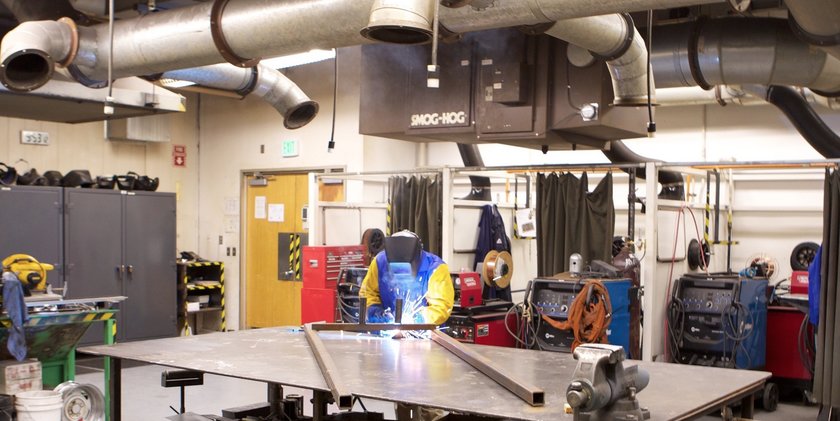
The facility, which was donated by Birmingham businessman George Barber, includes shop space, several classrooms, conference rooms and a 300-person auditorium.
The Birmingham AWTC was announced last year and has been simultaneously undergoing improvements while training workers.
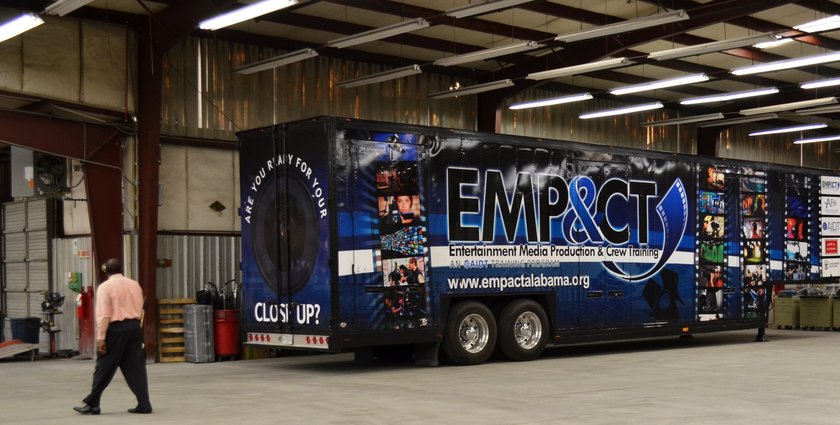
Castile said the facility is now the home to Entertainment Media Production & Crew Training (EMPACT) Alabama. Those interested in the entertainment industry can learn everything from building a set to lighting to operating a camera.
“It’s a large area for us right now and Birmingham is fairly central,” Castile said. “There is a good bit of activity in the Birmingham area and Mobile as well. Those jobs are like all jobs. They’re needed and we’re happy to provide the training.”
The EMPACT truck is parked in the AWTC warehouse and is used for training at various sites but also is loaned to production companies needing additional assets in shooting commercials or short films.
Hilson said AWTC is a collective effort where people who saw a need worked together to meet it.
“Its creation was a collaboration by many people that know Birmingham’s business success is critical to the entire state,” Hilson said. “And centralizing AIDT’s film-training arm, EMPACT, in Birmingham will help reach more students and professionals in a growing industry in Alabama.”
Former state Rep. Paul DeMarco, who, along with Rep. Rod Scott, helped bring the facility to Birmingham, said the AWTC is important to recruit and attract businesses to central Alabama.
“We want to make sure they have the workforce and a facility at their disposal to keep their workforce growing and educated and safe so we can continue the renaissance we’re having here in Birmingham,” DeMarco said.
Castile said he believes the AWTC is what it was envisioned to be.
“It’s really become quite the service center for workforce development in the Birmingham-Jefferson County area,” he said.
Site selection professionals surveyed by national publication Area Development once again ranked Alabama in the top five states for doing business, citing its strong labor climate and workforce development programs.
Alabama ranked No. 5 in Area Development’s 2015 “Top States For Doing Business” analysis, appearing this week online. It’s the sixth consecutive year that Alabama has placed in the overall top 5 in the publication’s rankings.
“The fact that Alabama is consistently getting high marks from site selection consultants indicates that the state is viewed as a prime location for expansion opportunities,” said Greg Canfield, secretary of the Alabama Department of Commerce. “The results reflect the strength of Alabama’s skilled workforce and our training programs, as well as a favorable business environment that companies from around the world are seeking.”
For its rankings, Area Development asked site selection consultants to provide their top picks for 21 factors comprising three overall categories: business environment, labor climate and infrastructure.
“Site consultants often have the best view of a state’s performance — especially when compared to other states,” Area Development writes. “They work on a variety of projects in multiple industries, interact with economic development offices, and conduct their own research. They get the hard-to-find details that are needed to select the best site for their client’s requirements.”
WORKFORCE ADVANTAGES
The Area Development site consultants rank Alabama highly in key workforce-related measurements.
The state ranked No. 1 for competitive labor costs, while its workforce development programs – chiefly, AIDT, the centerpiece of the Alabama Department of Commerce’s Workforce Development Division – ranked No. 4. Overall, Alabama’s labor climate ranked No. 5 among the states.
AIDT has provided training for more than 600,000 Alabamians and operates a number of specialized training centers around the state. It has worked with more than 3,300 companies, including manufacturers with a global focus.
“Last year in Alabama, AIDT — the state’s long-standing workforce development agency — opened the $7 million Alabama Aviation Center at Mobile Aeroplex to help Airbus assemble the workforce for the aerospace company’s newest aircraft assembly facility,” Area Development writes. “AIDT also recently opened a regional training center in Montgomery focusing on manufacturing and IT jobs.”
In addition, Alabama earned these rankings from the publication:
- 2 for cooperative state government
- 2 for favorable regulatory environment
- 3 for speed of permitting
The Area Development annual “Top States For Doing Business” ranked Alabama No. 4 in 2014 and 2013. Georgia topped the rankings this year.
Earlier this year, Area Development awarded Alabama a Silver Shovel award from accomplishments in economic development in 2014. Efforts by Alabama’s economic development team produced more than 18,100 new and future jobs and $3.4 billion in investment last year, according to a report from the Alabama Department of Commerce.
Business Facilities, another economic development publication, this year gave Alabama high marks for its workforce development programs and its “automotive manufacturing strength,” based on the state’s rapidly expanding auto industry.

MOBILE, Ala. — With customer deliveries of Alabama-made Airbus A320 Family aircraft set to begin in 2016, the European manufacturer is counting on its new production facility at Mobile Aeroplex to expand its presence in the world’s largest aviation market, according to Airbus Group Chairman Allan McArtor.
“We want to be here permanently and understood to be a U.S. citizen. That’s what Mobile can do for us,” McArtor told CCTV America in an interview for a video segment that examined why Airbus selected Alabama for its $600 million A320 Family assembly line project.
CCTV America is part of CCTV News, a global English-language news channel produced by China Central Television, the world’s largest broadcaster with a reach of more than 1.2 billion people. The English channel can be seen in more than 85 million homes across more than 100 countries and territories.
McArtor told CCTV America reporter Jessica Stone that Airbus’ production center in Alabama will help it meet surging demand for single-aisle passenger jets like the A320 and its siblings. He said the company has around eight years worth of orders for the aircraft on its books. Over the next 20 years, he added, the U.S. market will require 4,600 single-aisle aircraft, based on projections.
“Airbus wants to fill that need with aircraft stamped ‘Made in the U.S.A.,’” Stone said in her Dec. 5 report.
ALABAMA ADVANTAGES FOR AIRBUS
For Airbus, the Alabama facility follows a move into China, where the company opened an A320 Family assembly line in Tianjin in 2008 to serve the world’s fastest growing aviation market. The Mobile Aeroplex production center will have 1,000 workers once full production is reached. The facility will produce four aircraft per month, spread among A319, A320 and A321 versions.
Because Airbus planned to ship aircraft components into its first U.S. production facility, the presence of a deep-water port in Mobile was a key reason Alabama was selected for the project, Stone said. Alabama also delivered on more than $150 million in incentives, which included a new $7 million training center at Mobile Aeroplex for Airbus workers that is operated by AIDT, a division of the Alabama Department of Commerce.
“What do companies see in the state of Alabama that makes it an attractive place to set up shop?” Stone said in her report. “Well, a few things — low electricity rates, low taxes and virtually no unions.”
What does the future hold for Airbus’ Alabama facility? McArtor, recalling that in 2008 that Airbus lost out on a refueling tanker contract with the U.S. Air Force, told Stone he still hopes to win a portion of the tanker business. Airbus has made no secret of pursuing a U.S. military work.
“It’s conceivable, one day, we may do tanker conversions,” added Mobile Mayor Sandy Stimson.