Law enforcement, elected officials and residents gathered at a Cullman elementary school to talk about an uncomfortable issue facing parents – school shootings. They also got to see a demonstration of new technology that offers a possible solution.
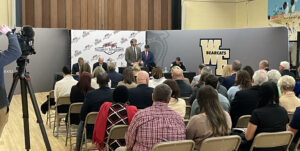
State Sen. Garland Gudger went to kindergarten at West Elementary School and opened by saying today’s threats were never something he had to worry about.
“As a father dropping my two boys off at school, you expect them to be safe,” he said. “I can’t imagine what’s happened at some of these other schools across the nation that weren’t able to pick their children up.”
The device is a deployable, ballistic wall unit in classrooms that can also be used as a multipurpose space. Alabama company KT Solutions said the units can be deployed in less than 10 seconds and offers a level of protection that stops up to a .308- caliber round.
A teacher who showcased the system in her classroom over the past month demonstrated the rapid deployment.
The room can also be used as shelter during severe weather events and other emergencies.
Kevin Thomas, CEO of KT Solutions, said his company was creating ballistic equipment for the military last year when he felt called to work on this invention in the days that followed the massacre in Uvalde, Texas.
“We took something that takes most folks two or three years to do, and we did it in eight months,” Thomas said. “What we do have control over is the ability to make things that are innovative in the meantime while we fix the bigger issues.”
U.S. Rep. Robert Aderholt commended Thomas on his initiative and said he’d like to see how the system can be implemented in classrooms across the United States.
“It’s great to live in a country where there’s so much ingenuity,” said Aderholt (R-Haleyville).
State Superintendent Eric Mackey said school safety is the issue that keeps principals up at night.
“From the time they get on the bus until they get home in the afternoon, they are your responsibility,” he said.
Mackey said the device demonstrated is “the one investment in government I can think of that I hope we never use.”
7. Secret Service may have deleted texts just like they may have gotten attacked by the former president
-
According to the Department of Homeland Security Office of Inspector General, text messages from Secret Service agents from January 5 and January 6, 2021, were deleted “as part of a device-replacement program.” The messages had been requested for an investigation into the riot at the U.S. Capitol. In response to the claim of deleted messages, Secret Service spokesman Anthony Guglielmi said, “We take strong issue with these categorically false claims and I will be responding in detail shortly.”
- This, of course, connects to allegations that former President Donald Trump tried to grab the steering wheel and physically fight with Secret Service agents that day, which has been disputed by the Secret Service themselves. CNN claims they have information that “corroborates” this claim with a source close to a D.C. police officer who they will not name to CNN, saying he witnessed a “heated exchange.” However, no one actually corroborates the allegation that Trump was grabbing at the steering wheel and attacking Secret Service agents. Hearsay about a hearsay account is not corroboration.
6. Alabama Democrats will pick another party leader
-
State Representative Chris England (D-Tuscaloosa) will not run for re-election as chairman of the Alabama Democratic Party. The State Democratic Executive Committee will take steps to elect a new chair on August 13.
-
A diverse list of candidates is expected to be presented to the committee by the Alabama Democratic Conference, according to the leader of the conference Joe Reed, who has also made comments about a need to rebuild the Democratic Party in Alabama.
5. Casey White will be charged with Vicky White’s death
-
Former Lauderdale County corrections officer Vicky White died from a self-inflicted gunshot wound after a national manhunt for her and escaped inmate Casey White. Now, Casey has been charged with murder for Vicky’s death.
-
The indictment says, “White caused the death of Vicky White who died from a gunshot to the head.” The official report stated that Vicky died from a self-inflicted gunshot wound, and that finding has not been denied or contradicted. Some attorneys have raised questions about the charge, saying Vicky White’s suicide was her choice. The attorneys quoted by CNN did not know of an instance where a suicide has been charged this way.
4. Democrats are completely out of touch
-
U.S. Representative Jason Crow (D-Colo.) has supported the idea that Democrats are completely out of touch, as he’s recently stated, “The bottom line is that the Democratic Party, the House Democratic Caucus is the party of national security in the 21st century.”
-
Crow went on to say, “We are the party that’s dedicated to rule of law, to affirming our connection to our allies, to addressing the largest security threat facing our planet and our country – that is climate change, which is both a threat multiplier and a threat magnifier.” New polling shows Republicans are becoming more working class and more multiracial, while Democrats are becoming more college-educated and losing Hispanic support.
3. Carl pushes for American drilling and Biden to avoid Saudi Arabia
-
U.S. Representative Jerry Carl (R-Mobile) has advocated for President Joe Biden to produce more domestic oil instead of seeking oil from Saudi Arabia. Carl recently spoke on the House floor about the issue.
-
Carl said that the current efforts from Biden would “bring the price of fuel down.” He added, “The price of fuel has gone up. In his text, he’s going to release fuel from his reserves. All it did was put money in the Chinese pockets, 950,000 barrels of oil, and someone’s got to be answerable for that… Don’t go to Saudi Arabia, Mr. President…Release our energy.”
2. Alabama representatives unhappy with Active Shooter Alert Act
-
The Active Shooter Alert Act of 2022 split Alabama’s delegation along party lines and has received criticism from U.S. Representative Barry Moore (R-Enterprise) for being “an anti-gun propaganda program designed to dramatize and inflate the reported number of ‘active shooter’ incidents in an effort to expand support for unconstitutional gun control measures.”
-
The act passed in the U.S. House of Representatives and would create an AMBER Alert for active shooters. Moore went on to say, “Sensationalizing violence specifically involving guns while ignoring the crime epidemic intensifying on their watch is a blatant attempt by Democrats to promote their anti-Second Amendment agenda, not the safety of Americans.”
1. Rogers says not to use ARPA money for prisons, but Congress left it pretty open-ended
-
While Alabama has a need for new prisons, U.S. Representative Mike Rogers (R-Saks) recently criticized how the state planned to finance the current $1.3 billion plan for new men’s prisons by using $400 million from the American Rescue Plan Act. However, it is pretty clear most states saw this money as a grab bag to use as they saw fit because pandemic-related expenses were not specifically required as a reason to spend the money.
-
Rogers said he’s “so aggravated” with the state’s spending plan and went on to say, “We gave the state the money to deal with COVID and the problems that came out of COVID.” Rogers added, “[T]he fact that they’re even discussing what to do with it rather than spending on rural broadband makes me just want to chew nails…All states are doing it. They’re using it as kind of a cookie jar to get their wish list fulfilled. But they ought to be spending on things to help us deal with the next pandemic, assuming we have another one.”
Recent shooting tragedies in New York City, Buffalo, and Uvalde, Texas, have brought to the fore discussions about gun control, mental health, and prevention of these senseless attacks.
What ensues is the heartbreak felt by well-meaning people across the country. The digital tapestry of “thoughts and prayers” again blankets social media.
And while the posts and “likes” are genuine, we must have a genuine discussion about how to prevent these mass casualty events.
The profiles of active shooters provide more than some illumination as to who the next attacker may be, and then lends law enforcement and communities the acumen to put those pieces together in time to prevent the next attack.
The investigation of an active shooter attack – whether in public places or schools – typically reveal that there were multiple warning signs. This hindsight is of little comfort to the innocent victims and their families.
It comes as no surprise that a group of neighbors, classmates, coworkers, friends, and family members come forward after the attack with troubling information about the shooter.
They notice that he was abusing drugs or alcohol. Friends say he was increasingly irritable or acting out violently toward others or animals. The attacker had significant issues at work or school. A relationship had recently failed. He was increasingly irritable, violent, or showed a sudden increase in interest in violence.
Many had contact with law enforcement. Families belatedly disclose a mental illness or mental distress. We then learn others knew the active shooter legally purchased the firearms or had access to weapons in the home. Too many people scrolled past or ignored the social media posts or messages of his intentions.
There is a reason this seems familiar.
The pre-attack behaviors of active shooters have distinct patterns and are like profile puzzle pieces needing proactive assembly. And if we can articulate these behaviors and patterns to the public, and put these pieces together to form a clearer picture, perhaps we can prevent further bloodshed.
The FBI engaged its Behavioral Analysis Unit to study correlations of active shooter attacks.
In 2018, the FBI released its conclusions about the pre-attack behaviors of active shooters aptly entitled “A Study of the Pre-Attack Behaviors of Active Shooters in the United States Between 2000-2013.” These studies have continued annually since, without diversion.
The Bureau found distinct, recognizable patterns – those profile puzzle pieces – that provide an additional context for “see something, say something.”
In 2021, the Secret Service, through its National Threat Assessment Center, studied thwarted school shootings in particular. What they found confirmed what the BAU found. School shooters have common observable characteristics and threat assessments save lives. But it is the common puzzle pieces of those assessments which must be our disseminated focus.
The profile puzzle pieces are not particularly surprising, but the frequency in which all active shooters display multiple pieces of the profile puzzle may be.
For instance, nearly all active shooters are male and about one in four had been diagnosed with a mental illness or attempted suicide prior to the attack. About 40% of active shooters spend less than a month planning their attack. Three out of four have a known connection to the attack site and more than half of the targeted victims were confronted in the days and weeks preceding the attack by the assailant.
The data is even more ominous for attack preparations. More than half of the active shooters spent less than one week preparing for the attack, as in buying weapons, ammo, body armor, written notes, et cetera. Ninety-two percent of active shooters legally purchased the firearms used in the attacks or had unfettered access to the weapons.
Profile pieces
Moreover, about four in five active shooters expressed and disclosed a grievance of some kind, whether unfair treatment at school or work, divorce, hatred of others, or some previous physical altercation. Only about 1 in 10 sought fame from their attacks, with most seeking revenge of some sort.
Nearly all active shooters engaged in violent behavior or threats of violence towards people or animals preceding the attack.
Prior to the attacks, 56% of the active shooters left digital clues of the impending intentions. Many chose a date to commemorate a previous mass shooting, such as the Columbine attack of 1999. Nearly 1 in 3 active shooters left behind legacy tokens, or manifestos, to explain their behavior, and did so just hours or days prior to the attack.
More profile pieces
Active shooters in schools have similar characteristics in attacks that were prevented.
Nearly all of the thwarted attacks were in public schools. More than 80% of the schools that foiled active shooter attacks had a physical security measure, such as lockdown capability. About two-thirds had school resource officers, who are typically armed security within patrolling the brick and mortar of the schools.
In fact, the Secret Service surmised that “targeted school violence is preventable when communities identify warning signs and intervene,” especially students in those communities. Sadly, only about 1 in 3 schools had some type of system that would allows the community or fellow students to notify the appropriate authorities.
We must transform observation into action which elicits a preemptive response. Those who observed the troubling behavior did nothing 83% of the time. These concerning behaviors, taken in the collective, give us those red flag puzzle pieces needed to identify the stressors that may be leading to a mass casualty event.
In fact, nearly all active shooters displayed at least four of these troubling behaviors prior to the attack. Since the planning of the attacks normally occur in a short period of time, we must disseminate these red flags to the public and law enforcement, so all have the ability to assemble the profile puzzle pieces.
Too often we discover that these behaviors are discarded as just poor or odd behavior. Too often eventual active shooters are confronted by eventual targets, friends, family members, or even law enforcement without any actions taken. Too often, the pieces lay unconstructed at the peril of public safety.
The profiles of active shooters are no longer anomalies or some mystic event that only clairvoyance might reveal. The puzzle pieces are typical. The puzzle pieces are known. We cannot prevent every attack, but it remains a worthy endeavor to prevent even one.
The intonation of “see something, say something” in the context of terrorism has been digested well by the American public. We must pivot that context to targeted violence in schools and public spaces. We must develop a systematic outlet to report pieces to the puzzle.
We know those in proximity of eventual active shooters always see something. Only a few say something. We now must make it our collective proactive responsibility to put the profile pieces together.
And effectively DO something.
Jay Town, vice president and general counsel at Gray Analytics, a defense contractor in Huntsville, is a former United States Attorney for the Northern District of Alabama. Town was as a career prosecutor focused mainly on violent crime and served 12 years as a United States Marine and judge advocate.
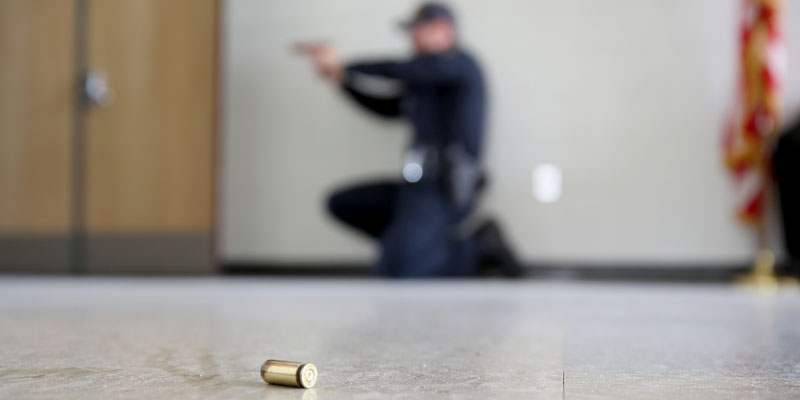
Thursday, over 60 officers from Calhoun County Sheriff’s Office, Anniston Police Department and Oxford Police Department endured inter-agency training at the Xtreme Concepts Inc. (XCI) Training Facility in Anniston, AL., to combat an active shooter situation.
Per a news release, the group went through three “challenging” scenarios dealing with an active shooter at XCI’s facility, formerly known as Fort McClellan, to “simulate a diverse field of situations.”
“I wanted to put something in there that they don’t see,” Anniston police Sgt. Donny Smith said, regarding a female shooter in an office romance gone bad scenario. “I want to get inside their heads.” (more…)
As reported by WHNT News, yesterday afternoon Huntsville police received a call indicating there was an active shooter emergency at the Williams School in Huntsville.
Police responded to the scene, cleared the building, but found no shooter. As to be expected, parents and loved ones gathered in fear that their children would be the victims of another school tragedy. Once the situation had stabilized, police began an investigation to determine who made the call.
Now law enforcement officials believe that the call likely came from a student at the school. Lt. Stacy Bates of the Huntsville Police Department said, “It came from a landline within the school. It was a juvenile voice we heard on the line, so we know it was a juvenile. . . We will prosecute them to the fullest extent of the law. We will use the cameras in the school system, use whatever means they have necessary to determine who did this.”
If it was a juvenile who made the call, then their names will not be released do to state law. However, Bates said they will charge the caller with all crimes possible. “At a minimum, you’ve got rendering a false alarm, depending on what it entails it can be a misdemeanor, it can be a felony. We’re going to go with the strictest charges we can find and as many as we can find in a situation like this,” said Bates.
Aside from criminal punishments, the age of the child also plays a large role in how the school system will proceed. If the child is in elementary school then they are likely to only receive a suspension, said Huntsville City School’s Spokesman Keith Ward. However, if they are in a higher grade, the punishment could involve expulsion.
As reported by ABC 33/40 News, the University of Alabama is installing technology on campus that could help prevent an active shooter tragedy.
As summer comes to a close and students start returning to Tuscaloosa, campus police are preparing to launch the ShotSpotter system throughout campus.
The ShotSpotter is an early warning detection system that allows law enforcement to quickly and easily identify the exact location of any shots fired on campus. There are a series of 69 highly sensitive sensors spread throughout the university. Should there ever be an active shooter scenario on campus, these sensors would save police precious time by pointing them to the location of the shooter.
Addressing the need for the ShotSpotter system, Campus Police Chief John Hook said,
“We’re approaching this in a preventative and rather proactive way. If you can decrease or reduce that time, I mean seconds count in this profession. We have to be sure we are first on scene and that we know about it before anybody else.”
SpotSpotter costs $189,000 to install, but this is a small price to pay for increased safety on campus.
With the recent trend of active shooter tragedies, most people are aware of the need to increase police response times. Many shootings occur in a very short span of time, and every second saved could mean life or death.
While the spotter system can never replace the our brave men and women in law enforcement, it can be an invaluable tool they use to save innocent lives.
A civilian team from the Aviation Center of Excellence at Fort Rucker has won the U.S. Army’s competition to develop an app to better respond to active shooter situations. The app will be released soon, and it will available for free on iTunes and Google Play.
Army Training and Doctrine Command was concerned at the possibility of an active shooter situation following the false alarm at Huntsville’s Redstone Arsenal last month. It decided to immediately commission an app to help first responders handle such complicated situations should another potentially dangerous situation arise.
“All these applications have the necessary and vital information that will save lives, time, and educate those with little or no training on active-shooter response situations,” Capt. Dylan Gallagan, the operations officer at the Army Office of the Provost Marshal General, said in a press release.
Judges determined the winner based on the capabilities of the app and “overall user experience.” The winning application instructs those in danger on how to optimize their safety during an active shooter situation. It also has access to emergency personnel, who can be contacted directly through the app with the push of one button.
According to Matt Maclaughlin, of TRADOC’s Senior Mobile Training Development program, the app’s step-by-step instructions are helpful because people can often forget their training and drills in stressful situations. “If adrenaline kicks in and they forget what to do in the moment, all of that information is right there in front of them,” he said on the Army’s website. “We’re going to try to think for you because there’s situations where you won’t have time to think.”
Recently, the Army has expanded its training programs into the digital realm for topics such as sexual harassment prevention, suicide prevention, and certain elements of combat tactics. With the development of the new emergency response app, the Army hopes it can continue to expand its digital capabilities in the future.
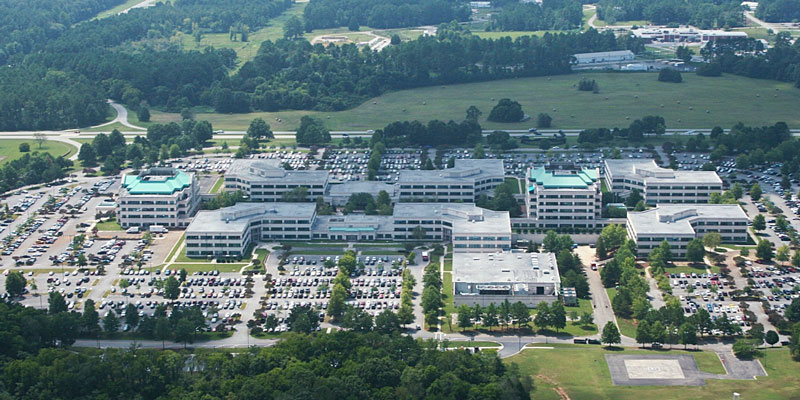
Update 1:05 pm: David Kumbroch with WHNT is reporting that Redstone Arsenal officials say they the threat is over after reports of a “possible active shooter” and that the gates are now back open, but the situation remains under investigation. A statement on Redstone’s official Facebook page says this:
This morning, a potential active shooter incident occurred at Redstone Arsenal, in the Sparkman Center. The installation was in lock-down mode with all gates closed, and employees sheltered in place at their respective buildings.
As of 12:30 p.m., employees can move about the post in an orderly fashion,
but are asked to keep movements limited, as needed.Movement remains
restricted in the area near the intersections and roads around the Sparkman Center.The gates to the Arsenal are open and operational.
This incident is under investigation. The safety and security of our
workforce remains our top priority.
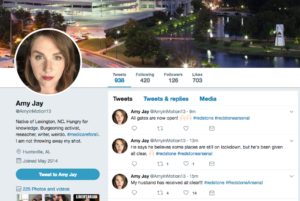
UPDATE: 12:45 pm: A private citizen, Amy Jay, tweeted at 13:32 that her husband (who presumably works at Redstone) received the “all clear” although some places may still be on lock down. Moments later she tweeted “All Gates Are Now Open.” Again, this is an unconfirmed source from a personal Twitter account, but it does appear to be a very promising update to the story below. As reported earlier, Redstone is scheduled to update the media at the top of the hour.
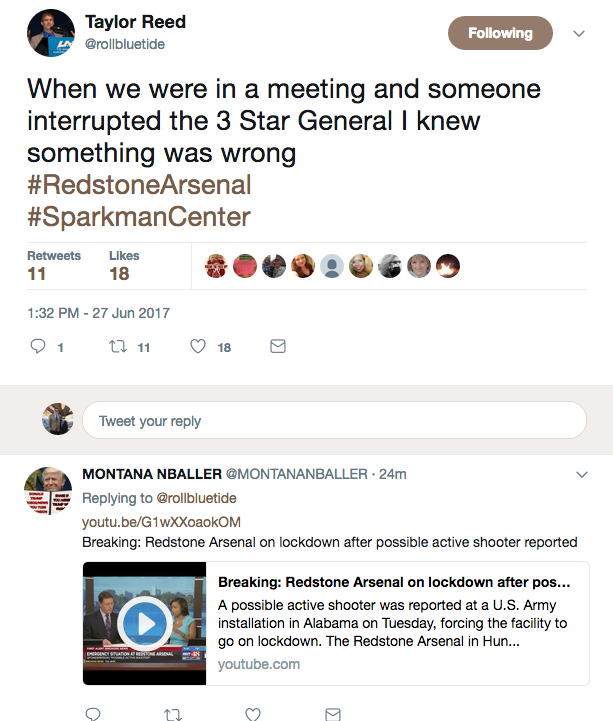
Original Report 11:04 am: Redstone Arsenal tweeted this morning that there’s a “possible active shooter” and the installation is on lockdown. At this point, that’s all we know.
David Kumbroch with WHNT tweeted Huntsville Hospital was on heightened alert because of this report, but they’ve not received any patients. Only seconds ago, he tweeted “CONFIRMED: FBI on scene of possible active shooter at Redstone Arsenal. More headed this way from Birmingham” only to follow that a few seconds later with another Tweet that reads “Worth nothing FBI has large, permanent presence on Redstone Arsenal.”
Redstone is telling employees this is not an exercise and at the City of Madison tweeted “ACTIVE SHOOTER on Redstone Arsenal near the Sparkman Center. Please watch the news to stay updated.”
Governor Ivey tweeted, “My office is being updated about the situation…and I will continue to closely monitor and pray for a peaceful and quick resolution.”
Once again, nothing has been confirmed at this moment, but Redstone Arsenal is on lockdown in a locked, safe location, and we are monitoring the situation and will provide updates as they’re available.
Twitter is active under the hashtag #RedstoneArsenal and Redstone is scheduled to update the media at 1:00 p.m.
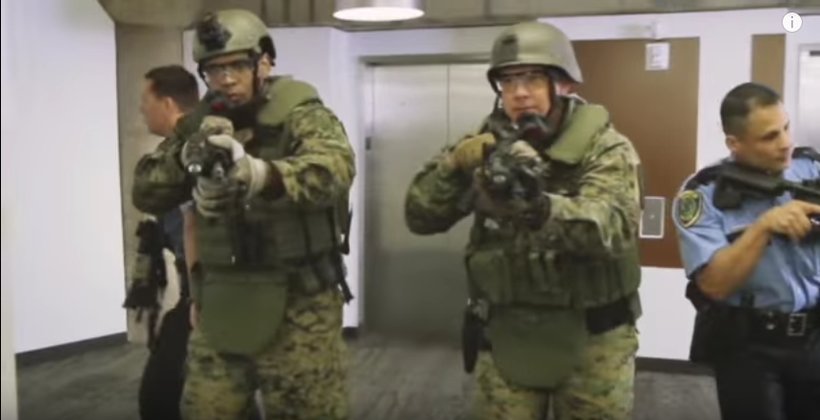
MONTGOMERY, Ala. — The Alabama Law Enforcement Agency (ALEA) officials said on Tuesday that two-thirds of the state’s law enforcement officers have been trained in how to respond to active-shooter situations, according to a report by the Decatur Daily.
The total number of officers who have been trained is roughly 10,600, almost double the number that had been trained just two years ago.
The training for Alabama sheriffs deputies and municipal police officers has included computerized simulations that replicate an active-shooter situation taking place in an office setting.
Such training has received increased interest in the wake of numerous active-shooter situations that have taken place around the country, most recently in San Bernardino, California, where radical Islamic terrorists killed 14 American citizens in a social services facility.
“We’re prepared for everything… anything from a ballgame to a Talladega race, anything that’s big, we’re going to have people there,” said ALEA Chief of Staff Hal Taylor.
“Unlike the way it was 10 or 15 years ago, when police officers would just set up a perimeter around an incident or crisis and call in a SWAT team, we can’t do that anymore,” added Col. John Richardson, director of Public Safety. “Time is of the essence and if you look back on it, most active shooter incidents usually last about 12 minutes or less, so we can’t wait for the SWAT team to come in an engage those shooters.”
Incidentally, Taylor said that 12 minutes is also the average amount of time it takes a trained Alabama law enforcement officer to make it to the scene of an active-shooter situation.
That means it has also been important for ALEA to train citizens on how to respond, resulting in 18,000 Alabamians being trained in the state’s “Run, Hide, Fight” program.
“If you can get away from the building, that’s what you want to do,” Taylor said.
ALEA in 2012 produced a six-minute video with broad instructions on how to respond to a shooter in a workplace environment.
“If you are ever to find yourself in an active-shooter event, your survival may depend on whether or not you have a plan,” the narrator says in the video, which can be viewed below. “The plan doesn’t have to be complicated. There are three things you can do that could make a difference: run, hide, fight.”
As Taylor mentioned before, the video encourages people to leave the building if at all possible and alert the authorities. If that is not possible, ALEA encourages people to find a place to hide and barricade themselves in. Then, as a last resort, fight with whatever weapons are readily available, including fire extinguishers, chairs, glass coffee pots or anything with an edge or weight.
(Video below: ALEA simulates a workplace active shooter to illustrate “Run, Hide, Fight”)
(h/t Decatur Daily)

Faulkner University was put into lockdown earlier today after reports of an active shooter on campus were disseminated through the University’s emergency information system.
The situation has now been resolved.
According to the Montgomery Policy Department, a custodial employee was shot by her estranged husband after a physical altercation on the campus. She is currently in critical condition. The shooter was taken into custody.
To complicate matters, a Hoover-area middle school was also sent into lockdown after Faulkner’s emergency message was misinterpreted by a parent of one of their students.
At 12:29 this afternoon, Yellowhammer News received an email from a parent of a student at Simmons Middle School in Hoover claiming they had received a text that there was an active shooter situation taking place at the middle school.
Yellowhammer immediately called the school and spoke to a member of the school’s administration, who said they had received no reports of a problem on campus.
In an effort to take every step to ensure the safety of the students, the administration and the school’s resource officer made the decision to put the school into lockdown.
As it turns out, the parent is also an adjunct professor at Faulkner University. He had received an emergency text through his Blackberry from a sender whose address started with “SMS.” He took “SMS” to be an abbreviation for Simmons Middle School, when it was actually the abbreviation for “short message service,” more commonly known as a text message, used by Blackberry’s emergency system.
Faulkner University had not included the college’s name in the emergency warning, since it was only being sent to Faulkner students and employees.
Follow Cliff on Twitter @Cliff_Sims