On Friday, former President Donald Trump announced his endorsement of Katie Britt for U.S. Senate in Alabama saying she was “a fearless America First Warrior.”
Trump originally endorsed U.S. Rep. Mo Brooks (R-Huntsville) but withdrew his support in late March.
In a press release, the former president said Brooks had gone “Woke” when he told rally attendees in Cullman last year to “look ahead” to the midterm elections instead of focusing on the 2020 presidential election.
Former President Donald Trump endorses @KatieBrittforAL #ALSen #alpolitics pic.twitter.com/PuV6LyZ45z
— Dylan Smith (@DylanSmithAL) June 11, 2022
Brooks responded to the Britt endorsement in a statement, saying Trump was “conned” again by Senate Minority Leader Mitch McConnell (R-Ky.).
“This is weird: Last time Donald Trump talked about Katie Britt, he said she was unqualified for the Senate,” Brooks said in a press release. “Donald Trump is the only man in American politics who could get conned by Mitch McConnell twice in an Alabama Senate race.”
The Alabama congressman also pointed out that Trump had a history of endorsing the wrong candidates.
“Let’s just admit it — Trump endorses the wrong people sometimes,” he argued. “He endorsed Mitt Romney, he endorsed John McCain and now he’s endorsed Katie Britt, who his own son, Don Jr. called ‘Alabama’s Liz Cheney.'”
Brooks reminded people of Trump’s involvement in the 2017 Senate race and encouraged people to go vote on June 21.
“Alabama grassroots remember in 2017 when Donald Trump and Mitch McConnell got involved in a Senate primary in Alabama, and we rejected them,” he said. “The people of Alabama will decide.”
This is weird: last time Donald Trump talked about Katie Britt, he said she was unqualified for the Senate.
Donald Trump is the only man in American politics who could get conned by Mitch McConnell twice in an Alabama Senate race.
— Mo Brooks (@MoBrooks) June 11, 2022
Yaffee is a contributing writer to Yellowhammer News and hosts “The Yaffee Program” Weekdays 9-11am on WVNN. You can follow him on Twitter @Yaffee
When 77% of voting Alabamians passed a statewide amendment to improve our 21 state parks, they did us a favor. Of the $85-million bond approved, $80 million will go toward modernizing the parks and investing in infrastructure to improve them. The funding will make the parks more profitable and improve their position as premiere tourism destinations.
The other $5 million will help the Alabama Historical Commission maintain acquire and construct historical sites.
The amendment approved by voters May 31 originated from the passage of House Bill 565, which was sponsored by Reps. Nathaniel Ledbetter and Wes Kitchens. These legislators showed great foresight to recognize the tens of thousands of tourists the parks lure to our state each year and the need for the updates and renovations to keep the parks attractive.
The bond issue is truly an investment in our state’s future – both economically and environmentally. With interest rates so low, it was the perfect time to make such a move, financially speaking.
The bill passed the House by a vote of 97-1, and it passed the Senate by a vote of 29-0 on an amended version. The final version passed the House 98-0.
Thank you Reps. Ledbetter and Kitchens for finding a much-needed issue that the majority in both chambers could also agree upon – unanimously, a rarity in the Legislature.
Our state parks are a division of the Alabama Department of Conservation and Natural Resources, and the 21 parks encompass approximately 50,000 acres of land and water in our state. They range from the Gulf Coast beaches to the Appalachian Mountains. They provide golf courses, hiking trails, restaurants, camping, fishing, conference centers, lodging and more.
The parks are beautiful wonders of nature and provide the best Alabama has to offer. They are found in the following cities: Bladon Springs, Clio, Grove Oak, Woodville, Delta, Auburn, Gallion, Ft. Payne, Florala, Opp, Gulf Shores, Rogersville, Guntersville, Coker, Eufaula, Spanish Fort, Huntsville, Pelham, Selma, Warrior, Camden and Alexander City.
For more information on these Alabama jewels of nature, visit www.alapark.com.
Beth Chapman is Alabama’s former State Auditor and 51st Secretary of State. She now owns and operates Beth Chapman & Associates, LLC. This is her weekly column, “Around the Capitol” published in newspapers and blogs across the state. She can be reached at Beth@bethchapman.com.
The controversial academic concept of Critical Race Theory (CRT) was introduced to Huntsville City Schools administrators and teachers during a training session in 2015, according to documentation obtained by Yellowhammer News.
An agenda of the two-day teacher training session, which began May 11, 2015, shows that district educators received instruction centered around the subject of “cultural responsiveness.”
CRT is specifically mentioned by name in the agenda on the second day of the training session. “Theoretical Foundations: Critical Race Theory/Racial Identity Development” is listed alongside the agenda’s 9:00-10:00 time slot.
The bottom of the agenda states the intentions of following up with teachers in a monthly meeting each semester to track the progress of educators’ implementation of the training material in classrooms.
While the emergence of CRT in the national political dialogue did not take place until 2020, the teacher training document would signify one of the earliest known efforts to incorporate the progressive academic concept in Alabama public schools.
Training agenda as follows:
The 2015 agenda outline mentions training participation with the “Central Office” a total of four times, which is an apparent reference to school district leadership.
When the teacher training on CRT occurred seven years ago, Casey Wardynski, a Republican candidate for Alabama’s fifth congressional district seat, was serving as Huntsville City Schools superintendent.
At the time of the presentation, the training facilitators, who held extensive backgrounds in culture and race education, held positions at Denver Public Schools and the University of Colorado Denver. Prior to accepting the Huntsville City Schools superintendent position in 2011, Wardynski served as the chief financial officer at Aurora Public Schools in Colorado.
Throughout his congressional bid, Wardynski has made his public opposition to CRT a central tenet of his campaign platform.
During a recent interview on WVNN’s “The Dale Jackson Show,” Wardynski was asked to respond to claims that tenets of CRT were incorporated into the school district while he was superintendent.
He denied the claims and contended, “Nobody even heard of Critical Race Theory until 2020.”
The contentious academic concept has become a leading social issue across the nation over the past two years, as partisan divides over CRT continue to spark intense debate.
Progressives have long argued that the implementation of CRT was necessary for sake of “anti-racism” and “equity.” However, many skeptics view the teachings as inherently racist in nature due to the concept’s fixation with racial classification and instances of labels such as “victims” and “oppressors” being incorporated in its teachings.
When reached for comment regarding his involvement in the 2015 training session, Wardynski pointed to the U.S. Department of Justice’s (DOJ) desegregation mandate which ordered the school district to achieve racial balance.
“The training referenced here was part of a 92-page court order from an Obama-appointed federal judge,” said Wardynski in a statement to Yellowhammer News. “While I’m not sure why this is coming up seven years after I left Huntsville City Schools, and 50 years after the federal order was instituted to end school segregation in Alabama, I am sure that it’s not something I elected to implement in my role as Superintendent of Huntsville City Schools.”
Consent order as follows:
Wardynski continued, “As a candidate for Congressional District 5, I’ve addressed the issues that come with federal control of a school system many times, and I’ll address them here. For fifty years Huntsville City Schools has operated under the control of the federal court. When I became Superintendent the School Board asked me to move the school system from “dual status” (under federal control because the court deemed it to operate in one way for black students and another for white students) to “unitary status” (a single system operating in the same way for all students and removed from federal control).”
According to a 2015 release detailing the consent order, the DOJ outlined steps the district was mandated to take as part of its instruction to further desegregate.
The release stated that “professional development” must be provided to educators regarding “strategies for teaching students from diverse backgrounds, understanding implicit bias and supporting positive student behavior.”
“As part of the federal court order, the Department of Justice sought professional development for teachers in culturally responsive teaching,” Wardynski noted. “Culturally responsive teaching means using students’ customs, experiences, and perspectives as tools for classroom instruction so that when academic knowledge is placed in the context of students’ experiences and frames of reference, students learn more easily and thoroughly. For example, rural students from families who have lived in one place for generations will have very different experiences from urban students who are new to their community.”
He added, “Placing knowledge in the appropriate context for each group will aid their learning. Culturally responsive teaching was ordered, not sought out. Until the court emplaced its order in 2015, culturally responsive teaching was not part of teacher professional development in Huntsville City Schools. If critical race theory was addressed by contractors in delivering culturally responsive teaching professional development, it is important to note that CRT was an unknown theory to myself and most Americans until it was featured in “woke” culture beginning in the spring of 2020.”
One of the first reports linking Huntsville City Schools to controversial teachings was in July 2021 when it was reported that the Mountain Brook School System reversed course on its decision to implement an Anti-Defamation League-linked anti-bias training program, which the liberal activist organization confirmed was utilized by 42 schools in Huntsville at the time.
James I. Dawson Elementary in 2013 became the first public school in the district to receive the Anti-Defamation League’s “No Place for Hate” designation.
“As part of implementing the desegregation order, Huntsville City Schools conducted multiple listening sessions in 2015 and every year thereafter,” advised the congressional candidate. “Records of these sessions are provided at the Desegregation Advisory Committee (DAC) website (hsvdac.com). Of note, until the 2021 report, there is no mention of culturally responsive teaching by any member of the Madison County Commission, teacher, parent, or DAC panel. Culturally responsive teaching and critical race theory never surfaced as an issue with the community during my time as superintendent because culturally responsive teaching wasn’t an issue and critical race theory only became an issue after it became the guiding theory for “woke” culture in 2020.”
The Alabama State Board of Education (BOE), in August 2021, passed a resolution banning the instruction of CRT in public schools.
Four months after the resolution’s passage, the Alabama State Department of Education began investigating a complaint filed by a concerned parent after Whitesburg Elementary School teacher training material was revealed in a now-deleted social media post, according to original reporting by Alabama Media Group.
Screenshots of the post that was circulated in conservative Facebook groups appear to show that the 2021 training session included a PowerPoint slide discussing white privilege, the outlet reported. The session contained language similar to that in the 2015 training agenda which indicated that educators reviewed content related to “Culturally Responsive Pedagogy.”
“I was the first Superintendent in the federal order’s 50-year history to take steps to bring federal control of Huntsville City Schools to an end,” said Wardynski. “About one-third of school systems in Alabama remain under federal control. While these orders were a federal response to Alabama state laws imposing segregation on school systems in the 1950s and 60s, elected state, county, and city leaders have left it to school systems to deal with the federal courts.”
The former superintendent concluded, “My interest in running for Congress includes serving on the House Judiciary Committee to bring accountability to the federal courts exercising federal control of local school systems. As I have stated during forums and many times in public, it is time to identify an endpoint for this federal system of intrusion into local school systems. Without such accountability, federal court control will persist without end as do many federal programs that were poorly designed and even more poorly equipped to address modern circumstances.”
An additional statement was provided to Yellowhammer News by the Wardynski campaign from Walter McGinnis, who served on the Huntsville City School Board of Education from 2012 to 2021.
The former board member contended that Wardynski “consistently fought” the consent order issued by the court.
“No one has done more to fight the woke left than Dr. Wardynski. An out-of-control liberal judge required this training,” stated McGinnis. “There were at least three community hearings in high school auditoriums regarding this federal control of our schools. Dale Strong remained silent the entire time while Dr. Wardynski consistently fought this liberal judge in court day in and day out.”
Dylan Smith is a staff writer for Yellowhammer News. You can follow him on Twitter @DylanSmithAL
Dr. Martin Luther King argued that the arc of the moral universe is long and bends toward justice. This geometry lesson was used to illustrate a belief that history is pulled gravitationally towards freedom.
One of the early “moral arcs” occurred 807 years ago this month when the Magna Carta was signed at Runnymede. This critical event would set in motion several important concepts now ingrained in our system of government. Perhaps the most important ideas acknowledged by the Magna Carter were that the British monarchs were not above the law, and their powers were neither limitless nor were they able to impose rules that violated established legal customs.
One custom that seems to attract universal interest is the power to tax and exploit from others their property to benefit the prevailing concept of the common good. Even in 1215 people had a tolerance for an acceptable level of taxation, but they also had a concept of excessive taxation, which was always a source of acrimony between the governed and civil authority.
While the Magna Carta addressed several issues, arbitrary taxation set in motion a fundamental concept that would be refined over time to require a process allowing taxpayers to consent or otherwise participate in the approval of any new taxes.
To curtail the King’s power to tax was significant. The King, like any sovereign, depended on taxes to support his palace, prerogatives, and policies. Indeed, one hallmark of absolutism is the ability to squeeze as much revenue from as many people to create a government directed solely by the monarch and accountable to no one.
Limiting the purse of the ruler was a mark along the road to greater liberty and freedom. It would be a stretch to argue that the Barons who forced King John to sign the Magna Carta were the first economic supply-siders. They were merely tired of funding royal initiatives that offered no local benefit while siphoning money and commodities out of their community.
The effect of the Magna Carta was a step toward limiting the government and allowing communities to retain their crops, gold, and property. Kings, like any other authority, chaff at having their financial plans approved by others. In King John’s case, he reluctantly signed the Magna Carta and later repudiated it, which started a war with his nobles. This civil war ended only after his successor, King Henry III, agreed to confirm the terms of the Magna Carta and reissued it to show royal assent.
The Magna Carta, by requiring some form of consent to levy and collect tax, indirectly created the need for a parliament to approve the King’s explanation of what taxes were necessary and why. Few societies in the 13th Century had any notion of assembling people together so the King could confirm his limited power by asking his subjects for taxes.
The uniqueness of this system would create an expectation of a relationship to balance the interests of the government and the governed. As the arc of history moved forward with Parliament, the powers of the King eroded, and greater power was ceded to a representative body.
While Parliament grew in authority, later, it too would come under scrutiny when it abused power and failed to recognize that it no longer represented the governed.
With the industrial revolution and the growth of a middle class, the power in Parliament became more reflective of an elite class with little attention to changes in the country. And so it was that 190 years ago this month, the Great Reform Act was passed to correct how members of Parliament were elected.
As Parliament developed, there was no uniformity in what constituted a district to elect a representative. In some cases, districts might be relatively small with limited land and population, while other districts would be much larger. In the same token, there was no set requirement of just who was eligible to vote in a district. Qualifications varied, which allowed the hierarchy to control both the voting district and the voters.
So, in the 1830s, rather than a voice of the people, Parliament had become more like King John in 1215 and lost touch with the population. It now abused its power by imposing laws, taxes, and a system that had no accountability to an industrialized country. Like the nobles, the growing middle class wanted a say in how government impacted their lives.
Proving once again the dynamic of the English system, Parliament reformed itself. In an appeal to liberty and the good will of all citizens, and believing in representative government, in 1832, Parliament accomplished two critical things in bending the arc of history toward justice.
First, the act changed how districts were allocated within cities and counties. Gone were the abusive boroughs controlled by an elite, and in their place were districts with similar populations and interests. Though not even remotely approaching the concept of “one man, one vote,” it still served as the genesis of voting districts with proportional representation.
Second, the franchise was expanded to allow a lower threshold of property ownership for eligibility to vote. This increased the eligible voting population more than 55%. While women were not allowed to vote and lower classes continued to be excluded, in the march toward greater participation in government, it was a clear step toward justice.
The act also created an objective system of voter registration that was the primary responsibility of local government. Additionally, boards were established to hear appeals for disputes about qualifications to vote, which further established a notion of due process by defusing power to allow a review of voting eligibility by a higher authority.
Both the Magna Carta in 1215 and the 1832 Reform Act continued a process to allow greater liberty, more freedom, and expanded justice, and these two initiatives served as bright beacons along the arc of history moving civilization towards greater self-determination.
Will Sellers is a graduate of Hillsdale College and an Associate Justice on the Supreme Court of Alabama. He is best reached at jws@willsellers.com
7. Alabama man arrested with a white nationalist group as they prepared to riot at pride event
- In Idaho, 31 members of Patriot Front were allegedly planning to riot during a “Pride in the Park” event. The individuals were masked and arrested after being located in the back of a U-Haul with shields, masks and shin pads.
- Among those arrested was a man from Lexington, Alabama, Wesley Evan Van Horn. The individuals were all wearing similar outfits of blue shirts, khaki pants, baseball caps and masks. The 31 people were from all over the country and arrested for suspected conspiracy to riot.
6. AOC pushing for the release of names of politicians who asked for pardons
- U.S. Representative Alexandria Ocasio-Cortez (D-N.Y.) has started pushing for the names of those who requested a pardon from former President Donald Trump after the U.S. Capitol riot on January 6 to be released. It seems obvious that if some did seek a pre-emptive pardon, it would be to avoid a witch hunt from Democrats. This isn’t a good look but might be a smart play, even if the pardons didn’t happen.
- AOC stated, “When you don’t know which of your colleagues were part of a potential conspiracy, then we need to find out. I believe that every member of Congress should be able to answer that question.” U.S. Representative Liz Cheney (R-Wy.) has also brought up the issue, singling out fellow U.S. Representative Scott Perry (R-Pa.), who denies it, and “multiple other Republican congressmen” who requested pardons from Trump.
5. Trump could be indicted according to Schiff, who made this claim many times before
- According to the January 6 riot House committee, there is enough evidence to indict former President Donald Trump. U.S. Representative Adam Schiff (D-Calif.) said, “I would like to see the Justice Department investigate any credible allegation of criminal activity on the part of Donald Trump.”
- There are allegations that Trump and his team worked to spread misinformation, and more evidence is reportedly set to be released this week. Schiff said, “There are certain actions, parts of these different lines of effort to overturn the election that I don’t see evidence the Justice Department is investigating.”
4. Rand Paul will campaign for Brooks
- U.S. Representative Mo Brooks (R-Huntsville) will face the runoff election in just over a week, and now, U.S. Senator Rand Paul (R-Ky.) will visit the state to campaign for Brooks. Paul will be visiting Huntsville and Homewood to hold town hall events.
- Paul, who has endorsed Brooks in the race, declared, “Mo has proven time and time again he will stand up for liberty and do what he thinks is right.” This will be the first in-person event Paul has attended for Brooks after holding a virtual town hall for Brooks just before the primary election.
3. Gun control framework agreed upon; Legislation includes mental health funding and increased background checks
- Gun control legislation has been agreed upon by a bipartisan group of U.S. Senators. There is no legislation written yet — only terms of increased background checks for those under 21 years old, mental health funding, funding for school security and grants for states to move forward with red flag laws.
- The Republicans supporting the framework are U.S. Senators John Cornyn (R-Texas), Thom Tillis (R-N.C.), Roy Blunt (R-Mo.), Bill Cassidy (R-La.), Susan Collins (R-Maine), Lindsey Graham (R-S.C.), Richard Burr (R-N.C.), Rob Portman (R-Ohio), Pat Toomey (R-Pa.), and Mitt Romney (R-Utah). The National Rifle Association (NRA) responded to the news, stating, “The NRA is committed to real solutions to help stop violence in our communities. We encourage our elected officials to provide more resources to secure our schools, fix our severely broken mental health system and support law enforcement. As is our policy, the NRA does not take positions on ‘frameworks.’”
2. Britt holds commanding lead over Brooks in poll
- In recent polling, U.S. Senate candidate Katie Britt has maintained a lead against U.S. Representative Mo Brooks (R-Huntsville) in the runoff election. Data released by the Alabama Forestry Association, an organization that has endorsed Britt, shows that Britt has an 18-point lead. The poll was conducted by McLaughlin & Associates.
- The survey showed 9% of voters remain undecided, but Britt has 54.6%, while Brooks has 36.4%. Among the respondents, 61.4% view Britt favorably, compared to 49% for Brooks, but 29% view Britt unfavorably, compared to 40.2% who view Brooks unfavorably. In the primary election, McLaughlin & Associates was the most accurate
1. Trump endorses Britt in U.S. Senate runoff
- In a last-minute shocker, former President Donald Trump endorsed candidate Katie Britt in the U.S. Senate. Earlier in the election, Trump rescinded his endorsement of U.S. Representative Mo Brooks (R-Huntsville), who had been asking for Trump to re-endorse him.
- In his endorsement, Trump explained why he wasn’t backing Brooks by noting the 2020 presidential election and saying, “Mo backtracked and made a big mistake by going Woke at our massive Cullman, Alabama Rally.” Trump went on to say, “Katie Britt, on the other hand, is a fearless America First Warrior. The opposition says Katie is close to Mitch McConnell, but actually she is not—in fact, she believes that McConnell put Mike Durant in the race to stop her, which is very possibly true.” The former president later added that Britt “is an Incredible Fighter for the people of Alabama.”
Radio talk show host Dale Jackson and CEO of 256Today Mecca Musick take you through Alabama’s biggest political stories, including:
— Did U.S. Representative Mo Brooks (R-Huntsville) want to raise your taxes?
— How much, if any, help did U.S. Senate candidate Katie Britt give former U.S. Senator Doug Jones (D-Mountain Brook) in getting elected in 2017?
— Will the U.S. House of Representatives District 5 race in north Alabama get uglier as we head towards a primary runoff?
Talk 99.5’s Tim Melton joins the show to discuss how the candidates in the U.S. Senate race are being received, attack ads, the January 6 commission and everything happening in Alabama politics this week.
Jackson closes the show with a “Parting Shot” directed at people who decided painting a Civil War cannon in “Pride” colors would be unifying.
Watch:
Dale Jackson is a contributing writer to Yellowhammer News and hosts a talk show from 5-9AM weekdays on WVNN and on Talk 99.5 from 10AM to noon.
After two years of limited activity due to the COVID-19 pandemic, Alabama Power’s Renew Our Rivers (ROR) program has kicked into high gear again in 2022, with volunteers helping get Alabama waterways ready for summertime recreation.
Mike Clelland, who has led Alabama Power’s ROR program for eight years, said volunteers have been excited to get back to the cleanups.
“We haven’t missed a beat,” Clelland said, referring to the 15 ROR cleanups held since March 5. “Despite the pandemic, people still had a good attitude and still wanted to participate.”
Renew Our Rivers off to strong start in 2022 waterway cleanups from Alabama NewsCenter on Vimeo.
More than 1,500 volunteers have participated in the 2022 cleanups so far, removing more than 43 tons, or more than 87,000 pounds, of trash. Since its start in 2000, ROR volunteers have removed more than 16 million pounds of trash and debris from local waterways.
Sam Marko, board member and treasurer for the Weiss Lake Improvement Association, said his group works closely with Alabama Power, the company’s Shoreline Management team and other supporters to protect the environment and the cleanliness of the lake.
The ROR event for Weiss in April, included about 150 people who collected nearly 3 tons of trash in and around the lake.
“All year long we try to have some sort of community cleanup to keep the lake looking beautiful,” Marko said. “Alabama Power and Mike (Clelland) have been wonderful partners in our efforts.”
The cleanup schedule includes a brief pause for summer, but volunteers will be back at it in August, with the next cleanup scheduled for Aug. 4 at Alabama Power’s Plant Miller in Jefferson County. See the full schedule and contact information for future cleanups here.
(Courtesy of Alabama NewsCenter)
Whether at a grill or at a poker table – or with a bow or golf club – more than 1,700 people lent their efforts this spring to the Breast Cancer Research Foundation of Alabama to help fight breast cancer.
The CahabaQue BBQ Cook-Off on April 9, followed by Pink Palace Casino Night on April 23, the Drive Out Breast Cancer golf tournament May 16 and the Bow-Up Against Breast Cancer 3D archery tournament May 21-22 netted about $300,000 for lifesaving breast cancer research across the state.


“Since our founding in 1996, the BCRFA has invested over $12 million to Alabama breast cancer research, thanks in large part to the generous community supporters and partners who make our events possible,” said Beth Bradner Davis, BCRFA executive director. She said that money raised through the events fuel the organization’s mission to eradicate breast cancer by funding research and growing awareness.
“BCRFA funding is unique because our grants accelerate the most promising, early-stage research happening right here in Alabama,” Davis added. “With our seed funding, researchers can gather the data needed to apply for larger national grants from funders like the National Institutes of Health or the National Cancer Institute.” On average, funds invested by the BCRFA are leveraged 14 to 1, she said.
“Research is what’s eventually going to cure this thing, and that’s why we’re all here,” said Eric Meyer, co-founder of Cahaba Brewing Co., which hosted the April 9 CahabaQue that attracted more than 1,200 guests to the brewery.
With more than 4,200 Alabama women receiving a breast cancer diagnosis this year alone, Davis noted that the BCRFA is meeting a critical need by accelerating science toward a cure. The organization has a full calendar of events throughout the rest of the year, including a disc golf tournament, BBQ cook-off, golf tournament, motorcycle ride and 5K walk/run. For more information, visit bcrfa.org/events.
(Courtesy of Alabama NewsCenter)
Building on a $10 million National Science Foundation grant obtained last August, an Auburn University-based program has expanded into a multi-institutional international research effort to promote science, technology, engineering and mathematics (STEM) education among underserved students.
Dubbed the Institute for Strengthening Pathways and Research Knowledge in STEM, the SPARK STEM Institute aims to engage teachers and faculty, social science researchers, K-12 and higher education administrators and the community.
That engagement will create and evaluate innovative research-based models for improving academic and social experiences to attract, retain and graduate more historically underrepresented students in STEM disciplines, said Overtoun Jenda, assistant provost for special projects and initiatives at Auburn.
“The programs at the institute include African Americans, Alaska Natives, Hispanics, Native Americans, Native Hawaiians, Native Pacific Islanders, persons with disabilities, persons from economically disadvantaged backgrounds and women and young girls,” Jenda said. “Over the life of this institute, our overarching goal is to increase the college and workforce readiness and associate, undergraduate and graduate degrees in STEM disciplines among these groups.”
The SPARK STEM Institute will award scholarships, stipends and internships to students, Jenda said. “However, our core effort is to provide mentorship and guidance to encourage and support student successes.”

Comprising eight core partner institutions in the greater Alabama Black Belt region, the SPARK STEM Institute takes a multi-targeted focus on areas that include state, regional, national and international objectives and participants from government, industry, national and local organizations and more than 60 affiliate institutions collaborating on ongoing projects and initiatives.
“This will be achieved and sustained by leveraging funding sources, conducting impactful service, involving exceptional and engaged faculty and mentors, and developing creative and transformative research-based models for improving academic performance and social integration in STEM disciplines,” Jenda said.
“This major award from the National Science Foundation and the establishment of the SPARK STEM Institute will allow Auburn and collaborating institutions to foster a more diverse workforce while improving educational opportunities for students with disabilities,” said James Weyhenmeyer, Auburn’s vice president for research and economic development.
SPARK STEM Institute consists of two informal STEM centers: SPARK STEM Center for Persons with Disabilities and SPARK STEM Center for Underrepresented Minorities and Underserved Populations. The centers will share the same goals but have distinct areas of focus and initiatives.
The institute is administered through the Office of Special Projects and Initiatives and governed by a board of deans and directors. Each center has its own advisory board.
Jenda will be assisted in the institute administration by others at Auburn, including Keri Hesson and Brittany McCullough with the Office of Special Projects and Initiatives, David Shannon with the College of Education and James Witte with the School of Aviation; as well as Carl Pettis, Alabama State University provost; and Mohammed Qazi, associate dean, College of Arts and Sciences at Tuskegee University.
A joint conference was held April 23 for two SPARK STEM Institute programs: the Greater Alabama Black Belt Region Louis Stokes Alliances for Minority Participation (GABBR LSAMP) and Making to Advance Knowledge, Excellence and Recognition in STEM (MAKERS). The institute has planned a multiday symposium involving representatives from each of the SPARK STEM Institute participating institutions for this fall at Auburn.
(Courtesy of Auburn University)
Our popular high steppin’ pistol totin’ Governor Kay Ivey won a very impressive reelection victory for governor on May 24.
Ivey turned back eight GOP primary challengers to win the Republican gubernatorial nomination without a runoff. She garnered an amazing 54% of the vote and carried every county in Alabama. That is a feat not often accomplished, especially considering she had eight folks running against her.
However, her popularity is probably the reason she had no serious thoroughbreds challenge her in the gubernatorial derby.
Any knowledgeable political pro could look at the odds of defeating one of the most popular incumbent governors in the nation with plenty of campaign resources and walk away from that uphill battle.
After all she had beaten a more impressive field in 2018, which included Huntsville Mayor Tommy Battle, without the need for a runoff.
Six of her male opponents were “also ran” unknown and still unknown candidates. The seventh male in the race, Tim James, whose claim to fame is that his daddy was governor, is becoming a perennial candidate. He has run three times and finished third three times. He got a respectable 15%, but he spent $5.7 million to get that amount. If he tries again, he will be considered in the Shorty Price category.
The only female in the race was first time candidate, Lindy Blanchard. She finished second to Kay Ivey with 18%. Therefore, the two females running for governor finished first and second. However, there is a world of difference in getting 54% and 18%. Lindy is a nice lady. If you meet her, you cannot help but like her. She spent an amazing $11 million of her own money. That equates into about $100 per vote. That may be a new record. That should tell her that she just might not be cut out for politics. She nor Tim James never got any traction or resonated.
The fact that Blanchard and James spent most of their $16 million combined on negative ads, and I might add disingenuous ads against Governor Ivey, is even more of a testament of how popular and resilient Ivey remains.
I said from the get-go that Ivey would win without a runoff and felt that way to the end. I have to admit that the night of the election when it appeared that the turnout was going to be lighter than expected, I wondered privately if she might dip below 50%. However, she outperformed and got about 54%.
Kay and her team ran a flawless campaign. Her TV ads were folksy and effective. She did not take anything for granted. She never said a bad word about any of her opponents. In fact, she never acknowledged them or called their name. Even in her victory speech, she said we have got to keep running hard against our Democratic opponent. Even though winning a statewide gubernatorial race as a Democrat is extremely unlikely. Winning the GOP primary for governor in the Heart of Dixie is tantamount to election.
Kay Ivey’s 2022 reelection victory is almost as remarkable as her mentor and idol and our only other female governor, Lurleen Wallace’s 1966 landslide victory.
There are several other constitutional offices that will be decided on June 21. The secretary of state runoff race will be the closest to watch. State Representative Wes Allen and two-term State Auditor Jim Zeigler are notched in a dead heat. Both got about 40%. Zeigler has name identification having run a dozen times statewide. Wes Allen has the qualifications. He has been a probate judge for over a decade prior to his House term. This one will be close and interesting.
The state auditor’s job will be filled by either Florence State Representative Andrew Sorrell or Kimberly preacher Stan Cooke. The Reverend Cooke did benefit from having run for this job before, and he also received a significant hometown vote from Jefferson County.
Our two incumbent conservative PSC members, Chip Beeker and Jeremy Oden, have liberal green leaning opponents in the June 21 runoff.
Greg Cook won an impressive 55-45 victory over Anniston Circuit Judge Debra Jones for Place 5 on the Alabama Supreme Court. He will fit in well with our current conservative and well-credentialed state high court.
Steve Flowers is Alabama’s leading political columnist. His weekly column appears in over 60 Alabama newspapers. He served 16 years in the state legislature. Steve may be reached at www.steveflowers.us.
I met her at a conference where we were assigned to the same table. She was bubbling with excitement about her church.
“It’s changed my life and my family’s life,” she said. “We can’t wait ‘til Sundays come!”
Her enthusiasm was refreshing to hear. But then she puzzled me when she told me where she lived and where her church was. The church is some 50 miles from her home, and three counties away.
Many of us were schooled differently.
I remember the Church Covenant that was frequently displayed on the walls of churches, right next to the attendance board. The covenant was common to missionary Baptist churches in the day and is traceable to John Newton Brown who included it in his “Baptist Church Manual” in 1853. The last line reads, “We moreover engage that, when we remove from this place, we will as soon as possible unite with some other church where we can carry out the spirit of this covenant and the principles of God’s Word.”
Many modern churches don’t display the covenant, and it’s true some church members, like the lady I met, don’t practice it. The idea is that we should belong to local churches in order to be involved in their ministries in local communities.
My mother-in-law listens to gospel music produced by a Southern preacher and played on his cable channel. I watched one day and heard him read the names of new church members, many of whom were from other states. This is an interesting phenomenon. I assume they worship through cyberspace and mail offerings, but again the question is how do they participate in their church’s ministry in the local community?
I’ve seen similar situations in some of the rural churches in our state who include members on their rolls from other places. These grew up in those churches but decided not to move their memberships—this would be almost like abandoning their culture, I’ve heard it said. Sometimes these far-away folk return for the annual homecoming service, and, of course, everyone is happy to see them. But the basic question remains: how do they participate in their church’s ministry in the local community?
I know we can’t be rigid about how far is too far. I’ve known people who’ve driven across their cities to attend churches on the other side of town. And I’ve heard it said, “It’s not the church nearest; it’s the church dearest.” But the basic premise of church membership remains that not only are we called to support our churches financially, but also to help them make a difference for God in local communities.
As Jesus said, the work begins in our own “Jerusalem” (Acts 1:8). -30-
“Reflections” is a weekly faith column written by Michael J. Brooks, pastor of the Siluria Baptist Church, Alabaster, Alabama. The church’s website is siluriabaptist.com.
TUSCALOOSA, Ala. – The University of Alabama dedicated the Judy Bonner Child Development Center in honor of the University’s first female president June 10.
The University of Alabama System Board of Trustees passed a resolution in February to rename the Child Development Research Center in recognition of Dr. Judy L. Bonner’s dedication, contributions and service to UA.
“We are honored to commemorate Dr. Bonner’s contributions to education at The University of Alabama by officially renaming the Child Development Research Center the Judy Bonner Child Development Center,” said UA President Stuart R. Bell. “Her career is a testament to the powerful role an educator plays in shaping the future of our communities, state and nation. The Judy Bonner Child Development Center will continue to shape young minds for generations to come.”
The Judy Bonner Child Development Center, part of the College of Human Environmental Sciences, is a leader in the study of young children. The state-of-the-art research facility is equipped with the latest multi-media research technology, seven large research suites and eight research rooms. Each research room has an adjoining observation booth.
“If you count the number of years I was a student and the years I was a member of the faculty and an administrator, I spent over 40 years at The University of Alabama,” Bonner said. “I truly love the Capstone, and I am profoundly honored that the board of trustees approved President Bell’s recommendation to name the Child Development Center for me.”
The Center houses the Children’s Program, a National Association for the Education of Young Children accredited laboratory school enrolling approximately 114 students ages two months to five years; Child Development Resources, which assists families across the state to provide a safe, loving and enriching life for their young children; Capstone Family Therapy Clinic, which provides the community with help in resolving personal problems and trains graduate students specializing in marriage and family therapy; and the Pediatric Development Research Laboratory. The facility is also home to the College of Education’s Belser-Parton Literacy Center.
“Important work takes place in this building. Combined with the primary mission of educating UA students, the expertise of the faculty and staff has an impact that is exponential,” Bonner said. “With their successful contract and grant activity, they touch the lives of young children and their families throughout our great state and beyond. I am so proud to have my name associated with their work.”
In 2012, the board of trustees unanimously elected Bonner to serve as the 28th president of the University. As president, she was credited with strengthening the diversity and inclusiveness of the student body, achieving new enrollment records, and leading the Crimson Tide to thrilling championships in athletics as well as successes in the pursuit of academic excellence and research.
Bonner began her distinguished UA career in 1981 as an associate professor before serving in several administrator positions including head of the department of nutrition and hospitality management, dean of the College of Human Environmental Sciences, provost and vice president of academic affairs, provost and executive vice president, and president.
She has been honored with numerous UA awards during her career including the Amanda Grace Taylor Watson Distinctive Image Award in 2007 and 2015, Frances S. Summersell Award in 2010, Living Legend Award in 2015, and Distinguished Alumna Award from the UA National Alumni Association in 2016. Named in her honor and first awarded in 2016, the Judy Bonner Presidential Medallion recognizes a member of the UA community who has gone above and beyond normal expectations to change the culture or implement new initiatives designed to advance the Alabama experience.
A native of Camden, Bonner earned her bachelor’s degree in dietetics and master’s degree in food and nutrition from UA before receiving her doctorate in human nutrition from Ohio State University. Prior to embarking on a career as an educator, her breakthrough research in the dietary needs of cystic fibrosis patients led to significant improvements in the treatment of the disease.
(Courtesy of the University of Alabama)
A nutty scent fills the sunlit back room of an old schoolhouse, right outside Greensboro’s downtown. It’s the commercial kitchen of Abadir’s and all is quiet and still; the only movement is Sarah Cole rolling out her toasty tahini cookie dough. (The warming tahini of a batch already in the oven is providing the roasting-nut perfume.)
Most weekends since she started Abadir’s in October 2020, these cookies, plus a range of breads, cakes and other sweet (and, sometimes, savory) pastries, are on offer at her pop-up shops at farmers markets, boutiques and restaurants in Selma, Tuscaloosa or Birmingham.
Some weekends she stays in Greensboro. She also takes orders through her website, while doing some catering, too. Yet, you won’t find the South’s usual sugar-laden and bleached-flour-based bakery suspects among the selections. Instead, with honey, dates, anise, coriander, rosewater and other Middle Eastern flavors, Cole creates confections that share her Egyptian heritage. And Abadir’s associated nonprofit, Black Belt Food Project (BBFP), is working to share the recipe for a brighter future in the region.

Homecoming
When Cole’s mother was 28, she left Egypt and moved to the Black Belt city of Demopolis, fleeing religious persecution. It was 1983, Hosni Mubarak was in power and her Christian mother (and others who shared her faith) were in danger under his rule. The plan was to head north to Canada after a brief stop in Alabama, where a cousin and her brother had settled earlier. Smiles exchanged over a bag of potatoes in the rural city’s small grocery store changed everything. “She met my dad, who was working in the produce department,” Cole says. They eventually married and raised Cole and her older sister in Demopolis.
But Cole says she never seemed to fit in Alabama. “I felt different, and not just my heritage, which for sure stood out here; it was more than that,” Cole says. “I liked different music; I liked to dress different. I was looking for a place to belong.” She thought she’d found it when she moved to Pittsburgh in 2017.
The job she had lined up fell through, and she ended up managing a struggling farm market and turning it around. “I added some educational programming and community events that brought more farmers and vendors and grew attendance,” she says. When the pandemic hit, she went to work for a local bakery where her longtime affection for cooking was reignited and expanded. “I’ve always loved food and cooking, but I didn’t really bake much until that job,” she says.
Both these roles in Pennsylvania got the ingredients for Abadir’s and BBFP stirring in her brain. “I’d been thinking about it for a while, but I didn’t want to do it in Pittsburgh. As much as I had wanted to get away from Alabama, it felt right to come back to do this,” she says.
Steady support has proved the Black Belt wanted Abadir’s, and Cole quickly realized the area needed BBFP; she founded it in 2021 to help create a better, stronger future for the region by providing food-related education, improving access to fresh food, battling food insecurity, creating food and restaurant industry employment opportunities and harnessing food’s power to foster connections.
Baked-in benefits
Cole began Abadir’s as a bakery for two reasons: “My business plan called for starting with pop-ups, and baked goods are easier to transport,” she says. “Baked goods are also great vehicles for introducing people to other culinary cultures. Melding Middle Eastern ingredients with more familiar Southern items helps people get comfortable trying new things. The combo happens to taste great, too.”
Built on their namesake sesame paste and with a bit of honey balancing the zip of orange zest, Cole’s toasty tahini cookies have been bestsellers from day one. “I took a recipe that was extremely buttery and sugary, lightened it up and added some Arab touches,” she says.
Cole has been surprised by the popularity of other items. “Sfouf is an Arab cake with coconut and turmeric,” she says. “It’s not super sweet, and the turmeric makes it intensely yellow. That color freaked some people out at first. Now, people request it all the time.” She was also shocked how fast maamoul, an Egyptian version of shortbread lightly sweetened with rosewater and stuffed with dates, became a favorite. “I didn’t expect many people to like them, but I can’t show up to a pop-up without them now. It’s been fun to see people enjoying the items that are strongly Arab.”
Her recipes are her own twists on classics, and her Egyptian treats are not strictly traditional; her Southern upbringing and current access to Southern ingredients, particularly produce, are often in the mix, exemplified in her cornmeal pound cake with fine-ground coriander seeds and almonds.

Eating well
While Cole focuses on delighting tastebuds, she’s equally interested in making simple food that truly nourishes the body. “Besides how they taste, I’m looking at ingredients’ nutritional aspects,” she says. She eschews yeast and uses a sourdough base to give lift to every bread she makes, even pita. She uses flours made from wholesome grains and less refined sugar, relying on fruits and honey to sweeten.
This emphasis on eating well feeds into her BBFP work, which is now moving front and center thanks to Abadir’s new location in a cottage on the other side of downtown. The space is mainly for BBFP; now the whole Abadir’s business will be mission-driven in support of BBFP.

Cole believes this for-profit and nonprofit collaboration is the best way for BBFP to achieve its goals. “One part of the mission is to help people eat in a way that will lead to improved health outcomes; we have poor health outcomes here now, and a good bit of that is related to the foods people have access to and so, what they eat.” The space means BBFP will be able to open the Black Belt Kitchen, which will conduct workshops and classes that increase nutrition knowledge and teach basic cooking skills and easy recipes.
Many of BBFP’s efforts will target kids, with both in-school and after-school programs. Other plans include exploring the area’s food heritage and history and, in the future, developing into a workforce incubator for aspiring cooks and chefs. “We’ll also have retail hours at some point, with Abadir’s baked goods for sale and probably some other grab-and-go items like take-home meals,” Cole says. “The space will also let us have pop-up dinners and, one day, a restaurant, one that is delicious but also healthful and accessible. That’s what this community needs.”
And community is at the core of it all. “I want it to be a real gathering space, a place that welcomes and uplifts all,” Cole says. To bring this vision to life, Cole is partnering with local farmers, Opportunity Alabama, Auburn University’s Rural Studio and Greensboro-based Project Horseshoe Farm, a nonprofit centered on health care for vulnerable populations, and others. “We’ve formed a coalition to brainstorm the future of BBFP and right now are working to secure funding and make it sustainable,” she says.
Abadir’s functions as the “face” of BBFP, and Cole explains the significance of the name. “It is my mother’s maiden name, but she and her family changed it to Anton when they moved to the United States so they didn’t stand out as ‘foreign.’ But I’ve always thought it was beautiful. And I love that it is unusual.”
She hopes this aspect sends a message. “I decided to come back to Alabama and make a space for myself where I could be me, and for others who feel like they don’t have opportunities here, so that’s part of why I named the business Abadir’s; I want the name to communicate to others who feel different that they have a place here.”
As she rough-chops beet greens to stuff into pitas for sandwiches to be sold at her next pop-up, Cole stresses that while inclusive hospitality is a tool for lifting up the local region, food remains the foundation of Abadir’s and BBFP. “I want people to see this community and to see themselves in a different and better light by giving them the resources and opportunities to take more control of their and their family’s future,” she says. “I think a natural way, the best way, to do that is with food.”
(Courtesy of Alabama NewsCenter)
Night one of the January 6 committee hearings in primetime went about how you would expect with Democrats claiming they finally nailed former President Donald Trump and Republicans claiming it was absolutely nothing to see.
Former U.S. Senator Clair McCaskill (D-Mo.) tried to argue that Republicans were hoping for higher gas prices to distract from the committee hearing, which makes about as much sense as pretending current President Joe Biden isn’t making prices go up with his terrible energy policies.
Watch:
Dale Jackson is a contributing writer to Yellowhammer News and hosts a talk show from 5-9AM weekdays on WVNN and on Talk 99.5 from 10AM to noon.
In the immediate aftermath of a snakebite, a natural question is “Will I die?”

The answer is, very likely, no, even if the snake is venomous. Only about five people die per year from snakebite in the United States. So, once the initial shock has passed, there is a better question to ask: “Will I be maimed for life?”
“So many people — in the Southeastern United States, especially — have persistent wounds, bad swelling and morbidity issues after snake envenomation, and there was no good place to send them for follow-up,” said Dr. William Rushton, associate professor in the University of Alabama at Birmingham Department of Emergency Medicine in the Marnix E. Heersink School of Medicine.
Rushton is a medical toxicologist and the medical director of the Alabama Poison Information Center, the state’s poison control center, based at Children’s of Alabama. Nearly all snakebites in Alabama trigger a call to APIC. In the heart of snakebite season, Rushton and fellow medical toxicologist Dr. Sukhshant Atti average one or two snakebite consults every day with providers throughout the state.
Nothing like it elsewhere
Last year, Rushton and wound-care expert Dr. Dag Shapshak, associate professor in the Department of Emergency Medicine, launched the first-of-its-kind UAB Comprehensive Snakebite Program, including one of the nation’s first dedicated snakebite follow-up clinics, which treats patients in the hospital, provides follow-up, and studies new approaches and protocols in snakebite. They and their team are pioneering new methods that have resulted in greater peace of mind for patients and doctors alike.


“This is the nation’s very first comprehensive snakebite program,” said Shapshak, who also runs the UAB Comprehensive Wound Care Clinic, where he specializes in treating persistent wounds and swelling. Shapshak’s typical patient in the Comprehensive Wound Care Clinic is about 80 years old and is dealing with complications from diabetes or cancer.
“Our snakebite patients are much younger, from 5 to 30 or so; but the same techniques apply,” Shapshak said. “And they can make the difference between lifelong complications and a full recovery.”
The snakebite clinic provided follow-up treatment after snake envenomation to 17 patients in 2021. That includes a teenage cheerleader with lingering complications and a truck driver with severe envenomation and necrosis that threatened both his job and his ability to play guitar. The UAB Comprehensive Snakebite Program uses lower doses of antivenom and has shorter patient stays than many other hospitals, typically discharging patients in less than 24 hours. Follow-up visits to the snakebite clinic are now offered to any patient whose care triggers a call to APIC, regardless of insurance status.
Deep thinking on snakebites
The UAB Comprehensive Snakebite Program is staffed by toxicologists, wound-care experts, pharmacists and physical therapists. It cares for adults and children as young as 5.
“We will keep seeing people as long as they have persistent wounds and swelling,” Rushton said. “What we’re doing is cutting-edge. No one else is thinking this deeply about snakebites and follow-up.”
“Leaving the hospital after a snake envenomation experience can create a sense of ‘now what?’” Atti said. “Many patients find their questions unanswered, including ‘Do I elevate my limb? Do I do physical therapy? How long will the swelling last?’ and ‘When can I get back to work?’ I believe that having a place to follow up with snake envenomation experts provides comfort to patients that they are not on their own when they leave the hospital.”
The clinic is also reassuring for medical providers, adds Dr. Matthew Kelly, co-medical director for Wound Care and Hyperbaric Medicine at UAB.
“Snakebites are relatively rare, and any one provider may not see too many patients with complications from snakebites,” Kelly said. “With the snakebite clinic, we are able to see patients from throughout the state, and as with many things, experience is key in understanding the nuances of clinical care.”
Bites, blood and avoiding the knife
Snakebites in the United States are rarely fatal. Each year, between 7,000 and 8,000 Americans report being bitten by a snake, and on average, five will die. During Rushton’s seven years in Alabama, there have been very few snakebite deaths, and each of those had relatively unusual circumstances, he says. Snakebite season in Alabama and the Southeast runs from roughly mid-March to mid-November, and most bites occur in the evening.
About 10% of envenomations in Alabama are from rattlesnakes. The rest are from other pit vipers, including copperheads, cottonmouths and water moccasins. Doctors are quick to distinguish envenomation from the more all-encompassing term snakebite, because up to 50% of bites are dry, with no venom injected.
The most common complications from envenomation are local wound damage, swelling of extremities and severely painful blood blisters. When a snake envenomates a person, often on the foot, the tissues fill up with blood.
“For someone with little experience of snakebite, that swollen leg can look like dead, necrotic tissue that needs to be removed to avoid wider damage,” Rushton said. “That’s a hallmark of our program: to keep people away from unnecessary or harmful procedures. These large blood blisters are cared for by a wound-care specialist who has specific training of the mechanisms of envenomation. What we don’t want is someone trying to cut away that tissue, at least early on during active envenomation.”
Comprehensive, multidisciplinary snakebite care
The program’s multidisciplinary approach is what truly sets it apart, Rushton says. While patients are in the hospital, physical therapists emphasize early range-of-motion exercises and getting patients out of bed. Rushton says UAB pharmacy expertise has been crucial with the timing of the antivenom. Patients then get follow-up in the snakebite clinic and the benefit of the program’s research efforts.
The Comprehensive Snakebite Program is an innovator in the use of thromboelastography, or TEG, a method of precisely studying blood coagulation, clot strength and clot stability. TEG can provide a more rapid answer than traditional tests, such as prothrombin time and partial thromboplastin time tests. Because the Department of Emergency Medicine is a national leader in research, access to TEG is widespread enough that every snakebite patient admitted to UAB can receive the benefit of this technology, Rushton notes.
Even though rattlesnakes make up less than 10% of envenomation in the Southeast, rattlesnake bites can cause life-threatening coagulopathy.
“We don’t want to miss those,” Rushton said. “The reason we get TEGs on every snakebite patient is to screen for rattlesnake bites that may have been erroneously reported as copperhead bites. If that is the case, we will be more aggressive about giving antivenom. TEG can also be used to more precisely measure the antivenom dose, for the benefit of the patient, Rushton said.
Although the evidence is still out on whether TEGs are better than traditional labs, Rushton says the team can predict rattlesnake bites on the thromboelastogram earlier than from traditional coagulation markers.
“Snakebites can be intimidating to treat given all of the various scenarios in which patients can present,” Atti said. “Many community hospitals in the state of Alabama don’t have enough antivenom for more than one loading dose nor the means to care for a critically ill patient from a snake envenomation. This can create a lot of uncertainty for a community physician in trying to decide whether a patient needs to be transferred to another hospital for further care. We’re able to guide physicians in such scenarios, allowing them to make sound decisions.”
This story originally appeared on the UAB News website.
(Courtesy of Alabama NewsCenter)
If a high note breaks your beer glass, it’s not the alcohol singing—it’s Opera Shots. Far from the stodgy image of the large woman in a Viking helmet, this progressive opera company takes opera to the street, the bar, and the brewery. Opera Birmingham showcases its singers before unsuspecting audiences who get a sip of culture along with their cocktail.
“People are sometimes surprised when we show up,” says Eleanor Walter, Director of Marketing and Community Engagement for Opera Birmingham.
The concept of Opera Shots began when director Keith Wolfe-Hughes moved to Birmingham in 2015 to lead Opera Birmingham. He had heard of New York’s Opera on Tap and began his own program in Birmingham. The concept was to take opera to new and unexpected places to introduce it to new audiences.
The Collins Bar, Avondale, Cahaba and Good People breweries have all hosted shows. So has a charter school in Woodlawn and on the street of Second Avenue North. Railroad Park hosted a children’s program that featured music from “Aladdin,” “Beauty and the Beast,” “Willy Wonka,” and “Mary Poppins.” The classic song “A Spoon Full of Sugar” sounded out to the delight of children and gratitude of parents.
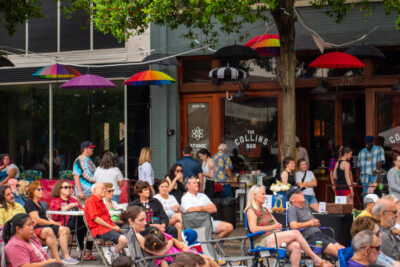
A crowd enjoys opera at an Opera Shots street party (Opera Birmingham/Contributed)
“If you expose children to opera at an early age, they grow up enjoying opera,” Walter says. “A family brought their four kids. The mom said she would have never gotten them all in a theater. But here, they could break out the picnic blanket and snacks in a welcoming atmosphere.”
Even through the Covid shutdown, this unstoppable opera company rolled out a flatbed truck and created a stage in their parking lot. The makeshift stage has traveled to several pop up places where opera had never been heard and remains on stand-by for future venues.
The singers come from a variety of sources. Some are visiting artists in town for a big show. Others belong to the company chorus. Some are opera students at Samford University or the University of Alabama. They each take a song or two and sing in turn from whatever serves as a stage, or just from a mic stand in the front of the bar. Occasionally, a duet may pair a couple of singers.
The songs range from high opera to musical theater to art songs. It’s an opportunity for singers to share a favorite such as the “Marriage of Figaro” by Mozart or “Let It Go” from the popular animated movie “Frozen.” Songs have been performed from “Le Boheme,” “Carousel,” Cole Porter, “Into the Woods,” and the film “Moana.”
Full operas stepped outdoors when Opera Birmingham performed the “Pirates of Penzance” in Avondale Park to sold-out audiences. “Three Little Pigs” followed for kids in the park’s amphitheater. Two popular events are the Sounds of the Season, holiday music, and an annual Vocal Competition that attracts rising stars from all over the country.

A performance of Opera Birmingham (Stewart Edmonds/Opera Birmingham Facebook)
While Opera Birmingham indulges in the rich heritage of opera with traditional shows such as “La Traviata,” “Tosca” and “The Barber of Seville,” it also steps out of its silk shoes into contemporary topics. Performances have addressed issues such as prisoners of war, unknown soldiers and Civil Rights. January’s “dwb (driving while black)” took a backseat to Covid but will return later on the real stage. This production stands as part of the Birmingham Speaks initiative to generate conversations out of the collision of life and art.
The outreach has successfully brought in new fans to productions. “We are seeing the next generation of opera patrons in the audience,” says Walter. “We will continue branching out.”
Opera Shots run monthly in spring and fall. If you are enjoying a drink and hear a voice strong enough to make the walls expand, it might just be opera. Give it a listen, you might find out the champagne of music could become your drink of choice.
(Courtesy of SoulGrown)
DOTHAN, Alabama — Officials in Dothan have formally kicked off a project to build a 100,000-square-foot speculative building in the Sam Houston Industrial Park to better prepare the Southeast Alabama city for industrial prospects.
The building will be located on a 41-acre site called Lot 3 in the platted industrial park at 102 Austin Court. Construction on the new building is scheduled for completion in Fall 2022.
Greg Canfield, Secretary of the Alabama Department of Commerce, said having available building for prospects is needed to continue to spur economic development. Studies indicate that 85% of companies with projects are seeking existing buildings as opposed to greenfield development.
“The availability of quality-sized buildings in Alabama needs to be expanded, so seeing the Dothan-Houston County area spearhead this new addition to the state’s building inventory is a big enhancement to continue Alabama’s growth in the industrial development arena,” Secretary Canfield said.
“We commend all the state, county, city and business leaders working together to put this facility in place to create future opportunities for the Wiregrass region.”
The project was officially launched this week with a groundbreaking ceremony attended by officials from the city of Dothan, the Houston County Commission, the city’s Industrial Development Board, the Dothan Area Chamber of Commerce/Grow Dothan, and others.
TARGETING GROWTH
The spec building will be a finished shell building with only a few elements needed for completion, including flooring, electrical, sprinkler system and dock/drive-in doors based on the customized needs of the prospect.
“This project continues to showcase the partnerships we have in our area from the local to state levels, to work collaboratively to enhance economic development progress for our area and continue to create employment opportunities for our residents,” Dothan Mayor Mark Saliba and Houston County Commission Chairman Mark Culver said in a joint statement.
The building will be expandable to add another 100,000 square feet, with 25’-by-50’ column spacing, and a 32-foot eave height. It will be served by Dothan Utilities (Alabama Municipal Electric Authority) with water, sewer and electric service. Natural gas service will be by Southeast Gas and telecommunication providers will include Troy Cable, WOW!, Spectrum and CenturyLink.
“This approximately $4 million project would not be possible without the teamwork of many entities to develop this project to lure more manufacturing or distribution related operations into the area,” said Brad Kimbro, chairman of the Dothan Area Chamber of Commerce.
“Projects like this take on certain risks and there are no guarantees but based on our rich history of undertaking past speculative building projects we are convinced this is the right time and place to move ahead.”
This project represents the fifth speculative building developed in the Dothan area to spur economic activity, with the size of buildings varying in size from 40,000 square feed to now 100,000 square feet.
“We have a great team and we all work together collaboratively to focus on the needs of our area and this project exemplifies the continued teamwork we have in our area,” State Rep. Dexter Grimsley said.
(Courtesy of Made in Alabama)
The four finalists at the recent 7th annual Alabama Seafood Cook-Off at The Lodge at Gulf State Park gave the five esteemed judges a difficult task in determining who will represent the state in the Great American Seafood Cook-Off in New Orleans.
With a variety of creative dishes to sample, the judges voted the more traditional fare as the top creations, awarding Jeffrey Compton of Homewood’s The Battery restaurant the $2,500 top prize.
This year’s Cook-Off judges were Jim Smith, chairman of the Alabama Seafood Marketing Commission and Executive Chef at The Hummingbird Way; Steve Zucker of Bob Baumhower’s Aloha Hospitality restaurants; Chris Nelson, Vice President of Bon Secour Fisheries, Inc.; Jason Burnett, founder of Oyster Obsession and digital director of Flower magazine; and Chef James Balster, Executive Chef of The Lodge at Gulf State Park.
The contestants had one hour to prepare their dishes, and the presentations were awarded up to 20 points each in five categories: presentation, general impression and serving methods; creativity and practicality; composition and harmony of ingredients; correct preparation and craftsmanship; and flavor, taste and texture. The teams started preparing the dishes at five-minute intervals to allow the judges to taste the dishes at peak readiness.
Compton’s winning Butter-Poached Redfish consisted of Alabama redfish, new potato blue crab salad, late spring vegetables, lemon aioli and garden herbs.
Compton, who was assisted by Kyle Kirkpatrick, grew up in the Florida Panhandle and went to Auburn University to continue his education. However, he was lured to the kitchen of Acre restaurant in Auburn and developed his meal preparation skills before opening a new restaurant in the Birmingham suburb.
“I grew up in Destin working on the beach, so I’ve always been around redfish,” Compton said. “I used redfish because it still has that white meat, but it’s a little firmer. That’s why I poached it in butter. I plated with a nice, light blue crab and potato salad. I thought those two paired well for balance.”
Cook-Off emcee Pete “Panini” Blohme said Morgan McWaters’ presentation “screamed Alabama” and was deemed runner-up in the competition.
McWaters, head chef at The Depot in Auburn, prepared a dish called Fried Green Snapper, which combined green tomatoes, Gulf red snapper, spicy creamed corn, jumbo crab, Granny Smith apple and red cabbage slaw, and Alabama white sauce.
“I really wanted to highlight fried green tomatoes, and I wanted to do it in a way to bring it to the next level,” said McWaters, who was assisted by Blaze Farrell. “I decided to wrap red snapper. That’s where the inspiration came from. I pan-seared my red snapper. I took it off and wrapped it in green tomatoes. I dipped it in buttermilk and coated it with a flour-cornmeal mixture and deep fried it.
“When I think of Alabama, I think of fried green tomatoes. I used red snapper because it has a mild, white flesh.”
Sam Adams of (small batch) pop-up tasting events in Birmingham offered her Seafood Tamal dish that was prepared with Alabama Gulf blue crab, black garlic masa, shrimp stock, fermented corn, shrimp pico de gallo, oyster emulsion with candied habaneros and local radishes.
“I made this because I thought it was very different, and Hispanic cuisine is near to my heart,” said Adams, who was assisted by Liz Brody. “I added the crab to the tamal with some tomatillos and jalapeños with vinegar to add some super bright acid to stand against the rich black garlic. We used beautiful Royal Red shrimp in the pico to get the richness from the shrimp. And the oyster emulsion is just a full, creamy experience in terms of textures.”
Robbie Nicolaisen of The Hound restaurant in Auburn presented an Asian twist in his seafood dish of Binchotan Grilled Cobia, which consisted of Alabama Gulf cobia, Chubby Belly XO glaze, crab fat rice middlins, green tomato dashi, nuoc cham braised cabbage and collard green togarashi.
“Every component in the dish has some influence from the ocean,” said Nicolaisen, who was assisted by Fernando Justiniano.
Judge Chris Nelson, whose family has been in the seafood business since the late 1880s, said it was a difficult task to determine the best dishes in the competition, and the winners were chosen by razor-thin margins.
“I thought it was a great representation of all the seafood products we have available here on the Gulf Coast, especially here in Alabama,” Nelson said. “I particularly liked the shrimp dishes, but I’m a little biased in that direction. The fish was excellent. Everything was prepared really, really well. I was impressed because the environment they had to cook in was probably not at all what they would normally prepare these dishes in.
“All my scores were within a point of each other. I had a tie, and they asked us to rank it to break the tie. I made a call on how practical the ingredients were. Some of the preparations were really complicated, so that detracted a little bit. But it all tasted wonderful.”
Scott Simpson, Executive Chef and co-owner of The Depot in Auburn, was the 2021 Cook-Off winner. Simpson’s winning dish last year combined pan-seared Gulf yellow edge grouper and Gulf shrimp with poblano chiles, sweet corn and Conecuh bacon risotto with cilantro crema.
“Everything was really delicious with beautiful presentations all the way around,” Simpson said as he presented the winners. “What a great group of competitors and culinarians to represent Alabama. It just shows the level of young talent the state is developing. It’s very encouraging.”
Chris Blankenship, Commissioner of the Alabama Department of Conservation and Natural Resources, oversees the Alabama Seafood Marketing Commission, which was established in 2011 to promote Alabama’s seafood resources. Commissioner Blankenship was pleased with the competition and support from all who enjoy Gulf seafood.
“It was great to have the competition at The Lodge at Gulf State Park,” Commissioner Blankenship said. “We have all these great chefs right at the edge of the Gulf of Mexico, taking these fine Alabama seafood products, preparing them with other Alabama products, like produce and fruit. When they use their creativity and talent to put that together in a dish, you know it’s going to be spectacular.
“I think all four of the participants really did a great job. They had a tough time picking a winner. But Jeffrey Compton prepared a great dish, and he’s going to represent us in New Orleans against the other states in August to try to be king of American seafood.”
David Rainer is an award-winning writer who has covered Alabama’s great outdoors for 25 years. The former outdoors editor at the Mobile Press-Register, he writes for Outdoor Alabama, the website of the Alabama Department of Conservation and Natural Resources.
Friday evening, former President Donald Trump announced his endorsement of Republican Katie Britt in Alabama’s 2022 race for the U.S. Senate.
The endorsement comes just 11 days out from the June 21 GOP primary runoff election.
In a statement announcing the endorsement, Trump railed against U.S. Rep. Mo Brooks (R-Huntsville), who lost the 45th president’s endorsement in late March.
“Last year I endorsed Mo Brooks for the U.S. Senate because I thought he was a Fighter, especially when it came to the Rigged and Stolen Presidential Election of 2020,” Trump’s statement began. “The evidence is irrefutable. Then, out of nowhere, and for seemingly no reason, Mo backtracked and made a big mistake by going Woke at our massive Cullman, Alabama Rally.”
According to Trump, Brooks drew his ire when the congressman told rally attendees to “look ahead” to the midterm elections rather than mourn the 2020 presidential election results, which prompted the endorsement to be rescinded seven months later.
“Instead of denouncing the Voter Fraud in the Election, Mo lectured the crowd of 63,000 people saying, ‘Put that behind you, put that behind you,’ meaning that, in effect, forget the Rigged Election and go on to the future,” lamented the former president. “The problem is, if you do that, it will happen again. Also, why do Republicans allow Democrats to get away with rigging and stealing elections?”
Trump continued, “Mo was strongly booed by tens of thousands of Great Alabama Patriots for abandoning his constituents, and what they know to be true about the Election Fraud. He foolishly started listening to the wrong consultants and not to the people, and his 54-point lead evaporated overnight. Likewise, his words caused me to withdraw my Endorsement, and Mo has been wanting it back ever since—but I cannot give it to him!”
Trump pushed back against Brooks’ claim that Britt held the support of Senate Minority Leader Mitch McConnell (R-Ky.).
Instead, the 45th president indicated that he believed U.S. Army veteran Mike Durant, who finished third in the May 24 primary election, could have been McConnell’s favored candidate.
“Katie Britt, on the other hand, is a fearless America First Warrior,” proclaimed Trump. “The opposition says Katie is close to Mitch McConnell, but actually, she is not—in fact, she believes that McConnell put Mike Durant in the race to stop her, which is very possibly true.”
He then touted Britt for her former service as head of the Business Council of Alabama, the state’s largest business advocacy organization.
“Katie is an Incredible Fighter for the people of Alabama,” advised Trump. “As President and CEO of Alabama’s Business Council, Katie has been working hard to Grow Alabama’s Economy, Create Jobs, and Restore the Great American Dream. She has the Total Support and Endorsement of Chairman Jimmy Parnell and the Alabama Farmers Federation.
He added, “The proud mother of two wonderful children, Katie, along with her great husband, Wesley, a Star at the University of Alabama and the New England Patriots, are True Champions for the American Family. Katie Strongly Supports our under siege Second Amendment, Stands Up for Parental Rights, and Will Fight for our Military, our Vets, and Election Integrity.”
“Above all, Katie Britt will never let you down. So Get Out and Vote for Katie Britt on June 21st in the Alabama Senate Runoff—she has my Complete and Total Endorsement!” concluded Trump.
In reacting to the endorsement, Britt expressed gratitude to Trump and stated her intentions of advancing the “America First agenda” as Alabama’s junior senator.
“I’m thankful to have President Trump’s endorsement and strong support,” said Britt in a statement. “President Trump knows that Alabamians are sick and tired of failed, do-nothing career politicians. It’s time for the next generation of conservatives to step up and shake things up in Washington to save the country we know and love for our children and our children’s children. In the Senate, I will fight to defend Alabama’s Christian conservative values, advance the America First agenda, and preserve the American Dream for generations to come.”
According to a poll released earlier on Friday by the Alabama Forestry Association (AFA), which was conducted by Trump-favored polling firm McLaughlin & Associates, Britt holds an 18-point lead over Brooks.
Dylan Smith is a staff writer for Yellowhammer News. You can follow him on Twitter @DylanSmithAL
The Alabama Department of Conservation and Natural Resources (ADCNR) announced that Matt Young of Gulf Shores, Alabama, has been named Southwest District Superintendent for ADCNR’s State Parks Division.
In addition to managing daily operations at Gulf and Meaher state parks, Young will work closely with State Parks staff and community leaders to strengthen local partnerships and promote both parks as world-class vacation destinations.
Young said he is honored for the opportunity.
“As a frequent visitor to Alabama’s State Parks, I know firsthand what a dedicated staff they have,” he said. “I am grateful to Director Lein for providing me with this opportunity to lead such a talented team. I look forward to serving one of the best state park systems in the country and strengthening the local partnerships that benefit Gulf and Meaher state park guests.”
Prior to joining the ADCNR’s State Parks Division, Young served as Assistant Director of Recreation and Cultural Affairs for the City of Gulf Shores where he supervised department staff, oversaw the operation of public beaches and other recreational facilities, developed partnerships with local and regional organizations and businesses, and helped develop and implement the city’s parks and recreation master plan. Young has also served as Commissioner of the City of Gulf Shores Planning Commission since 2019.
Young earned a Bachelor of Science in anthropology from the University of Arizona and a Master of Science in recreation and park administration from Eastern Kentucky University. Originally from California, he has lived in Gulf Shores since 2015.
“We are excited to have Matt as Southwest District Superintendent for our State Parks Division,” said Chris Blankenship, ADCNR Commissioner. “He brings a wealth of knowledge and experience to this position. We look forward to the benefits his leadership will bring to these parks.”
Young joins the Alabama State Parks Division as Gary Ellis, Gulf State Park’s Director of Community Relations and Administration, retires.
Ellis served as community liaison for Gulf State Park since 2019 until retiring in June 2022. During his tenure, he helped coordinate the establishment of a world-class lodge at the park, assisted in the planning for new park amenities and worked to position the park as an international ecotourism destination.
“Gary has been a key player in our modernization efforts at Gulf,” said Greg Lein, State Parks Director. “He helped paved the way for many future improvements at the park. We thank him for his service to the state of Alabama and wish him an enjoyable retirement.”
Throughout his career, Ellis provided leadership to organizations across the Southeast, including founding hospitality-focused Compass Media, and co-founding the Coastal Resiliency Coalition and the Gulf United Metro Business Organization. Ellis is a member of the Alabama Hospitality Hall of Fame and received the Alabama Governor’s Tourism Award in 2009.
“I’ve been fortunate to serve the people of coastal Alabama for more than 45 years,” Ellis said. “As a lifelong resident of Gulf Shores, I have dedicated my career to promoting the area as a great place to visit while encouraging environmental sustainability. I am grateful for the opportunity to have done so with Alabama State Parks.”
Former Business Council of Alabama CEO Katie Britt holds a comfortable lead over U.S. Rep. Mo Brooks (R-Huntsville) with under two weeks to go until the U.S. Senate GOP primary runoff election, according to a recent survey conducted by nationally renowned polling firm McLaughlin & Associates.
The poll, which was commissioned by the Alabama Forestry Association (AFA), was conducted June 6-9 and consisted of 500 likely Republican primary runoff voters. Respondents were surveyed evenly between landline, cellphone and text message.
Poll results are as follows:
- Katie Britt: 54.6%
- Mo Brooks: 36.4%
- Undecided: 9%
Alongside holding an 18-point lead on the ballot test, Britt’s favorability among the Republican electorate is 23.4% higher than that of Brooks’.
The poll’s findings show that 61.4% of respondents hold a favorable view of the first-time candidate, while 49.0% view the six-term congressman as favorable.
Regarding negatives, 29% of participants hold an unfavorable view of Britt compared to Brooks’ 40.2%.
The most recent McLaughlin & Associates survey conducted prior to the May 24 primary contest showed Britt and Brooks at 37.4% and 25.2%, respectively. Compared to the firm’s poll made publicly available Friday, Britt has gained 17.2% support compared to Brooks’ 11.2%.
The comparison suggests that Brooks will need to garner more support from the primary’s third-place finisher, U.S. Army veteran Mike Durant, to close the gap with Britt. According to the poll, 16% of respondents voted for Durant in the primary election.
McLaughlin & Associates, which released numerous polls leading up to the May 24 contest, emerged as the most accurate pollster during the Republican U.S. Senate primary.
Britt and Brooks will meet for a final time in the June 21 Republican primary runoff election. The GOP nominee for the seat held by retiring U.S. Sen. Richard Shelby (R-Tuscaloosa) will face off against the Democratic Party’s nominee in the November 8 general election.
Dylan Smith is a staff writer for Yellowhammer News. You can follow him on Twitter @DylanSmithAL
Friday, Republican U.S. Senate hopeful Katie Britt announced that her campaign had landed the endorsement of the Alabama Rural Electric Association of Cooperatives (AREA).
AREA is a member-owned federation that consists of 22 electric distribution cooperatives across the state.
Sean Strickler, AREA vice president for public affairs, stated that Britt would prove herself to be a “champion for rural Alabama” as a member of the U.S. Senate.
“Alabama’s electric cooperatives are happy to endorse Katie Britt to serve as the next United States Senator for Alabama,” said Strickler in a release. “Katie has a proven record of fighting to grow good-paying jobs and 21st century opportunity in every corner of our state, and we know that she will be a champion for rural Alabama in the Senate. From expanding high-speed broadband internet access to supporting Main Street in our rural communities, Katie Britt is the clear choice for Alabama families and Alabama’s future.”
In touting AREA’s endorsement of her candidacy, Britt pledged to serve the interests of rural Alabama in the upper chamber and ensure that “no community in our state is forgotten.”
“I’m honored to have the support of Alabama’s electric cooperatives. Over the past 12 months, we have traveled to all 67 counties across Alabama to share our message, listen to hardworking families, and answer their questions,” noted Britt. “The incredible reception we’re seeing in every corner of our state shows that Alabamians clearly know that I am the best candidate to defend Alabama’s values, families, and small businesses. I’m proud to be from the Wiregrass, and I’ll fight for rural Alabama in the Senate, ensuring no community in our state is forgotten.”
She concluded, “It’s time for the next generation of conservatives to step up and save the country we know and love for our children and our children’s children. As Alabama’s next U.S. Senator, I’ll work to ensure every hardworking Alabamian has the opportunity to achieve the American Dream, regardless of their zip code.”
Britt will face U.S. Rep. Mo Brooks (R-Huntsville) in the June 21 GOP primary runoff election. The candidate who receives the GOP nod will face the Democratic Party’s nominee in the November 8 general election to determine who will replace retiring U.S. Sen. Richard Shelby (R-Tuscaloosa).
Dylan Smith is a staff writer for Yellowhammer News. You can follow him on Twitter @DylanSmithAL
MSNBC’s Chris Hayes brought U.S. Rep. Mo Brooks (R-Huntsville) on his “All In” program to discuss the January 6 committee ahead of its primetime television spectacular. Hayes used the time to cover all the old tropes about that day with no new ground covered.
Towards the end of the interview, Brooks challenged the host to a debate on the 2020 election to discuss allegations of fraud and malfeasance by elected officials overseeing those elections.
Not surprisingly, Hayes wanted nothing to do with that conversation.
Watch:
Dale Jackson is a contributing writer to Yellowhammer News and hosts a talk show from 5-9AM weekdays on WVNN and on Talk 99.5 from 10AM to noon.
State Rep. Wes Allen (R-Troy), a candidate for Alabama Secretary of State, released his campaign’s second television advertisement of the 2022 GOP primary election cycle on Friday.
In the 30-second spot, titled “Experience,” Allen touts his record of elections administration as a former Pike County probate judge. Additionally, the conservative lawmaker outlines his successful legislative efforts to defeat the Democratic Party’s recent attempts to install liberal election laws.
“I’m Wes Allen, and I’m running to be Alabama’s next Republican secretary of state,” says Allen in the ad. “As a probate judge, I administered more than a dozen elections without a single error. And when liberals tried to establish curbside voting in Alabama, I sponsored and passed a bill to ban it permanently. And when Democrats tried to pass no-excuse absentee voting, I fought it and won. I’m Wes Allen, and I have the experience and passion to be the next secretary of state and I’m asking for your vote.”
Watch:
If elected, Allen stated his intentions to pull Alabama’s membership from the Electronic Registration Information Center (ERIC), which he contended held connections to leftist billionaire George Soros.
A piece of election security legislation Allen has pledged to promote as secretary of state would be to ensure that no voting machine in Alabama can be connected to the internet or Bluetooth.
Allen will face State Auditor Jim Zeigler in the June 21 Republican Party primary runoff election to determine who will replace term-limited Alabama Secretary of State John Merrill. The GOP’s nominee will have no Democratic Party opposition in the November 8 general election.
Dylan Smith is a staff writer for Yellowhammer News. You can follow him on Twitter @DylanSmithAL