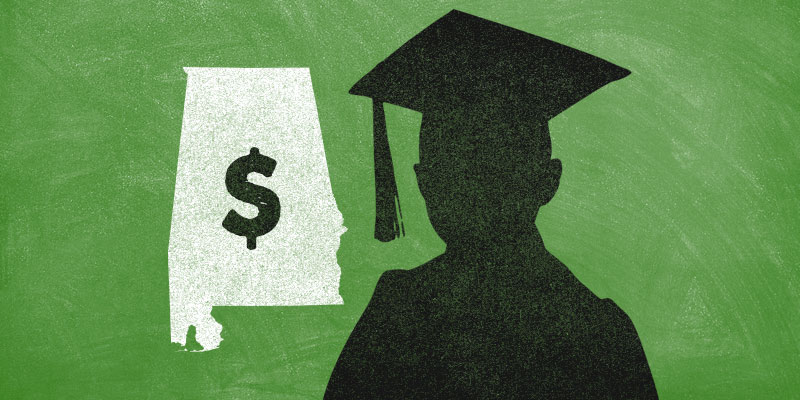
Though the Alabama legislature passed and Governor Kay Ivey signed into law a record Education Trust Fund budget for Fiscal Year (FY) 2020, the total state appropriation to public colleges and universities will still be considerably lower than the pre-recession high.
The FY 2008 education budget allocated $1,382,849,588 to the state’s public four-year higher education institutions, while the same appropriation this time around was $1,203,909,819. This means that four-year colleges and universities in FY 2020 will receive approximately 13% less than they did in FY 2008 on average.
Factoring in inflation, the difference is even more profound.
Additionally, when taking into account the growth in enrollment these four-year institutions have experienced during the same time frame, the numbers are staggering.
The Center on Budget and Policy Priorities even recently wrote that Alabama’s per-student state funding for higher education in the decade following the Great Recession “fell by more than 30 percent.”
In the fall of 2009, the total full-time enrollment for Alabama’s four-year schools was 126,185. In fall of 2018, that number had risen to 145,883 — an increase of nearly 14%.
While funding has ticked back up gradually since the recession, with the main exception of FY 2013, funding per-student has still lagged, even in recent years. For example, from the 2014-2015 academic year to the 2017-2018 academic year, per-student funding dropped 2% when adjusting for inflation.
However, the story is not quite the same for the Alabama Community College System.
The total appropriation for the state’s two-year institutions was $416,931,242 in FY 2020. This represents a marginal 2% total drop in funding from FY 2008.
The community college system’s recent recovery in funding deviates from four-year institutions, too.
From FY 2011-FY 2020, two-year schools received a 27.37% increase in appropriations from the state while four-year institutions saw a lesser increase of 17.83% during that same time period.
What stands out most from the numbers, though, is the enrollment trend in Alabama’s community colleges. Every two-year institution in the state had less full-time students enrolled in the fall of 2018 than they did in the fall of 2010.
Across the board, the community college system’s total full-time enrollment has dropped from 67,338 to 50,822 students in that time frame. So, while state funding for two-year schools has ticked upwards, enrollment has fallen by approximately 25%.
This signifies a surge in per-student funding for two-year schools.
In the 2010-2011 academic year, community college students were each matched with $6,785 in state appropriations. In 2017-2018, this number had risen to $9,196 per student.
Despite the differing trends between four- and two-year schools, the higher education community as a whole still clearly has one goal in common: to return to the pre-recession apportionment ratio between k-12/other and postsecondary.
Now, higher education only gets approximately 25% of the Education Trust Fund budget. This is significantly down from the 33% share of funding that was par for the course just over a decade ago.
With fall 2019 classes set to start this month across the Yellowhammer State, these data trends could get a closer look from policymakers moving forward.
Sean Ross is the editor of Yellowhammer News. You can follow him on Twitter @sean_yhn