Longtime benefactor Hugh F. Culverhouse Jr. has gifted the first endowment to support The University of Alabama School of Leadership and Policy through the Hugh F. Culverhouse Jr. Endowed Professorship in Leadership and Policy.
Culverhouse’s $500,000 gift will help the School attract and retain nationally recognized scholars and experts in public policy and leadership. The endowment is pending approval by The University of Alabama System Board of Trustees in February.
The School of Leadership and Policy will offer undergraduate and graduate degrees in the fields of public policy and leadership starting fall 2027. Its interdisciplinary, practice-oriented education will prepare students to engage in civic life and government by focusing on foundational principles shaping laws and discourse.
Through internships and community projects, they will encounter diverse viewpoints and organizations, gaining the skills needed to tackle complex challenges and develop effective solutions.
“This is a school where you’re emphasizing thoughtfulness and solutions,” Culverhouse said. “That appeals to me tremendously.”
Culverhouse’s support of the School’s mission to prepare students to become effective leaders, policymakers and public servants for the state of Alabama and beyond inspired his investment, as well as the leadership displayed by former Sen. Richard Shelby and Sen. Katie Britt, both UA alumni.
“This has the promise of changing the world for the better,” he said. “It’s an honor to invest in the future of the School and have the first endowed gift — it won’t be the last.”
Culverhouse’s endowed professorship at the UA School of Leadership and Policy continues nearly 13 years of charitable giving across UA’s campus, now totaling more than $20 million.
“Hugh and his wife, Eliza, are an incredible example of generosity. For their philanthropy to the University to cross the $20 million mark, and for it to have touched so many areas of campus, is truly remarkable. We are grateful to have them in the UA family,” said Vice President for Advancement Bob Pierce.
- The Eliza and Hugh F. Culverhouse Endowed Student Assistance Scholarship, which has awarded more than $2.8 million to 227 students, who are called Two Iron Club Scholars, since 2014.
- A $3 million gift to name the dance theater in the Smith Family Center for the Performing Arts in Eliza’s name.
- A $250,000 contribution to create the Eliza P. Culverhouse Graduate Support Fund in Dance, which supports graduate students in the dance Master of Fine Arts program in furthering their craft.
- Support for the UA women’s golf program through the Joy McCann Culverhouse Endowed Women’s Golf Scholarship in honor of Hugh’s mother, who played golf at UA.
“Whether it’s the ballet theater, the Two Iron Club Scholarship in the business college, the women’s golf team or the new golf course, our support aims to improve the entire university,” Culverhouse said. “And the professorship in the School of Leadership and Policy gives me something that I want to grow. This $500,000 is just the beginning.”
Courtesy of The University of Alabama.
The University of Alabama now offers TSA PreCheck® enrollment services provided by CLEAR, an official TSA PreCheck® enrollment and renewal provider, at the UA Passport Acceptance Facility, making it the only location in Tuscaloosa County and the first college campus in Alabama to provide the service.
Beginning Dec. 3, students, faculty, staff and community members can complete the enrollment process during regular passport facility hours, Monday-Friday, 9 a.m.-4 p.m. Individuals can now start the pre-enrollment process and book an appointment.
“This is an exciting opportunity to serve both our campus community and Tuscaloosa as a whole,” said Campus Mail Executive Director Stacy Vaughn.
“Providing access to TSA PreCheck® on campus means easier travel preparation and greater visibility for UA as an innovative leader.”
TSA PreCheck® members benefit from the convenience of keeping shoes, belts and light jackets on during the security checkpoint process.
They can also leave electronics and 3-1-1 compliant liquids in their carry-on bags. Members generally experience faster security screening, with about 99% of them waiting less than 10 minutes at airport checkpoints nationwide.
Participants may pre-enroll online before visiting the UA passport facility to finalize their enrollment.
A U.S. passport or other accepted form of identification is required. No appointment is necessary, and enrollment can be completed quickly in person.
UA joins only a handful of universities nationwide to provide this service, boosting its role as a hub for community resources.
For more information about TSA PreCheck® enrollment at UA, visit the Passport Acceptance Facility website.
Courtesy of The University of Alabama.
Alabama Athletics announced today a five-year renewal of Regions Bank’s sponsorship, elevating the long-standing relationship to Champion Partner in an agreement secured by Crimson Tide Sports Marketing.
The enhanced agreement provides a first-of-its-kind support for Crimson Tide student-athletes with name, image and likeness opportunities and an elevated presence and visibility for Regions around Alabama Athletics and forums.
In addition, the bank will deliver more financial education resources and expand opportunities for student-athletes to receive a customized Regions Greenprint plan that creates a personalized roadmap to help reach their financial goals.
In this new era of college athletics, Regions is providing more and more student-athletes with opportunities to work toward their financial goals. In the coming year, Regions has several events planned for student-athletes with more to come.
“Regions Bank is a leader in helping people build financial confidence, and our experience shows that the earlier a person can get started with their financial goals, the better prepared they are to meet challenges and opportunities that are ahead,” said John Jordan, head of Retail for Regions.
“For student-athletes, this is a pivotal time in their lives, and our branch associates are ready to come alongside with them to prepare for life after college. We are proud to expand our relationship with student-athletes at Alabama, and we look forward to bringing more resources to campus soon.”
The Champion Partner designation represents the highest tier with Alabama Athletics and Crimson Tide Sports Marketing. Regions’ elevated commitment underscores its deep presence across campus, within Tuscaloosa, and across the Southeast.
The agreement between Alabama Athletics and Regions includes:
- Gate signage at Saban Field at Bryant-Denny Stadium, welcoming fans to the home of Crimson Tide football
- Exclusive usage of the Football Radio Booth Cam, a behind-the-scenes feature connecting fans to the action
- Title sponsorship of a Crimson Tide football game
- Community events with appearances by Big Al, the Crimson Tide mascot, and cheer squad
“Regions and Alabama Athletics have been a team for many years, and we are proud to expand our relationship into a new era,” said Paul Hodges, Senior Vice President, Sponsorships and Experiential Marketing Manager for Regions.
“We are honored to play a leading role in helping student-athletes navigate the complicated and changing landscape of NIL while delivering the guidance and advice to help prepare them for the future. Whether on the field or in the classroom, there is great excitement and tradition at Alabama, and Regions is a key part of making it memorable.”
“Regions has been a valued partner of Alabama Athletics for more than 20 years, and we’re proud to see this relationship continue to grow,” said Todd Kucinski, Director of Business Development for Crimson Tide Sports Marketing.
“By investing in premium assets across our most visible platforms – and adding NIL for the first time – Regions is demonstrating its belief in Alabama Athletics, our fans, and our student-athletes in bold and meaningful ways.”
Crimson Tide Sports Marketing, the locally based team of Learfield – the media and technology company powering college sports – is the exclusive multimedia rights holder for University of Alabama Athletics and oversees all sponsorship agreements on behalf of the Crimson Tide.
Courtesy of The University of Alabama.
After a career dedicated to public service at The University of Alabama, Dr. Samory Pruitt, vice president for the Division of Community Affairs, plans to retire effective June 1, 2026.
At the time of his retirement, Pruitt will have served the University for 40 years and led the Division of Community Affairs since its creation in 2004. Then-president Dr. Robert E. Witt gave him the charge to create an administrative unit that would help UA fulfill its mission of working to improve the lives of those in Alabama and beyond through innovative efforts that integrated teaching, research, and service.
“It is time to wind down this chapter of my life, and while I look forward to this next chapter with family and friends, my service to others and the community will continue,” Pruitt said. “It has been an honor to serve alongside so many individuals in helping weave the University’s mission into the fabric of our community.”
RELATED: Dr. Stuart Bell retiring as University of Alabama president after decade of service to Capstone
Under his leadership, the division has grown to include the administrative offices, the Center for Community-Based Partnerships, and the Crossroads Civic Engagement Center, which collectively operate nearly two dozen programs and initiatives. Providing opportunities for students to engage in this work is important to its mission, so the division supports 10 graduate assistants, several undergraduates, multiple work-study students, and a host of student volunteers who work closely with the staff.
“I am thankful and grateful for the opportunities I have had to work with such amazing colleagues in the Division of Community Affairs. They are the best people and are the best at what they do. I am very proud of what we have accomplished together. We are all excited and believe that this upcoming year will be one of our best,” said Pruitt, who, along with two retired deans and others, will complete a methods book this fall based on the four “R’s” of community-engaged scholarship: relevance, reciprocity, research, and resilience.
Pruitt’s innovative approaches, service leadership mindset, and caring spirit have made him a respected figure in the field of engaged scholarship on an international stage. His vision led to the creation of the Journal of Community Engagement and Scholarship, a leading, peer-reviewed journal in the field of community-engaged scholarship. He continues to serve as publisher, and the publication is produced and printed at UA.
RELATED: Dr. Peter Mohler named as 30th President of The University of Alabama
“Over his decades of service, Dr. Pruitt has left a truly lasting mark on the University and the broader community through his tireless dedication to public service and community engagement,” said President Stuart R. Bell. “His contributions have positively influenced countless lives.”
Pruitt’s and the division’s outreach and public service have had a tremendous impact throughout the broader Tuscaloosa community, the Black Belt region, and across the state.
The division was recently recognized for this accomplishment and many others in resolutions by the Alabama Senate and House of Representatives, marking the 20th anniversary of the division in 2024. Notable among them are:
- The creation, in 2006, of the Crossroads Community Engagement Center, now the Crossroads Civic Engagement Center, to help teach skills for improved, sustained dialogue, as well as civic and community leadership efforts that help prepare the next generation to become informed, productive citizens.
- The creation, in 2007, of the Center for Community-Based Partnerships and its Council on Community-Based Partnerships.
- The Center houses a variety of programs focused on community education, partnerships for community engagement, global and community engagement, and community engagement research and publications. All provide UA with opportunities to support K-12 education and community-identified efforts, as well as learning opportunities for UA students and teaching and research opportunities for faculty and staff.
- Some of the programs and initiatives include:
- the Parent Teacher Leadership Academy, involving six Alabama school districts;summer enrichment programs such as the BLAST Academy, Swim to the Top and the STEM Entrepreneurship Academy;the Vision Days student recruitment program;the SCOPE (Scholars for Community Outreach, Partnership, and Engagement) student organization; andthe New Faculty Community Engagement Tour, established in 2017, as well as the Undergraduate Student Community Engagement Tour, begun in fall 2024.
- Some of the programs and initiatives include:
- The Council is comprised of faculty, staff, students, and community partners. It provides recognition and funding support for exemplary community-engaged scholarship efforts, including the provision of seed funds, graduate assistantships, travel funds, and award recognition funds.
- The Center houses a variety of programs focused on community education, partnerships for community engagement, global and community engagement, and community engagement research and publications. All provide UA with opportunities to support K-12 education and community-identified efforts, as well as learning opportunities for UA students and teaching and research opportunities for faculty and staff.
- Leading the efforts, in 2008, for UA to be invited to become the sixth U.S. higher education and first non-land-grant institution to become a member of the Engagement Scholarship Consortium, which now includes 57 institutions throughout the U.S. Its annual international conference in 2012 was hosted in Tuscaloosa by UA, drawing 619 attendees and making it the largest scholarly conference held on the UA campus.
- The creation of the Global Café and Language Partners program, which offered UA students opportunities to pursue study abroad through the Fulbright program which led to UA becoming a Top Student Fulbright Producing Institution for the first time in 2016. UA has achieved this distinction eight times in the last 10 years as of February 2025.
- The creation of the Winning Grants and Sustaining Communities Program in 2016 with renowned grant trainer Dave Bauer. The program is designed to help faculty, staff, community partners, and students acquire the skills to successfully write and submit grants in support of efforts to improve the quality of life for those in Alabama and beyond. To date, it has led to the acquisition of grants totaling more than $100 million in support of community-university partnerships.
- Established in 2016, the Community Affairs Board of Advisors, which is comprised of outstanding UA alumni who were student servant leaders as undergraduates and who have become leaders in their respective professions and communities. The membership chose as its motto, “Coming Back, Giving Back,” and supports the University through its time, through the mentoring and recruitment of students, and through its endowment of scholarships and committee support funds to support students both present and future.
- In 2019, after reviewing some of the division’s accomplishments, President Emeritus Witt wrote, “You have been on a remarkable 15-year journey, my friend. Your leadership and dedicated efforts have made the Community Affairs Division an invaluable asset to our university, our community, our state, and the country.”
During his career at UA, Pruitt has also had opportunities to lead and support efforts that helped bring together UA alumni and community partners to share and celebrate UA’s rich history.
In 2003, he led the successful Opening Doors program that marked the 40-year anniversary of the “Stand in the Schoolhouse Door.” In a thank you letter from the late Vivian Malone Jones to Pruitt in 2004, she wrote, “Please accept my sincere and heartfelt appreciation for your dedicated efforts in making a dream come true for me and my family and the thousands of Americans of all races and nationalities as we celebrated the 40th anniversary of the opening of higher education to African Americans who had been denied admission to our great University for so many years.”
Pruitt was also involved in the visioning and planning for the Autherine Lucy Clock Tower and the Malone-Hood Plaza, and the historical marker for Autherine Lucy Foster in 2017. He has led the UA United Way Campaign, as well as the Realizing the Dream initiative involving UA, Stillman College, Shelton State Community College, and the Tuscaloosa SCLC for more than 25 years.
Pruitt earned all three of his academic degrees from UA, including a doctorate in higher education. He began working at UA in 1986 in increasingly responsible positions in management and administration, including roles in the divisions of Financial Affairs and University Advancement, as well as in the President’s Office, before his current appointment.
In 2002, the University presented him with the award for Outstanding Commitment to Public Service. In 2014, he received The Frances S. Summersell Award, which recognizes an individual or individuals who have aided the educational mission of the University and improved the quality of life in the state, and in 2016 he was honored with the E. Roger Sayers Distinguished Service Award.
Pruitt’s deep engagement in the community has included service on the boards of more than 10 community organizations, including the West Alabama Chamber of Commerce, the Tuscaloosa Library Board, Big Brothers, Big Sisters, Youth Emergency Services, The Literacy Council of West Alabama, and the Tuscaloosa County Economic Development Authority. He is an active member of the Tuscaloosa Rotary Club.
In a profile of Pruitt written by UA freshman Isiah Shareef in 2025, Shareef wrote, “At the core of Dr. Pruitt’s leadership is a simple but powerful tactic: serve first. That mindset has created every move that he makes, especially in his role as vice president for Community Affairs. His vision for the future is bold but grounded, a university where every student experiences real-world engagement, where research starts with relevance, and where communities aren’t subjects but are partners.”
In 2022, Pruitt was inducted into the Tuscaloosa County Civic Hall of Fame and was recognized as a Living Legend by the Tuscaloosa Chapter of the NAACP in 2024. His commitment to service is further exemplified by his roles on the Stillman College Board of Trustees and the Board of the Academy of Community-Engaged Scholars.
He was inducted into the Academy of Community-Engaged Scholars in 2015 and served as board president for the Engagement Scholarship Consortium from 2015 to 2021, during which time he led the implementation of “ESC 2020: Vision, Focus, Impact” that helped establish the foundation for ESC’s extensive growth in recent years.
“Over the next year, I look forward to helping our campus achieve even greater success while saying thank you to the amazing people both on and off campus who have helped to make the impact of our work on the lives of others possible,” Pruitt said.
Courtesy of the University of Alabama
A dozen high school students from north Alabama participated in summer programs at the College of Community Health Sciences to learn about the need rural communities have for more doctors, dentists, and other healthcare professionals.
Through the Rural Health Scholars Program, Rural Dental Health Scholars Program, and Medical Opportunities and Outreach in Rural Education Scholars Program, all part of CCHS’s Rural Health Leaders Pipeline, the students spent five weeks on the UA campus taking college courses for credit, shadowing physicians and learning how to prepare to enter health professions education and training.
RELATED: University of Alabama programs prepare rural Alabamians for careers in health care (2024)
The Rural Health Leaders Pipeline was created to address the shortage of primary-care physicians in rural Alabama. The nationally recognized pipeline includes a sequence of programs from high school through medical school that recruits students from rural Alabama who are interested in healthcare careers and working as healthcare professionals in rural communities.
The Rural Health Scholars Program provides opportunities for rising high school seniors to pursue careers in medicine. Students take college courses, participate in seminars with practicing healthcare professionals, and visit healthcare facilities.
RELATED: Inaugural class of rural dental scholars welcomed by UA
The Rural Dental Health Scholars Program is for students between their junior and senior years of high school who have an interest in practicing rural dentistry. Students take college courses, participate in community engagement projects, and seminars about health care topics, and visit healthcare facilities.
The Medical Opportunities and Outreach in Rural Education (MOORE) Scholars Program is for high school seniors who plan to enter college in the next academic year. Students take college courses, participate in seminars, shadow physicians and other healthcare professionals, and visit healthcare facilities.
Rural Health Scholars:
- Lauren Barnett, Morgan County
- Kendal Davis, Morgan County
- Avery Hice, Cullman County
- Andrew Hopper, Etowah County
- Amari Long, Colbert County
- Emily Lynn, Jackson County
- Kendall Phillips, Jackson County
- Marcy Strange, Etowah County
- William Streetman, Marion County
Rural Dental Health Scholars:
- Hudson Hutcheson, Franklin County
- Jackquelyn Zepeda, Blount County
MOORE Scholars:
- Omar Baltazar, DeKalb County
Courtesy of the University of Alabama
The University of Alabama’s surge of philanthropic giving under President Stuart R. Bell has propelled the Rising Tide 2.0 capital campaign past its $1.8 billion goal.
The Rising Tide 2.0 has reached its fundraising goal with more than a year remaining in the original campaign timeline. The University will continue raising funds toward scholarships, faculty support funds, and campus facilities through September 2026, when the 10-year campaign draws to a close.
RELATED: Barefield gift to name UA’s College of Arts and Sciences
“Hitting the $1.8 billion goal for the Rising Tide 2.0 campaign with over a year to spare speaks to the generosity and commitment of our alumni, friends, and partners,” said Dr. Stuart R. Bell, who will complete his tenure in mid-July after 10 years as the University’s 29th president. “This milestone shows the power of a community united by a common purpose: to invest in the future of our students, faculty and campus. I’m grateful to every donor who’s helping build on the legacy of The University of Alabama as a place where opportunities grow and students reach their highest potential.”
Under Bell’s leadership, Rising Tide 2.0 is the most successful capital campaign for higher education in the history of the state of Alabama. To date, gifts from more than 182,000 donors, including more than 106,000 first-time donors, have:
- Generated more than 1,170 new endowed scholarships
- Produced almost 70 new endowed faculty support funds
- Supported the construction of more than 500,000 square feet of campus facilities
The campaign’s impact continues to enhance the campus footprint and elevate the UA experience, particularly at the Peter Bryce Campus, where 118,000 square feet of renovation at Bryce Main have resulted in the Catherine and Pettus Randall Welcome Center, which opened in January 2024, and the Smith Family Center for the Performing Arts, currently under construction and set to open in early 2027.
UA reached its original campaign goal of $1.5 billion in February 2024 and, two weeks later, announced the Rising Tide 2.0 with an enhanced goal of $1.8 billion. Since then, the University has achieved several fundraising milestones, including raising more than $261 million in charitable gifts and pledges from over 60,000 donors in Fiscal Year 2024. The total eclipsed the previous highwater mark of $226 million set in 2023.
On June 6, Rising Tide 2.0 received a significant boost from UA alumnus J. Frank Barefield Jr., who made a $35 million gift commitment to UA to name UA’s College of Arts and Sciences. The Barefield College of Arts and Sciences is the second college on campus to be named.
“UA supporters continue to rise to the occasion,” UA’s Vice President for Advancement Bob Pierce said. “The passion and confidence our alumni and donors have in The University of Alabama and in the Rising Tide is truly impressive, as is evident by their generosity. Dr. Bell has obviously been a key driver of this fundraising success, and his leadership will be missed during the final 14 months of the campaign. We expect to continue this momentum, however, through September 2026 to further elevate the University and benefit our deserving students.”
The success of the campaign since it launched in 2016 mirrors the University’s growth in enrollment, student achievement and nationwide recognition. In the last 10 years, UA has:
- Surpassed 40,000 in total enrollment, including a record 3,482 Alabama resident first-time freshmen in Fall 2024.
- Grown degrees awarded to more than 9,000 per year, while setting new records for academic success, including increasing graduation and retention rates.
- Achieved R1: Doctoral Universities – Very High Research Activity status in the Carnegie Classification of Institutions of Higher Education for the first time.
- Earned the distinction of Top Producing Institution of Fulbright U.S. Students in eight of the last 10 years.
- Completed more than 60 transformational building renovations and opened 26 new buildings, including Hewson Hall and Stran-Hardin Arena for adapted athletics.
Courtesy of the University of Alabama
Alumnus J. Frank Barefield Jr. has made a $35 million gift commitment to The University of Alabama to name the College of Arts and Sciences.
The J. Frank Barefield Jr. College of Arts and Sciences enrolls over 9,000 students across 80 majors, minors, concentrations and graduate programs. It is now one of only two colleges at the University to be named.
“Mr. Barefield’s remarkable generosity reflects the spirit of giving that defines The University of Alabama,” UA President Stuart R. Bell said. “His gift further elevates the College of Arts and Sciences, which educates thousands of students across disciplines and fosters excellence in research and creativity.”
The UA System Board of Trustees approved the gift and the College’s naming at its meeting on June 6. Board President Pro Tempore Scott Phelps expressed the Board’s appreciation for Barefield’s transformative gift and his support for education across the UA System.
Barefield’s gift provides the College with a fully discretionary endowment that allows its leadership to “act quickly, think boldly and lead purposefully” with initiatives such as:
- Launching innovative research the moment opportunity strikes
- Retaining top scholars with competitive support
- Intervening when students face unexpected hardships
- Investing in bold, high-impact initiatives across Alabama and beyond
“With this support, the College is poised to elevate its excellence in teaching, innovation, research and creative endeavors, reinforcing its commitment to meaningful impact and academic distinction,” said Dr. Joseph P. Messina, dean of the Barefield College of Arts and Sciences. “Mr. Barefield’s belief in our work affirms our mission. We are profoundly grateful for this support and look forward to the remarkable progress it will inspire in the years to come.”
About J. Frank Barefield Jr.
Barefield holds a bachelor’s degree in finance from UA, an MBA from UAB, is a Certified Public Accountant and Chartered Financial Analyst. He is an owner and the president of Abbey Residential, LLC, a multifamily real estate firm headquartered in Birmingham. His partner in Abbey Residential is Dr. Marnix E. Heersink, for whom the UAB Heersink School of Medicine is named. Barefield said his motivation to make the gift was to help UA students “dream big, because anyone can achieve their goals.”
“I am very appreciative of the education I received from The University of Alabama as it has been the foundation of whatever success I have achieved,” Barefield said. “My goal with this gift is to assist the University in its ability to attract and retain the top educators and students from around the world. I am humbled and honored that the College of Arts and Sciences will forever bear my name.”
Upon earning his degree at UA, Barefield was commissioned in the United States Air Force, serving four years before he was honorably discharged at the rank of captain. Barefield was also the silver medalist in the 1974 world powerlifting championships.
Barefield then transitioned to banking and finance in the Birmingham area, serving as vice president and senior investment officer at Southern National Bank and manager at Arthur Young & Company, an international public accounting firm. Currently, Barefield co-owns and manages a property portfolio through Abbey Residential, LLC in excess of $2.5 billion in assets.
Barefield and his wife, Barbi Breimann, reside in Vestavia Hills.
In addition to his support of UA, Barefield serves as board chair of Crime Stoppers of Metro Alabama and has supported other law enforcement initiatives in the area, including a gift to name the Hoover Police Department’s training facility. He also made a sizable gift commitment of $10 million to UA’s sister institution, the University of Alabama at Birmingham, to name its department of criminal justice and its entrepreneurship program.
He said he’s proud to extend his philanthropy to his alma mater and “can’t wait to see its impact on one of the top educational institutions in the world.”
“It’s a difficult thing to wrap your head around, that a school the size of The University of Alabama, and my name would somehow be associated with it,” he said.
About the J. Frank Barefield Jr. College of Arts and Sciences
Each year, the Barefield College of Arts and Sciences provides nearly half of all credit hours for UA’s students. As artists, scientists, political leaders, scholars and performers, these students excel in many ways:
- 54% of pre-health graduates are accepted to med school – 18% higher than the U.S. average.
- 85% of pre-law students are accepted to law school, many attending top 14 schools.
- Kate Herndon, a May 2025 graduate, was among 32 students in the nation to receive the Rhodes Scholarship.
- John Richardson, a May 2024 graduate, was the first UA graduate to be named an Eisenhower Global Scholar.
The College has equally talented faculty members across its 22 departments. In 2024, the Barefield College of Arts and Sciences’ faculty generated $41.5 million in grants, which funded meaningful research in areas that impact Alabama, our nation and the world. In the past five years, research funding increased by 42% over the prior five-year period.
The College has more than 55,000 alumni throughout 64 countries and all 50 states.
About The Rising Tide 2.0 Capital Campaign
The Rising Tide 2.0 capital campaign is the most successful capital campaign ever for higher education in the state of Alabama. UA reached its original campaign goal of $1.5 billion in February 2024 and, two weeks later, announced the Rising Tide 2.0 with an enhanced goal of $1.8 billion.
The campaign has generated more than 1,150 new endowed scholarships, produced 68 new endowed faculty support funds and supported the construction of more than 500,000 square feet of campus facilities.
Courtesy of The University of Alabama.
The University of Alabama Early College has significantly reduced tuition costs for high school students enrolling in its dual enrollment program. Starting this fall, tuition will be $33 per credit hour, making college-level courses more accessible and affordable for students across Alabama.
UAEC gives high school students the opportunity to earn college credit while still in high school, accelerating their academic journey and reducing the overall cost of higher education.
RELATED: Dr. Stuart Bell retiring as University of Alabama President after decade of service to Capstone
“This move makes Early College accessible to even more students to experience our support-driven dual enrollment program,” Lynette Campos, director of UA Early College, said. “The reduction reduces financial barriers and opens doors for more students to experience college-level coursework from a prominent, nationally ranked university.”
Early College offers over 100 course options, allowing students to get a head start on their college education. The program is designed to be flexible, with online and on-campus options that accommodate the varying needs of high school students.
The program is available to high school students who have completed the ninth grade and have at least a 3.0 grade point average on a 4.0 scale. Early College students start with the UAEC 200 College Readiness course, which is free of charge to all students and sets them up for success in future college courses.
Courtesy of The University of Alabama
The University of Alabama is about to make a major mark on the national stage as its men’s and women’s Amateur Athletic Union club hockey teams head to the college nationals in Jacksonville, Florida, March 5-9.
Both teams have worked tirelessly to get to this point, and now the spotlight is on them as they compete against some of the best club hockey teams in the country.
The Women’s Team: Hitting the Ice in Their First Season
For the women’s AAU club hockey team, making it to nationals in their inaugural season is a big accomplishment. What started as an idea between Keara Duffany, Teegan Mathey, and Morgan Grzybowski has grown into a powerhouse program, with the team winning its first-ever conference championship in the Women’s College Hockey South Division.
Duffany, the team’s captain and a senior studying kinesiology, explained, “It’s honestly been surreal. When we first came up with the idea, I never imagined we’d be so successful in our first season.”
After a successful regular season and securing the conference championship in a thrilling 3-2 victory over the University of Tampa, they now have their eyes on the national stage. Duffany and her teammates are determined to show the country that UA is a serious contender in women’s hockey, and they’re excited about the opportunity to compete against top teams from around the nation.
“We’re just focused on coming in strong and focusing on our performance,” Duffany said.
Grzybowski, the team’s president and co-founder, shares this journey’s excitement and deeper meaning.
“It would be incredible for us to win not just a conference championship but a national championship in our first official season,” she said. “A championship will put Alabama on the map as a women’s hockey school and bring in more attention nationally. Hockey in the South is still growing, and winning a championship would be a massive statement. It shows that hockey isn’t just a northern sport; we can compete at the highest level in the South.”
With the first game scheduled for Thursday morning against Tampa, the women’s team is eager to prove themselves in the national tournament. They’ve already made history by winning the conference title, but now they’re ready to add another chapter to their story.
The Men’s Team: Chasing the Cup
The men’s AAU club hockey team’s journey to nationals has been filled with hard work and a commitment to growth. Led by President Landon Claas, a junior sports management major, the team has focused on improving its game while aiming for the ultimate prize: respect.
“It’s the best teams in the country competing against each other for something that’s a big deal,” Claas said. “Winning a championship brings a lot of attention — not only to the team but to the school and the organization itself.”
The men’s team faces a tough challenge in nationals, with opponents like South Carolina, Delaware and Farmingdale. South Carolina, in particular, is a familiar foe, having played Alabama to a tie in previous matchups. Farmingdale, a team they faced last year in a close loss, also looms large as a source of redemption. But the team isn’t intimidated. Focusing on offensive zone work, conditioning, and team cohesion, they’re determined to make a statement at the tournament.
“It’s all about playing the game for the love of it,” said Matthew Keoshkerian, the team’s treasurer and assistant captain. “It means everything to us to compete at this level with our teammates and represent The University of Alabama.”
With their eyes on the prize, the hope is that a successful run at the national championship will increase recognition and respect for their hard work and dedication.
The Power of Dedication and Community
While both teams face different challenges, one thing is clear: their dedication to the game and to each other is unwavering. Both teams have fought hard to get to this point, overcoming the challenge of balancing school and hockey. But through it all, they’ve found a deep sense of camaraderie and pride in representing their school.
For the men’s team, making it to nationals is a chance to prove that club hockey can thrive at a high level. For the women’s team, it’s a chance to make history and show that women’s hockey in the South is just as competitive as anywhere else. And for both teams, nationals are more than just a tournament — they’re an opportunity to put UA on the map as a hockey school and continue building a legacy for future players.
As Grzybowski put it, “What’s carried us this far is the support we give each other as teammates. It’s become like a family, and seeing our hard work pay off on the ice has been so rewarding.”
Courtesy of the University of Alabama
The University of Alabama has again been recognized as a Top Producing Institution of Fulbright U.S. Students, a distinction that UA has now earned eight times in the last 10 years.
The Fulbright Program is an international academic exchange program with the goal of increasing mutual understanding and supporting friendly and peaceful relations between the people of the United States and other countries. Fulbright Top Producing Institutions are grouped by Carnegie Classification and represent the range of institutions engaging with the Fulbright Program and ensuring its broad impact on American communities across the country.
“The University of Alabama’s continued recognition as a Top Producing Institution for Fulbright U.S. Student Awards reflects our strong commitment to academic excellence and global engagement,” UA President Stuart R. Bell said. “These remarkable students are broadening their perspectives through research and teaching abroad while representing UA’s values—creative activity, leadership and service. Their success highlights the exceptional education and mentorship they receive at the Capstone, and we are immensely proud of their achievements.”
The Fulbright Program selected 14 UA students for various awards for the 2024-2025 academic year. The Fulbright Award of the U.S. Department of State offers one-year grants for independent study and research, and for English teaching assistantships overseas. The highly competitive program selects approximately 1,500 award recipients from more than 11,000 applicants annually.
“It is a great honor for UA to again be listed as a top producer in the U.S. Student Fulbright competition,” said Dr. Teresa Wise, associate provost for international education and global outreach. “Our students’ ongoing success in this competition reflects their high quality and their high interest in learning about countries and cultures across the globe.
“Although born from conflict, the spirit, promise and power of the Fulbright Program have endured for almost 80 years. I trust that our outstanding students will continue to both benefit from and contribute to the work of the Fulbright Program and to a peaceful and prosperous world as envisioned by Senator J. William Fulbright.”
The UA Capstone International Center offers guidance to students and faculty on a variety of prestigious international awards including Fulbright awards. The Capstone International Center website provides information for faculty members to learn about Fulbright awards as well as students interested in Fulbright and other awards.
Courtesy of The University of Alabama.
The University of Alabama research enterprise marked 10 years of continuous growth in fiscal year 2024, with gains in overall funding, new awards, and the number of proposals submitted.
New awards classified as research grew by nearly 21% compared to the previous fiscal year. In total, the University received $269.9 million in sponsored awards, marking an all-time high in external funding.
“The tremendous progress made by the Office for Research and Economic Development reflects our dedication to advancing knowledge and fostering economic growth,” said UA President Stuart R. Bell. “These achievements not only highlight the exceptional talent at UA but also reinforce our position as a national leader in innovative research and development.”
In 2021, The University’s economic impact topped $2.9 billion statewide. Funded research advances the world’s knowledge and helps translate scholarship to economic development that directly benefits the state of Alabama.
“The remarkable growth in research funding underscores the exceptional work of our world-class faculty, students and research staff,” said Dr. Bryan Boudouris, vice president for research and economic development. “This growth empowers us to make groundbreaking discoveries that drive meaningful progress and positively impact our communities, our state and the world.”
Successes in Research and Economic Development
Some notable successes for UA colleges and institutes in the past year include:
- The board of trustees approved a $96 million High Performance Computing and Data Center, which will house a supercomputer that supports world-class computationally focused research.
- The College of Engineering surpassed $100 million in external awards for the first time, its fifth consecutive year of significant growth in research funding.
- The Tuscaloosa County Economic Development Authority and The University of Alabama are partnering with Techstars, the most active pre-seed investor in the world, to bring first-of-its-kind, hydrologic innovation-focused accelerator and pre-accelerator programs to Tuscaloosa.
- In 2023, The University of Alabama ranked 75th in the nation—the highest in the state—for the number of patents granted that year, according to the National Academy of Inventors.
Nine University of Alabama students are among the 16 selected for the 2025 class of Capitol Scholars. Now in its second year, the Capitol Scholars Program provides outstanding UA System students interested in careers in or around the federal government with an immersive summer internship experience in Washington, D.C.
“The Capitol Scholars Program provides exceptional students across the University of Alabama System with life-changing career opportunities that may be difficult to access otherwise,” said Charlie Taylor, UA System vice chancellor for external affairs.
“The professional and networking opportunities offered through this unique program give students a more comprehensive understanding of government and prepare them for success both on campus and after graduation.”
The curated experience is designed for students to increase their understanding of governmental affairs and develop leadership skills. They will learn the art of policy research and advocacy and participate in high-impact professional experiences. The student will have networking opportunities with policy experts, governmental officials and UA System alumni.
“These UA System students are incredibly bright and passionate about serving Alabama, so we are enthusiastic about supporting their success and providing opportunities to impact our great state,” said Executive Director Carroll Phelps, who leads the program after nearly two decades running a Washington, D.C., internship program based on The University of Alabama’s campus.
The Capitol Scholars Experience
The 2025 class will participate in intensive internships and experiential learning opportunities across D.C. Those opportunities include Alabama congressional delegation offices, congressional committee offices, and governmental affairs agencies.
Students across the UA System were invited to apply for the program during the fall 2024 semester. Applicants underwent a rigorous, merit-based application and interview process, focusing on areas such as academic excellence, leadership, and commitment to national, state, and local community service.
UA Students in the 2025 Class of Capitol Scholars
- Katherine Gray of Tuscaloosa
- Hudson Hanner of Gardendale
- Jack Hastings of Plano, Texas
- Raven Hartsfield of Hoover
- Woods Hobbs of Tuscaloosa
- Alton Hudson of Huntsville
- Camila Lopez of Hoover
- Cassidy Matwiyoff of Reno, Nevada
- Addie Grace Pyron of Biloxi, Mississippi
Courtesy of the University of Alabama
“Like many, I was initially drawn to the engineering field by the machines and devices we use every day,” said Alexander. “As a young child, I was obsessed with trying to understand how things like ships and trains worked and how I might one day be able to build my own.”
His desire to understand how things work led him on a search of finding and interacting with like-minded people.
“As a teenager, I began to meet people that knew how to write computer code or build circuits to create something totally new—and the idea that I could learn to do that myself captivated ,” he said.
Alexander also began to realize how valuable the world of engineering can be in our everyday lives in ways we may not immediately know or realize.
“Nearly everything we do these days—from rockets, cars, and even things like microwaves—involves some kind of computer. Previously, we had to design unique mechanical devices or circuits to do specific math operations for each of these devices. Now, with computers, you can use the same basic circuit design for many different things just by changing the code that runs on it.”
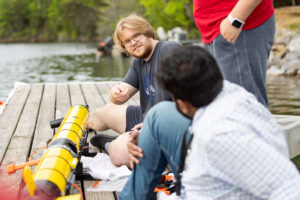
Along with guidance from many of his professors, including professor and researcher Dr. Aijun Song, Alexander’s passion for underwater robotics and acoustics began to take shape.
“Every robot needs some kind of computer to guide it, as well as some kind of power supply to run the motors, steer the rudder, and read data from the sensors. That’s the niche I ended up finding.”
This niche led him to work with Dr. Song to create a low-cost acoustic pinger, a device that sends out a repeated signal to locate a missing vehicle. Alexander feels empowered through their collaborative efforts and is prepared to meet challenges, especially as a first-generation college student.
“It’s certainly a challenging experience,” he reflected. “Most of the frustrations that I’ve experienced with being a first-gen student have been because of things I didn’t know to do in high school when I was preparing for college.”
His time at The University of Alabama has truly revealed an entirely new world of opportunity, along with unrivaled mentorships and unlikely friendships.
“When I first arrived at UA, I was worried that I wouldn’t really break out of my shell and would just stick to my friends I already had from growing up in Tuscaloosa,” Alexander said. “Instead, I’ve made friends with people from all across the country and even the world. The school has exposed me to all of the different paths I could potentially choose from and the freedom to explore those paths.”
The Shelby Institute for Policy and Leadership is proud to announce that 39 students have been selected to comprise the inaugural class of Shelby Scholars – an undergraduate program within the Institute. This prestigious undergraduate initiative is set to shape the future leaders of our state and nation. In 2023, Senator Richard Shelby donated his congressional materials to The University of Alabama to be archived for research and academic purposes and to benefit future leaders. Following his donation, the Shelby Institute for Policy and Leadership was created and endowed through appropriated federal funds and funds from The University of Alabama.
“It’s an honor to be selected as an inaugural Shelby Scholar,” said Samad Gillani, president of the Student Government Association from Hoover, Alabama. “We are all excited to benefit from this program, learn from accomplished leaders and better understand policymaking. I believe the group’s multidisciplinary makeup will lead to meaningful conversations about the various qualities of leadership impacting policy and public service.”
The launch of the Shelby Scholars program marks a significant milestone in the Institute’s history. This year’s cohort represents the first class to benefit from the program’s rigorous and comprehensive curriculum.
Stewart Hall, chair of the Shelby Institute for Policy and Leadership’s Board of Advisors and CEO of Public Policy Holding Company, shared, “Our Board’s vision for the Shelby Scholars program is to cultivate future leaders who will make impactful contributions to our state and nation. We were deeply impressed by the caliber of applicants and are excited to support these promising students who have already demonstrated leadership excellence on and off campus.”
Finis E. St. John IV, executive director of the Shelby Institute for Policy and Leadership and UA System Chancellor and Trustee emeritus, expressed enthusiasm about the program’s impact: “We look forward to working with these outstanding scholars. We know that these students will be leaders in the future in many fields, and our goal is to help prepare them for successful careers.”
As part of their curriculum, Shelby Scholars will participate in two exclusive classes this academic year: a speaker series featuring local, state and national leaders and a course on the Constitution’s role in modern society led by former UA Law School Dean and Shelby Institute Academic Director Mark E. Brandon. Outside of the coursework, Shelby Scholars will receive curated professional mentoring and support to participate in selective experiential learning opportunities, such as internships and undergraduate research.
The Shelby Institute for Policy and Leadership is committed to fostering the next generation of leaders through a nonpartisan, interdisciplinary approach. The Shelby Scholars program offers a credit-bearing curriculum designed to provide students from any academic field with a deep understanding of policy and public service through unique programming, experiential learning, and interactions with prominent guest lecturers.
The inaugural class of Shelby Scholars includes:
Hannah Adams, Birmingham, AL
Kalleigh Ahern, Brentwood, TN
Jack Allison, Birmingham, AL
Ella Kate Brooks, Sylacauga, AL
Olivia Brown, Homewood, AL
Taylor Carnley, Opp, AL
Maria Derisavi, Great Mills, MD
Alexandra Dunn-Cordova, Bellevue, WA
Olivia Frazier, Birmingham, AL
Samad Gillani, Hoover, AL
Katherine Gray, Tuscaloosa, AL
Aubrei Grisaffe, Tulsa, OK
Andrew Hall, Birmingham, AL
Hudson Hanner, Gardendale, AL
Raegan Harris, Duncanville, AL
Pierce “Jack” Harris III, Guntersville, AL
Emma Hou, St. Louis, MO
Alton Hudson, Huntsville, AL
Marah Inman, Hattiesburg, MS
Sophia Lotzow, Bainbridge, IN
Teegan Mathey, Aurora, IL
Cameron Morgan, Butler, AL
Hannah Kate Newman, Ooltewah, TN
Bennett Ogle, Farragut, TN
Ally-Anna Outlaw, Brundidge, AL
Morgan Patrick, Hoover, AL
Autumn Pernell, Tuscaloosa, AL
Julienne Pharrams, Deatsville, AL
Chloe Pickle, Hamilton, AL
Michael Regnier, Wake Forest, NC
Finley Richardson, Saraland, AL
Claire Roberts, Tuscaloosa, AL
Matthew Savas, Crystal Lake, IL
Counts Shanks, Springdale, AR
William Shelby, Tuscaloosa, AL
Samantha Simmons, Hartselle, AL
Taylor Simmons, Cullman, AL
Andrew Stovall, Winfield, AL
Reagan Wells, DeFuniak Springs, FL
Applications for the 2025–2026 Shelby Scholars class will open in Spring 2025. For more information, please visit Shelby Institute for Policy and Leadership.
This story was originally published by The University of Alabama.
The University of Alabama College of Education has signed the first two school districts to Teach in Bama, a program committed to identifying and supporting the next generation of exceptional teachers and keeping them in Alabama’s classrooms.
Tuscaloosa City Schools and Greene County Schools have signed a memorandum of understanding with the program, which is recruiting districts around the state.
Dr. Carlton McHargh, director of enrollment and student success in the College of Education, said the Teach in Bama development team began this endeavor in 2023 in response to the growing shortage of teachers both in the state and nationwide.
“The issue of filling full-time teaching vacancies has been extensively studied over the past years,” he said. “Notably, a recent study conducted by the Annenberg Institute at Brown University underscored a national shortfall of 55,000 teaching positions, with Alabama alone grappling with over 1,300 vacancies.”
How Teach in Bama works
High school juniors and seniors interested in teaching as a career choice will be recruited to become Teach in Bama Scholars.
Students selected for the cohort will enroll in UA Early College courses in the spring and fall semesters. Over the summer, participants will take a deeper dive into their future education and career at the Teach in Bama Institute under the mentorship of College of Education faculty and staff. Students will also take part in the UA Early College Summer Residential program, where they live and study on campus for five weeks.
In addition to the special programs and course credits, Teach in Bama participants will also have access to a wealth of UA resources including academic and career coaches, tutors and the UA writing center.
University support will continue into each TIB participant’s initial teaching experience after graduation as well.
Interested students must be current juniors or seniors with a 3.0 or higher GPA for both high school and all post-secondary work.
Applications require a personal statement and three recommendations (two school recommendations and one community/non-family member recommendation).
Program requirements
- Scholars must earn a minimum of three hours of University of Alabama Early College credit by Dec. 18, and enroll in a three or four hour UAEC class in the spring of 2025.
- Attend Early College Summer Residential Program and enroll in six hours and maintain at least a 3.0 GPA.
- Attend the Teach in Bama Institute (runs concurrently with the Early College Summer Program).
- Students meeting the above criteria will receive priority consideration for the Teach in Bama Scholarship to attend The University of Alabama.
- To maintain the Teach in Bama Scholarship, students must uphold their 3.0 GPA, enroll at UA and complete a minimum of 12 hours in an approved teacher education program each semester to continue receiving the scholarship.
School systems that sign an agreement with Teach in Bama will also be granted a preferred opportunity to recruit Teach in Bama Scholars.
A one-of-a-kind graduate program at the University of Alabama will pave the way for highly-skilled professionals to enter the ranks of the critical field of precision timing.
With nearly $3 million in support from the National Science Foundation, UA is offering 24 graduate school fellowships. The fellowships pay tuition and a stipend for students to concentrate in precision timing, the field of hyper-hyper accurate timekeeping traditionally based on atomic clocks.
The ACCEPT (Alabama Collaborative for Contemporary Education in Precision Timing) program is open to students seeking master’s and doctoral degrees in mathematics, physics and electrical engineering.
National Security Issue
The defense, communications, transportation, energy and finance industries rely on the technology. It serves as the backbone to over a third of the nation’s economy. With many professional retiring, the field’s workforce is greying. A new influx of scientists and engineers are needed to maintain the United States’ competitiveness.
“The loss of manpower has risen to a national security issue when coupled with the explosive growth in the area and the rapid improvement of other countries in this area,” said Dr. Adam Hauser, ACCEPT executive director and associate professor of physics and astronomy. “To meet the needs of society, government and industry sectors have communicated the need for workers with an interdisciplinary foundation, and a broad-based, workforce-development program beyond what an individual faculty member can achieve alone. The ACCEPT program is a response to that need.”
Silent Infrastructure
Precision timing is based on technology developed and implemented in late 1960s. It measures the natural frequency of cesium atoms as they oscillate between the precise energy levels. Advance atomic clocks, or optical clocks, can keep time so accurate they would not have gained or lost a second if they had started running at the dawn of the universe, according to the National Institute of Standards and Technology.
“Precision timing technology is a silent work horse in the background. It’s hard to imagine a world without atomic clocks, as this has become ubiquitous for our daily needs – such as – telecommunication, navigation, stocks. etc.,” said Dr. Thejesh Bandi, associate professor of physics and astronomy. “There currently are no focused programs training students to handle the present needs plus future requirements so there is a significant niche in workforce development required going forward.”
Graduate Opportunities
Through the grant from the NSF Research Traineeship Program, UA is providing an opportunity for up to 160 graduate students. The students have the chance to combine coursework across three departments. They will also receive professional development in teamwork, leadership, ethics and communication, critical areas identified by precision timing experts.
Students can put training into practice through research experiences with ACCEPT partners, student-led initiatives and networking at conferences and workshops.
“ACCEPT is a practical program with flexibility to meet the needs of industry,” said Dr. Patrick LeClair, professor and chair of the UA Department of Physics and Astronomy. “Students will be eligible for high-paying jobs in the government or private sectors the first day out of the program.”
UA Support
Along with Hauser, Bandi and LeClair, UA faculty involved in the program include:
- Dr. David Cruz-Uribe, professor of mathematics
- Dr. Todd Freeborn, associate professor of electrical and computer engineering
- Dr. Mizanur Rahman, assistant professor of civil, construction and environmental engineering
- Dr. Jordan Larson, assistant professor of aerospace engineering and mechanics
- Dr. Karri Holley, professor of higher education
- Dr. Sergei Gleyzer, associate professor of physic and astronomy
- Dr. Brendan Ames, associate professor of mathematics
- Dr. Adam Brooks, associate professor of communication studies.
For the 10th straight year, outside support of research and other sponsored activities at The University of Alabama increased.
One of the fastest growing major research institutions in the nation, the University saw a 21% increase in sponsored awards in fiscal year 2023 over the previous year. In all, nearly $256 million in support from external partners boosted research and discovery activities across campus.
“Record research growth speaks to the caliber of UA’s faculty and staff and propels us forward as leaders in higher education,” UA President Stuart R. Bell said. “Outside support of research and sponsored activities advances our institutional mission and reputation, creates the foundation for major developments in areas such as rural healthcare, water research and transportation and enables our undergraduate and graduate students to have a broader educational experience while preparing them to be future innovators.”
The $255.9 million in external awards is about 265% growth since 2014.
Sponsored awards include all competitive external funding for research, instruction, other sponsored activity, fellowships and construction.
Increasing outside support is a goal of the Office of Research and Economic Development. It’s strategic plan builds on the University’s designation by the Carnegie Commission on Higher Education as a Very High Research Activity doctoral university, the nation’s highest level of research activity.
“The University of Alabama continues to set records with growth in research, indicating a commitment to faculty, students and research staff working together to solve problems that are important to the future of our state,” said Dr. Allen Parrish, interim vice president for research and economic development. “This growth provides a pathway to prepare our students for jobs of the future that are both envisioned and enabled by this research.”
For the sixth consecutive year, fiscal year 2023, which ended in September, saw a record for sponsored awards directly supporting research at the university. External grants and contracts contributing to cutting-edge research and influential scholarship topped $145.6 million, an increase of 15.7% from fiscal year 2022.
UA’s research institutes and centers that focus on signature research themes of transportation, water, life research, cyber and multi-scale analytical sciences also contributed substantially to UA’s record year.
The institute infrastructure contributed to the submission of nearly 1,200 grant and contract applications from UA in fiscal year 2023, totaling more than $751 million, a 12% increase from fiscal year 2022.
For the 10th straight year, outside support of research and other sponsored activities at The University of Alabama increased.
One of the fastest growing major research institutions in the nation, the university saw a 21% increase in sponsored awards in fiscal year 2023 over the previous year. In all, nearly $256 million in support from external partners boosted research and discovery activities across campus.
“Record research growth speaks to the caliber of UA’s faculty and staff and propels us forward as leaders in higher education,” UA President Stuart R. Bell said. “Outside support of research and sponsored activities advances our institutional mission and reputation, creates the foundation for major developments in areas such as rural healthcare, water research and transportation and enables our undergraduate and graduate students to have a broader educational experience while preparing them to be future innovators.”
The $255.9 million in external awards is about 265% growth since 2014.
Sponsored awards include all competitive external funding for research, instruction, other sponsored activity, fellowships and construction.
Building on Momentum
Increasing outside support is a goal of the Office of Research and Economic Development. It’s strategic plan builds on the University’s designation by the Carnegie Commission on Higher Education as a Very High Research Activity doctoral university, the nation’s highest level of research activity.
“The University of Alabama continues to set records with growth in research, indicating a commitment to faculty, students and research staff working together to solve problems that are important to the future of our state,” said Dr. Allen Parrish, interim vice president for research and economic development. “This growth provides a pathway to prepare our students for jobs of the future that are both envisioned and enabled by this research.”
For the sixth consecutive year, fiscal year 2023, which ended in September, saw a record for sponsored awards directly supporting research at the University. External grants and contracts contributing to cutting-edge research and influential scholarship topped $145.6 million, an increase of 15.7% from fiscal year 2022.
UA’s research institutes and centers that focus on signature research themes of transportation, water, life research, cyber and multi-scale analytical sciences also contributed substantially to UA’s record year. The institute infrastructure contributed to the submission of nearly 1,200 grant and contract applications from UA in fiscal year 2023, totaling more than $751 million, a 12% increase from fiscal year 2022.
With nearly 300 Instaworthy spots to visit, The Alabama Mural Trail is growing, and travelers now have another reason — other than a great selfie — to explore the trail.
With the new, free digital passport travelers can earn points to exchange for prizes by visiting a selection of murals on the trail, which is led by The University of Alabama Center for Economic Development in partnership with several state tourism and economic development organizations.
“The digital passport will drive people to visit new neighborhoods and cities they might not have wandered before,” said Candace Johnson, UACED’s director of tourism and community development. “We want to encourage people to stay longer and travel further.”
Travelers can sign up online for a free digital passport, which is sent via text message and email — no app to download. Then travelers simply turn on their location services while visiting a mural on the trail to check in. Travelers also can snap a picture in front of the mural, tag @alabamatourist on Facebook and Instagram, and use #SweetHomeMurals.
Pick-up locations for prizes can be found on the Alabama Mural Trail website.

Launched in 2021, the trail has grown to nearly 300 murals across 60 counties, and the collection is updated regularly at alabamamuraltrail.org. The UACED team is working to incorporate all 67 of Alabama’s counties in the trail and is accepting mural submissions that meet certain criteria.
“Since the launch of the trail two years ago, we’ve already seen city leaders bring new murals to their community, making Alabama a more vibrant place to visit, live and work,” Johnson said.
The Alabama Mural Trail is a project of UACED in partnership with Alabama Association of RC&Ds, Ala-Tom RC&D, Alabama Mountain Lakes Tourist Association, the Alabama Tourism Department, and Alabama Black Belt Adventures. The trail encourages tourists and locals alike to explore the state’s rich culture and history through public art.
A student-led team from the University of Alabama has received a federal award for its research and efforts to help private well owners in Alabama predict and identify the risk of water contamination after flooding.
The UA team is one of just 21 student teams funded by the U.S. Environmental Protection Agency for research and innovative solutions to address environmental and public health challenges as part of the latest round of EPA’s People, Prosperity, and the Planet, or P3, Program. Each team receives up to $25,000 to help them develop their proof of concept and will be eligible to compete for a Phase II grant of up to $100,000 to further implement their designs.
The UA project will develop a flood-induced contamination risk assessment model for Alabama’s underserved Black Belt region using spatial analysis and known private well locations. It will also develop user-friendly water quality testing packets with educational materials to bring awareness to the threats of well-water contamination. The materials will detail flood recovery protocol, risks of microbial contamination and emergency contact information.
Direct beneficiaries of the project include state and local water quality regulators, governments and the general public in addition to private well owners.
“Private well owners are responsible for ensuring the safety of their well water,” said Dr. Leigh Terry, team advisor and assistant professor of civil, construction and environmental engineering. “Our goal is to empower the larger well water user community to both better understand their drinking water quality and take action after that quality has been degraded.”
Jourdan Kiaupa, a graduate student, leads the team, which is advised by Terry and Dr. Nate Jones, UA assistant professor of biological sciences. Dr. Nikaela Flournoy, an assistant professor of biology at Miles College, is also assisting on the project, along with Miles student Jaylin Jones. Justus King, a student from the University of Arkansas was part of the team over the summer as part of a National Science Foundation program that brought him to Tuscaloosa. More UA students are expected to join the team this fall.
The students will perform the well water sampling, analysis and kit testing under Jones and Terry’s mentorship and supervision.
In addition to developing a spatial analysis model and providing educational materials, the team will also determine the efficacy of pre-manufactured water quality testing strips by collecting samples from UA’s monitoring wells. The project will include a final report and model to identify areas in the state at risk of well contamination.
“The project brings engineers and scientists together to improve public health, empower individual well owners and improve the lives of rural residents across the Gulf Coast,” said Terry.
The University of Alabama partnered with several state agencies to launch a digital platform and on-demand learning program that offers essential education and training to physicians and health care professionals.
VitAL On-Demand signifies a milestone in standardizing content delivery and promoting professional development for health care professionals across Alabama.
“Through our partnership with the state of Alabama and other key agencies in developing VitAL On-Demand, providers will be equipped with the knowledge they need to excel in their practice and improve healthcare outcomes across Alabama,” said Dr. David L. Albright, UA Distinguished Research Professor and VitAL principal investigator.
This collaboration between VitAL and the state of Alabama reflects their shared vision of enhancing services, policies and community conditions for individuals facing mental health, substance use and trauma-related challenges. With VitAL’s reach extending to all 67 counties in Alabama, the impact of this partnership will be felt statewide.
VitAL On-Demand offers an extensive course catalog tailored to address the unique requirements of health care providers. These courses cover a wide range of topics in the health care industry, including alcohol use disorder treatment, substance use stigma and motivational interviewing techniques.
Successful completion of each one-hour course grants participants one Continuing Medical Education Credit or Continuing Education Credit, further supporting their professional development. Additional courses will be added to the course catalog over time.
The partnership between VitAL and key state agencies, including the Alabama Department of Mental Health, Alabama Department of Public Health and Alabama Medicaid agency, demonstrates a commitment to implementing evidence-informed practices and promoting education and community engagement throughout the state. Initial course offerings and descriptions can be viewed at vitalalabama.com/training-events.
The Fulbright Program has selected 13 University of Alabama students for various awards for the 2023-2024 academic year.
“UA’s 2023-24 Fulbright winners will venture out and have adventures in seven different countries on multiple continents,” said Dr. Teresa Wise, associate provost of international education and global outreach. “As they research, work, teach, learn and play across countries, cultures, perspectives and languages, we wish them the very best. We know that they will build on their UA experiences to help advance the Fulbright mission of promoting mutual understanding among all peoples of the world and that they will grow both personally and professionally. Congratulations to all our winners and alternates.”
Fulbright is the most prestigious United States international exchange program, offering opportunities for students, scholars and professionals. The Fulbright Award of the U.S. Department of State offers one-year grants for independent study and research, and for English teaching assistantships overseas. The highly competitive program selects approximately 1,500 award recipients from more than 11,000 applicants each year.
UA was recognized as a Top Producing Institution for Fulbright U.S. Student Awards for the sixth time in eight years in February.
Fulbright Student Research Award recipient:
- Caleb Ranum, of Coeur d’ Alene, Idaho, received a Fulbright award to research “People and Plants of the Early Iron Age in the Middle Danube Region” at Constantine the Philosopher University in Nitra, Slovakia. He is a second-year doctoral student in the department of anthropology, focusing on archaeology. He holds a bachelor’s degree from Pacific Lutheran University and master’s degree from UA.
Fulbright English Teaching Assistantship Awards offer U.S. students the opportunity to serve in an English classroom overseas, assisting the teacher and exchanging culture with the people of the host country.
Fulbright English Teaching Assistantship Award recipients:
- Jacob Camden, of Lafayette, La., will serve as an English teaching assistant in Germany. He is a major in philosophy, English and Spanish, with minors in German and world literature and liberal arts through the Blount Scholars Program. He is a resident of UA’s German House and 2023 recipient of the Algernon Sydney Sullivan Award.
- Katherine Dansereau, of Knoxville, Tenn., is a 2023 Honors College summa cum laude graduate in public health education and promotion with a minor in the Blount Scholars Program, as well as a master’s in health education promotion. She is a member of Mortar Board, the Carl A. Elliott Society and Omicron Delta Kappa Honor Society and was selected to teach English in Cambodia.
- Rose Doskey, of Marrero, La., is a 2023 Honors College graduate and member of Eta Sigma Phi Classics Honor Society and Delta Phi Alpha German Honor Society. As a member of New College, she holds a bachelor’s degree in interdisciplinary studies with a depth study in language, culture and society with a minor in theatre. She will teach in Germany.
- Austin Gregory, of Muscle Shoals, was an alternative masters in elementary education student before deciding to pursue law. He has been accepted and plans to attend the UA School of Law in fall 2024. Gregory was a 2021 summa cum laude graduate from the University of North Alabama where he earned his Bachelor of Arts in communication studies. He will teach in Taiwan.
- Emma Kenny, of Montgomery, graduated summa cum laude with her bachelor’s degree in political science and history with a legal history concentration in May. She is a member of the Blackburn Institute, Andrew Goodman Foundation’s UA Vote Everywhere, Anderson Society and The XXXI. She will teach in Kosovo.
- Madelyn Kloske, of Huntsville, earned her master’s degree in applied linguistics/teaching English as a second language in 2023 and is a former student-athlete on the women’s rowing team. She earned her bachelor’s degree from the University of Florida. She was selected to teach English in Spain.
- Vanessa Lent, of Green Bay, Wis., is a graduate student in Spanish literature and graduate teaching assistant in the 100-200 level of Spanish. A 2022 summa cum laude UA Honors College graduate, she earned her bachelor’s degree in biology with minors in Spanish and Blount Scholars liberal arts. She will serve as the graduate teaching assistant for UA’s study abroad program in Colombia this summer. She will teach English in Costa Rica in the fall.
- John “Jack” Lombardo, of Niskayuna, N.Y., is a secondary education and German major, and member of Phi Sigma Pi National Honor Society. He plans to pursue a career in education. He was selected to teach English in Germany.
- Austin Lynch, of Carmel, Ind., is a 2023 graduate in German and mechanical engineering. He hopes to begin a career in the energy industry from his Fulbright appointment. He will teach English in Germany.
- Claire Maurer, of Redmond, Wash., is a 2023 summa cum laude Honors College graduate in psychology with minors in anthropology and criminal justice. She was a member of Phi Beta Kappa honor society. She was selected to teach English in the Slovak Republic.
- Marie Moore, of New Lenox, Ill., is a 2023 Honors College summa cum laude graduate in secondary education and Spanish. She was a member of Mortar Board and the Carl A. Elliott Society. She was selected to teach English in Spain.
- Riley VanMeter, of Holland, Mich., is a 2023 summa cum laude graduate with bachelor’s degrees in Spanish and international studies with a minor in Italian language and literature, as well as a master’s degree in romance linguistics. He is a recipient of the Spanish program’s award for outstanding teaching by a graduate student and student-athlete on the men’s swim team. He was selected to teach English in Spain.
Additionally, four students were awarded alternate status in this year’s national competition and may have the opportunity to serve abroad if more funding becomes available or if a finalist is unable to participate. They are Sydney Del Rosario (Spain), Christine Thompson (Belgium), Lydia Fantoni (Bulgaria) and Colleen Rhein (South Korea).
Students with an interest in applying for next year’s Fulbright program can learn more at international.ua.edu and us
The University of Alabama has named Dr. Julie Sanford dean of the Capstone College of Nursing. An Alabama alum, she will begin her tenure Aug. 1.
Sanford served four years as dean and professor with the School of Nursing at the University of Mississippi Medical Center in Jackson, Mississippi. Under her leadership, research funding quadrupled, enrollment increased by 35% and $55 million was obtained for a new building.
“Dean Sanford is a highly respected academic and an accomplished health professional with a sustained record of excellence and service to the nursing profession,” said Dr. Jim Dalton, UA executive vice president and provost. “She is an alumna who knows and loves this university. We are thrilled to welcome her back to Tuscaloosa.”
Sanford earned her Bachelor of Science in Nursing from the UA Capstone College of Nursing, Master of Science in Nursing in adult health nursing and nursing education at the University of South Alabama and Doctor of Nursing Science degree from Louisiana State University.
“I am thrilled to return to the University of Alabama as dean of the Capstone College of Nursing,” said Sanford. “Our world is changing, and we have the opportunity in academic nursing to shape our future and prepare nurses who are patient-centered and practice-ready.
“The next three to five years will be a time of transformation in nursing education with the transition to competency-based education.”
She completed fellowships in the American Association of Colleges of Nursing’s leadership in academic nursing program in 2011 and executive leadership in 2015. Sanford was named as a fellow of the American Academy of Nursing in 2017 and fellow of the National League of Nursing Academy of Nursing Education in 2022.
In academic nursing since 1993, Sanford has served as director of the James Madison University School of Nursing and in other academic roles at Spring Hill College and the University of Southern Mississippi. She also worked as an emergency department nurse and progressed to professor at the University of South Alabama.
Recognized on national and international levels, Sanford provided U.S. Senate testimony advocating for Nursing Workforce Development funding and was recognized as a Champion for Change by the White House. Globally, she served five years as chair of the International Network of Universities’ Nursing Leadership Collaborative, which includes universities from Japan, South Africa, Spain, Sweden, the United Kingdom and U.S.
With more than $13 million in federal, state and foundation research and program funding, Sanford’s scholarly interests include the health status of informal caregivers, program development, decision-making, patient safety and the scholarship of teaching and learning. Known for her visionary leadership excellence, she was named a March of Dimes Nurse Executive of the Year and Rural Health Community Star by the National Organization of State Offices of Rural Health.
“Challenges are great,” Sanford said. “There is consensus in the nation that we must address health inequity. Our programs of research need to discover new knowledge and develop practices and policies that help nurses improve access to health care for all. We must be bold and consider unconventional partnerships to enhance innovation and broaden our perspective.
“Nursing is a practice discipline and innovations, capable nursing faculty, staff and students, impactful research and strong clinicians help us reach our ultimate goal – healthier patients.”
Bama Blitz, The University of Alabama’s annual online fundraising campaign, will launch at noon CDT Tuesday and conclude Thursday at noon CDT.
Alumni, faculty, staff, students and friends of UA can use the power of social media and crowdfunding to build support for a series of unique and impactful passion projects from UA colleges, schools and units. Now in its sixth year, the goal of Bama Blitz is to encourage giving at any level while highlighting unique and impactful projects that might otherwise go without funding.
In addition to the online support from donors, Bryant Bank has agreed to distribute $50,000 equally among passion projects that reach their fundraising goals.
Last year’s Bama Blitz raised a record $6.1 million from 1,329 gifts from alumni and supporters.
Gifts can be made at bamablitz.ua.edu. The website will provide live updates about fundraising totals for each passion project, as well as the total amount of money raised for the University.