A key piece of space flight hardware, manufactured at Alabama’s Marshall Space Flight Center, is on its way to Kennedy Space Center in Florida for the first crewed mission of NASA’s Artemis program.
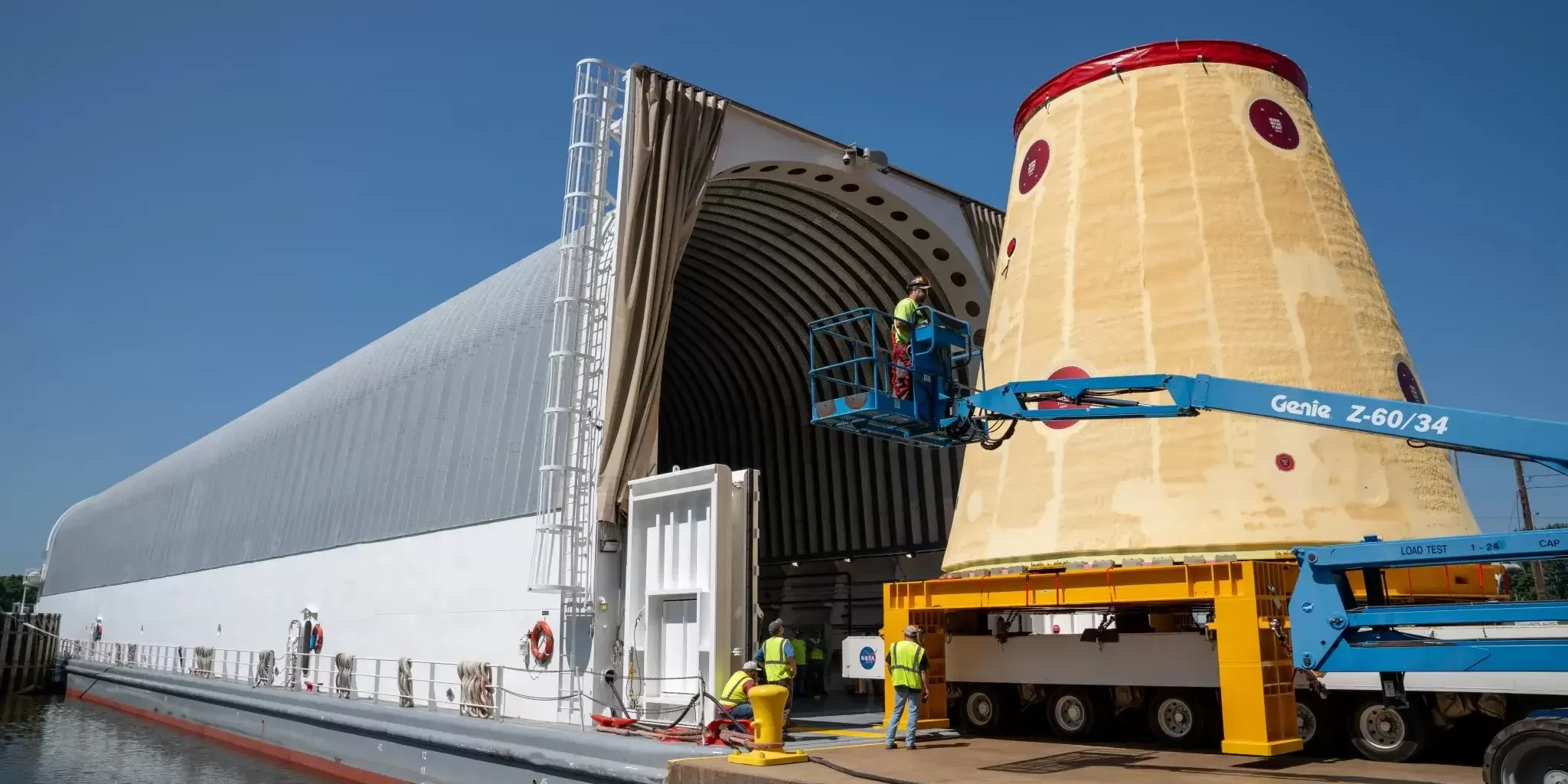
Marshall workers in Huntsville rolled out the launch vehicle stage adapter (LVSA) for Artemis II and loaded it on NASA’s Pegasus barge for shipment to Kennedy.
The cone-shaped launch vehicle stage adapter connects the rocket’s core stage to the upper stage and helps protect the upper stage’s engine that will propel the Artemis II test flight around the Moon, slated for 2025.
“The launch vehicle stage adapter is the largest SLS component for Artemis II that is made at the center,” said Chris Calfee, SLS Spacecraft Payload Integration and Evolution element manager. “Both the adapters for the SLS rocket that will power the Artemis II and Artemis III missions are fully produced at NASA Marshall.
“Alabama plays a key role in returning astronauts to the Moon.”

Crews moved the 27.5-foot-tall adapter out of NASA Marshall’s Building 4708 to the agency’s Pegasus barge last week. The barge is ferrying the adapter first to NASA’s Michoud Assembly Facility in New Orleans, where crews will pick up additional SLS hardware for future Artemis missions, before traveling to NASA Kennedy.
Once in Florida, the adapter will join the recently delivered core stage. There, teams with NASA’s Exploration Ground Systems will prepare the adapter for stacking and launch.
Engineering teams at NASA Marshall are in the final phase of integration work on the launch vehicle stage adapter for Artemis III.
The stage adapter is manufactured by prime contractor Teledyne Brown Engineering and the Jacobs Space Exploration Group’s ESSCA (Engineering Services and Science Capability Augmentation) contract using NASA Marshall’s self-reacting friction-stir robotic and vertical weld tools.
NASA’s SLS is the only rocket that can send Orion, astronauts, and supplies to the Moon in a single launch. The pioneering Artemis I mission took place in November 2022.
Alabama’s contribution
The SLS has deep roots in Alabama.
Marshall spearheaded the design and development of the rocket, and Boeing’s Alabama workforce also played a key role in the program. Altogether, 106 companies in Alabama made contributions to the SLS and Orion projects, according to NASA.
Marshall is home to the SLS Program Office, which leads the planning, design, development, testing, evaluation, production, and operation of the integrated launch vehicle.
Marshall team members also developed and tested the flight software in-house and built key parts of the rocket in their manufacturing facilities.
In addition, key structural tests of SLS’s liquid hydrogen and liquid oxygen fuel tanks were conducted at Marshall.
“Alabama space workers developed the landmark Saturn V rocket over a half century ago, and they’re leading the way on the new SLS rocket that will take American astronauts back to the Moon,” said Ellen McNair, Secretary of the Alabama Department of Commerce.
“These workers can take great pride in their contributions to the U.S. space program.”
Ready for to make waves🌊
A key adapter for @NASAArtemis II is safely inside @NASA's Pegasus barge and will soon make its way to @NASAKennedy.
Learn more about the role the cone-shaped launch vehicle stage adapter plays during launch and what comes next>>https://t.co/WEZih8oUdS pic.twitter.com/Dgk1ISnOP2
— NASA_SLS (@NASA_SLS) August 22, 2024
This story originally appeared on the Alabama Department of Commerce’s Made in Alabama website.