American society, and human civilization for that matter, rests on a constantly shifting balance between those who wish to preserve the past and those who seek to build the future, between those who value order and those who desire to unleash freedom, and between those who accept the world as it is and those who wish to shape it into what it could, someday, become.
There’s a little bit of everyone in each of those camps, but when opinions of all major issues are considered, people mostly lean toward one side or the other — the left or right side of the political spectrum. It’s a completely natural and surprisingly necessary balance once you dig into the reasons for each, and the healthy tension between the two sides in America has fostered an unprecedented level of knowledge, strength, and prosperity.
But …
But lately the left and right have stopped talking. Each side believes itself to be morally superior, and consequently, that the other side is morally inferior and not worth learning from, not worth negotiating with, and not even worth listening to.
We’re a house divided, or close enough to it to be worried.
But for those who still see value in our union, and who still want to live together, it’s critically important to understand not just “what” we think, but “how” we think, and most importantly, “why.”
What follows is my best effort to explain the “how” and “why” from my own perspective — a traditional, conservative one that would have been familiar to Ronald Reagan or William F. Buckley, Jr., in hopes that it’ll be of some value to both sides.
Why are there Conservatives and Progressives?
The division we’re seeing now is really nothing new. In fact, many believe the roots of how we understand modern conservatism and modern progressivism, and the arguments between the two, began way back in the Enlightenment.
Enlightenment thinkers were keen on discussing human nature, believing if we could understand human nature, we could then understand how to better govern ourselves.
One popular idea was John Locke’s theory of the blank slate, or if he were alive today, perhaps the blank emoji.

In this state, all men are born knowing equally nothing, thus all men are created equal, and the type of person we become is entirely caused by our own unique experiences. And if man were left alone in this pristine state of nature, and not influenced by the corrupting aspects of the world, we’d all essentially develop into good people — we’d all be the angel emoji. .

We’d only need a light social contract to preserve our natural rights, our natural liberties.
Thomas Hobbs believed very differently. He thought we’re all created with great flaws, and in a state of nature our irrational self-interest would cause us to all become awful people — we’re all the devil emoji. (Read “Lord of the Flies” for a great imagining of this theory.)

So Hobbs believed we needed a heavy contract, surrendering our natural rights to a strong ruler in exchange for him keeping us from killing one another, in exchange for keeping order.
Two polar opposite and competing ideas, one naive and the other dreary. Thinkers kicked them around for a century or so until a revolution occurred that caused them to bring together the best aspects of each and begin the modern conservative movement.
The American Revolution?
No. That was less of a war of true revolution than a war of preservation — preserving what liberty the colonists already had.
The revolution that kindled modern conservative thought was the French Revolution. They tossed out everything, from the ruling class to the church and even the calendar. Every aspect of society was deemed institutionally repressive (sound familiar?).
Liberty. Equality. Fraternity.
And if you didn’t get with the program: Terror.
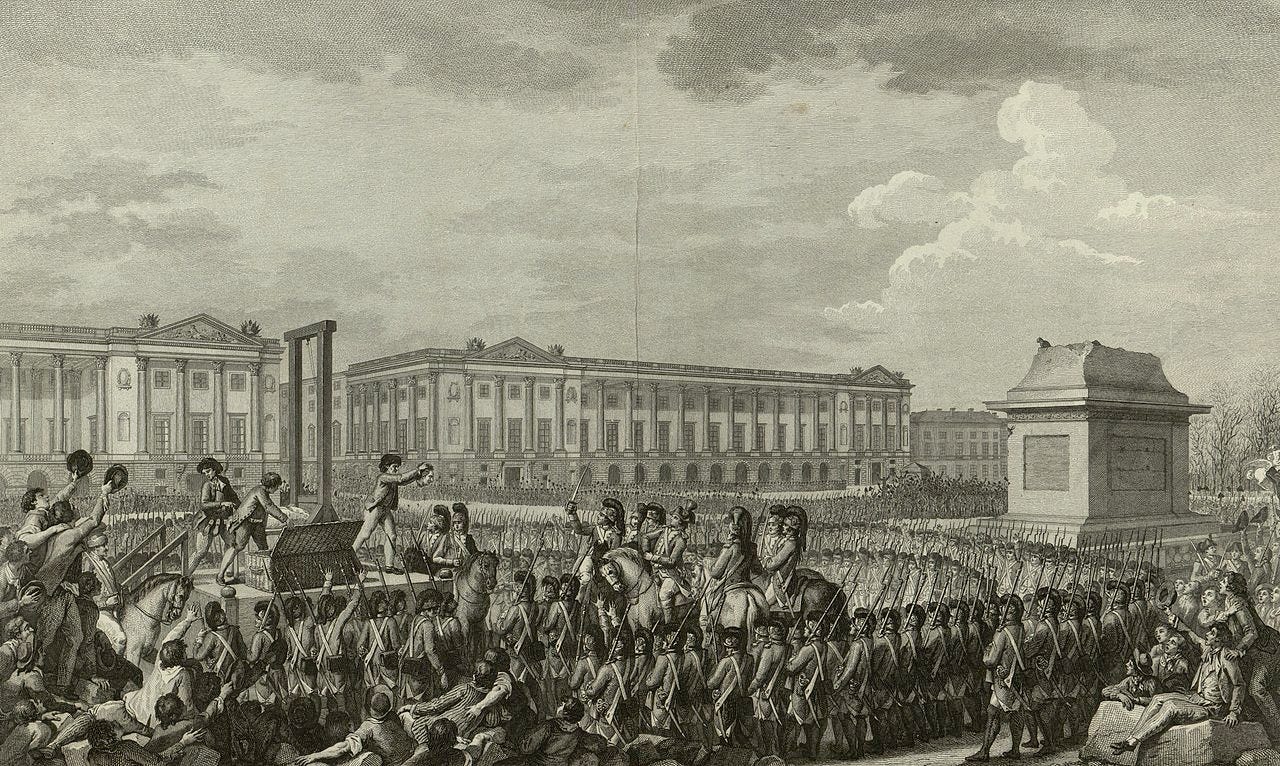
English and American thinkers looked on in horror at how much bad was being introduced to French society with such little good in return, and began to write about it.
Their basic argument was this: Sure, the enlightenment idea of liberty is important. These natural rights are real and must be protected. (Locke)
But so is order. (Hobbs)
An orderly society is damn hard to create and when order is lost, liberty is lost with it. Only chaos remains, as they saw on the streets of Paris. Rich and poor alike were being robbed and murdered, and in the end, a despot came to power to establish order and quash all freedom, just as Hobbs theorized — Napoleon.
Here’s the key, the American and English thinkers realized — a moderated Hobsian order creates the condition for moderated Lockean liberty. One comes before the other, a healthy society must have each, and they must remain in a delicate and constantly adjusting balance.
Liberty on one side. Order on the other. Too much of one and you get chaos (look at San Francisco) or tyranny (look at Shanghai).
Over the next 200 years the conservative movement began to notice certain ways of thinking, certain perspectives that tended to help society maintain the balance between liberty and order, maintaining a shared sense of boundaries that people could freely operate within.
And while conservatism doesn’t have a list of any doctrines or any sort of catechism or profession of beliefs, the writer and philosopher Russell Kirk did a fine job of combining these various perspectives into 10 general principles.
The first principle is that conservatives recognize that there is an enduring moral order.
We are not blank slates, or blank emogees, and we’ve known this for a very long time.
In chapter two of the Book of Romans, Saint Paul writes this about the Gentiles, who were never taught the laws of God, “They show the demands of the law are written in their hearts.”
All cultures possess a common understanding of morality. We may disagree on the high-definition details up close, but from far away we all see the same fuzzy image of what’s right and what’s wrong.
The ancients believed this was innate, and now modern developmental psychologists agree. Studies are showing that nature provides us with a “first draft” of not only personality, but of morality. As with all first drafts, it is not final, but one that’s later revised by experience, for good or bad. I’ll explain a little more about that in a moment, but conservatives recognize this enduring moral order, however uncomfortable it may make us.
Nations, and certainly individuals, ignore it at their own peril.
The second principle is tradition.
Conservatives understand things like customs, convention, and continuity help bind us to one another, thereby holding the community, and the larger society, together.
Tradition gives us a connection to the past and a stake in the future.
Edmund Bruke put it well when he wrote that, “society is a partnership not only between those who are living, but between those who are dead, and those who are to be born.”
We have simple traditions, like a wedding ring. We have complicated traditions, like weddings, or marriage itself … which can be very complicated.
We may not understand them all. Some are deeply meaningful in themselves. Some simply enable other meaningful things. But if we start tossing them aside like relics of an uninformed or superstitious past, we may find ourselves floating aimlessly through life, pushed and pulled by currents of reckless and unpredictable winds.
Because even when we demolish traditions, our innate need for order causes us to reestablish them in other forms, which are often inferior and more harmful than those that have been tested by time. (The French Revolution, again, brought so many examples of this. They did away with religion … so the state created a secular religion to take its place, and it was even more corrupt and harmful.)
Traditions keep us moored to something larger, and much studier, than just ourselves.
The next principle is prescription.
This isn’t like a pharmacist’s prescription. We haven’t found the “get smarter pill” … yet.
This is prescription in the legal sense, which is our observation that it is often wise to keep certain things that have been tested by time.
Or, if it ain’t broke, don’t fix it.
Generations upon generations have found that certain institutions or specific practices tend to produce the best results, or not.
Collectivism doesn’t work. Never has. Never will. Look at Cuba. Look at Venezuela. Look at the former Soviet Union. Further time and energy spent investing in that experiment should be discouraged, to say the least.
A man and a woman getting married, staying married, and having children generally leads to the best life outcomes — from personal wealth to life expectancy. That lifestyle should be encouraged.
That’s prescription at work.
Here’s a thought experiment to demonstrate the need for the next principle — prudence.
A bat and a ball cost $1.10 in total.
The bat costs $1.00 more than the ball.
How much does the ball cost?
If you were thinking 10 cents, like most people, then like most people, you’re wrong.
The correct answer to this problem is that the ball costs 5 cents and the bat costs — a dollar more — $1.05 … for a grand total of $1.10.
So why do so many people answer incorrectly? Because we have two track minds: one for thinking quickly and one for thinking things through, slowly. The problem is, we’re often stuck on one track, and it’s the quick one.
That is why conservatives believe in the principle of prudence.
Move slowly, because you don’t know what’s going to happen. Our problems are large and complex. You fix something here and it causes something to break over there.
We should distrust any politician who seems too confident.
Prudence, practically speaking, is putting doubt into practice. Far from pointless naysaying, doubting the best laid plans of mice and men could save money, and more importantly, lives.
Next, conservatives take note of variety.
Conservatism and variety may seem like they don’t go together, but they do. There’s absolutely nothing uniform or stagnant about the free market. There’s plenty of variety there.
But it’s not only the marketplace for goods and services. We seek variety in the marketplace of ideas, of institutions, of traditions.
Contrast that to the opposite ways of thinking: isn’t it interesting how in collectivist systems, everything seems to be uniform – the same ideas, even the same fashion.
Everything’s the same, and even when they express supposed radical ideas or alternative behaviors or even bizarre hairstyles, there’s an ironic sense of conformity to it all.
And that’s the key. Everything ends up being the same because a collectivist seeks equality in life’s outcome, not accepting true variety in life itself. There’s a rational, and even moral reason they feel this way, which I will explain later.
Kirk’s sixth principle of conservatism is imperfectability.
I write with a pencil for a reason. I make mistakes, often, and use the eraser nearly as much as the led.
Conservatism knows this, too.
The left’s central planner, despite all his resources and all his best intentions, will fail to produce the perfect plan, and even if he could, people couldn’t follow the plan perfectly. The results of such efforts on the scale of large governments usually end in disaster.
The Soviet Union promised a worker’s paradise. It delivered the gulags instead. A real hell on earth.
Conservatives say the best we can hope for in the world is a relatively free and orderly society, but some suffering is inevitable.
Seventh, conservatives have learned that freedom and property are closely linked.
The stronger a nation’s property laws – both real property and intellectual property – the freer and more prosperous are its people.
Remember the case of Suzette Kelo, who owned a little pink house near the coast of Connecticut? The town of New London used the constitution’s eminent domain clause, which was meant to allow governments to force private property owners to sell their lands at a fair value to be used for public infrastructure like roads, to force an unwilling Kelo to sell her property so a private company could develop a shopping center.
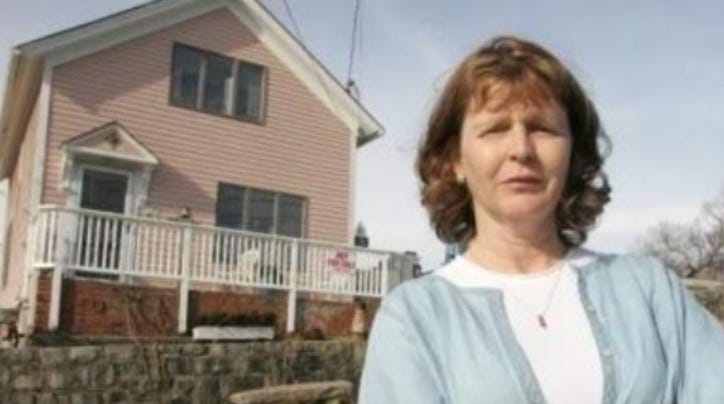
Our Supreme Court ruled that was permissible.
It’s not, and it never will be in a free country.
By the way, what did the town do with Kelo’s land after it forced her to sell it?
Nothing.
Their big plan for economic development never went anywhere (again, the folly of the central planner). Kelo’s beloved home became a vacant lot, as vacant as the morality the Supreme Court’s opinion was based upon.

Eighth, conservatives believe in the strength of voluntary community interaction, a group with shared interests coming together to discuss and hopefully solve problems.
This best expresses itself in local government.
Progressivism usually seeks centralized authority at the highest levels.
Libertarians usually seek not much authority at all.
But conservatives believe in decentralized, local authority. Those who are closest to the issues are usually positioned to make the best decision.
This isn’t always the case, of course. We have a national military because that’s the best organization for its mission, but we also have local police forces. I have no idea why we have a federal Department of Education, though.
Conservatism’s ninth principle is a belief in prudent restraints.
We have one of the best restraints known to men – the Constitution of the United States of America.
In other nations, their governmental documents lay out what the government can do and shall do. It’s all about “the government can do this” and “the government can do that.”
Not us.
Our governing document is full of statements like “Congress shall not …,” and we famously separate our powers – legislative, judicial, and executive.
In most nations, the legislative and executive functions are combined into a parliament, which would be something like if we only had the House of Representatives. The Speaker of the House would be the Prime Minster, and other members of the majority party would be appointed to run the various executive departments. That allows a government to act swiftly.
Us?
Not so much.
Our framers didn’t want us to act swiftly. They wanted us to act prudently, so they restrained our government every way they could.
Gridlock wouldn’t have been a bad word to their ears, and it shouldn’t be to ours.
Kirk’s 10th principle is how conservatives recognize that permanence and change must be reconciled.
People often say conservatives are resistant to change.
Not so. We’re just resistant to quick or reckless change.
We can add more liberty to the society, but it must be counterbalanced with the appropriate amount of order, even if it’s not a law but a maturing of the society to handle the new freedom.
Slowly, but surely.
Move too fast and you’re likely to produce a counter-reaction that destabilizes what’s good in society, and destroy that which you seek to improve.
Because conservatives recognize the imperfectability of man, we accept that we also don’t know everything yet. There are many things yet to be discovered, and not only in the areas of science and technology, but in our institutions, our government processes, and even in our hearts and minds.
When these changes are discovered, they must be balanced against what is already known and accepted.
The Objective: Ordered Liberty
Well-ordered liberty. That’s the key. That’s the lesson from the French Revolution, and every real revolution before or since. And that’s why conservatives think the way we do – to maintain the balance between order and liberty.
Or, seen through the metaphor of the ancient labyrinth, the ability to move (liberty) within an established boundary (order).

Where are those boundaries? That’s for each society, and generation, to establish and adjust for themselves. And we do it through the application of those 10 principles.
But understanding that doesn’t get to the core of the problem we’re currently facing — the deep distrust each “side” has for the other, how we believe that their ideas are not only wrong, but that their motives are even worse.
That’s simply not a sustainable attitude if we’re going to live with one another. We can disagree, but we really need to get a grip on the idea that those who disagree with us are terrible people who need to be canceled.
Perhaps the pathway out of the problem rests on our understanding that there’s an enduring moral order, because I firmly believe that there are people of good faith, on the left and right, who are making their decisions based on a common moral framework. It’s just that we all pay attention to certain aspects of morality to different degrees, and then make decisions based on what we believe are most important.
Moral Foundations of Conservatism and Progressivism
A few years ago, Professor Jonathan Haidt ran a study covering thousands of subjects across several disciplines and cultures looking for morals that we share in common, primed from birth, and found that we indeed have them, and he classified them into five foundations of morality.
- The first is “Harm/Care.” This is what causes us to care for others, to have compassion, to feel strongly about those who cause harm.
- The second is “Fairness/Reciprocity.” This is justice, or basically the Golden Rule.
- “In-Group Loyalty” is the third. This is what causes us to bond first with family, to create communities, nations. Think of it as our tribal instinct, even though that phrase can be understood as something undesirable.
- The fourth is “Authority/Respect.” This is that bit of order I was speaking about earlier.
- The last is “Purity/Sanctity.” This isn’t just about sex. It’s about seeking virtue and suppressing vice, trying to make the best of yourself, and keeping something — maybe your mind, your heart, your body, our environment — pure. For social conservatives, this may be remaining chaste before marriage. For environmental liberals, this may mean abolishing coal-fired energy plants.
Haidt’s research found that liberals score very high in two: Harm/Care and Fairness/Reciprocity, but somewhat low in the other three: Authority/Respect, In-Group Loyalty, and Purity/Sanctity.
Then he found that conservatives tend to care about all of these things equally. No one factor was high or low. They were all grouped somewhere in the middle.
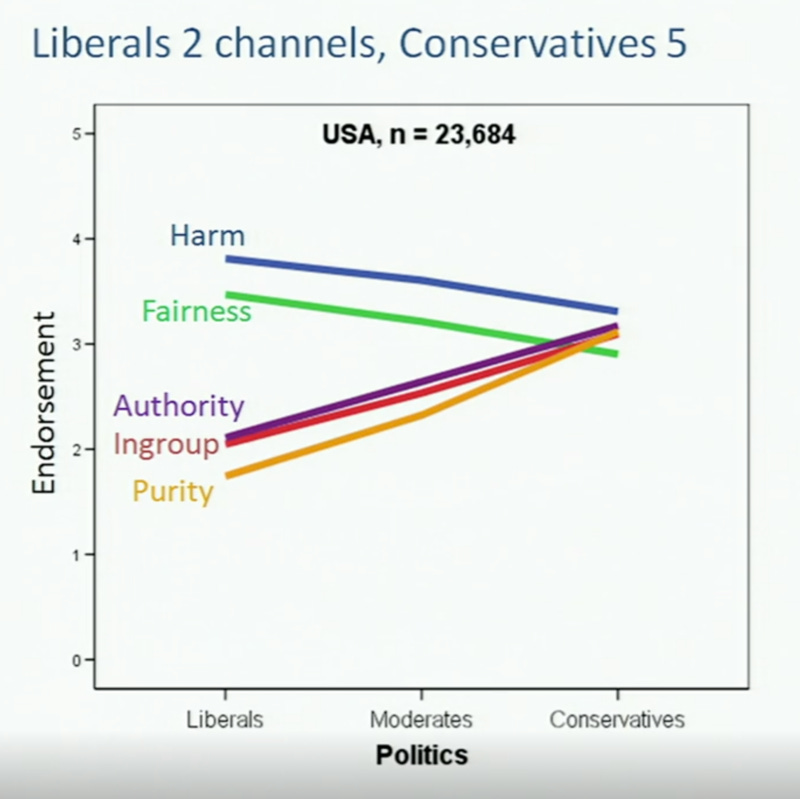
What interests me is the noticeable gap between how much liberals seem to care about Harm/Care and Fairness/Reciprocity, and then how little about Authority/Respect, In-Group Loyalty, and Purity/Sanctity.
That gap could explain why order will naturally decay without effort.
But it certainly explains the role conservatives play in society – they take up the slack in that gap, making sure we have order, making sure our communities are held together, and making sure we seek virtue.
Meanwhile, we have the liberals to focus heavily on Harm/Care and Fairness/Reciprocity.
However you look at the graph, it’s clear to me that we need both sides.
We need Americans focused on treating people better.
We need Americans focused on making sure people are treated fairly.
We need Americans focused on taking care of their families.
We need Americans focused on ensuring we have an orderly society to live in.
And we need Americans focused on keeping us healthy — mentally, emotionally, physically, and spiritually.
Folks like Professor Haidt would say mankind evolved that way to ensure that all of the tribe’s needs were met. I’d largely agree, but only add that I believe it’s all part of God’s plan. He knew, before the world was created, that a guy named Carl would have a strong instinct to protect and would eventually become a police officer in New York City, and that a girl named Joanna would feel the need to instruct little ones and would become a teacher in Nashville.
And he knew that you would care about the things you care about, and that you’d be doing what you are doing.
Because we’re a team.
We need order.
We need liberty.
We need each other.
And if we can treat each with dignity and courtesy, keep talking, and keep our minds open, we might … just might … keep the balance.
(J. Pepper Bryars is Alabama’s only reader supported conservative journalist. You can support his writing by subscribing here.)
The wind in my face was bitterly cold in downtown Dallas a few years ago since the winter weather was yet lingering. My continuing education classes had ended at the seminary in nearby Ft. Worth, so the afternoon was free for some sightseeing.
A chill came over me independent of the temperature when I walked onto Dealey Plaza and saw firsthand those sights emblazoned in my memory from childhood: Elm Street, the triple overpass and the sixth-floor window.
I thought back to that terrible Friday in November, 1963. Our class had just returned from lunch when Mr. Vines, our principal, made an announcement on the intercom.
“Boys and girls,” he said, “some of you may have heard already that our president’s been shot. Let’s try to finish out the day in school and I’ll let you know the latest news when I hear more.”
It seems strange now that the principal’s table radio was our only connection to the nation’s pulse.
Nevertheless, the senseless death of President Kennedy so paralyzed us that I don’t remember our doing much work in school that Friday afternoon. I remember my family and me glued to the old black-and-white television throughout the weekend and during the president’s funeral the next week.
That Friday in November will live in the bad memory section of my brain forever.
This week the world remembers another bleak Friday on which Jesus of Nazareth was murdered.
His death was senseless, too, for he’d done no wrong. In fact, bribed witnesses were brought in to lie about him at his trial. One of the thieves who died with him realized Jesus’ innocence when he said, “We are punished justly, for we are getting what our deeds deserve. But this man has done nothing wrong” (Luke 23: 41).
British writer Richard Jefferies told of a little boy who gazed at a graphic painting of Calvary and exclaimed, “If God had’a been there, he wouldn’t have let them do it!”
But God was there! He wasn’t removed from the event at Calvary. Paul insisted “God was in Christ, reconciling the world unto himself” (2 Corinthians 5:19).
God was present at the cross, and he showed us that he loves us in spite of disobedience, that he offers forgiveness to all and that he wants to be our partner in building a life filled with hope.
God’s redemptive plan wasn’t completed on Friday. The Father was faithful to his son and raised him on the third day. Now God promises to welcome all his children on the other side of death.
In light of God’s ultimate plan we believers have renamed that awful Friday.
We call it Good Friday.
And so it is.
Reflections is a weekly devotional column written by Michael J. Brooks, pastor of the Siluria Baptist Church in Alabaster, Ala. The church’s website is siluriabaptist.com.
For several years leading up to the 20[20] Census count, the national projections were that Alabama would lose one of our seven congressional districts and drop to six. When the count was taken, we surprised ourselves and the nation and kept our seven seats in the United States Congress.
Therefore, the legislature’s task in drawing our seven congressional districts was relatively easy. Except for some tweaking here and there due to growth in Madison, Limestone, Lee, Shelby and especially Baldwin Counties, and the loss of population in the Black Belt, our congressional district lines were kept basically the same as they have been for the past few decades.
We essentially have six of our seven districts that are safe Republican seats. We have one dedicated majority minority African American Democratic congressional district.
That Democratic seat is held by Congresswoman Terri Sewell. She has been in that seat for over a decade and has become a respected leader in the Democratic House leadership. The Democrats are in the majority which makes her a powerful member of the House.
However, most political experts and polling indicates that this year’s election will bring a swing of 30 or more Republican seat pickups or takeovers, thus making the Republicans the majority party. This will be beneficial for Alabama since six of our seven seats are held by Republicans. It will be particularly beneficial to folks in the fourth district, who have Robert Aderholt (R-Haleyville) as their congressman.
Aderholt is the most senior member of our delegation and is the ranking Republican on the House Appropriation Committee.
Congressman Mike Rogers (R-Anniston) is also gaining ground in seniority. He is a ranking member of the Armed Services Committee.
Congressman Gary Palmer (R-Hoover) represents the suburban areas of metro-Jefferson, Hoover and Shelby. It is considered one of the most Republican House districts in America.
We have two freshmen Republican congressmen, who are finishing their first two years in the House. Jerry Carl (R-Mobile) represents the coastal first district of basically Mobile and Baldwin Counties. He has taken to Congress like a duck to water.
Barry Moore (R-Enterprise) represents the second district made up of the Wiregrass and the fast growing Pike Road area of Montgomery as well as the populous counties of Autauga and Elmore.
All six of the aforementioned incumbents will be reelected without opposition.
The only excitement in congressional politics in the Heart of Dixie will play out in the fifth district. This Huntsville-Tennessee Valley seat is currently held by Mo Brooks, who has opted to run for the U.S. Senate, thus leaving a seldom seen open congressional seat contest. There are six Republicans vying for this open fifth district seat. The contestants are Dale Strong, Paul Sanford, Casey Wardynski, Harrison Wright, Andy Blalock and John Roberts.
Madison County Commission chairman Dale Strong appears to be the strongest candidate. He is far outdistancing the field in polling and fundraising. Some say that he could eclipse the field without a runoff.
The most ardent challengers will be former State Senator Paul Sanford and former Huntsville City School superintendent Casey Wardynski. Dr. Wardynski has done a good job fundraising.
There will be a large turnout in this congressional race. In fact, this Huntsville-Madison-Limestone Tennessee Valley area of the state will more than likely have the largest percentage turnout in the state. Not only is there an open congressional seat, but Mo Brooks is the local candidate for the open U.S. Senate Seat, and popular, incumbent Republican state school board member, Wayne Reynolds, will also be on the ballot with token opposition.
In addition, the only hotly contested Republican State Senate race between Tom Butler and Bill Holtzclaw is in the Madison-Limestone area. There are also three open hotly contested State House races, including filling the seats of Speaker Mac McCutcheon and veteran House member Howard Sanderford. There is also a hotly contested open sheriff’s race in Limestone County. Furthermore, the phantom candidate for the U.S. Senate, Mike Durant, claims Huntsville as his home. All of these ingredients are a recipe for a larger turnout in the Tennessee Valley than the rest of the state on May 24.
The congressional lines and six of seven congressmen will remain the same for this 2022 election cycle. However, hold the phone. The federal courts could change that for 2024.
Steve Flowers is Alabama’s leading political columnist. His weekly column appears in over 60 Alabama newspapers. Steve served 16 years in the state legislature. Steve may be reached at: www.steveflowers.us.
Our country faces an unprecedented mental health crisis. Two out of five adults report suffering from symptoms of anxiety and depression. More than half of those age 18-24 report these same symptoms and roughly one out of five say they have suicidal thoughts. Even before the COVID-19 pandemic, rates of anxiety, depression and suicide in the U.S. were rising. The tension we’ve all lived under for such a prolonged time has exacerbated this trend.
Medical professionals are not immune to the grief, trauma and isolation of the last two years. In fact, we have been right in the middle of it, sometimes likened to soldiers on a battlefield. Among medical professionals, frontline health care workers were hit the hardest as they worked long hours taking care of sicker and sicker patients. Outpatient physicians exhausted themselves keeping their patients out of hospitals, while trying to keep their medical practices open at a time of extraordinary demand.
The toll has been severe and will continue to be for some time. A year into the pandemic, 62% of frontline health care workers said that worry and stress negatively affected their mental health. Almost 50% said their physical health was negatively impacted. Three-quarters of frontline health care workers report burnout. We will likely see increased rates of Post Traumatic Stress Disorder (PTSD), depression, even suicide among health care workers.
This isn’t a theoretical concern. Many Alabama physicians recently participated in an anonymous wellness survey. The findings reveal some feel they are at the tipping point of despair and contemplating suicide.
Nationally, physicians and nurses die by suicide at twice the rate of the general population. Many others suffer in silence, afraid to get help because they fear the stigma will end the career they have spent a lifetime working for.
One such physician was Dr. Lorna Breen, an emergency room physician in New York City. She was worried she would lose her medical license or be ostracized by her colleagues because she was suffering due to her work on the front lines of the COVID crisis. She was not alone in this fear. An American College of Emergency Physicians survey found that 73% said there is a stigma in the workplace when it comes to getting help.
Dr. Breen sadly died by suicide in April 2020. In her honor, the Dr. Lorna Breen Heroes Foundation was born. The Foundation’s mission is to reduce burnout of health care professionals and to eliminate the stigma of seeking mental health services.
I recently invited Dr. Breen’s brother-in-law, Corey Feist, to speak at the annual meeting of the Medical Association of the State of Alabama about the Foundation’s work to promote the mental well-being of our frontline health workers. He also discussed the Dr. Lorna Breen Health Care Provider Protection Act, which was signed into law in March. This new law provides training for health care providers on suicide prevention and behavioral health, as well as an awareness campaign to address stigmatization and promote help-seeking among this workforce. As an Alabamian, I am proud that every member of our state’s congressional delegation supported passage of this law.
It is gratifying to see a political system that is so often divided come together to make progress on this issue. This bipartisan support is a recognition that the consequences of physician burnout and depression are drastic, ultimately resulting in higher costs, greater turnover, poorer overall quality of care and decreased patient satisfaction.
It is also gratifying to have seen expressions of appreciation from the public for our health care workers during this time of crisis. Believe me, that support means so much to physicians, nurses and others as we serve our patients and seek to improve the well-being of our communities.
Even after COVID, the heightened challenges and stresses of caring for others will continue. No one is immune to the growing mental health care tragedy in our nation. Fortunately, help is available. If you or someone you know is suffering from a mental health problem, resources and information about help are available at www.mentalhealth.gov. The 24-7 National Suicide Prevention Hotline is 1-800-273-8255. In Alabama, you can reach out to the state’s Department of Mental Health through www.mh.alabama.gov.
Dr. Aruna Arora is board-certified in Neuromuscular Medicine and is medical co-director of the ALS Clinic in North Alabama/Huntsville. She is the Immediate Past President of the Medical Association of the State of Alabama.
Often lost among the more provocative and controversial bills that generate headlines and hullabaloo during legislative sessions are the solid policy measures designed to address long-standing problems endemic to state government.
As the chair of the House Education Policy Committee, I can attest that we passed more than two dozen bills and measures to support our teachers and administrators, improve classroom instruction and increase test scores and outcomes in a variety of subjects.
For the fourth consecutive year, the legislature approved an Education Trust Fund budget with record funding, which, at $8.3 billion, makes historic investments in K-12 public schools, community colleges, and public four-year institutions, and each of these record budgets have been implemented without having to declare the painful, mid-year budget cuts known as proration.
It is important to note, in fact, that proration occurred on an average of every other year when Democrats controlled the legislature, but as a result of responsible budgeting practices that have since been put in place, proration has been avoided in each of the dozen years under Republican leadership. A generation of students and teachers will soon avoid experiencing the chaos that accompanies prorating the budget.
Included within the budget were the most generous pay raises awarded to public school educators in decades. Like other states across the nation, Alabama is experiencing a dramatic shortage of classroom teachers, so pass both targeted pay raises for new instructors and substantial salary increases for veteran educators in order to help us recruit, retain and re-entice desperately needed personnel.
Additional incentives, such as improved retirement benefits and loan forgiveness, were also enacted in order to attract teachers to particularly difficult-to-staff subjects like math and science and to geographic areas where the need is the greatest.
Funding increases for the Alabama Reading Initiative, commonly known as ARI, and the Literacy Act, two innovative programs designed to increase reading scores across the state; the Alabama Math, Science, and Technology Initiative; and the state’s nationally-recognized “First Class” pre-kindergarten program, which is the model for our new emphasis on funneling auxiliary teachers into K-3 classrooms, were included in the budget, as well.
Recognizing the need to focus laser-like attention upon increasing math scores across the state, an entirely new education program was also created and funded by the legislature.
Recent standardized test results revealed that Alabama currently ranks 52nd in the nation in math scores, a particularly embarrassing statistic when you consider that there are only 50 states in the union. Only 22% of Alabama students were proficient in math on the 2021 ACAP state assessment, including only 11% of low-income students and 7% of black students. In addition, 28 K-5 schools in Alabama currently have ZERO percent of students proficient in math.
A state that designed the rockets that took men to the moon and today houses factories that rely upon advanced engineering to manufacture state-of-the art automobiles, airplanes and weaponry must not be content for its students to wallow at the bottom of math skills.
The newly-created Numeracy Act will follow the model set by proven successful programs like ARI and the Alabama Literacy Act in order to concentrate educational resources on an obvious problem in need of addressing.
Much like ARI raised reading scores statewide by placing specially-trained reading coaches in public schools, the Numeracy Act will locate specially-trained math coaches in areas where they are needed. It also allows the State Department of Education to intervene in schools that continue to perform below expected levels even after additional educational resources are put in place.
A new Office of Mathematics Improvement within the State Department of Education will be tasked with ensuring that students are at or above grade-level proficiency in math by the fifth grade, and it will be held accountable for results.
As part of the first major overhaul and reform of state mental health services since Gov. Lurleen Wallace’s administration, the legislature passed a measure requiring each school system across Alabama to employ a mental health service coordinator. This effort goes hand-in-glove with the findings of the state’s Emergency Task Force on School Safety and Security that I chaired in response to a series of school shootings across the nation in 2018.
The COVID-19 pandemic lockdown and at-home instruction for students that resulted certainly reinforced the importance of access to high-speed broadband Internet in rural Alabama. When circumstances force reliance on classes and instruction through Zoom and other technology services, no student should be left behind because necessary Internet access is unavailable in the area where they reside. Much progress has been and continues to be made in the effort, and the legislature appropriated another $243 million to spur broadband expansion.
Additional bills such as those related to Accountability Act scholarships, which allow children from low-income homes to escape failing schools for those that perform well; the textbook selection process; English language learners; public school registrations for transferring military families; cybersecurity; school construction; and others were also passed this session.
While the media devotes the majority of headlines and spotlight to the measures that produce Internet clicks and provoke strong feelings among liberals and conservatives alike, please know that the House Education Policy Committee and my colleagues in the legislature are constantly working to improve public education for students, teachers and parents across the state.
Alabama is a special place to live, work, worship and raise a family, and taking our public schools to the next level will simply make an already great state even better.
Elected to represent Alabama’s House District 8 in 2010, State Rep. Terri Collins (R-Decatur) serves as chair of the House Education Policy Committee and holds a seat on the budget-writing committee for K-12 public schools, community colleges, and public universities.
The legislative session just concluded and coincided with the release of VOICES for Alabama’s Children’s annual data book. The VOICES report indicated we have many more issues ahead that need attention. The research results provided by VOICES are not good. (But keep reading, help is on the way.)
Too many children can’t read or perform math at grade level, and many of them are hungry and being abused in their own homes.
Since 1994, VOICES for Alabama’s Children has provided extensive research on the conditions of our children and released its annual data book. The report documents and tracks the facts on the health, education, safety and economic security of Alabama children by county.
VOICES’ data found there is only one mental health provider available for every 923 Alabamians. It pointed to research that shows unaddressed childhood trauma and Adverse Childhood Experiences (ACES) lead to lifelong chronic health issues. Those factors also can cause significant barriers to educational achievement and financial security.
Last year, less than 25% of our children were proficient in math. Data found that when it came to economic security, 24% of Alabama’s children live in poverty, and one in five of them are food insecure. In simple language, these children are hungry!
When it comes to education of Alabama’s poverty-stricken fourth graders, only 38% are proficient in reading, and only 12% are proficient in math.
In 2021, there were 3,453 children who entered foster care. An estimated 48% of those cases involved parental substance abuse use. And of course, there is child abuse involved in many of these homes as well.
Our legislators have made tremendous investments toward improving these statistics, and they are to be commended for it. Those investments include:
- $17.8 million in quality childcare programs
- $22 million more for First Class Pre-K (from 42-45% for 4-year olds)
- $1.5 million in first-time funding for summer and after-school pilot programs for K-12 students
- $20 million in provisions of the Alabama Numeracy Act
- $10 million in flexible grant funding for under resourced/underperforming schools
- $5 million for mental health pilot programs for youth and adolescents
- $1 million increase for school-based mental health services collaborations
- $4 million postpartum healthcare pilot program for new mothers
VOICES works on research, policy and advocacy. It strives to “ensure the well-being of Alabama’s children through research, public awareness, and advocacy. It partners with community leaders to encourage Alabama lawmakers to pass legislation beneficial to Alabama’s children.”
I greatly commend VOICES for all it has done for years and for what it continues to do for Alabama’s children. It also educates the public on how we need to improve the well-being of our children’s lives.
Great progress can be made to improve the lives of Alabama’s children. But legislators, and we as a society, must continue to be concerned if our children are learning, have access to three meals a day, and live in safe homes. We must be proactive to see that our children’s needs are met on a daily basis and our state’s needs will be met in the future, too.
More details about the VOICES data report can be found here.
Beth Chapman is Alabama’s former State Auditor and 51st Secretary of State. She now owns and operates Beth Chapman & Associates, LLC. This is her weekly column, “Around the Capitol” published in newspapers and blogs across the state. She can be reached at Beth@bethchapman.com.
President Biden’s policies have made every community in America a border city, and deadly fentanyl is flowing across the southern border and into communities all over the country. Even worse, fentanyl overdoses have become the number one cause of death for Americans between 18 and 45 years old.
This administration’s policies and their refusal to enforce our immigration laws is a direct threat to the health and safety of every single American because of the illegal drugs flowing across our southern border. It’s virtually impossible to find someone in this country who has not been touched by this issue – whether they’ve experienced it with a friend or someone in their family. It’s clear we have a crisis in this country, and it is plaguing every family.
My colleagues across the aisle have refused to hold President Biden’s feet to the fire when it comes to securing our open borders so we can stop the flow of illegal immigrants and drugs into the country. We’ve all been to the border multiple times and have introduced countless bills to fix this crisis, but Democrats won’t let a single of these bills come up for a vote.
A few days ago, President Biden announced he will end a Trump-era policy known as Title 42, which was a great tool we used to turn illegal immigrants around at the border due to health and safety concerns. Ending Title 42 gives the green light for illegal immigrants to flood the southern border and pour into communities around our country. It’s hard to imagine why the Administration thinks this is a good idea.
The terrible irony here is the Biden administration is effectively saying COVID is over for illegal immigrants, yet they are still requiring law-abiding Americans to wear masks on planes and in airports. Also, federal employees are still not required to show up to work because of the supposed health risks. This is flat-out hypocrisy.
After President Biden announced an end to Title 42, the National Border Patrol Council President said, “We are ultimately going to wave the white flag of surrender – the cartels are going to control our borders.” It is obvious the negative effects this will have on the border crisis. Not only has President Biden invited more folks to come into our country illegally, but he has also created a logistical nightmare for the Department of Homeland Security as they attempt to process countless people crossing the border.
As frustrating as this is, we cannot give up the fight to secure our border. Border security is national security, and we must put the safety and security of American citizens first.
Jerry Carl represents Alabama’s First Congressional District. He lives in Mobile with his wife Tina.
Russia’s invasion of Ukraine sent already rising oil prices even higher. Record gas prices are fueling the highest inflation rate in 40 years. President Biden blames high gas prices on Mr. Putin, but administration policies are hampering U.S. oil production.
Markets are forward-looking and incorporate new information almost instantaneously. Anticipated events will affect commodity and stock prices before they occur. Experts’ surprise at the full-scale invasion suggests that this likely explains the price rise from $90 to $120 per barrel over the next two weeks. But the increase from $40 in October 2020 to $90 in February seems hard to blame on Mr. Putin.
The Institute for Energy Research (IER) maintains a scorecard on Biden energy policies. Mr. Biden canceled the Keystone XL pipeline on Inauguration Day. The XL segment was not going to be completed until 2023, so White House press secretary Jen Psaki is correct that this is not reducing oil supplies today. But by foreshadowing administration policies, it could easily have driven up prices.
The Biden administration has stopped development in the Arctic National Wildlife Refuge and the Alaska National Petroleum Reserve and halted new leases on Federal lands and waters. A court ruling blocking a large Gulf of Mexico lease has not been appealed.
Ms. Psaki repeatedly cites 9,000 unused Federal leases as demonstrating industry culpability for high prices. As IER explains, oil production involves two steps: leases and drilling permits. Companies first sign leases for exploration and then apply for drilling permits where oil is found. A near doubling of the permit approval time under President Biden has produced a backlog of 4,000 applications.
President Biden has reversed President Trump’s reforms of the National Environmental Protection Act and the Clean Water Act. The policy process previously allowed environmental groups to endlessly litigate required environmental reviews, tying up production and pipelines for years. Wise policy should balance environmental costs and economic benefits and proceed when we decide that the benefits outweigh the costs. Prior to the Trump reforms, environmental groups nearly possessed veto power.
Mr. Biden is simply, in IER’s view, delivering on his 2020 election pledge: “No ability for the oil industry to continue to drill period. It ends.” And now the president is asking Iran, Venezuela and Saudi Arabia to pump more oil. Everyone, it seems, except America.
Anyone believing that climate change poses an existential threat to humanity must advocate such policies. Meeting the new goal of limiting temperature rise to 1.5 degrees Celsius will require an end to the use of fossil fuels within 10 or 20 years, not the distant future.
Prices and quantities are related. At a sufficiently high price, the quantity consumers are willing and able to purchase (the textbook definition of demand) will be zero. Banning gasoline pushes the quantity to zero but can also be interpreted as driving the price to infinity. High and rising gas prices are not a flaw of fighting global warming, they are the plan.
The only glitch is perhaps that the Ukraine invasion gave us 2023’s price of gas in March 2022, resulting in more pain sooner than intended. California Governor Gavin Newsome, who wants to ban the sale of gas-powered cars by 2030, now generously proposes rebates to Californians as relief from $6 a gallon gas.
We may be approaching a point of no return for domestic oil and natural gas production. Developing oil and gas involves enormous capital investment in wells, storage, transportation (pipelines or railroads), and refining or processing. These investments require years of use to recoup.
I do not support ending fossil fuel use to fight global warming, and you may wish to discount my investment insight. But how can drilling oil or natural gas wells to be used for only 20 (or perhaps now 15 or 10) years be profitable? A four-year reprieve from a Republican president may soon be irrelevant. A credible commitment not to ban fossil fuels may soon be necessary to significantly increase production.
Daniel Sutter is the Charles G. Koch Professor of Economics with the Manuel H. Johnson Center for Political Economy at Troy University and host of Econversations on TrojanVision. The opinions expressed in this column are the author’s and do not necessarily reflect the views of Troy University.
The scandal rocked the nation for two years. It was the origin of the “gate” reference to most every other scandal and the genesis of my interest in presidential history.
Intruders entered the Democratic National Committee headquarters in Washington’s Watergate Hotel on June 17, 1972. Investigators linked the burglars to the president’s reelection committee. President Nixon, the nation’s chief law enforcement official, was complicit in a cover-up of the crime. Actually, according to a new book on the scandal, the House Judiciary Committee cited 36 specific acts of obstructing justice.
Nixon’s downfall largely came about due to the testimony of Alexander Butterfield, former White House advisor, in response to questioning by attorney Fred Thompson, later to become a Hollywood actor and U.S. Senator. Garrett M. Graff in “Watergate—A New History,” called it “Butterfield’s bombshell”—the revelation the president had a secret White House taping system. As someone noted, “Nixon bugged himself.”
The U.S. Supreme Court affirmed special prosecutor Leon Jaworski’s request for selected tapes, and the June 23 tape was the “smoking gun” showing the president’s crime.
Graff’s book, a challenge at 793 pages, is filled with new information and is a reminder of what the nation faced in those days.
I’ve admired President Nixon. He was a leader gifted in so many ways. I never met him but did pay respects at his gravesite a few years ago. It was late afternoon and the setting sun glared in my camera lens, so the kind security officer allowed me to return the next morning on the way out of town to take a better picture.
I’ve always thought we can learn spiritual lessons from Watergate.
It’s hypocrisy when we declare one thing and live another. Nixon was hypocritical since his job was to enforce the laws of the nation. Christians are often accused of hypocrisy. The only valid response is to acknowledge it’s true. None of us lives up to our ideals, though we try. Browning wrote, “Ah, a man’s reach should exceed his grasp, or what’s a heaven for?” Sincere believers never insist they’ve arrived; instead we admit we’re on a continuing life journey of growth in holiness.
A second lesson we glean from Watergate is that we’re all bugged! Jesus said, “But I say unto you, That every idle word that men shall speak, they shall give account thereof in the day of judgment” (Matthew 12:36).
Words are powerful tools. They can be used to encourage and bless others, or they can be used to stir strife and division among others. What a sobering reminder that God hears our words, and we will stand before him one day to give account of every word and every deed. -30-
Reflections is a weekly devotional feature written by Michael J. Brooks, pastor of the Siluria Baptist Church, Alabaster, Alabama. The church’s website is siluriabaptist.com.
The crowded field for governor striving to oust incumbent Governor Kay Ivey, includes Tim James. He has run before. In fact, this is his third try for the brass ring. His last race was in 2010 when he barely missed the runoff by a few votes. He was edged out by Robert Bentley, who went on to win.
Tim James’ primary calling card has always been that he is the son of former Governor Fob James. The elder James was an ultra-successful businessman, who was first elected governor in 1978 as a Democrat and then elected to a second term as governor as a Republican in 1994.
Governor Fob James first election as Governor in 1978 is one for the record books. The 1978 Governor’s Race is one of the classics in Alabama political lore. That governor’s race, which began with three heavyweights – former Governor Albert Brewer, Attorney General Bill Baxley, and Lt. Governor Jere Beasley – was expected to be titanic. The Republicans were relegated to insignificance on the gubernatorial stage. Therefore, the winner of the Democratic Primary would be governor.
Meanwhile, over in east Alabama, a little known former Auburn halfback named Fob James strolled into the governor’s race. Fob’s entry evoked very little interest, only curiosity as to why he would want to enter the fray against three well-known major players. Fob was exposed as a card-carrying Republican but even a political novice like Fob knew he could not win as a Republican, so he qualified to run as a Democrat along with the three B’s.
Fob had become very wealthy by starting a successful manufacturing company in Opelika. When he signed up to run for governor the press wrote him off as a rich gadfly who simply chose politics rather than golf as his pastime. Little did they know that the fact he was rich and had a lot of time on his hands could spell trouble for the average political opponent, who had to worry about fundraising and feeding their family while running a full-time campaign.
Fob realized he was no political professional like the three B’s who had spent their entire political adulthood in public office, so Fob sought out professional advice. He had the money to think big and wanted to know who the best political consultant in the South was. It was an easy answer: Deloss Walker was political public relations genius who lived in Memphis. His track record for electing governors of southern states was 5-0. Walker was the most renowned and expensive political guru in the country in 1977.
Fob quietly sought out Walker, who at first refused to take Fob’s race. Walker’s first impression was that even he could not mold Fob into a winner against three well-financed, experienced thoroughbreds.
Nobody was aware Fob had garnered the genius Walker and had already been to political school when he signed up to run for governor in the spring of 1978. Brewer, Baxley, and Beasley ignored Fob. Baxley even praised him saying, “Fob would be a good governor. Too bad he’s not a serious candidate.” Those words would come back to haunt Baxley.
Fob traveled the state in a yellow school bus and let the three B’s tear each other up. Baxley, Beasley and Brewer spent all their time and money attacking each other with negative ads, all the while Fob ran positive ads. Folks were of the opinion that the three B’s had all probably shot their mothers in a bar fight but they liked old Fob James, even if they thought his name was “Bob” James.
It was too late for the three B’s when they saw a poll about a week before the election showing Fob ahead of all three of them. Baxley refused to believe it and kept hammering at Beasley and Brewer, ignoring Fob. When the votes were counted, Fob was in first place, Baxley second, Brewer was third, and Beasley finished fifth behind State Senator Sid McDonald.
Fob easily beat Baxley in the runoff. After all, what could Baxley say? He had run all over the state for three months saying Fob would make a good governor. Fob James had pulled off one of the most amazing upset victories in the history of Alabama politics. The Fob James story of the 1978 Governor’s Race is truly one for the record books.
Steve Flowers is Alabama’s leading political columnist. His weekly column appears in over 60 Alabama newspapers. He served 16 years in the state legislature. Steve may be reached at www.steveflowers.us.
Illegal immigration is at an all-time high. Just last year, nearly 2 million illegal immigrants from more than 160 countries were apprehended at our southern border—nearly 10 times the population of Alabama’s largest city of Huntsville. This is a direct result of the Biden administration rolling back the enforcement of immigration laws, limiting the ability of our law enforcement officers to fulfill their oath to defend our country, slashing funding, and closing ICE detention facilities.
We’re already on track to exceed last year’s record, with February becoming the 12th consecutive month with more than 150,000 illegal immigrant apprehensions. Yet the Biden administration continues to roll out the welcome mat for those who illegally enter our country. During his first few months in office, President Biden tried to brush off the surge in illegal immigrant apprehensions as nothing more than a seasonal trend. However, it has become quite clear that what’s happening at the border cannot be explained away by seasonal trends. The problem is only getting worse, and we cannot afford to keep ignoring it.
The crisis at our southern border has gotten so out of hand that any form of would-be border security hangs on Title 42—an emergency public health authority, determined by the Centers for Disease Control and Prevention (CDC) and invoked during the Trump administration, that prohibits the admission of non-essential travelers at the border to reduce the rate of infection. The Biden administration weakened Title 42 by allowing children to bypass the rule, meaning unaccompanied minors could come into the U.S. without being expelled. But now, pressured by calls from the far-left, the CDC announced that Title 42 will be completely rolled back on May 23. Worse, the Biden administration has not articulated another border security plan that would replace it.
Even with Title 42 in place, our Customs and Border Protection (CBP) and U.S. Immigration and Customs Enforcement (ICE) officers and agents are overwhelmed. And now, we’re seeing reports from Department of Homeland Security (DHS) officials warning of an anticipated 25,000 illegal immigrants waiting just south of the U.S.-Mexico border for Title 42 to end.
DHS officials are also conducting contingency planning, anticipating as many as 18,000 migrant encounters per day should Title 42 be lifted. If we think the situation at the southern border is bad now, just imagine what it will be like if Title 42 were rescinded completely, and no border security plan was put in its place. Disastrous. It’s as if you’re in a sinking ship trying to get the water out with a spoon until you decide to just throw the spoon overboard, too.
Open borders have ripple effects throughout the country. It may be true some immigrants come to our border in search of a better life, but when you signal there are no repercussions for breaking our country’s laws, opportunists will take advantage. Biden officials continue to give the green light for anyone wishing to cross our border without properly vetting them. Just this week, CBP agents arrested two illegal immigrants with criminal records, including kidnapping, murder, and sexual contact charges. Additionally, deadly, illegal drugs, such as fentanyl, are pouring across the southern border and claiming thousands of American lives. Since President Biden’s inauguration, CBP has seized nearly 3,000 pounds of fentanyl –a 41% increase from the year before. We’re seeing seizures of this deadly drug across the country, including in Alabama. In October of last year, Baldwin County Sheriff deputies seized 14 grams of fentanyl, enough to kill more than 7,000 people.
I can only conclude that keeping Americans safe is a last priority for the Biden administration. Yes, it appears the same Democratic politicians who continue to ask for trillions in “COVID relief funds” courtesy of the American taxpayer also want to pronounce the pandemic is over at the border.
I have visited the border and seen firsthand the impacts of the President Biden’s open borders agenda. When we continue to leave the door wide open to our country, it puts the American people at risk. It’s not smart, and it’s not safe. I urge President Biden and his administration to take charge of this crisis and put forth a plan that will secure our border and keep our country safe.
Senator Tommy Tuberville is serving his first term in the United States Senate. In response to the border crisis, he introduced the Empowering Law Enforcement Act to give local law enforcement officials authority to investigate, identify, apprehend, arrest, detain or transfer illegal immigrants, and legislation requiring the DHS to issue a Notice to Appear (NTA) to illegal immigrants.
Every year, the President of the United States puts forth a budget proposal for the upcoming fiscal year. While a president’s budget proposal is largely symbolic, it shows Americans what the top priorities are for the administration.
Typically, the president’s budget proposal is rolled out in February each year, but it has been significantly delayed yet again. Just last week, President Biden put forth his budget proposal for the next fiscal year, and I was very disappointed with what I saw. His massive budget request significantly increases social spending while allowing our defense budget to fall behind the rate of inflation.
The Biden administration has not laid out its National Security Strategy, and that lack of guidance and weak leadership is reflected in his budget. Our military and defense need a bold, strategic, and long-term vision, and they need the resources to make it happen. The federal government has a basic responsibility to defend the United States from threats at home and around the world, and meeting these needs requires a continual investment in our nation’s defenses. Simply put, we can’t afford to allow ourselves to fall behind other nations.
The world is less safe now than it was a year ago, and threats to the security of the United States are continuing to increase. Between Vladimir Putin’s global aggression and his invasion of Ukraine, China expanding its hypersonic capabilities and having the largest arm and navy in the world, and Iran continuing to promote terrorism in the Middle East, there are simply too many growing threats on the global stage for the United States to fall behind.
The United States – and the entire world – are safer and more secure when the United States is properly equipped to address these threats. Unfortunately, President Biden is pushing for our defense funding to fall behind due to the record-high inflation his terrible economic policies have caused. Under his watch, we are losing our place as the economic and military superpower we need to be.
Last year, President Biden attempted to cut defense spending, but my colleagues and I on the House Armed Services Committee successfully fought back against these cuts. We were able to boost defense spending to keep up with inflation, meet our defense needs, and give a much-needed raise to our servicemen and servicewomen. Just like last year, I will work again this year with House Armed Services Committee Ranking Member Mike Rogers (R-AL) and our committee colleagues to ensure we are fully funding our armed forces and giving our men and women in uniform the tools and equipment they need to keep our country safe and secure.
Jerry Carl represents Alabama’s First Congressional District. He lives in Mobile with his wife Tina.
It was no surprise when 60 years ago President Kennedy nominated Byron White as an associate justice of the United States Supreme Court.
With few detractors and almost nationwide acclaim, White was almost everyone’s choice, and his confirmation was dizzying.
Nominated on April 3, his judiciary committee hearing began just eight days later. After White testified for 15 minutes, his nomination was unanimously approved and immediately moved to the Senate floor, where he was confirmed by a simple voice vote.
On April 16 – less than two weeks after his nomination was announced – White took the oath of office.
During his 31 years on the Supreme Court, Justice White did his best to remain obscure. He loathed the press, rejected all attempts at biography, and even destroyed his personal papers. He considered his 994 opinions as the best expression of his judicial philosophy.
Though little-known today, White was once a household name – a sports hero whose fame and name identification rivaled anyone appointed to the court before or since.
Typifying what would now be referred to as a scholar athlete, White was a halfback at the University of Colorado, leading his team to an undefeated regular season followed by a post-season play in the Cotton Bowl.
Nicknamed “Whizzer White” because of his swift rushing ability, White was the runner-up for the 1937 Heisman Trophy.
At the ripe age of 21, he faced a critical decision. He was nominated for a Rhodes Scholarship but was also drafted by the nascent NFL Pittsburgh Pirates and offered the highest salary in the league. White considered his options and decided to do both, committing to play professional football in the fall and then head to Oxford when the season ended. Solving this personal dilemma would portend his practical way of handling cases.
White’s matriculation at Oxford was cut short when World War II began in Europe. He enrolled in Yale law school and used his earnings from professional football, which he continued to play, to fund his tuition.
Following the Japanese attack on Pearl Harbor, White left law school and joined the navy. He served in the Pacific as an intelligence offer and was assigned to debrief a young John F. Kennedy when his PT boat sunk. At war’s end, White completed law school graduating first in his class and earning a clerkship with Chief Justice Fred Vinson.
He eventually returned home to Colorado, where the economy was booming. White developed a successful law practice negotiating contracts and closing transactions for businesses and investors. His courtroom experience was limited to a handful of minor criminal cases.
While never a candidate, White was active in the local Democrat Party, working on any number of campaigns and using his celebrity status as a football hero to lend credibility to the candidates he supported.
One candidate, in particular, needed credibility by association.
John F. Kennedy was a backbench U.S. senator from Massachusetts, and few in Colorado, much less the western United States, had any idea who he was. In searching for someone to organize his presidential campaign in the West, Kennedy’s advisors chose White. It turned out to be a brilliant decision, and as the campaign developed, White grew close to the Kennedy family, which came to rely upon him for solid, practical advice.
Once Kennedy was elected, White’s raw organizational intelligence and managerial skill earned him a job in the administration. The Kennedys’ realized that White could run the Justice Department while Bobby held the title of Attorney General and worked on other matters.
As deputy attorney general, White handled the day-to-day operations of the Justice Department, hired staff, and organized the bureaucracy to support President Kennedy’s agenda. His work gave him a very high profile, especially with members of Congress who wanted certain constituents appointed to positions within their states.
And so, when a vacancy occurred on the Supreme Court, he was the president’s confidential first choice, but before White could be officially nominated, other candidates, for publicity’s sake, had to be vetted. As a result of this process, Kennedy was confronted with the opportunity to appoint the first African-American as a Supreme Court justice.
During the presidential campaign, Kennedy had proactively worked to earn the support of Martin Luther King, Jr., and other prominent Black ministers throughout the South, but, in return, they demanded more than lip service to promoting civil rights and appointing minorities to office. With the first Supreme Court vacancy, Kennedy was worried that Dr. King might demand the nomination of Judge William Hastie, but King never expressed disappointment with White.
While White’s nomination was well-received, a few detractors worried that his lack of courtroom experience and judicial service might prove detrimental. In addition, no one could determine if he would be a liberal or conservative jurist, and when asked to define the role of the Supreme Court, White simply replied, “to decide cases.”
White became the justice liberals loved to hate and conservatives hated to love. No doubt Kennedy supporters were disappointed in his dissenting opinions in landmark cases like Miranda and Roe. But conservatives, too, would find White’s jurisprudence hard to embrace when he approved affirmative action in higher education, agreed with campaign finance regulation, and ruled Georgia’s death penalty to be unconstitutional.
When he announced his retirement, the press was elated to see him go. His decisions were viewed critically, and his career on the court seen as the one blight tarnishing the Camelot myth.
The enigma of Byron White may be that in an age of celebrity judges, high stakes confirmation hearings, arguments over judicial philosophy, and national political groups funding campaigns to oppose and support a nominee, he was a judge who merely wanted to decide cases.
He eschewed pontificating on various high-minded principles, did nothing to court favorable public approval and left no record of his means or methods of reaching decisions. Much like Sir Christopher Wren’s tribute in St. Paul’s Cathedral in London, “If you seek his monument, look around you,”
Byron White’s legacy is contained in his decisions.
Will Sellers was appointed by Gov. Kay Ivey to the Supreme Court of Alabama in 2017. He is best reached at jws@willsellers.com
The house always wins.
But when it comes to half of the casinos that may open across Alabama if the current gambling bill passes, the public will have no idea who actually owns the house.
The public will have no idea who is raking-in all of those profits.
And the public will have no idea which casino owners are spreading campaign cash across the state, potentially corrupting oversight (if they haven’t already), and further degrading transparency and accountability within state government.
It stands to reason that if the State of Alabama, on behalf of its citizens, is going to give a few private business owners the right to operate casinos — and then prohibit anyone from competing against them — we should know their names.
And not just the company names, their officers, or agents, but the names of the actual owners — the living, breathing people who’ll be pocketing the hundreds of millions of dollars that Alabamians are guaranteed to lose annually at their businesses.
The Casinos
The bill that State Sen. Greg Albritton (R-Atmore) has proposed would allow 10 casinos to legally operate across Alabama:
- Four at the state’s old dog tracks in Birmingham and Mobile, and in Macon and Greene counties,
- One new facility in the state’s northeastern corner, either in DeKalb or Jackson counties,
- Two smaller ones only offering electronic games in Dothan and in Lowndes County,
- and the three electronic bingo facilities in Atmore, Montgomery, and Wetumpka that are currently run by the Poarch Band of Creek Indians would expand to include full-blown casino games.
The Owners
Records show that the Poarch Band of Creek Indians also owns the dog track in Mobile, and Albritton’s bill would give them the casino in the northeastern corner of the state, too (why, one wonders?).
But who currently owns the track in Birmingham and the ones in Macon and Greene counties? Wouldn’t it be interesting to learn which politicians they’ve been donating to?
I searched through the public records of the state’s business entities that are maintained by the Alabama Secretary of State’s office, and here’s what I found:
Nothing.
Nada.
Zilch.
Corporations aren’t currently required to report who their owners are, an official from the Secretary of State’s office explained.
“Yeah, it’s kind of strange,” the official said.
There are rumors of who owns them, for sure, that span from nationally known “reverends” to the children of once powerful Alabamians to the heads of major companies operating in the state, but there aren’t any public documents that clearly show who they are (and thus, show which lawmakers they’ve been contributing to).
We know that the late Milton McGregor once owned the track in Macon County and that Paul Bryant, Jr. (yep, son of the “Bear”), once owned at least part of the track in Greene County, but it looks like he sold at least parts of it. Who owns them now, and who owns the Birmingham location?
We just don’t know.
In fact, we don’t even know the legal names of these would-be casinos, let alone their owners.
Albritton’s bill gets around officially identifying them by using their “commonly known” names. For instance, part of the legislation puts it this way (emphasis mine):
“The owners of the locations in Greene County, commonly known as Greenetrack; Jefferson County, commonly known as the Birmingham Race Course; Macon County, commonly known as VictoryLand; …”
Commonly known as.
Those are some awfully suspicious weasel words.
How about calling them what they’re legally known as because what they’re proposing is, after all, a law.
And speaking of the law, there’s nothing in the bill’s text that would require the owners to be named, just the company names. If past is prologue, we shouldn’t expect to know who owns the Dothan or Lowndes County casinos, either.
Sunshine Amendment Needed
If the state is going to grant a few people regional casino monopolies — which basically grants them the power to print money forever — we ought to know who they are.
Some LLC-in-a-Box document filed with the Alabama Secretary of State’s office showing that the Birmingham Race Course (if that’s even its real name) is owned by the “ACME Corporation of Delaware” with some faceless attorney as its agent doesn’t cut it.
And neither does naming the company owned by a company that’s owned by yet another company. That’s how people hide true ownership.
We need names.
Of actual people.
And all of them.
Someone needs to offer an amendment to Albritton’s bill requiring these casino operators to produce an annual public report detailing the names of all owners of the company, to include any and all parent and subsidiary companies, and the percentage of ownership of each individual.
Until that happens, we will have no idea who the “House” really is.
Well, our lawmakers and lobbyists probably do, but the public won’t.
You won’t.
And the powerful want to keep it that way — the casino owners don’t have to personally face public scrutiny for their business practices, and the politicians don’t have to show the voters what gambling interests are funding their campaigns.
The potential for corruption is nearly a guarantee.
Whether you support or oppose gambling, the fact is that if this bill becomes law, a bunch of rich and powerful people are about to get much more rich and powerful.
We should know who they are.
(J. Pepper Bryars is Alabama’s only reader supported conservative journalist. You can support his writing by subscribing here.)
April is Child Abuse Prevention Month. Children’s charities will cover the doors of local businesses with symbolic blue ribbons, schools will have poster contests, and charities will take advantage of a heightened awareness and additional fundraising dollars. But what will you do?
On average, child abuse is reported every 10 seconds in this country, totaling over 3 million reports a year. Those are just the “reported” cases.
Each day in America, (the greatest country on earth and a “Christian nation”), at least three children die because of abuse and neglect in their own homes. Child abuse, not cancer or automobile accidents, is the leading cause of death for children ages four and under.
Only 15% of the expenditures of state and federal funds given to children’s programs are directed toward prevention. The other 85% goes toward problems, which have arisen because they weren’t prevented in the first place. Talk about getting the cart before the horse.
Daycare employees working with children during their most developmental stages are paid little. Educators who teach them are paid little, and even in the medical profession, pediatricians (not that some of these children have ever seen one) are paid less than any other type of physician.
Foster children in this state receive up to $19.05 for care a day, while our prisoners receive $42.54 a day. The average cost to board a dog in our state is around $40 a day. A travesty indeed!
There is a tremendous cost to us as a society and as individuals to do nothing. Child abuse and neglect are seen as social problems, but they are also economic problems. They increase costs in our education system, negatively affect our future work force, increase juvenile crime, promote predispositions to drug and alcohol addictions, contribute to our overcrowded prison system, decrease our work ethic and produce a decline in our nation’s moral values. Child abuse and neglect impact the entire future of the next generation.
So, what can we do to help?
Alabama native Helen Keller once said, “I am only one, yet I am one. I cannot do everything, but I can do something. I will not refuse to do the something I can do.”
Find a local charity – the Court Appointed Special Advocates (CASA), the Crisis Center, Children’s Trust Fund, VOICES for Alabama’s Children, Children First, your local child advocacy center, Alabama Youth Homes, King’s Ranch, or any number of children’s services offered in our state. The needs are many and they are great!
The children of today are the adults of tomorrow. Let’s work to prevent child abuse and neglect today, not wait to repair the damage tomorrow.
If you can give money, or time, or both, do it. But please, don’t refuse to do the “something” you can do!
Beth Chapman is Alabama’s former State Auditor and 51st Secretary of State. She now owns and operates Beth Chapman & Associates, LLC. This is her weekly column, “Around the Capitol” published in newspapers and blogs across the state. She can be reached at Beth@bethchapman.com.
Young Boozer is state treasurer, again, and deservedly so.
Boozer was first elected as Alabama’s State Treasurer in 2010. He did an excellent job during his first four years and was reelected in 2014 without opposition. Thus, serving eight consecutive years as state treasurer. He could have been elected to a third four-year stint. However, constitutionally he was term limited to two successive terms.
John McMillan was elected treasurer in 2018, after serving eight successful years as Agriculture Commissioner. Mr. Boozer was not ready to leave public service, so he agreed to become assistant superintendent of Banking with Superintendent Mike Hill.
During last year’s regular legislative session, the legislature passed a medical cannabis bill along with the legislation to allow for medical marijuana. They created an agency to oversee the prescription and regulatory process. The commission asked John McMillan to be executive director of the Cannabis Commission. Governor Kay Ivey subsequently appointed Young Boozer to McMillan’s remaining 15-month term ending in 2022. Boozer is running for reelection this year. He easily will be elected for another full four-year term through 2026. That will make him the longest-serving treasurer in state history. The legendary Agnes Baggett currently holds the record.
Young Boozer is perfectly scripted to be state treasurer. He grew up in Tuscaloosa and went to college at Stanford University. The elite California college is known for producing national entrepreneurs and bank presidents. Young graduated with honors and then went to Wharton Business School for a master’s in business. He went on to have a successful career as a national and international banker. He came home to be executive vice president of Colonial Bank in Montgomery. Young served on the Stanford University Board of Trustees from 2003 to 2008.
Therefore, you would have to say that he is probably the most qualified person to have ever served as Alabama’s State Treasurer because, essentially, the state treasurer is the state’s banker. He is uniquely qualified and is doing the job for the right reasons.
Young Boozer is one of the best political names I have ever seen. It is a name you remember. However, this Young Boozer is Young Boozer III. His father, Young Boozer II was a legendary football hero and businessman. The original Young Boozer was in the timber business in Geneva County and was Mayor of Samson. He died at age 33 of flu during the Flu Pandemic of 1918-1919. His widow moved the family to Dothan where Young Boozer II went to high school.
Young Boozer II was a superstar high school baseball and football player and student. He was brought to play both sports at the University of Alabama. In his class was the great Dixie Howell who was also from the wiregrass and also in that class was a lanky kid from Fordyce, Arkansas named Paul “Bear” Bryant. This trio of Dixie Howell, Bear Bryant and Young Boozer went out on a train to Pasadena, California and beat Stanford in the 1935 Rose Bowl and established the south and especially the University of Alabama as a football power to be reckoned with forever. Young Boozer II was a hero of that Rose Bowl game. He intercepted a pass in the waning moments of that game and clinched the victory.
Young Boozer II went on to be an ultra-successful businessman in Tuscaloosa. He was involved with Coach Bryant in several successful business ventures. Young Boozer II started and built Cotton States Life Insurance Company which he ultimately sold to Alfa Insurance, and it made him very wealthy. He was a gregarious, unassuming man, who was always smiling and joyous.
Our current state treasurer, Young Boozer III, has a son who is appropriately named Young Boozer IV. What if this Young Boozer has a son and he names him Young Boozer? He will be named Young Boozer the fifth.
Steve Flowers is Alabama’s leading political columnist. His weekly column appears in over 60 Alabama newspapers. He served 16 years in the state legislature. Steve may be reached at www.steveflowers.us.
No one is immune to the impact of mental health or substance use, especially in Alabama. In 2021, Alabamians identified mental health and substance use as the second greatest health concern in the state (Alabama Public Health). With an estimated 214,000 adults in Alabama suffering from a serious mental illness, our state has recognized the need for additional resources to address this crisis (NAMI Alabama).
As leaders in crisis care, we’ve seen firsthand how increased funding and resources support healthier communities. Together, we want to shed light on our state’s commitment to improving access to quality mental health and substance use treatment.
Historically, there have been few options for individuals in a mental health or substance use crisis. At times, boarding in hospital emergency departments or being booked in jails become the only options, and neither can provide the acute services needed. To tackle this issue, Governor Ivey and the state legislature recently appropriated funds to the Alabama Department of Mental Health to establish the Alabama Crisis System of Care, which brings together community, medical, prevention and intervention services.
Over the past two sessions, the Alabama Legislature allocated funds to establish four new Crisis Centers across the state: AltaPointe Behavioral Health Crisis Center in Mobile, Montgomery Area Mental Health Authority Crisis Center in Montgomery, WellStone Emergency Services Crisis Center in Huntsville and JBS Mental Health Authority Crisis Center in Birmingham. This year mental health care is once again prioritized, and two additional Crisis Centers are recommended for funding in Tuscaloosa and Houston counties.
Crisis Centers provide a stronger continuum of care in the mental health community, establishing an essential link between those who need care and the organizations who provide that care. As a dedicated place for communities, law enforcement, first responders and families to take individuals experiencing a mental health or substance use crisis, each facility provides rapid stabilization and helps connect individuals with the in-patient or out-patient care they need, all in an appropriate setting. Crisis Centers offer immediate care and continuing support for Alabamians, regardless of their ability to pay.
In addition to providing proper care, Crisis Centers alleviate unnecessary burdens placed on critical community resources. Crisis Centers will assist in reducing the number of arrests and hospitalizations due to mental health or substance use crises by decreasing the number of individuals held at local jails and admitted to hospitals.
These centers will save significant time for law enforcement and emergency responders by allowing them to spend more time protecting the community, ultimately maximizing the use of these valuable resources.
We ask that each community across the state support Alabama’s crisis system of care and learn more about how these resources lead to healthier, safer communities by providing access to the “right care, right time, right place.”
Anthony Reynolds is Crisis Care Project Director of the Alabama Department of Mental Health. Jim Crego is Executive Director of JBS Mental Health Authority. Tuerk Schlesinger is Chief Executive Officer of AltaPointe Health. Donna Leslie, LPC-S is Executive Director of Montgomery Area Mental Health Authority. Jeremy Blair is Executive Director of WellStone.
The month of March marks National Kidney Month in the U.S., an opportunity to bring awareness to something that affects more than one in seven adults, and a chance to reflect on the struggles kidney patients across the U.S. face every day. Currently, kidney patients face an uneven playing field, and a lot still needs to be accomplished in order to ensure that all patients have access to the care they need.
It’s an unlevel field that I’ve been operating on for most of my life. I was born with only one functioning kidney, meaning I knew early on that I would eventually need to start on dialysis. While I was able to defy doctors’ expectations and reach age 25 before I needed to begin the treatments, I quickly learned just how difficult it can be for patients to simply afford the life-saving care that dialysis treatments provide.
While Medicare covers 80% of the cost of dialysis treatments, patients usually need to undergo treatment three or more times each week, meaning that the remaining 20% can rapidly add up and create an increasingly large financial hurdle for patients and their families. Despite this challenge, many states across the U.S. – including my home state of Alabama – don’t require insurers to make Medigap plans to cover the costs Medicare doesn’t pay for available at affordable rates for patients under the age of 65. It’s a serious issue that completely hamstrings what patients are able to do and limits the type of life they can lead.
This issue was especially important to my long-time mentor and close friend Jack Reynolds. He lived on dialysis for 45 years and devoted his life to advocating for other patients. He credited the ability to do that to the fact that he had access to Medigap coverage. This coverage gave him the financial stability and freedom to live his life the way he wanted to, and he wanted every other dialysis patient to be able to say the same.
Now, Congress is considering a bill named in his memory which would make that dream a reality. The Jack Reynolds Memorial Medigap Expansion Act, which Representatives Cindy Axne (D-IA-3) and Jaime Herrera Beutler (R-WA-3) introduced last year, would guarantee that patients across the U.S. could affordably access Medigap coverage, no matter where in the country they live. Patients would no longer have to worry about whether their state requires those plans to be available in order to pay for the treatments they need to live.
Passing this bill would be both a life-saver and an enormous stress reliever for countless patients and their families. It would give them a greater sense of financial security, offer much-needed peace of mind, and make it easier for patients to become and remain eligible for a kidney transplant. This bill is a fitting commemoration of Jack’s life and legacy, and would ultimately give patients the level of freedom he valued so much.
Jack took me under his wing early on and showed me how public policy can have a real, tangible impact on dialysis patients’ lives. The Jack Reynolds Memorial Medigap Expansion Act is a remarkable opportunity to help a group of patients that has too often been left behind, and would mark a milestone achievement for kidney care in the U.S. As we approach the close of National Kidney Month, I hope that lawmakers recognize this opportunity and pass this essential bill.
Andrew Conkling is the president of the Dialysis Patient Citizens Board of Directors.
As policy director for Alabama Appleseed Center for Law & Justice, my work is centered around the intersection of poverty and criminal justice – the criminalization of poverty. As an Alabama native and graduate of the University of Alabama School of Law, I work as a legislative attorney and non-profit lobbyist committed to advocating for legislation that helps everyday Alabamians, especially poor and working-class Alabamians. Since 2020, my colleagues and I have been working to try to get a piece of legislation passed that will end the suspension of driver’s licenses for debt-based reasons.
According to data from the Alabama Law Enforcement Agency (ALEA), as of September 9, 2021, nearly 170,000 Alabamians had a suspended license for no other reason than failure to pay a traffic ticket or failure to appear in court as a result of receiving a traffic ticket. To be clear, these are not people who have lost a license due to the fact that they are habitually reckless or dangerous drivers. Instead, they are everyday people like you and me who got an unexpected traffic ticket for speeding, having a busted taillight, or some other minor traffic infraction. The reason that I am confident that their traffic infraction was minor is because they were allowed to continue driving after receiving their ticket instead of immediately being removed from the road – as is the case with DUIs and other dangerous infractions.
While it is important for Alabamians to follow traffic laws and avoid even minor traffic infractions, it is equally important to note that Alabama has a point system in place that helps ensure that our roads remain safe. Under this system, anyone that racks up 12 points for traffic infractions within a two-year period has their license suspended automatically. That is how we keep our roads safe and ensure public safety, not by punishing people by suspending their license simply because they are too poor to pay a traffic ticket.
When someone can’t pay a traffic ticket, the last thing that they need is more barriers put in their path making it harder for them to pay. In Alabama, it is no secret that public transportation is virtually nonexistent. That means that a driver’s license is often required for people to get or maintain a job. Likewise, a job is often required for someone to make the money they need to pay off their traffic ticket. Research has shown that 42% of people that lose their license lose their job, and 45% of those people are subsequently unable to find new employment. This only further devastates workforce development goals and efforts in the State of Alabama. Even worse, research has shown that the State of Alabama loses $804.86 in lost gas and income tax revenue per person whose license is suspended for failure to pay a traffic ticket or failure to appear in court for an unpaid traffic ticket. That means that if every single one of the 165,958 Alabama drivers whose licenses are suspended for debt-based reasons got their licenses back and got back to work, that would amount to approximately $133.6 million in tax revenue. Thus, the choice to punish people who cannot afford to pay their traffic tickets by crippling their ability to maintain employment is a choice to kiss millions of dollars in needed tax revenue goodbye.
Overwhelmingly, people who are impacted by this issue are honest, hard-working individuals who genuinely want to honor their debts and be productive citizens. Yet, hard times lead them to be unable to pay tickets which triggers a license suspension. Teon Smith is one example: Teon, a single mother from Montgomery who has an associate degree in business, was ticketed in 2014 for things like driving with her five-year-old child who was restrained by a seatbelt but was not in an approved car seat. She was put on a payment plan. Then she got into a car accident, lost her vehicle, and lost her ability to get to work, lost her job, and missed a few payments.
Teon’s license was suspended for several years. Hyundai would not even allow her on its campus because she lacked a license. After getting her license back, Teon started a new job. She was over the moon at finally being able to, as she put it, “get out there and get it.” Today, in addition to a full-time job, she supplements her income with gig work that she could not possibly do without a valid license. Getting her license back enabled Teon to provide for her family and fill two job openings at a time when Alabama sorely needs workers like her.
This practice of suspending driver’s licenses because people are too poor to pay a ticket is simply nonsensical. That is why bipartisan legislation – SB 117 sponsored by Senator Will Barfoot (R–Pike Road) and HB 200 sponsored by Representative Merika Coleman (D–Birmingham) – has been introduced this session to stop this practice. If passed, SB 117 or companion bill HB 200 will do several key things. Most importantly it will stop judges from suspending someone’s license post-adjudication for: (1) failure to pay unless the person has missed more than half their payments within a one-year period or has failed to make any payments within a 1-year timeframe; (2) failure to appear unless the person has failed to appear on more than one occasion. Worth noting, these two things only apply to post-adjudication events, meaning that the only people impacted are those who have shown up to court and taken responsibility for the fact that they owe the ticket yet also have indicated that they can’t pay it all at once and thus likely need a payment plan. Currently, when these individuals miss just one payment on their payment plan or fail to appear at a compliance hearing which is a hearing to discuss their payment plan, their license is suspended. This bill will change that.
A few additional things that this bill includes: (1) it allows a judge to continue to suspend someone’s license pre-adjudication if they fail to show up to court or elsewise fail to take steps to address their traffic ticket; (2) it allows ALEA to add points to someone’s driving record after they fail to appear to that pre-adjudication hearing; (3) it allows ALEA to add points to someone’s driving record as soon as they enter into a payment plan and before all payments are complete. These last two things are especially important to note as they each help enhance road and public safety by holding people accountable for their traffic infractions in a way that the law currently does not allow.
While the State Attorney General’s Office along with ALEA argue that this legislation is bad for public safety reasons, they fail to make a sufficient justification as to how that is so. If this legislation passes, judges will still be able to issue warrants for the arrest of people that willfully and repeatedly disobey orders to appear in court and that refuse to pay tickets despite having the means to. Similarly, law enforcement will still be allowed to suspend the licenses of people that accumulate more than 12 points within a two-year span (including points accumulated as a result of failing to appear in court). The only thing that will change is Alabama will be brought in line with the growing list of other states that have stopped using driver’s license suspensions as a way of criminalizing poverty.
Akiesha Anderson serves as policy director for Alabama Appleseed Center for Law & Justice
If there is one thing that we know for sure in Alabama, it’s that good coaches make all the difference. Whether it’s Alabama football or Auburn basketball, we have collectively witnessed the impact of incredible coaches who have supported and prepared their teams and taken them to the highest levels of performance.
As a former middle school math teacher, I know that this same level of coaching was a foundational reason for the academic success of my students. And it’s going to be a critical element of addressing the math crisis in our state.
Only 22% of Alabama students were proficient in math on the 2021 ACAP state assessment, including only 11% of low-income students and 7% of black students. This puts us dead last nationally. In addition, there are currently 28 K-5 schools that have 0% of students proficient in math.
Our students deserve better. In fact, they need better if they are to be prepared for the real world. The Alabama Legislature is considering a bill, the Alabama Numeracy Act (SB 171), to address this challenge with intensive teacher and student support. It is awaiting final passage in the House of Representatives today.
The Alabama Numeracy Act creates a comprehensive statewide plan to improve math achievement. The bill adds intensive support and funding for teachers and schools including: K-5 math coaches in every elementary school, training for teachers and principals, high-quality instructional materials and curricula for teachers to use in the classroom, intensive interventions for struggling students, and accountability to ensure schools are making progress. Although it is very similar to the Literacy Act, there is no student retention included.
Alabama voters care about getting this right for students. The most recent Alabama Daily News poll reported that about 56% of Republican voters support the Numeracy Act’s plan to modernize math education. Only 15% oppose it.
Just like Coach Saban and Coach Pearl ensure that their players have all the right support and training in place to be successful on the field or the court, the Alabama Numeracy Act is about ensuring that our teachers and students have the support and tools needed to be successful in the classroom.
With the right coaching, training and support, I have absolutely no doubt that Alabama students will rise to the highest level of performance and be able to compete in today’s economy.
To our state representatives, we urge you to lead our state to success by voting yes on SB 171, the Alabama Numeracy Act! Alabama teachers and students need your support!
Corinn O’Brien is the VP of Policy for A+ Education Partnership
Most of you are probably familiar with the phrase “drain the swamp.” Before I got elected, I knew the federal government was out of control and needed some big changes, but I had no idea how bad the problem truly is. For years, unelected bureaucrats have enjoyed huge amounts of power and control over our lives without much – if any – accountability for their actions. I see this problem firsthand every single day, and it’s only getting worse.
Unlike these unelected bureaucrats, elected officials like me are held accountable to the public in many ways. We are subject to elections every two, four or six years depending on the office, plus we have to be very transparent with our personal finances as well as our office finances. This is a good thing because it ensures we are being honest with you, spending your tax dollars wisely, and representing you to the best of our ability.
Unfortunately, there is a ridiculous number of federal employees who have immense power but are not subject to the same accountability measures as elected officials. This is the swamp that needs to be drained.
When these bureaucrats make decisions, they can directly impact the daily lives of millions of Americans. There is no better example of this than Dr. Fauci, who is the HIGHEST paid employee in the federal government. He makes nearly $425,000 a year, which is significantly higher than what most Americans make. Even worse, he is also set to earn a $350,000 a year pension when he retires, which is the highest pension in the federal government.
Paying Dr. Fauci this amount of money sickens me when he has repeatedly lied under oath to the American people. Since the start of the COVID pandemic, Dr. Fauci’s statements in public and his correspondence in private have contradicted each other. Last June, I wrote a letter to Speaker Nancy Pelosi urging her to look into Dr. Fauci’s personal finances to see if he has financially benefited from the COVID pandemic in any way. Unsurprisingly, this request was ignored. The American people deserve answers, though, and I’m not giving up.
I’m sick and tired of unelected bureaucrats earning massive salaries in exchange for doing nothing and lying to the American people. That’s why last week, I introduced the No Pension for Lying Bureaucrats Act. This bill would eliminate Dr. Fauci’s entire federal pension if he is found to have lied to the American people. The same standard would apply to any federal employee who’s found to have lied to the American people.
We’ve got a lot of problems in Washington, D.C., and most of them stem from bad leadership and a lack of accountability. I’m committed to doing my part to chip away at this problem and start holding overpaid government bureaucrats like Dr. Fauci accountable. It’s time to restore some commonsense and accountability to our government.
Jerry Carl represents Alabama’s First Congressional District. He lives in Mobile with his wife Tina.
Among the agencies recognized in the governor’s cabinet is the Alabama Department of Senior Services (ADSS). It is the one agency with guaranteed longevity because there is one thing for certain – we are all going to be senior citizens at some point in our lives. We pray we are anyway.
Fortunately for us and those we love, we have an outstanding department of senior services with many benefits for those they serve.
The agency has many responsibilities which include but are not limited to providing meals for qualified senior citizens, assisting with prescription drug medications, and Medicare and caregiver resources. According to the ADSS website, commissioner Jean Brown says the department’s purpose is to “preserve the independence and dignity of Alabama’s seniors and disabled population.” They do a good job at it, too.
The department even has its own hall of fame. Since 1983, the Alabama Senior Citizens Hall of Fame has honored hundreds of Alabamians aged 60 and older for their exceptional contributions to older Alabamians in their communities.
ADSS is currently seeking nominations for its 2022 hall of fame inductions. If you know of couples who have been married 65 years or longer or individuals who are 100 years of age or older, they qualify to be honored by the hall of fame. Also, individuals who have done outstanding work with seniors can be nominated for induction as well.
Think about people in your community who go out of their way to assist senior citizens and nominate them. It could be a director of senior adults at your church or the local parks and recreation department senior director, a doctor, nurse or more.
If you or an organization to which you belong are interested in making a nomination, visit AlabamaAgeline.gov for a nomination form. The deadline for this year’s nominations is May 1. Award winners will be announced this summer and honored in an induction ceremony in August.
If you or someone you love needs assistance with programs for senior citizens or help for people with disabilities, and caregivers, ADSS recently updated its Guide to Services directory, which is available on its website at AlabamaAgeline.gov.
Beth Chapman is Alabama’s former State Auditor and 51st Secretary of State. She now owns and operates Beth Chapman & Associates, LLC. This is her weekly column, “Around the Capitol” published in newspapers and blogs across the state. She can be reached at Beth@bethchapman.com.
Joe Biden’s time in the White House has been an unmitigated disaster. He has presided over one failure after another with the crisis at our southern border ranking high among them. Joe Biden and his socialist handlers are solely responsible for this crisis that is threatening the safety of every American.
President Trump made border security a top priority for our country. He worked to make sure that our brave ICE and Border Patrol agents had every resource they needed. President Trump put a halt to the ridiculously relaxed immigration policies that blatantly circumvented our nation’s laws. By starting construction of his famous wall, President Trump put America back in charge of its borders and sovereignty and most of all he put America FIRST!
Then, starting January 20, 2021, Joe Biden undid all our progress in pursuit of his “Open Border” socialist dream.
Where have Joe Biden’s open border policies gotten us? Deportations of illegal immigrants dropped by over 68% since 2020 to the lowest level in 26 years. At the same time, the number of illegal border crossings skyrocketed. Since Joe Biden took office, over 2 million illegal immigrants have tried to cross our border.
To make matters worse, in fiscal year 2021 alone, over 11,000 pounds of fentanyl have been seized at the border. That is enough of the deadly drug to kill every single American seven times over. Fentanyl overdoses are now the leading cause of death for Americans ages 18 to 45. Most fentanyl smuggled into the United States comes across the southern border and Joe Biden is simply ignoring it – Just imagine how much deadly fentanyl gets through undetected.
The facts are clear: open borders are a threat to American sovereignty, open borders are a threat to our safety and security, and open borders are a threat to our economy. Yet, Joe Biden and his administration continue to ignore the pain that their open border policies have caused American families across our nation.
Under President Trump, I worked every day to help him build the wall and enforce our immigration laws. Today, I continue my fight in Congress for President Trump’s America First policies and against Joe Biden’s open border socialism. We must secure our borders once and for all.
Congressman Mike Rogers (AL-03) serves in the United States House of Representatives, where he is the ranking member of the Armed Services Committee
One would think that our nation’s pandemic experience during the last two years would give Alabama’s lawmakers, especially the “conservative” ones, a very good reason to side with parents and education reform during the current legislative session.
But there are nearly 1.6 million reasons why they might not, because that’s how many dollars 63% of all Republicans currently in the statehouse, 65 of 102, have taken from the Alabama Education Association (AEA) in recent years, according to campaign finance records kept by the Alabama Secretary of State’s office.
The top 20 alone account for more than 57% of the $1,580,833 total haul that records show our Republican state representatives and state senators have collected from the teachers union.
I searched the public database, added up the AEA’s contributions to each lawmaker, and here’s what I found:
The Top Twenty
- State Rep. Tim Wadsworth, R-Arley: $117,625
- State Sen. Chris Elliott, R-Fairhope: $85,000
- State Sen. Garlan Gudger, R-Cullman: $65,000
- State Rep. Dickie Drake, R-Leeds: $57,500
- State Sen. Donnie Chesteen, R-Geneva: $50,000
- State Sen. Jack Williams, R-Wilmer: $50,000
- State Sen. Randy Price, R-Opelika: $47,604
- State Rep. Chris Sells, R-Greenville: $47,500
- State Rep. Tommy Hanes, R-Scottsboro: $40,000
- State Rep. Ritchie Whorton, R-Owens Cross Roads: $40,000
- State Rep. Phillip Pettus, R-Killen: $32,944
- State Sen. Shay Shelnutt, R-Trussville: $32,500
- State Rep. Corey Harbison, R-Good Hope: $32,500
- State Rep. Ginny Shaver, R-Leesburg: $32,500
- State Rep. Debbi Wood, R-Valley: $32,500
- State Sen. Greg Albritton, R-Atmore: $30,000
- State Sen. Jimmy Holley, R-Elba: $30,000
- State Sen. Andrew Jones, R-Centre: $30,000
- State Rep. Ed Oliver, R-Dadeville: $29,538
- State Rep. Rex Reynolds, R-Huntsville: $28,000
The Rest
- State Rep. Tracy Estes: $27,500
- State Rep. Wes Kitchens: $27,500
- State Rep. Paul Lee: $26,398
- State Rep. Will Dismukes: $25,000
- State Rep. Bob Fincher: $25,000
- State Rep. Jamie Kiel: $25,000
- State Rep. Rhett Marques: $25,000
- State Rep. Shane Stringer: $25,000
- State Sen. Tom Butler: $22,500
- State Rep. Steve Clouse: $22,500
- State Rep. Steve Hurst: $22,221
- State Rep. Brett Easterbrook: $20,000
- State Rep. Gil Isbell: $20,000
- State Rep. Craig Lipscomb: $20,000
- State Rep. Randall Shedd: $20,000
- State Sen. Jabo Waggoner: $17,500
- State Rep. Alan Baker: $17,500
- State Rep. Mike Holmes: $17,500
- State Rep. Kyle South: $17,500
- State Rep. Rodney Sulllivan: $17,500
- State Sen. Clyde Chambliss: $15,000
- State Sen. Larry Stutts: $15,000
- State Rep. Matt Simpson: $15,000
- State Rep. David Standridge: $15,000
- State Sen. Arthur Orr: $12,500
- State Sen. David Sessions: $12,500
- State Rep. Allen Farley: $12,500
- State Rep. Tom Whatley: $10,000
- State Rep. Cynthia Almond: $10,000
- State Rep. Reed Ingram: $10,000
- State Rep. Joe Lovvorn: $10,000
- State Rep. Kenneth Paschal: $10,000
- State Rep. Proncey Robertson: $10,000
- State Rep. Van Smith: $10,000
- State Rep. Margie Wilcox: $8,000
- State Rep. K.L. Brown: $7,500
- State Rep. Danny Crawford: $7,500
- State Rep. Harry Shiver: $5,500
- State Rep. Chris Blackshear: $5,000
- State Rep. Joe Faust: $5,000
- State Rep. Lynn Greer: $5,000
- State Rep. Nathaniel Ledbetter: $5,000
- State Rep. Mac McCutcheon: $5,000
- State Rep. Jeff Sorrells: $5,000
- State Rep. Andy Whitt: $3,000
Worth Mentioning
- Lt. Gov. Will Ainsworth, who is also president and presiding officer of the State Senate: $50,000
- State Auditor Jim Zeigler: $5,000
Caveat
Sometimes AEA contributions are filed on the state’s online database under “Alabama Voice of Teachers For Education Association,” which is the name of its political action committee. Other times its “Ala. Voice of Teachers for Education,” and “AVOTE” or “A-VOTE.” There might be even more ways it’s filed, but I’m not sure.
All those search term distinctions, even that dash, cause the report to generate different contributions, so who knows how much AEA money is actually given to each Republican lawmaker. The above numbers are “at least” figures.
You can visit the Secretary of State’s website and search the database yourself. It’s fairly easy, and will show you who else is contributing to each lawmaker.
Why this Matters
First, human nature causes one to give more attention to people who give us something — whether it’s adulation, criticism, love, pleasure, or in this instance, campaign cash.
Second, a group like the AEA isn’t going to throw its money away by contributing to lawmakers who’ll oppose its agenda, which has historically been one grounded in maintaining the status quo, one that’s favored more centralized authority, and one that has opposed giving parents more control over where and how and from who their children receive an education.
And with thousands of teachers across the state paying dues, and in the past without a choice, the AEA grew into a financial juggernaut that had an outsized influence on state policy that eventually grew well beyond the boundaries of education issues alone.
That’s why the Alabama Republican Party adopted a rule long ago banning its members from accepting money from the national and state teachers union.
So, under the AEA’s oversight, Alabama’s education system languished in mediocrity and failure, and languishes there today, while our sister states have adopted many reforms aimed at helping local systems, and parents, find better, more tailored solutions to educating their children.
Third, and here’s the kicker — there’s a really big education reform bill before the State Legislature that the AEA strongly opposes. From Al.com:
The Parents’ Choice Act, as introduced by (State Sen. Del) Marsh, would establish a path for parents to tap state money normally used on their child’s public school education — about $5,500 per student per year — and use it to pay for private school, a public school outside their district, home schooling expenses or other alternate education paths.
Many “conservative” Republican lawmakers are hesitant to support the bill, according to reports, and some reformers are concerned it won’t pass, or at least not without being significantly watered down.
The Opposing View
Lawmakers will say that accepting a campaign contribution from a person or entity doesn’t mean they’ll support whatever that contributor wants. And they’d be right to say that, because it’s the law.
And they’d also say that the AEA isn’t supporting them so they’ll vote for issues that align with the teachers union, but the other way around — they support laws that protect teachers, first, and that’s why the AEA has chosen to contribute to their campaigns.
They might even say that these attempts at reform are counterproductive and won’t work.
Maybe so, but that’s for their constituents to decide.
Going Forward
Sunshine is the best disinfectant.
These Republican lawmakers represent many of the state’s most conservative-minded communities, and it stands to reason that their constituents would want to enact every measure of education reform possible, especially in this “Year of the Parent” moment we’re seeing in education across the country.
If taking money from the teachers union is a good thing, then they’d be proud to be on this list, especially those on the top. They might even share it with their constituents to show how much support they receive from the AEA.
But if these lawmakers are not proud to be on this list, or worry what their constituents might think, then they ought to take a long, close look at the Parents’ Choice Act, and then show our state’s parents who they really represent.
(J. Pepper Bryars is Alabama’s only reader supported conservative journalist. You can support his writing by subscribing here.)