John H. Merrill is currently serving as Alabama’s 53rd secretary of state
My name is Kacy Gray. I am a resident of Chilton County, and I am a staunch advocate for protecting the sanctity of life.
Alabamians may remember the TV ad from 2020 in which I explained: “Today, I am a proud, pro-life mother of two, but when I was 18, I had an unexpected pregnancy.”
It was true then, and it’s true now — not a day goes by that I don’t deeply regret having an abortion. I was at a time in my life when I was much weaker in my faith and unable to see the long term consequences of my actions.
Since then, I made a personal pledge to do everything I can to advance pro-life principles and help others avoid making the same terrible mistake that I once made. That includes supporting pro-life, Christian champions to serve in elected offices across our state and nation.
This is why I supported Senator Tommy Tuberville over Democrat Doug Jones in 2020. And it’s why I’m proudly supporting Christian conservative Katie Britt on May 24.
Katie believes life begins at conception, and she will always fight to protect the God-given right to life.
And I’m disgusted that her political opponent would lie and falsely claim otherwise. Katie has never supported abortion and never will support abortion. She supports the overturning of Roe v. Wade and vocally opposed the confirmation of radical pro-abortion Justice Ketanji Brown Jackson – who her opponent called “intelligent.”
Katie is a strong Christian, conservative, 100% pro-life wife and mom of two precious children. I know she will fight for what is right in the U.S. Senate and make Alabama proud.
She has my vote on May 24, and I’d ask you to join me in praying for her against the vicious lies of her political opponent. Katie Britt is the energetic fighter we need to save the country we know and love and build a strong future for our kids.
Kacy Gray is a resident of Chilton County
One of the best parts of my job is nominating young men and women for appointments at one of our nation’s five military service academies each year.
Whether it’s the Air Force Academy, Coast Guard Academy, Merchant Marine Academy, Military Academy (West Point), or the Naval Academy, each U.S. Senator or Representative may have a maximum of five cadets or midshipmen at each service academy charged to his or her office at any one time. A maximum of 10 candidates may be nominated for each vacancy, and I make every effort to have a vacancy at each academy each year.
Getting a nomination – and ultimately an appointment – to one of our service academies is no easy task. The initial eligibility requirements are for candidates to be of good moral character, exhibit leadership skills (athletics, student body, scouting, church, etc.), and have a strong academic record. Each year, I submit to the academy my nomination, and the academy will conduct physical and medical exams. The candidates are then ranked by the academy in order of merit, and the most highly qualified receive an offer of appointment to fill the vacancy. Offers of appointment are usually made in April, prior to the admission to the academy in June or July.
This year, we have had six top-notch candidates from Alabama’s First Congressional District receive nominations to the academy. I couldn’t be more excited for these students.
Hayden Ward, an Augustine Scholar at McGill-Toolen Catholic High School, has received appointments to the Naval Academy, Military Academy, and Air Force Academy. She has accepted her appointment to the United States Air Force Academy Class of 2026. Owen Williams, a graduate of Fairhope High School, has committed to the Coast Guard Academy (the Coast Guard Academy does not take nominations). Another Fairhope High School student, Glenn Patrick, has received a nomination to the Merchant Marine Academy. William Jameson attends St. Paul’s Catholic School and has received nominations to the Air Force Academy and to the Naval Academy.
Clark Turner, a Mobile native and student at UMS-Wright Preparatory School, has received an appointment to the Naval Academy, where he plans to fulfill his lifelong dream of flying F-18s off aircraft carriers. Warren Stephens is a graduate of McGill-Toolen Catholic High School and is currently enrolled at the Georgia Military College, where he is a Naval Academy Foundation Scholar. He is looking forward to becoming an F-18 Super Hornet pilot when he reports to the Class of 2026 of the United States Naval Academy. Christopher Garden currently attends Alma Bryant High School and has received offers from the Air Force Academy and the Military Academy. He has chosen to follow in the footsteps of his brother and attend the Air Force Academy.
Our future is bright with these bright, talented, and capable students. Please join me in congratulating them!
Jerry Carl represents Alabama’s First Congressional District. He lives in Mobile with his wife Tina.
Just about everyone who wants a job in most parts of Alabama should have one by now with unemployment at 2.9%.
That low rate is tied for the all-time low in our state’s history. The latest numbers show an improvement over the 3.0% rate in February and 3.7% in March of this year.
For the most part, Alabamians have never had a problem wanting to work. We have an innate work ethic, and, as a whole, we take a great deal of pride in the work we do. That’s of course not everyone everywhere, but that is the spirit of the average Alabamian I believe.
Things are on an upswing and attribute it to whomever and whatever you’d like, it’s a great thing for our state, our citizens and our economy.
While the March rate represents 65,485 unemployed people, that’s the lowest number recorded in our state’s history. That number is down by 8,663 in February and an astounding 82,443 in that same time in 2021 – six months before the beginning of the COVIC-19 pandemic.
The number of people employed rose by 36,734 over the year to 2,204,978, and there have been 40,000 jobs gained since last year.
According to the Alabama Department of Labor, the civilian labor force increased by 9,901 to 2,270,463 over the month. The number of people employed increased by 36,734 over the year to 2,204,978.
Alabama has seen excellent job growth with more than 40,000 new jobs since last year.
Since last month, the greatest gains were seen in construction with 2,200 jobs; leisure and hospitality with 2,200; and the government sector with 2,500.
Shelby County had the lowest unemployment rate in the state with 1.7%. Cullman had 1.8%; and Limestone, Marshall and Morgan counties all followed with 1.9%.
Counties with the highest unemployment rates are Wilcox County with 8.8%; Lowndes with 6.5%; and Perry with 6.3%.
Major cities with the lowest unemployment rates are: Alabaster and Vestavia Hills at 1.4%; Homewood at 1.5%; and Hoover and Trussville at 1.6%.
Major cities with the highest unemployment rates are: Selma at 6.9%; Prichard at 5.0%; and Anniston at 4.7%.
While high gas prices approaching inflation and taxes might be fodder for political speeches, you won’t hear anyone talking about unemployment. There’s only high praise for low unemployment in Alabama.
Beth Chapman is Alabama’s former State Auditor and 51st Secretary of State. She now owns and operates Beth Chapman & Associates, LLC. This is her weekly column, “Around the Capitol” published in newspapers and blogs across the state. She can be reached at Beth@bethchapman.com.
We have been told repeatedly to “follow the science,” which usually means submit to expert rule. But experts, no matter how smart, cannot run society efficiently.
Recognizing the limits of experts is not anti-science. The Federal Reserve’s inflation forecasts provide more evidence on this.
Adam Smith in 1776 was one of the first to recognize that institutions were often products of “human action but not human design.” They arise and evolve spontaneously as people discover things which improved their lives. Economists Ludwig von Mises and Friedrich Hayek detailed the limits of expertise during debates over socialism in the 1930s and 1940s.
Once you know what spontaneous order is, you recognize its prevalence, and not just in economics. Consider language. No one person or group formulated English and new words continue to emerge. People used “ain’t” before it was in a dictionary.
The absence of a planner allows the use far of more information than any person or board could possess. Spontaneous orders achieve far greater complexity.
Leonard Read’s classic essay, “I, Pencil,” illustrates this truth: no one knows how to produce a simple pencil. Money is another spontaneous institution. People wanting to exchange peacefully with each other instead of taking or stealing discovered that using gold or silver made trading easier.
But governments took control of money before the rise of political liberalism which held that government was legitimate only when serving the people. Before liberalism powerful kings and emperors forced their subjects serve them.
The Federal Reserve System is quasi-public, with a board of governors appointed by the president and 12 regional banks controlled by member commercial banks. The Fed possesses considerable independence from politicians. The governors serve staggered 14-year terms. Member banks select the regional bank presidents.
Economists have found central bank independence to generally be beneficial. Nations with more independent central banks have significantly lower inflation rates without sacrificing growth. Economist Robert Barro likens central bank independence to the elusive free lunch.
Yet independence makes it difficult to ensure that the Fed truly serves citizens, a central argument of Alex Salter, Daniel Smith and Peter Boettke in “Money and the Rule of Law.” Just as taxation resembles theft (armed persons taking money that belongs to others), creating new currency resembles counterfeiting.
The consent of the governed distinguishes taxation from theft or monetary policy from counterfeiting. The Fed conducts discretionary monetary policy, increasing or decreasing the money supply to try to stabilize the economy. Economists do not agree whether monetary policy can accomplish this.
The Keynesian models of the 1960s, which allowed fine-tuning of the economy, were badly flawed. Most economists likely agree that the Fed cannot improve economic performance without accurate forecasts.
We are experiencing the worst inflation in forty years. The Fed’s Open Market Committee (OMC) conducts monetary policy and makes projections of key economic variables, including inflation. The Fed prefers a different price index than the Consumer Price Index (CPI), and this index currently shows lower inflation than the CPI, 6.3% versus 8.5%.
The differences, however, are not important: both have risen sharply over the past year. The Fed did not see this coming. As tallied by Florida Atlantic economist William Luther, in December 2020 the OMC projected 1.9% inflation for 2022; as late as December 2021 the forecast was only 2.2%. If price increases slow in the second half of 2022, inflation will be less than the current 6.3% but still well above the forecast.
The failure is not for want of experts. The Fed employs hundreds of PhD economists and pays top salaries. Many top professors in macroeconomics and money have Fed appointments.
Experts assure us they will improve society if we obey their commands. Yet when we pay attention, we see the limits of expertise. The Fed’s inability to see the onrushing freight train of inflation that has smacked America shows again that experts know much less than they think.
Daniel Sutter is the Charles G. Koch Professor of Economics with the Manuel H. Johnson Center for Political Economy at Troy University and host of Econversations on TrojanVision. The opinions expressed in this column are the author’s and do not necessarily reflect the views of Troy University.
It happened twice lately, and on the same day, when I was innocently identified as a preacher.
I walked into a funeral home and the director asked, “Are you the minister?” I said I was a minister but not the minister that day for that funeral. She said, “Oh, I knew you were a preacher.”
I was puzzled a bit since I was “out of uniform” with an open collar shirt and a sport jacket.
The same day I visited a local rehabilitation facility when the nurse came in. Elliott introduced me as his pastor, and she laughingly said, “I knew you were a pastor. My father is an Episcopalian rector and both of you give off the same airs.”
I hope the “airs” were fragrant!
This reminded me of the late John Bisagno who joked his most oft-spoken reply when someone asked if he were a minister was, “No, I just haven’t been feeling well lately.”
Then he got serious and told pastors in his convention audience, “Don’t go around acting like a preacher.”
I think I understand this admonition since I’ve seen some ill-advised preacher behavior.
One pastor lamented from the pulpit how poor he was and that his wife hadn’t had a new dress in some time. I’m not sure how accurate this was, but his comments served only to embarrass the congregation.
A friend told me about another pastor we knew who told my friend he’d asked a lady in his church for money since he knew she’d received an inheritance.
“And she wrote me a check,” he proudly told my friend.
And legions of pastors have asked for ministerial discounts at local businesses.
An occupational hazard for ministers is we may feel entitled since most people treat us kindly and defer to us. And we can mix our personal opinion with scripture and our congregants think we speak from Mt. Sinai. Furthermore, because we have flexibility of schedule, we’re either the hardest working or the least engaged in the workforce.
Surely there’s a better way.
If we’re struggling financially, we ought to have a private “checkbook to checkbook” talk with the finance team rather than broadcasting this from the sacred desk. If we conjecture, we ought to declare as the Apostle Paul did, “I say this, and not of the Lord.” If people give us things, we ought to be gracious in receiving them, but never demand or expect favors.
An agent told me once that ministers are pretty good insurance risks since we only have two sins: we work too hard and we eat too much! True enough. Most pastors are committed servants of God.
We just shouldn’t go around acting like a preacher.
Reflections is a weekly devotional feature written by Michael J. Brooks, pastor of the Siluria Baptist Church, Alabaster, Alabama. The church’s website is siluriabaptist.com.
Our iconic senior United States Senator Richard Shelby turns 88 this week. Shelby is in the waning months of his monumental career in the Senate. He will end his tenure at the end of this year after 36 years in the U.S. Senate.
Shelby is one of the most influential senators in Washington. His prowess at bringing federal dollars to our state from Washington is unparalleled in the annals of Alabama history. Indeed, Shelby may go down in American history as one of the greatest procurers of federal dollars funded to their state from the U.S. Treasury. He may only be surpassed by the late Senator Robert Byrd of West Virginia.
There is not a city or county in Alabama that has not benefitted from Senator Shelby’s seniority and power. Every major university has received additional federal dollars for development and new buildings. He has literally transformed the University of Alabama. An entire section of the massive campus has a cadre of buildings, mostly science, technology and engineering that are or should be named for him because he brought the money from Washington to pay for them.
UAB is one of the premier research and medical institutions in America because of Richard Shelby. Huntsville is one of the fastest growing and most prosperous high technology cities in America due to the influence of one Richard Shelby. The largest FBI facility in America has been moved from Washington, D.C. to Huntsville, Alabama under the direction of Senator Shelby. In his last hurrah, Shelby essentially has brought immense federal funding to completely rebuild and deepen Alabama’s port in Mobile.
His last years have been spent chairing the United States Senate Appropriations Committee. However, during his illustrious career, he has also been chairman of the Banking Committee, the Intelligence Committee, and the Rules Committee.
There has never been nor will there probably ever be an Alabama U.S. Senator to reach the pinnacle of power of Richard Shelby. It should be noted that Shelby served with distinction and effectiveness in the U.S. House of Representatives for eight years prior to being first elected to the Senate in 1986.
In my 2015 book “Of Goats and Governors, Six Decades of Colorful Alabama Political Stories,: I have a chapter entitled “Alabama’s Three Greatest Senators.” The chapter includes Lister Hill, John Sparkman and Richard Shelby. If I were writing that book today, Shelby would be alone as the greatest. Folks, that is saying a lot.
Senator Lister Hill and Senator John Sparkman were giants in Washington and tremendous ambassadors for Alabama. Both Sparkman and Hill served for 32 and 30 years, respectively, in the Senate with austere distinction. They served in tandem for more than 20 years and were respected giants on Capitol Hill. Our Hill-Sparkman team was unsurpassed in power and prestige from 1946 to 1970. They were admired not only in Alabama but throughout the nation.
Lister Hill was considered one of the greatest U.S. Senators. He was a statesman and the ultimate southern gentleman. He was chairman of the Senate Labor and Public Welfare Committee, as well as a ranking member of the Appropriations Committee. He was known as the father of most of America’s rural hospitals through his authorship and stewardship of the Hill-Burton Act. He also was the father of our crown jewel, UAB Medical Center.
John Sparkman was a U.S. Senator from Alabama for 32 years. He, like Hill, served a decade in the U.S. House of Representatives prior to his Senate career. Sparkman was chairman of the Banking Committee, which also oversaw housing. He was the author of all housing legislation, including creating HUD. Sparkman is also the father of the space and rocket development in Huntsville. In fact, Huntsville would probably be more appropriately named “Sparkmanville.” Senator Sparkman was the Democratic nominee for vice president in 1952.
Shelby has continued Sparkman’s and Hill’s legacy sustaining our crown jewels of Huntsville Space and Rocket Center and the UAB Medical Complex in Birmingham.
Senator Shelby has left an indelible mark on our state that will be felt by Alabamians for generations.
Steve Flowers is Alabama’s leading political columnist. His weekly column appears in over 60 Alabama newspapers. He served 16 years in the state legislature. Steve may be reached at www.steveflowers.us.
May is an interesting month for our neighbors to the South. This year, Mexico commemorates the 200th anniversary of the coronation of Emperor Agustín I, and the 160th anniversary of the Battle of Puebla.
These seemingly obscure events are vital to a complete understanding of the Mexican experience.
As a colony of Spain, the internal government of Colonial Mexico was dependent upon the competency of Spanish officials sent to govern in the name of the King. The absolute power of the King was never debated, and his representative reflected a dictatorial bent in governing the country.
But, as Spain liberalized under the limited influence of the Enlightenment, Mexico moved away from a central autocrat and, in a practical attempt at local government, divided the country into geographical territories resembling our states.
The revolutions in both America and France had an impact on Mexico in two ways. First, given the close proximity to the American Colonies, Mexico was well aware of independence gained from England and shared a similar mother country/colonist relationship with Spain that was neither warm nor appreciated. Second, with close ties to Spain and the various 19th century wars and dislocations in Europe, Spain was so completely distracted by continental concerns that governing Mexico became an afterthought.
Mexicans saw the possibilities of independence and the idea of freedom.
But, in as much as Spain might have been influenced by Enlightenment liberalization, Mexico as a culture and society had no basis to receive the fruits of these new liberties. So, when Mexico declared independence from Spain and actually became a sovereign country, that was a far as things went. It was a one-night stand with no long-term commitment.
Mexico had no historical memory of self-government and no real system to replace the representative of the King with an alternative. The rule of law was arbitrary and the structure for government as initially attempted never truly became anything close to a democracy, much less a republic.
So, in freeing Mexico from Spain, there was no model of past experience to guide the new nation. And while there were military men who lead by force, they were incapable of converting their military leadership to govern and build institutions for sustained self-government. In short, there was no George Washington.
There were only strong men who gained power by force while attempting to unify the country, but they ultimately found despotism easier than the niceties of collaboration. Thus, in the preliminary stages of Mexican independence, government emerged from a survival of the fittest contest, and the execution of political rivals was often considered to be much easier than campaigning or submitting to a vote.
Achieving independence was easy as Spain was distracted with its own internal issues. But, when the new government attempted to draft a constitution and establish a working government, discussions broke down, and factions buoyed with rational and enlightened ideas were unable to reach any consensus for a sustained period of time.
With only ideas and no experience in self-government, the initial government disintegrated. Two hundred years ago, into this void stepped Agustín de Iturbide. He had been a successful general and had the presence of mind to unify his command with opposition forces to form a governing coalition. With the frustration that any new country would face and without the experience of history to provide any guidance for independence, the coalition failed.
But there was one history lesson observed and that from Napoleon who crowned himself Emperor. Agustín de Iturbide followed suit and simply proclaimed himself Emperor Agustín I without any consent, approval, or other ratification. Truly an amazing feat and in reality, a turn away from any enlightenment reason to dictatorial hubris.
The Emperor’s reign was short-lived. He abdicated and left the country for the safety of Europe. General Antonio López de Santa Anna, known by all Texas schoolchildren as the enemy of the Alamo, now started his rise to power.
While intending to unite the country under his leadership, Santa Anna was never able to fully control the country or provide a basis for continuity of government. He, too, would be forced into exile, and Mexico would again start the cycle of near anarchy resulting in military rule, quelling freedoms so anticipated by independence from Spain.
With significant natural resources even then, rampant corruption prevented any stable funding of a cohesive national government. Had a strong leader emerged with skills to create an effective government and pursue a viable constitution, outcomes might have been different.
But given the abundant natural resources, dictators were able to obtain easy credit allowing a posh lifestyle for themselves and their supporters. Each extension of credit led to further debt renegotiations until the government was unable to pay.
Collecting debts in our modern world is easy. There is a simple reliable system that deals with debtors and creditors in an equitable manner to sort out disputes and allow repayment. The rule of law acknowledges the importance of debt and its repayment, so we have courts to manage disagreements and even an entire system of bankruptcy laws to effectively compromise legal obligations.
Nations in the 19th century had no such system, so when Mexico’s debts were so large and could not be repaid, the country simply stopped paying. While this gave initial relief, the long-term consequences were not good; in Mexico’s case, the creditor nations, opting to collect by force, sent their armies across the Atlantic and invaded.
At first, the major European creditor countries united and were able to achieve some level of credit satisfaction, but the French remained chagrined, so they embarked on a crusade to not only collect debts owed to them but also to conquer.
While marching on Mexico City, a far superior French Army was checked and defeated at the Battle of Puebla on May 5, 1862.
Victory over a major European power was a significant and emotional victory for the Mexicans, and it offered ample cause and opportunity for celebration.
The anniversary of this battle is recognized as Cinco de Mayo; an important consequence of the Mexican experience now embraced internationally. With a history of more lows than highs, May 5 serves as a great excuse to reflect upon Mexican independence.
Will Sellers was appointed by Gov. Kay Ivey to the Supreme Court of Alabama in 2017. He is best reached at jws@willsellers.com
Now that it’s the end of April, the federal government will soon release the latest numbers from the Consumer Price Index to officially tell us exactly how much inflation has risen in the past year.
Some people will probably call “BS” on whatever number is generated by the CPI, though, because they believe it’s either inadvertently flawed, purposefully manipulative, or so dense and detached that it’s become practically useless as a means of measurement.
And there’s just no amount of political spin or economic theorizing that can explain those concerns away. Like so many other aspects of our institutions, many people have simply lost trust in the CPI.
That’s why I created my own index — a “No BS” one, or NBS-CPI as I like to call it — to measure precisely how much more I’m personally spending on my family’s primary non-fixed expenses — groceries and gas. And since we mostly shop through the WalMart Grocery App, I have detailed receipts to base the calculations upon.
So, when a literal apples-to-apples price comparison is made between what I paid for something at Walmart in April 2021 and what it cost now in April 2022, plus the price of regular unleaded down the road, my own NBS-CPI shot-up to slightly more than 12.5%.
That number is probably much closer to measuring the true level of inflation being felt by our nation’s families, and it hasn’t been that high since President Ronald Reagan took office in January 1980.
Here are the numbers:

So, what’s up with the CPI?
Some think the measurement was fundamentally broken after the Bureau of Labor Statistics, which comes up with the number, moved away from tracking a fixed list of products to one where items are removed or added based on price or quality fluctuations.
Critics of the CPI, like stock trader and financial commentator Peter Schiff, have explained that until a couple of decades ago, government economists would track the price of the same basket of products, and the resulting changes would be averaged together to create the inflation rate.
If broccoli was in the basket, it stayed in the basket.
But some economists began arguing that a fixed basket isn’t how people actually shop. They said that if a product becomes too expensive, a shopper would scratch it off their grocery list and replace it with something else less expensive.
So, if broccoli suddenly costs too much, economists assume shoppers will replace the broccoli with, say, Brussel sprouts.
And then the CPI starts tracking the less expensive product.
It’s clear to see what they’re trying to do — base their measurement on dynamic, human behavior rather than a static list — but the flaw in their model is the many assumptions they have to make, and some are probably wrong. (I wouldn’t swap broccoli for Brussel sprouts in my house, for instance. It’d be a total waste. I’m sure you have limitations like that, too).
The Bureau of Labor Statistics conducts surveys and market research to inform those assumptions and make those changes, it says, so they’re not done on a whim. But still, when you dig into what changes they’ve made, and then look at your own behavior (and your own grocery receipts!), it just doesn’t seem right.
Then there’s the argument that the bureaucrat-economists at the Bureau of Labor Statistics have simply made all this far too complicated.
For instance, one would think that coming up with the rate of inflation for a product is a simple calculation:
Increase in Price ÷ Original Price x 100 = % Increase.
Do that for the entire basket of products you’re tracking, get the average percentage of them all, and voilà — the inflation rate. That’s how I calculated my NBS-CPI.
Nope
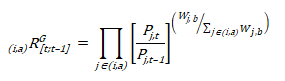
Here’s just one of the formulas they use at the Bureau of Labor Statistics to calculate the CPI:
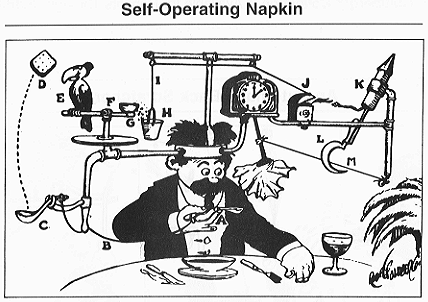
Decades of problem solving, generations of added processes, and the natural tendency of bureaucracies to construct Byzantine-like labyrinths rather than draw straight lines from problems to solutions has created a Rube Goldberg Machine to calculate what could originally be worked out by a fourth grader.
This is one reason people distrust these numbers: people aren’t capable of checking the government’s homework, and when they take a look they see a myriad of perplexing systems and confusing jargon.
This causes some to believe it’s all a scam, and that these measurements are systemically manipulated for the benefit of those with wealth and power.
Maybe.
After what happened in the subprime mortgage crisis a few years ago, I wouldn’t put anything past Wall Street and their lackeys in Congress.
Much of how the world works can be explained by incentives — what reason does a person have to do one thing and not the other? That, and repeating the question the great orator Cicero asked when evaluating legal claims: “Cui bono?”, which is a Latin phrase meaning “who benefits?”
Find out what the incentives are for an action, and who benefits from it, and you’re probably going to be in the ballpark.
The key word in the title “government economist” is, alas, government. And with the CPI, we’re essentially trusting the government to not only grade its performance in managing the economy, but to create the test, and then change the questions when it doesn’t like the answers.
The incentive, however underlying it may be, is to produce the lowest number for inflation possible.
And who benefits?
Consider what’s hitched to inflation — automatic cost-of-living increases for government employees, some large private employers, and retirees. While not automatic, higher inflation certainly gives employees across the board more of a justification to demand increased wages.
And while I’m uncertain, I suspect that Wall Street has managed to make money from all of this. Maybe someday we’ll learn exactly how.
Going Forward
We’ll see how close the real CPI is to my own NBS-CPI in just a few days. It’ll be closer than last month’s number, which was 8.5%, but not close enough to fully restore my faith in the measurement.
Until then, I plan to release an update of the NBS-CPI on a monthly basis until we’re out of this mess.
(J. Pepper Bryars is Alabama’s only reader supported conservative journalist. You can support his writing by subscribing at https://jpepper.substack.com/subscribe.)
In Alabama, it is illegal for any individual to return or mail another individual’s absentee ballot application or their absentee ballot. This practice, known as ballot trafficking or ballot harvesting, is a dangerous practice that often leads to ballot traffickers stealing the votes of well-meaning and unsuspecting voters. Alabama law requires that the chain of custody be maintained for both absentee applications and absentee ballots. If the chain of custody for an absentee application or ballot is broken, then the law has been violated.
According to §17-11-4 of the Code of Alabama, “The application may be handed by the applicant to the absentee election manager or forwarded to him or her by United States mail or by commercial carrier, as determined by rule by the Secretary of State.” Under Alabama law, the application must remain in the voter’s custody or with an approved commercial mail carrier during the entire process.
Pertaining to absentee ballots, §17-11-9 states that after completing their ballot, voters must “forward it by United States mail to the absentee manager or hand it to him or her in person.” Once again, the absentee ballot must remain in the custody of the voter or an approved commercial mail carrier.
Ballot trafficking will not be allowed in our state. It undermines the legitimacy of the elections process, and it leads to many Alabamians having their votes trafficked by paid political operatives.
These traffickers are not seeking to make it easier to vote. In fact, they are trying to make it easier to cheat. Ballot trafficking cheats Alabamians out of their opportunity to freely elect their leaders without coercion or manipulation.
If you are a witness to ballot trafficking or have been a victim of ballot trafficking, then it is incumbent upon you to report this activity to the Secretary of State’s Elections Division at 334-242-7210 or by visiting stopvoterfraudnow.com. Individuals who are found to be engaged in ballot trafficking will be referred to prosecuting authorities so they can be indicted and prosecuted to the fullest extent of the law.
Early last year, I joined my friend Rep. Kat Cammack and several colleagues in asking our constituents to submit nominations for hometown heroes who had made an impact in their community over the course of the previous year. The past two years have been tough on millions of Americans across the country who have battled illness, loss of jobs, loss of family members, and financial struggles. Despite this, there are so many unsung heroes around us who work constantly to make the world a better place.
Brian Copes and his students at Chickasaw High School are great examples of hometown heroes. Mr. Copes teaches construction and manufacturing at Chickasaw High School, where he has worked tirelessly with his students to produce and ship affordable prosthetic legs to amputees in Latin America. The legs are made with a 3D printer, and the program has been going on for more than a decade.
These students saw a need in developing countries because about 80% of amputees live in developing countries where prosthetics are too expensive for most people to afford. Life Changer Manufacturing, which is the name for this group of students, has now had the opportunity to travel to El Salvador and Honduras to fit 26 amputees this school year.
The students are not stopping there, though. This summer they will travel to Mexico to fit more amputees with prosthetic limbs that cost the amputees absolutely nothing. The school is also working to develop a solar powered computer lab to be shipped to Central America.
The incredible work being done by Mr. Copes and his students at Chickasaw High School has resulted in them receiving the Presidential Volunteer Service Award. Earlier today, I had the privilege of presenting the award winners with this prestigious award, which honors people whose service has positively impacted communities around the country and inspired others to do the same. This distinct honor is certainly well-deserved!
While there’s a lot of negativity in the world, I hope you are encouraged as I am by the hard work and service of these students at Chickasaw High School. South Alabama – and the world – are better off because of Life Changer Manufacturing, and I couldn’t be prouder to represent them in Congress.
Jerry Carl represents Alabama’s First Congressional District. He lives in Mobile with his wife Tina.
We’ve just completed the month designated by U.S. lawmakers as Financial Literacy Month. It would appear many of them aren’t financially literate, and it shows. But we are fortunate here in Alabama to have government leaders who are.
Alabama just passed historic budgets, and our state has the lowest unemployment rates ever. Financially speaking, things are going well right now – better than at any other time in our state’s history.
While there is always room for improvement, Alabama has come a long way, and there are many people to thank for their leadership in getting the state to this point. Gov. Kay Ivey; Finance Director Bill Poole; State Treasurer Young Boozer; Sen. Arthur Orr, chairman of the Senate Finance and Taxation Education Committee; Sen. Greg Albritton; chairman of the Senate Finance and Taxation General Fund Committee; Rep. Danny Garrett, chairman of the House Ways and Means Education Budget Committee; and Rep. Steve Clouse, chairman of the House Ways and Means General Fund Committee. These leaders are all fiscal conservatives and have worked hard to get Alabama on financially sound footing.
So how can the state become more fiscally responsible? By saving more than it spends.
Sounds like a no-brainer, but it’s just money savings 101. Taking care of what the state owns is another way to save money by using resources it has at its disposal instead of always reaching for the newest, biggest, brightest toys.
I’ve often promoted that the state should invest in buying used cars versus new cars as a money savings measure but have always been shot down on the idea. Either way, we don’t need fully loaded SUVs for government employees to drive across the state.
Utilizing technology to conduct virtual training and meetings is another way the state can save dollars. State government leaders can stop paying celebrities $50,000 each to make public service announcements on behalf of Alabama, and it can start putting annual reports online instead of printing them and mailing them out by the thousands. This may sound like trivial things but believe me I’ve seen it firsthand – it’s astronomically expensive!
So, while Alabama is doing well at the present time financially speaking as a state, our officials should use the end of Financial Literacy Month as the beginning of a challenge to save our citizens and our state even more money. It’s a sure bet you won’t hear one citizen complain about it at all.
Beth Chapman is Alabama’s former State Auditor and 51st Secretary of State. She now owns and operates Beth Chapman & Associates, LLC. This is her weekly column, “Around the Capitol” published in newspapers and blogs across the state. She can be reached at Beth@bethchapman.com.
Rapidly rising house prices are contributing to inflation but may also signal a housing market bubble. Overpriced real estate contributed to the financial crisis of 2008 and the Great Recession. Do we need to fear another housing crash in addition to inflation?
How much have prices gone up? The Case-Shiller index has jumped 35% since January 2020; between 1996 to 2006, this index rose 125%. Some markets have seen increases of nearly 45%. Prices in Alabama have increased at about the national rate.
What exactly is a bubble? A bubble refers to excessively high and rising prices for assets. What is too high? Consider how you could decide how much to pay for a house. One approach considers the value you would get from living in the house. This would depend on your income, other expenses, and preferences.
You could also answer based on what others would pay. You might only be willing to pay $100,000 to use a Florida beach condo. But if you could sell it for $500,000, you would gladly pay more than $100,000.
A bubble occurs when prices exceed the value in use, referred to as the fundamental value. High and rising prices can be self-sustaining. Someone might pay $500,000 for the condo to sell it for $700,000, and someone might pay $700,000 hoping it will go to $1 million. Eventually, the speculative bubble must burst because prices cannot rise to infinity.
Investors can lose lots of money in a speculative bubble. But investors spend their money and should be aware of the potential for loss. Bubbles can though have detrimental effects for the economy. Prices serve as signals. Builders will build more homes in response. But these homes will not be needed after the bubble bursts. Temporarily high prices might lead homeowners to make decisions they will later regret, like thinking their house will fund their retirement and saving less or borrowing against equity which then disappears.
Economists have developed new statistical tests to try to detect bubbles. One is produced by the Dallas Federal Reserve Bank. Any test for a bubble must estimate the fundamental value, or price based exclusively on use. The main one the Dallas Fed uses is the ratio of home prices to rents. Purchase prices and rents should be related since potential homebuyers could always rent instead.
This method then considers economic factors affecting the price-to-rent ratio. If economic factors drive up the price-to-rent ratio, this is not a bubble. Finally, they consider whether an observed increase in the ratio might occur by chance. When the price-to-rent ratio sufficiently exceeds that based on economic forces, we are in bubble territory.
The price-to-rent ratio has now been indicating a bubble for six consecutive quarters. When calculated retrospectively, this ratio indicated a bubble for a full decade before the Great Recession. It is not 2006 yet. And an index using the home price to income ratio has a weaker bubble signature.
No one statistical test will ever conclusively identify an asset bubble. Part of the reason is the same reason bubbles start: people disagree over future fundamental values. Many Americans have decided to move due to the COVID-19 pandemic. Remote work is allowing people to move out of cities. Others are fleeing blue states where governments enacted draconian COVID restrictions. Lumber shortages and price spikes related to COVID disruptions slowed home building. House prices may reflect economic forces after all.
The prevalence of bubbles is one reason economists disagree over the desirability of free markets. Markets prices are supposed to act as signals, as described, but bubbles produce unreliable signals. Markets will not effectively direct production with frequent bubbles. Free market economists see bubbles as relatively infrequent, unavoidable, and often caused by government.
What does a potential bubble mean for you or me? Would-be real estate moguls should exercise caution. Homeowners should be wary of capital gains they have not yet realized. If the Federal Reserve gets serious about controlling inflation, interest rate hikes may well burst a housing bubble.
Daniel Sutter is the Charles G. Koch Professor of Economics with the Manuel H. Johnson Center for Political Economy at Troy University and host of Econversations on TrojanVision. The opinions expressed in this column are the author’s and do not necessarily reflect the views of Troy University.
My 10-year-old grandson asked me to join in an Easter egg hunt.
“I’ll versus you,” he said.
I was puzzled until my daughter explained this means “challenge.”
“It’s slang,” his 12-year-old brother added.
He did “versus” me, and miraculously, he won, and claimed the five-dollar prize!
Every generation has slang, defined as a shorthand understood by that generation. My generation used words like “groovy,” “dweeb” and “take a chill pill.” More recently we’ve heard words like “epic fail,” “skrilla,” “bling” and “diss.” And a COVID vaccine shot is now a “Fauci ouchie.”
Closely akin to slang is jargon, the shorthand language of vocation. Thus there’s medical jargon, military jargon, computer jargon and theological jargon. I’ve been with families after surgeries when the doctor explained the outcome. And I’ve heard them say, “Doc, can you say that again? I’m afraid I don’t understand what you said.”
I think the worst offenders are our brave men and women in uniform. Their code words leave the rest of us in befuddlement. Who knows what “bivouac at 1835 hours” means?
Of course, religious leaders have our own slang. A pastor might say, “Today I want to deliver an expository discourse on eschatology,” or “I will speak about the hypostatic union of Christ.” And we’ve heard enough about “tracking” and “unpacking” to last a lifetime.
Jargon and slang are appropriate if the audience is one’s age group or workmates, but not appropriate for a general audience for which they convey no meaning.
Furthermore, Bruce Barton in “The Man Nobody Knows” argued that great language is “marvelously simple.” He gave three examples:
Our Father which art in Heaven, hallowed be thy name.
The Lord is my shepherd; I shall not want.
Four score and seven years ago . . .
Barton further noted, “Not a single three-syllable word; hardly any two-syllable words. All the greatest things in human life are one-syllable things—love, joy, hope, home, child, wife, trust, faith, God—and the great pieces of writing, generally speaking, use the small word in place of the large if meaning permits.”
The Apostle Paul agreed, I think, when he explained the preeminence of a clear gospel word over an ecstatic utterance. “I’d rather speak five words clearly understood than ten thousand words in a tongue,” he wrote (1 Corinthians 14:19). Thus it’s 2,000 times better to speak a clear word in worship than a word liable to be misunderstood.
Slang and jargon and technical words have their place, but when someone explains the love of God for us all, and his wonderful offer of mercy and forgiveness, we must be sure our words are clear and clearly understood by those who hear.
Reflections is a weekly devotional feature written by Michael J. Brooks, pastor of the Siluria Baptist Church, Alabaster, Alabama. The church’s website is siluriabaptist.com.
As a first-time candidate, I came in with a set of expectations about the challenges I might face running to serve Alabama in the United States Senate. With a month to go before the primary, much of what I thought about this process was true, but there were some revelations that revolted even an optimist like me.
Career politicians and the political class that surround them cannot be trusted and most are in it purely for themselves. Running for office takes a fraction of the skill it took to do what I did in the military and in business but because you have to deal with so many bottom-feeders and self-obsessed power-hungry people, great people who would otherwise make great candidates choose to stay away instead of joining the fight to drain the swamp.
We need new leaders with vision about what needs to get done to take us in a new direction and right now there are few people willing to join the fight because of the corrupt practices that are all too common among the ruling political establishment. I always knew the media and the permanent political class was out to destroy President Trump, but now I understand it at a totally different level. Now that I’m running, I see what incredible liars many of them are. Gone are the days of fair and honest reporting or public service as a means of giving back.
Take former “Congressman” Parker Griffith, who was given air-time to claim that I suffer from PTSD because I served our country. Are you kidding me? Griffith is attacking all of our veterans when he says something so reprehensible. Yet, Congressman Mo Brooks and chief of staff Katie Boyd Britt were happy to sit by while Griffith attacked the honor of the men and women who serve our country and come home and get back to work. Why? Because that’s politics. That’s how it “works.”
It’s no wonder we don’t trust the majority of people who hold or are running for political office. It’s truly unfortunate that we view public officials this way. But in so many cases – it’s deserved.
And it’s why the fight is so important – it’s why I stood up to serve “One More Tour” as I call it, to go to Washington, kick some tail, and come back home having made a difference for our state.
I am a Christian conservative who served my country for 22 years, sacrificed everything on the battlefield, raised a family, and created and ran a successful business that employs over 500 people. I’ve lived the values that make our state a wonderful place to raise a family and build a business. But of course, the shady political players have decided to aim their sights on me because I’m not their chosen one and they know they will never control me.
I have said for years that in any transition, it is the power brokers with the most to lose who resist change the most. It’s clear now that they fear losing the control they have had for years when I win this seat. I’m more qualified and have a proven record of service, but rather than let the people decide, the big money players with the big egos saturate the market with attack ads with ridiculous accusations about my character to try to sway public opinion.
In spite of all this, I’m honored to have the opportunity to run for this seat and will never stop fighting in spite of the challenges thrown my way. For someone like me, the chance to serve in this capacity could only happen in America and I thank God every day that I live here in the great state of Alabama.
Mike Durant is a Republican candidate for U.S. Senate in Alabama
We knew it was coming.
When Florida’s Parental Rights in Education bill became law-keeping teachers from discussing age-inappropriate sexual material with students in kindergarten through third grade – the media pounced.
They dubbed it “Don’t Say Gay,” which is hardly an accurate depiction of what’s contained in the law. Disney, one of the state’s largest employers and owner of ABC (and ABC News), condemned the law. Liberal talking heads took turns on CNN and MSNBC attacking Gov. DeSantis and the Florida Legislature as being bigoted.
So, when the Alabama Legislature took up not one, but two bills in the closing hours of our 2022 legislative session related to protecting children and gender education, we knew our turn was next.
It didn’t take long.
White House press secretary Jen Psaki, who is reportedly leaving the Biden administration in a matter of weeks to join MSNBC, decided to lecture Alabama’s legislators from the press room podium the very day these issues were being debated on the floor of the State Legislature.
“…Alabama’s lawmakers and other legislators who are contemplating these discriminatory bills have been put on notice by the Department of Justice and the Department of Health and Human Services,” she announced.
The over-the-top and inaccurate headlines soon followed.
“Alabama passes bills to target trans minors and LGBTQ classroom discussion” – NBC News
“Alabama governor signs into law two bills limiting transgender youth protections” – CNN
“Alabama governor signs ‘Don’t Say Gay,’ trans care and bathroom ban bills” – ABC News
We were called “hateful,” “hurtful,” and “ignorant” by TV news presenters from their Washington, D.C. and New York City bubbles.
Did any of them bother to set foot in our state to talk to our residents or the lawmakers the people of Alabama elected to represent them? Did they try to understand why we passed these measures before painting us with the broad brush of their own hatred of people with differing opinions?
I know I made myself available to the media for interviews. However, no one reached out to me in my role as chairman of the Alabama Republican Party until over a week after the bills had been signed – well after the news cycle and public attention had moved on to something else.
I suspect they knew my comments wouldn’t fit their predetermined narrative. With that in mind, I thought I would set the record straight in this article, and share with you why the Alabama Republican Party supports these measures. It’s because we care about our children. We want young women to feel safe in school bathrooms, we want a fair playing field in school sporting events, and we want to make sure children don’t make irreversible life changing decisions before they are old enough to fully understand the consequences.
It’s really quite simple, we want our children to be safe, successful, and have an education that does not push a social agenda on them while still in elementary school. There is nothing more important than protecting our children, and Alabama is now leading the nation in this area. I think we need to thank our State Legislature for their work on this issue. We may not be biologists, but we still know the difference between male and female. Perhaps this makes us overqualified to be on the Supreme Court, or maybe it just means we won’t bow to a politically correct agenda that doesn’t make sense.
People are tired of the media bias. They want objective reporting that gives all the facts, tells both sides of the story, and allows the audience to make up its own mind. It’s time to return to basic journalist standards that will allow all Americans to be accurately informed. Until then, I plan to keep trying to set the record straight.
John Wahl is the Chairman of the Alabama Republican Party
I’ve had the honor of serving in law enforcement for 36 years, including the past 15 years as sheriff in Baldwin County. I am a past president of the Alabama Sheriffs Association. Needless to say, the safety, well-being and support of law enforcement officers is deeply personal for me.
Not only is that why I’m proudly endorsing Christian conservative Katie Britt to serve as Alabama’s next U.S. Senator, but it’s also why I find the false, ridiculous attacks on her by an out-of-state special interest Club so offensive.
Residents across Coastal Alabama, especially, should remember that this is the same Swamp Club that smeared then-Congressman Bradley Byrne and now-Congressman Jerry Carl last election cycle. The Club has a proven record of being against our interests and putting America last. This is why the Trump family calls them the “Club for Chinese Growth.”
I’m honored to serve as co-chair of the Stars and Shields for Katie Britt Coalition, which is an advisory committee of more than 50 sheriffs and police chiefs from across our state. I’m backing Katie because I know firsthand that she is a tireless champion for law enforcement officers, public safety, and all Alabamians.
Let me set the record straight.
In the Senate, Katie will always fight for the heroic law enforcement officers who keep Alabama families, neighborhoods and communities safe.
These incredible men and women leave the safety of their homes every day so that others can return to and live safely in theirs. Our law enforcement officers’ sacrifice and dedication to serving others is something our country can never take for granted, and Katie knows that we owe them a debt of gratitude that can never be repaid.
Katie is committed to being a proactive partner to our law enforcement officers in combating crime, strengthening communities, and getting deadly drugs off the streets across our state. But you don’t just have to take it from me.
Shelby County Sheriff John Samaniego was appointed by President Donald Trump’s administration to serve as a commissioner on the Presidential Commission on Law Enforcement and the Administration of Justice, and Sheriff Samaniego is one of my fellow co-chairs of the Stars and Shields for Katie Britt Coalition.
Here’s what Sheriff Samaniego has to say about Katie:
“With the Biden liberals trying to defund our police, we need a Senator who’ll have our back, and that’s why I’m supporting Katie Britt. Katie will get tough on violent criminals and fight for stronger borders to keep illegal immigrants and deadly drugs out of Alabama. Take it from me – Katie Britt is a strong conservative who will keep your family safe.”
The fact of the matter is that Katie has never supported and does not support the radical Defund the Police movement; she has never supported and does not support BLM; and she has never posted, said, or done anything to indicate otherwise.
Katie strongly supports our law enforcement officers, and she’ll fight to defend the police in the U.S. Senate. She supports ensuring our law enforcement agencies are better funded so that our officers are the best trained, equipped and resourced in the world. This helps ensure safe, strong communities across Alabama.
I know from personal experience that Katie also is focused on issues directly related to supporting our law enforcement community, such as improving access to quality mental health care, combatting the opioid epidemic and flood of drugs into Alabama, and keeping kids in school and off the streets.
In 2018, I was proud to visit with President Donald Trump at the White House to discuss cracking down on illegal immigration and keep Alabama communities safe. Katie shares our commitment to finishing building the wall, securing the border, upholding law and order, and putting America and Alabama first.
Between the national climate and the pandemic, it’s been a tough period of time for our law enforcement. We need more allies, advocates and partners like Katie Britt, and we need less swamp creatures like the Washington, D.C. Club that’s falsely attacking her.
Katie Britt backs the blue, and she’ll always have Alabama’s back. We need her to fight for us in the Senate, and I’d encourage you to join me in supporting her on May 24.
Hoss Mack is the Sheriff in Baldwin County, Alabama. He has been in law enforcement since 1985, the past 15 years as sheriff. A Republican, Mack is a past president of the Alabama Sheriffs Association.
With increasing threats around the globe – specifically from China and Russia – it is more important now than ever for the Department of the Navy to develop and implement a serious plan to ensure we have a fully-funded, strategic shipbuilding plan.
Russia’s aggression in Ukraine and China’s growing naval power should serve as a serious wakeup call for the United States to examine our capabilities and our long-range plans to defend ourselves and our interests from bad actors like Russia and China. In Congress, I sit on the Seapower and Projection Forces Subcommittee, where one of our many responsibilities is overseeing Navy programs related to shipbuilding.
It is very clear to all the members on the subcommittee (which is led by my friend Rep. Rob Wittman from Virginia), that the United States desperately needs to increase investment and long-term planning to ensure our naval shipbuilding is keeping up with demand. That’s why Rep. Wittman and several others on the House Armed Services Committee recently visited shipyards in Mobile and around the Gulf Coast to learn firsthand what our capabilities and what our needs are. My colleagues and I have been sounding the alarm on this for months because we know just how important it is to not fall behind and allow folks like Russia and China to lead.
Just last week, the Biden administration released its 30-year shipbuilding plan. I was extremely disappointed by most of what I saw in the plan. This plan would actually do the exact opposite of what we should be doing. It would reduce our ability to protect our aircraft carrier strike groups, reduce our ability to eliminate an enemy’s minefield, and it would reduce the Marine Corps ability to carry out forcible entry missions while reducing our fleet’s missile launching capabilities.
Even worse, President Biden’s budget request would actually shrink our naval fleet. Their plan is to decommission 24 ships while only adding eight new ships, despite clear evidence that our naval fleet is not large enough to adequately counter growing threats. The United States Navy currently has 298 active ships, while China has 355 active ships. China is not stopping there – in fact, they are on track to have 460 active ships by 2030, whereas the Biden admin wants to reduce our Navy to 291 ships. This is simply unacceptable and makes the world a more dangerous place.
Shipbuilding is not something that happens overnight. It takes years to build a single ship, and we can’t afford to wait until we are in desperate need to start increasing production. Cutting our naval power now to save a little money puts the United States at a serious disadvantage and could cause us serious harm in the years to come. Now is the time to make strong investments in our military, develop a long-term strategy, and ensure our men and women have the tools they need to protect and defend the United States.
Jerry Carl represents Alabama’s First Congressional District. He lives in Mobile with his wife Tina.
Alabama’s Caleb Hicks was invited to the White House earlier this month to participate in the president’s annual Easter Egg Roll.
Hicks was not just invited to participate but was given a leadership role (no pun intended) in helping manage the egg hunt section of this event. He and his fiancé, Katie Phillips, both worked the event and reported it was not only fun, but the opportunity of a lifetime. But it was more than fun for Hicks; it was work. Hicks is the communications and membership director of the Alabama Egg and Poultry Association, which is responsible for, among other things, promoting Alabama’s billion-dollar poultry and egg industry.
The American Egg Board, which manages promotions for the egg industry in the U.S., invited about a dozen people from across the country, and due to his job, Hicks was one of them. You may be familiar with the board via its well-known “Incredible Edible Egg” campaign.
The White House Easter Egg Roll has been an annual event since 1878 when Rutherford B. Hayes was president. It has been held most years since then, except for inclement weather, war times and the past two years due to the COVID-19 pandemic.
Approximately 30,000 people attended the event this year. They were selected through a national lottery. American farmers donated 100,000 eggs to the event and to the Maryland Food Bank. Americans decorate and eat approximately 3 billion eggs during the Easter season.
Hicks is quick to point out that Alabama does its part in the production of all things eggs and poultry. Alabama’s egg and poultry industry has an annual economic impact of $15 billion in our state. We rank second nationally in broiler production. Poultry is one of the largest industries in the state and makes up one-eighth of Alabama’s economy. It is responsible for 86,000 jobs and produces over 1billion birds each year. Out of the 1.7 million table egg laying hens, 500 million eggs are produced. That’s a whole lot of eggs.
Thank you to Hicks for representing our state and one of its largest industries at the biggest egg hunt of them all at the biggest house of them all. Keep Alabama relevant. Eat more poultry and eggs.
Beth Chapman is Alabama’s former State Auditor and 51st Secretary of State. She now owns and operates Beth Chapman & Associates, LLC. This is her weekly column, “Around the Capitol” published in newspapers and blogs across the state. She can be reached at Beth@bethchapman.com.
In 2020, the federal government started sending checks to many Americans in response to COVID-19. The presumption was that Uncle Sam’s checks would make us better off. But government transfers cannot make a nation wealthier and have contributed to inflation.
To understand this, we must distinguish money and currency. Money is a medium of exchange, or a way to make purchases. People accept money when they sell things because they expect to exchange it for things they want. Many different items have served as money in different places and times, from tobacco to gold, silver, paper, and soon possibly Bitcoin.
You or I have money because we produced something, worked for someone, or sold something of value, like a car. Or because someone who earned money gave it to us as a gift or inheritance. Money represents unconsumed production.
Currency is the item serving as money. In the U.S. today, it is the dollar of course, green pieces of paper or entries in bank accounts.
Once an economy moves beyond using commodity money, currency must be produced. Whoever produces the currency can acquire goods and services without producing anything. This explains the necessity of controlling counterfeiting. A good currency must be hard or impossible to duplicate.
Governments long ago took over supplying currency because the supplier can usually make some extra to spend themselves. When metal coins served as currency, a type of counterfeiting called “scraping” was possible. Someone could scrape a little off several coins and mint an extra one. Kings protected against scraping by placing their royal seal on the coin; a defaced seal would reveal scraping. Of course, kings charged for minting coins.
Beginning with the CARES Act, Uncle Sam authorized $4.6 trillion and spent $3.6 trillion, much of it transferred to households and businesses through stimulus checks, the Payroll Protection Plan, and assistance for landlords. Yet the government can only make currency, not money. If you earn an extra $3,000 from part-time work, you can spend more than before but there are also more goods and services available. A $3,000 stimulus check did not make more goods and services available.
One of Adam Smith’s great insights in “The Wealth of Nations” was recognizing that wealth depends on our ability to produce and consume. Previously people associated wealth with possessing large quantities of gold and silver. Smith recognized that the true value of gold was its ability to be exchanged for consumption goods.
More currency does not increase our ability to produce goods and services. Currency creation can make the persons who get the dollars to spend first better off. Suppose the Federal Reserve doubled the number of dollars and gave them all to you. Prices would likely double, but you could still buy a lot, lot more than before.
Government can also tax money from some Americans and transfer it to others. But taxes and transfers cannot make us all better off. If Uncle Sam taxed everybody $10,000 and gave us the cash back, we would merely be where we were before.
COVID spending arguably reduced our ability to produce goods and services. Government checks caused some to work less or stop working altogether. Labor shortages have worsened supply chain problems, making us at least temporarily poorer.
Inflation costs Americans as well. Most Americans will receive raises to offset higher prices (this is part of the inflation), but prices and our incomes do not rise simultaneously. And we have no guarantee that a raise, when it comes, will completely offset inflation. The cost of inflation includes fear and anxiety.
All of this began with an impossibility: government redistribution cannot make all Americans more prosperous. Confusing currency and money sustains an impression that larger bank balances increase prosperity. Today, some politicians promote government checks as relief from inflation. They apparently hope to pull the same ruse on us again.
Daniel Sutter is the Charles G. Koch Professor of Economics with the Manuel H. Johnson Center for Political Economy at Troy University and host of Econversations on TrojanVision. The opinions expressed in this column are the author’s and do not necessarily reflect the views of Troy University.
I’ve been chief of the Florence Police Department for 10 years this summer. Needless to say, the safety, wellbeing and support of law enforcement officers is deeply personally for me.
Not only is that why I’m proudly endorsing Christian conservative Katie Britt to serve as Alabama’s next U.S. senator, but it’s also why I find the false, ridiculous attacks on her by an out-of-state special interest club so offensive.
I’m honored to serve as co-chair of the Stars and Shields for Katie Britt Coalition, which is an advisory committee of more than 50 sheriffs and police chiefs from across our state. I’m backing Katie because I know firsthand that she is a tireless champion for law enforcement officers, public safety and all Alabamians.
Let me set the record straight.
In the Senate, Katie will always fight for the heroic law enforcement officers who keep Alabama families, neighborhoods and communities safe.
These incredible men and women leave the safety of their homes every day so that others can return to and live safely in theirs. Our law enforcement officers’ sacrifice and dedication to serving others is something our country can never take for granted, and Katie knows that we owe them a debt of gratitude that can never be repaid.
Katie is committed to being a proactive partner to our law enforcement officers in combatting crime, strengthening communities and getting deadly drugs off the streets across our state. But you don’t just have to take it from me.
Shelby County Sheriff John Samaniego was appointed by President Donald Trump’s administration to serve as a commissioner on the Presidential Commission on Law Enforcement and the Administration of Justice, and Sheriff Samaniego is one of my fellow co-chairs of the Stars and Shields for Katie Britt Coalition.
Here’s what Sheriff Samaniego has to say about Katie:
“With the Biden liberals trying to defund our police, we need a senator who’ll have our back, and that’s why I’m supporting Katie Britt. Katie will get tough on violent criminals and fight for stronger borders to keep illegal immigrants and deadly drugs out of Alabama. Take it from me – Katie Britt is a strong conservative who will keep your family safe.”
The fact of the matter is that Katie has never supported and does not support the radical “defund the police” movement; she has never supported and does not support BLM; and she has never posted, said or done anything to indicate otherwise.
Katie strongly supports our law enforcement officers, and she’ll fight to defend the police in the U.S. Senate. She supports ensuring our law enforcement agencies are better funded so that our officers are the best trained, equipped and resourced in the world. This helps ensure safe, strong communities across Alabama.
I know from personal experience that Katie also is focused on issues directly related to supporting our law enforcement community, such as improving access to quality mental health care, combating the opioid epidemic and flood of drugs into Alabama, and keeping kids in school and off the streets.
Between the national climate and the pandemic, it’s been a tough period of time for our law enforcement. We need more allies, advocates and partners like Katie Britt, and we need less swamp creatures like the Washington, D.C. club that’s falsely attacking her.
Katie Britt backs the blue, and she’ll always have Alabama’s back. We need her to fight for us in the Senate, and I’d encourage you to join me in supporting her on May 24.
Ron Tyler is the Chief of Police in Florence, Alabama. He has served the Florence Police Department for 27 years.
It was unique in the history of telephone calls. She asked the ministry assistant if she could talk with the pastor and we connected.
“I won’t give my name,” she said, so I conversed with this unknown person for some time.
She explained she was married to an area pastor, and her husband thought he and she ought to be blameless in every regard. No argument from me. Then she further explained how her church received offerings.
“At the end of the service, a deacon reads the envelopes or checks and tells how much everybody gave,” she said. “My husband gives more than we can afford because he knows we have to be exemplary. What should I do?”
Well, only one of many times I filibustered while trying to think of a rational response. Granted, it was unusual to talk with anyone who felt they gave too much to the Lord’s work. In fact, I’d never heard this before. Nor had I heard of a church following this procedure. I thought this would happen in our church only once!
Jesus had much to say about religious people who “practiced their piety before men” (Matthew 6). He spoke of three spiritual pursuits. The first is “alms,” or as we would say, charitable giving. This is the origin of the famous saying, “Let not your right hand know what the left is doing.” The point is we give to God’s glory, not for our own.
Then Jesus spoke of public prayers and fasting. Both praying and fasting are good but should be done to draw us closer to God, not to win praise from others.
Back to the caller, I told her that I didn’t see any value in the way her church announced individual gifts, and I’d recommend she have a serious talk with her husband about budgeting.
In another place we began a building campaign. Our consultant explained that I, the pastor, was expected to announce our over-and-above monthly pledge to encourage others. I thought of this clear teaching of Jesus and struggled with what to do. I ended up telling the congregation that we would give the equivalent of what we’d pay for lunch every day. I guess it worked. The pledges came in and the building has been used for many years, though it could be argued I violated scripture in telling others about money and fasting!
The question we must ask in every decision of life is why do we do what we do? If we do it to gain the praise of others, we do it wrongly. The best course is to try to please God first of all and to do so with thankful hearts. -30-
Reflections is a weekly devotional feature written by Michael J. Brooks, pastor of the Siluria Baptist Church, Alabaster, Alabama. The church’s website is siluriabaptist.com.
Alabama has lots of money. The general fund budget and education trust fund budget saw investments of almost $11 billion in spending for 2023. Since we have it, why not spend it is the mentality. And that’s what has been planned – including pay raises for state employees and educators.
There were a number of tax-relief measures handed out, and who doesn’t love tax relief, especially with the recent annual passing and pain of April 15. The Alabama Small Business Relief and Revitalization Act was passed, and it’s self-explanatory. (These are cliffs notes, remember – not the details.)
There was also the repeal of the business privilege tax, which cuts that $100 minimum payment in half starting in 2023. Thank you, Sen. Tom Butler.
And thanks to Lt. Gov. Will Ainsworth and the Alabama Military Stability Commission, Alabama now leads the nation in military-friendly states with our new legislative package of bills that were passed – six in all.
Then broadband funding was expanded and provides tons of money for investing in its
future across the state, which is long overdue. Thank you again, Sen. Clay Scofield and Rep. Randall Shedd.
Election integrity was addressed during the session with a bill that specifically stops private companies from funding election-related activities. Thank you, Rep. Wes Allen, who is a former probate judge.
Constitutional Carry was passed, and law-abiding handgun owners no longer have to purchase a pistol permit in Alabama. Some will say that’s good, and some will say that’s bad. Just remember, reciprocal states will still require a state-issued permit when you travel.
Which bathroom children in public schools should use was up for debate – go figure. It was decided that students should use the bathroom that coincides with the gender to which they were born. There were other controversial bills that dealt with puberty-blockers, too.
Goodbye to the 21 legislators who will leave us this year, as this is their last regular session of the Legislature. Many are retiring, others are seeking different offices, but they are all to be commended for their years of service.
Best of luck and thank you to Senators Jim McClendon, Del Marsh, Priscilla Dunn, Malika Sanders-Fortier, and Jimmy Holley; plus Representatives Lynn Greer, Mike Ball, Allen Farley, Howard Sanderford, Mac McCutcheon, Kerry Rich, Mike Holmes, K.L. Brown, Louise Alexander, Merika Coleman, Rodney Sullivan, Rich Wingo, Wes Allen, Mike Jones, Steve McMillan and Victor Gaston.
Beth Chapman is Alabama’s former State Auditor and 51st Secretary of State. She now owns and operates Beth Chapman & Associates, LLC. This is her weekly column, “Around the Capitol” published in newspapers and blogs across the state. She can be reached at Beth@bethchapman.com.
One of President Biden’s first actions when he took office was banning new oil and gas lease sales on federal lands and waters. This moratorium on new leases in federal waters has been particularly devastating to south Alabama and the Gulf Coast region. These actions resulted in the cancellation of scheduled lease sales under the Gulf of Mexico Energy Security Act (GOMESA) program, which provides critical revenue to our state and our region.
I immediately got to work and introduced the Gulf Conservation and Recreation Funding Act, which would require the Department of Interior to pay GOMESA states (Alabama is one of them) the revenues they are missing out on due to leases canceled by President Biden’s Executive Order 14008 on January 26, 2021. This is a huge issue for AL-01 because in 2020, GOMESA funds supported upwards of $26 million in recreation and conservation projects in south Alabama. These projects include boat ramps, shoreline restorations, bike trails, and park enhancements. Each year, local county commissioners and municipal governments plan projects based on forecasted GOMESA funds. Since the cancellation of new lease sales, our coastal communities and our state have been denied a vital source of funding.
While GOMESA funds are majorly important for our coastal communities, the impacts of the Administration’s decision to cancel oil and gas lease sales on federal lands and waters impacts so much more. For almost a year and a half now, ALL of us have been paying more and more at the pump each time we fill up. These rising fuel prices are also contributing to significant cost increases for virtually everything we purchase – especially our groceries and basic household items.
Thankfully, the Biden administration has been feeling the pressure from federal courts and from the American people, and we are finally seeing some progress on rolling back their war on American energy. Just last Friday, the administration announced it would resume oil and gas lease sales on federal lands beginning this week. This is a great step in the right direction, but it unfortunately does not include lease sales on federal waters and it limits the acreage available to about two-thirds of what was available during the Trump administration.
Just recently, I introduced the Unleashing American Energy Act, which would require a minimum of two oil and gas lease sales a year in the Gulf of Mexico and in the Alaska Region of the Outer Continental Shelf (this would bring us back to Trump-era levels). My bill would also prohibit future moratoriums or delays on oil and gas leasing. Although this bill won’t solve all our energy problems overnight, it will help lower energy prices, bring relief to millions of Americans, and ensure liberals can’t cripple our energy industry again.
America has abundant natural resources, and we produce the cleanest energy in the world. Becoming energy independent is critically important for the United States because it will result in lower energy prices for all Americans, while ensuring we do not rely on dictators and terrorists around the globe to provide for our energy needs. I’ve been fighting to make this happen for over a year, and I won’t let up until we fully unleash American energy and end the regulatory assault on our energy producers.
Jerry Carl represents Alabama’s First Congressional District. He lives in Mobile with his wife Tina.
Cities across America own golf courses, but analysis from the Reason Foundation shows that many lose money on them. Is subsidizing golf a proper function of government?
The Reason study found over cities reporting finances for their golf courses. Seventy percent of cities lost money in 2020, which may have been unrepresentative due to state COVID restrictions. All four Alabama cities reported on (Fort Payne, Gadsden, Millbrook and Pelham) lost money on golf.
In the market, losses indicate that businesses are not producing value equal to the value of resources used. Producing low valued products or services with scarce resources reduces our standard of living. Are cities wasting money on golf?
Answering this question is a little tricky. Golf courses create value in two ways. One is through play (although golfers sometimes wonder why they pay for such frustration). Golf courses also boost the value of adjacent real estate. Developers may build golf courses to sell houses, not to earn profits from course operation. Privately owned courses may create value even if losing money.
Cities generally do not generate auxiliary revenue from golf, so operating deficits are likely being covered out of the budget. Tax dollars have alternative uses, like repairing roads. Should the courses be closed, or is the problem poor management?
Interestingly, firms in the golf industry manage municipal courses. Companies offering this service include Troon, Hampton, Club Corp, and Arnold Palmer. Peter Hill helped build one of the first management companies. A Golf Week story summarized his observations: “Often, municipalities allowed courses to fall into disrepair, didn’t manage the books well, or had trouble finding the proper price point. Or sometimes they realized they simply didn’t know how to run a golf course efficiently.”
Abraham Lincoln said that government should only do things that people “need to have done, but can not do at all, or can not so well do, for themselves.” The existence of private golf courses creates a strong presumption against government golf. Yet local governments provide many services also provided by businesses. Government offers unfair competition for business. A city facility charging prices too low to cover costs rarely goes out of business and the manager (a government bureaucrat) may not be fired. Businesses can go broke competing with tax subsidized prices.
The political influence of avid golfers is a bad reason for government golf. Although municipal golf courses are open to all, only 24 million Americans played a round in 2019. Avid golfers are a portion of this total and on average have incomes well above the national median. Taxpayers should not fund anyone’s hobby.
Two better arguments exist. The first is expanding opportunities. Golf is an expensive sport which many children never get to try. It offers many networking opportunities for professionals, so some familiarity could help promote upward income mobility.
Private efforts like the World Golf Foundation’s First Tee program, however, may better achieve this goal. Cities could use tax dollars for vouchers for play by low-income residents or golf field trips for middle and high school students instead of owning golf courses.
The second argument is as an amenity. Restaurants, museums, recreation, and golf affect the “livability” of a region and help businesses attract and retain good workers; economists call these local public goods. Businesses do not provide these and may have to pay higher salaries for employees in areas with few amenities.
The conditions for legitimate investment in amenities, however, are strict. There must be no privately owned, open to the public golf courses within reasonable driving distance. (This also alleviates unfair competition concerns.) Many amenities are not available in rural areas. Evidence should be presented to show the value of golf versus other amenities (e.g., bowling or laser tag).
Local governments are probably better served focusing on roads, schools, and trash collection. Enterprising politicians are sometimes called political entrepreneurs. Politicians who want to go into business should use their own money, not tax dollars.
Daniel Sutter is the Charles G. Koch Professor of Economics with the Manuel H. Johnson Center for Political Economy at Troy University and host of Econversations on TrojanVision. The opinions expressed in this column are the author’s and do not necessarily reflect the views of Troy University.