The University of Alabama community gathered in large numbers this week to honor the life of student James “Jimmy” Gracey, holding a series of memorial events in Tuscaloosa following his death during spring break in Spain.
A standing-room-only Catholic mass was held Monday evening at St. Francis of Assisi University Parish, where students, friends, and faculty filled the church to capacity.
The remembrance continued Tuesday night, when hundreds gathered outside the Theta Chi fraternity house for a candlelight vigil organized by Gracey’s fraternity brothers.
Speakers at the vigil, including Theta Chi International President Toby Roth, shared personal reflections on Gracey’s character as mourners filled the lawn and surrounding areas. The University of Alabama President Peter Mohler also attended.
Friends remembered Gracey as someone known for his compassion and generosity.
“Jimmy was always smiling — like, just a big smiler,” one speaker said. “And Jimmy was so compassionate.”
Another fraternity brother described his integrity in everyday moments.
Speaking about times Jimmy would ask to borrow his car, one fraternity brother shared, “My gas tank was always a little more full than when I left it … That was the kind of guy Jimmy was.”
Gracey, a 20-year-old University of Alabama junior, died last week while on spring break in Barcelona, Spain. He had been out with friends at a nightclub before disappearing in the early morning hours of March 17, prompting a widespread search.
Authorities later located his body in a nearby marina. A preliminary autopsy indicated the death was likely accidental, and police have said they are not currently pursuing criminal charges as they await final toxicology results.
The report noted that large crowds gathered for both memorial events, underscoring the impact Gracey had on his peers and the broader campus community.
54 workers at a Dothan cigar manufacturing facility learned this week their jobs are going away, but the global tobacco company closing its doors in Houston County isn’t leaving them empty-handed.
On Wednesday, PMI U.S. announced they will wind down operations in the Wiregrass in the coming months as part of their public health mission to pivot toward a smoke-free future. Roughly 20 employees will stay on to support ongoing needs of the facility and community.
According to the company, all those impacted by the closure will receive a top-notch severance package that includes extended salary continuation, company-paid health insurance for a period after departure, and help finding their next job.
“Everyone impacted will receive strong support,” the company said in a news release today.
Cigars were not actually originally part of PMI’s core business — the Dothan facility came to the company through its 2022 acquisition of Swedish Match, and the site itself has operated as a cigar maker for roughly 25 years.
But today’s announcement is part of a broader shift toward smoke-free, FDA-authorized nicotine products, such as Zyn, which the company says is intended to help the nearly 30 million American adults who still smoke move away from cigarettes.
“The decision to close our manufacturing operations in Dothan reflects our focus on operating efficiently and sustainably across all aspects of our business and on accelerating the growth of our smoke-free business in America,” Peter Luongo, Managing Director of PMI’s cigar business said Wednesday.
“This change does not diminish the pride we have in the work done in Dothan. The dedication, craftsmanship, and teamwork of our colleagues here have had a meaningful impact on our business.”
PMI said its broader U.S. commitment remains unchanged, having invested more than $1 billion in American manufacturing and workforce development since 2022.
The company said those investments are generating thousands of jobs and more than $800 million in annual economic impact nationwide.
Five Alabama shopping districts have earned national recognition after being named among the most “envied” retail destinations in the country, according to a new ranking from financial media company MarketBeat.
The list, based on a poll of 3,026 respondents, asked a simple question: which shopping districts across the U.S. people most wish they had in their own communities.
The results span iconic retail corridors like Chicago’s Magnificent Mile and New York City’s Fifth Avenue, as well as creative, locally driven districts in cities such as Seattle, New Orleans, and San Antonio.
What connects these Alabama districts is not size or luxury, but authenticity. Each one is built around locally owned businesses, historic or repurposed spaces, and a strong sense of community identity.
Rather than traditional mall-style shopping, they offer something more personal—places where visitors can meet shop owners, interact with artists, and experience a blend of retail, culture, and gathering space. For Alabamians looking for a different kind of weekend getaway, these districts offer destinations that are as much about the experience as the shopping itself.
Pepper Place (Birmingham) — #40
Ranking highest among Alabama locations, Pepper Place has transformed a former Dr. Pepper syrup plant into one of the South’s most vibrant gathering spots. The district blends design shops, local makers, and a highly popular Saturday farmers market, drawing visitors from across the state.
Its industrial setting and creative energy make it both a shopping destination and a community hub, anchored by businesses like FarmStand by Stone Hollow Farmstead, known for farm-fresh goods and locally made products.
Downtown Fairhope — #142
Often described as one of Alabama’s most charming downtowns, Fairhope offers a walkable shopping experience lined with oak trees, flowers, and more than 100 locally owned boutiques and galleries.
With no national chains and a strong emphasis on personal service, the district has become a destination for shoppers seeking unique, small-batch goods. Stores like Fairhope Soap Company highlight the area’s focus on craftsmanship and locally inspired products.
Downtown Opelika — #170
Downtown Opelika has quietly built a reputation as one of the state’s most compelling small-city retail districts. Historic brick storefronts along Railroad Avenue and 8th Street house a mix of boutiques, antique stores, and specialty shops.
The area’s appeal lies in its authenticity—businesses are locally owned, and the atmosphere reflects a genuine sense of community rather than curated trendiness. Shops like The Surcie Shoppe exemplify the district’s focus on thoughtfully selected, one-of-a-kind items.
Downtown Florence (Court Street) — #180
In Florence, Court Street anchors a historic downtown that blends shopping with the cultural influence of the Shoals’ music heritage. Boutiques and specialty stores fill preserved buildings, while nearby restaurants and live music venues enhance the overall experience.
The presence of nationally recognized designer Billy Reid, whose flagship store is located downtown, adds a layer of broader appeal while maintaining strong local roots.
Lowe Mill ARTS & Entertainment District (Huntsville) — #190
Housed in a former textile mill dating back to 1901, Lowe Mill offers one of the most unique shopping experiences in the region. The sprawling complex is home to more than 150 working artist studios, where visitors can watch creators at work and purchase directly from them.
Part retail, part studio space, and part cultural venue, Lowe Mill functions as a creative village. Its markets, events, and hands-on experiences make it a destination for both shoppers and art enthusiasts.
MarketBeat founder Matt Paulson said the results reflect more than aesthetics.
“These districts aren’t just pretty streets; they are ecosystems that shape brand loyalty and buying behavior,” Paulson said. “When thousands of people envy the same retail corridors, it tells you a lot about where the strongest consumer pull still lives.”
For Alabama, the takeaway is clear: the state’s most celebrated shopping districts are succeeding not by competing with large-scale retail, but by offering something increasingly valued—authenticity, creativity, and a strong sense of place.
For those looking to plan a quick getaway without leaving the state, these “envied” districts double as ready-made destinations—places where a day trip can turn into a full weekend built around exploring some of Alabama’s most distinctive local treasures.
A summer twilight run in Cullman will honor the life of former Alabama sports reporter Christina Chambers while raising support for the young son she left behind.
The Christina Chambers Twilight 5K is scheduled for Friday, Aug. 7, at 8 p.m. at Cotton Creek in Cullman. Organizers say the evening event will bring together runners, walkers, and community members for a race designed to celebrate Chambers’ life and the impact she had on those around her.
Proceeds from the event will benefit Chambers’ son, Constantine, along with local charitable causes selected in her honor, offering a way for the community to both remember and give back.
The race also reflects Chambers’ deep connection to running. A Cullman native and former competitive athlete, she was known for her determination and energy — qualities organizers say inspired the creation of a 5K in her memory.
Chambers was widely recognized across Alabama as a sports journalist with a career spanning multiple television markets. She joined WBRC in 2015 and became a familiar presence in sports coverage, particularly during high school football season. After stepping away from a full-time role in 2021, she continued contributing as a freelance reporter during the 2025 football season.
Before her time in Birmingham, Chambers worked as a sports reporter and anchor at WAKA in Montgomery and held previous roles in Columbus, Georgia, and Atlanta, where she covered Auburn athletics and high school sports. She also contributed freelance coverage for championship events through Raycom Media and the Alabama High School Athletic Association.
A graduate of Cullman High School, Chambers went on to compete as a Division I cross country and track athlete at the University of Alabama at Birmingham, where she earned her degree in journalism.
She was 38 at the time of her death in December 2025. She died in Hoover in an incident investigated by local authorities as an apparent murder-suicide.
In the months since, support for Chambers’ family has continued to grow, particularly in her hometown. According to local reports, her parents, who operate Chambers Farm and Garden Supply in Cullman, are partnering with Cotton Creek to help bring the event to life.
Organizers say the twilight format is intended to create a unique and uplifting atmosphere, with participants running under evening lights alongside music and community support. The event is open to runners and walkers of all experience levels.
Registration for the race is now open, with organizers encouraging community members across North Alabama to participate in honoring Chambers’ legacy while supporting her family.
The Alabama Butterbean Festival has come to an end after 20 years in Pinson, but conflicting accounts remain over what led to the festival’s closure and whether anything similar might take its place.
In a March 17 press release, the Clay-Pinson Chamber of Commerce announced it is restructuring and moving away from its traditional role, saying newly elected leadership in Clay and Pinson had chosen not to continue funding the organization “in its current form.”
The Chamber said the shift would move its focus toward fundraising initiatives and partnerships benefiting education and first responders.
Festival organizers separately confirmed the event’s end in a Facebook post, writing, “After 20 incredible years in Pinson, Alabama, The Alabama Butterbean Festival has come to a close.”
But Pinson Mayor Hoyt Sanders disputed the Chamber’s characterization in comments to the Trussville Tribune, saying the city had not voted to withdraw funding for the festival or formally end support for the Chamber.
“It is an incorrect statement that we voted to pull funding for the Butterbean Festival,” Sanders told the Tribune.
According to the news outlet, Sanders said city officials had been asking questions about the Chamber’s broader service agreement, not the Butterbean Festival itself.
“We had a couple questions about the general service side,” Sanders said. “In my mind we were working through some things and then were notified about their decision yesterday.”
The Chamber’s press release, however, framed the move as a response to a significant shift in municipal support.
Board President Dean Kirkner said the organization was “disappointed by the decision from new city leadership to withdraw financial support,” but added that the Chamber’s commitment to Clay and Pinson remains strong.
The dispute appears to center not only on the festival, but on the Chamber’s wider role. The Tribune reported that discussion at Pinson’s Feb. 5 council meeting focused on questions about what the Chamber was providing outside of the annual event.
Former Pinson Mayor Robbie Roberts added another layer of context in his own Facebook post, saying he spoke with several Chamber board members and came away believing there was little hope for an Alabama Butterbean Festival this year.
Roberts said the Chamber owns the Alabama Butterbean Festival name, mascot and web address, tracing that ownership to the merger of the original festival group into the Chamber.
He also said the Chamber had been asked whether it would host the event for a flat $10,000 fee without any guarantee of broader Chamber funding, but that Chamber leaders maintained the organization and the festival were not separable.
Roberts wrote that while the city may try to host another fall festival, “it doesn’t look like it will be the ‘Alabama Butterbean Festival.’”
That account differs somewhat from Sanders’ comments to the Tribune. Sanders said the city would try to preserve the event in some form.
“We will be looking to make efforts to keep it going,” Sanders told the newspaper.
What appears settled for now is the fate of the Alabama Butterbean Festival itself: the Chamber and festival organizers have both announced that it has ended.
What remains unsettled is whether Pinson can create a successor event — and whether the city and Chamber can resolve the dispute over how one of the community’s signature traditions came to a close.
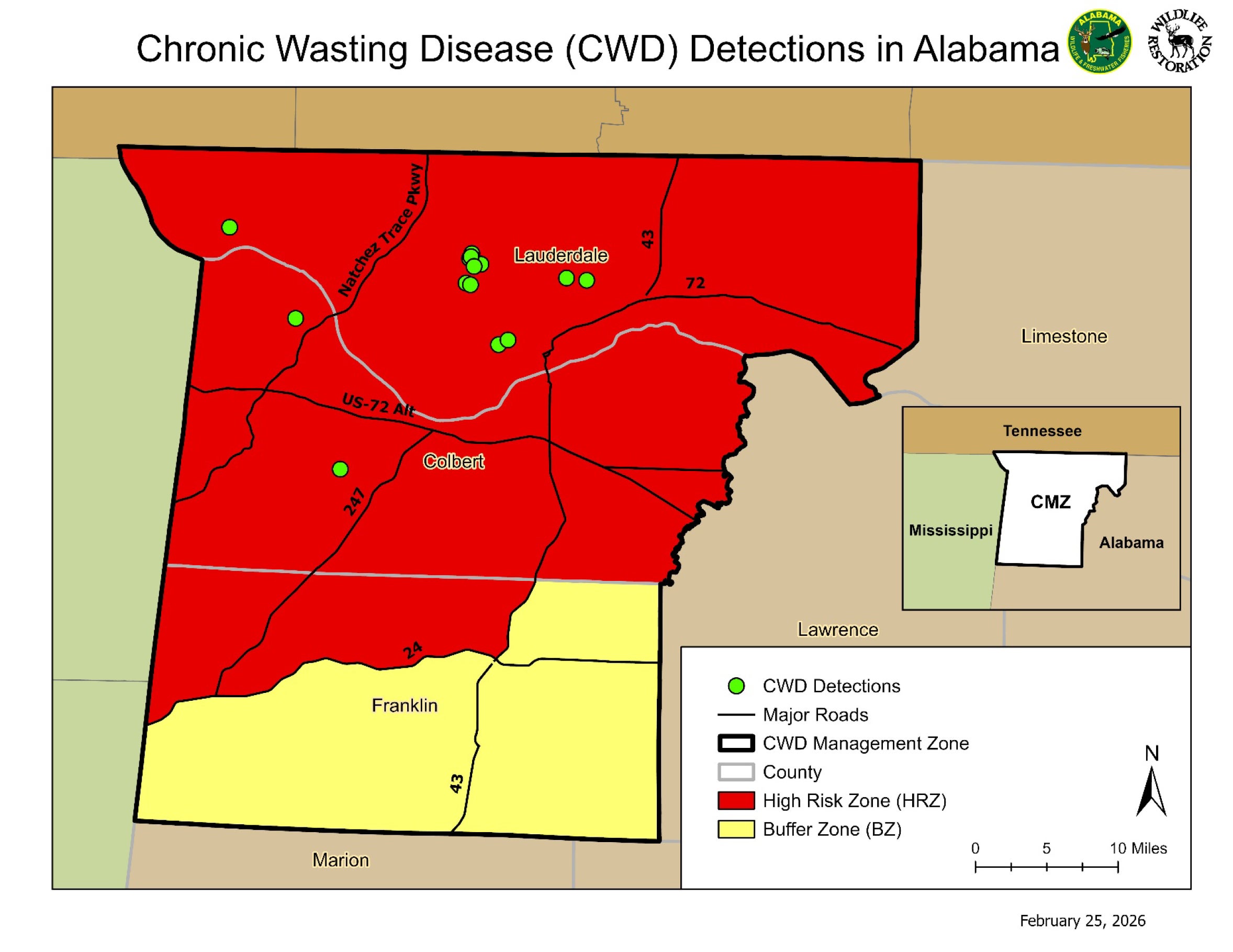
The results of CWD (chronic wasting disease) monitoring from the Alabama Department of Conservation and Natural Resources’ (ADCNR) Wildlife and Freshwater Fisheries (WFF) Division include nine whitetail deer that tested positive in the 2025-2026 season. The good news is the disease remains localized in northwest Alabama with eight additional positives in Lauderdale County and one new in Colbert County.
Olivia Sciandra, WFF’s Wildlife Health Program Coordinator, said the recent 2025-2026 positives bring the total detections in the CWD Management Zone (CMZ) to 21 since the first detection in 2022.
“The detections thus far we had this season have not changed our existing zone,” Sciandra said. “The one detected in Colbert County was in the far north of the county near the Natchez Trace, just south of the Tennessee River, north of the previous positive in Colbert County.”
In the 2025-2026 season, 2,886 deer were sampled with 937 samples coming from deer within the CMZ. During the gun deer season, WFF has mandatory sampling weekends for all deer harvested in the CMZ. In the 2025-2026 season, three mandatory weekends were held. WFF collected 573 samples from within the CMZ during those weekends.
Deer harvested in the CMZ cannot be transported outside the zone. Only completely deboned meat, cleaned skull plates with attached antlers with no visible brain or spinal cord tissue present, upper canine teeth with no root structure or other soft tissue present and finished taxidermy products or tanned hides can be transported outside the CMZ.
Sciandra thanked the hunters in the CMZ for contributing to the ongoing effort to help mitigate the spread risk of CWD.
“The hunters in Lauderdale, Colbert and Franklin counties are responsible hunters,” she said. “Most hunters are providing their harvested deer for testing, allowing us to get the distribution of where positives are.
“I think most of our hunters, especially in Colbert and Lauderdale counties, are now used to the mandatory sampling in the CMZ, and having their harvested deer tested for CWD is becoming the status quo for hunters in these counties. I’ve had a lot of great conversations with hunters in Franklin County who are getting accustomed to getting their deer tested. In most cases, hunters want to know about the health of the deer they are harvesting.”
This past season, WFF added an incentive to hunters in the CMZ who bring their deer to have them sampled during the mandatory weekends. Hunters who submit the deer for sampling are eligible to receive a CWD Sampling Permit from ADCNR to harvest one additional antlered deer from within the CMZ for each sample submitted. CWD Sampling Permits are only available at WMA check stations and ADCNR mobile sampling locations. No more than two additional CWD Sampling Permits will be issued per hunter above the season bag limit, combined for the High-Risk and Buffer zones. CWD Sampling Permits are non-transferable.
“A lot of hunters are really enjoying the additional antlered deer permit that we were able to issue during the mandatory weekends,” Sciandra said. “One of the conditions of the permit was that the hunter would return the deer harvested under that permit for sampling. These permits benefit both hunters and our agency by providing additional harvest opportunities while incentivizing hunters to submit samples for CWD, which allows us to monitor the distribution of CWD in Alabama. We were able to issue 379 permits during our mandatory weekends this season.”
The updated CWD map shows the locations of deer that tested positive for CWD.
CWD is a transmissible spongiform encephalopathy found to affect deer and other cervids. It is believed to be caused by an infectious prion and has an extended incubation period. Diagnosis requires examination of brain and lymphatic tissue. Infected deer become emaciated, behave erratically and eventually die. Active surveillance for CWD in Alabama was initiated in the 2002-2003 hunting season following the confirmation of CWD in Wisconsin in early 2002. To date, WFF has tested a total of 27,488 deer.
The CMZ, which was established after WFF’s first detection of CWD, includes all of Lauderdale, Colbert, and Franklin counties. Within the CMZ, the High-Risk Zone (HRZ) includes all of Lauderdale and Colbert counties and a portion of Franklin County. The HRZ portion of Franklin County extends north of State Highway 24 from the Alabama/Mississippi state line east to U.S. Highway 43. The remainder of Franklin County south of State Highway 24 and east of U.S. Highway 43 has been designated as a Buffer Zone within the CMZ.
CWD was detected in the bordering states of Mississippi and Tennessee in 2018. Alabama’s first positive was confirmed in January 2022, in Lauderdale County. Currently, the other surrounding states of Florida and Georgia have positive CWD cases. More than 35 states and four Canadian provinces also have confirmed cases of CWD.
Any member of the cervid family, including white-tailed deer, harvested out of state must be properly prepared before it can be legally brought into Alabama. Parts that may be legally imported include completely deboned meat, cleaned skull plates with attached antlers with no visible brain or spinal cord tissue present, upper canine teeth with no root structure or other soft tissue present and finished taxidermy products or tanned hides.
Some of the deer that have been found positive for CWD looked perfectly healthy. Most of the CWD-positive deer have been hunter-harvested deer with no outward signs of CWD. When infected animals start showing symptoms, it can be just abnormal behavior. They can have a drooping, sick posture. Other symptoms include trouble with balance, excessive salivation or the loss of weight.
“In Alabama, we have collected 2,886 samples total this year and will continue to collect samples during this current sampling season through the end of June,” Sciandra said. “We anticipate getting at least a couple of hundred more statewide through road kills or sick deer reports.”
The sampling procedure includes removing lymph nodes from the base of the deer’s head that are sent to Auburn to the Alabama Department of Agriculture and Industry’s Thompson-Bishop-Sparks State Diagnostic Laboratory. It is a U.S. Department of Agriculture National Animal Health Laboratory Network-approved facility to test for CWD by using enzyme-linked immunosorbent assay (ELISA) for possible positive and immunohistochemistry (IHC) to confirm positives.
“We used to have to send our positive samples to Iowa for confirmation testing,” Sciandra said. “Typically, when a positive sample is detected, an independent ELISA test is re-run and an additional IHC test is conducted to confirm the sample as positive for CWD. This past year, the lab at Auburn was approved to do the IHC confirmation testing. That way, we’re able to get our CWD positive results back to hunters faster. In most cases, it’s a week to two weeks, at most four weeks.”
Hunters statewide can utilize self-service locations with freezers to drop off the heads from harvested deer for CWD testing. Those heads with a portion of the neck attached will be picked up by WFF personnel to be tested. Visit www.outdooralabama.com/cwd-chronic-wasting-disease/cwd-sampling for a map of freezer locations. Hunters who drop off deer heads are required to fill out tags that include contact information and location where the deer was harvested. A tear-off tag has an identification number that the hunter should retain.
“Outside of our hunting public, we’re really appreciative of the cases where people reported sick or strange-acting deer to us,” Sciandra said. “Most Alabamians enjoy watching wildlife, and when they see something odd going on, they can contact our agency. Because of that, we’ve been able to get additional samples from deer. One that was found in Lauderdale County was a sick, strange-acting deer that was reported before the deer season started. That one ended up being CWD positive.”
Anyone who sees a sick or strange-acting deer is asked to contact the local WFF district office or go online at www.outdooralabama.com/CWD-Info and click on the link Report Sick Deer.
David Rainer is an award-winning writer who has covered Alabama’s great outdoors for 25 years. The former outdoors editor at the Mobile Press-Register, he writes for Outdoor Alabama, the website of the Alabama Department of Conservation and Natural Resources.
Ben Raines, the award-winning environmental journalist, filmmaker, and charter captain whose documentary and book “Saving America’s Amazon” gave the Mobile-Tensaw Delta its internationally recognized name, weighed in Wednesday on the Stockton solar controversy during an appearance on FM Talk 106.5’s “Midday Mobile with Sean Sullivan.”
His verdict on the land itself was blunt.
“This property is not pristine Baldwin County Wetlands,” Raines said. “It’s heavily impacted already. It’s covered in planted pine – being grown, planted after being cut over.”
The property at the center of the controversy is the proposed site of a 260-megawatt Silicon Ranch solar farm, contracted to supply power to a Meta data center in Montgomery.
The project has drawn fierce local opposition, with residents saying they were blindsided by plans to convert more than 4,500 acres of Mobile County land to solar panels.
That backlash prompted State Sen. Greg Albritton (R-Atmore) to file SB354, a one-year statewide solar moratorium that has cleared committee and awaits a full Senate vote.
Albritton’s bill has drawn fierce opposition from industry.
The American Clean Power Association, the national trade group representing utility-scale solar developers, expressed to Albritton in a letter this week that a statewide moratorium could hamper an industry employing more than 3,000 Alabamians and send a message to businesses nationwide that Alabama is an unpredictable place to invest.
Ben Raines, whose credibility on Delta ecology is unmatched in the state, acknowledged that beautiful waterways run through the property, specifically calling out Rains Creek, a spring-fed tributary with some personal affection — but he said the broader land picture matters enormously in these decisions.
“EO Wilson described planted pine plantations as biodiversity deserts,” he said, referencing the legendary Alabama-born Harvard biologist who wrote the foreword to Raines’ own book. “That’s what we’re looking at for most of this property.”
Raines also noted that a large residential subdivision had previously been proposed for the same site — and that such development would be “so much more destructive” to the surrounding creeks and Delta ecosystem than solar panels.
“A solar farm can easily avoid the wetlands and not have a dramatic impact on these creeks,” he said, “versus a subdivision or a factory site.”
Raines argued if something is going on that land, solar isn’t the worst option, and Alabamians should be careful which hills they choose to defend.
“You’ve got to pick your ditch to die in,” he said, quoting one of his old editors, “because you can’t die in every one of them.”
Grayson Everett is the editor in chief of Yellowhammer News. You can follow him on X at @Grayson270.
A Republican lawmaker is pushing legislation that would bar abortion providers and organizations that support abortion from teaching sex ed in Alabama public schools, promoting faith-based presenters and a “success sequence” framework in their place.
State Rep. Susan DuBose (R-Hoover) discussed SB209 in an exclusive interview with “The Rightside” in partnership with Yellowhammer News at the Alabama State House on Tuesday, saying it is designed to protect students from inappropriate content and keep groups like Planned Parenthood out of Alabama classrooms.
“We put a clause in there — if you are an abortion provider, or if you support abortion, your group cannot come in and teach in our schools,” DuBose said. “Planned Parenthood, they don’t need to be teaching sex ed in our schools.”
DuBose said she wants schools to partner instead with faith-based organizations that send nurses and other presenters to teach age-appropriate topics including sexting, online pornography, and bullying.
Among DuBose’s highest-profile victories was her long-running push to codify sex-based definitions in Alabama law.
Her House legislation advanced the issue in earlier sessions, and in 2025 the effort culminated in enactment of the “What is a Woman Act,” which brings “clarity, certainty, and uniformity” to Alabama law regarding sex-based terms and safeguards separate male and female spaces.
She also highlighted what she called the “success sequence” as a core component of the curriculum she envisions.
“We talk about the success sequence, which means you graduate from high school, get married, and then have a baby, and you’re like 99% chance of being successful in life,” DuBose said.
DuBose, who has previously sponsored legislation defining “male” and “female” in Alabama law and protecting women’s sports, said she has taken it upon herself to handle the legislature’s most sensitive social issues.
“I keep hearing these bills that have the word sex in them called ‘Susan bills,’ because it’s awkward for the men. Men don’t like discussing this stuff, but it’s necessary in the world in which we live,” DuBose said. “I have taken it upon myself.”
Tuesday was day 23 of the legislative session. There are seven legislative days remaining.
Sawyer Knowles is a capitol reporter for Yellowhammer News. You may contact him at sawyer@yellowhammernews.com.
Alabama’s entire congressional delegation joined together on the floor of the U.S. House of Representatives Thursday morning to honor the servicemembers killed in a KC-135 crash over western Iraq last week, including three airmen with ties to Birmingham’s Air National Guard.
U.S. Rep. Mike Rogers (R-Saks), Chairman of the House Armed Services Committee, led the bipartisan group, which included Reps. Dale Strong (R-Huntsville), Robert Aderholt (R-Haleyville), Barry Moore (R-Enterprise), Gary Palmer (R-Hoover), Shomari Figures (D-Mobile), and Terri Sewell (D-Birmingham) — in a moment of silence on the House floor. Ohio was also represented in the tribute.
“Mr. Speaker, I rise today with my colleagues from the State of Alabama and Ohio to honor the lives of the six KC-135 crew members who tragically lost their lives in support of Operation Epic Fury on March 12 of 2026,” Rogers said. “Our prayers are with the families.”
Rogers honored Major John Klinner, Captain Ariana Savina, and Technical Sergeant Ashley Pruett, who were assigned to the 6th Air Refueling Wing performing duties through the 99th Air Refueling Squadron out of Birmingham, Alabama.
He also paid tribute to the Ohio Air National Guard crew members: Captain Seth Covell, Captain Curtis Angst, and Technical Sergeant Tyler Simmons, assigned to the 121st Air Refueling Wing out of Columbus.
Yesterday, Alabama’s two U.S. Senators, Katie Britt (R-Montgomery), Tommy Tuberville (R-Auburn), alongside President Donald Trump and other senior U.S. officials, who attended the dignified transfer of the six fallen KC-135 crew members in which the remains of the airmen were received on American soil.
Grayson Everett is the editor in chief of Yellowhammer News. You can follow him on X @Grayson270.
President Donald Trump was joined by Alabama U.S. Senators Katie Britt (R-Montgomery) and Tommy Tuberville (R-Auburn), along with Secretary of War Pete Hegseth, Chairman of the Joint Chiefs General John D. Caine, and U.S. House Speaker Mike Johnson at Dover Air Force Base this week for the dignified transfer of six American servicemembers killed during Operation Epic Fury — including three from Alabama.
Among those honored was Major Alex Klinner, 33, of Trussville — an Auburn University graduate and eight-year Air Force veteran who flew 362 combat hours and 181 combat support hours across four deployments. He is survived by his wife, Libby, and three young children.
“Attending the dignified transfer of Maj. Alex Klinner today was humbling and heartbreaking. In recent days, I’ve learned more about Maj. Klinner—the many lives he touched, the devoted family man he was, and his deep love of country,” Senator Britt said on Wednesdsay.
Maj. Klinner, he had been promoted to major and deployed for Operation Epic Fury less than a week before the crash. His three children are specifically a two-year-old and seven-month-old twins.
Also killed were Captain Ariana G. Savino, 31, and Technical Sergeant Ashley B. Pruitt, 34, both of whom served in the 99th Refueling Squadron of the 117th Air Refueling Wing at Sumpter Smith Joint National Guard Base in Birmingham.
Capt. Savino logged 348 combat hours across deployments in 2020 and 2026. TSgt. Pruitt, a wife and mother, flew 888 combat flight hours over deployments spanning 2018 through 2026.
All three Alabamians died in the loss of a U.S. KC-135 refueling aircraft over western Iraq, along with three Ohio-based airmen: Capt. Seth R. Koval, 38, of Mooresville; Capt. Curtis J. Angst, 30, of Wilmington; and Tech. Sgt. Tyler H. Simmons, 28, of Columbus.
Of the two Birmingham-based servicewomen, Britt added, “Capt. Savino and TSgt. Pruitt were dedicated servicemembers whose lives were tragically cut short in devoted service to their nation. They were part of our community and exemplified the very best of what it means to be an Alabamian.”
“Wesley and I will be forever grateful to Ariana, Ashley, and Alex for their exemplary service and ultimate sacrifice, and we ask that all Alabamians join us in continuing to pray for their families and loved ones during this unthinkable time.”
Grayson Everett is the editor in chief of Yellowhammer News. You can follow him on X @Grayson270.
A University of Alabama student from the Chicago suburbs has been reported missing in Barcelona, Spain.
James Paul “Jimmy” Gracey, a 20-year-old junior at UA, was last seen in the early morning hours of Tuesday, March 17, outside the Shôko nightclub on Barcelona’s popular Barceloneta Beach — and has not been heard from since.
Gracey is a UA junior, a member of the Theta Chi fraternity, who stands 6’1″ at roughly 175 lbs.
His family describes him as a responsible and devoted son and brother, and says the disappearance is completely out of character.
Spanish police have opened a formal investigation, and early indications suggest foul play may be involved.
“Our family is deeply concerned about James “Jimmy” Gracey, who has been missing in Barcelona since the early morning hours of March 17,” the family said in a statement on Tuesday.
“Jimmy is a 20-year-old University of Alabama student visiting friends abroad during spring break. He was last seen around 3:00 AM CET at the Shoko nightclub in the Port Olímpic area. He was wearing a white T-shirt, dark pants (likely joggers), and a gold chain with a rhinestone cross.
He is approximately 6’1” and 175 pounds. We are asking anyone who may have seen Jimmy or has any information—no matter how small—to please contact 224.505.3886. Jimmy is a kind, responsible, and devoted son and brother.
It is completely out of character for him not to check in with family and friends. We are working closely with local authorities and are incredibly grateful for the support we have received.
We ask that you keep Jimmy in your thoughts as we continue to do everything we can to bring him home safely. Thank you.”
A Barcelona reporter toldWIAT that police reviewed CCTV footage and saw Gracey leave the club with another person, which has led investigators to suspect foul play.
If you have information, call 224-505-3886
Grayson Everett is the editor in chief of Yellowhammer News. You can follow him on X @Grayson270.
Support from across Alabama and the nation is pouring in for the family of U.S. Air Force Major John A. “Alex” Klinner after the Trussville resident was killed while serving overseas earlier this month.
A GoFundMe campaign created to support Klinner’s wife, Libby, a teacher, and their three young children has already surpassed $1 million in donations, reflecting a broad outpouring of generosity from people who never met the airman but want to help the family he left behind.
Local reports say Klinner had recently moved to Trussville with his wife and children, embracing a new beginning for the family in the community.
Trussville Mayor Ben Short also reflected on the loss in a message shared with residents.
“Among those lost was Major Alex Klinner, who had only recently moved to Trussville with his family, beginning a new chapter of life in our community,” Short said. “While his time here was short, the loss we feel is no less significant.”
Short added that Klinner’s decision to serve his country represented “the very best of our nation.”
The fundraiser, titled “Honoring Major Alex Klinner — Supporting Libby & Children,” was organized by Klinner’s sister-in-law, Sarah Rose Harrill, to help the family navigate life after the loss of their husband and father.
Funds raised will go directly to Libby Klinner and the couple’s children to provide stability and support in the months and years ahead.
Major Klinner, 33, was killed on March 12 when a KC-135 refueling aircraft crashed in western Iraq during a mission connected to Operation Epic Fury, according to U.S. Air Force officials. He had served eight years in the United States Air Force.
In a social media post following the tragedy, his wife, Libby Klinner, reflected on the loss.
“Alex and his crew were on the plane that crashed in Iraq. I’m devastated to lose the best person I know, my best friend.”
Beyond his military service, organizers of the fundraiser say Klinner was known for his character and commitment to others.
“Alex was more than a serviceman,” Harrill wrote on the fundraising page. “He was a devoted husband, a loving father, and the kind of person who would quietly step in to help anyone who needed it. He embodied what it means to be a servant leader.”
Klinner and his wife were raising three young children — a two-and-a-half-year-old and seven-month-old twins. In a moment, the young family found their lives permanently changed.
“Libby and Alex built a beautiful life together and were raising three precious children,” Harrill wrote. “In an instant, Libby has been left to walk through profound grief while caring for their young family.”
The campaign’s goal has been raised to $2 million as the donations continue to come from thousands of individuals moved by the family’s story.
At the time of writing this article, the amount donated was $1,378,099. Among the largest contributors so far is hedge fund manager Bill Ackman, who donated $80,000 to the effort.
Organizers say the fundraiser is intended not only to provide financial support but also to surround the family with encouragement during an extraordinarily difficult time.
“During this incredibly difficult season, we want to surround Libby and the children with the same generosity and love that Alex so freely gave to others,” Harrill wrote.
Those wishing to support the Klinner family can contribute through the GoFundMe campaign or share the fundraiser with others as the community continues honoring the legacy of a husband, father and airman who served his country.
As a prelude to this year’s Power & Influence Top 50 list, launching April 1 in a special 15th anniversary year for Yellowhammer News, we are proud to continue a tradition that asks an important question in Alabama’s political landscape: Who’s Next?
Year after year, Power & Influence offers the most candid insight into the top 50 influential leaders moving the needle in Montgomery across business, politics and public service — leveraging their influence to the benefit of Alabama.
Today, we’re directing that insight into the next generation of Alabama leaders. The eleven individuals below are described in a quote from leaders speaking to their impact, effectiveness, and upward trajectory. They are each well on their way to running the state.
Emory Cox
Special Assistant to the President for International Economic Relations
“I’m incredibly proud to see Emory receive this honor, but in no way am I surprised. Emory’s personable nature, vast policy knowledge, and sharp political instincts are far beyond his years.
He proved to be an incredible asset to my office and the State of Alabama during his four years as my Senior Economic Advisor, and is now playing a critical role in helping carry out President Trump’s economic agenda to help all Americans.
From Larry Kudlow to Kevin Hassett, Emory has learned under some of the most brilliant economic leaders in American history, while coming into his own as a leader in this space. One of the things I most admire about Emory is that his success has never caused him to forget where he came from.
He is a proud Pell City native and keeps his Alabama values at the forefront of everything he does.
Emory’s dedication to public service and his love for our great state will continue to bring about meaningful results in both Washington, D.C. and Alabama.”
– U.S. Senator Tommy Tuberville (R-Auburn)
Maggie Oliver
Chief Development Officer, Alabama Port Authority
“In leadership and in economic development, vision and strategic focus are essential to driving meaningful growth. Maggie Oliver embodies both.
Throughout her time at the Alabama Port Authority, she has articulated a clear and compelling vision for how the Port has and will serve as a catalyst for economic development across our state – strengthening supply chains, attracting new industry, and expanding opportunities for Alabama businesses.
Maggie has a presence that commands a room, but more importantly, she pairs that presence with thoughtful leadership and a deep commitment to Alabama’s future.
I am excited to see her continued leadership at the Port and know she will have a positive impact on our state for many years to come.”
– Zeke Smith, Chairman, Alabama Port Authority Board of Directors
Harrison Adams
Alabama Department of Workforce
“As SGA president at the University of Alabama, Harrison Adams learned much about constituents and politics. He had interest early in his career to positively engage in state government policy growth.
He brought that interest and experience to my Senate President Pro Tem office growing strong relationships, while accomplishing much with our team.
He has spent the last 15 months navigating change that is yielding strong outcomes as a Deputy Secretary at the Alabama Department of Workforce.
His calm and efficient demeanor has elevated the department’s profile and effectiveness with all those he interacts with.
Harrison continues to impress me and many in our state as his impact through dedicated and effective public service continues to grow.”
– Greg Reed, Secretary of the Alabama Department of Workforce
Kristin Hellmich
Director of External Communications, Poarch Creek Indians
“Kristin Hellmich leads with intention, listens carefully, and understands the responsibility that comes with telling the story of the Poarch Band of Creek Indians.
Kristin approaches her work with respect for our history and a clear eye toward the future, ensuring our voice is represented accurately and authentically.
In a fast‑moving and often complicated political environment, her steady approach and sound judgment make a meaningful difference.”
– Stephanie Bryan, Chairwoman and CEO of Poarch Creek Indians
“As chief financial officer, Phillip has transformed the Federation’s accounting, membership and Alfa Health divisions through technology, professional development and expanded services for members and county Federations.
His investment strategies have resulted in record growth for Alabama FarmPAC and the Alabama Farmers Agriculture Foundation, deepening the organization’s impact in both the political arena and philanthropic efforts such as scholarships and Ag in the Classroom. Last year, Phillip and his team led implementation of Alfa Health Plans, delivering an affordable health care option for members just five months after Gov. Kay Ivey signed the legislation into law.
Phillip is a graduate of the Alfa Leadership Academy, a successful small business owner and newly appointed member of the Dixie Electric Cooperative board of directors.
He is a devoted husband and father and embodies Alfa’s Core 4 Values of Faith, Family, Community and Integrity. Phillip is already building a legacy of leadership within our organization and certainly is deserving of recognition.”
– Paul Pinyan, Executive Director, Alabama Farmers Federation
Lindsey McAdory
CEO and Chief Strategist CBG Strategies, LLC
“Lindsey McAdory has many exceptional attributes. He’s a seasoned political storyteller who can frame the challenges facing our city and develop a plan of action.
He’s a builder — bringing people together, forging strong partnerships, and uniting leaders into coalitions that get things done. And when crisis situations arise, Lindsey excels at mapping out effective solutions.
But what truly sets Lindsey apart is his vision. He sees where Birmingham is headed, and he knows how to carve the path to get there.
He helps us turn potential into promise. Lindsey’s not just thinking about the next step forward; he’s charting the course for what comes next. His eyes are fixated on building a better Birmingham.”
– Randall Woodfin, Mayor of Birmingham
Saylor Cuzzort
Communications Director + Alabama Senate Republican Caucus
“It is rare to find a person who possesses true talent, innate instinct and abundant affability in the perfect balance, but one such person is Saylor Cuzzort.
Her love for this state and insatiable work ethic are exceeded only by her ability and her integrity.
Saylor’s impressive intelligence enables her to effectively analyze all facets of a complicated issue, but what most distinguishes her from other capable young people is her ability to act on her knowledge and timely execute the task at hand with grace and poise.
With everything she does, her kindness and humility shine through, and I’m excited to see all the ways in which she impacts our state and our nation for the better — she’s just getting started!”
– Caroleene Dobson, 2026 candidate, Alabama Secretary of State
Annie Dunne Meissner
Director of Finance and Events, Alabama Republican Party
“Annie Meissner has quickly become an invaluable leader on the Alabama Republican Party team.
As Director of Events and Finance, she has been instrumental in strengthening our fundraising efforts while planning and executing events that bring together grassroots supporters, donors, and Republican leaders from across Alabama.
If you’ve attended an ALGOP event recently, you’ve likely seen Annie’s work firsthand. She executed an incredibly successful Trump Victory Dinner featuring Donald Trump Jr., organized a sold-out Candidate Meet & Greet with Senators Katie Britt and Tommy Tuberville, and leads numerous donor events that keep our supporters engaged.
Annie is absolutely a rising leader in Alabama politics.”
– Shannon Whitt, Chief of Staff, Alabama Republican Party
Anna Grace Gamble
External Affairs Manager, Alabama Rural Electric Association
“Anna Grace has been an exceptional addition to the Electric Cooperative family. She reflects the values and character of our members and has cultivated invaluable relationships with legislators and policymakers that help advance the cooperative mission.
She is thoughtful, professional, and well-regarded by those around her. She brings a steady presence to her work and approaches it with care. Those qualities have helped her make a positive impression early in her career, and will continue to do so.”
– Sean Strickler, Chief Operating Officer, Alabama Rural Electric Association
Scott McClintock
Vice president of Policy and Public Affairs, Business Council of Alabama
“Scott’s recognition on Yellowhammer’s ‘Who’s Next’ list is a well-deserved honor and a testament to the impact he has already made in Alabama’s policy and political landscape.
Scott brings a rare combination of strategic insight, policy expertise, and a deep commitment to advancing pro-growth, pro-business solutions for our state.
His leadership has strengthened BCA’s advocacy efforts and helped ensure the voice of Alabama’s job creators is heard clearly in Montgomery and beyond.
We are proud to see him recognized as one of the rising leaders shaping Alabama’s future.”
– Helena Duncan, President and CEO, Business Council of Alabama
Justice Smyth
Executive Director, Tuscaloosa County Economic Development Authority
“I couldn’t be more proud to see Justice receive this well-deserved recognition. His strategic thinking, uncompromising integrity, and commitment to results have made a real difference for our community and for economic development across our region.
He approaches every challenge with intelligence and purpose, and he does so with the kind of character that makes everyone around him better.
Justice represents the very best of what a young leader in this field can be, and I am confident his impact on our state will only continue to grow.”
– Tim Parker, III, President & CEO, Parker Towing Company
Yellowhammer News’ 15th Anniversary Power of Service event will be held on April 7, 2026 in Montgomery. The 2026 Power & Influence list will debut its first installment of 10 honorees on April 1, 2026. For sponsorship opportunities, please contact courtney@yellowhammernews.com.
The first major victory for the Continental Army occurred 250 years ago on March 17, 1776, when the British evacuated Boston.
Following the fighting at Lexington and Concord, thousands of colonial militiamen surrounded the British army when they retreated to Boston. The Royal Navy maintained supply lines, and while the colonial forces effectively contained the British, they lacked the manpower to liberate Boston from British occupation.
As the siege of Boston began, George Washington assumed command. His army consisted largely of short-term militia with uneven training, limited discipline, and severe shortages of weapons, ammunition, and artillery. Washington quickly realized that the Americans lacked the heavy guns necessary to threaten British positions within Boston.
Determined not to launch a reckless frontal attack with significant losses, he instead focused on strengthening the army’s organization and searching for a strategic opportunity that might force the British to leave.
One of the most important developments in breaking the stalemate came far away from Boston. Earlier, in May of 1775, American forces captured Fort Ticonderoga in northern New York. The fort contained a large supply of artillery, including cannons, mortars, and other heavy weapons that the Continental Army desperately needed.
Washington approved a bold plan proposed by Henry Knox, who suggested retrieving the captured cannons from Fort Ticonderoga and transporting them hundreds of miles through winter conditions to Boston. Against all odds, Knox and his team moved nearly sixty tons of artillery over frozen rivers, snow-covered roads, and mountainous terrain. In January of 1776, Knox successfully delivered the artillery to Washington.
Although the Americans now had artillery, Washington still needed a way to use it effectively. Boston was heavily defended and a direct assault, even with artillery support, was unwise. So, Washington identified a location that could shift the balance without requiring a full-scale attack.
South of Boston stood Dorchester Heights. Whoever controlled these heights would command a dominant position over the British fleet and the city below. If American artillery could be placed there, British ships would become vulnerable, and the entire British position in Boston would be threatened.
But Dorchester Heights lay within range of British defenses, and any attempt to fortify the hills would have to be carried out quickly and secretly.
Washington carefully planned the operation and organized a diversionary bombardment of British positions while troops prepared materials for fortifications. Under cover of darkness, American soldiers quietly moved artillery, timber, and tools onto the heights, where they constructed fortifications and placed the cannons brought from Fort Ticonderoga in menacing positions. When British forces looked up to see fortified positions armed with heavy artillery, they knew the siege was over.
On March 17, 1776, British troops and loyalist civilians began evacuating Boston as approximately 11,000 soldiers and more than 1,000 loyalists boarded ships and sailed to Halifax in Nova Scotia.
The withdrawal ended the nearly year-long siege without a large-scale battle. Washington entered Boston soon afterward, greeted by cheering residents who celebrated the departure of British forces.
The evacuation was a remarkable success for the Continental Army. What had begun as an improvised militia force had managed to contain and ultimately force out one of the most powerful armies in the world.
Based on Washington’s strategic leadership, momentum seemed to shift to the Americans.
Washington had transformed a loose collection of militia units into an organized army. He introduced discipline, established supply systems, and encouraged cooperation among soldiers from different colonies. These efforts created a more unified, fighting force capable of carrying out complex operations.
Most importantly, Washington showed patience and strategic judgment. Instead of attempting risky frontal assaults potentially destroying the Continental Army, he focused on strengthening his position and waiting for the right opportunity. His decision to rely on artillery and maneuver rather than a direct attack proved crucial.
Washington’s leadership embraced a larger strategic view of the conflict by supporting innovative solutions that were risky but offered substantial rewards. His approval of Knox’s plan to retrieve the artillery from Fort Ticonderoga and transport it in winter over rough terrain demonstrated his willingness to trust capable subordinates. Without those guns, the siege of Boston would have continued unabated.
In the end, the secrecy, preparation, and timing of the maneuver reflected tactical planning to covertly place heavy artillery above Boston Harbor. Thus, Washington’s broad and comprehensive vision ensured that the cannons were strategically placed on a high point to force the British to leave.
The British evacuation of Boston had several important consequences for the American Revolution.
First, it provided the Continental Army with its first major victory. Up to that point, the war’s outcome remained uncertain. Forcing the British to abandon a major city demonstrated that the American cause was viable and strengthened confidence among soldiers and civilians alike.
Second, the victory boosted morale across the colonies. News of the British withdrawal spread quickly, encouraging support for the revolutionary movement and paving the way for the Continental Congress to seriously consider independence.
Third, the evacuation allowed Washington to gain valuable experience as commander-in-chief. The siege taught him important lessons about patience, organization, logistics, and strategy that would influence his leadership throughout the war. In many ways, the action in Boston was a precursor to crossing the Delaware River.
Finally, the British retreat shifted the focus of the conflict. After leaving Boston, British forces concentrated their efforts on New York, beginning a new phase of the war. Although the fighting would continue for many years, the events at Boston showed that American forces could challenge British power effectively. The British also saw their vulnerabilities in concentrating forces in an unfamiliar environment.
The British evacuation on March 17, 1776, was more than a simple retreat. It was a powerful demonstration that the Continental Army could organize, plan, and execute operations capable of overcoming British advantages. Success at Boston strengthened the revolutionary cause and helped set the stage for the long struggle that would ultimately lead to the Declaration of Independence four months later.
Will Sellers is an Associate Justice on the Supreme Court of Alabama. He is best reached at jws@willsellers.com.
For decades, customers at Wintzell’s Oyster House in Mobile have laughed at one of the restaurant’s most famous wall signs: “Free oysters to any man 80 years old accompanied by his father.”
The offer, long treated as a humorous impossibility, finally became reality when Jimmy Rush celebrated his 80th birthday by walking into the downtown Mobile restaurant with his 99-year-old father, Jim Rush. According to FOX10 News, it was the first time the offer had ever been redeemed.
The moment was decades in the making for the Rush family. The Mobile television station reported that Jimmy and his father had been visiting the downtown restaurant together since 1972, when they would attend Friday night Mardi Gras parades and stop in for oysters beforehand.
The sign eventually became a long-running family goal. Carl Rush, Jimmy’s brother, said the family had talked for 25 to 30 years about whether their father might live long enough for one of his sons to turn 80 and finally qualify for the offer.
When that day arrived, the family turned the occasion into a celebration. About 60 relatives and friends gathered at the restaurant, where Wintzell’s honored the sign’s promise by serving Jimmy a dozen free oysters.
In a Facebook post, Wintzell’s Oyster House said the Rush family had long been part of the restaurant’s story and helped turn one of its most famous traditions into a real-life milestone.
The story has drawn so much attention that the father and son found themselves on national television appearing on ABC World News Tonight with David Muir.
The moment also cast new attention on one of Alabama’s best-known seafood institutions. Wintzell’s Oyster House began in 1938 as a six-stool oyster bar and has grown into a dining landmark known for its oysters, seafood specialties and walls covered with thousands of the founder’s homespun sayings.
The Alabama broadcaster also noted that Jim Rush, now 99, is a World War II and Korean War veteran who said he remains in good health aside from losing his vision and takes no medication.
The family is already thinking ahead. Carl Rush said he will turn 80 in October 2028, when his father would be 102, and hopes they will be able to return and do it all over again.
For generations of customers, the free-oyster sign has been part of the charm of visiting Wintzell’s — a joke that seemed impossible to claim.
Where I grew up, the term “hijacking” usually referred to the disappearance of a fresh load of moonshine on its way to market. Hijacking occurs when something, or even some process, is taken over without the consent and, at times, even the knowledge of the rightful owner.
Hijacking, like classic high-seas piracy, is one of the most direct and forceful means of stealing something from someone.
Well, folks, I’ve recently come to realize you can hijack a whole lot more than moonshine in the South. A bunch of hijackers from California, and even China, have come to recognize our home, the Southeastern United States, as a field ripe for the picking.
Just last year, in the November elections in Georgia, millions of dollars from these hijackers flowed into the Georgia Public Service Commission races. As a result, two incumbent Republican PSC commissioners lost by about 24 points apiece. That is the first time a Democrat has been elected to the PSC in Georgia since 2000. That, my friends, was a good old-fashioned hijacking.
So, who was the hijacker? An operation called the Georgia League of Conservation Voters pumped about $2.2 million into the Georgia PSC races. They got their money from their mothership, a national group called the League of Conservation Voters.
This organization, with funding from liberal groups across the nation, reckoned that just a little of their money in down-ballot races would let them sneak in under the radar and hijack those Georgia elections. They were right. They pulled it off slick as a whistle. And now they are setting up a hijacking in Alabama.
And while it sounds like something from a John Grisham novel, an outfit headquartered in Beijing is a prominent player in the money trail funneling cash through the League of Conservation Voters and right to Alabama.
Conservation Alabama is the local wing of the League of Conservation Voters, and they partner with and help support a liberal environmentalist group called Energy Alabama. These two organizations are carrying the water for the same folks who hijacked the elections in Georgia.
So, how do we stop them?
Last week, the Alabama State Senate took a major step toward derailing these liberal out-of-state hijackers with the passage of SB360 – a bill that passed the Senate without a single dissenting vote 32-0.
This legislation does three things to deal with rising power bills while stopping the influence of California environmental groups in our elections.
First, it freezes rates for Alabama Power for three years. Folks, that is an unprecedented action by our Legislature that gives Alabama families and businesses rate assurance that no one else in the nation has.
Second, it enlarges the Public Service Commission from three commissioners elected statewide to seven commissioners elected by Congressional District. This historic change in the structure of the PSC puts more power in the ballot box and in the hands of the people than has ever existed.
Third, it creates a cabinet level position for a Secretary of Energy that will raise the importance of providing affordable, reliable energy to a new level. But this Secretary will not have ultimate power. The elected commission members can override the Secretary and nothing, absolutely nothing, happens without a vote of the seven elected commissioners.
These California hijackers, with financial backing that goes all the way to China, have crossed the Chattahoochee River. But they will find it a whole lot harder to work their devious plans with seven elected commissioners rather than three.
Nevertheless, liberal environmentalists are still going to argue that a three-year rate freeze is a bad thing and that giving the people more control at the ballot box is somehow wrong.
After unanimous passage in the Senate, the House will begin work on the legislation this week. A unified show of strength against these out-of-state pirates will help serve notice that Alabama cannot be hijacked by paid social media trolls and intentional deception.
With only a few days left in the legislative session, let’s hope our House of Representatives will finish the job and send these hijackers packing back to California.
See you next week.
Steve Flowers is Alabama’s leading political columnist. His weekly column appears in over 60 Alabama newspapers. He served 16 years in the state legislature. Steve may be reached at steve@steveflowers.us.
A fan-favorite flavor from Tuscaloosa has officially made its way to downtown Birmingham. B’Ham Chicken at the Pizitz Food Hall is now exclusively serving the legendary Irish Gold sauce from Innisfree Irish Pub, bringing one of Alabama’s most recognizable bar sauces to a new audience.
For years, the Irish Gold sauce has been a staple at Innisfree Irish Pub in Tuscaloosa, where it has built a loyal following among The University of Alabama students, alumni, and visitors.
Known for its bold, tangy flavor with just the right amount of heat, the sauce has become synonymous with late-night wings, game days, and Tuscaloosa nightlife.
Now, through a new partnership, B’Ham Chicken is the only place in Birmingham where guests can enjoy the iconic Irish Gold sauce.
The collaboration connects two places that represent different but equally vibrant parts of Alabama’s food scene. Innisfree has long been known as a gathering spot in Tuscaloosa, where the Irish Gold sauce first gained popularity as the perfect complement to wings.
Its signature balance of sweetness, tanginess, and spice helped the sauce develop a reputation that extends far beyond the city.
At the same time, B’Ham Chicken has become a go-to stop inside Birmingham’s historic Pizitz Food Hall, serving crispy fried chicken, sandwiches, and comfort-food classics to locals and visitors exploring downtown.
Bringing Irish Gold into the B’Ham Chicken kitchen allows customers in Birmingham to experience a flavor that has been part of Tuscaloosa traditions for years.
Visitors to the Pizitz Food Hall can now experience the Irish Gold flavor firsthand at B’Ham Chicken. The sauce is available exclusively at the stand, offering a limited but exciting opportunity to enjoy one of Tuscaloosa’s most talked-about sauces without leaving Birmingham.
For anyone who has ever had Irish Gold wings in Tuscaloosa — or anyone curious about what makes the sauce so popular — B’Ham Chicken’s new offering delivers a taste of that tradition right in the heart of downtown.
Baylor Frazier is a digital and radio sales specialist for YHN Media Group. For advertising opportunities through our portfolio of publications, you can contact him directly at baylor@yellowhammernews.com.
Long before the name appeared in Madison, the “Donut Dollies” were a familiar sight to American troops stationed in war zones.
During World War I, World War II, and the Vietnam War, women volunteers with the American Red Cross traveled to military bases and field hospitals to lift the spirits of service members. Rather than serving in combat roles, they delivered small comforts — coffee, donuts, games, and conversation — offering soldiers a reminder of home during some of the most difficult moments of war.
The nickname stuck, and decades later the spirit of those volunteers is alive and well in Madison, Alabama, where a group of women has adopted the same name while carrying forward the same mission of appreciation.
The modern-day Donut Dollies gather on the first Tuesday of each month to serve coffee, donuts, and conversation to local veterans.
The group, made up of volunteers from Madison Methodist Church, focuses on building community and creating a welcoming space where veterans can gather, share stories and feel appreciated for their service.
“We meet here to serve the veterans. We got kind of hooked into it,” Carol Moats, president of Madison Methodist Women, told local reporters. “We thought, Oh, that’s a way we can serve an easy way, and it blesses us more than it does them, really.”
While donuts and coffee are the centerpiece, the gathering is about much more than refreshments. The monthly event provides a place where veterans from different eras and backgrounds can come together in fellowship.
“It’s a blessing for us, these men, no matter where they served, how they served, if they were in a conflict or not, they served our country,” Moats said. “It’s the least we can do is to give back to them, to love on them, to just bring a little bit of joy to them every month.”
Moats also said the name “Donut Dollies” was chosen as a tribute to the original women who supported American troops during wartime, whose example helped inspire the Madison group’s efforts.
Though today’s volunteers are serving in a church fellowship setting rather than a war zone, the goal remains similar to that of the original Donut Dollies — offering appreciation, connection and a reminder that the sacrifices of service members are not forgotten.
As Alabamians look ahead to warmer nights after the rollercoaster temperatures of early spring, the return of Milky Way viewing season offers another reason to spend time outdoors.
Stargazers across the southern United States can once again spot the bright band of our home galaxy stretching across the night sky from early spring through the fall.
According to astronomy guidance from the photography and night sky resource Capture the Atlas, the best opportunity to see the Milky Way in southern states like Alabama typically runs from late March through late September.
During that time, the brightest and most detailed portion of the galaxy — known as the Galactic Center — rises high enough in the night sky to be visible.
The broader Milky Way viewing season stretches from February through October, though the best views usually come on clear nights far from city lights.
Timing also plays a key role for those hoping to catch a glimpse of the galaxy. The best chance to see the Milky Way generally occurs between midnight and 5 a.m., when the sky is darkest and the galaxy is positioned higher above the horizon.
Nights with a new moon or minimal moonlight provide the clearest views because bright moonlight can wash out the faint band of light created by billions of distant stars.
The galaxy’s appearance in the sky also shifts as the season progresses. In late winter and early spring, the Milky Way is most visible in the early morning hours. By midsummer, it rises higher and can be seen during the middle of the night, while in early fall it may appear earlier in the evening.
Where you watch from can make a significant difference as well. Light pollution from cities and towns can obscure the Milky Way, meaning the best views are typically found in darker rural areas where artificial lighting is limited.
Astronomy apps and online tools can also help stargazers plan their viewing. Programs such as PhotoPills allow users to track moon phases, sunrise and sunset times and the position of the Milky Way based on their location.
With the right conditions — clear skies, minimal moonlight and a dark viewing location — Alabama residents willing to stay up late or wake early may have the chance to see one of the most remarkable sights in the night sky: our own galaxy stretching across the heavens.
The Tuscaloosa County Commission has reached an agreement with the Tuscaloosa County Parks and Recreation Authority (PARA) to purchase the historic Bama Theatre and adjoining office space in downtown Tuscaloosa.
County leaders say the move will help preserve one of West Alabama’s most recognizable cultural landmarks while ensuring the venue remains available for community events, performances and public gatherings.
Opened in 1938, the Bama Theatre has long served as a centerpiece for arts and cultural activity in Tuscaloosa County. Over the decades, the venue has hosted musical performances, theatrical productions, school programs and a wide range of community events.
Commission officials said acquiring the property will keep the landmark under civic ownership and preserve its role as a gathering place for residents and visitors.
The theatre itself carries significant historical importance.
It was constructed in the late 1930s as part of a joint city hall and theatre project funded by the Public Works Administration, one of the major New Deal programs created during President Franklin D. Roosevelt’s effort to help the country recover from the Great Depression.
The auditorium was designed to resemble a Mediterranean courtyard under a starlit sky and features murals painted by Italian artist Navino Nataloni. In recognition of its historical significance, the building was added to the National Register of Historic Places in 1984.
County leaders say the facility will continue to play a major role in Tuscaloosa’s cultural life.
The Tuscaloosa County Commission plans to partner with the Arts and Humanities Council of Tuscaloosa County, as well as both the Tuscaloosa County and Tuscaloosa City school systems, to expand use of the theatre for concerts, drama productions, dance performances and pageants.
Officials say the venue will also continue hosting the wide variety of events residents have come to expect, including concerts, movies, dance recitals and live theater performances.
Members of the Tuscaloosa County Commission — Probate Judge and Chairman Rob Robertson and commissioners Stan Acker, Jerry Tingle, Mark Nelson and Reginald Murray — unanimously supported the purchase.
County leaders said the goal is to ensure the Bama Theatre continues serving as Tuscaloosa County’s central hub for arts, entertainment and community gatherings for generations to come.
As the United States approaches the 250th anniversary of its founding in 2026, reminders of the country’s enduring spirit often appear in simple, everyday moments. In Alexander City, that reminder comes in the form of a waving American flag, a passing car horn, and a Vietnam veteran standing proudly along a busy roadway.
According to WSFA, 75-year-old Army veteran Richard Woodham — originally from Wetumpka — now lives at the Bill Nichols State Veterans Home in Alexander City, where he has created a small but meaningful roadside routine.
Every morning and afternoon along Elkahatchee Road, Woodham steps outside the veterans home carrying an American flag. Drivers passing by often respond the same way — with a quick honk of the horn — and Woodham answers with an enthusiastic wave.
The exchange lasts only seconds, but it has quietly become a small ritual of patriotism for motorists traveling through the area.
Woodham, who served in the Vietnam War, says the daily routine is his way of reminding people not to take their freedom for granted.
“You go to sleep at night and wake up free in the morning!” Woodham said.
There is no sign asking drivers to honk. According to Woodham, people simply do it anyway, and he answers the only way he knows how — by waving the American flag and sometimes shouting his own cheerful greeting.
“America USA!!”
WSFA reporter Rosie Langello shared a video on Facebook showing the daily exchange between Woodham and passing drivers outside the Bill Nichols State Veterans Home.
In a world where global conflicts and divisions often dominate the headlines and the hope of lasting world peace still feels distant, Woodham’s roadside routine reflects something else that continues to endure: the quiet pride many Americans — and many Alabamians — still carry for their country.
For Woodham, the routine is not just symbolic. At 75, he says waving the flag keeps him moving and helps him stay active.
“Well… I tried to build up my muscle,” he said.
But the Vietnam veteran says there is another reason he stands outside each day with the flag.
He says he waves it for the veterans who can’t anymore.
“When it gets to waving… it puts a little tonic in your body,” Woodham said.
If you happen to drive down Elkahatchee Road and see him standing with the flag, Woodham says he is only asking for one thing — a quick honk of the horn to remind him that America is still worth waving for.
The freedoms Alabamians enjoy today were secured in no small part by the profound service and sacrifice of the men and women who wore this nation’s uniform. That debt does not end when a veteran comes home.
That’s why the opening of the Alabama Veterans Resource Center matters. Last month, state leaders, veterans, and community partners gathered in Montgomery to mark the launch of the AVRC, a new statewide hub designed to help veterans and their families find support in one place.
The center was created through 2025 legislation as a public corporation built around a public-private partnership model, with a mission focused on easing the often difficult transition from military service to civilian life.
Veterans and their families can visit the center to gain general knowledge about services available to them. Some of these services could be support with U.S. Department of Veterans Affairs (VA) claims, employment resources, mental health services, and more.
Its impact is already being felt, and outreach is extending beyond the service itself — whether that’s a father bringing his son, a friend supporting a widower, and beyond — Alabamians are spreading the word that the center exists to serve.
Look no further than former Air Force Senior Master Sergeant Alvin Jeffries, who recently retired from the Air Force after 33 years of service.
“During my career, I was assigned to a variety of locations, including Beale AFB, CA; Headquarters Air Force, Washington, D.C.; Buckley SFB, CO; and Maxwell AFB, AL, along with four deployments overseas,” Jeffries says.
“After returning to the area, I came across a local advertisement for the Alabama Veterans Resource Center offering assistance with veterans’ claims.”
“I was immediately impressed by the one-stop-all approach the center provides,” Jeffries continued. “From workplace assistance and family support to legal aid, their comprehensive services have already helped make my transition to civilian life much smoother and far less stressful.
“I am deeply grateful for the professionalism and dedication shown by Executive Director Ms. Alex Karagas and Veteran Service Officers Shawn White and Juan Jones. Their responsiveness, knowledge, and commitment ensured all my questions were answered and every need was met.”
The center has already received extraordinary support from communities and organizations across the state of Alabama, and more than 100 nonprofit organizations have been identified as partners and resources for veterans and their families.
This coordinated and collaborative approach is exactly what the AVRC was established to do. In less than two months, these partners and resources have helped the AVRC serve hundreds of veterans and their families already.
With hundreds of thousands of veterans residing in the state, Alabama has one of the highest state per capita nationwide in veteran population.
“I’ve worked closely with veteran advocates across our state to understand where Alabama can do more for those who served,” Chairman of the Alabama Senate Military and Veterans Affairs Committee, State Sen. Andrew Jones (R-Centre), who introduced the legislation that established the Alabama Veterans Resource Center, said.
“The AVRC is designed to help veterans navigate the transition to civilian life by linking them with meaningful career opportunities and resources to expand their skills. Alabama is proud to be known as a military-friendly state, and initiatives like this help ensure we are just as committed to our veterans.”
Grayson Everett is the editor in chief of Yellowhammer News. You can follow him on X @Grayson270.
U.S. Senator Tommy Tuberville (R-Auburn) pressed pharmaceutical and national security experts Wednesday on how to reduce American dependence on Chinese drug manufacturing, warning that the current supply chain leaves the country dangerously exposed.
Tuberville participated in a Senate Committee on Aging hearing focused on China’s control over the American pharmaceutical supply chain, questioning witnesses on regulatory failures, tariff options, and the urgency of returning drug manufacturing to the United States.
Rosemary Gibson, who has written extensively on pharmaceutical supply chains, told Tuberville that China controls approximately 90% of key starting materials used to make generic drugs and active pharmaceutical ingredients.
Asked what would happen if China cut off those exports, Gibson’s answer was stark.
“A lot of people would die in this country,” Gibson said. “Our healthcare systems would cease to function.”
Gibson argued the United States is effectively importing unregulated pharmaceutical products and said the solution is using quality data from Department of Defense testing to exclude manufacturers from countries that do not meet American standards.
Gordon Chang, another witness at the hearing, said breaking China’s pharmaceutical monopoly would require emergency action and could not happen overnight.
“China has been able to outmaneuver the FDA because they do have such a big monopoly on all parts of the chain,” Chang said. “The only way to do that is to break that monopoly. Unfortunately, this is going to take some time. But it is possible.”
Chang said Section 232 tariffs, an enhanced investment tax credit, and invoking the Defense Production Act could help stimulate domestic pharmaceutical production.
He warned that within two to three years the United States faces a period of extreme vulnerability if action is not taken.
Tuberville also highlighted the Clear Labels Act, legislation signed onto by GOP colleagues, including fellow Alabama U.S. Senator Katie Britt (R-Montgomery), that would require drug labels to disclose the country of origin of ingredients.
Former Congressman Ted Yoho, who also testified, framed the issue in national security terms.
“We’d be beholden to another country, i.e. China,” Yoho said. “This is something it’s imperative that we get right.”
Sawyer Knowles is a capitol reporter for Yellowhammer News. You may contact him at sawyer@yellowhammernews.com.
Earlier this week, I shared important news about the future of the Shoals area and the role our region will play in strengthening America’s defense industrial base.
It is an announcement that reflects years of work and a belief I have long held: that Northwest Alabama is ready to lead again.
A few months back, I wrote here about how Alabama has always stepped forward when America needed us most.
From the nitrate plants in Muscle Shoals during World War I, to the power generated by TVA that supported victory in World War II, to the rockets that carried us to the moon during the Cold War, our state has never been a bystander in history.
Today, I want to focus on a place that represents both our proud past and our promising future: The Shoals.
For generations, The Shoals has been known around the world for its unmistakable sound. FAME Studios and Muscle Shoals Sound helped shape American music, producing hits that transcended geography, politics, and time. Artists came here because there was something special in the water, special in the “Singing River,” a spirit of craftsmanship, grit, and excellence.
But what is true for the sound that came out of our region is also true for its industry: it is innovative, resilient, and built to last.
That spirit supplied weapons made with American-produced nitrates for our troops overseas. That spirit rolled railcars off the production lines that strengthened our industrial backbone. And that spirit is still with us today as we look toward the next chapter of American strength.
For too long, communities like ours were told that chasing marginal savings overseas was “just the way the world works.” I never accepted that decline was inevitable.
Over the past several years, I have worked alongside my colleagues in the Alabama delegation and on the Appropriations Committee to ensure that when America rebuilds its industrial capacity, Alabama, and particularly the Fourth District, is not an afterthought, but a priority.
That work has included fighting for targeted investments in our defense industrial base, supporting policies that restore America’s maritime dominance, and ensuring that major federal resources are directed toward communities that have the workforce, infrastructure, and determination to lead.
The Shoals checks every one of those boxes.
We have skilled workers.
We have available industrial capacity.
We have river access and strategic geography.
And most importantly, we have a culture that understands what it means to build something that lasts.
That is why I was proud to announce this week that the U.S. Navy will soon hold a ribbon-cutting ceremony for a new defense industrial facility in Muscle Shoals.
This 2.2 million square foot facility will anchor shipbuilding and maritime production in Northwest Alabama, representing a major investment in our nation’s security and our region’s future.
This effort is also the result of important partnerships across the Shoals region. AE Shoals has played a key role in fostering the development of this project and advancing the vision for a manufacturing and technology center of excellence serving the aerospace and national security sectors.
The facility itself was owned by the Retirement Systems of Alabama, whose investment has helped position this site for new economic opportunity, and we are excited to welcome Hadrian, the company that will be carrying out the advanced manufacturing work here.
This project did not happen overnight. I spent nearly six years working to bring new industry to an unused facility in the Shoals, and that effort ultimately came to fruition through legislation that secured the resources necessary to make this vision a reality. The result is a transformative step forward for our region.
This facility will help bring thousands of manufacturing jobs and new opportunities to Northwest Alabama. But just as importantly, it will help restore America’s ability to produce the tools necessary to defend freedom and maintain strength at sea.
This project is only just the beginning. In the years to come, I will be dedicated to expanding the Shoals area to be a collaborative campus for both national and international partners working with the Navy and Department of War.
When we talk about national security, we often picture men and women in uniform. We should. But national strength also depends on welders, engineers, machinists, technicians, and the next generation of skilled workers who will power America’s comeback.
The future factory floor will not look like it did in 1942. It will be driven by advanced manufacturing, automation, digital engineering, and cutting-edge technology. It will require precision and innovation. And it will demand a workforce ready to meet that moment.
As current events show, our security at home and abroad demands no less. Northwest Alabama is ready.
Just as The Shoals once surprised the world by becoming the epicenter of American music, I believe it is poised to surprise the country again, this time by strengthening America’s maritime power and helping secure good-paying jobs for generations to come. The sound of industry will ring throughout the world.
When America calls, the Shoals area answers.
And I am proud to help ensure that this region’s next great chapter is written right here at home.
Robert Aderholt (R-Haleyville) represents Alabama’s 4th Congressional District. He is a senior member of the House Appropriations Committee.