Lying on a luxury queen-sized bed within a tent, one thought comes to my mind: ‘Can I get those cicadas to sing a show tune?’
Such thoughts also brought interior laughter at my odd request for nature’s top 40 singers. It made me realize I had left behind deadlines, bills, and problems as I listened to a summer song.
I arrived so tired, the bags under my eyes could go shopping on their own. Now was the time to indulge in what science is proving: nature calms us, body, mind, and spirit. The Japanese even have a term for it: forest bathing, where fresh air is filled with life-giving oxygen.

I had reached Selah’s Acres RV and Camping Experiences in Hazel Green, outside of Huntsville. Here, glamping means more than sleeping comfortably in the woods, as shown in the name. “Selah” dates to the Bible and means peace at the end of a passage.
Owners Mike and Meeka Stringfellow do not treat their guests as guests. Everyone who enters their domain becomes family. They invite you into the warmth and sanctuary of home. Along with their four children and Mike’s sister, Adrienne, the whole experience from arrival to a big breakfast is an open-arm adventure under the stars.
The Stringfellows have taken on a huge project—restoring a homestead and its environment. As they peel back the layers, they are discovering a natural wonderland. The privet in the woods yielded to a wetland that is home to rare native orchids. The field by the barn is filling up with butterflies, attracted to the spreading vines of passionflower. The purple and white flower of the vine is stunning enough, but add in the orange wings of Gulf Fritillaries, and magic begins. Nearby, a frog pond throbs with the croaking of lovelorn amphibians.
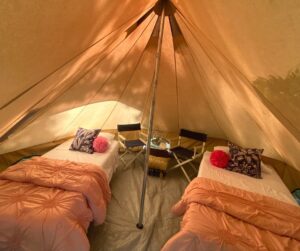
The family moved to this corner of paradise as a result of a dramatic quest for simplicity and nature. They vacated a 3,400 square-foot home and moved six people into a 34’ RV. Within that 340-foot interior, they grew closer as a family and as people of faith. According to Mike, “Those are my happy days when I could walk through the middle of the RV and kiss every child on my way.” Meeka loved the freedom of a minimalist life, emotionally and financially.
All of the family contributes, with the three boys aiding Mike in clearing the woods. Their daughter helps with breakfast. Adrienne shared her artistry by painting the tents in bright, cheerful colors featuring birds and flowers.
The tents are charming, with sparkle lights, glowing lamps, plump pillows, and large, comfy beds. Best of all, there is an air conditioner. And mosquito netting covering the door. All of it comes together for a good night’s sleep. In the adjoining RV is a bathroom and showers.
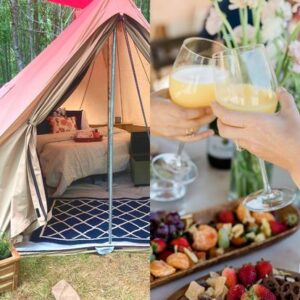
Café and picnic tables are dotted around the camping site. Guests can sit family-style with the Stringfellows, or choose a private table for two.
Committed to the community, they support local businesses. In the welcome package inside the tent sat (very delicious) chocolates and chocolate-covered strawberries provided by Chocolates by Julia, which are made to order. Little Blessings Bakery provided tasty cinnamon buns. Two Chicks on a Roll made a very credible Philly Cheesesteak sandwich that could compete with Philly’s own.
The whole enterprise is dedicated to Selah, the word David uses at the end of his Psalms. The pause to reflect. The time to take stock. The breath inhaling the scent of trees. The family displays a deep respect for life – in their guests and their land. As I walked through their woods, I found beautiful and unique plants, trees, and creatures. The Strongfellows embraced each new discovery as if welcoming a new friend. It is refreshing to see people who embrace all of life, from a half-inch orchid bloom to grown-up people seeking rest.
At Selah’s Acres, nature wraps you in its warm embrace. As you dream in its arms, don’t forget to slip out into the night to see the stars. And listen to the cicadas. You will return renewed, filled with vigor and the promise of a new day.
Click here for more information.
(This story originally appeared on SoulGrown, an affiliate of Yellowhammer Mulitmedia)
He started out as a smart aleck. Robert Bailey sat through his law school classes wondering if his professors could succeed in an actual court of law. After becoming a lawyer, Bailey wrote an 800-page thriller about an aging professor called to work a trial. After honing it down to the real kernels of the story, he sold a two-book deal to a publisher. Now, with more than one million books sold, Robert Bailey is releasing his ninth book in June.
In “The Professor,” Bailey honed his craft, working eight years to learn how to write a successful thriller novel. Inspired by a creative writing course at Davidson College and Stephen King’s book “On Writing,” he decided to give it a shot. While maintaining a demanding law career and a family with three children, he rose every morning at 4 a.m. to pursue his dream.
“At first, I heard a lot of no’s and felt pretty dejected. Then, I basically applied the 10,000-hour rule. By the second book, I was better at setting up scenes—using less thinking and more action,” says Bailey, referring to the theory in “Outliers: The Story of Success” by Malcolm Gladwell.
It was his second book, “Between Black and White,” that got the yeses rolling in. After receiving three call backs, he chose his current agent. A big boost launched him in 2002 when “Forrest Gump” author Winston Groom wrote a blurb for one of his books. He hit pay dirt when “The Wrong Side,” a story about the murder of a teen pop star, rose to the best seller list at the Wall Street Journal.
A truly Alabama writer, the Huntsville-native grew up spending time on a family farm in Hazel Green. His father cheered for the Tide, referring to Paul “Bear” Bryant as “The Man.” In “The Professor,” it is the coach who convinces the protagonist, a member of the 1961 team, to return to teach in the law school.
“I grew up on football, yes ma’am, no ma’am, and Bear Bryant. His death was announced over the loud speaker at my school. He was mythic figure—guys who played for him talked about him with such reference. The aura of winning was something people wanted to be a part of,” Bailey says.

It was another larger-than-life character who influenced his decision to become a lawyer, Atticus Finch, the hero of “To Kill a Mockingbird.” He joined Lanier Ford Law Firm in 1999, after he graduated from the University of Alabama School of Law. He defends insurance companies in mostly personal injury cases, which led him to create his current series protagonist, Jason Rich, a classic ambulance chaser. “Rich Blood” put the man who advertises on billboards as “Get Rich,” in a moral struggle. “Rich Waters,” his upcoming book, places Rich at Lake Guntersville. The combination of a charming small town with a placid lake and inherent danger at Sand Mountain and a fictional meth trade sets the stage for a family-driven thriller.
A personal favorite of Bailey’s is “The Golfer’s Carol.” Straying far from his thriller books, this novel is a combination of “It’s a Wonderful Life,” “A Christmas Carol” and “A Field of Dreams” meeting on a golf course. The novel sprang from a time when his father was dying and his wife was diagnosed with cancer. Released on election day during the pandemic, the novel inspires hope through tough times. Writing the four life-changing lessons in the book allowed Bailey to mourn his father, a legendary storyteller who kept the kids on the edge of their seats between bouts of laughter.
Bailey believes in capturing his audience through emotion. “No tears in the writer, no tears in the reader,” he says. He confesses the process gives him “a buzz” when the words flow from brain to fingers to screen. He already has a new idea for his next book in the Rich series.
“The character of Jason Rich has a lot of meat on his bones,” Bailey says.
Thomas & Mercer and Putnam are Bailey’s publishers. His books can be found on Amazon and at Barnes & Noble.
There are only two places on earth where the natural phenomenon called a jubilee occurs: the Fairhope area and Japan.
Dana Maloney has had the good fortune of living in both places. Rather than the bounty of sea creatures lulled out of their watery homes into the shallows, her personal jubilees came in different packages. While others may be snapping up flounder, crab, and shrimp during the brief oceanic wonder, Dana gained more permanent gifts. In Japan, her third son was born. In Fairhope, she reali
zed a dream of owning her own bed and breakfast. Jubilee Suites now welcomes others to enjoy their own personal celebrations whether it is a vacation, gathering, or business that brings them to this elegant lodge overlooking Mobile Bay.
It started when Dana and her husband Jim discovered that a grandbaby was on the way. A move to Fairhope from their home in Charlotte, North Carolina became a given when their daughter-in-law spotted a For Sale sign in front of the former Away at the Bay Bed & Breakfast.
The Maloneys purchased the prime property and began the renovation to create luxury suites and transform it into a resort packed with amenities. Guests can explore the coast in kayaks and paddleboards available for free at the beach front, along with life jackets. The gentle, shallow waters of the bay make watersports safe enough for small children to catch a ride with dad. Yoga sessions can be booked, as well as guided boat tours and adventures.
(Jubilee Suites/Contributed)
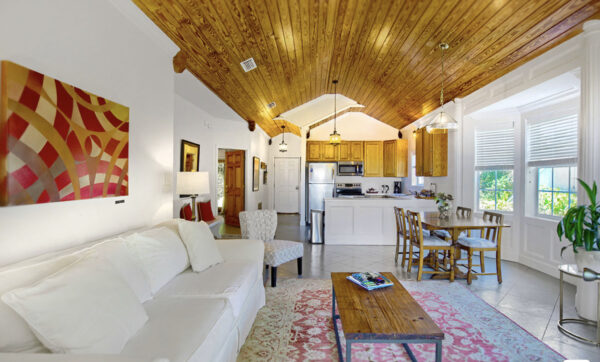
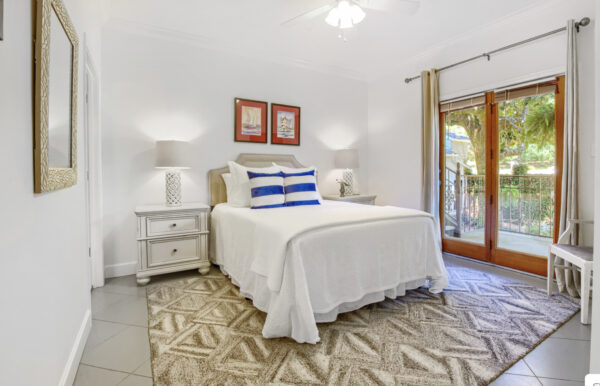
Guests can retreat to one of seven suites, four two-bedrooms, and three one-bedrooms. These are complete with kitchens, dining, and living areas, and washers and dryers. Five of the suites open to balconies with sunset views.
After a good night’s sleep, guests start the morning as Jim makes cooked-to-order gourmet breakfasts. The big table in the great room seats diners family-style, with separate café tables available. The big table is recommended, as Dana is a master of conversation starting. She gets to know her guests and shares commonalities among them to promote dialog, even networking opportunities. The daughter of an Air Force father and wife to a Navy husband, Dana learned quickly how to make new friends and get to know new places. She channels this gift from the time guests arrive at the New Orleans-style courtyard to checkout.
“You can never put a price on friendship,” says Dana Maloney.
(Jubilee Suites/Contributed)
While guests can experience the great room, fire pit, gorgeous sunsets, and warm hospitality, the couple also wants to share their corner of paradise with the community. Dana’s goal: to make the world a better place. Starting in December, Dana and her experience manager, Christy Wells-Fritz, are expanding their hospitality with monthly speakers in a series called Minds and Meals. Their purpose is to bring people together—guests and locals—to share ideas and interests.
The first speaker on December 5 is Lynn Oldshue, the author of “Our Southern Soul” and local NPR commentator. On February 5, Alan Hammack, who was one of the designers of the popular game Dungeons and Dragons, will be the guest speaker. A legend in the gaming community, he will discuss how games are made and played.
March 6, Susan Hammack, former president of the Alabama Wildflower Society, will speak on the sentiency of plants. The series, with the exception of holidays and summer, will be held on the first Monday of the month at 6 p.m. in the great room.
The property and buildings have long been associated with sunsets over the water. Once a sailor’s lodge, it has come a long way since it was built in 1940 to house ship workers, many of them World War I and World War II veterans.
These workers shared beds in eight-hour shifts, with no change of linens, unimaginable to us today, especially now with big, comfortable beds with spotless, fresh linens in the large rooms. The former dormitory, once located in Chickasaw, was moved across the bay to sit at its current ledge in 1947 by the Shoop family.
A veteran himself, Mr. Shoop lived there with his wife and four children and rented rooms. For a time, it was the Sunset Beach Hotel, a nod to the spectacular painted sky at the end of the day. At his passing, his widow sold the property and the result was a series of seven owners.
The old seaman’s rest has come full circle with a new Navy family continuing its long history of welcoming those who love ocean breezes. With two granddaughters and another on the way and a flow of new friends, the Maloneys plan a long stay as celebrated as a summer jubilee.
(Courtesy of SoulGrown)
For those who bravely untangle last year’s Christmas tree lights, imagine covering an entire zoo or botanical garden with the illuminating bulbs.
All across Alabama, the custom of lighting up Christmas rises to the level of art with dancing elves, prancing reindeer, walking Gingerbread men, and in one case, a mooning Santa. The displays range from dramatic to whimsical, high in the tree tops to below ground, and from elegant to so tacky that the infamous Griswold house would not make the cut.
From November through January, you can fill your senses with holiday cheer. Start early, and follow the lighted trail from north to south. Or, choose an old favorite to share with the whole family. These light displays are filled with joy, whimsy, motion, humor and the holidays at their best.

(Galaxy of Lights/Contributed)
Huntsville Botanical Garden’s Galaxy of Lights (Huntsville)
Santa meets astronauts in the Rocket City. Starting with a patriotic red glare, moon rovers light the way. Just down the way, space meets pre-history with dinosaurs alight. In between there are fairy tale heroes and heroines, woodland scenes and a host of flowers. Follow the 2.5-mile path either by foot or car through the light display scenes. On dog walking nights, your four-footed friend can chase an animated squirrel. The lights are on from November 11 through January 1 from 5:15 p.m. to 8:30 p.m.
Christmas at the Falls (Gadsden)
Arrive early at Noccalula Falls for a two-for-one spectacular. Get there before dark and take the walkway to the Falls where you can see nature’s superb light show with a sunset/view combo. Then, take your time walking through the lights and music of dancing snowflakes and exotic animals. Get a cup of cocoa and ride the train that circles the light show. On Paws for the Falls nights, canine companions are welcome, but you may want to keep them away from the animated tigers! Santa visits between November 25 and December 23. The lights run from November 24 to January 2.
Annual Sportsman Lake Winter Wonderland (Cullman)
Here is your chance to hear sleighbells in the snow. With a snow machine and horse and carriage rides, you can jingle all the way through Sportsman Lake Park. Or, take the train. Or, drive your car to see more than a million lights sparkle along the way. Snap your Christmas card picture in the photo booth. Santa may photobomb you with candy canes. The park will be celebrating the 20th year of this holiday spectacular. Open November 19-23, 26-28, December 1-5, 8-12, 15-23. December 26-30 is drive-through only.
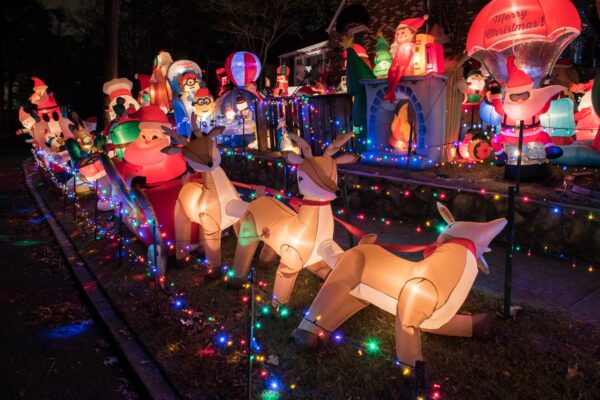
(Wacky Tacky Light Tour/Mark Peavy)
Wacky Tacky Light Tour (Birmingham)
Going against the grain of beautiful lights, the Wacky Tacky Light Tour seeks out the most outrageous, crazy, kooky and just downright funny home light displays. They claim their standards are low, and hard to meet. This two-hour bus tour includes Santa’s Trailer Park, Dueling Neighbors, Mooning Santa, Toomer’s Corner in Lights, and Star Wars—since nothing says Christmas like a few Darth Vaders. Including a Hanukkah House with its spinning dreidel, fiddler on the roof, and Joy to the World, minus the ’J’, it is your most inclusive light tour choice. The homeowners are in on the joke, as someone who hangs 10,000 lights from his roof is not cursed with shyness, and they lobby to join the tour. The tour runs four nights: December 13, 15, 20 and 22, with buses leaving every ten minutes. Reservations required. Participants can purchase seats or reserve a private bus for this popular fundraiser for underserved children.
Glow Wild at the Birmingham Zoo (Birmingham)
Lanterns glow in the night at this new holiday show, which has been described as Zoolight Safari on steroids. Wild animals and sea creatures rise into the sky aglow from lantern lights. You may spy a mythical dragon along the way! Before you walk through the Zoo, take a lift on the Red Diamond Express Train, followed by a twirl on the Carousel. While you will not be able to see the animals, you may hear some of the night calls, giving the setting all of the magic of an illuminated jungle. This show runs on non-rainy nights from November 16 through January 16, Wednesday through Sunday from 5 p.m. to 9 p.m., entry closes at 8 p.m.
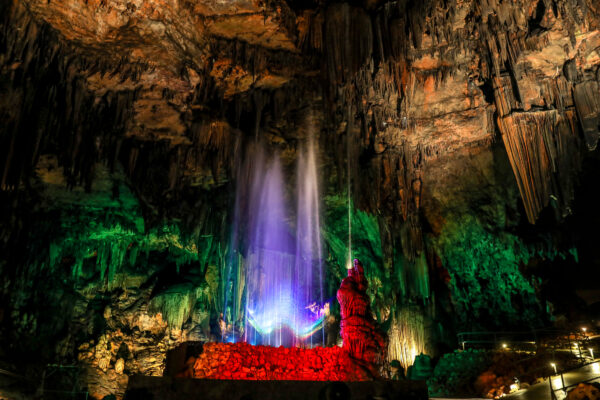
(Majestic Caverns/Contributed)
Majestic Cavern’s Christmas Laser Light Show (Childersburg)
Prepare your pupils as you walk into total darkness before laser lights illuminate the caves in a colorful explosion. Majestic Caverns (formerly Desoto Caverns) enjoys a grand theater for its light show: a 120-foot high and 100-yards long cathedral cavern. This show is the perfect choice for families with young children: it runs during the daytime, is not impacted by weather and stays a modest 60 degrees year-round. Their Christmas Laser Light Show will be on display during all tours from November 20 through December 31, from 10 a.m. to 4:30 p.m.
Montgomery Zoo’s Christmas Lights Festival (Montgomery)
Penguins can be spotted outside as the Montgomery Zoo transforms into a Winter Wonderland. Thousands of lights morph into your favorite animals. Walk the tour, but also catch a ride on the train or the Zoofair Skylift. Warm up in the Mann Museum while you get new decorating ideas from the Christmas Tree Village. Santa and fresh-baked cookies accompany hot chocolate on select nights. Live entertainment plays at the Overlook Café. The display runs from December 2 to 25. Give the gift of life for animals in the wild at the Animal Angel Tree.
Christmas Nights of Lights (Mobile)
There are no beads or moon pies, just a million lights—in fact, the largest synchronized light show in Alabama. Dancing on the street remains, however, as illuminated figures sway to the music. Tune your car radio to the posted station as you drive through. Expect to hear new holiday hits along with your favorite traditional carols. The path will light your way through nutcrackers, trees, and snowflakes as they sparkle to the rhythm. The illumination lasts November 11 through January 1, 6 p.m. to 11 p.m.
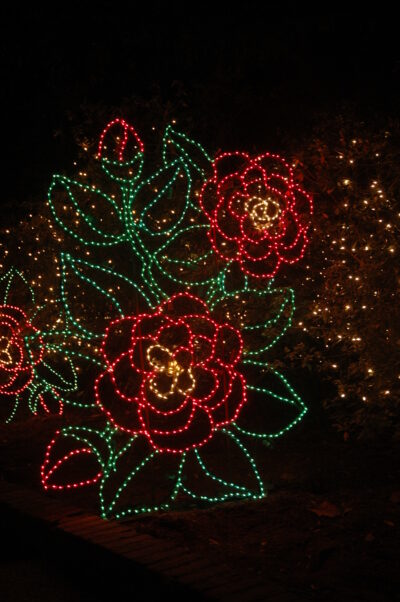
(Bellingrath Gardens and Home/Contributed)
Bellingrath Gardens and Home’s Magic Christmas in Lights (Mobile)
Come and see how creative the gardeners are—three million lights crafted into scenes designed and built by three Bellingrath employees. They work year-round putting the magic in Magic Christmas in Lights. There are plenty of botanical settings such as Secret Garden, Flower Walk, and Live Oak Plaza. If you look carefully, fish swim in the trees, butterflies flutter, and dragons parade in the Asian-American Garden. A Nativity Scene and Mardi Gras celebrate two holidays in separate scenes. Candyland and Gumball Cove are popular with the little ones. The illuminated path is made for walking, but wheelchairs and wagons are available. Tour the house, resplendent in holiday décor. Santa can be found nightly in the Magnolia Room from November 25 through December 23. Hot chocolate and hot food available.
Annual Christmas Lighted Boat Parade (Gulf Shores/Orange Beach)
Decorated from stem to stern, these boats are floating parties. Starting at Lulu’s, boats float on the Waterway Village with lights ablaze, heading for The Wharf. The parade can be viewed along the canal from Gulf Shores or Orange Beach. The boaters decorate sails and sides with colorful lights and lighted figures that glide by in the dark. The festivities begin at dusk.
(Courtesy of SoulGrown)
It all started with a 1930s Shirley Temple doll for Mary Charles Robbins. Living in a home with no radio, before television, dolls provided her main entertainment.
“The composition dolls are the ones from my era. They have such good expressions on their faces. I would say they are my favorites since I played with them,” says Robbins, now 86 years-old.
Today, the Mary Charles Doll House is one of 10 repair shops world-wide that are approved by the Madame Alexander Doll Company. People seek out the tiny historic house in Homewood—formerly the location of Carriage House on Oxmoor Road—from all over the country. Part retail, part museum, the Mary Charles Doll House is crammed with antique and vintage dolls, teddy bears, doll clothes, doll houses and doll house furnishings. Very few things are new, except for the exquisite miniatures for tea sets and doll houses designed and painted by artists specializing in working small.
Mary Charles began her doll dream house forty years ago when she went into business with three other ladies. They opened an antique store, with no retail experience and even less funding.
“The rent was $50 a month, can you believe that!” says Robbins, Her original business stood across what is now CVS.
While customers bought furniture and lamps, quite a few asked, “Do you have any old dolls?” Encouraged by a friend who was a doll collector and who repaired dolls, she opened a shop that both sold and restored dolls. Her go-to restorer remains a star attraction.
“She is one-of-a-kind. It is amazing to see dolls shipped in from all over the country and leave revived. No one is as good as she is,” says Robbins.
Far from a toy store, the Doll House attracts adults, mostly women, who enjoy dolls and furnishing doll houses. Everywhere you look are dolls of all kinds. There’s Lucy stomping grapes and trying to keep up with chocolates on the conveyor belt in classic “I Love Lucy” shows. Raggedly Ann and Andy and Barbie and Ken remain together. Chatty Cathy no longer talks, but stands proud among the 150 brands of dolls found here. And Elvis has not left the building.
“A man who is an Elvis impersonator bought one of my Elvis dolls,” says Robbins.
An entire room is dedicated to Madame Alexander Dolls. For more than 100 years, these dolls have been cradled by little girls and passed down through families. Created in 1923 to replace the heartbreak so often met with porcelain dolls, Madame Alexander worked to maintain the quality of the glass art with sturdier materials. She believed that doll play taught children kindness and compassion. Robbins agrees and laments the lack of doll play today.
“Children learn about how to be a good mother and about life,” says Robbins.
Even fewer girls furnish doll houses, now almost exclusively an adult passion. One local lady lawyer purchases high-end doll house chandeliers and furniture at prices usually reserved for full size. Many of the furnishings are copies of museum pieces. In the back room, drawers of wall paper and racks of windows resemble a doll-sized home furnishings store. Purchases range from tiny tubs to thumb-nail-size porcelain cakes, sewing machines, stoves, beds, sofas and tiny wall paintings.
Seasonal offerings are Christmas decorations and pumpkins. One shopper wanted to create a Halloween doll house and bought ghosts, jack-o-lanterns and old trees.
Handmade Steiff teddy bears range from cuddle-size to Beauty-and-the Beast collectibles. There are original Steiff circus train cars still carrying lions and tigers. They join Russian stacking dolls, lead soldiers from the 1920s, and vintage paper dolls in the front room of the store. A few items are there just because Mary Charles likes them, like music boxes and classic costume jewelry. Baskets with tea sets stand ready to serve anyone from an American girl doll to daddy. You can even find Beanie Babies. Some of the earliest dolls to celebrate the diversity of girls are found on the porch room.
While many of the dolls may be above the average price point, Robbins keeps a $5 basket in front of the door. She also contributes dolls to children who cannot afford them.
Everything in the store is for sale, except for Bandit, Robbin’s little dog. He lays faithfully next to her comfortable perch in front of the elegant fireplace in the historic home.
Even as many of her customers, the doll collectors, fade out, she holds hope that dolls will experience a renaissance. As she demonstrates a rare topsy-turvy doll—Cinderella at the ball on one side, with a flip of the dress she changes into rags—she comments on how things can change for the better. For her, the old dolls are friends for life, a wish she cherishes for every little girl.
(Courtesy of SoulGrown)
She was only five years old when she tentatively toddled over to the paleontologist to show him her dinner-plate sized find. He leaned in with a smile of patience, assuming it was just a rock. He flipped up his sunglasses for a better look. The fossil hunt was 20 minutes in and the smallest child had picked up a museum-quality fossil. It was an Attenosaurus track, called a “coal lizard.” These giant ancient reptiles spanned from six to eight-feet long and dominated swamps as the largest land animal before the dinosaurs emerged.
“There are no dinosaurs at the Union Chapel Mine, but these fossils are rarer than dinosaur bones,” says Carl Sloan, secretary of the Alabama Paleontological Society and leader of the Fresh Air Family field trip.
Officially named the Steven C. Minkin Paleozoic Footprint Site, this former strip mine in Walker County has been rated as the most important Coal Age footprint site in the world by international experts, according to Congressional findings. These findings resulted in saving the Union Chapel Mine from being covered over by the Mining Reclamation Act. The site has produced thousands of tracks, some new to science, and the largest collection of specimens documenting these animals. It’s the number one site for vertebrates and the most prolific source of tracks left behind by the earliest reptiles on earth. Scientists from around the globe are attracted to the site for its abundance of fossils and the biodiversity of what was an ancient swamp teeming with terrestrial and aquatic life.
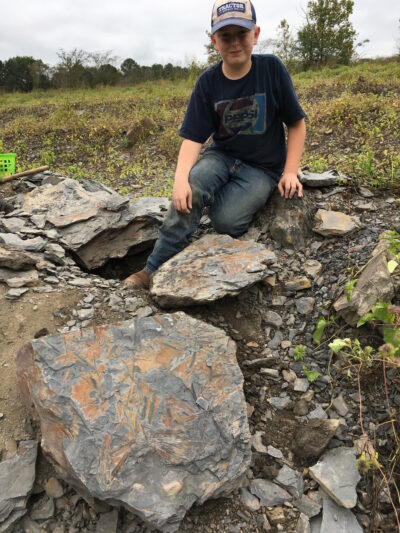
Camden with this museum-quality fossil (Verna Gates/Contributed)
The fossils are so abundant, that a small child can pick up a rock and find a rare track. A 10-year-old boy found a cluster of trilobites. A 12-year-old boy, Camden Davis, made news by unearthing evidence of the entire life cycle of an ancient seed fern, which went straight to a museum. The finest piece was found by Cindy Wallace, a mom who was watching her fossil-fanatic son hunt from pile to pile. She looked at the slab beside her and pulled it up, revealing seven hand-sized prints of the Attenosaurus.
“This is the largest find I know of,” said Jim Lacefield at the time of the find. He is the author of “Lost Worlds in Alabama Rocks.”
Groups such as universities and education programs such as Fresh Air Family take students and families to the site. School field trips and family weekend adventures offer a chance for amateurs to participate in scientific discoveries. The Alabama Paleontological Society organizes monthly hunts. Everyone keeps their fossils unless they are museum-quality, in which case they generally go to the McWane Science Center in Birmingham or the Alabama Museum of Natural History in Tuscaloosa.
The original discovery of the site was made in 1999 by Ashley Allen, a high school science teacher in Oneonta. He announced to his class that he would like to take them on a fossil field trip to a coal mine. A student raised his hand to offer a mine owned by his grandmother. When Allen scouted the site, he found the tracks resembling a tiny truck, which turned out to be rare arthropod tracks.
The Union Chapel Mine was a strip mine, pulling out layers of coal. According to national law, it was due to be reclaimed, which would have covered up the fossil record. Allen and Steven Minkin lead the charge to save the site. It literally took an act of Congress. Now owned by the State of Alabama, it takes special permission to explore the site.
The ancient swamp forest would have looked much different from today’s swamp. The trees were more like tall ferns, with green-scales for bark and leaves at the top. Some rose to 150 feet and were extinct by the time dinosaurs came looking for vegetation. Beautiful fern fossils are the easiest finds in the rock piles at the former mine. With low oxygen and high acidity, the waters did not break down the plant material, leaving finely chiseled remnants of delicate leaves.
While the large amphibians offer the showiest fossils, the site is famous for its fish, especially the horseshoe crab. Here is the only record of its life-cycle in the time period.
While tracks do not reveal what the whole body looked like, it can reveal size and behavior. It tells us if they congregated. Or lived solitary lives. What did they do when they met other creatures? Or, were they avoiding something that might eat them.
While the scholars might debate the lives of creatures from long ago, fossil hunters can enjoy the ease of the hunt. Literally, almost every rock captures a footprint or a plant. Those with patience can sort through piles to find treasures. Others split rocks to see what might be hidden inside. Whatever is found is a unique glimpse into an ancient world.
(Courtesy of SoulGrown)
If a high note breaks your beer glass, it’s not the alcohol singing—it’s Opera Shots. Far from the stodgy image of the large woman in a Viking helmet, this progressive opera company takes opera to the street, the bar, and the brewery. Opera Birmingham showcases its singers before unsuspecting audiences who get a sip of culture along with their cocktail.
“People are sometimes surprised when we show up,” says Eleanor Walter, Director of Marketing and Community Engagement for Opera Birmingham.
The concept of Opera Shots began when director Keith Wolfe-Hughes moved to Birmingham in 2015 to lead Opera Birmingham. He had heard of New York’s Opera on Tap and began his own program in Birmingham. The concept was to take opera to new and unexpected places to introduce it to new audiences.
The Collins Bar, Avondale, Cahaba and Good People breweries have all hosted shows. So has a charter school in Woodlawn and on the street of Second Avenue North. Railroad Park hosted a children’s program that featured music from “Aladdin,” “Beauty and the Beast,” “Willy Wonka,” and “Mary Poppins.” The classic song “A Spoon Full of Sugar” sounded out to the delight of children and gratitude of parents.
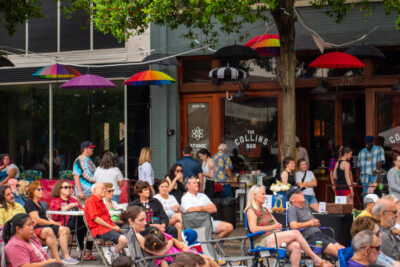
A crowd enjoys opera at an Opera Shots street party (Opera Birmingham/Contributed)
“If you expose children to opera at an early age, they grow up enjoying opera,” Walter says. “A family brought their four kids. The mom said she would have never gotten them all in a theater. But here, they could break out the picnic blanket and snacks in a welcoming atmosphere.”
Even through the Covid shutdown, this unstoppable opera company rolled out a flatbed truck and created a stage in their parking lot. The makeshift stage has traveled to several pop up places where opera had never been heard and remains on stand-by for future venues.
The singers come from a variety of sources. Some are visiting artists in town for a big show. Others belong to the company chorus. Some are opera students at Samford University or the University of Alabama. They each take a song or two and sing in turn from whatever serves as a stage, or just from a mic stand in the front of the bar. Occasionally, a duet may pair a couple of singers.
The songs range from high opera to musical theater to art songs. It’s an opportunity for singers to share a favorite such as the “Marriage of Figaro” by Mozart or “Let It Go” from the popular animated movie “Frozen.” Songs have been performed from “Le Boheme,” “Carousel,” Cole Porter, “Into the Woods,” and the film “Moana.”
Full operas stepped outdoors when Opera Birmingham performed the “Pirates of Penzance” in Avondale Park to sold-out audiences. “Three Little Pigs” followed for kids in the park’s amphitheater. Two popular events are the Sounds of the Season, holiday music, and an annual Vocal Competition that attracts rising stars from all over the country.
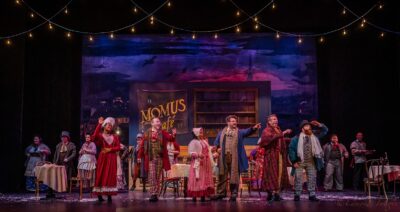
A performance of Opera Birmingham (Stewart Edmonds/Opera Birmingham Facebook)
While Opera Birmingham indulges in the rich heritage of opera with traditional shows such as “La Traviata,” “Tosca” and “The Barber of Seville,” it also steps out of its silk shoes into contemporary topics. Performances have addressed issues such as prisoners of war, unknown soldiers and Civil Rights. January’s “dwb (driving while black)” took a backseat to Covid but will return later on the real stage. This production stands as part of the Birmingham Speaks initiative to generate conversations out of the collision of life and art.
The outreach has successfully brought in new fans to productions. “We are seeing the next generation of opera patrons in the audience,” says Walter. “We will continue branching out.”
Opera Shots run monthly in spring and fall. If you are enjoying a drink and hear a voice strong enough to make the walls expand, it might just be opera. Give it a listen, you might find out the champagne of music could become your drink of choice.
(Courtesy of SoulGrown)
Summer may turn a wildflower hike into a sauna, but there are plenty of creeks, caves, swimming holes and natural phenomena to make working up a sweat worthwhile. Our famed hydrangeas are in full bloom in every variety from climbing to giant foot-long blooms. Creature features include the largest emergence of bats east of the Mississippi and a glowworm only seen here and Down Under. Alabama is a natural paradise, ranked as number four in biodiversity in the United States. Much of this diversity is due to our five geologic regions. Alabama is a special place for the explorer willing to seek its charms. Here are 10 nature experiences to add to your list this summer.
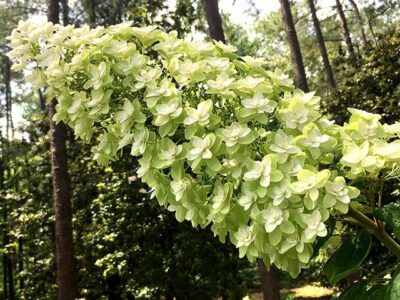
(Aldridge Gardens/Facebook)
Admire Hydrangeas at Aldridge Gardens
Hydrangeas come in more than white, pink, and blue. You can also find purple, burgundy, and orange. Eddie Aldridge scoured the woods and gardens of Alabama to find unusual varieties of hydrangeas. His most famous discovery was the Snowflake Hydrangea, with its white, double bloom. More than 50 varieties of hydrangea dot the walking paths of the personal garden the Aldridges gifted to the City of Hoover. These blooms show-off in early summer, but retain blooms steadily, drying into intriguing colors as they fade. Alabama is hydrangea-central with more types and numbers of hydrangeas than anywhere else in the world. A wildflower garden in the back grows sunflowers, Joe Pye Weed, ironweed and
Turkey Creek Nature Preserve
After you admire the many wildflowers in bloom: coneflower, rosinweed, butterfly weed, blazing star and white buckeye, the waters will call to you. The swimming residents of Turkey Creek require pure water for their survival. The colorful Vermillion Darter’s only home in the world is the cascading waters of the creek. The creek hosts seven protected species, making it one of the most biodiverse areas in the country. The hiking trails lead you through historic Native American and iron-making sites along with lush flora. After you explore, take a dip in a real swimming hole. Blue Hole offers the vintage childhood experience of plunging into a clear, clean natural pool. The Falls features a natural waterslide down the rocks into the fresh water.
Take a Moonlight Guided Canoe Tour
The sound of owls hooting in the night. The sash of moonlight trailing through the gentle waves. Frogs singing in the trees and ponds. The soft sound of paddles pushing water behind them. With any luck and depending on where you put in, you may spy the flash of red of an Indian Paintbrush. The Cahaba River Society provides everything you need to enjoy a romantic (even if it’s only a love of nature) evening on the river. You may even see Dismalites turning on their blue-green illumination on scattered boulders. The guide will point out wildlife, seen and heard. The sycamore, willow, sweet gums and water oaks drape over the water. Beginners can enjoy this easy paddle.
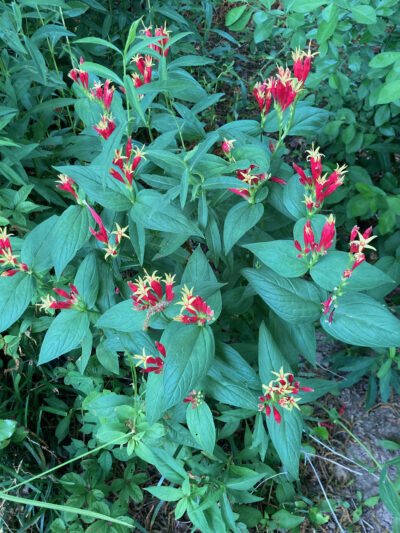
Indian Pinks (Verna Gates/Contributed)
Search for shark teeth at Shark Tooth Creek
Water willow leads you down the path to find treasures. Indian Pinks lean in to see what you may find. Ancient Alabama was underwater and giant sea creatures swam over much of the state. They left evidence of their presences in the form of shark teeth. In Aliceville, all that remains of this grand ocean is a shallow creek where thousands of sharks’ teeth have been found by paleontologists and children. Experts conjecture that the area was once a barrier island, like its modern-day cousin, Dauphin Island. Shark teeth are not attached to the gum, like humans, and they generally shed a tooth a week. The lemon shark may discard as many as 30,000 teeth in a lifetime. The teeth found here originated in the mouths of 16 different species of ancient sharks.
See bats at Sauta Cave National Wildlife Refuge
As you travel along Highway 72 near Scottsboro, keep a sharp lookout for mile marker 131. Pull over on that small side road that leads to Sauta Cave, which used to be called Blowing Wind Cave. You may notice a distinct lack of mosquitos as you traverse the path at the biting-bug prime time of dusk. A sign leads down to a platform facing the cave entrance. A cool breeze emerging from the mouth brings welcome relief to the hot day. Soon, you will see one or two bats, including rare gray and Indiana bats, which are protected by the cage blocking the entrance. In the largest emergence of bats east of the Mississippi, more than 400,000 bats will fly above you, swirling like a dark cloud in frenzied motion. Be grateful for these bats, as they can eat their weight in mosquitoes and other bugs every night. Along the path to the cave, you will find black-eyed Susans, spiderworts, rosinweed, and partridge pea.
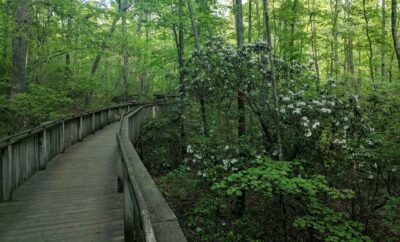
(DeSoto State Park~Fort Payne, Alabama/Facebook)
Marvel Big Leaf Magnolias at Desoto State Park
Our native magnolia tree grows large, soft leaves that can range from one to three feet long. These whoppers form a circle, resembling a canopy over the tree. They look like palm trees in the forest. Except for one thing: a huge, white flower that spans nearly a foot across. The giant bloom sits above the leaves and issues a sweet scent that roams far beyond the tree. Desoto State Park is filled with these trees along its Boardwalk Trail. An easy path, it circles around and across the creek. Some of the walk is raised, giving you a clear view down onto many of the blooms.
See Black Belt Flowers and Birds
The patches of yellow and purple slash across flat fields of flowers, punctuated by the flash of red or blue or yellow of a flickering bird dipping down for a tasty bug. The Alabama Black Belt is home to prairie grasses such as big and little blue-stem, which color coordinates with a purple clover. There are unusual sun-loving wildflowers, such as prairie rosinweed, prairie coneflower, and golden asters, that typically make their home in the Great Plains, and are not expected in the Camelia State. These remnants remind us of what was here before cotton was king. These long stretches of grasses are home to thousands of animals, including birds. The weekend of July 29–30, birders will congregate in the city of Greensboro to enjoy the birds and the prairie in bloom. Join Alabama Audubon for this event. other colorful natives.
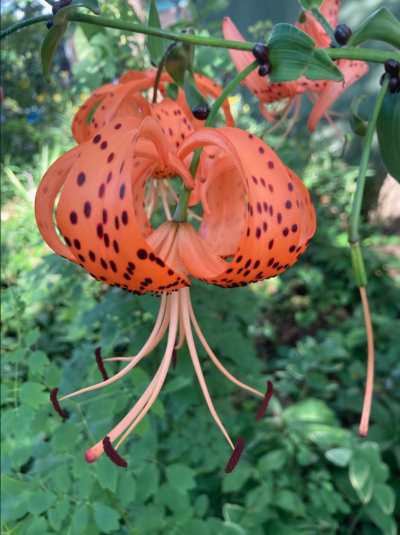
Tiger lily (Verna Gates/Contributed)
Paddle Bear Creek Canoe Trail
In so many places, the summer water levels can shrink so low that canoeing becomes a walk with a boat. Bear Creek is fed by dam releases, making it the only sure bet for a good ride in sufficient water. The lazy creek can be paddled fast, or cruise along for a gentle ride. Novices and families with kids can safely traverse the watery path while observing summer flora along the rich banks. Several sand bars call for a picnic and shell search. There is a morning and evening run on two different sections. An overachiever can make both in a day, or take two days adding a visit to the nearby Dismals Canyon. Along the way, you will see wild white hydrangeas blooming along with Indian Pinks, orange butterfly weeds, cardinal flower, spiderworts, and hopefully, a tiger lily. The creek is located near Hackleburg.
Climb through Caves and Caverns
Caves and caverns feature walking paths with native flora adding color with blooms and butterflies. Hibiscus, Indian Pink, blue sage, and hydrangeas line the trails. Butterflies flutter over the milkweed. Alabama is a mecca for caves, which maintain a temperature between 55 and 60 degrees. Caves literally are a cool place to go in the heat of summer. Desoto Caverns has created its own entertainment district with everything from a squirt gun lost trail to hula hoops. Inside, the show includes special effects along with history facts. Cathedral Caverns offers hiking trails to explore before you cool off inside. The giant entrance to this cave gives way to “Goliath,” measuring 45 feet tall and 243 feet around, making it one of the biggest stalagmites in the world. Rickwood Caverns tours take you 175 feet below the earth into what was once an ocean bed. See the miracles water can carve in its twists, turns, and shapes.
Cruise to see Lotus Blooms
In summer, the Mobile-Tensaw Delta is brimming with yellow lotus flowers. They bob in the waters, tossing their thick fragrance up onto the banks for your senses to embrace. By the thousands, they float on the waters all along the riverways. One way to see them is to take one of the cruises leaving from Blakeley State Park and Gulf Shores. Wild Native offers a variety of tours from pontoon to canoe tours of wildlife and wildflowers. If you time it right, you can make Shark Week at Gulf State Park, but you might not want to go in the water!
For information on exploring outdoor Alabama, visit FreshAirFamily.org.
(Courtesy of SoulGrown)
“We were just stupid enough or crazy enough to think we could actually do it,” says Gary Jones, president of the Alabama Theatre Organ Society. “We knew we had to do it.”
To most of us, the Alabama Theater is a masterpiece of Moorish design, velvet seats, and a massive stage. It is where we go to see movies or bands, dance recitals, comedians, and weddings in the glamorous setting.
Others see a beautiful organ rising up from the floor. An instrument of physical and musical beauty. An irreplaceable instrument. Something worth saving.
The Alabama Theatre Organ Society was happily maintaining their crown jewel, the Mighty Wurlitzer throughout the 1970s and the early 1980s. The reward for their hard work was the opportunity to touch the magic keys of that powerful instrument. Their work was self-funded with a spring and fall organ concert. The Alabama Theatre managed to stay a first-run movie theater throughout the 1970s in spite of the waning fortunes of Birmingham’s once-vibrant downtown in the next decade.
Hopes were raised in the mid-1980s when a development group purchased surrounding properties and the Alabama Theatre, with intentions to make the Alabama the keystone. Unfortunately, their plans failed and the money ran out. Pushed into bankruptcy, the Alabama stood in the path of the wrecking ball.
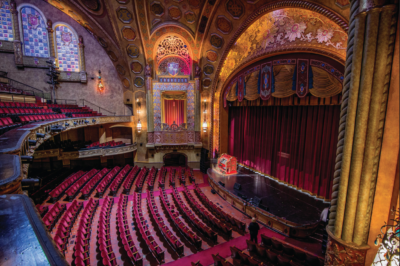
(Birmingham Landmarks/Contributed)
At one time, there were 73 theaters in Birmingham’s historic theater district: the Princess, the Strand, Rialto, Galax, and Franklin. A movie-loving city, Birmingham was second only to New York to show the first talkies. The Marvel Theater had a hand-cranked phonograph for sound to accompany the hand-cranked movie reel. All had been reduced to rubble and new buildings stood in their place. The only ones left were the Alabama, Lyric, and Carver. At least those remained—most American cities lost their grand movie houses.
To prevent the inevitable, the organ society appealed to the bankruptcy judge, pleading for permission to at least save the Mighty Wurlitzer. He refused. It was all or nothing. The organ society would have to buy the whole building.
There were around 80 members of the organ society, 30 who were active, and about 10 who did the work, according to Jones, who was on the board of directors at the time. The plucky group of organists partnered with the Birmingham News. They ran ads that promised for a $25 donation you would get your name in the paper and a T-shirt that said, “I helped save the Alabama Theatre.”
The T-shirt money raised enough to pay off the taxes. That left the $686,000 mortgage to be assumed by the small organization. They formed Birmingham Landmarks, Inc. a separate non-profit to manage the theater, and now other historic buildings.
“Assuming the mortgage was easy, maintaining the mortgage and paying the power bill was tremendous. We had to hustle to put on shows as it was a self-sustaining endeavor—no city or state money. It was a roll of the dice to see if the event that day made money. We seemed to either make money or lose our shirt,” Jones says.
Fortunately, there were enough people in Birmingham with fond memories of the Alabama. Thousands of them came together to raise enough money to save the theater and of course, the Mighty Wurlitzer. Today, the Alabama stays busy with bookings. The only two promotions put on by the theater itself are the summer and holiday movie showings. The “Sound of Music” will soon be seen in the summer schedule, just like when it first danced across the Alabama screen in 1965, thanks to the Mighty Wurlitzer and its mightier organists.
(Courtesy of SoulGrown)