Madison and Jared Powell arrived in Auburn as newlyweds with different dreams and separate career goals. Now, they will walk across the same graduation stage as Dr. Powell and Dr. Powell, earning Ph.D.s. Their fields could not be more different, but a shared Auburn experience turned two individual journeys into a milestone achieved together.
Jared came to Alabama to pursue a dream tied to Auburn since childhood. Though raised in Michigan, he grew up cheering for the Tigers because his father played baseball here in the late 1980s. Discovering Auburn’s strong experimental plasma physics program confirmed that this was where he belonged.
“I’ve been an Auburn sports fan my entire life,” he said. “When I found out how good the plasma program was here, it sealed the deal.”
Madison planned to complete a master’s degree in education administration, not a doctorate. She wanted to impact students and teachers, but the support she found at Auburn led her toward a bigger opportunity. Professors encouraged her to continue, and a close cohort made the work meaningful.
“I just enjoyed it,” she said. “They told me I was seven classes and a dissertation away from a Ph.D., and I thought, ‘That’s just eight things. I can do eight things.’”
Madison’s research focuses on authentic leadership in education and how momentous experiences, such as nature-based learning trips, help build stronger school leaders. She hopes her work will support teachers, students and future administrators in developing transparent, empathetic leadership. Her path in school leadership has now led her to serve as an assistant principal in Opelika.
Jared’s research tackles the “radio blackout” problem that affects spacecraft when they re-enter Earth’s atmosphere at hypersonic speeds. His dissertation explores how radio waves travel through plasma and how to improve communication during re-entry. “I’m proud to make one small contribution to a problem people have worked on for more than 60 years,” he said.
Like many graduate students, both Powells spent late nights writing, revising chapters and preparing for their defenses. They understood each other’s workload because they were living it at the same time. Their dog, they joked, deserves an honorary degree after sitting through every practice presentation.
Outside of academics, they protected their time together by never skipping daily workouts. OrangeTheory became their shared escape. “It’s guaranteed time we can spend together,” Jared said.
Auburn soon became more than a place to study. Community, opportunity and small traditions, like Toomer’s lemonade or spotting toilet paper in downtown streets after a big win, made it home. “Auburn people love Auburn,” Madison said. “Not just the winning or just sports. All of it.”
Jared will begin a postdoctoral research appointment at Auburn in January, working on additional experiments and publications before pursuing a career in industry. Madison hopes to one day become a principal, and maybe even a superintendent, focusing on leadership that supports students and teachers. Both careers look outward, toward impact far beyond campus.
A single Ph.D. represents persistence and long nights of work. Two Ph.D.s under one roof represent something deeper, devotion not only to their fields but to each other. As Auburn welcomes the Powells across the graduation stage, the community celebrates not just two new doctors, but a family whose Auburn story is just beginning.
Courtesy of Auburn University
Auburn University’s College of Forestry, Wildlife and Environment (CFWE) has received a matching gift from the You Might Be for Auburn Foundation (UMB4AU) to support a restoration project underway at Crooked Oaks, the former homestead of Auburn’s beloved former football coach Pat Dye.
RELATED: The rebirth of Pat Dye’s Crooked Oaks in Notasulga, Alabama, is underway
The CFWE was gifted the 415-acre property in 2023. In Notasulga, not far from Auburn’s main campus, Crooked Oaks now serves as a living legacy to Dye’s vision to provide hands-on learning experiences for Auburn students.
Devoted to education
Born from fellowship and a shared devotion to education, the Birmingham-based UMB4AU foundation is humble but serious about its mission to support Auburn.
The founding directors of UMB4AU, Dan Lovell and David Pursell, are passionate about the charity’s mission to fund activities that benefit Auburn faculty, students, athletes and facilities, and have significantly contributed to numerous projects that advanced the university and its academic programs.
By virtue of a recent discussion with CFWE Development Director Heather Crozier, one of the original foundation members, Jay Evers, connected with Dye’s intent for Crooked Oaks and championed the restoration initiative with the directors.
Like other successful philanthropic endeavors, the foundation hopes its gift will galvanize the Auburn community to donate the matching funds required to complete the project during Auburn’s 2025 Tiger Giving Day crowdfunding event this fall.
Love of the land
As a fellow nature lover and former high school football player, Evers feels a kinship with Dye, whom he knew personally.
“You know, he moved from one season to another, and I know football gave him great pleasure,” Evers said. “But if you asked him how he identified, he would probably lean more toward the land than he would football.”
Dye began developing the property in 1998 with his partner, Nancy McDonald, and continued to improve all aspects of the land until his death in 2020. The Tiger Giving Day project will restore the cherished Japanese maple nursery that Dye had planted himself.
Crooked Oaks Manager N.L. Hart believes the project will ensure the property maintains the horticultural integrity envisioned by Dye and McDonald as an educational and recreational resource.
Developing a community resource
“These funds will be crucial to enable our staff and students to improve the infrastructure and layout of the nursery to optimize both its functionality and accessibility,” Hart said. “This includes installing and repairing irrigation systems for the various gardens and drainage areas that will prevent erosion.”
True to Dye’s vision, providing student experiential learning opportunities will be a cornerstone of the project.
The Crooked Oaks staff and Auburn faculty in the CFWE and the College of Agriculture will engage graduate and undergraduate students to develop the nursery and assist with grafting new Japanese maple seedlings and other species that will be featured.
Hart said the Crooked Oaks nursery is offering numerous Japanese maple cultivars and Camellia sasanqua, japonica and hybrid cultivars for sale, with future plans to diversify the inventory.
To complete the Tiger Giving Day project, Crooked Oaks will require high-quality supplies and materials, such as grafting tools, soil amendments, multi-purpose gardening tools and shade material to enhance the overall gardening process.
Additionally, a key component of the project is to revitalize the existing greenhouse that will be used for overwintering seedlings and other plants. The anticipated cost for the projects is estimated to be more than $100,000.
Sharing a legacy
“UMB4AU’s matching gift will have a tremendous impact at Crooked Oaks that will benefit the college, its students and academic programs,” said Janaki Alavalapati, the Emmett F. Thompson Dean of the CFWE. “On Tiger Giving Day, we are hopeful the Auburn family will help us exceed the match required to leverage UMB4AU’s generous donation to restore Coach’s beloved gardens.”
This year, Auburn University will celebrate the 10th anniversary of Tiger Giving Day on Sept. 10. During the popular crowdfunding event, the community is invited to support various projects that will change lives on campus, in our communities and across the state.
“When you think about all the different facets in the opportunities out there for people to be involved, whether they’re bird hunting or buying plants or having a corporate retreat or whatever it is, there’s a legacy we can all share in from now on, and as long as there is planet Earth, there will be Crooked Oaks,” Evers said.
Individuals who wish to participate in this campaign or to learn about additional giving opportunities may contact Crozier at 334-740-9522 or vannhea@auburn.edu. For more information about Crooked Oaks or to inquire about nursery sales, visit the Crooked Oaks website.
Courtesy of Auburn University.
The Problem
The health of honey bees and native bees is in crisis, posing a significant threat to agriculture and ecosystems worldwide. Bees are essential pollinators, contributing to the production of many crops that humans rely on for food. However, native bee populations are declining, and managed honey bee colonies are dying at high levels due to various stressors, including parasitic mites, pesticide exposure, and habitat loss. This has serious implications for food security and biodiversity.
Our Work
At Auburn University’s Bee Center, we are leading the charge to address this critical issue. Our mission is to perform impactful research that promotes the health of honey bees and native bees. We collaborate closely with the USDA ARS Stoneville Pollinator Health Research Unit, sharing insights, jointly collecting and analyzing data and co-supervising graduate students. This collaboration has led to the deployment of new tools to manage honey bee pests, the identification of appropriate planting and management actions for wildflowers and the understanding of invasive plants’ role in bee forage.
RELATED: Sen. Tuberville introduces bill to protect American beekeepers, honey producers from fake imports
The Bee Center is making significant strides in bee health research. We are leading the U.S. Beekeeping Survey, which tracks the status of managed honey bee health across the country. This survey has revealed critical insights, such as the exceptional number of colony losses overall, as well as the recent higher percentage of losses among beekeepers that are tremendously important for the pollination of specialty crops. These findings inform policymakers and researchers, driving research priorities and shaping agricultural practices.
Our research and education work has a global focus, too, as the honey bee parasitic mite Tropilaelaps mercedesae is spreading throughout Asia and into Eastern Europe. By leading efforts to understand and manage this mite, we are preparing U.S. beekeepers for its potential arrival, demonstrating our commitment to proactive and preventive measures.
We are at the forefront of addressing high colony loss and mortality, particularly due to another honey bee parasitic mite, Varroa destructor. Through the Specialty Crop Research Initiative, a large USDA-supported project, we have teamed up with researchers from across the U.S. and Canada to identify new tools and improve application methods for controlling this mite. Our field trials, conducted under typical beekeeping conditions, are a testament to our practical and solution-oriented approach.
Beyond research
Our impact extends beyond research, involving the community through teaching and outreach. The Bee Center is committed to providing exceptional immersive learning experiences for undergraduate students. By embedding them in our labs and those of our collaborators, we offer real-world experiences that demonstrate their contributions to society. Our students play a critical role in designing and executing experiments, communicating findings and engaging in outreach activities.
We connect with local beekeepers and farmers through field days, state-wide meetings, online surveys, and direct communication. Understanding their needs and addressing them practically is at the heart of our work. Our monthly regional webinar series, held in collaboration with Alabama Extension, as well as our beekeeping demonstration videos and in-person workshop,s are just a few examples of how we deliver education and support to our stakeholders.
The future
Auburn’s Bee Center is not just about today; it’s about shaping the future. Our upcoming initiative, SEBees, will provide immersive pollinator research and outreach experiences for undergraduate students. This aligns with Auburn’s strategic plan to offer exceptional student experiences, allowing them to make meaningful contributions while preparing them for real-world scenarios.
Our vision is to make lasting contributions to sustainable agriculture and bee conservation. By working closely with our network of collaborators and stakeholders, we aim to be leaders in our field, providing solutions to critical issues and inspiring future generations.
Auburn’s Bee Center is a beacon of innovation, collaboration, and impact. We are driving change, leading research, and making a significant difference in bee conservation and sustainable agriculture. Through our dedicated efforts, we are positioning Auburn as a leader and driver in this vital field, ensuring a healthier future for bees and the ecosystems they support.
Courtesy of Auburn University
Samantha Sampson’s deep love for Hashbrown started in the wee hours of the night as she formula-fed the tiny orange kitten. She did her best to keep the baby and his brother, Tater Tot, nurtured.
But, despite her efforts, Tater Tot grew stronger while Hashbrown struggled.
RELATED: Alabama cat survives 14-month trip to Las Vegas
A visit to Sampson’s primary vet confirmed a serious heart issue for the small feline, and he recommended Dr. Randolph Winter at Auburn University’s College of Veterinary Medicine for continued care.
Winter would eventually perform the first surgery of its kind to treat Hashbrown’s heart disease.
A dedicated pet owner
Sampson and her husband take care of feral cats in their neighborhood, but by trying to do good, they embarked on an unexpected medical journey.
“Hashbrown’s mother was a feral cat. It took months to catch her, and when we did, we learned she was pregnant,” Sampson said. “Only two kittens from her litter survived: Hashbrown and Tater Tot.”
When the kittens were six weeks old, Sampson brought them to her veterinarian, Auburn alumnus Dr. Cody Bryan of Eastside Animal Hospital. He heard a heart murmur in Hashbrown, confirmed his lungs were filled with fluid and referred the kitten to see Winter, with whom Bryan worked during vet school.
Hashbrown’s diagnosis, supravalvular mitral stenosis, meant he had a ridge of tissue above the mitral valve that prevented blood from moving from the top of his heart to the bottom.
“I knew Hashbrown couldn’t keep up with his brother, but he could still be a spunky, playful kitten. I had to help him,” Sampson said.
Working as a team
When Winter started working with 4-month-old Hashbrown last fall, the kitten relied on medications to breathe comfortably and struggled to run and play like a normal kitten. Winter had treated similar conditions, but because supravalvular mitral stenosis was so rare, he’d never seen a patient quite like Hashbrown.
Winter normally performs minimally invasive surgeries alone, but, due to Hashbrown’s size, he needed another surgeon, Dr. Michael Tillson, to help him gain access to the heart to perform the cardiological procedure.
“We needed a team-based surgical cardiology approach,” Winter said. “Dr. Tillson and I had worked together before on many patients, but not on a cat as severe, small and young as Hashbrown.”
Confident in care
Sampson immediately appreciated Winter’s communication.
“Dr. Winter explained everything to me. He was confident in his abilities, so I had no doubts,” Sampson said. “Dr. Winter said, ‘I know I can do this, but it’s up to Hashbrown to fight during recovery.’”
Sampson knew Hashbrown would fight.
Winter felt confident because the cardiology and surgical teams considered logistics and identified steps for a successful procedure. He admitted that hybrid procedures are not common but confirmed proven teamwork exists between the two fields.
“This is part of what we do at Auburn,” he said. “The surgical team is great to partner with, and we collaborate in a way that works.”
A pioneering surgery
The surgery involved a hybrid balloon valvuloplasty, which meant Winter inflated a balloon across the obstructed area around Hashbrown’s heart, making a larger opening. Once the balloon was deflated and removed, blood could flow properly.
Rightfully anxious about the surgery, Sampson’s worry was eased by Winter’s bedside manner.
“Dr. Winter explained the surgery in layperson’s terms,” she said. “There were even whiteboards in the exam room on which he drew pictures, so we could fully understand what would transpire. The level of care the Auburn team provided was amazing, from the surgeons to the medical students to the scheduling desk.”
Making up for lost time
Following surgery, Hashbrown acted like the kitten Sampson knew he could be.
“As soon as Hashbrown had the surgery and recovered, it’s like he is making up for lost time,” Sampson said. “He is a fighter and has a will for life.”
Following his post-op appointment in March, Winter confirmed Hashbrown’s prognosis is strong.
“He is running and playing like a normal cat, climbing the walls and having energy,” he said.
The hole near Hashbrown’s heart remains open, and the doctors are hopeful it will stay open for the cat’s lifetime.
Sampson is optimistic, too, thanks to Auburn.
“The team at Auburn gave us hope, and, honestly, I do not think any other place could do what they have done,” she said.
Courtesy of Auburn University
The first time N.L. Hart drove through the gate at Crooked Oaks, past stands of Japanese maples, a tranquil pond, and a wide-open, big-sky horse pasture, her mind raced with ideas for the property’s future.
“I’d seen pictures, but getting into the building and looking around, I thought, ‘OK, this can be done. We can do this,’” Hart recalled. “It was just creativity running wild. When it comes to the possibilities for Crooked Oaks, we and our guests are only limited by our imagination.”
Hart joined Auburn University’s College of Forestry, Wildlife and Environment (CFWE) in September to manage the 415-acre site in ways that not only support hands-on learning experiences for students but also honor the legacy of the property’s former owner, the late Auburn football coach Pat Dye.
RELATED: Dye’s Crooked Farms donated to Auburn University
As head coach from 1981 until 1992, Dye led the Tigers to four Southeastern Conference (SEC) championships, won SEC Coach of the Year three times, and was named National Coach of the Year in 1983.
The Roots of Crooked Oaks
Dye began developing the property in Notasulga, Alabama, in 1998, and he lived there with his longtime partner and now-retired Auburn nursing educator Nancy McDonald.
Together, they offered the site as a venue for weddings, and they frequently hosted events that raised hundreds of thousands of dollars for Auburn scholarships.
Following Dye’s death in 2020, the property was gifted to the CFWE in 2023.
College leaders saw the gift as an occasion to provide expanded educational opportunities for students, especially those studying wildlife enterprise management, and a new development campaign is underway to support such opportunities.
What Crooked Oaks offers the community
Hart said that as more people in the community and at the university are imagining Crooked Oaks’ potential, demand for the site is increasing.
“Since November, our calendar has been filling up with private events, including Auburn Panhellenic formals,” she said.
About 25 miles south of Auburn’s main campus, Crooked Oaks can host events ranging from board meetings and staff retreats to alumni get-togethers and weddings with up to 400 guests.
Facilities include Dye’s main house, guest cabins, and a lodge with a full-service kitchen. In all, there are enough beds for up to 28 adults. There’s also a 10,000-square-foot lighted pavilion,a gazebo, and a formal ceremonial garden and lawn.
Nestled in a rolling, forested landscape, Crooked Oaks’ still, rustic environments make for relaxing, photo-worthy settings, Hart said.
For wedding proposals, Hart recommends a dock at Dye’s former lake house, as well as what she and her staff call “the secret spot” – a peaceful place along a creek with natural waterfalls. Another of her favorite places at Crooked Oaks is a clearing where deer run through.
There also are peaceful walking paths that lead visitors alongside the creek and through some of the hundreds of now-mature Japanese maples that Dye planted on the property.
Dye’s love of Japanese maples led him to create a nursery at Crooked Oaks, which the CFWE is using to propagate both maples and camellias. The maples include an array of cultivars with different light needs, growth habits, and coloration.
“We are rebuilding the grafting side of that business, and we have cultivars on the property that Coach had planted that we’ll be selling as well,” Hart said.
Branching out
As Hart looks to the future, she sees lots of other opportunities for the site to benefit the college, its university partners and those they serve.
While the college holds pistol and archery classes at the property, it also is exploring the possibility of working with the faculty of Auburn’s Parks and Recreation Management program to develop small-scale campsites, she said.
Meanwhile, Hart sees the potential for offering programs at Crooked Oaks that would allow members of the public to learn about land management. Such educational programs would not only further the college’s educational mission, Hart said, but they would also honor Dye’s legacy and his commitment to stewardship.
As Dye once wrote of Crooked Oaks, “The good Lord created it, and then I just put a few touches on it, so I can enjoy it and appreciate it. Because no one can paint a picture like Mother Nature.”
This story previously appeared on Auburn University’s website.
Alabama’s three land-grant institutions are working to provide information and support to families dealing with “heirs property” through programming at Alabama Cooperative Extension System offices throughout the state.
Ryan Thomson, an assistant professor in agricultural economics and rural sociology at Auburn University, and Adam Rabinowitz, an Extension agricultural economist and associate professor in agricultural economics and rural sociology at Auburn, are part of the Alabama Heirs Property Alliance (AHPA), a group of professionals from land-grant institutions who are available to assist families with this complex issue.
 The AHPA was founded as a collaboration between Alabama A&M, Auburn and Tuskegee universities and is supported by the Alabama Cooperative Extension System with funding from the U.S. Department of Agriculture. The association helps families understand their legal rights, build their family tree, navigate the paperwork and connect with lawyers specializing in heirs property across Alabama.
AHPA’s mission is to help families protect their land and avoid the risks that come with unresolved heirs property.
Imagine owning a piece of land that’s been in your family for generations, but no one really knows who is in charge or how to get a clear understanding of who owns the land or who is allowed to use it. Some might call it “family land,” “Granny’s place” or even “kinfolk property.”
While these terms sound friendly, they hide a bigger problem. This type of land, known as “heirs property,” can cause serious trouble for families if they don’t take steps to clear up ownership.
Heirs property is real property (land and a house) that gets passed down from someone who died without a will, a will that is not properly processed in court or a will that simply leaves the property to “all my children.” Instead of one person owning the property, all of the family members (heirs) share it together.
This is known legally as “tenancy in common” or “undivided interest property.” It means each family member owns a stake in the whole property, but no one owns any specific piece. In some places, this is called a “clouded” or “tangled” title. It may sound fair, but it often leads to a lot of headaches and heartache down the road.
The first challenge is that banks will not loan or approve a mortgage on the property. This forces all property expenses, like roof repairs, renovations and upkeep costs, to come directly out of pocket. As a result, many heirs properties fall into disrepair and rapidly lose the value of the buildings. Since the property lacks a clear title, the family’s intergenerational wealth is effectively trapped in legal limbo.
When ownership is unclear, decisions about the property also become difficult. For example, one person wants to build a house on the land, but if any other co-heir disagrees, then the house cannot be built. Maybe someone else needs money and wants to sell the property, but not everyone agrees, so the sale cannot go forward.
This type of shared ownership leaves families stuck and unable to use, sell or develop the land. As time goes on, the number of co-heirs generally increases, making consensus even more difficult.
This is where the real problems arise. Sometimes, just one family member can force the entire property to be sold, even if the others don’t want that. This is called a partition sale, and historically, the land gets sold for far less than it’s worth. Predatory heir hunters often target distant family members, buy their shares and force the sale of the property right out from under the family. Then the property is lost forever.
Another common source of loss occurs when the family forgets to pay the taxes, and the property goes up for a tax sale. In the end, this land meant for the family can be sold, and descendants may lose the intergenerational wealth that was meant for them.
Unresolved heirs property can also prevent access to helpful government programs. Whether it’s farming assistance, disaster relief or home improvement grants, families need a clear title or specific proof of ownership to qualify for these benefits. Thankfully, FEMA updated its proof of occupancy policies in 2022 to decrease displacement following a disaster. Without proper documentation, families struggle to improve the land, sell crops or recover from damage after natural disasters.
Families bear the brunt of the issues that arise from unresolved heirs property. Disputes and disagreements can sever relationships, creating long-lasting bitterness that makes moving forward more difficult. What should be a source of pride and family legacy becomes a legal mess that causes stress and division.
How can families protect their land and avoid these problems? In theory, it’s simple.
Take steps to resolve heirs property before it’s too late. Families should map the family tree and work together to find a solution that is appropriate for them. This may be clearing the title, which means legally deciding who owns what part of the property and in what form.
Or it might be developing a tenant-in-common agreement legally outlining a set of rights and responsibilities that each family member will follow. This often involves a historical title search by a lawyer, which then informs the creation of a family estate plan.
These methods can help protect the land from being lost, ensure future generations benefit from it and make it easier to sustain.
If your family has land that’s been passed down without a will, don’t wait until it’s too late. Take action to resolve ownership and secure your family’s legacy for future generations. With the right help, you can turn what some call “stuck land” into a protected family resource.
The Auburn University KickStart Fund, a designated fund within the Auburn University Foundation, has received a grant from Truist Foundation that will help provide direct, non-dilutive funding to select Auburn-affiliated companies exhibiting best-in-class potential for success.
The Truist Foundation grant marks the first corporate donation to the AU KickStart Fund, which is designed to bridge the gap between new business formation by students, faculty and local area residents and initial seed or Series A funding. The AU KickStart Fund will be administered under the governance and oversight of the Harbert College of Business and the New Venture Accelerator.
Dan O’Keefe, entrepreneur-in-residence at Auburn’s New Venture Accelerator (NVA), who is leading the establishment of the AU KickStart Fund, highlighted the importance of this commitment by Truist Foundation to keeping the initial momentum going strong, especially during the traditional holiday and end-of-the-year giving season.
“We’ve made great progress since announcing the AU KickStart Fund in June,” says O’Keefe, “with Auburn alumni stepping up in a big way. Truist Foundation’s recognition of the opportunity to support Auburn entrepreneurs and the alignment between our vision and their mission in the community is a great example of how partnering with the AU KickStart Fund can help young entrepreneurs launch their businesses.”
“We are proud to support Auburn University’s KickStart Fund,” said Alex Bumpers, Truist market president for Auburn and Montgomery. “Our purpose at Truist is to inspire and build better lives and communities and we look forward to working closely with Auburn’s New Venture Accelerator to help support entrepreneurship.”
 |
Expanding the Auburn entrepreneurship ecosystem
Auburn’s NVA has established itself as the go-to source of new business idea formation, start-up business education and new business pitch competition training for Auburn students and faculty. The growth of Auburn’s Tiger Cage Pitch Competition and the success of many of the companies the NVA has supported is proof of the tremendously promising investment opportunities being created by aspiring entrepreneurs at Auburn.
Several startup businesses mentored at the NVA have successfully progressed to secure seed, early stage and A, B and even C Series investors to commit more than $110 million in next-stage funding to stand-out start-up businesses—but the NVA decided it could do more.
So, the NVA conducted a detailed assessment of how its pitch competition training and business formation advisory services might be expanded through direct, grant-based capital infusions, and the findings were clear—the availability of non-dilutive grants for the most promising prospects will help grow the list of successful Auburn University-based start-ups.
The AU Kickstart Fund is a new element in the NVA’s strategy to help finance Auburn-based start-up teams, including enlisting strategic partners, generating pro forma financial projections, and assisting with the creation of a formal business plan as required for consideration by early-stage investors. The financial support provided through the AU KickStart Fund, coupled with the expanded hands-on mentoring from the NVA’s team of entrepreneurs-in-residence, will help propel best-in-class new ventures at Auburn to the next level.
Auburn University’s McCrary Institute for Cyber and Critical Infrastructure Security was awarded a $10 million Department of Energy grant in partnership with Oak Ridge National Laboratory to create a pilot regional cybersecurity research and operations center to protect the electric power grid against cyberattacks.
The total value of the project is $12.5 million, with the additional $2.5 million coming from Auburn University and other strategic partners.
The center, officially named the Southeast Region Cybersecurity Collaboration Center, will bring together experts from the private sector, academia and government to share information and generate innovative real-world solutions to protect the nation’s power grid and other key sectors. It will include a mock utility command center to train participants in real-time cyber defense.
“Auburn University is proud to be at the forefront of this important field as we work against one of the greatest threats the country and the business sector will face in the future,” said Steve Taylor, Auburn University’s senior vice president for research and economic development. “The center will conduct critical research and provide real operational solutions to protect all of us as we address these challenges. We are thankful to Oak Ridge National Laboratory for partnering with us and Rep. Mike Rogers for his support in securing funding for this critical program.”
The center will run experiments with industry partners in a research lab environment to support integration of new and existing security software and hardware into operational environments. Research labs will be established at Auburn University, housed at the Samuel Ginn College of Engineering, and at the Oak Ridge National Laboratory in Oak Ridge, Tennessee.
“We are excited to work with Auburn on this important national mission,” said Oak Ridge National Laboratory Director Stephen Streiffer. “We’re combining our capabilities to partner with industry, develop new security technologies and transfer those technologies to industry, all while developing the workforce that will operate these enhanced systems.”
Workforce and skills development will be a core role of Auburn’s in this partnership.
“This project provides an exciting opportunity for our college and our students,” said Mario Eden, dean of the Samuel Ginn College of Engineering. “Our students will get hands-on experience in a real-world environment. We have a proven track record of innovation and this project perfectly aligns with our mission to provide the best student-centered engineering experience in America and expand our engineering knowledge through research.”
With an emphasis on critical infrastructure, the research will help utilities across the nation become more resilient to the increasing threat of cyberattacks.
“We know that adversaries want the ability to disrupt our energy infrastructure, which could be devastating for our communities,” said Moe Khaleel, associate laboratory director for National Security Sciences at ORNL. “SERC3 will focus on establishing regional partnerships and developing science-based solutions to mitigate these threats – and keep everyone’s lights on.”
Puesh M. Kumar, director of the Department of Energy’s Office of Cybersecurity, Energy Security and Emergency Response, praised the collaboration between organizations.
“I applaud Auburn University and Oak Ridge National Laboratory’s collaborative effort to advance grid cybersecurity,” Kumar said. “Everyone must come together – industry, the national laboratories, academia, as well as State and Federal governments – if we are to succeed against the growing cyber threats facing the U.S. energy sector from malicious actors and nation-states like the People’s Republic of China. This partnership is a critical example of that.”
Frank Cilluffo, director of the McCrary Institute, said the project is at the core of what the institute does.
“A secure and resilient grid is a national and regional imperative,” Cilluffo said. “Spearheaded by James Goosby at McCrary and Tricia Schulz at Oak Ridge, we will create new research to rapidly identify, share and mitigate cybersecurity risks while we train the future workforce we need to keep us safe.”
Tiger Giving Day, Auburn University’s annual day of giving, is back for its ninth year this week.
The lineup for Wednesday features 45 projects from across campus, ranging from digitizing Auburn Athletics’ fragile film reels to funding field trips for students in grades 6-11 attending Summer STEM Academies.
Other projects include creating a sensory gym for patients in the Auburn University Speech and Hearing Clinic and helping student veterans thrive in the transition from military to academic life by providing access to needed technology.
Established in 2015, Tiger Giving Day provides a platform for grassroots-led projects that are integral to Auburn’s land-grant mission and championed by students, faculty and staff. Donors can visit the Tiger Giving Day website to read about each project and see short video pitches recorded by students and faculty before making a gift.
Tiger Giving Day unites compelling campus and community needs with the generosity of alumni, friends, students and faculty. The crowdfunding aspect of the day allows donors and campus champions alike to see the projects moving closer to their funding goals in real time over the course of 24 hours, highlighting the power of collective giving.
Each featured project needs help reaching its single-day funding goal.
Among the projects featured this year is the Auburn Sustenance Project, a student-led organization that aims to support child development by ensuring Auburn schoolchildren who rely on school-provided meals are fed during school breaks. Funds from Tiger Giving Day would help student leaders purchase needed food storage and distribution tools, including a deep freezer, plastic bins and hand carts.
“Nutrition is a huge factor in child development and education because hunger affects a child’s emotional, developmental and cognitive health. If a child is hungry, they aren’t going to sleep well, be able to focus in class or study well,” said Caroline Purvis, lecturer in the College of Human Sciences’ Department of Human Development and Family Science and faculty advisor for the Auburn Sustenance Project. “Since our students decided to take on this issue in 2021, they’ve provided 95,400 meals and 23,970 snacks to children in Auburn City Schools.”
Another project, Auburn’s SKILL program, provides one-on-one academic support and coaching for undergraduate students with executive function differences, like autism or ADHD. Participating students work with coaches on time management and study strategies and receive weekly action plans and grade tracking.
“Because SKILL is a supplemental fee-based service, some students with great potential aren’t able to access our services,” said Mandi Buckalew, SKILL program director and academic coach. “Support from Tiger Giving Day would allow us to offer coaching at a greatly reduced cost and help more students develop the skills that will help them both in the classroom and in their professional lives. “
Since 2015, Tiger Giving Day donors have funded nearly 300 projects for the university. Gifts can be made at TigerGiving.org.
As part of Auburn’s growing efforts to broaden Artificial Intelligence (AI) training to higher education institutions, the university is now partnering with the Alabama Community College System to offer its Teaching with AI course to more than 4,000 faculty teaching across the State’s 24 two-year institutions.
An expansion of the university’s AI teaching and learning initiatives, the partnership enables faculty from Alabama’s community and technical colleges to complete the online course developed by Auburn’s Biggio Center, currently available to faculty at all Southeastern Conference member institutions. The partnership is part of the System’s broader workforce readiness initiative, led by the Paths for Success Foundation, to provide advanced skills, credentials and certifications to Alabama citizens through its two-year colleges.
“Our state’s community and technical colleges boast top-tier instructors dedicated to student success, and as the world continues to change, our collaboration with Auburn’s Biggio Center and Paths for Success keeps our faculty at the forefront of technology to educate Alabama’s current and future workforce,” said Jimmy H. Baker, chancellor of the Alabama Community College System.
By completing the AI course, faculty will learn advanced AI principles and best practices by completing eight virtual, interactive modules that combine course structure with hands-on practice and collaborative tools. More than 155,000 students are currently enrolled across the State’s two-year system, pursuing academic and workforce programs through dual enrollment, technical training, adult education, and community education initiatives. By connecting AI principles and practices to their programs, faculty completing the course can earn an AUAI Explorer digital badge.
The partnership also empowers community college instructors to demystify the AI landscape and harness its abilities within the classroom and beyond. More than 50 institutions have already signed on to participate in the course, with plans for expansion to other schools. The course adoption coincides with Governor Ivey’s Executive Order 738 to establish a task force focused on advancing Generative Artificial Intelligence to benefit Alabama’s citizens.
“Auburn is pleased to partner with our two-year institutions to support our state’s higher education goals,” Auburn Provost Vini Nathan said. “Alabama’s community colleges play a key role in our higher education system and are critical to advancing our shared goals of ensuring our workforce is knowledgeable and trained in AI.”
For more information on Auburn’s Teaching with AI course, visit Auburn’s Biggio Center website.
Assistant Professor Andre da Silva is conducting cutting-edge research on ways to grow hops in Alabama within Auburn University’s Department of Horticulture in collaboration with faculty, industry leaders and students. As an Alabama Extension vegetable specialist, da Silva also shares his research findings with growers and brewers.
“Our goal is to provide information from the bine to the tap reaching hop producers, brewers and consumers,” da Silva said.
Da Silva, who is a recent recipient of the Professional Early Career Award from the American Society for Horticultural Science, has received multiple grants from both Auburn and the USDA, totaling approximately $200,000. The overarching aim of his research is to uncover how to grow hops in Alabama by identifying suitable varieties, or cultivars, and providing recommended crop management practices.
This is a timely research focus, given that hops — which are the flower, or cone portion, of the perennial Humulus Lupulus plant — are a key ingredient in beer for their preservative properties, flavor and smell.
“The beer industry has steadily increased in the last two decades, but they rely on hops being imported. So, if we have our own hops with high quality, that would be ideal for the local brewery industry,” he said.
Currently, about 98% of hops are grown in the Pacific Northwest. The reason: hops plants are finicky to grow, da Silva said. They require about 16 hours of sunlight and moderate temperatures. If the conditions deviate from this desired range — such as in the southeast that has shorter days and higher temperature — they won’t grow well.
But if the hops plants get what they need, their growth is astonishing. Hops plants can grow up to 10 inches a day and reach a maximum height of 12 to 18 feet, requiring even the tallest scientists to use a ladder when harvesting hops.
Da Silva, who has published over 93 peer-reviewed research and extension papers combined and amassed over $2 million in funding across his areas of research, is uncovering how to overcome challenging climate conditions in Alabama by conducting real-world research on Auburn’s campus in the greenhouse and in the field, known as the hop yard, in the E.V. Smith Research Center, and most recently, in the Ornamental Horticulture Research Center.
Harnessing science to grow hops in Alabama
Compared to the Pacific Northwest, the southeast has shorter days during the growing season, as well as hotter and drier conditions — posing unique hurdles for hops plants.
To address these potential issues, da Silva has tested two different mulching systems by covering plants in the hop yard with pine bark or black fabric and comparing these plants’ growth and soil moisture to those plants without mulching. He discovered hop growth and soil moisture were highest for the plants covered with pine bark and the black fabric.
“When we start to use those fabrics, we warm the soil and induce water intake and plants will grow faster,” he said.
While crop management practices can aid hops’ growth and avoid pesky weeds, da Silva says growers may still encounter unavoidable issues. To address this, da Silva has investigated which cultivars of hops plants are best suited for Auburn’s dry and hot conditions.
Specifically, he planted 16 different hop cultivars side by side in the greenhouse. He then subjected these plants to water stress. His results indicate that Cascade and Chinook may be well-suited for Alabama. Simultaneously, he surveyed brewers about preferred cultivars.
Da Silva’s not only interested in how to cultivate the needed conditions to grow hops in Alabama, he’s also collaborating with Alex Harkess, an adjunct faculty member in Auburn’s College of Agriculture and a faculty investigator at HudsonAlpha Institute for Biotechnology, to promote efficiency related to harvesting hops.
“The plant can be either male or female, but only the females make those big, beautiful hop cones that are useful for beer productions,” said Harkess. “So, in a species that is 50-50 male and female, only half your crop that you plant from seed or cuttings will end up being useful.”
Ideally, growers would be able to plant only the profitable female plants. The problem: male and female seeds look identical.
That’s where genetics come in. The scientists have worked together to better understand “what makes a male a male and a female a female” at the genetic level by leveraging genome sequencing approaches, Harkess said.
Their initial findings served as important preliminary data for a USDA National Institute of Food and Agriculture fellowship obtained by Sarah Carey, a postdoctoral associate at HudsonAlpha who is mentored by Harkess. Among her goals, Carey focused on identifying genes that determine sex on the hops plant and creating a reference genome for multiple hop plant varieties.
“Auburn, being the land-grant institute in the state, has some of the best expertise in the southeast for growing diverse crops in diverse places,” said Harkess. “And what HudsonAlpha has expertise in is doing large-scale genome sequencing and plant genotyping, so those two really go hand-in-hand together.”
Sharing science with growers, and hops with brewers
Da Silva’s work doesn’t stop with the scientific results; he actively works to translate his findings for growers.
“Having hops research at Auburn doesn’t help only our research, but also benefits students and our community,” said da Silva. “We are providing guidelines based on our research, so we are translating scientific information to help growers.”
He meets with growers regularly to share information about best practices, with the hopes they will be able to contribute to a booming hops industry in Alabama. These future hops grown in Alabama will likely not have too much trouble finding a home. Brewers across the state are eager to use locally grown hops in their beers.
This connection between growers and brewers is being piloted right here on campus as part of the FoodU campus initiative through a collaboration between the College of Agriculture and Auburn’s Brewing Science and Operations program within the College of Human Sciences, said Desmond Layne, head of the Department of Horticulture.
“We are proud of our FoodU campus initiative and our ever-increasing number of talented partners,” said Layne. “FoodU links the growing of specialty crops with the utilization of those crops for food in campus dining and the culinary sciences program and also for aesthetic and future value-added purposes.”
As part of the FoodU initiative, da Silva began working closely with Clark Danderson, an assistant professor and director of the Brewing Science and Operations program, to see whether hops grown right here in Alabama could help create a high-quality, local beer.
“To me, the benefit of cross-disciplinary research is that it connects different perspectives and backgrounds to solve challenging problems with real-world implications,” Danderson said about this innovative hops research.
This team expanded when Layne introduced da Silva to Drew Kostic, head brewer and general manager at New Realm Brewing at Auburn, over lunch.
“The excitement was palpable on both sides,” said Kostic, who is a graduate of Auburn’s Brewing Science and Operations Program. “This type of collaboration is what I’m here to do —work with the state and the community to make the best possible beer we can and help put Alabama beer on the map further.”
Their goal: bring da Silva’s hops to create an Auburn beer by the fall 2024 football season.
They may even get festive with their offerings, using pumpkins grown from da Silva’s research to make a fall-themed beer.
This collaboration deftly taps into the locally sourced food movement and has caught the interest of others looking to replicate their partnership across the country, Kostic said.
Another strength of this endeavor is that students, including future leaders in the hospitality management industry within the Horst Schulze School of Hospitality Management, will have a unique vantage point and hands-on educational experience through their involvement with New Realm Brewing within the Tony & Libba Rane Culinary Science Center.
Danderson also says he plans to share insights about local hops and da Silva’s research with his brewing science students.
“They say rising tides lift all boats, and that’s what we’re here to do is really make Alabama beer and beer across the United States better by working together, partnering with each other and sharing this knowledge with our students,” Kostic said.
Until then, more research projects are underway to address the impact of crop management practices and environmental conditions on hop production in Alabama. Da Silva says hops research and yield will be bolstered by Auburn’s new hop yard in Mobile, Alabama that can accommodate 300 plants.
“We’re going to be able to provide hops in larger scales so that we can provide bigger batches to the Auburn brewery,” da Silva said.
For most academic scientists conducting biomedical research, the possibility of advancing a new medicine to the clinic is, at best, an aspiration. Despite the odds, Gary Piazza and his research team in Auburn University’s Harrison College of Pharmacy discovered a highly potent and selective anticancer drug and are collaborating with investigators at the University of Alabama-Birmingham (UAB) O’Neal Comprehensive Cancer Center to advance a new drug candidate to clinical trials for patients with the most fatal of cancers.
Piazza joined the Harrison College of Pharmacy (HCOP) in 2021 as the W.W. Walker Professor and head of the Department of Drug Discovery and Development. A highly respected cancer investigator, Piazza is a UAB graduate with over 35 years of research experience, including 10 years as a professor at the University of South Alabama Mitchell Cancer Institute (MCI) in Mobile and 10 years as a principal scientist with Southern Research in Birmingham.
Along with his administrative responsibilities, Piazza continues his groundbreaking research as director of the newly created Cancer Research Center at HCOP. His collaborators also made the move from MCI to Auburn including medicinal chemist Xi Chen, cancer biologist Adam Keeton, pharmacologist Yulia Maxuitenko and lab manager Kristy Berry.
“Having a multidisciplinary team with diverse scientific expertise has allowed us to solve many technical problems as we seek to advance our experimental drugs to the clinic,” said Piazza.
Piazza also brought with him multiple actively funded research projects, including three R01 projects from the National Institutes of Health National Cancer Institute and a project from the Breast Cancer Research Foundation of Alabama, along with several million dollars in funding.
Selective targeting
From his early research in a class of drugs known as non-steroidal anti-inflammatory drugs (NSAID), Piazza was the first to publish evidence a drug called sulindac could kill cancer cells by a specific mechanism known as apoptosis, or programmed cell death. This research supported the clinical development of a sulindac derivative called exisulind to treat precancerous colon adenomas (polyps) in patients with familial adenomatous polyposis who are at high risk of developing colorectal cancer.
“NSAIDs are not considered to have strong anticancer activity and are not FDA approved for long-term use to either prevent or treat cancer because of potentially fatal gastrointestinal and other toxicities,” said Piazza. “Yet, this unusual anticancer activity of NSAIDs commonly used to treat everything from headaches to arthritis inspired me to better understand the underlying mechanism of action.”
His research looks to use his novel series of compounds to inhibit a protein called RAS, a protein in which mutations in RAS genes have been known for decades to be responsible for many human cancers and those that are the most fatal, especially pancreatic, colorectal and lung.
A unique approach
Piazza is optimistic that their lead compound, ADT-1004, is an attractive drug candidate inching closer and closer to clinical trials. Although more research is needed, Piazza is encouraged by the promising anticancer activity that ADT-1004 has shown in mouse models of pancreatic cancer and our detailed understanding of how the drug can selectively kill cancer cells.
“In many ways, cancer cells are just like normal cells, especially those cells in tissues where there is rapid cell division, for example, in the gut,” said Piazza. “The difficulty in cancer drug development has always been the ability to find target-directed small molecules that can selectively kill cancer cells without harming normal cells.”
Potential at Auburn
Piazza is excited about what can be accomplished on The Plains to be a beacon of hope in the battle to fight cancer.
“Most of my career prior to joining Auburn was in the pharmaceutical industry where I learned the value of collaboration and in cancer centers, I saw sick patients every day coming in for chemotherapy, which made me more determined not to be satisfied with only conducting basic research,” said Piazza. “At Auburn, I recognized the diverse expertise within the college, which I believed could help solve some of the major hurdles we encountered to advance our experimental anticancer drugs to the clinic.”
Auburn University’s Veterans Resource Center (VRC) unveiled a display featuring a World War II dress uniform worn by late Auburn alumnus and United States Marine Corps veteran Eugene B. Sledge at a special ceremony on campus Friday.
Sledge, a Mobile native, was a Marine whose 1981 memoir “With the Old Breed: At Peleliu and Okinawa” chronicled his World War II combat experiences in the Pacific theater and was used as source material for the 2010 HBO miniseries “The Pacific.” After the war, Sledge attended Auburn — then known as Alabama Polytechnic Institute — where he was a member of the Phi Delta Theta fraternity.
The display includes one of Sledge’s full dress uniforms, several medals, a canteen, shovel, copy of his book and his mortar sight carrying case, among other items. The Sledge family began donating relics from his days in the service to Auburn more than 20 years ago, items that were kept in the Special Collections and Archives at the Ralph Brown Draughon Library. The Eugene B. Sledge Papers are held in the Special Collections and Archives and contain material from all aspects of his life, service, career and family.
Members of the Sledge family attended the unveiling and were grateful to see the display become a reality.
“I’m just honored to see my father’s legacy perpetuated like this, and this is a wonderful tribute,” said Henry Sledge, Eugene’s son and an Auburn alumnus. “I’m deeply honored that Clay Buchanan, Curtis Pippin and the rest of the team at the Veterans Resource Center did what they did. I’m totally impressed by their sense of urgency, attention to detail, their execution and the dedication they showed to make this happen.
“Things like this don’t just happen overnight, and I’m hugely grateful to everyone who worked to make this possible. It’s beautiful, and I’m also grateful to Greg Schmidt, Tommy Brown and the rest of the team at the archives for being such good stewards of my father’s papers, letters and everything.”
Henry Sledge spoke of his father’s affinity for his alma mater and is pleased the university will continue to honor his service and connections to the land-grant institution.
“He loved Auburn University,” Sledge said. “I went here, and so did my brother and mother. People here at Auburn made this happen, and that shows the legitimacy of my father’s legacy and his reputation.”
Known as “Sledgehammer,” Eugene Sledge earned a Bachelor of Science in business administration from API in the summer of 1949. He returned to the Plains in 1953, working as a research assistant until 1955, when he graduated from API with a Master of Science in botany.
Sledge, a mortarman who rose to the rank of corporal, earned a doctorate in biology from the University of Florida in 1960 and taught the subject at the University of Montevallo from 1962-90. He died in 2001 at the age of 77 and would have celebrated his 100th birthday on Nov. 4.
In addition to Sledge’s family, Auburn University First Lady Tracy Roberts — an Air Force veteran — VRC leadership, members of the Auburn Student Veterans Association (ASVA) and other university leaders, staff and faculty were on-hand for the unveiling. The unveiling took place on the 248th anniversary of the creation of the U.S. Marine Corps and the eve of Veterans Day.
The project was the brainchild of Marine Corps veteran and Auburn student Clay Buchanan, who worked with individuals from Special Collections & Archives, the VRC, ASVA, Auburn University Student Affairs, Auburn University Facilities, the Alabama Marines Foundation, the Marine Corps League and the City of Auburn to bring the display to life.
“When I realized the collection included a dress blue uniform, I felt it deserved to be in a displayed area because it represents what we are doing here at the Veterans Resource Center and the Auburn Student Veterans Association,” said Buchanan, a business and professional flight double major. “I couldn’t think of a better way to show that, and I’d like to thank everybody who helped me make this happen.”
The display will reside in the VRC conference room in Foy Hall, in the heart of the university’s sprawling campus.
“The Eugene Sledge display at the Auburn Veterans Resource Center showcases the journey from military service to academic success, offering a relatable and motivating example for our student veterans,” said Curtis Pippin, program coordinator for the Auburn VRC. “As both an Auburn alumnus and a military hero, Sledge’s story connects deeply with our community, highlighting the diverse experiences and strengths that veterans bring to our campus.
“This display celebrates his legacy and underscores Auburn’s dedication to supporting the unique paths of its veteran students as they transition into university life.”
In a state as dynamic and diverse as Alabama, access to timely, reliable information is critical. For more than 100 years, the Alabama Cooperative Extension System has been a trusted partner for our state’s residents, providing solutions for life’s everyday challenges.
From its humble beginnings to its present-day impact, Alabama Extension has come a long way in fulfilling its mission to extend knowledge and improve lives across Alabama.
Founded with a primary goal of disseminating agricultural expertise to farmers and rural residents, Alabama Extension was initially a response to the pressing needs of a predominantly agrarian society. Its focus early on was to share research-based practices as a means to boost agricultural productivity and foster rural economic development.
Over time, Extension expanded in scope to address the state’s changing landscape. And while our commitment to agricultural research and education remains unwavering, we have diversified our programs to meet the growing needs of our state’s diverse communities.
Recent years have seen Extension’s embrace of cutting-edge technologies to better reach and serve its stakeholders. This forward-looking approach has allowed Extension professionals to stay relevant in the digital age, as we leverage new and emerging tools to deliver information directly to those who need it most. The organization’s agility and adaptability have enabled it to remain a trusted source of knowledge in an ever-changing world.
A remarkable example of Extension’s commitment to innovation is its collaboration with Auburn University Outreach and multiple colleges, including Nursing, Human Sciences and Pharmacy, to bring health care solutions to rural Chambers County. The introduction of the OnMed Care Station, a groundbreaking telehealth platform, has revolutionized health care access for the community. Residents can now access affordable, real-time virtual visits with licensed health care professionals. This initiative has not only improved health care accessibility but also set a precedent for the transformative power of technology in health care delivery.
Another pivotal facet of Alabama Extension’s mission is fostering economic growth and enhancing quality of life for Alabamians. Through science-based programs and partnerships, as well as the research muscle of Auburn University and Alabama A&M University, the Extension System provides expertise in agriculture, forestry, wildlife and natural resources, human sciences, community development and urban programs.
One of the hallmarks of Extension’s modern approach is its extensive network of educators who work tirelessly in all 67 counties of Alabama. These dedicated professionals serve as liaisons between the wealth of knowledge generated by our state’s research institutions and the people who can benefit most from it. This grassroots presence ensures that Extension’s resources are accessible to everyone — from urban centers to rural areas.
Alabama 4-H is a shining example of Alabama Extension’s commitment to youth development. In the past year alone, 4-H engaged more than 123,000 young Alabamians. This program, a part of the U.S. Department of Agriculture and implemented by Extension, empowers youth aged 9-18 with leadership skills that extend far beyond their formative years. By instilling resilience, goal setting and self-determination, Alabama 4-H equips young people to become confident leaders who actively participate in shaping their communities and futures.
Nutrition education is another crucial area where Alabama Extension has made a significant impact. For more than half a century, the Expanded Food and Nutrition Education Program (EFNEP) has been an integral part of the system’s statewide outreach. This program teaches individuals with limited resources how to improve their dietary practices and manage available resources effectively. The Supplemental Nutrition Assistance Program-Education (SNAP-Ed) complements these efforts by educating individuals and families on making healthy food choices within a limited budget. Together, these programs promote healthier eating habits and improve the overall quality of life for countless Alabamians.
As the Alabama Cooperative Extension System continues to evolve and innovate, its commitment to serving the residents of Alabama remains steadfast. Its promise of extending knowledge and improving lives is not just a slogan, but a guiding principle that ensures a prosperous and sustainable tomorrow for all Alabamians.
How challenging is it to farm sustainably?
The answer is complex. While technological and scientific advancements have improved the resiliency of modern farms, there are challenges that today’s farmers face in adopting conservation practices.
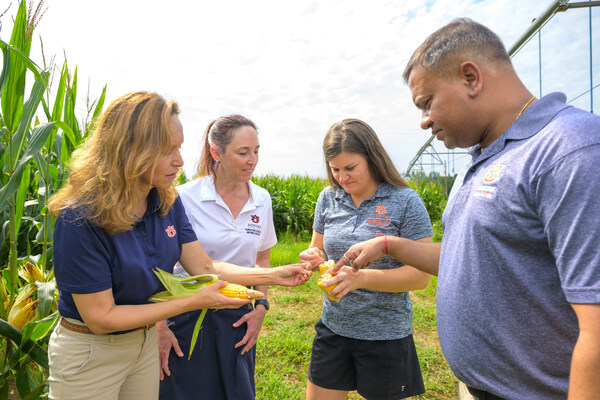
Enter the Alabama Cooperative Extension System, the Auburn University College of Agriculture and the Alabama Agricultural Experiment Station. A team of researchers from these entities comprise what is known as The Future of Farming Project, created to increase adoption of soil, nutrient and water conservation practices by establishing on-farm demonstrations.
It’s an effort with farmers, for farmers.
“We are helping farmers adopt digital technologies and sustainable agricultural practices,” said Brenda Ortiz, Alabama Extension specialist and professor in the Department of Crop, Soil and Environmental Sciences. “My responsibilities are demonstrating, evaluating and training farmers and crop consultants on how to best use digital technologies to increase crop productivity while strengthening environmental sustainability.”
Ortiz’s specialty is in precision irrigation. She helps farmers adopt a sustainable approach that allows the application of water to the plant at the right time and place, and in measured doses, creating optimal growing conditions. This is a win-win for the farmer: less water wasted, plus better yields.
And Ortiz represents just one part of The Future of Farming Project. She’s joined by fellow Auburn faculty members and Alabama Extension specialists Audrey Gamble, Rishi Prasad and Michelle Worosz, as well as Auburn alumna and agricultural economist at Compliance Services International Leah Duzy. Together, they aim to help farmers adopt conservation practices and tackle the social or economic barriers they face.
“One challenge is the fact that conservation practices do cost money for growers to adopt and install and may increase the management time required by the grower,” Duzy said. “However, for growers to invest in conservation practices such as cover crops and smart irrigation practices, they need to clearly understand the cost of the practices and the benefits that will impact their profitability across a field.”
For example, growers adopting smart irrigation practices such as soil moisture sensors and variable-rate irrigation are likely to increase overall yield and profitability across the field.
And adding cover crops — a crop planted to protect and improve soil during the seasons in which cash crops are not actively growing — has the potential to decrease the need for irrigation through improved water holding capacity.
“Some farmers may plant cover crops with the primary goal of increasing soil moisture storage and improving drought resilience, while other farmers may plant cover crops to provide supplemental nutrients to the following cash crop,” Gamble explained.
If they are fully informed on the costs and benefits of these conservation practices, growers can make decisions regarding adoption.
Prasad’s focus is nutrient management, which he calls “an art as well as a science.” He helps farmers practice the 4R principles: the right rate of nutrients, at the right time, with the right source and the right method of application.
“Managing nutrients sustainably in Alabama farms will ensure that farmers have a profitable crop harvest and have fewer nutrient losses to the environment,” he said. “Fertilizers are expensive, and losing them means losing money and, at the same time, contributing to environmental issues such as polluting freshwater bodies or emitting greenhouse gases.”
These experts partnered with Posey Farms in North Alabama, L.C. Farms in South Alabama and Lazenby Farms in Central Alabama to provide regional on-site demonstrations, allowing Alabama farmers to learn in person from both the researchers and from their peers.
Mitch Lazenby of Lazenby Farms hosted one of these on-site demonstrations over the summer. He shared his story of adopting conservation practices over the last 25 years.
“We are seeing how we can close up our gaps,” he said. “How can we get seed to soil with more cover, tighter and closer, with more biomass? There are so many nuances to these conservation practices, you really can pick any one of them and begin.”
Many Auburn University alumni teachers are bucking the state and national trend that declares as many as 70% of teachers are said to have considered leaving their jobs in recent years.
Although the teacher shortage is not isolated to a specific region, these College of Education alumni offer their own distinctly Auburn responses to “why” they have stayed.
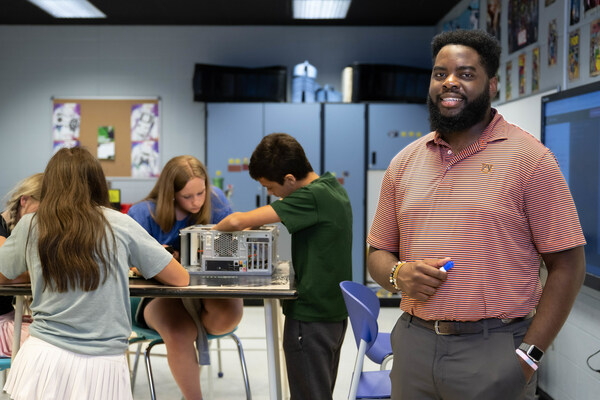
Nick Wilson ’18
Nick Wilson could be making a lot more money, with a lot less stress, working a lot fewer hours, but he’s not leaving the teaching profession any time soon.
“This is the best job in the world,” said the 2018 social science education graduate. “But even still, you have to know your ‘why.’ I started my teaching career with a desire to give back — to my community and my high school that gave me so much. But after I got into this I realized, that’s not enough to stay in it.”
For Wilson, the “why” is not complicated.
A high school coach and career preparation teacher in Ashville, Wilson uses every opportunity to stay connected with his students — his “why.”
“I initially started developing relationships with my students as part of a pedagogical approach,” he said. “But it quickly evolved into my entire focus. I care about these students, and the fact that I can have positive relationships with them — see them at church, talk with them after practice, know what’s going on in their lives outside of school — just makes my job as a teacher that much easier.”
Megan Cook ’13
Megan Cook discovered her passion for the Spanish language and culture in 2006 in Lima, Peru. The then 16-year-old’s mission trip to South America propelled her into a decades-long journey to share her love of other languages and cultures with future generations of students.
“When I started at Auburn, I would have never believed anyone had they told me I would become a middle school Spanish teacher and department chair of world languages,” she said.
Now, in her ninth year of teaching, Cook has seen the highs and lows of the profession.
“Anytime I’m frustrated, or I see the salary of another job that I’m potentially qualified for, I remind myself that the grass won’t be greener and that those opportunities can’t compete with the time I get with students in the classroom,” she said.
It’s the purpose she finds in building relationships with students that overcomes every negative and challenge.
“I can’t imagine another job that is as fun, exciting, entertaining or rewarding. And that’s what keeps me in it. I can’t imagine giving this up.”
DeAngelo Johnson ’20
Beginning a teaching career in the midst of a pandemic was not the plan when he transferred to Auburn as an elementary education major. But that’s the reality DeAngelo Johnson faced when he graduated in December 2020.
“The kids were just happy to have a teacher,” he said. “But it gave me an opportunity to jump in and provide structure.”
Bridging gaps and covering needs, Johnson has moved to several different classrooms in Huntsville, Alabama, during the past few years. He’s now in cybersecurity — a field he had no previous experience in but one that has quickly become one of his strengths.
He’s aware of the challenges in his chosen profession and the complaints of fellow educators. The lesson he touts the most is to remember his “why.”
“Kids know when their teachers are unhappy or don’t want to be there,” he said. “I don’t want that. I tell my students that I didn’t choose this because I hate kids. I love kids. I want to be here for them however I can.”
These alumni teachers have more in common than a love of their alma mater. They have supportive administrations, a clearly defined purpose and a commitment to building relationships with their students. They’re thriving because they know their “why.”
“She’s a real personality. Kind of a drama queen because she’s very talkative and loves being the center of attention, almost like she’s saying, ‘look at me, look at me,’” said Auburn University’s Raptor Center Director Wade Stevens.
And that’s exactly what almost 70,000 Philadelphia Eagles fans did at Lincoln Financial Field last Thursday night — watch Independence, better known as “Indy,” soar across the field, eliciting the awe of bystanders and ushering in another Eagles home game.
Stevens said he might get in trouble with Indy’s handler, Amanda Sweeney, for calling her a drama queen, but her outgoing personality is partially why she was the perfect bald eagle for this Eagles pregame flight — she knows how to put on a good show.
Raptor center review
One of a few university-based raptor centers in the U.S., the raptor center is a division of Auburn’s College of Veterinary Medicine. The center’s mission is to “provide the highest quality medical care and rehabilitation for wild raptors, support raptor conservation efforts, expand the public’s knowledge about raptors, inspire their passion for raptor ecosystems and embolden the Auburn spirit.”
This education and rehabilitation center has grown steadily for five decades, and it achieves its mission through intentional outreach, modern facilities and innovative program offerings, including around 400 activities throughout southeastern states.
Stevens joined the center one year ago as its first full-time director.
“We are currently reviewing what the raptor center is doing now, considering alternative methods to achieve outcomes, and drafting plans for successful implementation — this is how the partnership with the Philadelphia Eagles came about,” he said.
Pregame stadium flight raises awareness
Even with minimal knowledge of college football, chances are most people know about Auburn’s pregame stadium flight tradition.
The tradition started in the early 2000s. The raptor center saw the resident eagle’s pregame flight as an opportunity to connect to Auburn’s battle cry history, as well as to raise awareness about raptor conservation.
“It’s common in the raptor rehabilitation world to take unreleasable raptors, those that cannot learn to hunt or feed in the wild and use them for educational purposes,” Stevens said. “Having free-flighted educational shows at football games has drawn attention to our cause and our mission.
“Granted, we are not out there explaining the natural history of an eagle, but people will see a flight and then look up the center to find out more about our program. The same will be true for our experience in Philadelphia.”
Enter the Philadelphia Eagles
When first arriving at Auburn, Stevens had big dreams of taking the raptor center to the national level — to market its services beyond Auburn, to expand the center’s outreach and to elevate its rehab facility and educational programs, all to a national level.
Stevens credits his staff handlers’ relationships with initiating conversations with Philadelphia Eagles’ leadership. Some birds started to retire and back off service, and their handlers would refer the client to Auburn, like with Challenger of the American Eagle Foundation.
This is how the Eagles partnership began.
“The bald eagle is one of our country’s greatest symbols of freedom, strength and pride,” said Brian Papson, vice president of marketing for the Philadelphia Eagles. “While it represents so much and is viewed with profound reverence and admiration, the bald eagle also serves as the foundational element on which the identity of our franchise was built, 90 years ago.
“The Auburn University Raptor Center is a nationally recognized, mission-driven institution committed to the conservation efforts of one of our planet’s most breathtaking animals. Watching Indy descend upon Lincoln Financial Field in ceremonial fashion during the National Anthem is an exciting moment for our fans to take in and adds another important layer to our gameday experience.”
Indy says “Look at me”
Last Tuesday, Indy took an airline flight to Philadelphia in preparation for her grand stadium soar. Arriving at Auburn at age 2, bald eagle Indy has been with the raptor center for five years prepping for her moment to shine, which includes watching her figure — currently a flight-optimal seven and a half pounds.
“With birds trained for free-flighted performance, weight management is important,” Stevens said. “Their activity, intake and output are closely monitored to ensure the proper flying weight.”
Stevens confirmed Indy was at “fighting weight” for this flight.
Of course, training also is essential.
Auburn’s eagles fly four to six days per week during the football season to maintain their training. In fact, hundreds of hours go into training for both the birds and their handlers.
The raptor center has a dedicated staff and group of volunteers. Normally with long-term intentions, student volunteers enter the program and are assigned either an owl, hawk, falcon or vulture; they learn about the care and husbandry of that bird and assist with training the eagles at Jordan-Hare Stadium.
For Indy’s Philadelphia flight, raptor center advocates Stevens, Sweeney, Andrew Hopkins and Dr. Amberly Sokoloff were in attendance.
Philadelphia Eagles + Auburn: Future of flight
The Auburn University Raptor Center sees Indy’s flight with the Eagles as just the beginning. Since the ink dried on an agreement, the center teemed with anticipation of and preparation for the Eagles vs. Vikings game.
“We are really excited about our new relationship with the Eagles. If all goes well, we hope this flight becomes a more regular occurrence,” Stevens said.
After all the talk of logistics and schedules, Indy flew one of the biggest flights of her life — delivering the Auburn University Raptor Center, and its mission of raptor conservation, to a brand-new audience.
Six researchers at Auburn University have asteroids named in their honor for their contributions to planetary science during the Asteroids, Comets, Meteors (ACM) conference last week in Flagstaff, Ariz.
Yaeji Kim, Youssef Moulane, John Noonan, Mohi Saki, Zexi “Lucy” Xing and Kumar Venkataramani were officially honored Wednesday.
Kim is a graduate student in aerospace engineering in the Samuel Ginn College of Engineering. Moulane, Noonan, Saki and Xing are in the Department of Physics in the College of Sciences and Mathematics, or COSAM. Venkataramani was a researcher in the Department of Physics in COSAM and is now at California Institute of Technology, or Caltech.
“These six researchers have made significant contributions to science, and they were nominated by multiple members of our community to have an asteroid named after them to reward them for their contribution to our field and inspire others to share their passion for astronomy,” said Dennis Bodewits, associate professor in the Department of Physics.
Kim, a graduate student, was awarded the prestigious Zonta International Amelia Earhart Fellowship and the LSSTC Data Science Fellowship Program at Northwestern University.
Moulane, a postdoctoral researcher, is being honored for increasing awareness of science in Africa. Moulane, who observed a great comet earlier this year, was instrumental in bringing a major astronomy meeting to South Africa.
Noonan, a postdoctoral researcher, received a $493,072 grant from the Association of Universities for Research in Astronomy to investigate the role of sulfur in comets. He is being honored for his work combining observations of comet 67P/Churyumov-Gerasimenko with the Hubble Space Telescope with gas measurements obtained by instruments on board the Rosetta space mission.
Saki, a postdoctoral researcher, used the James Webb Space Telescope to uncover core elements of Comet 238P. He was able to confirm water production rates and determine that it did not emit levels of carbon dioxide.
Xing was a visiting scholar at Auburn University and observed the first active interstellar comet 2I/Borisov and measured its water production rates, showing that the object was eroding rapidly. She also won the COSAM graduate poster award at the Auburn Research Symposium in 2021.
Venkataramani, a former postdoctoral researcher now at Caltech, conducted research on astronomical spectra. His research, using ground-based and orbital telescopes, has advanced our understanding of the chemical composition and reflectance properties of small solar system bodies.
“I am proud of all of the accomplishments these researchers have made,” said Bodewits. “Having an asteroid named in your honor is not only an incredible achievement very few scientists will ever have, but it will also inspire future generations of students to conduct research that could make a difference in the field of astronomy.”
Auburn University President Christopher B. Roberts spoke of his aspirations for the future of the land-grant institution at his official Presidential Installation ceremony at the Jay and Susie Gogue Performing Arts Center on Thursday afternoon.
With Alabama Gov. Kay Ivey — an Auburn alumna and president of the Auburn University Board of Trustees — and several other dignitaries looking on, Roberts was thankful, humbled and inspired while giving his remarks at the special celebration.
“What an overwhelming feeling,” said Roberts, who began serving as Auburn’s 21st president on May 16, 2022. “Gov. Ivey, thank you for your support of Auburn, and I really want you to know how honored I am to have this position. In this role, I’m often asked what the Auburn Family means to me, and it means everything.
“The Auburn Family and the spirit we have on this campus is a true mark of distinction. As your president, I am going to dedicate myself to the vision I have discussed. I believe in educating the next generation of brilliant scholars and citizens who will serve the needs of Alabama, the nation and the world.”
Ivey presented Roberts with the President’s Medallion, which was first presented to President Harry Philpott at his installation nearly 60 years ago. The medallion features the inscription “Truth flourishes where the student’s lamp has shone” on one side and the Auburn University seal and its three pillars of research, instruction and extension on the other.
“President Roberts, as someone who cares deeply about this campus, I am thrilled we have you serving at the helm,” said Ivey, a 1967 Auburn graduate. “There’s no one better for the job. There are three characteristics a leader must have — character, competence and commitment. Chris no doubt has all three, and I am confident he will take this university we all love to even greater heights.
“I look forward to working with you as we strive for excellence for Auburn and our state, and I share your vision and your belief that Auburn University can change Alabama and the world for the better.”
Bob Dumas, president pro tempore of the Board of Trustees, joined Ivey, 2022-23 Auburn Student Government Association President Jake Haston and Harbert College Advisory Council Associate Professor Kerry Inger from the Harbert College of Business with turns at the podium as Roberts was officially welcomed as the university’s chief administrator.
“On behalf of the board, I thank you all for investing your time, your trust and your support in Dr. Christopher Roberts as Auburn University’s 21st president,” said Dumas, who served as the event’s host. “Throughout Auburn’s distinguished 167-year history, we have only gathered a handful of times to install a new president. Today is important to our university because it is an extraordinary opportunity to symbolically transition the leadership of our institution to an individual who represents the very values and ideals that we all collectively share.
“Chris, in accepting the call to lead our institution, you join a distinguished group of educators and scholars who have played integral roles in shaping its history, guiding its direction and chartering its success. We charge you with safeguarding Auburn’s rich heritage and guiding its future, strengthening its role as a leading institution and continuing our tradition of excellence across our academic, research, scholarship and extension programs through service to our communities.”
Auburn University is the first university in the nation to possess a vehicle designed specifically to make community events accessible for those with sensory needs.
The Sensory Activation Vehicle, or SAV, is one of the programs offered by KultureCity, a Birmingham-based nonprofit dedicated to creating sensory accessibility and promoting inclusivity for all.
Assistant Professor Morgan Yordy, Associate Clinical Professor Ann Lambert and former student advisor Cassandra Jones in Auburn’s College of Nursing were looking for a way to increase inclusivity across campus and discovered KultureCity.
Alabama doctors Julian Maha and Michele Kong started the organization as a result of their son’s autism. It has provided sensory resources for 550 venues in five countries, including all major league baseball stadiums and basketball arenas in the United States. Other KultureCity programs include sensory certification and sensory bags.
Maha said Auburn is the first American university with a SAV.
“We know a lot of families attend Auburn athletic events,” said Yordy. “We also know that more children are facing mental health challenges, beyond conditions like autism and ADHD.”
Through the support of KultureCity and the Merrill Stewart family, Auburn Nursing has a SAV to utilize at events on campus and around the community. The acquisition will allow nursing faculty and students to provide a sanctuary for individuals who need to escape the loud noises and bustling activity at such events.
The SAV is not only a quiet place, which can be quieter with noise-cancelling headphones, but it contains interactive sensory stations to distract from an overstimulating environment and reduce anxiety.
Currently, Auburn Nursing occupies a portion of the first aid station of Neville Arena to provide a sensory room at gymnastics meets. Faculty use KultureCity sensory bags, which contain noise-canceling headphones, fidget tools and other resources, in this space. That is also where Auburn Nursing houses its Tiger Babies program.
Anna Kate Graham, a senior majoring in human development and family science in the College of Human Sciences and an intern in the College of Nursing, said she has noticed children at gymnastics meets who cover their ears to diminish the loud music and enthusiastic fans.
“It’s a lot of lights and a lot of noises,” said Graham. “We’re in the arena right now because parents aren’t aware that this exists for their children. We want to open that door, let people spend time inside and see what we have to offer.”
Nursing faculty has had much success with outreach programs involving Auburn Athletics. The Tiger Babies breastfeeding support tent opened in 2015 to provide a clean and comfortable environment for mothers to nurse prior to Auburn football games. Since 2018, a Tiger Babies station has had a permanent location inside Jordan-Hare Stadium, allowing mothers to nurse before and during football games. The first aid station in Neville Arena also provides such an environment.
Yordy and Lambert are optimistic they can develop a similar arrangement with Auburn Athletics and the SAV. They also want to provide the trailer at local community events.
“Auburn Athletics has been helpful and so welcoming with Tiger Babies, we’re hoping as we introduce more programs to help engage families, that athletics will come on board again, and we can expand throughout athletics,” Yordy said.
“It is something we’ll be proud to take to events on campus and beyond. SAV will be utilized not only on campus, but within the community as part of the SOUND program.”
Based on the line of the creed, “I believe in a sound mind, in a sound body and a spirit that is not afraid…,” Yordy said Auburn Nursing coined the acronym SOUND for the program nursing will develop to support the SAV. SOUND stands for Sensory Outreach Under Nursing Direction.
For a son
Maha and Kong founded KultureCity so everyone, especially children, could enjoy group gatherings, like sporting events, music concerts and birthday parties.
“He loved going to these public events,” Maha recalled of his son, “but because of his sensory needs, he was one of those kids that couldn’t last the entire time as the crowds and the noise overwhelmed him. These trailers can help people regulate themselves, calm down and decompress in the privacy of the room.
“The trailers also educate the general community about the sensory needs of certain individuals and provide tools to organizations to help individuals to stay through an event so they can become part of the community.”
For those places or venues without a trailer or a permanent sensory room, KultureCity offers its sensory bags. In Alabama, staff at the Birmingham Zoo and McWane Science Center have access to the bags and, with KultureCity’s help, are trained on how and when to utilize them with visitors.
For the Auburn Family
Sensory issues aren’t limited to children. In fact, Maha said one in six individuals has a sensory need or an invisible disability, such as post-traumatic stress disorder, autism or dementia or is recovering from a stroke.
Yordy said the vehicle and SOUND program will be aimed to helping families enjoy all events together.
“Sensory needs are a common medical condition in which the brain has trouble receiving and responding to information that comes in through the senses,” explained Maha. “Common sounds, lights, crowds and even certain smells might not only be overwhelming, but also cause physical pain.
“Because of this, these individuals withdraw from communities, not by choice, but by circumstance as they worry about how the world will accept or include them. KultureCity changes that. We make the ‘nevers’ possible.”
KultureCity vows to “make the nevers possible by creating sensory accessibility and inclusion for those with invisible disabilities.” Its website contains videos of people who, thanks to KultureCity, can no longer say they never had a birthday party, attended a concert or ran a marathon.
Merrill H. Stewart Jr., founder, president and CEO of the Birmingham-based construction firm Stewart/Perry Company and an alumnus of Auburn’s Raymond J. Harbert College of Business, vowed that because of Auburn Nursing’s SAV, “lives will be better.”
Linda Gibson-Young, professor and outreach coordinator for Auburn Nursing, is certain the SAV will be the primary way nursing faculty and students will meet the needs of individuals with sensory needs.
AUBURN – A Michigan-based biomedical device company has created a novel imaging tool that better detects cancer in women with dense breast tissue, and an Auburn University Harbert College of Business graduate is leading the charge to deploy the imaging technology nationwide.
Developed by Delphinus Medical Technologies, the FDA-approved SoftVue system uses a water-based scanning technique and proprietary ultrasound technology to create a 3D image of the whole breast to detect the presence of cancer in its earliest stages — all without exposing the patient to radiation or uncomfortable compression.
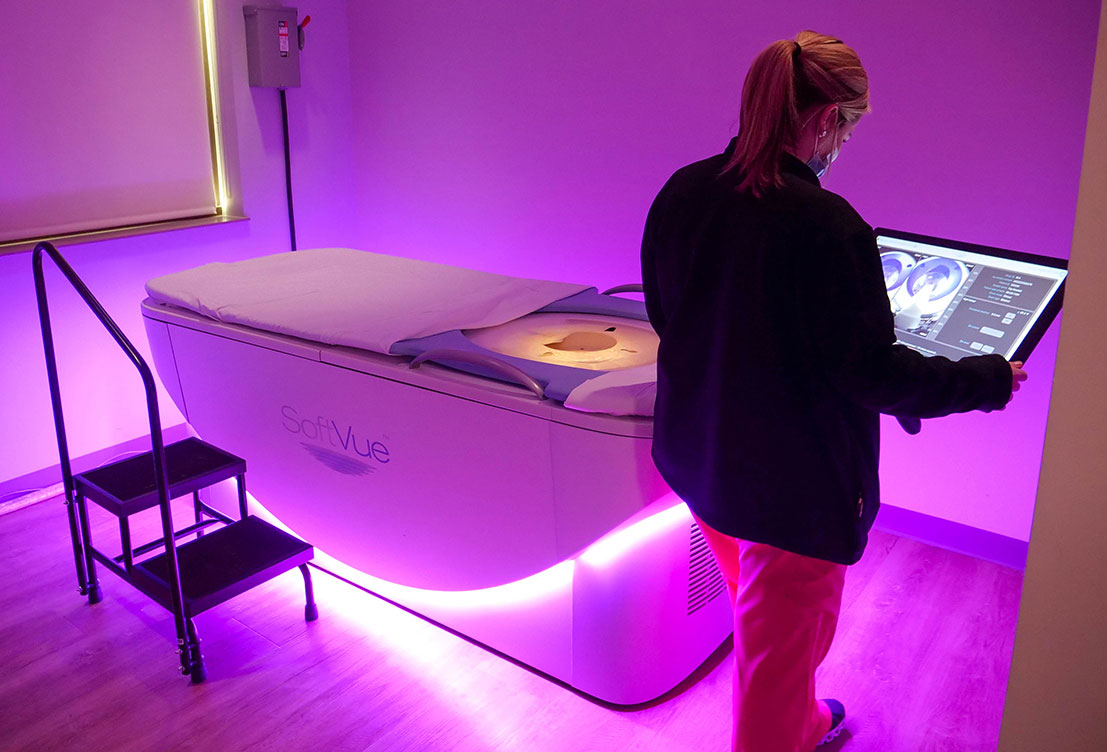
“As an adjunct to screening mammography, SoftVue finds 20% more cancer compared to mammography alone,” said Mark Forchette, the Delphinus president and CEO, who earned an Auburn degree in marketing in 1981. “It’s a new approach, and the radiologists who have used this system have found that it gives better insight to the tissue that they’re looking at.”
One of those radiologists is Dr. Cynthia Lorino, a breast imaging specialist at the Breast Health Center in Auburn and only the second U.S. location offering this screening technology.
According to Lorino, mammograms remain the best screening tool, but they aren’t perfect, particularly for the nearly 50% of women over age 40 who have dense breast tissue and face a higher incidence of cancer.
Conventional mammography uses X-rays to image breast tissue, and the scans are created in black and white. However, dense breast tissue also appears white in a mammogram, making it difficult for radiologists to see small tumors that appear as white.
“SoftVue gives us additional information to help us find small cancers not seen on mammogram,” said Lorino, noting that the SoftVue images are different from those generated from mammography scans or other ultrasound methods. “SoftVue also decreases the risk of finding (non-cancerous) lesions, which may look suspicious on 2D ultrasound.”
This specificity means SoftVue will produce fewer false-positive test results, so fewer patients will have to undergo unnecessary and invasive biopsy procedures.
Next step: Going nationwide
With two SoftVue Systems now operating, the first was installed in Detroit, Forchette has an ambitious plan to deploy more nationwide.
“Our objective as a company is to put a system in the top population centers of the United States as quickly as possible,” said Forchette. “In a couple of years, we’d like to be in enough markets so every patient in the United States would be within a two-hour drive of a SoftVue system.”
Lisa Petersen, the manager at Auburn’s Breast Health Center, said about 200 local patients each month will benefit from the SoftVue imaging system. So far, Petersen said she has heard all positive reviews from the patients who have undergone a SoftVue scan, which she said is covered by health insurance.
“Feedback from our patients has been great,” she said. “The patients say the exam is not uncomfortable and they are reassured by the additional testing for dense tissue.”
Throughout the technology development and regulatory approval process, Forchette said one of his priorities has been to break down technological barriers to produce the disruptive technology that will save lives.
“We had to tap the talent of a bunch of brilliant young people and inspire them to believe that no wall, no matter how daunting, is going to stand between us and our goal,” he said, referring to the Delphinus engineers and scientists.
According to Forchette, the Triple Acoustic Detection technology in SoftVue provides a whole new level of tissue characterization, but it also creates a massive amount of data that requires huge amounts of computational processing power to create an image.
“We had to wrestle the computational laws of physics to the ground and make it into a process and workflow that could fit into a busy breast clinic today,” said Forchette, who then oversaw the team that completed the FDA approval process, which included a series of studies over three years that produced the clinical data required for a rigorous regulatory review.
Earning the FDA’s stringent Premarket Approval was a daunting task, Forchette said, but it’s immensely rewarding and a tremendous proof source that our technology accomplishes what we say it does.
“What we offer is an alternative that lets sites do what they’ve long wanted to but there hasn’t been the technology to do it,” he said.
Petersen is delighted with the SoftVue rollout.
“The SoftVue [system] is an important addition to our breast center and will allow us to provide the highest quality care to our patients,” she said. “We are incredibly appreciative both to Delphinus and our leadership at East Alabama Medical Center for investing in the women of Lee and surrounding counties.”
Auburn is proud to celebrate the recent confirmation of Auburn alumnus Gen. Lloyd Austin as our nation’s secretary of defense.
We applaud your incredible achievement and thank you for your continued service to protect our country.
Auburn is proud to celebrate the recent confirmation of Auburn alumnus Gen. Lloyd Austin as our nation’s secretary of defense.
We applaud your incredible achievement and thank you for your continued service to protect our country.
Auburn is proud to celebrate the recent confirmation of Auburn alumnus Gen. Lloyd Austin as our nation’s secretary of defense.
We applaud your incredible achievement and thank you for your continued service to protect our country.