The Alabama State Department of Finance has granted Auburn University $2 million to fund an ambitious health care access initiative aimed at addressing significant health disparities across rural Alabama.
Auburn University Outreach, in collaboration with the colleges of Pharmacy, Nursing, Human Sciences and the Alabama Cooperative Extension System, first pioneered this groundbreaking project in Chambers County.
Auburn’s Rural Health Initiative will expand its transformative healthcare access model to combat health disparities in rural Alabama. This novel approach merges cutting-edge telehealth technology provided by OnMed with hands-on wellness care delivered by Auburn faculty and students specializing in health-related fields. The state-of-the-art OnMed telehealth station offers affordable, private and efficient health care access to patients.
This technology facilitates real-time patient encounters with licensed clinicians, bringing quality health care to individuals in underserved areas. The Chambers County Community Wellness Center, which opened last February, is the project’s inaugural site, providing health care services during times when traditional health facilities are typically closed.
“Our center in Chambers County has touched so many lives in that community. Our vision was to learn from this experience alongside the community so we could continue expanding the work through our partnership with Alabama Cooperative Extension System, other disciplines across campus and university and community partners across the state,” said Hollie Cost, assistant vice president for University Outreach and Public Service and project director for the initiative. “These funds will enable us to do that with the anticipated outcome of remapping the rural health landscape and improving the quality of life across rural Alabama.”
The $2 million grant will be used to replicate this health care model across various rural Alabama communities, with an emphasis on addressing each community’s unique needs. Communities will be selected and prioritized based on accessibility limitations, availability of facilities, community support and low rankings on health factors and health outcomes.
“The funds provided by the Alabama Department of Finance through ARPA will enable us to work toward our goal of equitable health care access across rural Alabama,” said Royrickers Cook, vice president for University Outreach and associate provost. “The center we’ve established in Chambers County collaboratively with the Alabama Cooperative Extension System, other colleges across campus and Chambers County community members and leaders enabled us to refine a model to replicate in these underserved areas throughout the Black Belt. We are especially enthusiastic about the opportunity to partner with other universities and health care service providers to deliver high-quality health care and health education to our neighbors.”
Leaders in the Extension system are identifying ideal locations in these communities by collaborating with local leadership. This approach will enable Auburn University and the Alabama Cooperative Extension System to remain fully engaged in developing health programs that address the unique needs identified through patient visits to the telehealth station.
Paul Brown, associate director for the Alabama Cooperative Extension System, added, “The Rural Health Initiative is all about public-private partnerships that, when leveraged, increase reach and impact. Our presence in all 67 counties, combined with strong ties to University Outreach and college partners, makes Extension the ‘great connector’ between academic institutions and Alabama communities. Extension faculty are experts in the engagement processes and subject matter content and are committed to fostering interdisciplinary and collaborative approaches to improve health and well-being.”
Auburn’s dedicated faculty and students from various disciplines will deliver health and wellness education and services tailored to each community’s specific needs. Disciplines currently involved in the initiative include nursing, pharmacy, health sciences, speech, language and hearing. Services provided encompass a wide range of health care needs, including but not limited to COVID-19 and infectious diseases testing and vaccinations, speech and hearing evaluations, maternal health care education, nutrition planning, diabetes management, medication management and asthma management.
Linda Gibson-Young, a nursing professor, outreach coordinator and the initiative’s health services director, notes that, “health services in rural environments have a profound impact on the well-being and quality of life of residents. This model adds accessible and high-quality health care to improve health outcomes by addressing preventive care, early intervention and management of chronic conditions.”
The $2 million funding award will support telehealth station installation and leasing, staffing needs, health and wellness programming, community engagement, program promotion and project administration. Communities chosen for the project will be expected to address necessary facility improvements, internet and utility expenses.
A conservative project estimate indicates that the allocated funds would sustain four health and wellness centers for two years.
For more information about the Auburn University Rural Health Initiative, contact Hollie Cost at 334-740-2897 or hac0043@auburn.edu.
It’s a Monday afternoon and student volunteers gather in Lupton Hall for their shift. As they arrive, a shift leader puts them to work assembling meals and preparing pans of food for service. Soon, they’ll deliver meals to Auburn community members and in Lee County.
This is the Campus Kitchen at Auburn at work.
Campus Kitchen is a volunteer force of more than 300 students working to combat food insecurity, defined by the USDA as a “lack of consistent access to enough food for every person in a household to live an active, healthy life.”
Formed in 2011, this student-led, nonprofit organization recovers excess food from on-campus dining halls and repackages it into nutritious meals. Students work in shifts to plan menus, pick up the food from the dining halls, and deliver meals on campus and off.
Auburn Family Meal
“We usually pick up about 1,000 pounds of food a week and deliver about 800 to 900 meals a week,” said Elise Fitzgerald, president of the Campus Kitchen at Auburn. A lot of those meals are delivered on campus. “Auburn Family Meal is where students and faculty at Auburn University can come sit-down or grab take-home meals, no questions asked.”
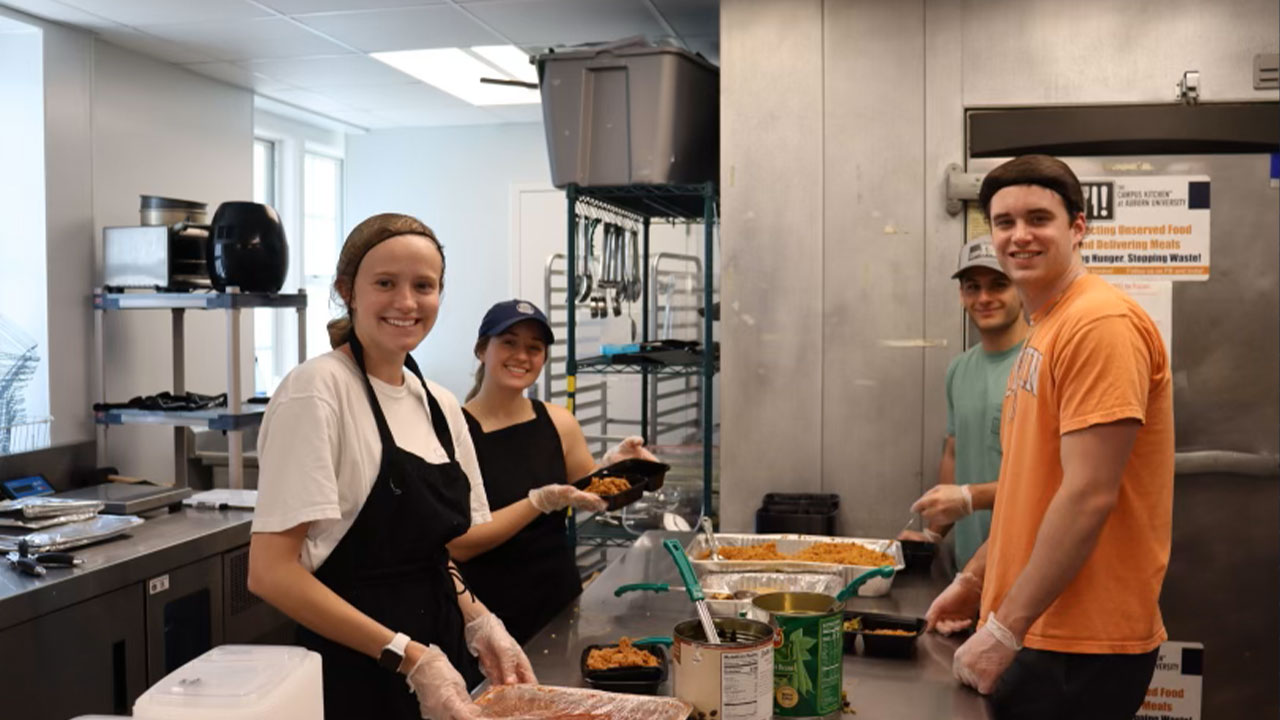
Volunteers are the lifeblood of Campus Kitchen as they plan meals, gather and package food and deliver it on campus and off.
Campus Kitchen hosts Auburn Family Meal Monday, Wednesday and Friday from 5:30- 6:30 p.m. in Lupton Hall. In addition, students may visit the Campus Food Pantry, open Monday through Friday to stock up on nonperishable items.
A biomedical sciences major on a pre-med track, Fitzgerald is passionate about the connection between food and health.
“The correlation between having access to healthy food and health care is essential,” she said. “Being malnourished can really affect a lot of different health problems, in college, and especially down the road when you get older.”
Approximately 30 percent of college students at American schools are food insecure — and Auburn is no exception. Research shows that lack of access to healthy food can lead to depression and anxiety, malnutrition, poor academic performance and higher dropout rates. Campus Kitchen, the Office of University Outreach and Campus Dining work in tandem to increase access to nutritious food.
“We were able to renovate the spaces where the Campus Kitchen and the Campus Food Pantry are located with a grant that we received from our partner Aramark. We have specific language in our contract with Aramark that requires that unserved food be donated to Campus Kitchen,” said Glenn Loughridge, director of campus dining and concessions. “Sometimes food insecurity can be hard to spot at Auburn, but it’s there.
“It’s part of our mission to make sure everybody gets fed every day. Our partnership with Campus Kitchen is really important in making that happen.”
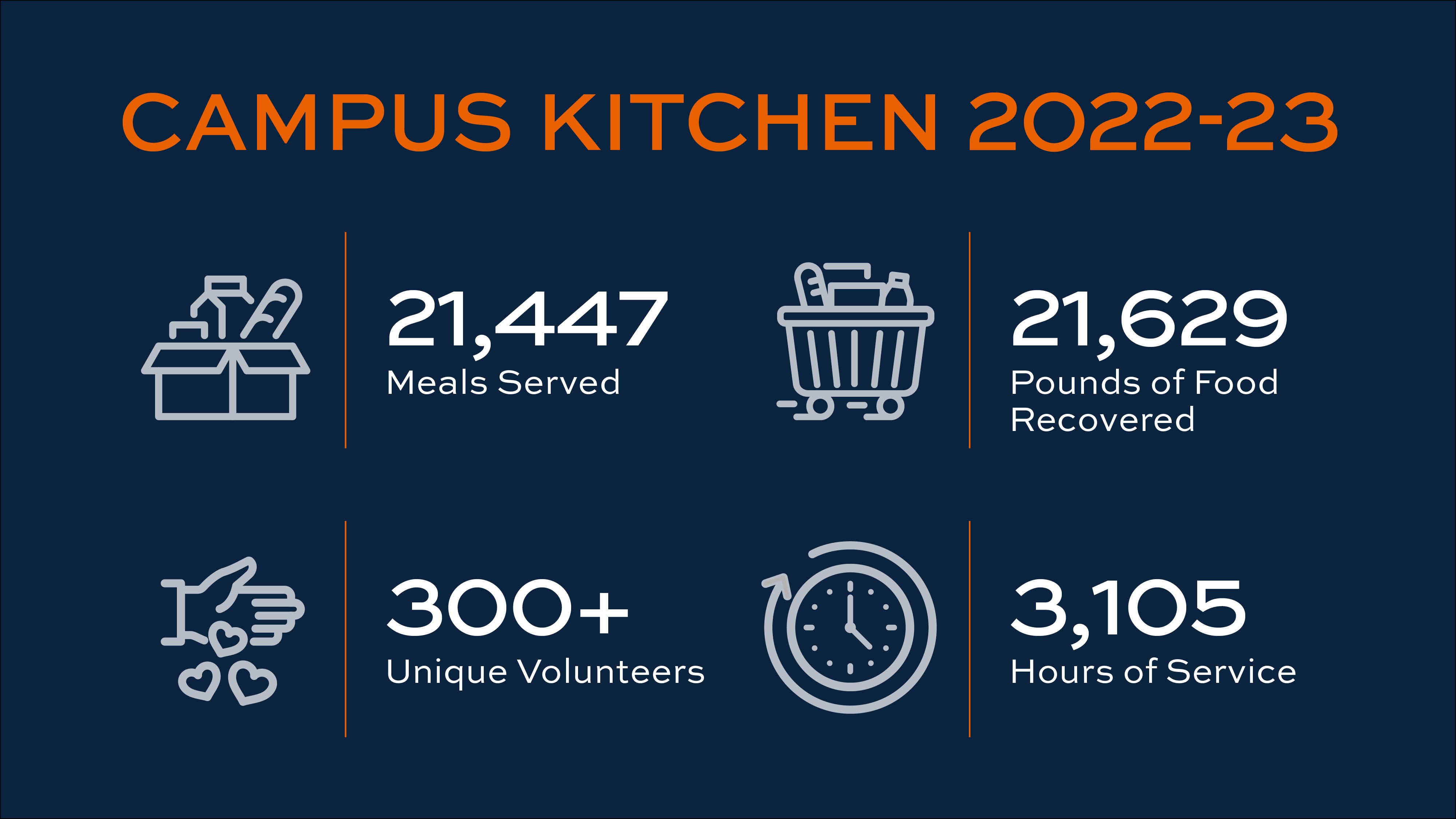
Campus Kitchen has made an impact on campus and off.
Feeding the Community
Campus Kitchen also delivers meals off campus to the Auburn and Lee County communities. It partners with the Food Bank of East Alabama, Meals on Wheels and area churches to deliver to food insecure. Feeding America estimates that 1 in 7 people in Alabama are facing hunger, some 746,550 people.
“In community deliveries, we see the impact Campus Kitchen has. With Meals on Wheels, we go door-to-door to deliver meals,” Fitzgerald said. “Typically, they’re elderly residents that are disabled and don’t really have transportation or a way to get meals from the grocery store. I’ll never forget, I handed six meals to this older male and he just gave me a hug and he was like, ‘This is such a blessing. These meals mean so much to me.’”
Mobile Food Pantry
This year, Campus Kitchen is working on a new project to expand access to nonperishable food by piloting a Free Little Pantry on campus. They’re working with Eagle Scout Ethan McCulloch to build the prototype.
“I learned about food insecurity in our community through the Scouting For Food program,” McCulloch said. “I didn’t know that the same problem existed in the college population until I learned about Campus Kitchen from a family friend. I hope that this food pantry will expand food availability to those in need on campus and in our community.”
Inspired by the design of the free little libraries, the small pantry will have shelves stocked with nonperishable items supplied by the Campus Kitchen partnership with the Food Bank of East Alabama. The idea is that eventually community members will help to stock the pantry with donations and keep the community fed on a consistent basis.
“We plan on planting little food pantries around the community that are for anyone who needs food,” FItzgerald said. “We’re working with Ethan to build the first food pantry. It will give us an idea of how much it costs and we’ll be able to see how it works in the community. Our hope is that by Tiger Giving Day we can have a goal in mind so that we can say how much money we want to raise to get the program off the ground.”
Their current plan is to build five of the mobile food pantries and test how it works.
“We want to gauge how manageable it is,” Fitzgerald said. “How often we need to refill them, where they are most needed. If it works, we’ll add more. Right now we’re laying the groundwork, partnering with the Food Bank of East Alabama to stock them and with a variety of nutritious food. Once it catches on in the community, we may not have to spend as much out of pocket to restock them because we’ll have that community support. That’s the hope! We want it to have a real, lasting impact.”
Winner of the 2023 Fred & Charlene Kam “Human Touch” Service Award, Campus Kitchen is always looking for volunteers, community partners and those who are combating hunger. Visit their website to learn how you can help in the fight against hunger.